

Category: Books
We create insanities (William H. Gass)
Put yourself in a public place, at a banquet—one perhaps at which awards are made. Your fork is pushing crumbs about upon you plate while someone is receiving silver in a bowler’s shape amid the social warmth of clapping hands. How would you feel if at this moment a beautiful lady in a soft pink nightie should lead among the tables a handsome poodle who puddled under them, and there was a conspiracy among the rest of us not to notice? Suppose we sat quietly; our expressions did not change; we looked straight through her, herself as well as her nightie, toward the fascinating figure of the speaker; suppose, leaving, we stepped heedlessly in the pools and afterward we did not even shake our shoes. And if you gave a cry, if you warned, explained, cajoled, implored; and we regarded you then with amazement, rejected with amusement, contempt, or scorn every one of your efforts, I think you would begin to doubt your senses and your very sanity. Well, that’s the idea: with the weight of our numbers, our percentile normality, we create insanities: yours, as you progressively doubt more and more of your experience, hide it from others to avoid the shame, saying “There’s that woman and her damn dog again,” but now saying it silently, for your experience, you think, is private; and ours, as we begin to believe our own lies, and the lady and her nightie, the lady and her poodle, the lady and the poodle’s puddles, all do disappear, expunged from consciousness like a stenographer’s mistake.
–From William H. Gass’s essay “The Artist and Society” (1968). Collected in Fiction and the Figures of Life. I shared the paragraphs preceding this one yesterday.
“Midsummer Day” — A. A. Milne
“Midsummer Day”
by
A.A. Milne
from Not That It Matters
There is magic in the woods on Midsummer Day—so people tell me. Titania conducts her revels. Let others attend her court; for myself I will beg to be excused. I have no heart for revelling on Midsummer Day. On any other festival I will be as jocund as you please, but on the longest day of the year I am overburdened by the thought that from this moment the evenings are beginning to draw in. We are on the way to winter.
It is on Midsummer Day, or thereabouts, that the cuckoo changes his tune, knowing well that the best days are over and that in a little while it will be time for him to fly away. I should like this to be a learned article on “The Habits of the Cuckoo,” and yet, if it were, I doubt if I should love him at the end of it. It is best to know only the one thing of him, that he lays his eggs in another bird’s nest—a friendly idea—and beyond that to take him as we find him. And we find that his only habit which matters is the delightful one of saying “Cuckoo.” Continue reading ““Midsummer Day” — A. A. Milne”
We nullify the consciousness of others. We make their experiences unreal. (William H. Gass)
You can measure the reality of an act, a man, an institution, custom, work of art in many ways: by the constancy and quality of its effects, the depth of the response which it demands, the kinds and range of values it possesses, the actuality of its presence in space and time, the multiplicity and reliability of the sensations it provides, its particularity and uniqueness on the one hand, its abstract generality on the other—I have no desire to legislate concerning these conditions, insist on them all.
We can rob these men, these acts and objects, of their reality by refusing to acknowledge them. We pass them on the street but do not see or speak. We have no Negro problem in our small Midwestern towns. If someone has the experience of such a problem, he is mistaken. What happened to him did not happen; what he felt he did not feel; the urges he has are not the urges he has; what he wants he does not want. Automatically I reply to my son, who has expressed his desire for bubble gum: Oh, Peppy, you don’t want that. Number one, then: we deny. We nullify the consciousness of others. We make their experiences unreal.
–From William H. Gass’s essay “The Artist and Society” (1968). Collected in Fiction and the Figures of Life.
Entries under “A” from Captain Grose’s Dictionary of the Vulgar Tongue (1811)
The following definitions are from the “A” section of Captain Grose’s Dictionary of the Vulgar Tongue (1811).
ABBESS, or LADY ABBESS, A bawd, the mistress of a brothel.
ABEL-WACKETS. Blows given on the palm of the hand with a twisted handkerchief, instead of a ferula; a jocular punishment among seamen, who sometimes play at cards for wackets, the loser suffering as many strokes as he has lost games.
ABIGAIL. A lady’s waiting-maid.
ABRAM. Naked. CANT.
ABRAM COVE. A cant word among thieves, signifying a naked or poor man; also a lusty, strong rogue.
ABRAM MEN. Pretended mad men.
TO SHAM ABRAM. To pretend sickness.
ACADEMY, or PUSHING SCHOOL. A brothel. The Floating Academy; the lighters on board of which those persons are confined, who by a late regulation are condemned to hard labour, instead of transportation.—Campbell’s Academy; the same, from a gentleman of that name, who had the contract for victualling the hulks or lighters.
ACE OF SPADES. A widow.
ACCOUNTS. To cast up one’s accounts; to vomit.
Continue reading “Entries under “A” from Captain Grose’s Dictionary of the Vulgar Tongue (1811)”
Gaha: Babes of the Abyss (Book acquired and read sometime in May 2015)

Jon Frankel’s Gaha: Babes of the Abyss is simultaneously familiar and estranging, a bizarre California crime-noir-dystopian shot through a druggy haze. It’s funny and weird, part caper, part adventure story, where everything’s just a little off (and more than a little sleazy). The easy comparison to Philip K. Dick is not unwarranted: Frankel’s satire is a dark mind-bender and a propulsive page-turner. Civil War, a genetically-altered ruling class, sex, violence, drugs, and real estate. The title is new from new indie imprint Whiskey Tit (Ms. Miette’s the honcho there, so you know it’s good stuff). Their blurb:
She was seventeen and all leg, banging the hell out of a pinball machine. I watched her play, my back to the bar. There was a cigarette going in her left hand with a cone of ash hanging off the end. The muscles in her bare thighs tensed up every time she bumped her pelvis into the coin box. As the ball shot toward her flippers she turned her feet in and banged with the right and then the left hand, knocking the ash to the floor. The red light on top of the machine started to turn and a police siren went off. It barked, “Pull off to the side of the road!” and she slapped the flipper, sending the ball up into a thousand-point hole. While the lights flashed and sirens sang she took a long drag off the cigarette.
I should have known better.
So begins Jon Frankel’s unflinching saga of Bob Martin, real estate pimp of Los Angeles in the year 2540, and his hapless, hopeless efforts to stay out of trouble in the company of 17-year-old Irmela von Dorderer and her big sister Elma. He should have known better, indeed.
True False (Book acquired, 6.11.2015)
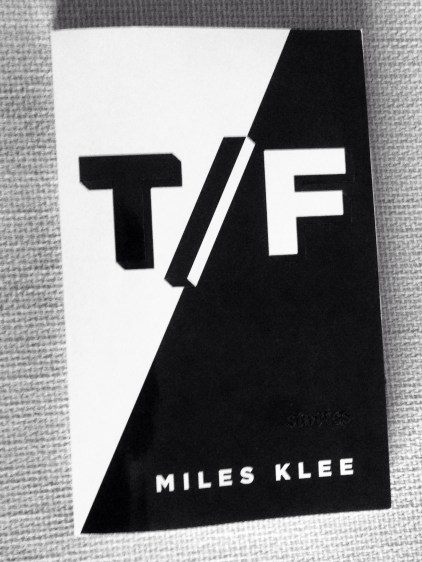
Miles Klee’s collection True False is new from indie O/R. You can read some excerpts at their site.
Blurb(s):
“Miles Klee demonstrates a delightfully prehensile grasp of the more oblique peculiarities of sentience. Very highly recommended.” —William Gibson
“Miles Klee is a fresh genius of the American literary sentence, and his every paragraph is aburst with nervous, agitative exactitudes. So much gets itself zanily and definitively rendered in the crackle of his ultravivid prose that True False is not just a joltingly original collection but the essential record of the inner terrors of our hyperurban era.” —Gary Lutz
A collection of stories that range from the very short to the merely short, these forty-four tales evoke extraordinary scenes in an understated manner that’s marked Klee one of today’s most intriguing writers. From the apocalyptic to the utopic, from a haunted office building to a suburban pool that may be alive, a day in the mind of a demi-god Pythagoras to a secret race to develop artificial love, True False captures a fractured reality more real than our own.
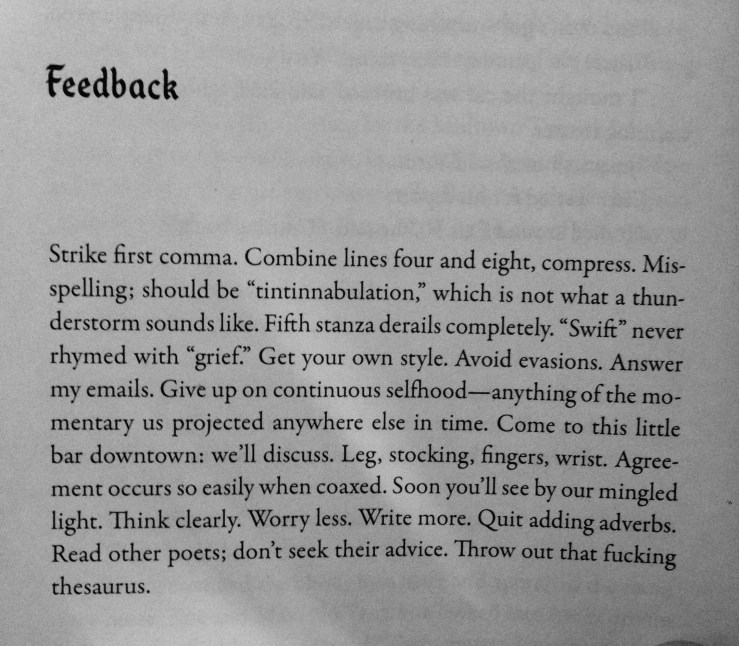
Write It Right, Ambrose Bierce’s Blacklist of Literary Faults
In addition to his famous Devil’s Dictionary, Ambrose Bierce also composed another dictionary of sorts, Write It Right: A Little Blacklist of Literary Faults. Sample entry:
Commit Suicide. Instead of “He committed suicide,” say, He killed himself, or, He took his life. For married we do not say “committed matrimony.” Unfortunately most of us do say, “got married,” which is almost as bad. For lack of a suitable verb we just sometimes say committed this or that, as in the instance of bigamy, for the verb to bigam is a blessing that is still in store for us.
Bierce’s tongue-in-cheek introduction is particularly funny:
The author’s main purpose in this book is to teach precision in writing; and of good writing (which, essentially, is clear thinking made visible) precision is the point of capital concern. It is attained by choice of the word that accurately and adequately expresses what the writer has in mind, and by exclusion of that which either denotes or connotes something else. As Quintilian puts it, the writer should so write that his reader not only may, but must, understand.
Few words have more than one literal and serviceable meaning, however many metaphorical, derivative, related, or even unrelated, meanings lexicographers may think it worth while to gather from all sorts and conditions of men, with which to bloat their absurd and misleading dictionaries. This actual and serviceable meaning—not always determined by derivation, and seldom by popular usage—is the one affirmed, according to his light, by the author of this little manual of solecisms. Narrow etymons of the mere scholar and loose locutions of the ignorant are alike denied a standing.
The plan of the book is more illustrative than expository, the aim being to use the terms of etymology and syntax as little as is compatible with clarity, familiar example being more easily apprehended than technical precept. When both are employed the precept is commonly given after the example has prepared the student to apply it, not only to the matter in mind, but to similar matters not mentioned. Everything in quotation marks is to be understood as disapproved.
Not all locutions blacklisted herein are always to be reprobated as universal outlaws. Excepting in the case of capital offenders—expressions ancestrally vulgar or irreclaimably degenerate—absolute proscription is possible as to serious composition only; in other forms the writer must rely on his sense of values and the fitness of things. While it is true that some colloquialisms and, with less of license, even some slang, may be sparingly employed in light literature, for point, piquancy or any of the purposes of the skilled writer sensible to the necessity and charm of keeping at least one foot on the ground, to others the virtue of restraint may be commended as distinctly superior to the joy of indulgence.
Precision is much, but not all; some words and phrases are disallowed on the ground of taste. As there are neither standards nor arbiters of taste, the book can do little more than reflect that of its author, who is far indeed from professing impeccability. In neither taste nor precision is any man’s practice a court of last appeal, for writers all, both great and small, are habitual sinners against the light; and their accuser is cheerfully aware that his own work will supply (as in making this book it has supplied) many “awful examples”—his later work less abundantly, he hopes, than his earlier. He nevertheless believes that this does not disqualify him for showing by other instances than his own how not to write. The infallible teacher is still in the forest primeval, throwing seeds to the white blackbirds.
Read/peruse/download Ambrose Bierce’s Write It Right at Project Gutenberg.
Copulation — Agostino Arrivabene

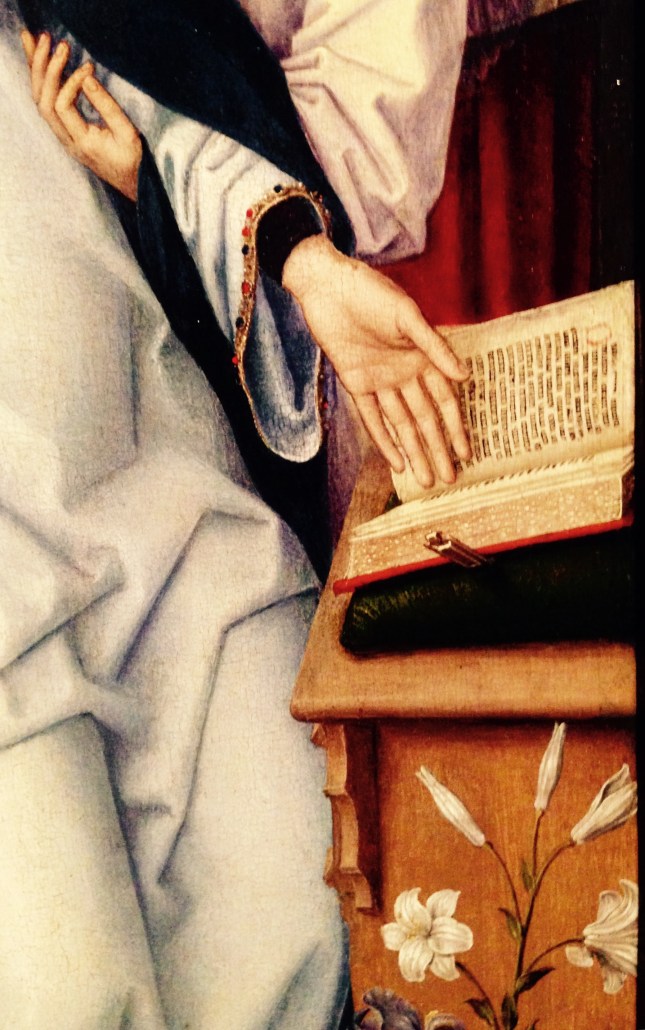
The Annunciation (Detail) — Hans Memling
Kafka’s Statue of Liberty
As he entered New York Harbor on the now slow-moving ship, Karl Rossmann, a seventeen-year-old youth who had been sent to America by his poor parents because a servant girl had seduced him and borne a child by him, saw the Statue of Liberty, which he had been observing for some time, as if in a sudden burst of sunlight. The arm with the sword now reached aloft, and about her figure blew the free winds.
The first paragraph of Franz Kafka’s novel Amerika.
The translation here is by Mark Harman, from his reworking of the novel “based on the restored text” and published by Schoken as Amerika: The Missing Person. I reviewed Harman’s translation several years ago.
The Medusa v. The Odalisque (Infinite Jest)
But this one other short high-tech one was called ‘The Medusa v. The Odalisque’ and was a film of a fake stage-production at Ford’s Theater in the nation’s capital of Wash. DC that, like all his audience-obsessed pieces, had cost Incandenza a real bundle in terms of human extras. The extras in this one are a well-dressed audience of guys in muttonchops and ladies with paper fans who fill the place from first row to the rear of the balcony’s boxes, and they’re watching an incredibly violent little involuted playlet called ‘The Medusa v. The Odalisque,’ the relatively plotless plot of which is just that the mythic Medusa, snake-haired and armed with a sword and well-polished shield, is fighting to the death or petrification against L’Odalisque de Ste. Thérèse, a character out of old Québecois mythology who was supposedly so inhumanly gorgeous that anyone who looked at her turned instantly into a human-sized precious gem, from admiration. A pretty natural foil for the Medusa, obviously, the Odalisque has only a nail-file instead of a sword, but also has a well-wielded hand-held makeup mirror, and she and the Medusa are basically rumbling for like twenty minutes, leaping around the ornate stage trying to de-map each other with blades and/or de-animate each other with their respective reflectors, which each leaps around trying to position just right so that the other gets a glimpse of its own full-frontal reflection and gets instantly petrified or gemified or whatever. In the cartridge it’s pretty clear from their milky-pixeled translucence and insubstantiality that they’re holograms, but it’s not clear what they’re supposed to be on the level of the playlet, whether the audience is supposed to see/(not)see them as ghosts or wraiths or ‘real’ mythic entities or what. But it’s a ballsy fight-scene up there on the stage — having been intricately choreographed by an Oriental guy Himself rented from some commercial studio and put up in the HmH, who ate like a bird and smiled very politely all the time and didn’t have even a word to say to anybody, it seemed, except Avril, to whom the Oriental choreographer had cottoned right off — balletic and full of compelling little cornerings and near-misses and reversals, and the theater’s audience is rapt and clearly entertained to the gills, because they keep spontaneously applauding, as much maybe for the film’s play’s choreography as anything else — which would make it more like spontaneously meta-applauding, Hal supposes — because the whole fight-scene has to be ingeniously choreographed so that both combatants have their respectively scaly and cream-complected backs 155. to the audience, for obvious reasons… except as the shield and little mirror get whipped martially around and brandished at various strategic angles, certain members of the playlet’s well-dressed audience eventually start catching disastrous glimpses of the combatants’ fatal full-frontal reflections, and instantly get transformed into like ruby statues in their front-row seats, or get petrified and fall like embolized bats from the balcony’s boxes, etc. The cartridge goes on like this until there’s nobody left in the Ford’s Theater seats animate enough to applaud the nested narrative of the fight-scene play, and it ends with the two aesthetic foils still rumbling like mad before an audience of varicolored stone. ‘The Medusa v. The Odalisque’ ’s own audiences didn’t think too much of the thing, because the film audience never does get much of a decent full-frontal look at what it is about the combatants that supposedly has such a melodramatic effect on the rumble’s live audience, and so the film’s audience ends up feeling teased and vaguely cheated, and the thing had only a regional release, and the cartridge rented like yesterday’s newspapers, and it’s now next to impossible to find.
155. The Medusa wears a kind of chain-mail backless evening gown and Hellenic sandals, the Odalisque a Merry Widow.
From David Foster Wallace’s novel Infinite Jest.
Tom Clark/John Fahey (Books acquired, 6.16.2015)
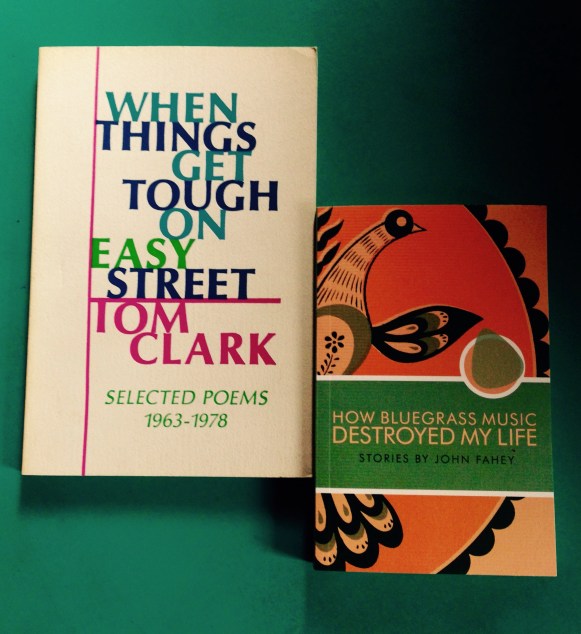
I spent the past couple of days in NYC, visiting friends and museums &c., and while to my shame I didn’t make it to the famous Strand (I blame my young children’s limited patience), I did visit Spoonbill & Sugartown Booksellers in Brooklyn, where I picked up this handsome Tom Clark collection for the friend who took me there, along with John Fahey’s collection How Bluegrass Music Destroyed My Life (which the same friend had loaned me 15 or so years ago, and I had actually returned). I also bought some kids books which I didn’t photograph because my kids absorbed them already.
Bloomsday blog


Selections from one-star Amazon reviews of Ulysses
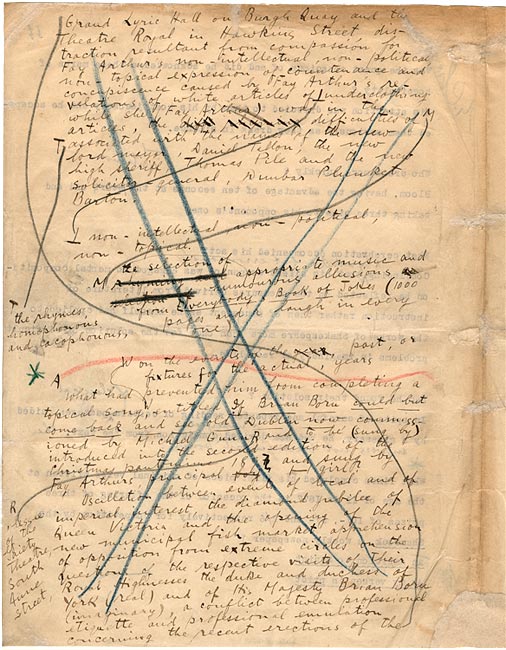
A list of Irish heroes (from “The Cyclops” episode of Ulysses)

Another page of Joyce’s notes, plus links to more

William Faulkner’s Joyce anxiety
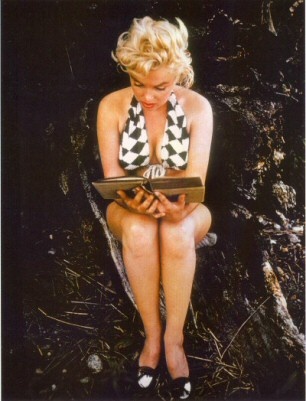
Biblioklept’s lousy review (the review is lousy, not the book) of Dubliners
Joyce’s entry on the 1901 Irish Census

Biblioklept’s review (not so lousy, the review) of a superior full-cast audio recording of Ulysses
James Joyce explains why Odysseus is the most “complete man’ in literature

Leopold’s Bloom’s recipe for burnt kidney breakfast
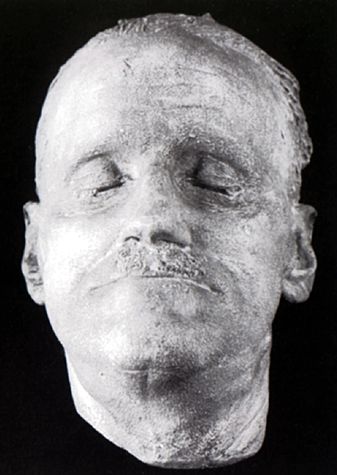
Silver Chalice with Roses — Julian Alden Weir

“Books Which Have Influenced Me” — Robert Louis Stevenson
“Books Which Have Influenced Me” by Robert Louis Stevenson
The editor has somewhat insidiously laid a trap for his correspondents, the question put appearing at first so innocent, truly cutting so deep. It is not, indeed, until after some reconnaissance and review that the writer awakes to find himself engaged upon something in the nature of autobiography, or, perhaps worse, upon a chapter in the life of that little, beautiful brother whom we once all had, and whom we have all lost and mourned, the man we ought to have been, the man we hoped to be. But when word has been passed (even to an editor), it should, if possible, be kept; and if sometimes I am wise and say too little, and sometimes weak and say too much, the blame must lie at the door of the person who entrapped me.
The most influential books, and the truest in their influence, are works of fiction. They do not pin the reader to a dogma, which he must afterwards discover to be inexact; they do not teach him a lesson, which he must afterwards unlearn. They repeat, they rearrange, they clarify the lessons of life; they disengage us from ourselves, they constrain us to the acquaintance of others; and they show us the web of experience, not as we can see it for ourselves, but with a singular change—that monstrous, consuming ego of ours being, for the nonce, struck out. To be so, they must be reasonably true to the human comedy; and any work that is so serves the turn of instruction. But the course of our education is answered best by those poems and romances where we breathe a magnanimous atmosphere of thought and meet generous and pious characters. Shakespeare has served me best. Few living friends have had upon me an influence so strong for good as Hamlet or Rosalind. The last character, already well beloved in the reading, I had the good fortune to see, I must think, in an impressionable hour, played by Mrs. Scott Siddons. Nothing has ever more moved, more delighted, more refreshed me; nor has the influence quite passed away. Kent’s brief speech over the dying Lear had a great effect upon my mind, and was the burthen of my reflections for long, so profoundly, so touchingly generous did it appear in sense, so overpowering in expression. Perhaps my dearest and best friend outside of Shakespeare is D’Artagnan—the elderly D’Artagnan of the Vicomte de Bragelonne. I know not a more human soul, nor, in his way, a finer; I shall be very sorry for the man who is so much of a pedant in morals that he cannot learn from the Captain of Musketeers. Lastly, I must name the Pilgrim’s Progress, a book that breathes of every beautiful and valuable emotion. Continue reading ““Books Which Have Influenced Me” — Robert Louis Stevenson”
“Gifts” — Ralph Waldo Emerson
“Gifts”
by
Ralph Waldo Emerson
“Gifts of one who loved me,—
Twas high time they came;
When he ceased to love me,
Time they stopped for shame.”
Twas high time they came;
When he ceased to love me,
Time they stopped for shame.”
IT is said that the world is in a state of bankruptcy, that the world owes the world more than the world can pay, and ought to go into chancery, and be sold. I do not think this general insolvency, which involves in some sort all the population, to be the reason of the difficulty experienced at Christmas and New Year, and other times, in bestowing gifts; since it is always so pleasant to be generous, though very vexatious to pay debts. But the impediment lies in the choosing. If, at any time, it comes into my head that a present is due from me to somebody, I am puzzled what to give until the opportunity is gone. Flowers and fruits are always fit presents; flowers, because they are a proud assertion that a ray of beauty outvalues all the utilities of the world. These gay natures contrast with the somewhat stern countenance of ordinary nature; they are like music heard out of a workhouse. Nature does not cocker us: we are children, not pets: she is not fond: everything is dealt to us without fear or favor, after severe universal laws. Yet these delicate flowers look like the frolic and interference of love and beauty. Men used to tell us that we love flattery, even though we are not deceived by it, because it shows that we are of importance enough to be courted. Something like that pleasure the flowers give us: what am I to whom these sweet hints are addressed? Fruits are acceptable gifts because they are the flower of commodities, and admit of fantastic values being attached to them. If a man should send to me to come a hundred miles to visit him, and should set before me a basket of fine summer fruit, I should think there was some proportion between the labor and the reward.
For common gifts, necessity makes pertinences and beauty every day, and one is glad when an imperative leaves him no option, since if the man at the door have no shoes, you have not to consider whether you could procure him a paint-box. And as it is always pleasing to see a man eat bread, or drink water, in the house or out of doors, so it is always a great satisfaction to supply these first wants. Necessity does everything well. In our condition of universal dependence, it seems heroic to let the petitioner be the judge of his necessity, and to give all that is asked, though at great inconvenience. If it be a fantastic desire, it is better to leave to others the office of punishing him. I can think of many parts I should prefer playing to that of the Furies. Next to things of necessity, the rule for a gift which one of my friends prescribed is, that we might convey to some person that which properly belonged to his character, and was easily associated with him in thought. But our tokens of compliment and love are for the most part barbarous. Rings and other jewels are not gifts, but apologies for gifts. The only gift is a portion of thyself. Thou must bleed for me. Therefore the poet brings his poem; the shepherd, his lamb; the farmer, corn; the miner, a gem; the sailor, coral and shells; the painter, his picture; the girl, a handkerchief of her own sewing. This is right and pleasing, for it restores society in so far to the primary basis, when a man’s biography is conveyed in his gift, and every man’s wealth is an index of his merit. But it is a cold, lifeless business when you go to the shops to buy me something, which does not represent your life and talent, but a goldsmith’s. This is fit for kings, and rich men who represent kings, and a false state of property, to make presents of gold and silver stuffs, as a kind of symbolical sin-offering, or payment of blackmail. Continue reading ““Gifts” — Ralph Waldo Emerson”
 Biblioklept