Books Acquired, 11.02.2011

20111106-152604.jpg

I teach a night class on Wednesdays, and although I enjoy it, I also teach morning sections on Wednesdays, so I’m exhausted when I get home over twelve hours later that night. Anyway, I was thrilled to find a nice little packet from Shocken/Pantheon when I came home last Wednesday—a memoir, a graphic novel, and a book that blends and comments on both.

Meir Shalev’s My Russian Grandmother and Her American Vacuum Cleaner is new in translation from Schocken. Their description—

From the author of the acclaimed novel A Pigeon and a Boy comes a charming tale of family ties, over-the-top housekeeping, and the sport of storytelling in Nahalal, the village of Meir Shalev’s birth. Here we meet Shalev’s amazing Grandma Tonia, who arrived in Palestine by boat from Russia in 1923 and lived in a constant state of battle with what she viewed as the family’s biggest enemy in their new land: dirt.

Grandma Tonia was never seen without a cleaning rag over her shoulder. She received visitors outdoors. She allowed only the most privileged guests to enter her spotless house. Hilarious and touching, Grandma Tonia and her regulations come richly to life in a narrative that circles around the arrival into the family’s dusty agricultural midst of the big, shiny American sweeper sent as a gift by Great-uncle Yeshayahu (he who had shockingly emigrated to the sinful capitalist heaven of Los Angeles!). America, to little Meir and to his forebears, was a land of hedonism and enchanting progress; of tempting luxuries, dangerous music, and degenerate gum-chewing; and of women with painted fingernails. The sweeper, a stealth weapon from Grandpa Aharon’s American brother meant to beguile the hardworking socialist household with a bit of American ease, was symbolic of the conflicts and visions of the family in every respect.

The fate of Tonia’s “svieeperrr”—hidden away for decades in a spotless closed-off bathroom after its initial use—is a family mystery that Shalev determines to solve. The result, in this cheerful translation by Evan Fallenberg, is pure delight, as Shalev brings to life the obsessive but loving Tonia, the pioneers who gave his childhood its spirit of wonder, and the grit and humor of people building ever-new lives.

20111106-152615.jpg

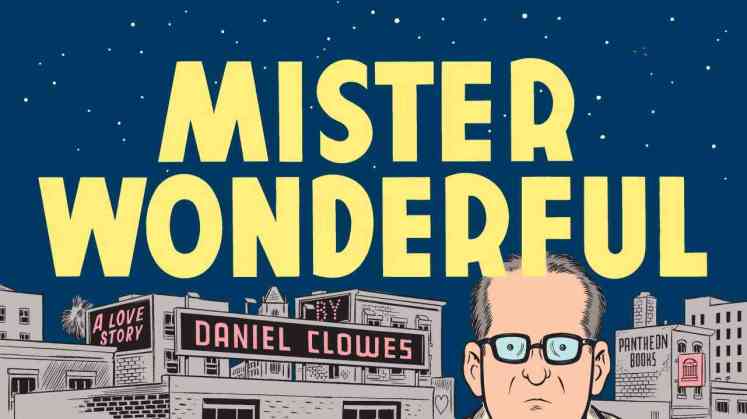
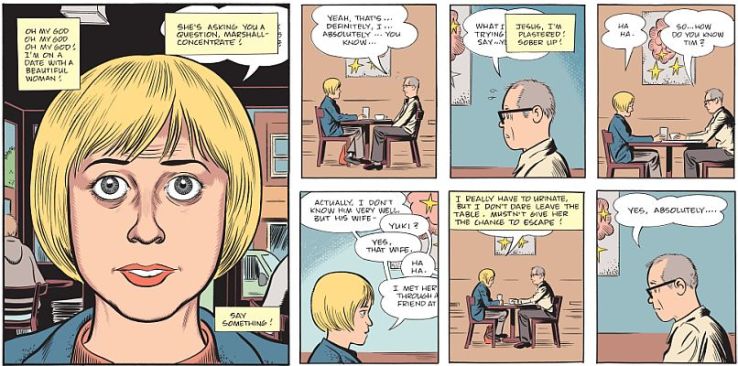
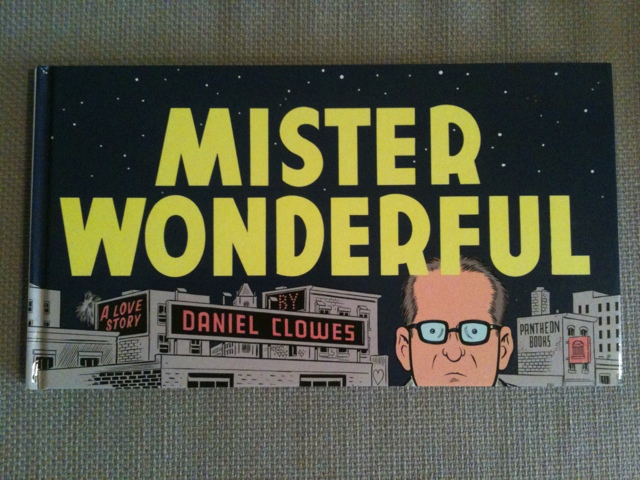
I read Daniel Clowes’s Mister Wonderful that Wednesday night. It was a treat—a wonderful balance of sweetness and acidity. I’m sometimes frightened by how closely I identify with Clowes’s protagonists. Full review next week.

20111106-152627.jpg

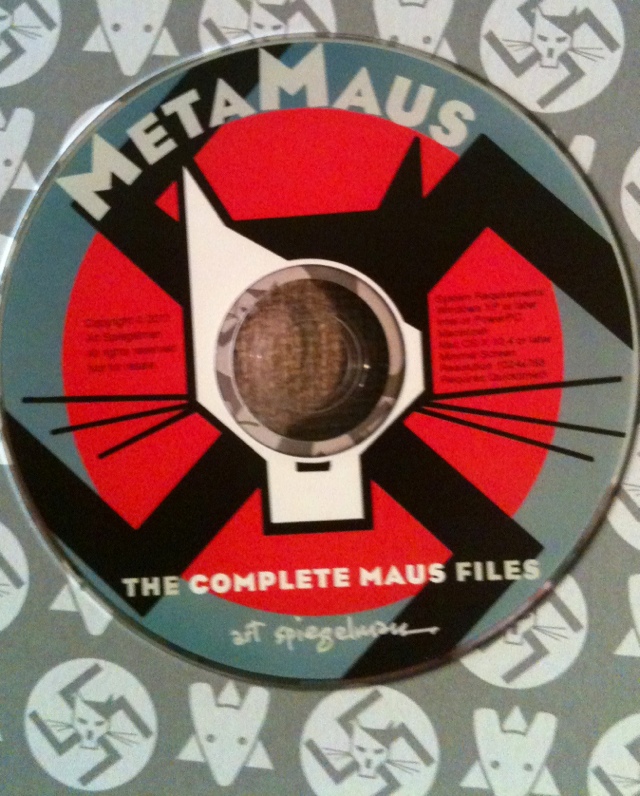
I can’t believe that Art Spiegelman’s MetaMaus hasn’t been remarked upon more—perhaps folks are still digesting it, like me, I guess. I consumed the first 50 pages immediately after finishing Mr. Wonderful, staying up way too late (all of this, accompanied by some mediocre red zin led to a mini-hangover and a generally poor performance teaching classes the next morn). Anyway, MetaMaus is far more engaging than any description of it might suggest. It combines Spiegelman’s cartoons with interviews and other media to detail the process behind creating the original Maus books (or, book singular I suppose is more appropriate). Fascinating stuff, covering memory and art and representation and mice &c. I’ll probably review it in bits and pieces—it seems like too much to process. It also comes with a DVD which I haven’t taken the time to look at yet—-

20111106-152636.jpg


Batman vs. Stray Toaster — Bill Sienkiewicz

Seven Stories of Deadly Sins — Stefan Glerums

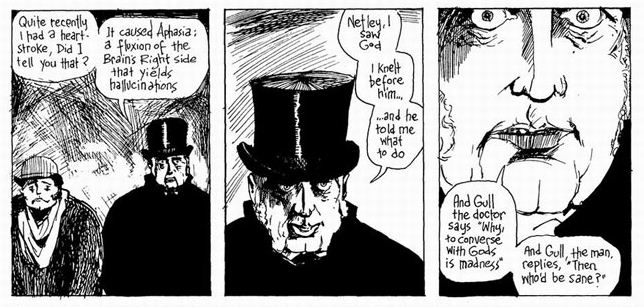
From Hell — Alan Moore & Eddie Campbell

From HellAlan Moore and Eddie Campbell’s epic revision of the Jack the Ripper murders, posits Sir William Gull, a physician to Queen Victoria, as the orchestrator of the Jack the Ripper murders that terrified Londoners at the end of the 19th century. The murders initially arise out of the need to cover up the knowledge of the existence of an illegitimate son begat by foolish Prince Albert, Victoria’s grandson. However, for Gull the murders represent much more–they are part of the continued forces of “masculine rationality” that will constrain “lunar female power.” Gull is a high-level Mason; during a stroke, he experiences a vision of the Masonic god Jahbulon, one which prompts him to his “great work”–namely, the murders that will reify masculine dominance.

One of the standout chapters in the book is Gull’s tour of London, with his hapless (and witless) sidekick Netley. In a trip that weds geography, religion, politics, and mythology, Gull riffs on a barbaric, hermetic history of London, revealing the gritty city as an ongoing site of conflict between paganism and orthodoxy, artistic lunacy and scientific rationality, female and male, left brain and right brain. The tour ends with a plan to commit the first murder. From there, the book picks up the story of Frederick Abberline, the Scotland Yard inspector charged with solving the murders. Of course, the murders are unsolvable, as the hierarchy of London–from the Queen down to the head of police–are well aware of who the (government-commissioned) murderer is. The police procedural aspects of the plot are fascinating and offer a balanced contrast with Gull’s mystical visions–visions that culminate in a climax of a sort of time-travel, in which Gull not only sees London at the end of the twentieth century, but also receives a guarantee that his murder plot has had its intended effect. From Hell takes many of its cues from the idea that history is shaped not by random events, but rather by tragic conspiracies that force people to willingly give up freedom to a “rational” authority. The book points repeatedly to the 1811 Ratcliffe Highway murders, which led directly to the world’s first modern police force. In our own time, if we’re open to conspiracy theories, we might find the same pattern in the 21st century responses to terrorism (Patriot Act, anyone?).

Although From Hell features moments of supernatural horror in Gull’s mysticism, it is the book’s grimy realism that is far more terrifying. London in the late 1880s is no place you want to be, especially if you are poor, especially if you are a woman. The city is its own character, a labyrinth larded with ancient secrets the inhabitants of which cannot hope to plumb. Despite the nineteenth century’s claims for enlightenment and rationality, this London is bizarrely cruel and deeply unfair. Campbell’s style evokes this London and its denizens with a surreal brilliance; his dark inks are by turns exacting and then erratic, concentrated and purposeful and then wild and severe. The art is somehow both rich and stark, like the coal-begrimed London it replicates. Although Moore has much to say, he allows Campbell’s art to forward the plot whenever possible. Moore is erudite and fascinating; even when one of his characters is lecturing us, it’s a lecture we want to hear. His ear for dialog and tone lends great sympathy to each of the characters, especially the unfortunate women who must turn to prostitution to earn their “doss” money. And while Abberline’s frustrations at having to solve a crime that no higher-ups want solve make him the hero of this story, Gull’s mystic madness makes him the narrative’s dominant figure. Rereading this time, I realized there is no character he reminds me of as much as Judge Holden from Cormac McCarthy’s Blood Meridian. I’m also reading Joseph Conrad’s The Secret Agent now, a book that dovetails neatly with From Hell, both in its time and setting, but also in its exploration of social unrest and duplicitous authority. Both novels feature detectives fighting a complacent system, and both novels feature a working class that threatens to erupt in socialist or anarchist rebellion.

From Hell is a fantastic starting place for anyone interested in Moore’s work, more self-contained than his comics that reimagine superhero myths, like Watchmen or Swamp Thing, and more satisfying and fully achieved than Promethea or V Is for Vendetta. Be forewarned that it is a graphic graphic novel, although I do not believe its violence is gratuitous or purposeless. Indeed, From Hell aspires to remark upon the futility and ugliness of cyclical violence, and it does so with wisdom and verve. Highly recommended.

[Ed. note: We ran a version of this review last year; we run it again in celebration of Halloween].

“If You Write Every Day, Then You Are a Writer” — Alan Moore’s Advice to Unpublished Authors

More Wuthering Heights Humor from Hark! A Vagrant


At Hark! A Vagrant, Kate Beaton riffs some more on Wuthering Heights.

Calvin & Hobbes on Capitalism, Regulation, and “Anti-Business Types”

The AV Club Interviews Cartoonist Kate Beaton (Hark! A Vagrant)

The AV Club interviews Kate Beaton, she of Hark! A Vagrant. Here, she talks a bit about A Game of Thrones

AVC: You were a history major. Do you still read history for fun?

KB: I do, yeah. I pick up books every now and then. The only problem is, I pick up books and I don’t read them, because if I do reading, it’s for a comic. But I will. I will probably pick up the second half of John A. Macdonald’s biography, which comes out this year. [Laughs.] Because I think he’s a fascinating guy. [Macdonald was the first prime minister of Canada. —ed.] I read so much, but it’s always for comics, and there’s not much time in between to just settle down and start reading something for yourself. Recently, I started reading that Game Of Thrones that everybody was reading. It’s kind of a quick and fun read. And that was really nice, because I made time to read something that wasn’t for comics. Reading history for fun will turn my brain into, “How do you make this into a comic?” and then it turns into work. [Laughs.] There’s dangerous waters there.

AVC: I’d love to see the Kate Beaton take on A Game Of Thrones. And that’s at least somewhat less polarizing than politics. You do a lot of literary strips—would you ever consider one about contemporary literature? 

KB: [Laughs.] Oh, no. No. I like doing literature that’s popular, that a lot of people have read or know about, so Game Of Thrones does fit into there. I did do a couple drawings and put them on Twitter, and they get good reactions. But I feel like, for a while, everybody was doing Game Of Thrones something or other, so I just sort of stayed out of there. And besides, you could hardly do a comic about that without spoiling it, because someone new dies every chapter. [Laughs.] It’s likeGame Of Massacres. And you wouldn’t want to ruin that for anybody.

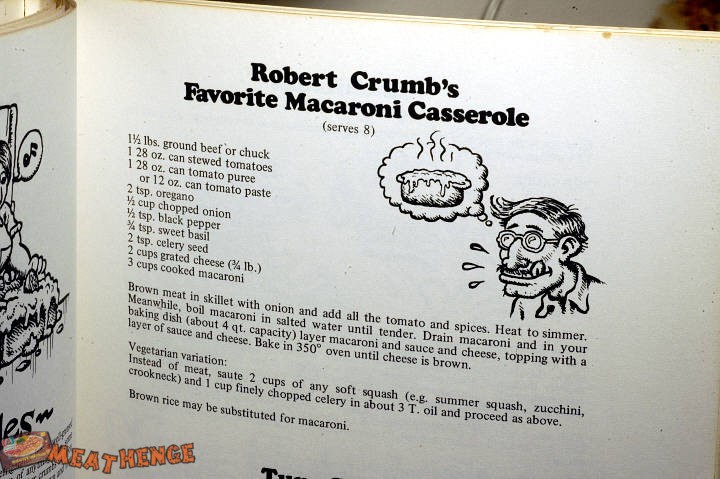
Recipe Comix

Great collection of recipe comix at Saveur magazine. Marvelous stuff. A few choice panels, plucked not entirely but still somewhat at random—

Eli Valley
Frank Gibson and Becky Dreistadt
Emily Horne


Dune Cover (Marvel Comics Adaptation) — Bill Sienkiewicz

Hark, a Vagrant! Does the Romantics

Kate Beaton is the best. 

All Four Twilight Books in One Short Webcomic

Twilight Comic by Lucy Knisley

Thanks to Lucy Knisley, you never have to read the Twilight series.


“The Prince and the Sea” — Em Carroll


Read “The Prince and the Sea,” another beautiful, dark webcomic from Em Carroll (she also did the brilliant tale “His Face All Red”).

The AV Club Interviews Comix Journalist Joe Sacco

The AV Club interviews Biblioklept fave Joe Sacco, whose books Palestine and Safe Area Goražde should be required reading for any thinking person. Sacco explores some of the messiest, ugliest terrains in the world, plumbing disaster and war with heart, wit, and insight (read our post on Sacco for more, including links to shorter works). From the interview—

AVC: You got out of journalism school in 1981, so in addition to the shift in public perception about comics as an adult medium, your career has also spanned a profound shift in the journalism industry. Do you think in some ways you’ve been the beneficiary of that?

JS: As many problems as I have with the mainstream media and the way it goes about its business, I’d say at least journalists were, for the most part, trained in discrimination. I have my problems, mostly with editorial decisions in bigger cities, in editorial offices as opposed to with columnists or reporters. I realize that, as time’s gone by with the new media—I’m talking about the electronic media—you could see a shift to emphasis on visuals and on shorter attention spans. I’m sorry, in a way, if my work is a beneficiary of that. I would hope my work has other attributes that have led to a success. But I can’t know for sure, you know? I think the comics market is the only growing part of the publishing industry, of the book-publishing trade. It’s increasing its share as time goes by. I think it also has to do with the sheer weight of good work that’s out there now—obviously not just my work. There are many other great cartoonists working in fiction and other fields that are just really doing work that has to be looked at, that you cannot ignore.

See the Trailer for Spielberg’s Adventures of Tintin

Wilson — Daniel Clowes

In the first line of the first panel of the first strip in Daniel Clowes’s graphic novel Wilson, the eponymous character, looking directly at the reader, claims, “I love people!” The statement is both ironic and strangely true. Our hero Wilson loves the idea of loving people, and goes about his daily business (walking his dog, drinking coffee, mailing boxes of shit to his former in-laws) in a way that maximizes human contact. With no real family of his own, Wilson reaches out to every person he passes by, addressing them as “brother” or “sister” in an embracing, Emersonian spirit. The problem is that, as much as he loves the idea of loving humanity, Wilson pretty much hates every person he meets. Here’s the opening episode—

Wilson comprises about 70 one-page episodes, each with six or seven panels, each essentially self-contained yet part of a loose plot. The episode above is indicative of the structure of each chapter: a build-up, a monologue, often delivered to disinterested stranger, and then an anti-punchline in which Wilson reveals the ironic cognitive dissonance at the core of his being. The effect can be hard to process, and Clowes’s acerbic humor is clearly not for everyone. Although Clowes uses a traditional Sunday comic page structure, his technique is unsettling: the humor is drawn not so much from the deflationary punchlines that end each chapter, but the overall disconnect between perception, desire, and reality that those punchlines reveal.

Clowes uses this method consistently throughout Wilson, but alternates styles and color palettes, moving from a classic-Clowes style familiar to anyone who’s read Eightball or Ghost World, to a bouncy, cartoony style (see: “Marriage”). The choice to change up the styles calls back, again, to the Sunday comic pages of yore; it also underscores Wilson’s unstable identity, as the narrative slips through gradations of more realistic to more cartoony representations. It is a consistent inconsistency.

Surprisingly, Wilson has a cohesive plot. After the death of his father, Wilson seeks to reunite with his ex-wife, whom he believes to be a drug-addicted hooker. He also hopes to meet the child she was pregnant with when she left him—

Wilson does find his wife. And then he finds his teenage daughter. And then he kinda sorta kidnaps her, or at least doesn’t bother to return her to her adoptive parents. And then he goes to prison. But maybe I’m spoiling the plot now. In any case, Wilson’s adventures are hardly zany. They are poignant and sad and pathetic and cringe-worthy. Clowes is willing to punish his already-tortured protagonist, and yet there’s a payoff for pour Wilson. Throughout the graphic novel, Wilson yearns for human connection, yet is always disappointed by the humans around him who can never measure up to his ideals. Like any sociopath, Wilson lacks a meaningful emotional core; throughout the narrative he longs to experience an epiphany, staring at the ocean, for example, in the hopes illumination. He finally earns this epiphany near the close of his life. The moment is unexpectedly touching, and provides the kind of balance that proves Wilson a work of art and not merely a collection of funny strips. Recommended.

Wilson is available now from Drawn & Quarterly.

“Marriage” — Daniel Clowes

From Daniel Clowes’s graphic novel Wilson, available from Drawn & Quarterly.