David Foster Wallace on David Lynch’s Dune

1984’s Dune is unquestionably the worst movie of Lynch’s career, and it’s pretty darn bad. In some ways it seems that Lynch was miscast as its director: Eraserhead had been one of those sell-your-own-plasma-to-buy-the-film-stock masterpieces, with a tiny and largely unpaid cast and crew. Dune, on the other hand, had one of the biggest budgets in Hollywood history, and its production staff was the size of a small Caribbean nation, and the movie involved lavish and cutting-edge special effects (half the fourteen-month shooting schedule was given over to miniatures and stop-action). Plus Herbert’s novel itself is incredibly long and complex, and so besides all the headaches of a major commercial production financed by men in Ray-Bans Lynch also had trouble making cinematic sense of the plot, which even in the novel is convoluted to the point of pain. In short, Dune’s direction called for a combination technician and administrator, and Lynch, though as good a technician as anyone in film, is more like the type of bright child you sometimes see who’s ingenious at structuring fantasies and gets totally immersed in them but will let other kids take part in them only if he retains complete imaginative control over the game and its rules and appurtenances—in short very definitely not an administrator.

Watching Dune again on video you can see that some of its defects are clearly Lynch’s responsibility, e.g. casting the nerdy and potato-faced Kyle MacLachlan as an epic hero and the Police’s resoundingly unthespian Sting as a psycho villain, or—worse—trying to provide plot exposition by having characters’ thoughts audibilized (w/ that slight thinking-out-loud reverb) on the soundtrack while the camera zooms in on the character making a thinking-face, a cheesy old device that Saturday Night Live had already been parodying for years when Dune came out. The overall result is a movie that’s funny while it’s trying to be deadly serious, which is as good a definition of a flop as there is, and Dune was indeed a huge, pretentious, incoherent flop. But a good part of the incoherence is the responsibility of De Laurentiis’s producers, who cut thousands of feet of film out of Lynch’s final print right before the movie’s release, apparently already smelling disaster and wanting to get the movie down to more like a normal theatrical running-time. Even on video, it’s not hard to see where a lot of these cuts were made; the movie looks gutted, unintentionally surreal.

In a strange way, though, Dune actually ended up being Lynch’s “big break” as a filmmaker. The version of Dune that finally appeared in the theaters was by all reliable reports heartbreaking for him, the kind of debacle that in myths about Innocent, Idealistic Artists In The Maw Of The Hollywood Process signals the violent end of the artist’s Innocence—seduced, overwhelmed, fucked over, left to take the public heat and the mogul’s wrath. The experience could easily have turned Lynch into an embittered hack (though probably a rich hack), doing f/x-intensive gorefests for commercial studios. Or it could have sent him scurrying to the safety of academe, making obscure plotless l6mm.’s for the pipe-and-beret crowd. The experience did neither. Lynch both hung in and, on some level, gave up. Dune convinced him of something that all the really interesting independent filmmakers—Campion, the Coens, Jarmusch, Jaglom—seem to steer by. “The experience taught me a valuable lesson,” he told an interviewer years later. “I learned I would rather not make a film than make one where I don’t have final cut.”

—From “David Lynch Keeps His Head” by David Foster Wallace; collected in A Supposedly Fun Thing I’ll Never Do Again.


“An Equal Amount of Blueberries in Each Muffin”

Seven Sci-Fi Films That Are Smarter Than Prometheus

A list of great sci-fi movies would undoubtedly include Ridley Scott’s signature films, Alien (1979) and Blade Runner (1982), but I don’t know if there’s enough room on that list for Scott’s latest  Prometheus, a gorgeous collection of set-pieces smeared onto a messy, hole-filled plot, signifying nothing. I’ve already written at some length about Prometheus’s metaphysical shortcomings, but I’m never especially happy to write negative reviews without providing alternatives. Here are seven movies that demonstrate the best in depth of intellect that the genre has to offer.


1. Metropolis, 1927 (Dir. Fritz Lang)

Metropolis foregrounds many of the tropes that will come to dominate serious sci-fi (film and literature alike). The dystopian future of Metropolis imposes a strict division of classes, relegating the poor workers to underground drudgery while the (literal) upper class enjoy privileged leisure. Lang explores this divide via a Romeo & Juliet story of sorts—Freder, son of the city’s Master becomes infatuated with Maria, a girl from the underworld. He follows her into the labyrinth under the city and soon witnesses industrial horrors that harm the subterranean workers. The plot becomes more complicated when a mad scientist unveils an automaton—a robotic Maria—that he will use as part of a nefarious scheme. Metropolis’s expressionistic design and camera work still seem fresh and innovative almost a century after filming, and the film’s take on class disparity is as affecting as ever.


2. Alphaville, 1965 (Dir. Jean-Luc Godard)

Godard’s dystopian New Wave crime noir talkie follows the strange exploits of Lemmy Caution, who drives in from the Outlands in his Ford Galaxie to find a missing agent, capture the founder of Alphaville, and destroy Alpha 60, the totalitarian computer that keeps Alphaville’s citizens from indulging in poetry (or other forms of free expression). Godard makes no attempt to design a future: Alphaville is filmed in contemporary Paris. The effect is baffling; Alphaville is an exercise in uncanny realizations. The dialogue is pure New Wave stuff—crammed with literary and art reference—and will just as likely bore as  many audience members as it enthralls. In the end though, Anna Karina as Natacha von Braun is reason enough to watch this film.


3. 2001: A Space Odyssey,1968 (Dir. Stanley Kubrick).

Watch it. Then watch it again.


4. Solaris, 1972 (Dir. Andrei Tarkovsky)

Tarkovsky’s Solaris is a slow, engrossing meditation on grief. Based on the novel by Polish writer Stanisław Lem, Solaris centers on psychologist Kris Kelvin, who goes to the space station orbiting the planet Solaris in order to investigate the series of emotional collapses that the crew have suffered. Kelvin soon slips into his own existential crisis, as a ghost–or psychological construct—of his dead wife appears to him. Solaris is gorgeous and measured, using its near-three-hour running time to grand effect.


5. The Thing, 1982 (Dir. John Carpenter)

Antarctic  research station. Shapeshifting parasites. Kurt Russell. Dogs. Flamethrowers. Blood tests. Kurt Russell’s beard. Ennio Morricone’s score. Wilford Fucking Brimley. Paranoia. Paranoia. Paranoia.


6. Nausicaä of the Valley of the Wind, 1984 (Dir. Hayao Miyazaki)

A millennium after apocalyptic war destroys human civilizations, the groups that remain scramble to control the few resources left on the planet. A toxic jungle swarming with mutant insects—and dominated by the giant Ohmus—encroaches on the few bastions of clean soil that remain to humankind. Adventurous Princess Nausicaä though learns the secrets of the jungle—and also knows how to communicate with the Ohmus—only she has to navigate sides in the emerging war between rival kingdoms. Miyazaki’s film, based on his manga, is lush and detailed, a fully-realized world that is simultaneously frightening and beautiful. The film’s take on ecology is not so much preachy as it is prescient.


7. Primer, 2004 (Dir. Shane Carruth)

Primer was shot on a $7,000 budget, but it never looks or feels cheap. This story of four engineers who invent a time machine in a garage is decidedly unglamorous and consistently engaging; Carruth (who also wrote and stars in the film) throws the audience into the deep end, offering no exposition, let alone explication for the audience to latch onto. The film explores the bizarre moral implications—and possible side effects (and defects) of time travel.


And I Only Am Escaped Alone to Tell Thee About Ridley Scott’s Prometheus

Prometheus, a big summer popcorn flick is the latest from Ridley Scott, the visionary auteur who gave us Kingdom of HeavenBody of Lies, Robin Hood, and G.I. Jane.  Okay, forgive the sarcasm—Scott is also responsible for some fine films, including Blade Runner and Alien, which Prometheus is most decidedly a prequel to, despite the early incoherent maybe-it-is-maybe-it-isn’t buzz from the studio. I list some of Scott’s recent (and not-so-recent) films as a reminder of what many film fans might be happy to overlook: Ridley Scott may have a keen sense of style and a competent grasp on storytelling and emotion, but he’s essentially a hired gun who happens to make better-than-average genre flicks. Prometheus is another entry in his middling non-canon.

Obligatory plot summary (no spoilers):

At the end of the 21st century, two archaeologists find a series of apparent star maps at ancient sites. Positing these maps as an invitation from “Engineers” — clearly, an alien species who created human life (how they make this inductive leap is never made quite clear) — the archaeologists head to the outer limits of the universe in the spaceship Prometheus. Along for the ride are a host of expendables, a skeptical Captain Janek (Idris Elba), ice-queen/corporate rep Vickers (Charlize Theron), and David (Michael Fassbender), an android who has apparently mastered Proto-Indo-European, the language these alien astronauts presumably speak (again, why this should be is never explicated). The Prometheus’s crew follow the star maps to an Earth-like moon and land near a giant temple, where they discover the remains of the Engineers, as well as some vases filled with black ooze. Being reasonable folks, they break quarantine and bring samples back on the Prometheus (recall now how Ripley tries so hard to prevent Dallas from bringing Kane back aboard the Nostromo in Alien). All proverbial hell breaks loose, and Prometheus begins to rack up a predictable body count as it slowly settles on archaeologist Shaw (played by an excellent Noomi Rapace) as its heroine.

Along the way, Prometheus gloms clumsily on to questions about creation and origin, but these questions lack real depth. The filmmakers rely heavily on clichés, hackneyed dialogue, and overdetermined images to present their creation theme, and the effect is largely divorced from the visceral spirituality we might otherwise associate with such a grand subject. Fassbender’s android is perhaps the clearest symbol of creation, a robot boy with daddy issues. (David’s creator Weyland, portrayed by Guy Pearce, foots the bill for space exploration because, of course, he’s searching for immortality. Quick aside: Why in the fuck is Pearce, a man in his forties, cast as a dying elderly man?). While Fassbender does a marvelous job as David the android, his performance retreads familiar territory (nods to Data and HAL 9000). David’s motivations are never entirely clear, and while some may argue this makes for a more interesting film, the lack of clarity is ultimately part of the film’s deflections. In Prometheus, the refusal to telegraph clear meaning isn’t subtle ambiguity, it’s the mark of empty spectacle, of filmmakers who aren’t entirely sure if they have a thesis or not.

This isn’t to say that there aren’t some fantastic moments in Prometheus. The film is beautiful, the designs impeccable, and Noomi Rapace’s Shaw emerges as an enthralling heroine, a final girl to rival Ripley. The film is at its finest when it focuses its energies on Shaw, as in a bizarre alien-abortion scene, probably the most thrilling segment of Prometheus. However, most of the marginal plots fail to coalesce. Charlize Theron’s Vickers could just as easily have been written out of the film, for example. Also, we’re told at the beginning that there are 17 crew members on Prometheus, but the body count here is so nebulous that it becomes impossible to keep track of who’s dead and who’s alive, let alone care. Ultimately, it’s the mishmash of mythologies that muddies Prometheus: Is this Pandora’s Box? Pinocchio? The Fountain of Youth? Genesis? The Book of Revelation?

Prometheus is all contours and surfaces, roomy, spacious, and slick. Near the end of the film, when one character, dying, announces “There is nothing . . .” it feels like a fairly concise summary of the film’s spiritual program. I suppose I’ve devoted so many words to Prometheus simply because I fear that it’s one of those popcorn flicks like Avatar or Inception that people will try to pretend are deep or meaningful or clever. In his glowing review, Roger Ebert suggests Prometheus is “all the more intriguing because it raises questions about the origin of human life and doesn’t have the answers.” Ebert’s analysis fails to leave out that the film doesn’t even try to answer—at best, it offers a smug shrug, a winking nihilism, pure cinematic spectacle as a substitution for meaning, gussied up in the robes of inquiry.

There is a moment though when Prometheus manages to synthesize its elegant bombast with the existential questions it wishes to pose. The end of the movie—yes, there are potential spoilers ahead—follows the same curve of self-annihilation that we see in Alien, with Ripley, final girl, safe but traumatized, a survivor who may now bear witness. In what I take to be the grandest shot in the film, a terrified Shaw gazes up at the alien spacecraft as it crashes down. The spacecraft recalls an ouroboros, the snake that eats its own tail, symbol of self-reflexivity, death-in-birth: it recalls too, both thematically and physically, the shapes of the reptilian aliens that haunt the rest of the Alien franchise. Watching the wreckage of ships, I was instantly reminded of the final chapter of Moby-Dick. In the epilogue, Ishamael tells us, “The Drama’s Done. Why then here does any one step forth? – Because one did survive the wreck.” The chapter begins with a quote from Job: “And I only am escaped alone to tell thee.” Whether or not Prometheus is actively alluding to Moby-Dick is beside the point. What both narratives do well is explore the capacity for survival, illustrating what it means to witness catastrophe on a cataclysmic scale. While Prometheus hardly explores its metaphysical questions with the depth or aplomb of Melville, it does tap into the same impulse that makes Alien such a great film, illustrating the Darwinian competition that underwrites existence.

If it seems I’ve been too hard on Prometheus, it was not my intention to declare it a bad or stupid or graceless film—again, it’s a good summer popcorn flick, filled with spectacle and thrills. I should point out that my wife and I caught the matinée, had a nice dinner, and then came home and watched AlienPrometheus actually does a remarkable job of answering to some of the mysterious imagery that dominates the planetoid scenes in that film, but it ultimately suffers by comparison with Alien. Prometheus is too antiseptic and spacious, with none of the gritty, grimy, cramped corners that makes Scott’s earlier film so scary and paranoia-inducing. Prometheus also lacks the naturalistic performances and dialogue of Alien, which I suppose is more an issue of how much film has changed since the 1970s than anything else. On the whole though, Prometheus isn’t a bad summer flick—it just can’t live up to its marketing buzz, let alone its own metaphysical posturing.

See Astra Taylor’s Documentary Examined Life, Featuring Judith Butler, Peter Singer, and Cornel West

World Cinema, a Short Film by the Coen Brothers

Minotaur (Fellini’s Satyricon)

Rats! (Herzog’s Nosferatu)

William Friedkin Interviews Fritz Lang

Derrida (2002 Documentary)

“Chasing a Bee” — Mercury Rev

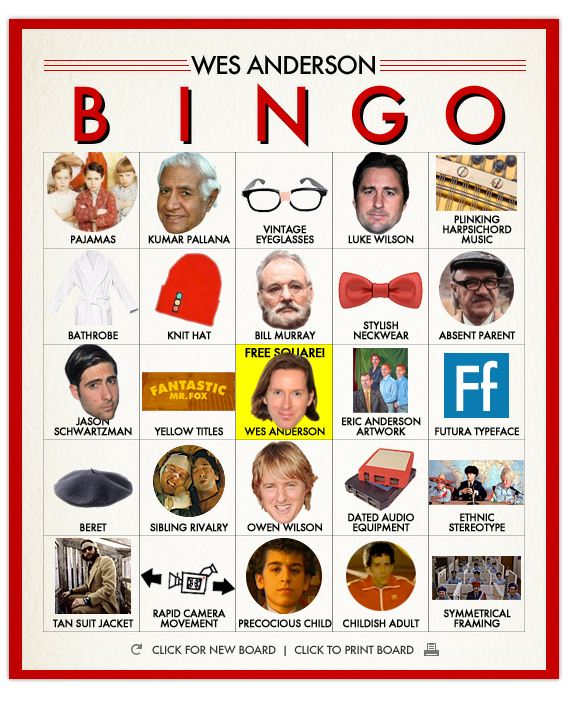
Wes Anderson Bingo

(Via Slate’s Brow Beat blog; go there to get printable variations of the board).

RIP — In Honor of My Desktop PC, 2002-2012

Jackson Pollock Documentary

Science Friction — Stan Vanderbeek

I Review the Trailer for Baz Luhrmann’s Adaptation of The Great Gatsby

There’s a part in William Gaddis’s big novel The Recognitions where Basil Valentine talks about how forged paintings are always outed as fakes over time because they ultimately illustrate not the original genius of the artist, but instead show how the current zeitgeist interprets the artist. Film adaptations of books aren’t painted forgeries, but they are highly susceptible to the same critical limitations that Valentine discusses. We can see this plainly in Baz Luhrmann’s 1996 adaptation of Romeo & Juliet, a messy, vibrant, flaky film thoroughly shot-through with the aesthetic spirit of the nineties. I like Luhrmann’s R&J, despite its many, many faults. One of its great saving graces is that it seems aware of its own spectacle—it unselfconciously acknowledges itself as a product of its time, as just one of many, many adaptations of Shakespeare’s deathless work.

Lurhmann has taken a stab at F. Scott Fitzgerald’s The Great Gatsby. He’s not the first. Others attempted to turn Fitzgerald’s classic novel of the jazz age into a movie in 1926 (the film is lost), 1949 (there’s a reason you never saw it in high school), and 1974 (I’ll come back to the Redford Gatsby in a moment). Most recently, a 2000 anemic TV production featured Mira Sorvino as Daisy and Paul Rudd as a terribly miscast Nick Carraway. Up until now, high school teachers across the country who wanted to foist an adaptation on their students (and maybe free up a day or two of lesson planning) have had to choose between the 2000 A&E production or Jack Clayton’s 1974 Francis Ford Coppola-penned debacle—this is the one I was subjected to in high school. It features Robert Redford as Gatsby, Sam Waterston as Nick, and Mia Farrow as Daisy, and none of them are terrible, but the movie is dull, overly-reverential of its source material, and heavy-handed. It also looks incredibly dated now, its evocations of the 1920’s jazz age petrified in gauzy ’70s soft-focus shots. It just looks and feels very 1970s.

Judging by its trailer, Lurhmann’s Gatsby is making absolutely no play at all for timelessness. Just as his earlier mashup, 2001’s Moulin Rouge!, essentially uses the Belle Époque as a sounding board for transgenerational spectacle, Lurhmann’s Gatsby looks like another thoroughly interpretative gesture, a hyperkinetic, hyperstylized film that makes no bid at realism. This is what 2012 thinks 1922 should look like (or at least this is 2012’s ideal, shimmering, sexy version of 1922.) Here’s the trailer:

Overwrought, frenetic spectacle is exactly what I would expect from Luhrmann. There’s a transposition of meaning here, where Gatsby’s famous party turns into a rave of sorts, where Daisy’s phrasing of “You always look so cool” takes on anachronistic dimensions. But the trailer seems faithful (if hyperbolic) to images described in the book. By way of comparison, let’s look at the first shot in the trailer, the car full of young black people treating said car as a party scene. Here’s the text:

As we crossed Blackwell’s Island a limousine passed us, driven by a white chauffeur, in which sat three modish Negroes, two bucks and a girl. I laughed aloud as the yolks of their eyeballs rolled toward us in haughty rivalry.

“Anything can happen now that we’ve slid over this bridge,” I thought; “anything at all. . . .”

Even Gatsby could happen, without any particular wonder.

The energy of the scene is expressed—and magnified—in Luhrmann’s shot, but it’s impossible to say yet whether or not the invocation to change expressed in this citation will transfer to film.

It’s also obviously too early to make any pronouncements on the casting, although I’ll submit that you could find a worse Jay Gatsby than Leonardo DiCaprio (who I think, for the record, was great as petulant, whiny Romeo in Luhrmann’s breakthrough film). I’m not sure about Tobey Maguire as Nick Carraway, but there’s a certain, I don’t know, emptiness to him that may work well in our unreliable narrator. My big concern is Carey Mulligan, who I think is very sweet and I will admit to having a mild crush on—is she right for Daisy Buchanan, one of the meanest, most selfish creatures in literature? The other Buchanan, husband Tom, is portrayed by Joel Edgerton with a kind of seething rage here in the clip. Dude looks positively evil—cartoonishly so (which is really saying something, because Luhrmann seems to turn everything into a cartoon). Edgerton’s Tom presents as the glowering obstacle to the pure, positive love between Daisy and Gatsby. And here might be the biggest trip up with the film: The trailer seems to be advertising a love story.

Now, of course reading is an act of interpretation, a highly subjective experience dependent on any number of factors (see also: the opening paragraph to this riff). But good reading and good interpretation is generally supported by textual evidence, and the textual evidence in Gatsby reveals not so much a love story, but a bunch of nefarious creeps and awful liars who ruin the lives of the people around them with little thought or introspection. I mean, really, the principal characters are basically vile people (hence the reason your high school English teacher loved to point out Nick Carraway’s signature unreliability as a narrator—he glosses over so much evil). But again, it’s just a trailer, and trailers are made to make people buy tickets to movies, and people will pay to see a love story. We’ll have to wait for the film to assess Lurhmann’s interpretation. For now, it’s enough to suggest that the trailer achieved what it needed to—as of now, The Great Gatsby is still trending on Twitter. This is buzz; this is what a trailer is supposed to create. And if a byproduct of that buzz is to get more people reading or rereading, that can’t be a bad thing.

Bill Murray Hosts a Tour of Moonrise Kingdom; Drinks Spiced Rum