So the wife and I went to see The Hunger Games last night. By way of readerly context: she ate up the trilogy in a spare week; I listened to the first audiobook last summer, and wrote about it here, including these sentences which loosely sum up my feelings:
Look, I get that these books are for kids, and that they’re probably a sight better than Twilight, but sheesh, exposition exposition exposition. There’s nothing wrong with letting readers fill in the gaps (especially when your book is ripping off The Running Man + a dozen other books). Also, there’s a character in this book who I think is named after pita bread.
However, I was prepared to accept that the plot of The Hunger Games could make for a fine film—I mean, it’s basically “The Most Dangerous Game,” or Lord of the Flies, or The Running Man, or Logan’s Run or whatever—so I went with an open mind.
By way of context/citation, here’s a trailer that gives a fairly accurate visual sense of the film—up to a point (I will belabor that point momentarily):
Short review:
Plot—fine.
Dialogue—fine.
Pacing—not bad.
Acting—better than average, especially Jennifer Lawrence as lead Katniss. (Lawrence stars in a better film called Winter’s Bone, which is like the real hunger games, by the bye). Woody Harrelson brought more to his character, drunken mentor Haymitch, than Collins’s cardboard book allowed, so kudos, bro.
Music/score—surprisingly good and rarely overused. I think T-Bone Burnett supervised. Also, no forced obtrusive pop songs from the “soundtrack.”
Set design—fine, I guess, although who knew the dystopian future would look like Coal Miner’s Daughter (for the plebes) and future-Vegas/Logan’s Run (for the aristocrats). The scenes in the capital city will look incredibly dated in ten years, but whatever. The thunderdome itself where the kids fight it out was underdeveloped, but this had more to do with plotting and pacing. But hey, the movie was already almost two and a half hours long, which is long, so, fine, I guess.
Editing/camera work: Not fine. Horrible. I’m probably referring more to the director’s choices than to the acutal work of the DP and cinematographer here—I mean the lighting was good — what I’m talking about was the shoddiness of the framing of each shot, of the camera’s faux-unsteadiness, as if a shaky-cam in someway connotes realism or drama. The shaky cam connotes headache and nausea — especially when used so liberally. The camera seemed unable to ever simply rest on an image, particularly during the first 30 minutes. The shots—from bizarre and disparate angles—jump-cut around, refusing to actually show the audience the staging and action.
Particularly frustrating is an opening scene where Katniss hunts a deer in a lush green forest. There’s the potential here for an excellent introduction to the character—to her seriousness, her gravity, her skill, her keen attenuation to environment (all extremely relevant later, of course) — the camera could simply show the audience the hunt, linger a bit even — I’m not talking about Malickian nature-gazing, but simply taking the time to attune character to setting. Instead, the camera whips around frenetically with a nervous energy that seems to have nothing to do with Katniss’s calm, steady bowhand. It’s as if the director does not trust the audience to attend to a specific shot or angle for more than 2 seconds.
My frustration grew after this initial scene, as the director seemed determined to withhold any simple shot that would establish place or character. This frustration culminated in a climactic scene at the beginning of the Battle Royale—excuse me, Hunger Games tournament—where the contestants, admitted to the arena, either run for weapons or cover. There’s a bloodbath here, one that highlights the intense Darwinian stakes in play—only, again, we don’t really get to see it. The camera whirls around as if it were in the hands of someone’s dad at a birthday party, two beers in, as he tries to capture everything all at once on his cheap Sony — and therefore misses everything. Sure, the conceit might be that this shaky unsteady whirling is how Katniss experiences the scene, but the Hunger Games tourney is televised, so obviously we could see what the home audience could see, right? I’m not asking for gore or explicit violence here, to be clear: I simply don’t understand why the camera refused to show the basic action that was happening on the screen. Repeat this criticism for every single fight scene.
The clunky, clumsy fight scenes reminded me of Christopher Nolan’s shoddy work in the Batman films or even the sheer incomprehensibility of Michael Bay’sstuff : is this what audiences will accept? Are these what pass for action films? I’m not arguing that these Hollywood blockbusters need to adhere to the precision that we can find in Hong Kong martial arts films (or even Ang Lee’s arty take on such films, Crouching Tiger, Hidden Dragon)—but, c’mon, even the Jason Bourne movies and recent James Bond movies respected their audiences enough to adhere to a modicum of verisimilitude.
Verdict: The Hunger Games, like any dystopia, succeeds or fails by how well it synthesizes—and then surpasses—its myriad sources. The film, in this case, is simply okay. Dystopia has so assimilated our culture’s collective imagination (from the aforementioned Batman films to political ads to the wild financial success of Collins’s HG trilogy) that its tropes are overly-familiar, to the point that they have become comfortable, well-worn. A more successful dystopian vision—let’s take Cormac McCarthy’s The Road or Alfonso Cuarón’s film Children of Men or Margaret Atwood’s Year of the Flood as ready recent examples—offers familiarity with one hand and utter strangeness with the other. Successful dystopian visions are strange, disruptive, and uncanny—they allow us to project ourselves into worlds we pray are impossible. The Hunger Games feels, dare I say, dull, predictable, and somehow awfully normal. Catch it on cable in two years.
Pablo Picasso, Les Demoiselles d'Avignon, oil on canvas, 1907 (MoMA)
Painting is not done to decorate apartments –PICASSO
People speak of naturalism in opposition to modern painting.
Where and when has anyone ever seen a natural work of art?
Asked Picasso.
Depressed at the apparent lack of interest in one of his early still lifes, Matisse visited his dealer to retrieve it, only to learn that it had been purchased after all.
By Picasso.
The interrelationship of Picasso and Braque during Cubism:
Like being roped together on a mountain, Braque said.
The oddity that Velazquez and Picasso, surely two of the three greatest Spanish-born painters, each used his mother’s name rather than his father’s.
Among the many paintings in her Paris flat, Gertrude Stein had two exceptional Picassos.
If there were a fire, and I could save only one picture, it would be those two. Unquote.
The Bateau-Lavoir, the legendary former Montmartre piano factory broken up into artists’ studios, where Picasso contrived any number of his early masterpieces — while living with no running water and only one communal toilet.
The so-called anarchist artist who in 1988 smeared a large X in his own blood on a wall in the Museum of Modern Art — and in the process splattered an adjacent Picasso.
Picasso. Cézanne. Matisse. Braque. Bonnard. Renoir.
All of whom painted portraits of Ambroise Vollard.
Cartier-Bresson. Brassaï. Man Ray. Lee Miller. Robert Doisneau. Robert Capa. David Douglas Duncan. Cecil Beaton.
All of whom photographed Picasso.
Picasso’s play, Desire Caught by the Tail — which could be performed for the first time only privately, because of the Nazi occupation of Paris.
But avec Camus, Sartre, Michel Leiris, Raymond Queneau, Dora Maar, Pierre Reverdy, Simone de Beauvoir.
There is no such thing as abstract art, said Picasso.
You always have to start somewhere or other.
Gertrude Stein once delighted Picasso by reporting that a collector had been dumbfounded, years afterward, to hear that Picasso had given her her portrait as a gift, rather than asking payment.
Not understanding that that early in Picasso’s career, the difference had been next to negligible.
You never paint the Parthenon; you never paint a Louis XV armchair. You make pictures out of some little house in the Midi, a packet of tobacco, or an old chair.
Said Picasso.
Future generations will regard Bob Dylan with the awe reserved for Blake, Whitman, Picasso and the like.
Said an otherwise seemingly rational writer named Jonathan Lethem.
Picasso, avec laughter, after being asked if he had used models for Les Demoiselles d’Avignon:
Where would I have found them?
Picasso’s admiration for Charlie Chaplin.
Diego Rivera’s.
Stalin’s.
Kees van Dongen’s admission that there were occasions during his own early Montmartre years when he was forced to filch milk and/or bread from neighborhood doorsteps — with an accomplice named Picasso.
Picasso, in Paris during the Nazi occupation and learning that someone had accused him of having Jewish blood:
I wish I had.
A rejection of all that civilization has done.
Said the London Times of a first Post-Impressionist exhibition, in 1910 — which included Cézanne, van Gogh, Gauguin, Matisse, Picasso, others.
My old paintings no longer interest me. I’m much more curious about those I haven’t done yet.
Said Picasso, at seventy-nine.
The twenty-five short (and short-short and micro) stories that comprise Matt Mullins’s Three Ways of the Saw bristle with gritty, buzzing energy—these are crack-shot tales, simultaneously precise and off-center. Mullins offers a world of stumbling rock bands and day-drinkers, sorry sons and ugly lovers, all fumbling for meaning against the world’s sharp edges. Organized into three novellas-(of sorts)-in-stories, Saw is spiky, stinging, but also deeply moving, probing some of the darker places we’ve all been (or might be headed to).
Matt was kind enough to talk to me about his work over a series of emails, even though I’m sure he was busy—he had just gotten back from this year’s Association of Writers & Writing Programs (AWP) conference in Chicago where he helped promote Saw, which is fresh from Atticus Books. Matt teaches creative writing at Ball State University. In addition to his writing, he’s also a musician and filmmaker. Check out his blog.
Biblioklept: How was AWP?
Matt Mullins: I had an excellent time at AWP. Things had come full circle. Three years ago at AWP Chicago, I’d interviewed for the tenure-track job I now have teaching creative writing at Ball State University. Two years ago in Denver, I was part of the hiring committee that brought us our most recent fiction hire, Cathy Day. Last year in DC I found out Three Ways of the Saw had been accepted by Atticus Books. This year I was back in Chicago signing the book for people at the Atticus booth in the book fair, and hustling boxes of wooden matches with a picture of book cover on them. I believe AWP is in Boston next year If I go, I’m planning on buying a lotto ticket and a twelve pack at the first party store I see inside the city limits.
Biblioklept: The twelve pack will come in use if your luck is bold or ill (but I hope your luck remains good).
MM: Truly, the beer shares its love with us whether we’re drowning sorrows or celebrating.
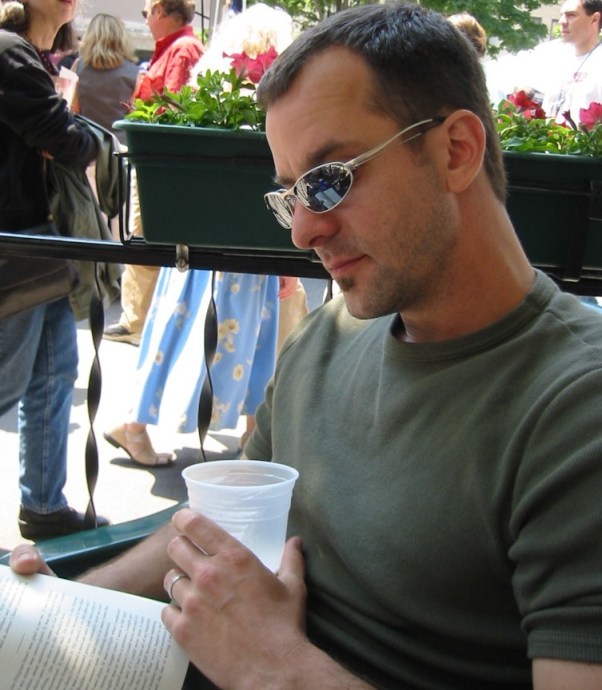
The writer, in repose, enjoys a libation and book
Bibliokept: Could you describe the vibe at AWP for those of us who’ve never been? How important is it for authors?
MM: The vibe at AWP, the book fair specifically, always reminds me that there is a hell of a lot of love for books out there, regardless of what the cyber-world might cause us to think with the rise of e-readers and online literary magazines. Hundreds of tables filled with beautifully crafted books, some of them hand typeset, hand-stitched, custom illustrated, others slicker and more traditional, but all of them filled with an astonishing breadth of literature. More great books than anyone could read in a lifetime. There’s definitely that going on, a serious love for the book as an object.
Then there’s the conference. 8,000 writers descending upon a swanky hotel in City X (Austin, Chicago, New York, Vancouver, D.C., etc. It changes each year.) to attend panels on a wide variety of subjects of concern to writers who teach in university/college creative writing programs. Readings by notable authors in both the literary and indie publishing worlds. Fancy receptions with open bars put on by various sponsors. Serious networking.
Then there’s all the crazy “off site” events. Parties put on by lit magazines and publishers. Readings in bars and clubs. All the things you can imagine happening when you let thousands of writers and artistically inclined people loose on a city en masse for a long weekend. One of the interesting things I’ve noticed with AWP over the last few years is that there are now two strains that intermingle at will. There is what I would call the “indie-lit” community, the more recent community of people running small non-university affiliated presses and online literary magazines, and there is the longer standing community of university affiliated presses and creative writing programs. It’s been great to see how the coming together of these two communities (which have communities within and across their own larger communities) has energized the whole situation. It’s brought more people who love good writing together. This year the conference sold out for the first time in its forty-some year history.
In terms of its importance for authors: Many writers can take it or leave it. It’s a great place to meet editors of literary magazines and otherwise make connections with people who are potentially interested in reading your work. And personally, I’ve always enjoyed wandering through the book fair with a back pack and picking up submission guidelines at each journal’s table that I’ll sort through later as I get ready to send out a round of stories or poems. But it’s not a make or break situation for a writer by any means. I’m sure there are many writers out there to whom this conference would not appeal one bit. More power to them.
Biblioklept: Well, it sounds like you’ve had a lot of success at AWP. I hope that Three Ways of the Saw picked up some traction there. It’s a cool book, somehow simultaneously raw and refined. There’s a gritty energy to your prose, but it’s also precise and even elegant in its economy. Some of my favorite pieces in the book, like “Steam” and “Accepting Inner Change at the Grocery Store,” are these succinct moments that somehow encode epiphanies that aren’t forced, that are, for lack of a better word, naturalistic (this is a long-winded way of me saying: I completely identify with the truth of these moments as a reader, as a human). I’m curious about how you draft and execute them.
MM: For me there’s a certain grace inhabiting those things living at the very edge of our understanding. When, for various reasons, they spill over into some kind of sense we can apprehend we get a feeling of momentary clarity that can resonate forward into a longer lasting epiphany that changes the way we see ourselves and the world. There are those things born of a raw truth that come to us like a slap in the face. And there are those things that slide over us with a gentle sadness or joy. Whatever their type, they’re always there. They surround us. What brings them into focus is life context bumping up against individual consciousness.
When I’m trying to work that mechanism in a story, I don’t really know what that moment might be when I start out. Or if I do think I know what it is when I start out, it usually ends up being something else. What tends to happen, though, is that I end up writing my character into outer circumstances that allow a kind of collision, subtle or raw, with the character’s inner circumstances that result in this third element, this realization (or failed realization) of that new collided inner/outer state.
The language is the delivery mechanism for this idea, so it must be precise if the meaning is to come across. But language is sound and rhythm and even shape as well as meaning so all of those elements need to come together if this “third thing” as I’m calling it is to emerge fully. I think maybe it’s the attention to the language and the fact that these true moments don’t need to be conjured so much as revealed and caused to shine anew through the method of their delivery that makes their arrival feel natural rather than forced. Saying something the reader already intuits to be true in an unexpected way makes the gut say yes even as it makes the head tease out the complexities of the idea.
Biblioklept: There’s a moment in the title story, “Three Ways of the Saw,” when the narrator connects the scientific fact that matter can never be created nor destroyed, only changed, to the philosophical implication that, “if this is true it means the whole universe already contains everything that ever was or will be” — and hence all people are intrinsically connected (the narrator goes on to link himself to Nixon and Hitler and Gandhi and Jesus and rubber bands). Your collection contains a strong, unifying tone, but you also get inside the heads of lots of different kinds of people. Where do your characters come from?
MM: My characters come from within and from without. By within I mean two things. First, every character, no matter where it comes from, has a little part of me in its chemistry, if only by virtue of the fact that it’s being filtered through my consciousness. Secondly, some characters are wholly products of my imagination. That is, they are born in my head and I evolve them from there.
By without, I mean some of my characters are based partly on my experience with others. Some are inspired by people I know well. Others come from people I’ve seen or encountered indirectly. But even these characters that come from without have to be filtered through me to end being in the story, so they invariably take on facets of my perception, intentional or not, which makes them that first type of character I mentioned that comes from within. So, to untangle that, I guess the answer is that all my characters come from within–eventually–regardless of if they were born in my head or were filtered through it.
But more than where they come from is what I want from them. I want them to be compelling, flawed, multi-faceted and someone a reader can attach themselves to, whether it’s by way of sympathy or interest in “what’s going to happen to this person next.”
You make a good point about the collection’s unifying tone across its variety of characters. I believe in the idea of universality through specifics. That is, the more specific you get with a character’s mind, world and situation, the more universal your story becomes. It appears antithetical at first glance and I’ve had many a student tell me they wrote something purposefully vague because they wanted everyone to “Get it.” But what happens with vagueness is detachment and disinterest. So I always tell them to get that vaseline off the camera lens and start showing me the facets of the diamond. Because this much I’ve learned: When things vividly emerge for the reader, they descend into the story and the resulting empathy/interest allows them to attach themselves to the character and their experience. That’s why we could all relate to a well written story about astronauts that might say something universal about loss or isolation or perspective, or whatever, even though 99.99999% will never be in outer space.
Biblioklept: I teach basic college composition, not fiction writing, but I have a similar mantra: get to the abstract through what’s concrete. I’m curious about your teaching: Has it influenced how you write?
MM: Teaching influences my writing in that it keeps the creative process, revision and the idea of reading good examples by writers I admire in the forefront of my mind. Those are the general practices I try to pass along to my students. I’ve been teaching a lot of screenwriting over the last few years, and this has given me certain ideas about plot and character arc and scene and dialogue that have influenced the shape of some things I write as well, the more narrative stories particularly. I also have a clearer understanding of how to book end scenes I want to purposefully withhold so they emerge in the reader’s mind without literally appearing in the story. But screenwriting also pushes me toward more non-narrative forms of storytelling, because sometimes I want to get away from that more traditionally narrative mode. So this makes me more experimental in my approaches at times. But In general, teaching influences my writing by keeping me engaged in the idea of craft, how to talk about it, what I understand it to be. It keeps my mind focused on the practical application of techniques, which is where the true guts of writing are, at least for me, whether it’s in a traditional narrative or experimental mode.
Biblioklept: One of the techniques you use in a few of the stories is second-person perspective. What are the risks and payoffs in writing in this POV?
MM: Second person is much maligned, I think sometimes rightly so, for being presumptuous. Forcing the reader into a story as the protagonist–it’s a leap some readers aren’t willing to make, especially if they can’t connect themselves to the characterization or the outer realities of the character. 2nd person requires that leap of faith on the reader’s part. Especially when the reader gets drug through some shit and those “you’s” aren’t dwelling in very happy places. So there’s a risk in alienating the reader due to the nature of the leap you’re asking of them. Also, it’s a self-conscious device to create “intimacy” between the reader and the story, something that brings attention to what is usually a more subconscious relationship between reader/character that’s different from the objective subjectivity of the first person and the more distant narrative omniscience of 3rd; and that self-consciousness can put people off. This is why I only use 2nd person sparingly, and when I do it’s for very specific reasons. For me, unless 3rd person is essential to some aesthetic element of the story, I won’t use it.
For example, in “Getting Beaten” I’m using it to get the reader in close on a rather lost, though I hope sympathetic, character who undergoes a violent experience. I wanted to put the reader as close to that experience and subsequent catharsis as possible. 2nd person seemed the best way to bring across that character’s inner turmoil while attaching the reader to the outer situation. But that in itself wouldn’t justify its use for me. That story can be told just as well in 1st or 3rd person. 2nd person became integral to that story when I realized its true ending, which involves the projection of a second “you” into the story that pulls up next to the “you” the reader has been associating with the entire time–this effect of one you watching the other you in the context of how the story makes the idea of those two presences interact with each other would be impossible to write in the 1st or 3rd person.
“Accepting Inner Change in the Grocery Story” is a kind of companion piece in that it’s assumed the “you” is the same character if you were to view him objectively. With that story there’s also this idea of the doppelgänger, you confronting you, and this idea of a kind of psychic time travel. Using 2nd person here allowed me to get a character to confront himself literally while also throwing the idea of the reader inside that same mirror while pulling them back and forth in time.
In “The Bachelor’s Last Will and Testament” I shift between the 2nd person and that 1st person legalese of the will. So using 1st person for the beginning of the piece wasn’t working and 3rd felt too distant.
In “How to Time an Engine” I’m using it more in the poetic tradition of direct address, though I’ve angled the address to the character on the receiving end of my marveling over luck and timing versus karma, divine providence and fate and how maybe they’re all just different versions of the same thing. Using second person in that piece allows me to turn the reader into the example itself (the you) as we (reader and narrator) consider the idea together.
So, for me, when I’m trying to bend the whole idea of what “person” means in fiction, I might employ 2nd person. But, knowing its risks, I don’t make that choice too often. I think if a writer takes that kind of considered approach to 2nd person they’ll probably reap the rewards rather than suffer the risks.
Biblioklept: I’m curious what you’re working on now—more short stories? Music? Film? Do you have plans for a novel? Another Mortal Kombat film? (Oh, wait, I think that’s a different Matt Mullins . . .)
MM: Yeah, that other Matt Mullins. He’s something else. You’ve got to check him out on YouTube. He does all that acrobatic flying through the air ass-kicking type stuff. He also looks a little bit like I did when I was younger. When I first stumbled upon him it was almost like seeing an alternate reality version of myself, as if after the last time I had my nose busted in a fist fight I said, “Forget this reading and writing bullshit,” and started studying the martial arts instead. It makes me wonder how many Matt Mullins are out there and what they’re into. Maybe one likes to write. Maybe we can trade books one day or have a beer.
As for what I’m working on now: My interactive literary project in progress currently lives at lit-digital.com. I’ve been working on some videopoems and short, experimental films when I have the time. I have a manuscript of prose-poem type things called The Roaring Engine of Here that I want to finish up and start shopping around. I have a couple feature-length screenplays roughed out that I need to finish, and I have an idea for a novel that blows up my time spent as copywriter in corporate America. Basically, I just need to nail down what I want to focus on and get to it.
Biblioklept: Have you ever stolen a book?
MM: I went to an all-boys Catholic boarding school. We actually had to wear suit jackets with a crest on the breast pocket. But it was not some quasi Ivy League prep school. It was like the knock off version of that–an ignorant, ugly, cruel, violent place, but it taught me something of life’s truths early. You were required to bring your Bible to theology class under threat of “detention” and/or “demerits.” One day, I found I’d lost my Bible . . .


 Biblioklept