In a disguised way, Goya in the Caprichos drew a parallel between witchcraft and the activities of the clergy. He stressed the resemblance between witches and friars in their obedience to the hierarchy of their calling, the younger deferring to the older. In plate 47, Obsequio al maestro (“Homage to the master”), an apparently senior witch looks down with stony disdain at another, who ois offering her (or him) the gift of a dead baby; the supplicant’s gesture reminds one of a groveling postulant kissing the cardinal’s ring. “Es muy justo,” runs the Prado text: “This is quite fair, they would be ungrateful disciples who failed to visit their professor, to whom they owe everything they know about their diabolical faculties.”
Plate 46, Correccion (“Correction”), shows a group of brujos, male witches, as seminarians, consulting “the great witch who runs the Barahona seminary” — whatever that institution may have been. Of course, Goya could not be too explicit about this: on the other side of any public criticism of clerical practices lay the ever-watchful eye of the Inquisition, which Goya had to be at pains to avoid.
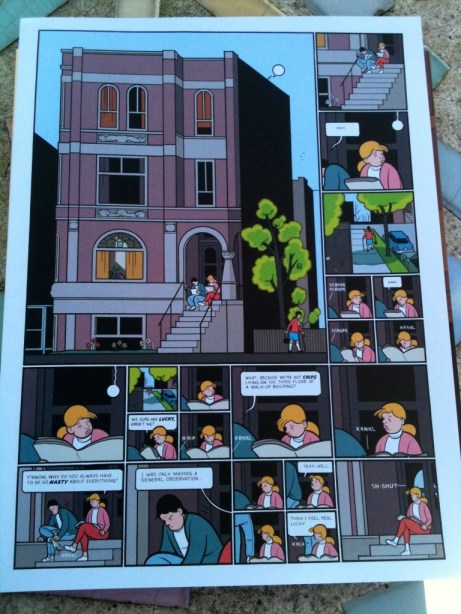
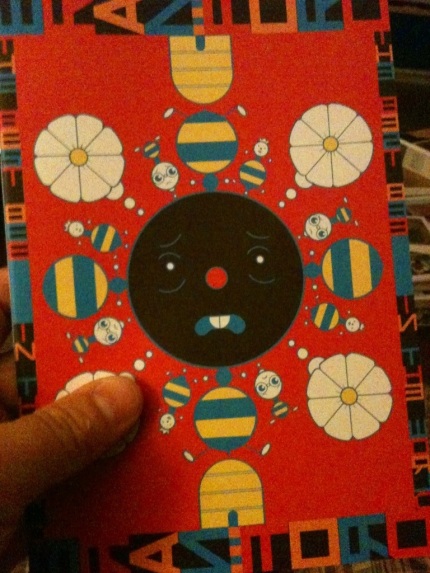
Not sure of the name of this episode, but I’ll refer to it as I just met, a phrase that repeats twice in a huge headlinish font that seems to suggest, y’know, title:
I just met uses a few pages to tell the story of a deteriorating relationship—what happens when two twenty-somethings turn into two mid-to-late-thirtysomethings?
The comic opens with an establishing shot of what I take to be the building in Building Stories; we also get a glimpse of what I assume will be another character, the beehive, and a few other details that surely will attach themselves to these panels in future readings. We also get the general bitter tone of the couple’s relationship:
He was one of those dudes who was once in a band; she was one of those chicks who thought guys in bands were cool.
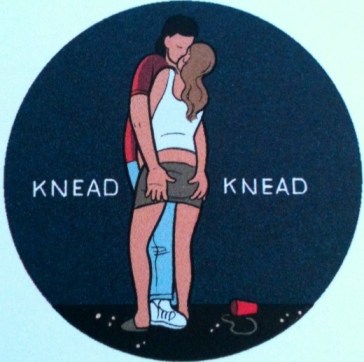
The romance of their initial hookup is summed up neatly in the pic below; knowing Ware’s spare, precise style, the trash on the floor seems to scream symbolic detail!
The hurt and disappointment in I just met unfolds over just a few painful pages—painful mostly in their concrete reality.
We know who these people are, even if we’re lucky enough not to be them.
Just as in Branford, the Best Bee in the World, which I read earlier (although, to be clear again, there are no reading directions or prescriptions for Building Stories), there’s a theme of eternal recurrence, of mistakes playing out again and again in a painful, recursive loop.
Just when Ware threatens to overstate the mundane repetitions his principals suffer, he pulls off a daring and effective move, transposing his characters into the psychic collective memory of a future that’s in many ways already familiar. The effect is simultaneously jarring and oddly reassuring—the promise that our capacity for human connection and deep empathy will never buckle under the threat of drastic technological change, but also suggesting that the cost of maintaining this emotional constant is deep, ugly pain.
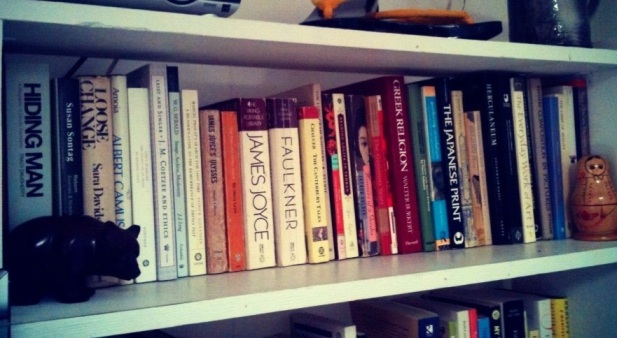
Book shelves series #43, forty-third Sunday of 2012
Kind of a hodgepodge shelf—some literary biography, a few now-redundant collections, some literary criticism, art books, etc.
Tracy Daugherty’s Donald Barthelme biography Hiding Man is on the far left; I reviewed it a few years ago, taking note of my favorite part, the so-called postmodernists’ dinner.
I picked up Penguin’s The Essential James Joyce in Jimbocho, an area in Tokyo known for used bookstores.
I recall paying maybe ¥100 for it. It comprises a few selections from Ulysses and Finnegans Wake, some of Joyce’s (totally unessential) poetry, and the entirety of Dubliners, Exiles, and Portrait. I’ve kept it because of sentiment (and I like the cover).
Had Robinson Crusoe never left the highest, or more correctly the most visible point of his island, from desire for comfort, or timidity, or fear, or ignorance, or longing, he would soon have perished; but since without paying any attention to passing ships and their feeble telescopes he started to explore the whole island and take pleasure in it, he managed to keep himself alive and finally was found after all, by a chain of causality that was, of course, logically inevitable.
We couldn’t endure a life in nature, necessarily always a free nature, without respite, so we always step outside nature, for no reason but survival, and take refuge in our reading, and live for a long time in our books, a more undisturbed life. I’ve lived half my life not in nature but in my books as a nature-substitute, and the one half was made possible only by the other half. Or else we exist in both simultaneously, in nature and in reading-as-nature, in this extreme nervous tension which as a form of consciousness is endurable only for the shortest possible time span. The question can’t be whether I live in nature as nature, or in reading-as-nature, or in nature-as-reading, in the nature of nature-as-reading andsoforth, so Roithamer. To everything that we think and fill our own life and that we hear and see, perceive, we always have to add: the truth, however, is … as a result, uncertainty has become a chronic condition with us. Those abrupt transitions from one nature into the other, from one form of awareness into the other, so Roithamer. When we think, we know nothing, everything is open, nothing, so Roithamer.
Chris Ware’s latest collection Building Stories comprises fourteen comics of different shapes, sizes, and formats. I wrote about opening the box a few days ago, and I’ll (try to) write about reading each of the pieces.
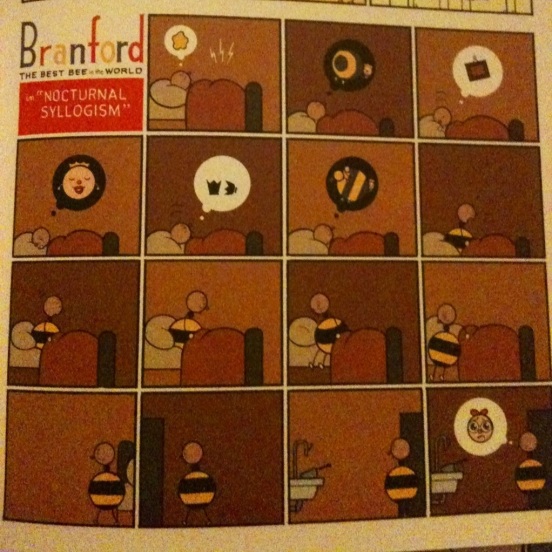
I started with Brandford, the Best Bee in the World, the tragicomic existential dilemma of a bee:
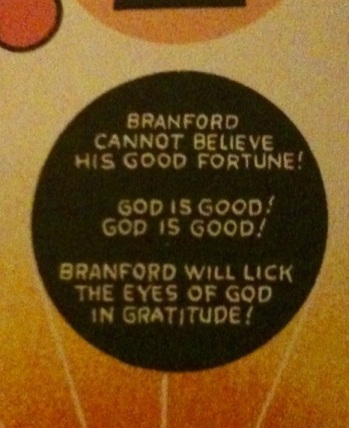
In an opening segment freighted with peril, our hero Branford finds himself “trapped in a box of hard air,” in a predicament that makes “the water run fast out of the holes in the front of his face.” When he does find a way out, he takes at as a sign of redemption from the Almighty:
Branford, now free to return home to his wife and family, promises God to quit lusting after the queen bee.
Easier said than done—even if his erotic dreams are interrupted with the domestic problems of crooked picture frames, broken vases, and burnt dinners:
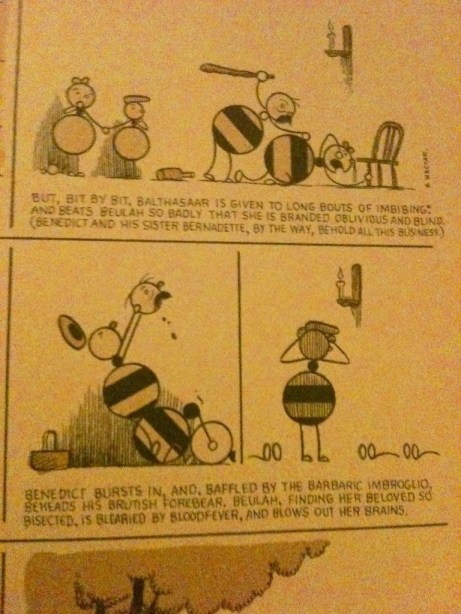
Branford solves his domestic trouble by going out into the world to provide pollen for his family, even if it means suffering an existential breakdown of identity, one that causes him to flashback to his beeblooded past.
The flashback episode introduces heavy alliteration that continues throughout the rest of the narrative. Framed as a 19th century comic strip, it combines zany humor with horrific familial violence and suicidal despair, an unnerving, bizarre combination that carries over throughout the comic:
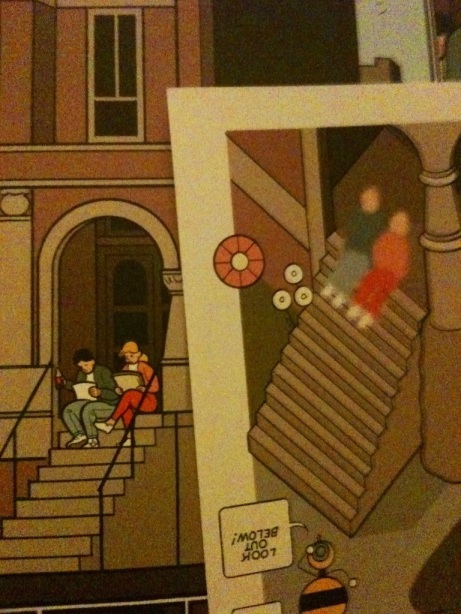
I won’t spoil anymore of Branford, other than pointing out that its narrative arcs in a strange loop. And even as its narrative doubles back into itself, it also points out, metatextually calling to another volume of Building Stories: here, see Branford to the right (and upside down) to a larger comic with no name.
I took the visual overlap as a prompt to read the comic on the left next. How did I start with Branford and not one of the other comics? It was on top.
One autumn I went to stay for the hunting season with some friends in a chateau in Picardy.
My friends were fond of practical joking, as all my friends are. I do not care to know any other sort of people.
When I arrived, they gave me a princely reception, which at once aroused distrust in my breast. We had some capital shooting. They embraced me, they cajoled me, as if they expected to have great fun at my expense.
I said to myself:
“Look out, old ferret! They have something in preparation for you.”
During the dinner, the mirth was excessive, far too great, in fact. I thought: “Here are people who take a double share of amusement, and apparently without reason. They must be looking out in their own minds for some good bit of fun. Assuredly I am to be the victim of the joke. Attention!”
During the entire evening, everyone laughed in an exaggerated fashion. I smelled a practical joke in the air, as a dog smells game. But what was it? I was watchful, restless. I did not let a word or a meaning or a gesture escape me. Everyone seemed to me an object of suspicion, and I even looked distrustfully at the faces of the servants.
The hour rang for going to bed, and the whole household came to escort me to my room. Why? They called to me: “Good night.” I entered the apartment, shut the door, and remained standing, without moving a single step, holding the wax candle in my hand.
I heard laughter and whispering in the corridor. Without doubt they were spying on me. I cast a glance around the walls, the furniture, the ceiling, the hangings, the floor. I saw nothing to justify suspicion. I heard persons moving about outside my door. I had no doubt they were looking through the keyhole.
An idea came into my head: “My candle may suddenly go out, and leave me in darkness.”
Then I went across to the mantelpiece, and lighted all the wax candles that were on it. After that, I cast another glance around me without discovering anything. I advanced with short steps, carefully examining the apartment. Nothing. I inspected every article one after the other. Still nothing. I went over to the window. The shutters, large wooden shutters, were open. I shut them with great care, and then drew the curtains, enormous velvet curtains, and I placed a chair in front of them, so as to have nothing to fear from without.
Then I cautiously sat down. The armchair was solid. I did not venture to get into the bed. However, time was flying; and I ended by coming to the conclusion that I was ridiculous. If they were spying on me, as I supposed, they must, while waiting for the success of the joke they had been preparing for me, have been laughing enormously at my terror. So I made up my mind to go to bed. But the bed was particularly suspicious-looking. I pulled at the curtains. They seemed to be secure. All the same, there was danger. I was going perhaps to receive a cold shower-bath from overhead, or perhaps, the moment I stretched myself out, to find myself sinking under the floor with my mattress. I searched in my memory for all the practical jokes of which I ever had experience. And I did not want to be caught. Ah! certainly not! certainly not! Then I suddenly bethought myself of a precaution which I consider one of extreme efficacy: I caught hold of the side of the mattress gingerly, and very slowly drew it toward me. It came away, followed by the sheet and the rest of the bedclothes. I dragged all these objects into the very middle of the room, facing the entrance door. I made my bed over again as best I could at some distance from the suspected bedstead and the corner which had filled me with such anxiety. Then, I extinguished all the candles, and, groping my way, I slipped under the bedclothes.
For at least another hour, I remained awake, starting at the slightest sound. Everything seemed quiet in the chateau. I fell asleep.
I must have been in a deep sleep for a long time, but all of a sudden, I was awakened with a start by the fall of a heavy body tumbling right on top of my own body, and, at the same time, I received on my face, on my neck, and on my chest a burning liquid which made me utter a howl of pain. And a dreadful noise, as if a sideboard laden with plates and dishes had fallen down, penetrated my ears.
I felt myself suffocating under the weight that was crushing me and preventing me from moving. I stretched out my hand to find out what was the nature of this object. I felt a face, a nose, and whiskers. Then with all my strength I launched out a blow over this face. But I immediately received a hail of cuffings which made me jump straight out of the soaked sheets, and rush in my nightshirt into the corridor, the door of which I found open.
O stupor! it was broad daylight. The noise brought my friends hurrying into the apartment, and we found, sprawling over my improvised bed, the dismayed valet, who, while bringing me my morning cup of tea, had tripped over this obstacle in the middle of the floor, and fallen on his stomach, spilling, in spite of himself, my breakfast over my face.
The precautions I had taken in closing the shutters and going to sleep in the middle of the room had only brought about the interlude I had been striving to avoid.
Did I read it before? In high school? Not in college, not in grad school, I’m certain of that.
That I could have read Notes from Undergroundin full three times, but not Crime and Punishment—how?
I vaguely recall wandering into Crime and Punishment as a young man. All those Russian names though. My attention was on other matters.
And so reading Crime and Punishment this month I repeatedly felt a strange anger or shame at all my younger selves for lacking the attention or the will or the discipline to stick it out . . . and these words, attention, discipline, will, they don’t seem like the right words, because the book compels, commands,rewards . . .
2. You are familiar with the plot of course:
Our hero, our anti-hero, young Raskolnikov murders a pawnbroker, an old woman; in the rush of the crime, he fails to close the door, and the pawnbroker’s innocent sister sees him. So he murders her too. The rest of the novel deals with the psychological fall out of this crime. Sure, there’s a sister and a mother, a failed marriage plot, a detective, a friend, and a love interest, a prototypical hooker with a heart of gold, etc.—but that’s it. That’s the plot.
3. What impels Raskolnikov to murder the pawnbroker?
Perhaps I shouldn’t answer here. Perhaps it’s better to suggest you just read the book if you haven’t yet—because is not this the driving question?
(Oh you’ve read the book? I’ll continue then).
4. Raskolnikov murders the pawnbroker not because he is an indigent student in need of funds. He murders her to test his theory—or rather, he murders her to test his place within the scheme of his theory.
The Murderer, Edvard Munch
5. Raksolnikov’s idea:
I maintain that all great men or even men a little out of the common, that is to say capable of giving some new word, must from their very nature be criminals—more or less, of course. Otherwise it’s hard for them to get out of the common rut; and to remain in the common rut is what they can’t submit to, from their very nature again, and to my mind they ought not, indeed, to submit to it. . . . I only believe in my leading idea that men are in general divided by a law of nature into two categories, inferior (ordinary), that is, so to say, material that serves only to reproduce its kind, and men who have the gift or the talent to utter a new word. . . . The first category, generally speaking, are men conservative in temperament and law-abiding; they live under control and love to be controlled. To my thinking it is their duty to be controlled, because that’s their vocation, and there is nothing humiliating in it for them. The second category all transgress the law; they are destroyers or disposed to destruction according to their capacities. The crimes of these men are of course relative and varied; for the most part they seek in very varied ways the destruction of the present for the sake of the better. But if such a one is forced for the sake of his idea to step over a corpse or wade through blood, he can, I maintain, find within himself, in his conscience, a sanction for wading through blood . . .
Raskolnikov believes that “extraordinary men” have the right, the duty, even, to transgress law—even to the extremes of murder (even mass murder) in order to bring about a new word, a new idiom, a new philosophy, a new paradigm, a new zeitgeist, even a New Jerusalem.
Raskolnikov wants to know if he is one of these “extraordinary men.”
6. But Raskolnikov, like Macbeth or a figure out of Poe, is plagued by doubt, misgiving—and more than a touch of insanity and egomania.
His instability and his psychological and moral dilemma is summed up neatly in only the second chapter of the book:
“And what if I am wrong,” he cried suddenly after a moment’s thought. “What if man is not really a scoundrel, man in general, I mean, the whole race of mankind—then all the rest is prejudice, simply artificial terrors and there are no barriers and it’s all as it should be.”
7. The word or an iteration of the word psychology appears 25 times in the Constance Garnett translation I read.
Crime and Punishment was published in 1866, when Sigmund Freud was ten years old.
(I am not naively/stupidly suggesting that Freud invented psychology, by the way. I’m just riffing).
8. What Crime and Punishment does so well:
Harnesses the intellect of its protagonist Raskolnikov, shows us his fevered mind in revolution, shifts us through his moods and dilemmas and despairs and strange joys.
9. And it’s not just the interior of Rakolnikov’s skull we get such access to—Dostoevsky gives our lead a marvelous, taunting foil in the detective Porfiry, a loyal and empathetic counterpoint in friend Razumikhin, a despicable enemy in the poseur Luzhin, and a dark-future forecast in Svidrigaïlov.
Each of these characters represent viewpoints and attitudes about psychology and morality without ever falling into being mere allegorical sketches or mouthpieces for Dostoevsky’s ideas.
10. Dostoevsky—unlike certain contemporary novelists I’ll neglect to name—doesn’t tell us that his character is brilliant (or troubled, or confounded, or fucked up). And he goes beyond showing us—he actually lets us experience the character’s psychology.
11. A marvelous, frightening episode that illustrates point 10:
12. This isn’t to say that Dostoevsky’s handling of characterization is flawless.
His women appear less fully-realized than his men, as if he perhaps cannot inhabit their minds so fully or exercise their brains, their souls, their voices.
Raskolnikov’s sister Dunya, for example, is a bold, more perfect, more more moral, more stable version of her brother, a woman who seems able to withstand conflict, disappointment, and misfortune with ease—too much ease. Raskolnikov’s mother, in contrast, is something of an idealized blank—not just a mother, but the mother figure: nonjudgmental, loving—her character summed up in her hugging her son and forgiving him for what she cannot forgive.
It’s the depiction of Raskolnikov’s love interest Sonia that I find most troubling though. Dostoevsky renders her an unsubtle merging of the Virgin Mary with Mary Magdalene. Her alcoholic father forces her into prostitution to save the family, but she never appears bitter or angry or even upset. Dostoevsky rarely affords her a speaking role, and in her biggest scene she reads the entire parable of Lazarus. Sure, she makes the words her own, but she’s being ventriloquized. The strings show. She’s pure symbolism, really, and stands in stark contrast to the dark, flawed humanity of Raskolnikov.
13. Re: Point 12 above: If Dostoevsky shows a certain weakness in his depiction of women, he perhaps compensates in other areas. For example, Luzhin’s roomate Andrey Semyonovitch, a utopian socialist, serves as a mouthpiece for emerging feminist ideas. And if Dostoevsky mocks would-be reformers in his novel, it’s not always with vitriol, but sometimes with understanding, and even perhaps love. After all, this is Raskolnikov’s pretension—to be a reformer of others, to step over the line of law, to be a great man.
14. But Raskolnikov is a failed reformer, or at least is unable to live with his trespass, his sin. Crime and Punishment’s epilogue emphasizes the Jesusian theme of the possibility of resurrection, even as it subdues or complicates that possibility.
We get the final image of Raskolnikov “mechanically” taking up Sonia’s copy of the New Testament; he doesn’t open it to read, but instead reflects on the possibility of a new life with Sonia, a life that “would cost him great striving, great suffering.” Dostoevsky does not let his protagonist off the hook, even as he offers the reader a final comforting vision of “the gradual renewal of a man, the story of his gradual regeneration, of his passing from one world into another, of his initiation into a new unknown life.”
15. There’s a strong temptation to see the epilogue as tacked on, as a sentimental gesture to the reader’s sense of stable morality, as a bit of window dressing that covers the ugliness of the narrative.
And perhaps this is true.
I’d argue though that Dostoevsky gives us a cold, ugly ending in the figure of Svidrigaïlov, who more or less commands the final moments of the narrative, moments that lead inexorably to his suicide—the self-erasing gesture that Raskolnikov cannot commit to. I think that Svidrigaïlov’s suicide might stand as a placeholder for Raskolnikov’s—an exchange of sorts.
And Svidrigaïlov’s death is not without a small measure of redemption—the redemption of other-directedness, of giving, of selflessness. It is far more complicated and troubling than the Jesusian resurrection that Dostoevsky implies as a possibility for Raskolnikov, but it also strikes me as far more real.
Bring Up the Bodies continues Mantel’s reappraisal of the Tudor saga through the eyes of Thomas Cromwell, a story she began in Wolf Hall, which won the Booker Prize in 2009.
Hers is a story unique in Man Booker history. She becomes only the third author, after Peter Carey and J.M. Coetzee, to win the prize twice, which puts her in the empyrean. But she is also the first to win with a sequel (Wolf Hall won in 2009) and the first to win with such a brief interlude between books. Her resuscitation of Thomas Crowell – and with him the historical novel – is one of the great achievements of modern literature. There is the last volume of her trilogy still to come so her Man Booker tale may yet have a further chapter.










 Biblioklept