This Dickinson poem is a sort of epigraph to Anne Carson’s novel-poem-poem-novel Autobiography of Red. I had never read either, before today, somehow, but oh my electric!
-Okay. I’ll try. The narrator is Gordon Lish—a version of Gordon Lish, of course (Gordon!), who tells us about a cryptographic “test” his aunt, an agent for the National Reconnaissance Office, sent him in 1963.
-Why did she send him this test?
-Poor Gordon was jobless and had a wife and kids to support and-
-You mean his kid the novelist Atticus Lish?
-Please don’t interrupt; no, these, these are other kids; Atticus comes later, but Lish does write about him in Cess. Anyway-
-What does he say about Atticus?
-He writes that “Atticus is, a, you know, a writer by Christ—is a novelist, by Christ, is indeed, if I, by Keerist, may say so myself, ever so proudly so, ever so rivalrously so, a novelist of nothing less than of rank.” Okay?
-Okay.
-So: The narrator gets this “test” from his aunt and-
-What does it look like? What is it?
-It’s a long list of esoteric words.
-May I see?
-It’s a pretty long list.
-How long?
-About 170 pages, about 22 words per page.
-May I see a section then?
-Sure:
-Whoa!
-That’s what I thought too! In fact, I first got a digital copy from publisher OR—so I was just reading, you know, on an iPad—which is, I mean, if you can imagine, I wasn’t doing the flicking through thing, the physical browsing thing—so I had no idea that there would be this big long list of words as like, the main course. I was shocked. It was electric. Continue reading “A review of Gordon Lish’s novel (spokening) Cess”→
September 5th.–I took a walk of three miles from the village, which brought me into Vermont. The line runs athwart a bridge,–a rude bridge, which crosses a mountain stream. The stream runs deep at the bottom of a gorge, plashing downward, with rapids and pools, and bestrewn with large rocks, deep and shady, not to be reached by the sun except in its meridian, as well on account of the depth of the gorgeas of the arch of wilderness trees above it. There was a stumpy clearing beyond the bridge, where some men were building a house. I went to them, and inquired if I were in Massachusetts or Vermont, and asked for some water. Whereupon they showed great hospitality, and the master-workman went to the spring, and brought delicious water in a tin basin, and produced another jug containing “new rum, and very good; and rum does nobody any harm if they make a good use of it,” quoth he. I invited them to call on me at the hotel, if they should come to the village within two or three days. Then I took my way back through the forest, for this is a by-road, and is, much of its course, a sequestrated and wild one, with an unseen torrent roaring at an unseen depth, along the roadside.
My walk forth had been an almost continued ascent, and, returning, I had an excellent view of Graylock and the adjacent mountains, at such a distance that they were all brought into one group, and comprehended at one view, as belonging to the same company,–all mighty, with a mightier chief. As I drew nearer home, they separated, and the unity of effect was lost. The more distant then disappeared behind the nearer ones, and finally Graylock itself was lost behind the hill which immediately shuts in the village. There was a warm, autumnal haze, which, I think, seemed to throw the mountains farther off, and both to enlarge and soften them.
To imagine the gorges and deep hollows in among the group of mountains,–their huge shoulders and protrusions.
“They were just beginning to pitch over the mountains, as I came along,”–stage-driver’s expression about the caravan.
A fantastic figure of a village coxcomb, striding through the bar-room, and standing with folded arms to survey the caravan men. There is much exaggeration and rattle-brain about this fellow.
A mad girl leaped from the top of a tremendous precipice in Pownall, hundreds of feet high, if the tale be true, and, being buoyed up by her clothes, came safely to the bottom.
Inquiries about the coming of the caravan, and whether the elephant had got to town, and reports that he had.
A smart, plump, crimson-faced gentleman, with a travelling-portmanteau of peculiar neatness and convenience. He criticises the road over the mountain, having come in the Greenfleld stage; perhaps an engineer.
Bears still inhabit Saddleback and the neighboring mountains and forests. Six were taken in Pownall last year, and two hundred foxes. Sometimes they appear on the hills, in close proximity to this village.
Nathaniel Hawthorne’s journal entry of September 5th, 1838.
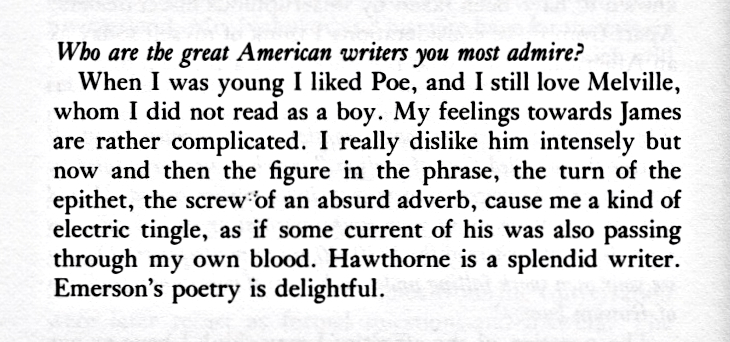
From a 1966 interview between Vladimir Nabokov and Alfred Appel, Jr., originally published in Wisconsin Studies in Contemporary Literature and reprinted in Strong Opinions.
September 1st.–Last evening, during a walk, Graylock and the whole of Saddleback were at first imbued with a mild, half-sunshiny tinge, then grew almost black,–a huge, dark mass lying on the back of the earth and encumbering it. Stretching up from behind the black mountain, over a third or more of the sky, there was a heavy, sombre blue heap or ledge of clouds, looking almost as solid as rocks. The volumes of which it was composed were perceptible by translucent lines and fissures; but the mass, as a whole, seemed as solid, bulky, and ponderous in the cloud-world as the mountain was on earth. The mountain and cloud together had an indescribably stern and majestic aspect. Beneath this heavy cloud, there was a fleet or flock of light, vapory mists, flitting in middle air; and these were tinted, from the vanished sun, with the most gorgeous and living purple that can be conceived,–a fringe upon the stern blue. In the opposite quarter of the heavens, a rose-light was reflected, whence I know not, which colored the clouds around the moon, then well above the horizon, so that the nearly round and silver moon appeared strangely among roseate clouds,–sometimes half obscured by them.
A man with a smart horse, upon which the landlord makes laudatory remarks. He replies that he has “a better at home.” Dressed in a brown, bright-buttoned coat, smartly cut. He immediately becomes familiar, and begins to talk of the license law, and other similar topics, making himself at home, as one who, being much of his time upon the road, finds himself at ease at any tavern. He inquired after a stage agent, named Brigham, who formerly resided here, but nowhas gone to the West. He himself was probably a horse-jockey.
An old lady, stopping here over the Sabbath, waiting for to-morrow’s stage for Greenfield, having been deceived by the idea that she could proceed on her journey without delay. Quiet, making herself comfortable, taken into the society of the women of the house.
Nathaniel Hawthorne’s journal entry for September 1st, 1838. From Passages from the American Note-Books.
“There is a wild beast in your woods,” said the artist Cunningham, as he was being driven to the station. It was the only remark he had made during the drive, but as Van Cheele had talked incessantly his companion’s silence had not been noticeable.
“A stray fox or two and some resident weasels. Nothing more formidable,” said Van Cheele. The artist said nothing.
“What did you mean about a wild beast?” said Van Cheele later, when they were on the platform.
“Nothing. My imagination. Here is the train,” said Cunningham.
That afternoon Van Cheele went for one of his frequent rambles through his woodland property. He had a stuffed bittern in his study, and knew the names of quite a number of wild flowers, so his aunt had possibly some justification in describing him as a great naturalist. At any rate, he was a great walker. It was his custom to take mental notes of everything he saw during his walks, not so much for the purpose of assisting contemporary science as to provide topics for conversation afterwards. When the bluebells began to show themselves in flower he made a point of informing every one of the fact; the season of the year might have warned his hearers of the likelihood of such an occurrence, but at least they felt that he was being absolutely frank with them.
What Van Cheele saw on this particular afternoon was, however, something far removed from his ordinary range of experience. On a shelf of smooth stone overhanging a deep pool in the hollow of an oak coppice a boy of about sixteen lay asprawl, drying his wet brown limbs luxuriously in the sun. His wet hair, parted by a recent dive, lay close to his head, and his light-brown eyes, so light that there was an almost tigerish gleam in them, were turned towards Van Cheele with a certain lazy watchfulness. It was an unexpected apparition, and Van Cheele found himself engaged in the novel process of thinking before he spoke. Where on earth could this wild-looking boy hail from? The miller’s wife had lost a child some two months ago, supposed to have been swept away by the mill-race, but that had been a mere baby, not a half-grown lad. Continue reading ““Gabriel-Ernest” — Saki”→
A colleague dropped by today, burst in my office really, if you’ll forgive the cliché, animated, ecstatic almost—Read this!—he commanded, thrusting a big fat hardbacked Gore Vidal volume in front of me. Read this, his finger pointing to the last paragraph of the 1981 essay “Pink Triangle and Gold Star” (ostensibly a review of Renaud Camus’ novel Tricks). So I read it. See? It’s just like today! my colleague declared. Vidal’s essay ends with a call for the unity of marginalized people to resist “our ruling class” — the banks, The Wall Street Journal, the Pentagon — and “their kindly voice,” Ronald Reagan. We then had a brief discussion about Donald Trump’s bid for the presidency, something I have until now refused to talk about at all because it’s all just too weird.
I sometimes feel like I’m living in a Thomas Pynchon novel.
I sometimes feel like I’m living in a J.G. Ballard short story.
I sometimes feel like I’m living in some distorted, slipped timeline.
Reading Philip K. Dick’s novel Martian Time-Slip, I kept wanting to burst into someone’s office, animated, pointing to a paragraph, crying, Read this! See? It’s just like today!
Not that we’ve colonized Mars but—
—colonial metaphors, yes? Cowboys and Indians…
But also, that we’d want the final frontier to be just like home: Desert Mars with green lawns, irrigated flower gardens. Swimming pools. Dick’s Mars is California 1964 and California 2015. And: a water-scarce environment to come.
Did I mention that the novel is set in 1994?
I sometimes feel like I’m living in a Don DeLillo novel.
But where was I? I launched into this riff with a long anecdote, so—What my colleague and I worked into was, ultimately, a discussion of the sheer irreality of modern life—the paranoia that permeates American culture, the sense that the last two decades seem like a bad repetition of Bad Times that outdated textbooks told us had been conquered.
(Or maybe I’m just getting old).
(Sorry for the scatterbrainededness of this ordeal. I finished the novel this afternoon and if I don’t get this down now it seems I won’t get anything down).
So obviously you can find alienation, instability, and repetition right there in the title Martian Time-Slip.
And Dick loads the novel with images and props and ideas to evoke those themes of alienation, instability, and repetition: autism, primitivism, schizophrenia.
Colonies, camps, U.N. as World Police.
Health food.
And land speculation.
And abjection.
And abjection erupts in paranoia and irreality, pointing to a People Who Aren’t People:
He saw, through the man’s skin, his skeleton. It had been wired together, the bones connected with fine copper wire. The organs, which had withered away, were replaced by artificial components, kidney, heart, lungs—everything was made of plastic and stainless steel, all working in unison but entirely without authentic life. The man’s voice issued from a tape, through an amplifier and speaker system.
Possibly at some time in the past the man had been real and alive, but that was over, and the stealthy replacement had taken place, inch by inch, progressing insidiously from one organ to the next, and the entire structure was there to deceive others.
—so the sense that the contemporary person is just a technological mediation, a deception, inauthentic. (Dear reader, attach this passage to what you will, but it seems to me surpassing prescient).
I’ve done a poor job of outlining the plot, right? Sorry. But look, it’s a Philip K. Dick novel, and certainly one of his better ones—and if you’re a more-than-casual reader, you know it, I think, and if you’ve read his finest—VALIS, The Man in the High Castle, Ubik, A Scanner Darkly, Palmer Eldritch—you might should could read Time-Slip.
But so plot, well: Here’s Lawrence Sutin on the novel, from Divine Invasions: A Life of Philip K. Dick:
Life in the bleak Martian colonies bears a striking resemblance to business as usual on modern-day Earth…In the parched Martian colonies, grasping Arnie Kott is the chief of the powerful plumber’s union (based on the fifties Berkely Co-op Phil despised for its wrangling politics). The little guy, repairman Jack Bohlen, is a onetime schizophrenic who still lives with schizophrenia’s aftereffects. An autistic kid, Manfred Steiner, slipslides helplessly forward and backward in time, into realms of entropy and death.
Arnie seeks to capitalize on Manfred’s timeslipping, and Dick—who, let’s just admit it, isn’t always the most writerly writer (whatever that means) handles the time slippage with rhetorical aplomb, making the reader slip-slide through time with Manfred, Arnie, and Jack. I shared an extended passage a few days ago as an example; it shows us (a version of) Manfred decaying in a future Martian slum. The imagery is abject and pitiful, evoking again the notion of a human’s decay into machination:
He lay there for a hundred and twentythree years and then his artificial liver gave out and he fainted and died. By that time they had removed both his arms and legs up to the pelvis because those parts of him had decayed.
He didn’t use them anyhow. And without arms he didn’t try to pull the catheter out, and that pleased them.
Time-Slip rockets into rhetorical reverberation, cycling its final chapters into a strange decay. The timeslips jar the reader’s narrative perception—Hey wait, didn’t I already read this?—unsettling expectations, and ultimately suggesting that thisMartian Time-Slip is just one version of Martian Time-Slip. That there are other timelines, distorted, slipped.
And there are threads—wires, if we want to borrow one of the novel’s motifs—that don’t fully connect. There are short circuits, misfires, gaps. Dick tears into the real stuff, the inner material, and pulls it up to the surface without putting it all back together too neatly.
There’s even a slippiness to Dick’s resolved wires (if you’ll excuse my torturing the metaphor). The novel concludes in a strange jolt of domestic restoration, a kind of farce of the traditional comedic and tragic conventions where all returns to normal—there is no normal, never—and so No normal never is, paradoxically, paranoiacally, normal.
I sometimes feel like I’m living in a Philip K. Dick novel.
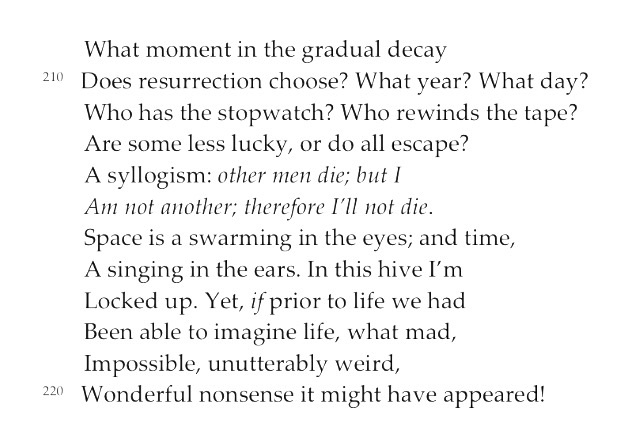
I picked up Vladimir Nabokov’s novel Pale Fire on a weird whim. I mean, I quite literally passed by it in the bookshop I frequent; it was misshelved, or unshelved, really. Someone had left it in sci-fi, near the “Bs” (B-for-Ballard, if you must know). Pale Fire, eh? I thought. Can’t remember this one. Because I had never read it, somehow. An amazing novel, one I dove into after sampling a bit of Clarice Lispector’s Selected Cronicas (still sampling—this is one of those books that’s lovely to dip gently into between selections) and after failing to get through the first essay in Elizabeth Hardwick’s Seduction and Betrayal. Not sure if I can (should?) muster a “review” of Pale Fire, but it’s one of the better prepostmodern-postmodernist novels I’ve ever read—very very funny and a beautiful mindfuck.
Early in J.G. Ballard’s 2003 novel Millennium People, our narrator David Markham remarks that “A vicious boredom ruled the world, for the first time in human history, interrupted by meaningless acts of violence.” The sentence delivers three of the novel’s key terms: boredom, meaningless, and violence. These words (or iterations of these words) repeat so often in Millennium People that any connotative spark they might bear becomes dulled. Even the violence becomes boring.
The violence in the novel resonates from its central plot about a middle-class revolution in Chelsea Marina, an “enclave of middle-class decorum.” Corporate psychologist David Markham is drawn into this revolution after his ex-wife dies in an apparently-meaningless bombing at Heathrow Airport. (She dies at the baggage carousel—symbolically-overloaded and thoroughly-Ballardian). Initially, Markham’s goal is to infiltrate the group as a kind of unwitting police spy. However, he soon takes part in acts of terrorism and meaningless violence, led in large part by Kay Churchill, an ex-film studies professor who rails against the evils of Hollywood and travel. Soon, Kay ventriloquizes Markham:
…I could hear her voice inside my head: bullying, pleading, sensible and utterly mad. The middle class was the new proletariat, the victims of a centuries-old conspiracy, at last throwing off the chains of duty and civic responsibility.
Kay eventually leads Markham to Millennium People’s would-be heart of darkness, demented pediatrician Dr. Richard Gould. Kay and Markham:
‘Richard says that people who find the world meaningless find meaning in pointless violence.’
‘Richard? Dr Richard Gould?’
‘You’ll meet him again, when he’s ready. He’s the leader of our middle-class rebellion. His mind is amazingly clear, like those brain-damaged children he looks after. In a way, he’s one of them.’
Kay is a far more interesting character than Gould. Unfortunately, Ballard teases out Gould as the Big Bad, occasionally having him show up to dialogue with Markham on finding big-em Meaning in all the meaninglessness of the world. God as a Void, the evils of the 20th century infecting the new millennium, etc. These ideas repeat and repeat and repeat, bumping along a muddled plot. Indeed, much of the plot and many of the themes of Millennium People might be condensed into this conversation between Markham and his one-time colleague/boring-assed doppelgänger Henry the psychologist. Markham speaks first in this exchange, explaining the revolution to Henry (I’ve added bold-faced emphasis if you’re in a hurry):
‘Middle-class pique. We sense we’re being exploited. All those liberal values and humane concern for the less fortunate. Our role is to keep the lower orders in check, but in fact we’re policing ourselves.’
Henry watched me tolerantly over his whisky. ‘Do you believe all that?’
‘Who knows? The important thing is that the people at Chelsea Marina believe it. It’s amateurish and childish, but the middle classes are amateurish, and they’ve never left their childhoods behind. But there’s something much more important going on. Something that ought to worry your friends at the Home Office.”
“And that is?’
‘Decent and level-headed people are hungry for violence.’
‘Grim, if true.’ Henry put down his whisky. ‘Directed at what?’
‘It doesn’t matter. In fact, the ideal act of violence isn’t directed at anything.’
‘Pure nihilism?’
‘The exact opposite. This is where we’ve all been wrong – you, me, the Adler, liberal opinion. It isn’t a search for nothingness. It’s a search for meaning. Blow up the Stock Exchange and you’re rejecting global capitalism. Bomb the Ministry of Defence and you’re protesting against war. You don’t even need to hand out the leaflets. But a truly pointless act of violence, shooting at random into a crowd, grips our attention for months. The absence of rational motive carries a significance of its own.‘
While Ballard’s diagnosis of the end of the 20th century is both perceptive and prescient, the novel’s repetitions build to very little. Ballard puts his interlocutors into fascinating territory, but then squirms away. Here’s Gould holding forth to Markham:
We’re living in a soft-regime prison built by earlier generations of inmates. Somehow we’ve got to break free. The attack on the World Trade Center in 2001 was a brave attempt to free America from the 20th Century. The deaths were tragic, but otherwise it was a meaningless act. And that was its point.
Markham then immediately turns the conversation to the Heathrow bombing that killed his ex-wife. The potential for a shocking exchange simply veers back to the novel’s central thesis.
And that thesis becomes muddied. Markham, Gould, Kay, and other revolutionaries make bold, radical declarations, but often append them in a sentimentality at odds with their revolutionary claims. Ballard’s characters let us know that they think murder is wrong. The contradiction between the impulse for meaningless violence and the core (and very middle-class) values that often restrains the impulse remains unexplored. This unresolved contradiction might have been a purposeful tactic meant to highlight the limits of our narrator’s desire for real revolution, but there’s little to lead a reader to this conclusion beyond his own hopeful imagination. Ballard seems as uncommitted as the characters.
A lack of force and shock—that’s the problem of Millennium People, I suppose. It’s unfair and unproductive to expect Ballard to rewrite Crash or High-Risehere, even though he’s playing with many of the same themes and motifs. And yet those novels exist. Dr. Richard Gould is a pale answer to Crash’s Dr. Robert Vaughan (or Richard Wilder of High-Rise or Strangman of The Drowned World or Dr. Barbara of Rushing to Paradise…). Ballard’s satire suffers from a lack of full commitment. The hyperbole peters out; the tonal inconsistencies, far from clashing, become dull.
Still, there’s much to commend in Millennium People even if it falls short of Ballard’s finest work. The novel’s larded with little riffs and satirical observations: “America invented the movies so it would never need to grow up,” Kay remarks. Markham observes in a riot “the outrage of professional men and women who had never known pain and whose soft bodies had been pummelled only by their lovers and osteopaths.” We’re informed that “From now on ordering an olive ciabatta is a political act.” (I would love to read the notebook where Ballard recorded these phrases, if such a treasure exists).
Millennium People’s prescience—like most of Ballard’s previous work—only comes into sharper relief over time. The erosion of the middle class, the spike in income inequality, the inability of regular working people to live in places like London or New York City anymore—Ballard’s mapped it all out here. The contemporary world Ballard satirizes in Millennium People—published just a few years before his death in 2009—is already thoroughly Ballardian. The millennium caught up to the man.








 Biblioklept