I was a slow reader. That is, I was slow getting to be fast. I remember having a hell of a lot of trouble reading in the third grade. I learned how to read in the fifth grade, I think it was. But that’s puzzling, because, although I remember having a lot of trouble when I was in school because I couldn’t read, I also remember that I was reading Malory’s Morte d’Arthur with love and astonishment then. It was the first book I read that I remember with absolute clarity. Yet that was before I officially “learned to read.” By the time I was in the seventh grade I was a speed-reader. I became a member of a speed-reading team. Speed-reading teams were at that time fairly common. Our high school had a team of readers, and you went out and read against other schools, and then did these comprehension tests. One year I was the speed-reading champ of the state of Ohio. I read slowly now. I learned to slow down, and read properly, when I started reading philosophy seriously, and, as a consequence, finally learned to read poetry properly too. Now I’m practically a lip reader again, although I can still go like hell if I have to.
Category: Literature
A Clip from The Kidnapping Of Michel Houellebecq
Michel Houellebecq is always performing Michel Houellebecq.
Roberto Bolaño’s Fiction (Book Acquired, 07.24.2014)
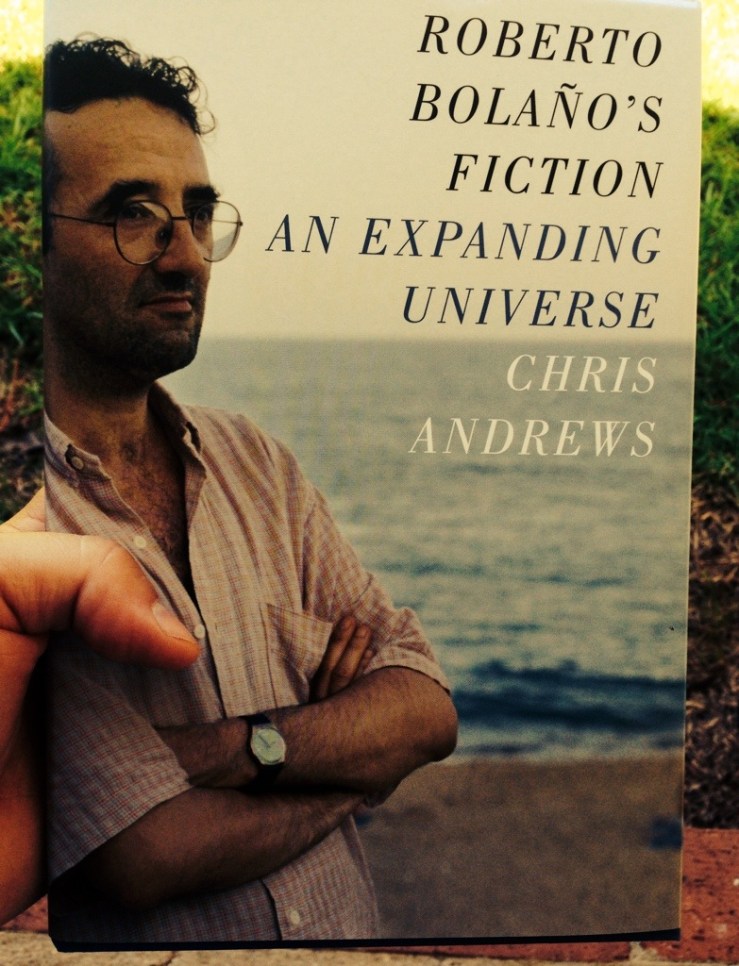
So of course I’ve been eating up Roberto Bolaño’s Fiction: An Expanding Universe, a new critical study by Bolaño’s translator Chris Andrews. I’ve read the introduction and the first three chapters so far, and the study, far from being dry and academic, compels me to dig deeper.
The book really starts with the second chapter, with Andrews simply trying to situate Bolaño-as-publishing-phenomenon in the first chapter. The introduction—which you can read at publisher Columbia UP’s site—offers a clear overview of what Andrews aims to do.
Andrews writes that:
…the interconnected series of narratives that begins with Nazi Literatures in the Americas (originally published in 1996) and ends with the stories that appeared posthumously in The Secret of Evil … can be regarded as forming a single, openly structured edifice whose two sustaining pillars are The Savage Detectives and 2666, and for which Woes of the True Policeman served as a preparatory model.
Andrews’s description recalls Javier Moreno’s geometry of Bolaño’s fictions:
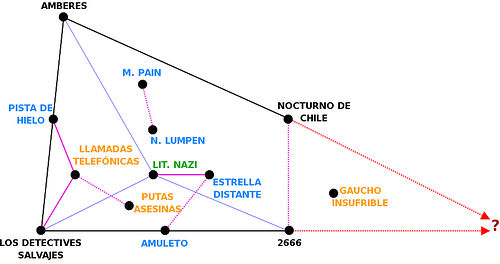
This model has greatly influenced my own reading of Bolaño over the years, leading to my conceptualization of Bolaño’s later work existing in a self-creating, self-deconstructing Bolañoverse.
Andrews’s description of the Bolañoverse (he doesn’t use the term):
Bolaño expanded or “exploded” his own published texts, blowing them up by adding new characters and episodes as well as circumstantial details. He also allowed characters to circulate or migrate from text to text, sometimes altering their names and properties. Within his novels and stories, he inclded representations of imagined texts and artworks, that is, metarepresentations. Finally, some of his characters and narrators are over-interpreters: they seize on details, invest them with significance, and invent stories to connect and explain them.
More to come; for now, the publisher’s blurb:
Since the publication of The Savage Detectives in 2007, the work of Roberto Bolaño (1953–2003) has achieved an acclaim rarely enjoyed by literature in translation. Chris Andrews, a leading translator of Bolaño’s work into English, explores the singular achievements of the author’s oeuvre, engaging with its distinct style and key thematic concerns, incorporating his novels and stories into the larger history of Latin American and global literary fiction.
Andrews provides new readings and interpretations of Bolaño’s novels, including 2666, The Savage Detectives, and By Night in Chile, while at the same time examining the ideas and narrative strategies that unify his work. He begins with a consideration of the reception of Bolaño’s fiction in English translation, examining the reasons behind its popularity. Subsequent chapters explore aspects of Bolaño’s fictional universe and the political, ethical, and aesthetic values that shape it. Bolaño emerges as the inventor of a prodigiously effective “fiction-making system,” a subtle handler of suspense, a chronicler of aimlessness, a celebrator of courage, an anatomist of evil, and a proponent of youthful openness. Written in a clear and engaging style, Roberto Bolano’s Fiction offers an invaluable understanding of one of the most important authors of the last thirty years.
The final test of truth is ridicule (H.L. Mencken)
The final test of truth is ridicule. Very few religious dogmas have ever faced it and survived. Huxley laughed the devils out of the Gadarene swine. Dowie’s whiskers broke the back of Dowieism. Not the laws of the United States but the mother-in-law joke brought the Mormons to compromise and surrender. Not the horror of it but the absurdity of it killed the doctrine of infant damnation…. But the razor edge of ridicule is turned by the tough hide of truth. How loudly the barber-surgeons laughed at Harvey—and how vainly! What clown ever brought down the house like Galileo? Or Columbus? Or Jenner? Or Lincoln? Or Darwin?… They are laughing at Nietzsche yet…
From H.L. Mencken’s Damn! A Book of Calumny.
“A Fugue” — William H. Gass
My dad wouldn’t let me have a dog. A dog? A dog we don’t need. My mom made the neighbor’s spitz her pal by poisoning it with the gin she sprinkled on the table scraps. Feed it somewhere else, my dad said. A dog we don’t need. My dad wouldn’t let me have a dog. Our neighbor’s spitz–that mutt–he shits in the flower beds. Dog doo we don’t need. At least feed it somewhere else, my dad said. My mom made the table scraps tasty for her pal, the neighbor’s spitz– that mutt–by sprinkling them with gin. You’re poisoning Pal, my dad said, but never mind, we don’t need that mutt. My mom thought anything tasted better with a little gin to salt it up. That way my mom made the neighbor’s spitz her pal, and maddened dad who wouldn’t let me have a dog. He always said we didn’t need one, they crapped on the carpet and put dirty paws on the pant’s leg of guests and yapped at cats or anyone who came to the door. A dog? A dog we don’t need. We don’t need chewed shoes and dog hairs on the sofa, fleas in the rug, dirty bowls in every corner of the kitchen, dog stink on our clothes. But my mom made the neighbor’s spitz her pal anyway by poisoning it with the gin she sprinkled on the table scraps like she was baptising bones. At least feed it somewhere else, my dad said. My dad wouldn’t let me have a pal. Who will have to walk that pal, he said. I will. And it’s going to be snowing or it’s going to be raining and who will be waiting by the vacant lot at the corner in the cold wet wind, waiting for the damn dog to do his business? Not you, Billy boy Christ, you can’t even be counted on to bring in the garbage cans or mow the lawn. So no dog. A mutt we don’t need, we don’t need dog doo in the flower beds, chewed shoes, fleas; what we need is the yard raked, like I said this morning. No damn dog. No mutt for your mother either even if she tries to get around me by feeding it when my back is turned, when I’m away at work earning her gin money so the sick thing can shit in a stream on the flower seeds; at least she should feed it somewhere else; it’s always hanging around; is it a light string in the hall or a cloth on the table to be always hanging around? No. Chewed shoes, fleas, muddy paws and yappy daddle, bowser odor: a dog we don’t need. Suppose it bites the postman: do you get sued? No. I am the one waiting at the corner vacant lot in the rain, the snow, the cold wet wind, waiting for the dog to do his damn business, and I get sued. You don’t. Christ, you can’t even be counted on to clip the hedge. You know: snicksnack. So no dog, my dad said. Though we had a dog nevertheless. That is, my mom made the neighbor’s pal her mutt, and didn’t let me have him for mine, either, because it just followed her around–yip nip–wanting to lap gin and nose its grease-sogged bread. So we did have a dog in the house, even though it just visited, and it would rest its white head in my mother’s lap and whimper and my father would throw down his paper and say shit! and I would walk out of the house and neglect to mow or rake the yard, or snicksnack the hedge or bring the garbage cans around. My dad wouldn’t let me have a dog. A dog? A dog we don’t need, he said. So I was damned if I would fetch.
From William H. Gass’s novel The Tunnel.
We should never write without feeling (William T. Vollmann)
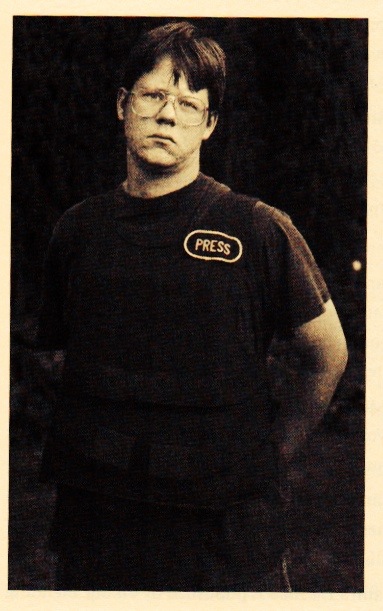
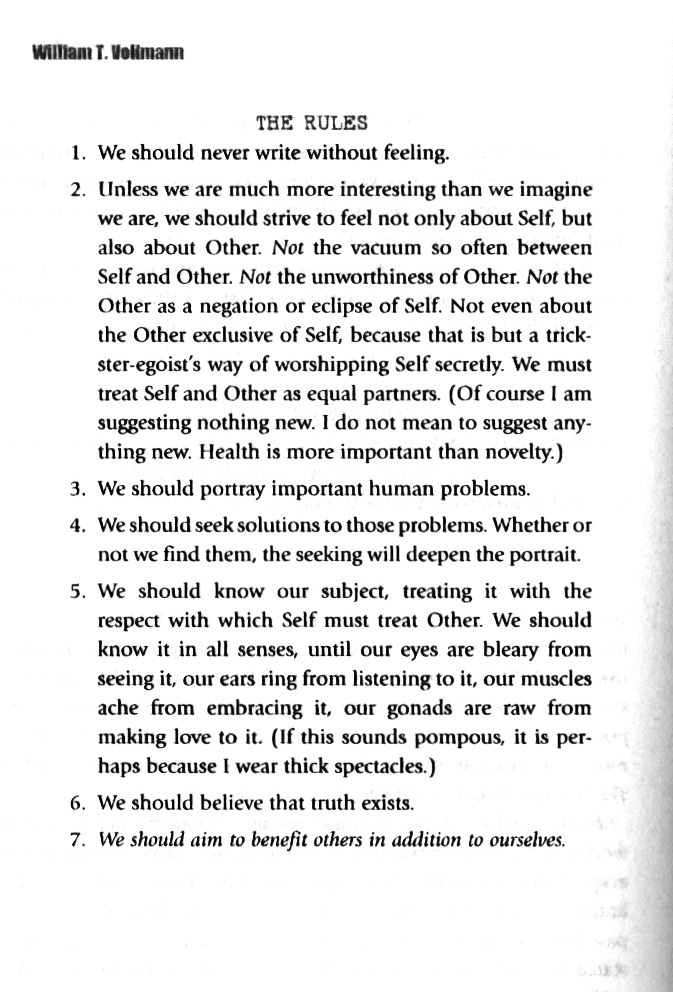 From “American Writing Today: A Diagnosis of the Disease,” a manifesto William T. Vollmann published in the Spring ’90 issue of Conjunctions. The image here, along with the image of Vollmann in his press flak jacket (1992), are from the anthology Expelled from Eden.
Competent and informative novels (Doris Lessing’s The Golden Notebook)
During that period of three months when I wrote reviews, reading ten or more books a week, I made a discovery: that the interest with which I read these books had nothing to do with what I feel when I read-let’s say—Thomas Mann, the last of the writers in the old sense, who used the novel for philosophical statements about life. The point is, that the function of the novel seems to be changing; it has become an outpost of journalism; we read novels for information about areas of life we don’t know-Nigeria, South Africa, the American army, a coal-mining village, coteries in Chelsea, etc. We read to find out what is going on. One novel in five hundred or a thousand has the quality a novel should have to make it a novel—the quality of philosophy. I find that I read with the same kind of curiosity most novels, and a book of reportage. Most novels, if they are successful at all, are original in the sense that they report the existence of an area of society, a type of person, not yet admitted to the general literate consciousness. The novel has become a function of the fragmented society, the fragmented consciousness. Human beings are so divided, are becoming more and more divided, and more subdivided in themselves, reflecting the world, that they reach out desperately, not knowing they do it, for information about other groups inside their own country, let alone about groups in other countries. It is a blind grasping out for their own wholeness, and the novel-report is a means towards it. Inside this country, Britain, the middle-class has no knowledge of the lives of the working-people, and vice-versa; and reports and articles and novels are sold across the frontiers, are read as if savage tribes were being investigated. Those fishermen in Scotland were a different species from the coalminers I stayed with in Yorkshire; and both come from a different world than the housing estate outside London. Yet I am incapable of writing the only kind of novel which interests me: a book powered with an intellectual or moral passion strong enough to create order, to create a new way of looking at life. It is because I am too diffused. I have decided never to write another novel. I have fifty ‘subjects’ I could write about; and they would be competent enough. If there is one thing we can be sure of, it is that competent and informative novels will continue to pour from the publishing houses. I have only one, and the least important of the qualities necessary to write at all, and that is curiosity. It is the curiosity of the journalist. I suffer torments of dissatisfaction and incompletion because of my inability to enter those areas of life my way of living, education, sex, politics, class bar me from. It is the malady of some of the best people of this time; some can stand the pressure of it; others crack under it; it is a new sensibility, a half-unconscious attempt towards a new imaginative comprehension. But it is fatal to art.
From Doris Lessing’s The Golden Notebook.
Moby-Dick (Alasdair Gray’s Lanark)
It is a relief to turn to the honest American book about the whale. A captain wants to kill it because the last time he tried to do that it bit off his leg while escaping. He embarks with a cosmopolitan crew who don’t like home life and prefer this way of earning money. They are brave, skilful and obedient, they chase the whale round the world and get themselves all drowned together: all but the storyteller. He describes the world flowing on as if they had never existed. There are no women or children in this book, apart from a little black boy whom they accidentally drive mad.
From Alasdair Gray’s unwieldy cult classic Lanark. In this particular episode, a version of the author of the novel Lanark itself (a conjurer-king, not named Gray) discusses and describes the great national epics; he chooses Moby-Dick as the American epic. There is no listing of a Scottish national epic; presumably Gray intends his novel to fill that slot.
“A Crossbreed” — Franz Kafka
“A Crossbreed”
by
Franz Kafka
I have a curious animal, half kitten, half lamb. It is a legacy from my father. But it only developed in my time; formerly it was far more lamb than kitten. Now it is both in about equal parts. From the cat it takes its head and claws, from the lamb its size and shape; from both its eyes, which are wild and flickering, its hair, which is soft, lying close to its body, its movements, which partake both of skipping and slinking. Lying on the window sill in the sun it curls up in a ball and purrs; out in the meadow it rushes about like mad and is scarcely to be caught. It flees from cats and makes to attack lambs. On moonlight nights its favorite promenade is along the eaves. It cannot mew and it loathes rats. Beside the hen coop it can lie for hours in ambush, but it has never yet seized an opportunity for murder.
I feed it on milk; that seems to suit it best. In long draughts it sucks the milk in through its fanglike teeth. Naturally it is a great source of entertainment for children. Sunday morning is the visiting hour. I sit with the little beast on my knees, and the children of the whole neighborhood stand around me.
Then the strangest questions are asked, which no human being could answer: Why there is only one such animal, why I rather than anybody else should own it, whether there was ever an animal like it before and what would happen if it died, whether it feels lonely, why it has no children, what it is called, etc.
I never trouble to answer, but confine myself without further explanation to exhibiting my possession. Sometimes the children bring cats with them; once they actually brought two lambs. But against all their hopes there was no scene of recognition. The animals gazed calmly at each other with their animal eyes, and obviously accepted their reciprocal existence as a divine fact.
Sitting on my knees, the beast knows neither fear nor lust of pursuit. Pressed against me it is happiest. It remains faithful to the family that brought it up. In that there is certainly no extraordinary mark of fidelity, but merely the true instinct of an animal which, though it has countless step-relations in the world, has perhaps not a single blood relation, and to which consequently the protection it has found with us is sacred.
Sometimes I cannot help laughing when it sniffs around me and winds itself between my legs and simply will not be parted from me. Not content with being lamb and cat, it almost insists on being a dog as well. Once when, as may happen to anyone, I could see no way out of my business problems and all that they involved, and was ready to let everything go, and in this mood was lying in my rocking chair in my room, the beast on my knees, I happened to glance down and saw tears dropping from its huge whiskers. Were they mine, or were they the animal’s? Had this cat, along with the soul of a lamb, the ambitions of a human being? I did not inherit much from my father, but this legacy is quite remarkable.
It has the restlessness of both beasts, that of the cat and that of the lamb, diverse as they are. For that reason its skin feels too tight for it. Sometimes it jumps up on the armchair beside me, plants its front legs on my shoulder, and put its muzzle to my ear. It is as if it were saying something to me, and as a matter of fact it turns its head afterwards and gazes in my face to see the impression its communication has made. And to oblige it I behave as if I had understood, and nod. Then it jumps to the floor and dances about with joy.
Perhaps the knife of the butcher would be a release for this animal; but as it is a legacy I must deny it that. So it must wait until the breath voluntarily leaves its body, even though it sometimes gazes at me with a look of human understanding, challenging me to do the thing of which both of us are thinking.
Translated by Willa and Edwin Muir.
Obscenity as a technical device (Henry Miller)
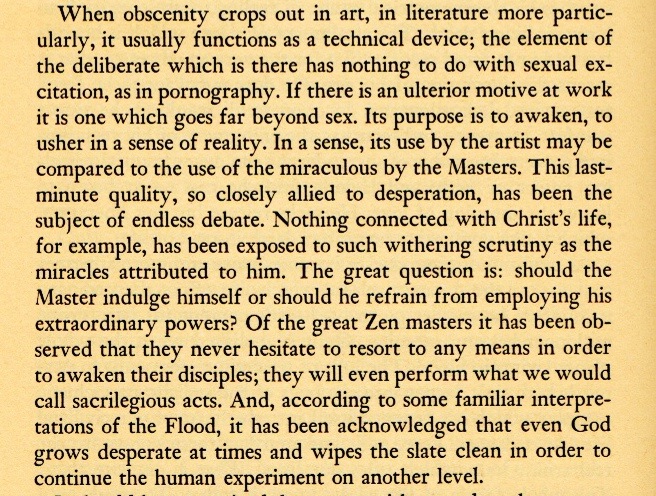
From “Obscenity and the Law of Reflection,” collected in Henry Miller on Writing.
Four Notes from Nathaniel Hawthorne’s Note-Books
- Punishment of a miser,–to pay the drafts of his heir in his tomb.
- A series of strange, mysterious, dreadful events to occur, wholly destructive of a person’s happiness. He to impute them to various persons and causes, but ultimately finds that he is himself the sole agent. Moral, that our welfare depends on ourselves.
- The strange incident in the court of Charles IX. of France: he and five other maskers being attired in coats of linen covered with pitch and bestuck with flax to represent hairy savages. They entered the hall dancing, the five being fastened together, and the king in front. By accident the five were set on fire with a torch. Two were burned to death on the spot, two afterwards died; one fled to the buttery, and jumped into a vessel of water. It might be represented as the fate of a squad of dissolute men.
- A perception, for a moment, of one’s eventual and moral self, as if it were another person,–the observant faculty being separated, and looking intently at the qualities of the character. There is a surprise when this happens,–this getting out of one’s self,–and then the observer sees how queer a fellow he is.
From Nathaniel Hawthorne’s American Note-Books.
“Wrong Note” — Thomas Bernhard

Vollmann in His Studio

There’s a great big fat long profile of William T. Vollmann by Tom Bissell at The New Republic—it’s one of the better pieces I’ve read on an author who is more widely read about than, you know, read.
From the profile, details of a visit to Vollmann’s studio:
Half of Vollmann’s studio felt like a proper gallery, with finished pieces handsomely framed and displayed. The other half was split into what looked like a used bookstore on one side and a struggling industrial arts business on the other. I imagined Vollmann had a gallery somewhere that showed his stuff, yes? Actually, no. “I’ve had a couple of photographer friends who have shows,” Vollmann said. “Every time, they always end up impoverished.” He employs “a couple dealers” who sell his work to various institutions, but he considers his studio a “perpetual gallery.” Vollmann gets additional income from Ohio State, which has been buying Vollmann’s work and manuscripts for several years. Vollmann has no idea why Ohio State has shown such interest in his work, but he’s grateful to the institution, which has been paying the mortgage on his studio for the last decade.
He began our tour proper while a dinging train from the city’s light-rail line rumbled by, just feet from his curtained windows. Woodcuts, watercolors, ink sketches, silver-gelatin black-and-white photographs, portraits. “Gum-printing is a nineteenth-century technique,” he told me. “It’s the most permanent coloring process. But it’s slow, and toxic. … I also have this device here, which is based in dental technology. … It’s like a non-vibrating, very high-speed Dremel tool. … This was originally drawn with pen and ink, and then I had a magnesium block made with a photo resist.” Some of the pieces he showed me were complete; most were not. He estimated that he has “dozens and dozens” of pieces going at any one time.
Vollmann’s most important artistic influences are Gauguin and what he described as the “power colors” of Native American art. His other inescapable influence is the female body. The majority of Vollmann’s visual art centers upon women generally and geishas, sex workers, and those he calls “goddesses” specifically. Usually they are nude. From where I was standing I counted at least two dozen vaginas, their fleshy machinery painstakingly drawn and then painted over with a delicate red slash. Vollmann uses live models, so every vagina within sight is currently out there right now, wandering the world.
A New Yorker Short Fiction Reading List
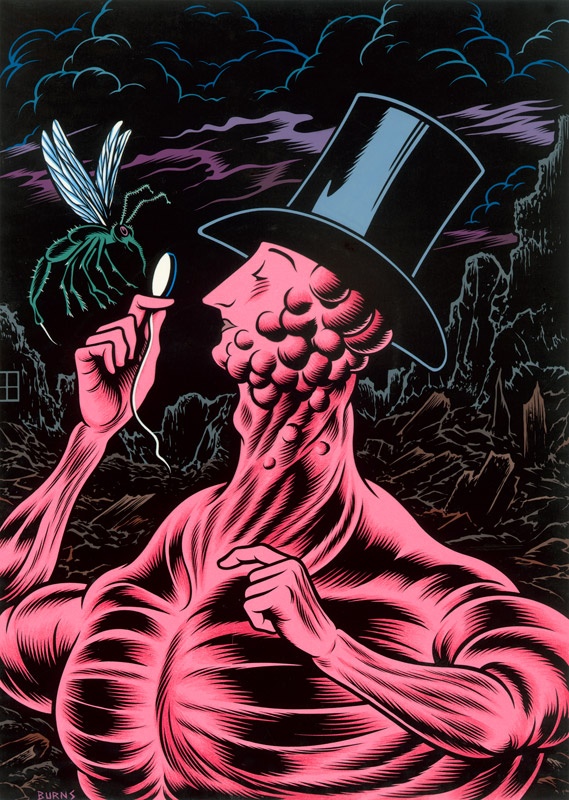
As you, savvy reader, are undoubtedly already aware, The New Yorker has opened up some of its archive for the rest of the summer (to show off its website redesign, I guess).
Here’s a reading list of short fiction from the archives (admittedly, some of the stuff I wanted to put on here is still behind a paywall).
Some of the stories on the list are classics, some are pieces I’ve shared on this blog before, some are excerpts from longer works, and a few are stories I have yet to read myself.
“The Daughters of the Moon” by Italo Calvino
“Backbone” by David Foster Wallace
“My Father Addresses Me on the Facts of Old Age” by Grace Paley
“The Insufferable Gaucho” by Roberto Bolaño
“Victory Lap” by George Saunders
“Gavin Highly” — Janet Frame
Did it happen this way? The land lay like stone, and one night, all night long, rain pelted down on it the way people, they say, hammer hard on a stone to find blood. And in the morning the land was cut in two by a deep flow of creek, clotted with red weed—Gavin Highly’s creek.
But all this was a long time ago. I did not know back then that hearts could be laid out like land and cut in two by storms coming out of the sky, or that dreams could be thrown, as Gavin Highly threw the ashes of his fire or his oyster shells or his old tins and bottles or his scraps of food, deep into the dark flowing divided heart to be buried there. I did not know, and my brother did not know. We cared more about plums—ah, they were yellow and dusty blue and hung on trees, over Gavin Highly’s fence, and in the early autumn the sun burned on each plum till its tight yellow or blue dusty skin gave in and rolled up like a blind to let in more sun. The plums split and were ripe and we ate them and, if Gavin Highly caught us, all he said, in one breath, was “Hop-it-you.” I think he understood about plums.
Read the rest of Janet Frame’s story “Gavin Highly” at The New Yorker.
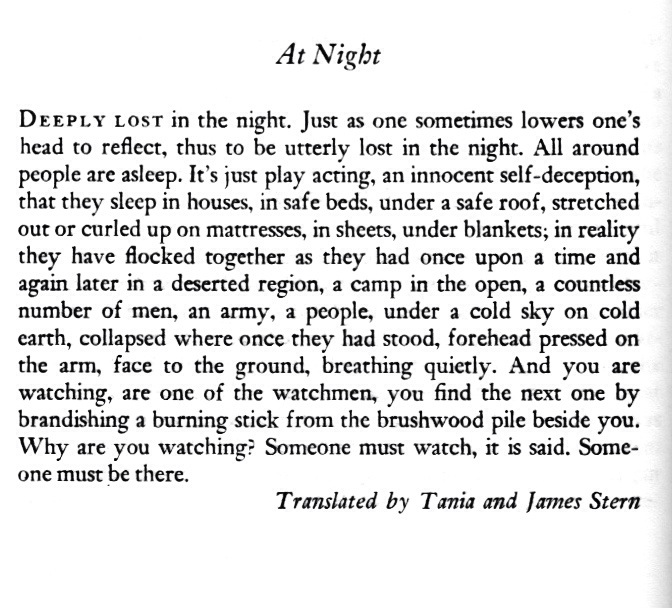
“At Night” — Franz Kafka
Four by Thomas Bernhard (Books Acquired, 7.15.2014)
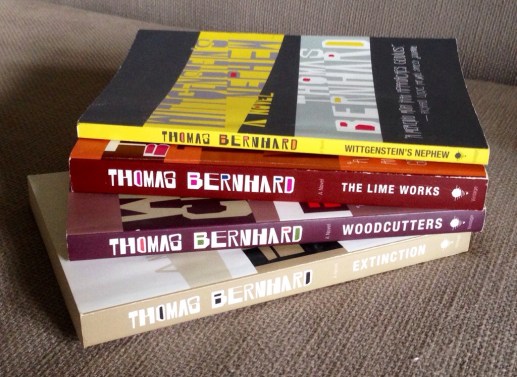
So the other week, Turner wrote, at my favorite local bookstore—a labyrinthine maze you wouldn’t believe, formed from wooden frames filled with dusty paper stacks, obstacles of boxed books, unexplored (the boxed books, not the shelves), littering the pathways (the boxed books)—just under 2 million books (all the books, shelved, and boxed), if a certain clerk is to be believed (and I believe her)—and you wouldn’t believe, and I know you wouldn’t believe because I go there often enough, me, living just a mile away, sometimes walking, briskly, or at an even pace—and with this free time on my hands, and with all these unsolicited review copies, creating a little pool of credit, of trade of etc.—I know you wouldn’t believe because I so often hear the irregular clientele remarking on their own personal disbelief, or their own befuddlement, or, more often, I see them get lost, and even then I’m enjoying that, maybe offering (mis)direction, or, more likely, intercepting the high school seniors—What are you reading? Yes? Faulkner! No! Not that edition!—And so the other week at my favorite local bookstore, I happened upon, neatly stacked in a to-be-shelved shelf, a neatly stacked stack of Thomas Bernhard novels, or, more precisely, a compliment stack of Thomas Bernhard novels, a so-called stack of novels that I did not so-call “own,” a so-called stack of Thomas Bernhard novels that I had not read, not to mention have in my own personal possession, a little series of Vintage English translation editions that could be nestled next to my own meager collection, already, yes, Gargoyles and Correction and Concrete and Yes and The Loser and The Voice Imitator and Frost—but not Old Masters, and Old Masters not in this neatly-stacked bundle (it was never a bundle), no, not Old Masters, which, Turner wrote, Chang wrote about on this so-called website, no, no not Old Masters, not in the so-called bundle, but what to begrudge, begrudge that, no, Turner thought and wrote, and then, looking back over what he had written, thought, No, this is rubbish, I must delete all this, I must erase all this and not push publish.
 Biblioklept