Watch The Lives of Brian, A Documentary About Flann O’Brien

“Smoking as a Fine Art” — A. A. Milne

“Smoking as a Fine Art”

by

A. A. Milne

My first introduction to Lady Nicotine was at the innocent age of eight, when, finding a small piece of somebody else’s tobacco lying unclaimed on the ground, I decided to experiment with it. Numerous desert island stories had told me that the pangs of hunger could be allayed by chewing tobacco; it was thus that the hero staved off death before discovering the bread-fruit tree. Every right-minded boy of eight hopes to be shipwrecked one day, and it was proper that I should find out for myself whether my authorities could be trusted in this matter. So I chewed tobacco. In the sense that I certainly did not desire food for some time afterwards, my experience justified the authorities, but I felt at the time that it was not so much for staving off death as for reconciling oneself to it that tobacco-chewing was to be recommended. I have never practised it since.

At eighteen I went to Cambridge, and bought two pipes in a case. In those days Greek was compulsory, but not more so than two pipes in a case. One of the pipes had an amber stem and the other a vulcanite stem, and both of them had silver belts. That also was compulsory. Having bought them, one was free to smoke cigarettes. However, at the end of my first year I got to work seriously on a shilling briar, and I have smoked that, or something like it, ever since. Continue reading ““Smoking as a Fine Art” — A. A. Milne”

As Goethe said, theory is gray, but the golden tree of life is green (Donald Barthelme)

Charles and Jacques were still talking to Hector Guimard, the former trombone player.

— Yours is not a modern problem, Jacques said. The problem today is not angst but lack of angst.

— Wait a minute, Jacques. Although I myself believe that there is nothing wrong with being a trombone player, I can understand Hector’s feeling. I know a painter who feels the same way about being a painter. Every morning he gets up, brushes his teeth, and stands before the empty canvas. A terrible feeling of being de trop comes over him. So he goes to the corner and buys the Times, at the corner newsstand. He comes back home and reads the Times. During the period in which he’s coupled with the Times he is all right. But soon the Times is exhausted. The empty canvas remains. So (usually) he makes a mark on it, some kind of mark that is not what he means. That is, any old mark, just to have something on the canvas. Then he is profoundly depressed because what is there is not what he meant. And it’s time for lunch. He goes out and buys a pastrami sandwich at the deli. He comes back and eats the sandwich meanwhile regarding the canvas with the wrong mark on it out of the corner of his eye. During the afternoon, he paints out the mark of the morning. This affords him a measure of satisfaction. The balance of the the afternoon is spent in deciding whether or not to venture another mark. The new mark, if one is ventured, will also, inevitably, be misconceived. He ventures it. It is misconceived. It is, in fact, the worst kind of vulgarity. He paints out the second mark. Anxiety accumulates. However, the canvas is now, in and of itself, because of the wrong moves and painting out, becoming rather interesting looking. He goes to the A&P and buys a TV Mexican dinner and many bottles of Carta Blanca. He comes back to his loft and eats the Mexican dinner and drinks a couple of Carta Blancas, sitting in front of his canvas. The canvas is, for one thing, no longer empty. Friends drop in and congratulate him on having a not-empty canvas. He begins feeling better. A something has been wrested from the nothing. The quality of the something is still at issue–he is by no means home free. And of course all of painting– the whole art– has moved on somewhere else, it’s not where his head is, and he knows that, but nevertheless he–

— How does this apply to trombone playing? Hector asked.

— I had the connection in my mind when I began, Charles said.

— As Goethe said, theory is gray, but the golden tree of life is green.

 From Donald Barthelme’s short story “City Life.”

William T. Vollmann’s Europe Central | A Short Riff on a Long Book

Kilian Eng
Kilian Eng

1. William T. Vollmann’s Europe Central,  811 pages in my Penguin trade paperback edition (including end notes), is a virtuoso attempt to describe or measure or assess or explain or analyze the Eastern front of WWII, a part of the war that in my American ignorance I know, or knew (no, know) so little about.

2. The book covers 1914-1975, most of the composer Dmitri Dmitriyevich Shostakovich’s life. If Europe Central has a hero, it is Shostakovich.

From the book’s last end note, “An Imaginary Love Triangle: Shostakovich, Karmen, Konstantinovaskya”:

When I think of Shostakovich, and when I listen to his music, I imagine a person consumed by fear and regret, a person who (like Kurt Gerstein) did what little he could to uphold the good—in this case, freedom of artistic creation, and the mitigation of other people’s emergencies. He became progressively more beaten down, and certainly experienced difficulty saying no—a character trait which may well have kept him alive in the Stalinist years. In spite of the fact that he joined the Party near the end, to me he is a great hero—a tragic hero, naturally.

That’s Vollmann’s own authorial voice, of course, and there we have perhaps the most concise condensation of Europe Central.

3. Maybe a clarification though: Europe Central is not (just) a fictional biography of Shostakovich: There are many, many other characters that Vollmann uses to power his beast: the Soviet director Roman Karmen and the translator Elena Konstantinovskaya, those other points in the book’s central love triangle; German artist Käthe Kollwitz; Samizdat poet Anna Akhmatova; Generals Paulus (German) and Vlasov (Soviet)—similarly disgraced; SS man Kurt Gerstein, who oversees death camps; there’s Lenin, there’s Stalin. There’s “the Sleepwalker,” one Adolf Hitler. And many, many more.

4. Is Europe Central too big?

No. I don’t think so.

5. I lazily suggested that the book uses Shostakovich as an organizing principle. We could also argue for Operation Barbarossa (Germany’s disastrous invasion of the USSR) as the book’s main thrust. Or, we might say that the book reframes Wagner’s Ring Cycle. Or that it somehow restages Shostakovich’s Opus 40 and Opus 110. (Back to Shostakovich!).

6. Or the telephone! Yes, that totem of modernity, communication, power—the telephone!—the telephone is the central image of Europe Central. Indeed, it initiates the novel: “A squat black telephone, I mean an octopus, the god of our Signal Corps…” That octopus, those tendrils, those lines of communication snake throughout Europe Central.

7. Another description of Europe Central, perhaps, from one of its earliest chapters—

Most literary critics agree that fiction cannot be reduced to mere falsehood. Well-crafted protagonists come to life, pornography causes orgasms, and the pretense that life is what we want it to be may conceivably bring about the desired condition. Hence religious parables, socialist realism, Nazi propaganda. And if this story likewise crawls with reactionary supernaturalism, that might be because its author longs to see letters scuttling across ceilings, cautiously beginning to reify themselves into angels. For if they could only do that, then why not us?

8. Was that enough of Vollmann’s language for this short riff?

No?

I shared various citations from Europe Central on Biblioklept as I read it, even riffing a bit now and then. Check out some of Vollmann’s strange, wonderful prose—it’s far more convincing than anything I can write about his book.

So:

On parables and their value

On Käthe Kollwitz, who kept painting poor people.

On the assurance of a sleepwalker.

On the musicality of a weeping son.

On the more-than-real reality of representations of reality.

On monarchs, murderers, martyrs, lunatics, perverts, etc.

On abjection.

On lending books as one of the purest expressions of love.

10. I left off from the list above one of the finest passages in the book, a section where the unnamed “I” narrator of some of the Soviet sections of Europe Central shifts into Shostakovich’s consciousness, and then, perhaps, into Vollmann’s own authorial voice—and then back. The narratological dimensions here are too big to suss out in my lazy riff, but I find the passage’s main thrust one of the most compelling issues of modern art (or Modern Art, if you prefer): Can art use irony to conceal its true feelings? Can love be self-ironic? And if so, how does this complicate the truth of the expression?

I think this matters because Vollmann thinks this matters—put another way, Vollmann believes in Art and Truth and, significantly, in Love, and the power of love against the backdrop of totalitarianism, despotism, murder, privation, starvation, rape, maiming, gas chambers, mass graves, infanticide, total war…

11. What Vollmann achieves in Europe Central, through the reality and fictionality (and reality of the fictionality of the reality) of his characters, is a language of love. Vollmann posits love, or the possibility of love, or the possibility of imagining the possibility of love, as a response to despair.

12. Point 11 is maybe a way of saying that Europe Central is about so much more than central Europe during WWII—but if you’re at all familiar with Vollmann, gentle reader, of course you’d expect that. Still, I learned a lot about a subject which I thought I knew something about.

Whether or not Vollmann is a generous writer depends on your perspective—you’re swimming in the deep end here, and many of the connections between the different sections don’t cohere until you’ve got the hang of the book. But once you get the hang of it—once you learn to read it—Vollmann’s generosity is almost overbearing in its profundity. How did he research it, do all the reading that went into it, and still make all the voices sing? How? 

13. Europe Central is probably not the best starting place for Vollmann, but I think it will appeal to fans of certain giant polyglossic postmodern novels. I’ll admit to a predilection for WWII metafictions, too, but I can’t really anticipate how readers of historical fiction might regard what Vollmann does here. Can I end by writing Highly recommended? I don’t know. I’m not sure who this book is for… but I loved it.

“An Arrest” — Ambrose Bierce

“An Arrest”

by

Ambrose Bierce

Having murdered his brother-in-law, Orrin Brower of Kentucky was a fugitive from justice.  From the county jail where he had been confined to await his trial he had escaped by knocking down his jailer with an iron bar, robbing him of his keys and, opening the outer door, walking out into the night.  The jailer being unarmed, Brower got no weapon with which to defend his recovered liberty.  As soon as he was out of the town he had the folly to enter a forest; this was many years ago, when that region was wilder than it is now.

The night was pretty dark, with neither moon nor stars visible, and as Brower had never dwelt thereabout, and knew nothing of the lay of the land, he was, naturally, not long in losing himself.  He could not have said if he were getting farther away from the town or going back to it – a most important matter to Orrin Brower.  He knew that in either case a posse of citizens with a pack of bloodhounds would soon be on his track and his chance of escape was very slender; but he did not wish to assist in his own pursuit.  Even an added hour of freedom was worth having.

Suddenly he emerged from the forest into an old road, and there before him saw, indistinctly, the figure of a man, motionless in the gloom.  It was too late to retreat: the fugitive felt that at the first movement back toward the wood he would be, as he afterward explained, “filled with buckshot.”  So the two stood there like trees, Brower nearly suffocated by the activity of his own heart; the other – the emotions of the other are not recorded.

A moment later – it may have been an hour – the moon sailed into a patch of unclouded sky and the hunted man saw that visible embodiment of Law lift an arm and point significantly toward and beyond him.  He understood.  Turning his back to his captor, he walked submissively away in the direction indicated, looking to neither the right nor the left; hardly daring to breathe, his head and back actually aching with a prophecy of buckshot.

Brower was as courageous a criminal as ever lived to be hanged; that was shown by the conditions of awful personal peril in which he had coolly killed his brother-in-law.  It is needless to relate them here; they came out at his trial, and the revelation of his calmness in confronting them came near to saving his neck.  But what would you have? – when a brave man is beaten, he submits.

So they pursued their journey jailward along the old road through the woods.  Only once did Brower venture a turn of the head: just once, when he was in deep shadow and he knew that the other was in moonlight, he looked backward.  His captor was Burton Duff, the jailer, as white as death and bearing upon his brow the livid mark of the iron bar.  Orrin Brower had no further curiosity.

Eventually they entered the town, which was all alight, but deserted; only the women and children remained, and they were off the streets.  Straight toward the jail the criminal held his way.  Straight up to the main entrance he walked, laid his hand upon the knob of the heavy iron door, pushed it open without command, entered and found himself in the presence of a half-dozen armed men.  Then he turned.  Nobody else entered.

On a table in the corridor lay the dead body of Burton Duff.

“Magic” — Katherine Anne Porter

“Magic”

by

Katherine Anne Porter

And, Madame Blanchard, believe that I am happy to be here with you and your family because it is so serene, everything, and before this I worked for a long time in a fancy house—maybe you don’t know what is a fancy house? Naturally … everyone must have heard sometime or other. Well, Madame, I work always where there is work to be had, and so in this place I worked very hard all hours, and saw too many things, things you wouldn’t believe, and I wouldn’t think of telling you, only maybe it will rest you while I brush your hair. You’ll excuse me too but I could not help hearing you say to the laundress maybe someone had bewitched your linens, they fall away so fast in the wash. Well, there was a girl there in that house, a poor thing, thin, but well-liked by all the men who called, and you understand she could not get along with the woman who ran the house. They quarreled, the madam cheated her on her checks: you know, the girl got a check, a brass one, every time, and at the week’s end she gave those back to the madam, yes, that was the way, and got her percentage, a very small little of her earnings: it is a business, you see, like any other

—and the madam used to pretend the girl had given back only so many checks, you see, and really she had given many more, but after they were out of her hands, what could she do? So she would say, I will get out of this place, and curse and cry. Then the madam would hit her over the head. She always hit people over the head with bottles, it was the way she fought. My good heavens, Madame Blanchard, what confusion there would be sometimes with a girl running raving downstairs, and the madam pulling her back by the hair and smashing a bottle on her forehead. Continue reading ““Magic” — Katherine Anne Porter”

“Books in the West” — Morely Roberts

“Books in the West”

from

Morely Roberts’s A Tramp’s Notebook

Since taking to writing as a profession I have lost most of the interest I had in literature as literature pure and simple. That interest gradually faded and “Art for Art’s sake,” in the sense the simple in studios are wont to dilate upon, touches me no more, or very, very rarely. The books I love now are those which teach me something actual about the living world; and it troubles me not at all if any of them betray no sense of beauty and lack immortal words. Their artistry is nothing, what they say is everything. So on the shelf to which I mostly resort is a book on the Himalayas; a Lloyd’s Shipping Register; a little work on seamanship that every would-be second mate knows; Brown’s Nautical Almanacs; a Channel Pilot; a Continental Bradshaw; many Baedekers; a Directory to the Indian Ocean and the China Seas; a big folding map of the United States; some books dealing with strategy, and some touching on medical knowledge, but principally pathology, and especially the pathology of the mind.

Yet in spite of this utilitarian bent of my thoughts there are very many books I know and love and sometimes look into because of their associations. As I cannot understand (through some mental kink which my friends are wont to jeer at) how anyone can return again and again to a book for its own sake, I do not read what I know. As soon would I go back when it is my purpose to go forward. A book should serve its turn, do its work, and become a memory. To love books for their own sake is to be crystallised before old age comes on. Only the old are entitled to love the past. The work of the young lies in the present and the future. Continue reading ““Books in the West” — Morely Roberts”

Portrait of Walt Whitman — Thomas Wilmer Dewing

Miracle in the rain (Clarice Lispector)

“I’ve discovered a miracle in the rain — Joana thought — a miracle splintered into dense, solemn, glittering stars, like a suspended warning: like a lighthouse. What are they trying to tell me? In those stars I can foretell the secret, their brilliance is the impassive mystery I can hear flowing inside me, weeping at length in tones of romantic despair. Dear God, at least bring me into contact with them, satisfy my longing to kiss them. To feel their light on my lips, to feel it glow inside my body, leaving it shining and transparent, fresh and moist like the minutes that come before dawn. Why do these strange longings possess me? Raindrops and stars, this dense and chilling fusion has roused me, opened the gates of my green and sombre forest, of this forest smelling of an abyss where water flows. And harnessed it to night. Here, beside the window, the atmosphere is more tranquil. Stars, stars, zero. The word cracks between my teeth into fragile splinters. Because no rain falls inside me, I wish to be a star. Purify me a little and I shall acquire the dimensions of those beings who take refuge behind the rain.”

From Clarice Lispector’s Near to the Wild Heart.

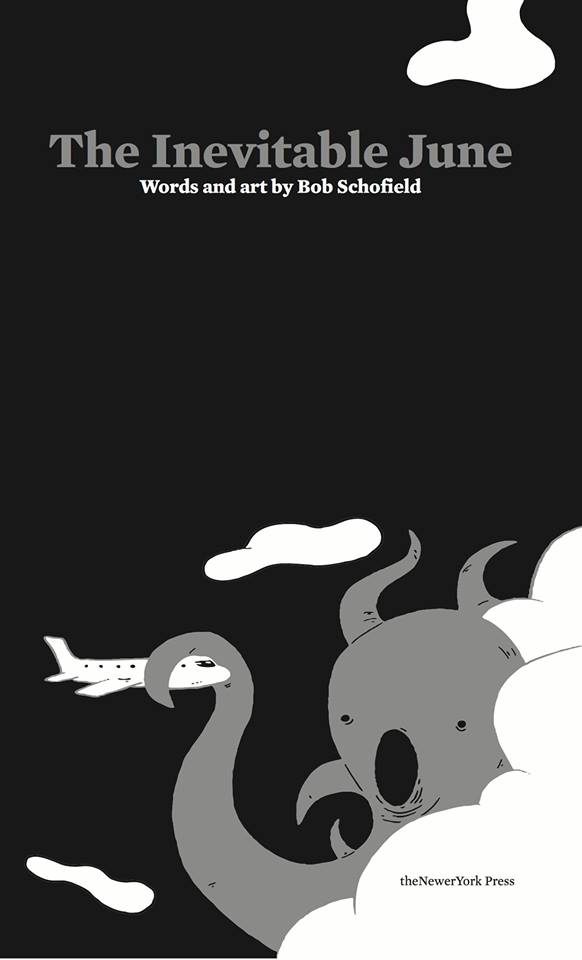
The Beautiful Weirdness of Bob Schofield’s The Inevitable June

TIJ-COVER

Bob Schofield’s The Inevitable June continues theNewerYork Press’s dedication to beautiful weirdness. They’ve billed The Inevitable June as “words and art,” which is truth in advertising, yes, but is also a way of avoiding putting a label on this strange little book.

Is it a comic? A novella? A thought experiment? A prose-poem? A flip-book? Something entirely new? Yes.

But entirely new is wrong too, because, as the billing states, what we’ve got here are those ancient raw elements of storytelling, words and pictures, resynthesized into something that, in its strangeness, evokes newness and surpasses novelty. 

2

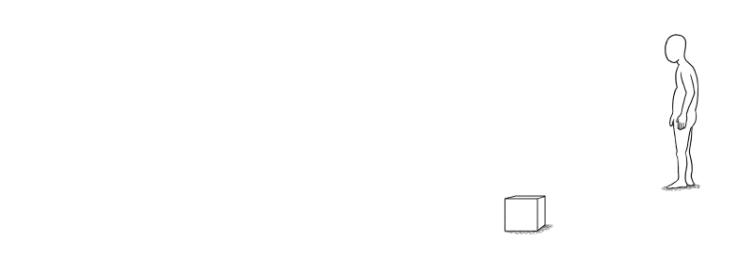
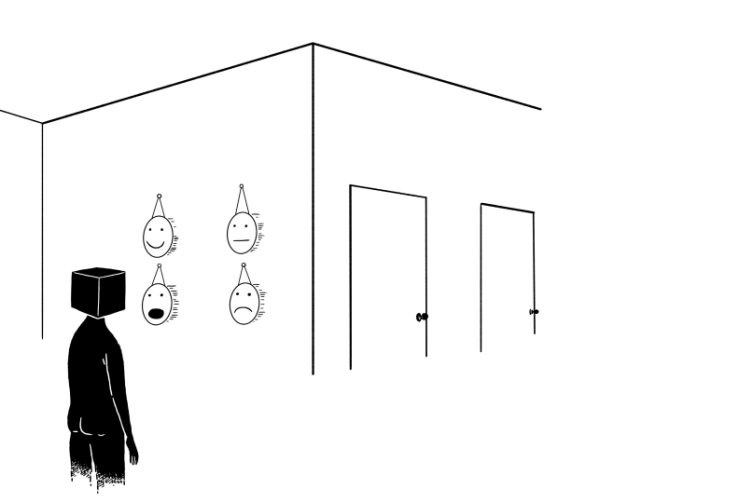
An initial simplicity of form, both in written and drawn line, allows the reader’s consciousness to slip into the strangeness of June. We begin with a simple black-on-white square (emblem of a page or a screen? (or hey man it’s just a square?)) which turns into a cube, or a box rather, one side open (a door; a window) its interior obscured. Should the reader stick his head in? Yes. The book seems to take place in this box, an imaginative dream-machine that we might recall from a childhood or two. 

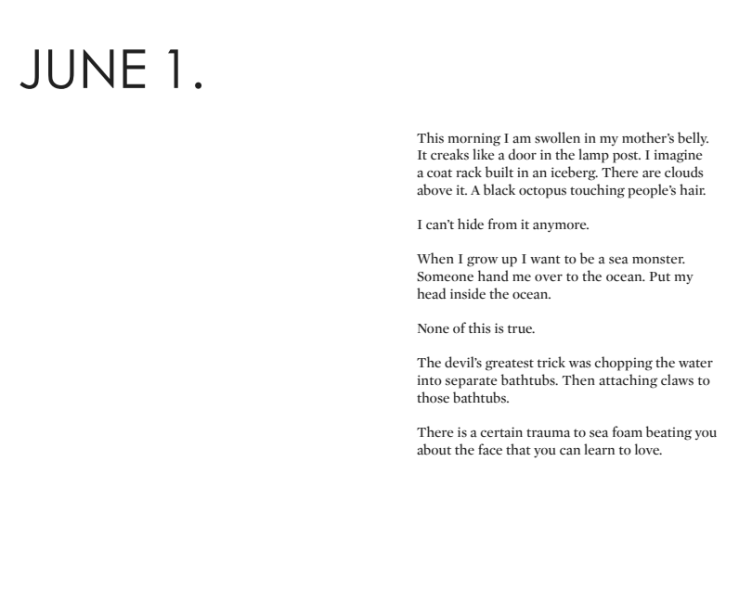
What follows is an almanac of tragicomic weirdness, each entry logging the events of a new morning in an eternal June.

1

The clarity and concreteness of Schofield’s prose jars against its symantic expression, evoking a dream-nightmare world of continual creation and destruction. Every morning the world begins—and ends—anew, complete with new metaphors which crumble or dissolve or give way under the strain of the next morning’s creation.

3

The Inevitable June echoes with images of oceans and fires, glass airplanes and invisible pilots, octopuses and yetis, angels and demons. Its transmutations both challenge and invite the reader to play a game where the rules have not been, cannot be, verbalized. 

4

Is the game consciousness?

A version of consciousness anyway, a metaphor for consciousness—a collection of words and art, black and white lines, inky abysses and blank fields of possibility. If The Inevitable June attests that imaginative power can transform, it also underscores the costs and conditions of that transformation—the edges, the borders, the limits—the constraints of time, the days on a calendar. Interposed, our protagonist travels, falls, rises, dreams, and performs his various identities.   

I read Schofield’s  book a few times (it’s short) in different formats—on a laptop, a tablet, and then the physical book. Oh, and on my iPhone. I reread that thing on an iPhone waiting in my car to pick up my son from school. It was a different read each time, offering new strangenesses, new pathways, pratfalls, and pitfalls. The Inevitable June is not for all readers, obviously, but it gave me some joy in its puzzles and prose. Recommended.

Breakfast was not suspected. No prophecy, no type of breakfast had been published. (De Quincey)

No such discovery as “breakfast” had then been made: breakfast was not invented for many centuries after that. We have always admired, and always shall admire, as the very best of all human stories, Charles Lamb’s account of the origin of roast pig in China. Ching Ping, it seems, had suffered his father’s house to be burned down; the outhouses were burned along with the house; and in one of these the pigs, by accident, were roasted to a turn. Memorable were the results for all future China and future civilization. Ping, who (like all China beside) had hitherto eaten his pig raw, now for the first time tasted it in a state of torrefaction. Of course he made his peace with his father by a part (tradition says a leg) of the new dish. The father was so astounded with the discovery, that he burned his house down once a year for the sake of coming at an annual banquet of roast pig. A curious prying sort of fellow, one Chang Pang, got to know of this. He also burned down a house with a pig in it, and had his eyes opened. The secret was ill kept—the discovery spread—many great conversions were made—houses were blazing in every part of the Celestial Empire. The insurance offices took the matter up. One Chong Pong, detected in the very act of shutting up a pig in his drawing-room, and then firing a train, was indicted on a charge of arson. The chief justice of Pekin, on that occasion, requested an officer of the court to hand him a piece of the roast pig, the corpus delicti, for pure curiosity led him to taste; but within two days after it was observed that his lordship’s town-house was burned down. In short, all China apostatized to the new faith; and it was not until some centuries had passed, that a great genius arose, who established the second era in the history of roast pig, by showing that it could be had without burning down a house.

No such genius had yet arisen in Rome. Breakfast was not suspected. No prophecy, no type of breakfast had been published. In fact, it took as much time and research to arrive at that great discovery as at the Copernican system. True it is, reader, that you have heard of such a word as jentaculum; and your dictionary translates that old heathen word by the Christian word breakfast. But dictionaries, one and all, are dull deceivers. Betweenjentaculum and breakfast the differences are as wide as between a horse-chestnut and chestnut horse; differences in the time when, in the place where, in the manner how, but preeminently in the thing which.

Galen is a good authority upon such a subject, since, if (like other pagans) he ate no breakfast himself, in some sense he may be called the cause of breakfast to other men, by treating of those things which could safely be taken upon an empty stomach. As to the time, he (like many other authors) says, [peri tritaen, ae (to makroteron) peri tetartaen,] about the third, or at farthest about the fourth hour: and so exact is he, that he assumes the day to lie exactly between six and six o’clock, and to be divided into thirteen equal portions. So the time will be a few minutes before nine, or a few minutes before ten, in the forenoon. That seems fair enough. But it is not time in respect to its location that we are so much concerned with, as time in respect to its duration. Now, heaps of authorities take it for granted, that you are not to sit down—you are to stand; and, as to the place, that any place will do—”any corner of the forum,” says Galen, “any corner that you fancy;” which is like referring a man for his salle à manger to Westminster Hall or Fleet Street. Augustus, in a letter still surviving, tells us that he jentabat, or took hisjentaculum in his carriage; now in a wheel carriage, (in essedo,) now in a litter or palanquin (in lecticâ.) This careless and disorderly way as to time and place, and other circumstances of haste, sufficiently indicate the quality of the meal you are to expect. Already you are “sagacious of your quarry from so far.” Not that we would presume, excellent reader, to liken you to Death, or to insinuate that you are “a grim feature.” But would it not make a saint “grim,” to hear of such preparations for the morning meal? And then to hear of such consummations as panis siccus, dry bread; or, (if the learned reader thinks it will taste better in Greek,) [Greek: artos xaeros!] And what may this word dry happen to mean? “Does it mean stale bread?” says Salmasius. “Shall we suppose,” says he, in querulous words, “molli et recenti opponi,” and from that antithesis conclude it to be, “durum et non recens coctum, eoque sicciorem?” Hard and stale, and for that reason the more arid! Not quite so bad as that, we hope. Or again—”siccum pro biscocto, ut hodie vocamus, sumemus?”[5] By hodie Salmasius means, amongst his countrymen of France, where biscoctus is verbatim reproduced in the word bis (twice) cuit, (baked;) whence our own biscuit. Biscuit might do very well, could we be sure that it was cabin biscuit: but Salmasius argues—that in this case he takes it to mean “buccellatum, qui est panis nauticus;” that is, the ship company’s biscuit, broken with a sledge-hammer. In Greek, for the benefit again of the learned reader, it is termed [Greek: dipuros], indicating that it has passed twice under the action of fire.

From Thomas de Quincey’s “Dinner, Real and Reputed.”

A Symbolic Head — Arthur Merton

“The Legacy” — Virginia Woolf

“The Legacy”

by

Virginia Woolf

“For Sissy Miller.” Gilbert Clandon, taking up the pearl brooch that lay among a litter of rings and brooches on a little table in his wife’s drawing-room, read the inscription: “For Sissy Miller, with my love.”

It was like Angela to have remembered even Sissy Miller, her secretary. Yet how strange it was, Gilbert Clandon thought once more, that she had left everything in such order-a little gift of some sort for every one of her friends. It was as if she had foreseen her death. Yet she had been in perfect health when she left the house that morning, six weeks ago; when she stepped off the kerb in Piccadilly and the car had killed her.

He was waiting for Sissy Miller. He had asked her to come; he owed her, he felt, after all the years she had been with them, this token of consideration. Yes, he went on, as he sat there waiting, it was strange that Angela had left everything in such order. Every friend had been left some little token of her affection. Every ring, every necklace, every little Chinese box-she had a passion for little boxes-had a name on it. And each had some memory for him. This he had given her; this -the enamel dolphin with the ruby eyes-she had pounced upon one day in a back street in Venice. He could remember her little cry of delight. To him, of course, she had left nothing in particular, unless it were her diary. Fifteen little volumes, bound in green leather, stood behind him on her writing table. Ever since they were married, she had kept a diary. Some of their very few-he could not call them quarrels, say tiffs-had been about that diary. When he came in and found her writing, she always shut it or put her hand over it. “No, no, no,” he could hear her say, “After I’m dead-perhaps.” So she had left it him, as her legacy. It was the only thing they had not shared when she was alive. But he had always taken it for granted that she would outlive him. If only she had stopped one moment, and had thought what she was doing, she would be alive now. But she had stepped straight off the kerb, the driver of the car had said at the inquest. She had given him no chance to pull up. . .. Here the sound of voices in the hall interrupted him. Continue reading ““The Legacy” — Virginia Woolf”

“Indian Camp” — Ernest Hemingway

“Indian Camp”

by

Ernest Hemingway  

At the lake shore there was another rowboat drawn up. The two Indians stood waiting.

Nick and his father got in the stern of the boat and the Indians shoved it off and one of them got in to row. Uncle George sat in the stern of the camp rowboat. The young Indian shoved the camp boat off and got in to row Uncle George.

The two boats started off in the dark. Nick heard the oarlocks of the other boat quite a way ahead of them in the mist. The Indians rowed with quick choppy strokes. Nick lay back with his father’s arm around him. It was cold on the water. The Indian who was rowing them was working very hard, but the other boat moved further ahead in the mist all the time.

“Where are we going, Dad?” Nick asked.

“Over to the Indian camp. There is an Indian lady very sick.”

“Oh,” said Nick.

Across the bay they found the other boat beached. Uncle George was smoking a cigar in the dark. The young Indian pulled the boat way up on the beach. Uncle George gave both the Indians cigars. Continue reading ““Indian Camp” — Ernest Hemingway”

“I penetrated beneath the Curtain through a disused S-Bahn tunnel which led to the center of the earth” (William Vollmann)

As soon as I’d rested, I penetrated beneath the Curtain through a disused S-Bahn tunnel which led to the center of the earth, which I can now assure you is a hemispherical room whose pattern of blue and white tiles have been chessboarded, staired and umbrella’d for centuries. Here I discovered rows of listening devices like pictures in a gallery, each machine affixed to reality by its two wires, each one labeled: ZOYA, VLASOV, GEHLEN . . . They went on and on, infinitely. Where was SHOSTAKOVICH? But after all, I had to see him; I had to face him! In a crypt in Berlin I’ve spied the effigy of an infant whose hand reaches innocently out at the world which he has been denied, while a stone eagle guards him. I was the child within the tomb! I had nothing, not even an eagle, because he hated me.

But I found resurrection in the delicious moonlight of Berlin-East. And like a champagne cork I popped up into the air, speeding into Europe Central! It was quite gusty; I would have enjoyed carrying my Variometer, to check variations in barometric pressure. But my Variometer was another item I’ve lost over the years. Prague’s hills crowded with trees and towers were all dark; Riga was buried under autumn leaves; and in an empty snowy park in Moscow I found Shostakovich walking round and round.

Smeared with iron-colored grime I interrupted his circles; I blocked his way; I snivelled and insisted: Herr Schostakowitsch, I’m sorry—

Indignantly he interrupted: I must tell you this, my dear German friend: I feel it’s the worst cynicism to, to, to besmirch yourself with ugly behavior and then speak beautiful words. I, do you know, I think it’s preferable to say ugly words and not commit illegal acts . . . But nothing could take me away from him now! He was everything to me. He—and Elena, of course. (Where was Elena?)

Oh, how cold it was! I had to get down and grovel in the snow. But it paid off; I fulfilled my objective. People rarely choose to accept my apologies. But in the end, Shostakovich did. He’s a very nice man.

What I dreamed of by then was inventing a method to bring about a reconciliation between him and Elena (who was codenamed LINA); was I supposed to shoot him before or after that? How about not at all? You see, I’d come to adore the man, and I valued his happiness more than my own. Many’s the time I’ve peeped in on him as he’s composing. When he closed his eyes, I saw how happy he truly was; with my Zeiss lenses I was able to obtain a magnified view of the veins in his eyelids, which pulsed in time with what must have been his Fifth Symphony, described by R. Taruskin as a series of components, gestures or events that are immediately recognizable as signs or symbols whose referents are not specified by any universally recognized and stable code. Now he was smiling! His fingers spread out on the table and he seemed to be playing a complex chord on the piano, or perhaps milking Elena’s left breast—how I loved him for his happiness!

On one of those assassination visits, which now numbered more than the total number of Allied bombing raids on Berlin, he’d confided to me that there was a certain other world he sometimes lived in, a world beneath the piano keys; not caring to hurt his feelings by revealing that I already knew that, I calculated the sum instead: Let me keep this all straight; first there’s Berlin itself, divided into East and West just as Europe is; second of all, there are the four sectors of Germany; meanwhile, within the Soviet zone, there’s this other zone, this place where everything is beautiful and pure (this is why I loved him; this is in fact an extremely Germanic conception); but who can go there? Only Shostakovich himself? Can Elena go there, too? She left him because she didn’t want to go there; but what if she’d actually left him because he believed her capable of entering that world and she knew that she couldn’t? Whenever I listen to Opus 40 I believe that she can, but if that’s the case, where did the operation break down? He’d told me that toward the end she was really trying; she framed the first page of the score to Opus 40, a composition which was truly her as he knew her; and she hung it up on the wall of her little flat on Kirovsky Prospekt in Leningrad, to show him that she, that she, you know (these last six words come verbatim from Shostakovich). All right, but could he ever bring her there? Please God, why not?

He’d also told me of a nightmare which had attacked him for years: He tries to make love with Elena but every time he takes her into his arms the telephone rings.

I begged him for the password. I wanted admission to that world east of East, the world beneath the piano keys. If I only had that, I’d be free; I wouldn’t need to worry about which list the Gehlen Organization kept me on.

He said: But that’s sad, because you’re not my, how should I say, I mean, your name’s not Lyalka! What’s the basis of our relationship? I mean, frankly, you really haven’t been very, you know. Moreover, it’s not your world.

Where is my world then, Herr Schostakowitsch? Build one, my dear friend . . .

From William T. Vollmann’s novel Europe Central.

The passage comes from the section “Airlift Idylls,” near the end of the novel. “Airlift Idylls” is told by an unnamed narrator who claims

The section reads like Kafka, or Philip K. Dick, or Sigizmund Krzhizhanovsky, a Cold War tale of assassination as an endless loop, where our narrator dreams himself into another existence.

“Flavia and Her Artists” — Willa Cather

“Flavia and Her Artists”

by

Willa Cather    

As the train neared Tarrytown, Imogen Willard began to wonder why she had consented to be one of Flavia’s house party at all. She had not felt enthusiastic about it since leaving the city, and was experiencing a prolonged ebb of purpose, a current of chilling indecision, under which she vainly sought for the motive which had induced her to accept Flavia’s invitation. Continue reading ““Flavia and Her Artists” — Willa Cather”

Maurice Sendak’s Erotic Illustrations for Herman Melville’s Pierre (Book Acquired, 5.09.2014)

20140520-162625-59185259.jpg

Pierre, Herman Melville’s follow up to Moby-Dick, was, without a doubt, the most challenging, perplexing, befuddling book I read in school. I still don’t get it.

Still, I love Melville, and I love Maurice Sendak, so when I saw this unused copy of the Kraken addition for half-cover price at my favorite local used bookshop, I couldn’t resist.

Sendak’s bawdy illustrations recall William Blake to me—great stuff—although I’ll probably read Moby-Dick or The Confidence Man again before I make time for Pierre.

Read more about this edition of Pierre here.

20140520-162627-59187043.jpg

20140520-162630-59190560.jpg Continue reading “Maurice Sendak’s Erotic Illustrations for Herman Melville’s Pierre (Book Acquired, 5.09.2014)”