“People” — Karel Čapek

people

The Complete Short Stories of J.G. Ballard (Tenth Riff: The Eighties)

jgb_complete_ss4003111

PREVIOUSLY:

Introductions + stories 1956-1959

Stories of 1960

Stories of 1961

Stories of 1962

“The Subliminal Man,” Black Friday, and Consumerism

Stories of 1963-1964

Stories of 1966

Closing out the sixties

The seventies

IN THIS RIFF:

“A Host of Furious Fancies” (1980)

“News from the Sun” (1981)

“Memories of the Space Age” (1982)

“Myths of the Near Future” (1982)

“Report on an Unidentified Space Station” (1982)

“The Object of the Attack” (1984)

“Answers to a Questionnaire” (1985)

“The Man Who Walked on the Moon” (1985)

“The Secret History of World War 3” (1988)

“Love in a Colder Climate” (1989)

“The Enormous Space” (1989)

“The Largest Theme Park in the World” (1989)

“War Fever” (1989)

1. “News from the Sun” (1981) / “Myths of the Near Future” (1982) / “Memories of the Space Age” (1982)

Let me first confess how happy I am to be finished with this enormously enormous book (okay, not physically enormous on my Kindle, but still…). Let me also confess to dread at having to finish out these riffs (no, no one is forcing me, but still…). At this point, I feel like I could write my own Ballard story—a crazed astronaut here, a drained swimming pool there, a femme fatale, some psychotropic drugs, armchair psychology, a swamp, some birds (perhaps), a plane or two, time obsession, sex obsession, space obsession. Obsession obsession Anyway. Ballard arguably peaks in the early 1980s; everything after reads like a day-glow Keith Haringesque pop-approximation of his grittier seventies stuff—or (worse) scolding wrapped up in little morality plays.

But, like I said (wrote), Ballard is in his prime in the early 1980s, and “News,” “Myths,” and “Memories” are some of his finest stories (file these triplets in my quasi-fictional-but-c’mon-we-can-make-this-happen collection The Essential Short Stories of J.G. Ballard)—they are also some of his most Ballardian, riffing on space-travel-as-cosmic-taboo, paranoid parables obsessed with time. A particularly Ballardian paragraph (from “Memories”):

He had almost ceased to breathe. Here, at the centre of the space grounds, he could feel time rapidly engorging itself. The infinite pasts and future of the forest had fused together. A long–tailed parakeet paused among the branches over his head, an electric emblem of itself more magnificent than a peacock. A jewelled snake hung from a bough, gathering to it all the embroidered skins it had once shed.

(Parenthetical aside: “Myths” and “Memories” are both set in Florida. Ballard’s depiction of Florida feels thoroughly inauthentic (I’m Floridian), but that inauthenticity also feels thoroughly appropriate).

2. “A Host of Furious Fancies” (1980)

Ballard constructs this little tale around a psychoanalytic reading of Cinderella:

The entire fairy tale of Cinderella was being enacted, perhaps unconsciously, by this deranged heiress. If she herself was Cinderella, Dr Valentina Gabor was the fairy godmother, and her magic wand the hypodermic syringe she waved about so spectacularly. The role of the pumpkin was played by the ‘sacred mushroom’, the hallucinogenic fungus from which psilocybin was extracted. Under its influence even an ancient laundry van would seem like a golden coach. And as for the ‘ball’, this of course was the whole psychedelic trip.

But who then was Prince Charming? As I arrived at the great mansion at the end of its drive it occurred to me that I might be unwittingly casting myself in the role, fulfilling a fantasy demanded by this unhappy girl. . . .

For all my resistance to that pseudo–science, it occurred to me that once again a psychoanalytic explanation made complete sense of these bizarre events and the fable of Cinderella that underpinned them. I walked up the staircase past the dismembered clock. Despite the fear–crazed assault on them, the erect hands still stood upright on the midnight hour – that time when the ball ended, when the courtships and frivolities of the party were over and the serious business of a real sexual relationship began. Fearful of that male erection, Cinderella always fled at midnight.

Etc.

Ballard’s Freudian riff would be more interesting as an essay.

(The story also showcases some of his typical chauvinism: The psychiatrist is described as the “woman psychiatrist” — just as earlier a dentist is referred to as a “lady dentist,” etc. Straight through to the end of the collection. In the 1990s).

3. “Report on an Unidentified Space Station” (1982) / “The Enormous Space” (1989)

“Report” and “Space” both read like takes on Sigizmund Krzhizhanovsky’s Soviet-era short story “Quadraturin” — both concern space, that corollary to time, and, just as Ballard repeatedly posits time as a matter of perspective, he treats space—area—the same way here. “Report” is a bit more satisfying than “Space,” which feels like a retread of so many of Ballard’s revenge stories—only with, uh, some comical cannibalism.

4. “The Object of the Attack” (1984) / “Answers to a Questionnaire” (1985)

“Attack” and “Questionnaire” are maybe the same story—only “Questionnaire” is essentially perfect, whereas “Attack” feels like a clumsy, heavy first draft (but only because “Questionnaire” exists—do you see what I mean by this?)

Both stories showcase Ballard’s syntheses of religion (messianic; apocalyptic) and assassination (political; media-saturated). While “Attack” employs a discursive-but-still-linear approach to the theme, “Answers to a Questionnaire” gives us a discontinuous but more engaging riff in the form of (uh) exactly what its title promises.  First fifth:

1) Yes.

2) Male (?)

3) do Terminal 3, London Airport, Heathrow.

4) Twenty–seven.

5) Unknown.

6) Dr Barnardo’s Primary, Kingston–upon–Thames; HM Borstal, Send, Surrey; Brunel University Computer Sciences Department.

7) Floor cleaner, Mecca Amusement Arcades, Leicester Square.

8) If I can avoid it.

9) Systems Analyst, Sperry–Univac, 1979–83.

10) Manchester Crown Court, 1984.

11) Credit card and computer fraud.

12) Guilty.

13) Two years, HM Prison, Parkhurst.

14) Stockhausen, de Kooning, Jack Kerouac.

15) Whenever possible.

16) Twice a day.

17) NSU, Herpes, gonorrhoea.

18) Husbands.

19) My greatest ambition is to turn into a TV programme.

20) I first saw the deceased on 17 February 1986, in the chapel at London Airport. He was praying in the front pew.

Essential, natch.

5. “The Man Who Walked on the Moon” (1985)

I should’ve wedged this passable but ultimately forgettable little tale in elsewhere. J.G. Ballard’s faux memoir of a faux astronaut. Pass.

6. “The Secret History of World War 3” (1988)

“The Secret History of World War 3” is Ballard’s “I told you so” sequel to one of his best stories (frankly a much better story), 1968’s “Why I Want to Fuck Ronald Reagan.” In his unofficial sequel, Ballard imagines (the horror!) of a third Reagan term (post-Bush 1), in which the country is obsessed with the President’s (lack of) health:

…the nation’s TV screens became a scoreboard registering every detail of the President’s physical and mental functions. His brave, if tremulous, heartbeat drew its trace along the lower edge of the screen, while above it newscasters expanded on his daily physical routines, on the twenty–eight feet he had walked in the rose garden, the calorie count of his modest lunches, the results of his latest brain–scan, read–outs of his kidney, liver and lung function. In addition, there was a daunting sequence of personality and IQ tests, all designed to reassure the American public that the man at the helm of the free world was more than equal to the daunting tasks that faced him across the Oval Office desk.

The story concerns a man who—alone, always alone, despite his wife, I mean this is Ballard here, hero’s alone (and right, justified) in his paraonoia—a man who is the only person to remember the brief outbreak of WW3, wedged, as it is, among updates of Ronnie and Nancy’s bowel movements. The story is farcical but juvenile, and if it seems surprisingly sophomoric, it’s worth noting that “TSHofWW3” echoes not just “Fuck Ronald Reagan,” but also one of Ballard’s earliest efforts, “Escapement” (1956), where a man sits on his couch in disbelief as his wife (stand-in for the whole world) fails to perceive what he perceives.

7. “Love in a Colder Climate” (1989) / “The Largest Theme Park in the World” (1989) /“War Fever” (1989)

A trio of late period lectures blazoned in the day glow approximations that anyone who live in the late eighties will not-so-fondly recall. Ballard evokes the neon apocalyptic impulses of the day, reworking his familiar themes—reproduction, civilization, war (etc.). Our baroque surrealist’s strokes are broader, not as sharp, more magnified—more Haring than Delvaux. Michel Houellebecq will pick up JGB’s torch here (with arguably better results) a decade and a half later.

8. On the horizon:

A handful of stories of the nineties: Or: Ballard returns to the same well with diminishing returns.


“El Hombre” — William Carlos Williams

eh

“The String Quartet” — Virginia Woolf

“The String Quartet”

by Virginia Woolf

Well, here we are, and if you cast your eye over the room you will see that Tubes and trams and omnibuses, private carriages not a few, even, I venture to believe, landaus with bays in them, have been busy at it, weaving threads from one end of London to the other. Yet I begin to have my doubts-

If indeed it’s true, as they’re saying, that Regent Street is up, and the Treaty signed, and the weather not cold for the time of year, and even at that rent not a flat to be had, and the worst of influenza its after effects; if I bethink me of having forgotten to write about the leak in the larder, and left my glove in the train; if the ties of blood require me, leaning forward, to accept cordially the hand which is perhaps offered hesitatingly-

“Seven years since we met!”

“The last time in Venice.”

“And where are you living now?”

“Well, the late afternoon suits me the best, though, if it weren’t asking too much-”

“But I knew you at once!”

“Still, the war made a break-”

If the mind’s shot through by such little arrows, and-for human society compels it-no sooner is one launched than another presses forward; if this engenders heat and in addition they’ve turned on the electric light; if saying one thing does, in so many cases, leave behind it a need to improve and revise, stirring besides regrets, pleasures, vanities, and desires-if it’s all the facts I mean, and the hats, the fur boas, the gentlemen’s swallow-tail coats, and pearl tie-pins that come to the surface-what chance is there? Continue reading ““The String Quartet” — Virginia Woolf” →

“Too Blue” — Langston Hughes

tooblue

RIP Mavis Gallant

mg

RIP Mavis Gallant, 1922-2014

The Globe and Mail has reported the death of Mavis Gallant, the Canadian writer who lived much of her life in Paris, writing sharp, observant short stories.

I had never read Gallant until last year, when The New Yorker fiction podcast introduced me to her work via Margaret Atwood, who read Gallant’s story “Voices in the Snow” for the series. Years earlier, Antonya Nelson read Gallant’s story “When We Were Nearly Young” for the same series.

Gallant published many, many stories for The New Yorker (which may consider unlocking some of them, yes?), including “Florida,” which you can read here.

Gallant will be remembered for her short stories, of course. her Paris Review interview:

With few exceptions, books of short stories seldom sell well. Short-story readers are a special kind of reader, like readers of poetry. Many novel readers don’t like collections of stories—I think that they dislike the frequent change of time, place and people. Of course, stories should not be read one after the other. A book of stories is not a novel. Someone once said to me, “Katherine Mansfield died before she was ready to write a novel. Perhaps she would never have been ready.” I thought that was just stupid.

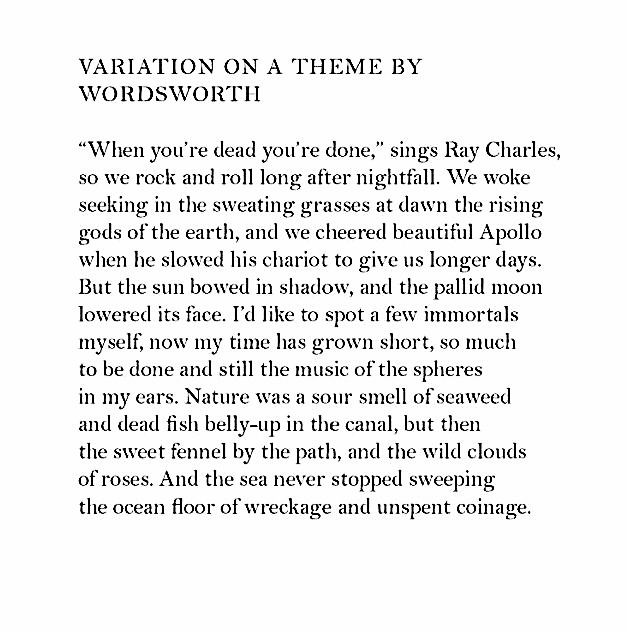
“Variation on a Theme by Wordsworth” — Marvin Bell

mb

Carvings in Natural Concrete — Siri Derkert

Immaterials, August Cross’s Contemporary Take on Goya’s Caprichos

20140216-114744.jpg

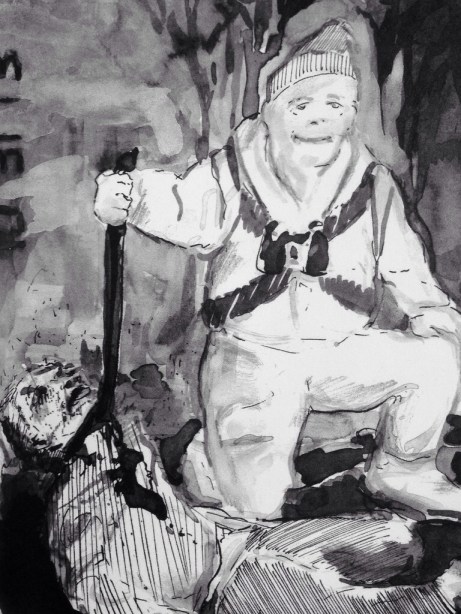
August Cross’s Immaterials—new from indie Inpatient Press—is a dark, strange hybrid of art and poetry. Cross offers 32 chapters here, each combining a stark, rough black and white and gray watercolor with a spare (not-quite) haiku. Cross takes his lead from Francisco Goya here—specifically Goya’s black and white aquatint series, Los Caprichos, and the later etching series The Disasters of War. Cross’s contemporary riff on Goya is apparent in the opener “unmanned,” where Goya’s witches turn into drones:

20140216-114755.jpg

The text accompanying the image introduces the biting, cruel irony that courses throughout Immaterials:

20140216-115320.jpg

While the phrase “unmanned” refers overtly to the drones themselves, it also reflects back on the attempt to completely depersonalize modern warfare—to unman, unperson both the remote pilot and the target, who becomes “no human life.” That spirit of irony and criticism, often oblique, informs all of Immaterials.

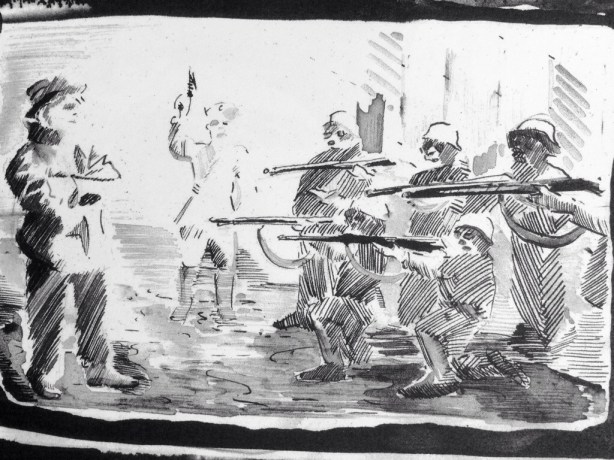
In “monolith,” Cross updates Goya’s The Third of May, 1808, ending the accompanying poem with the line: “a warning to whistleblowers”:

20140216-114810.jpg

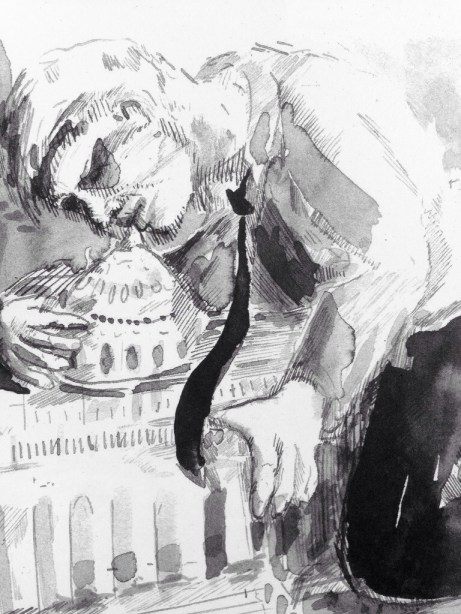
In “dat capitol,” Cross transmutes Goya’s Colossus into a bizarre, dark-eyed lover, a politician gripping the capitol sensually, violently, sucking from its teat. The tone is simultaneously playful and ominous (just like Goya’s work):

20140216-114827.jpg

That same dark, violent humor is readily apparent in many of the pieces, like “selfie,” where a grinning cop  takes a selfie with his miserable captive, or “big game,” where “the tie is a leash / the boot is a lack / uniforms trick young men into shocked shells”:

20140216-114847.jpg

There’s a roughness, a rudeness to Cross’s work—a splattering of ink, a muddiness to the grays, a blurriness of line that causes the viewer to have to intensify his gaze in an attempt to resolve the picture (or perhaps look away). The poems too at first appear simple, rude, rough—Cross opts for the monosyllable, the German root. But again, an intensified gaze—a review, a reread—reveals the second and third meanings of each phrase, where the inelegant alliteration of “shocked shells” hides the vacant human subject—the shell, its immaterial essence choked out.

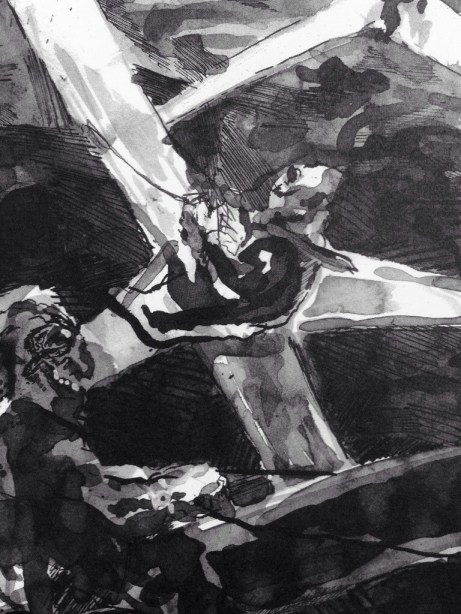
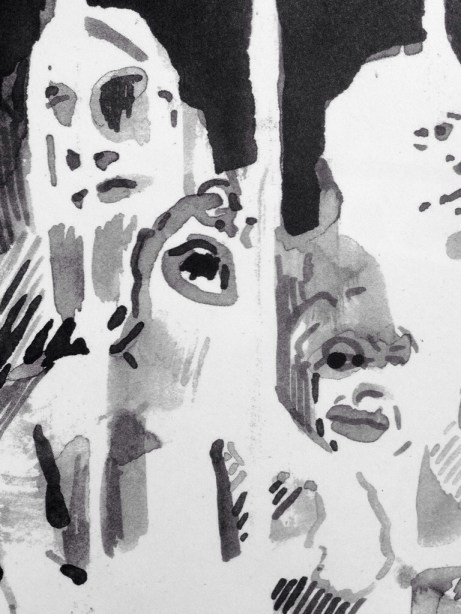
Immaterials presents a sharp if oblique critique of contemporary American society, perhaps summed up best in the two faces in the center of this detail from “gaol over-crowded:

20140216-114837.jpg

Might the howl of the center left figure turn into a laugh? A bark? Either way, it’s tempered by the grimace of the man center right, who focuses intently away from the gaze of the viewer, aiming sights on something the viewer cannot see, can never see.

“Paul’s Case” — Willa Cather

“Paul’s Case”

by Willa Cather

It was Paul’s afternoon to appear before the faculty of the Pittsburgh High School to account for his various misdemeanors. He had been suspended a week ago, and his father had called at the Principal’s office and confessed his perplexity about his son. Paul entered the faculty room suave and smiling. His clothes were a trifle outgrown, and the tan velvet on the collar of his open overcoat was frayed and worn; but for all that there was something of the dandy about him, and he wore an opal pin in his neatly knotted black four-in-hand, and a red carnation in his buttonhole. This latter adornment the faculty somehow felt was not properly significant of the contrite spirit befitting a boy under the ban of suspension.

Paul was tall for his age and very thin, with high, cramped shoulders and a narrow chest. His eyes were remarkable for a certain hysterical brilliancy, and he continually used them in a conscious, theatrical sort of way, peculiarly offensive in a boy. The pupils were abnormally large, as though he were addicted to belladonna, but there was a glassy glitter about them which that drug does not produce.

When questioned by the Principal as to why he was there Paul stated, politely enough, that he wanted to come back to school. This was a lie, but Paul was quite accustomed to lying; found it, indeed, indispensable for overcoming friction. His teachers were asked to state their respective charges against him, which they did with such a rancor and aggrievedness as evinced that this was not a usual case, Disorder and impertinence were among the offenses named, yet each of his instructors felt that it was scarcely possible to put into words the real cause of the trouble, which lay in a sort of hysterically defiant manner of the boy’s; in the contempt which they all knew he felt for them, and which he seemingly made not the least effort to conceal. Once, when he had been making a synopsis of a paragraph at the blackboard, his English teacher had stepped to his side and attempted to guide his hand. Paul had started back with a shudder and thrust his hands violently behind him. The astonished woman could scarcely have been more hurt and embarrassed had he struck at her. The insult was so involuntary and definitely personal as to be unforgettable. In one way and another he had made all his teachers, men and women alike, conscious of the same feeling of physical aversion. In one class he habitually sat with his hand shading his eyes; in another he always looked out of the window during the recitation; in another he made a running commentary on the lecture, with humorous intention.

His teachers felt this afternoon that his whole attitude was symbolized by his shrug and his flippantly red carnation flower, and they fell upon him without mercy, his English teacher leading the pack. He stood through it smiling, his pale lips parted over his white teeth. (His lips were continually twitching, and he had a habit of raising his eyebrows that was contemptuous and irritating to the last degree.) Older boys than Paul had broken down and shed tears under that baptism of fire, but his set smile did not once desert him, and his only sign of discomfort was the nervous trembling of the fingers that toyed with the buttons of his overcoat, and an occasional jerking of the other hand that held his hat. Paul was always smiling, always glancing about him, seeming to feel that people might be watching him and trying to detect something. This conscious expression, since it was as far as possible from boyish mirthfulness, was usually attributed to insolence or “smartness.” Continue reading ““Paul’s Case” — Willa Cather” →

“Trilobites” — Breece D’J. Pancake

“Trilobites”

by Breece D’J. Pancake

I open the truck’s door, step onto the brick side street. I look at Company Hill again, all sort of worn down and round. A long time ago it was real craggy, and stood like an island in the Teays River. It took over a million years to make that smooth little hill, and I’ve looked all over it for trilobites. I think how it has always been there and always will be, least for as long as it matters. The air is smoky with summertime. A bunch of starlings swim over me. I was born in this country and I have never very much wanted to leave. I remember Pop’s dead eyes looking at me. They were real dry, and that took something out of me. I shut the door, head for the café.

I see a concrete patch in the street. It’s shaped like Florida, and I recollect what I wrote in Ginny’s yearbook: “We will live on mangoes and love.” And she up and left without me—two years she’s been down there without me. She sends me postcards with alligator wrestlers and flamingos on the front. She never asks me any questions. I feel like a real fool for what I wrote, and go into the café.

The place is empty, and I rest in the cooled air. Tinker Reilly’s little sister pours my coffee. She has good hips. They are kind of like Ginny’s and they slope nice curves to her legs. Hips and legs like that climb steps into airplanes. She goes to the counter end and scoffs down the rest of her sundae. I smile at her, but she’s jailbait. Jailbait and black snakes are two things “Won’t touch with a window pole. One time I used an old black snake for a bullwhip, snapped the sucker’s head off, and Pop beat hell out of me with it. I think how Pop could make me pretty mad sometimes. I grin.

I think about last night when Ginny called. Her old man drove her down from the airport in Charleston. She was already bored. Can we get together? Sure. Maybe do some brew? Sure. Same old Colly. Same old Ginny. She talked through her beak. I wanted to tell her Pop had died, and Mom was on the warpath to sell the farm, but Ginny was talking through her beak. It gave me the creeps.

Just like the cups give me the creeps. I look at the cups hanging on pegs by the storefront. They’re decal-named and covered with grease and dust. There’s four of them, and one is Pop’s, but that isn’t what gives me the creeps. The cleanest one is Jim’s. It’s clean because he still uses it, but it hangs there with the rest. Through the window, I can see him crossing the street. His joints are cemented with arthritis. I think of how long it’ll be before I croak, but Jim is old, and it gives me the creeps to see his cup hanging up there. I go to the door to help him in.

He says, “Tell the truth, now,” and his old paw pinches my arm.

I say, “Can’t do her.” I help him to his stool. Continue reading ““Trilobites” — Breece D’J. Pancake” →

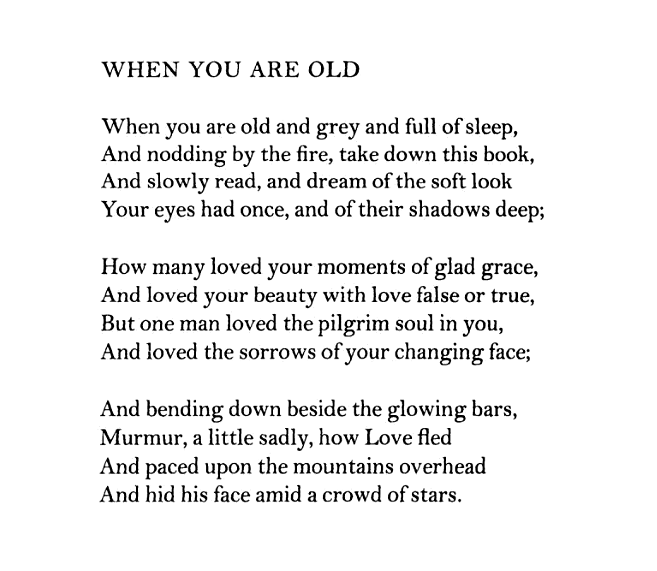
“When You Are Old” — W.B. Yeats

yeats

Derrida Speaks of Love (Or Not)

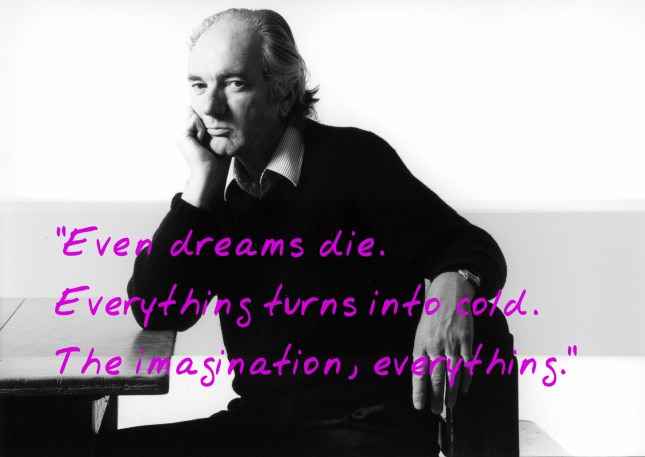
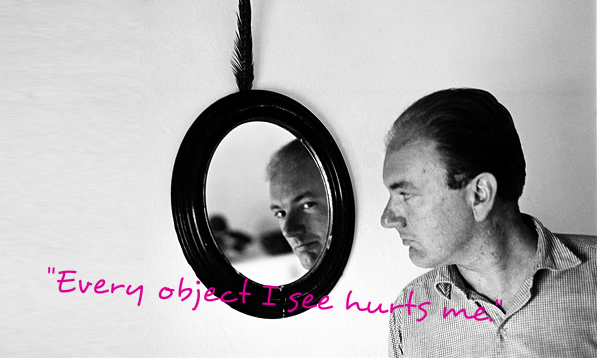
Valentine’s Day Wishes from Thomas Bernhard

tb1

tb2

tb3

tb5

tb6

ThomasBernhardWalking

“How Sir Tristram and Isoud Drank the Love Drink” — Sir Thomas Malory

“How Sir Tristram demanded La Beale Isoud for King Mark, and how Sir Tristram and Isoud drank the love drink”

by Sir Thomas Malory

From L’Morte d’Arthur

THEN upon a day King Anguish asked Sir Tristram why he asked not his boon, for whatsomever he had promised him he should have it without fail. Sir, said Sir Tristram, now is it time; this is all that I will desire, that ye will give me La Beale Isoud, your daughter, not for myself, but for mine uncle, King Mark, that shall have her to wife, for so have I promised him. Alas, said the king, I had liefer than all the land that I have ye would wed her yourself. Sir, an I did then I were shamed for ever in this world, and false of my promise. Therefore, said Sir I Tristram, I pray you hold your promise that ye promised me; for this is my desire, that ye will give me La Beale Isoud to go with me into Cornwall for to be wedded to King Mark, mine uncle. As for that, said King Anguish, ye shall have her with you to do with her what it please you; that is for to say if that ye list to wed her yourself, that is me liefest, and if ye will give her unto King Mark, your uncle, that is in your choice. So, to make short conclusion, La Beale Isoud was made ready to go with Sir Tristram, and Dame Bragwaine went with her for her chief gentlewoman, with many other.

Then the queen, Isoud’s mother, gave to her and Dame Bragwaine, her daughter’s gentlewoman, and unto Gouvernail, a drink, and charged them that what day King Mark should wed, that same day they should give him that drink, so that King Mark should drink to La Beale Isoud, and then, said the queen, I undertake either shall love other the days of their life. So this drink was given unto Dame Bragwaine, and unto Gouvernail. And then anon Sir Tristram took the sea, and La Beale Isoud; and when they were in their cabin, it happed so that they were thirsty, and they saw a little flasket of gold stand by them, and it seemed by the colour and the taste that it was noble wine. Then Sir Tristram took the flasket in his hand, and said, Madam Isoud, here is the best drink that ever ye drank, that Dame Bragwaine, your maiden, and Gouvernail, my servant, have kept for themselves. Then they laughed and made good cheer, and either drank to other freely, and they thought never drink that ever they drank to other was so sweet nor so good. But by that their drink was in their bodies, they loved either other so well that never their love departed for weal neither for woe. And thus it happed the love first betwixt Sir Tristram and La Beale Isoud, the which love never departed the days of their life.

So then they sailed till by fortune they came nigh a castle that hight Pluere, and thereby arrived for to repose them, weening to them to have had good harbourage. But anon as Sir Tristram was within the castle they were taken prisoners; for the custom of the castle was such; who that rode by that castle and brought any lady, he must needs fight with the lord, that hight Breunor. And if it were so that Breunor won the field, then should the knight stranger and his lady be put to death, what that ever they were; and if it were so that the strange knight won the field of Sir Breunor, then should he die and his lady both. This custom was used many winters, for it was called the Castle Pluere, that is to say the Weeping Castle.


How to Get the Love You Deserve (Life in Hell)

Hell

“Love Song” — William Carlos Williams

love song