The Complete Short Stories of J.G. Ballard (Eleventh Riff: The Nineties)

jgb_complete_ss4003111

PREVIOUSLY:

Introductions + stories 1956-1959

Stories of 1960

Stories of 1961

Stories of 1962

“The Subliminal Man,” Black Friday, and Consumerism

Stories of 1963-1964

Stories of 1966

Closing out the sixties

The seventies

The eighties

IN THIS RIFF:

“Dream Cargoes” (1990)

“A Guide to Virtual Death” (1992)

“The Message from Mars” (1992)

“Report from an Obscure Planet” (1992)

“The Secret Autobiography of J G B” (1981/2009)

“The Dying Fall” (1996)

1. “Dream Cargoes” (1990)

By the 1990s Ballard had written essentially the same stories over and over—with diminishing returns. Some of the weakness in the later entries in the Complete Short Stories can be attributed to Ballard’s prescience. The world caught up to him at some point, blunting his satire into something goofier, more cartoonish, but also sharpening the reactionary streak that always glowed under the surface of his writing. At his peak, Ballard used his stories to provoke readers into looking at their culture in a new way, and the best of those stories still retain a futurist power. However, many of the late period stories blazon their moral outrage in a wearisome didactic streak.

1990’s “Dream Cargoes” is paint-by-numbers Ballard: Themes of time, sleep, mutation, ecological disaster, birds, etc. The plot anticipates one of Ballard’s weaker novels, Rushing to Paradise (1994), a day-glo nightmare about misguided attempts to steward the forces of nature. And like Rushing to Paradise, the prose here is weak—Ballard relies on the stock phrases that litter his earliest stories.

2. “The Message from Mars” (1992) / “Report from an Obscure Planet” (1992) / “A Guide to Virtual Death” (1992)

“The Message from Mars” anticipates public disinterest in astronomy (and science in general), the end of NASA’s space shuttle program, and China’s emerging dominance as a world power with space flight capability. So there you go. (It also posits the horror of a President Quayle!). Ballard sends a group of astronauts on a Mars mission, refuses to share their findings with us, and then leaves them, once they land, in their space shuttle, where they live on for decades, silent, incommunicado, alienated from humanity in their self-imposed exile. Ballard’s cynicism is balanced by his refusal to overstate any kind of moral here—the story succeeds in its evocation of mystery.

“Report from an Obscure Planet” is another riff on millennial anxieties, written in the perspective of a “we” condemning the human race for its shortsighted, disastrous treatment of the planet. Ballard doesn’t seem to keen on the future wonders promised by computers:

Driven by the need for a more lifelike replica of the scenes of carnage that most entertained them, the people of this unhappy world had invented an advanced and apparently interiorised version of their television screens, a virtual replica of reality in which they could act out their most deviant fantasies. These three–dimensional simulations were generated by their computers, and had reached a stage of development in the last years of the millennium in which the imitation of reality was more convincing than the original. It may even have become the new reality to the extent that their cities and highways, their fellow citizens and, ultimately, themselves seemed mere illusions by comparison with the electronically generated amusement park where they preferred to play. Here they could assume any identity, create and fulfill any desire, and explore the most deviant dreams.  

While “Report from an Obscure Planet” uses a didactic narrator and a heavy hand to telegraph its message, its companion piece “A Guide to Virtual Death” is far more fun, wicked, and shockingly accurate (if wildly hyperbolic). Sure, yes, okay—another list from Ballard, and okay, yes, sure—I tend to be keen on his lists (“The Index,” “The Assassination of John Fitzgerald Kennedy Considered as a Downhill Motor Race”)—but they also tend to be his strongest pieces. As usual with his list-stories, Ballard feels obligated to begin with a note:

For reasons amply documented elsewhere, intelligent life on earth became extinct in the closing hours of the 20th Century. Among the clues left to us, the following schedule of a day’s television programmes transmitted to an unnamed city in the northern hemisphere on December 23, 1999, offers its own intriguing insight into the origins of the disaster.

6.00 am Porno–Disco. Wake yourself up with his–and–her hard–core sex images played to a disco beat.

7.00 Weather Report. Today’s expected micro–climates in the city’s hotel atriums, shopping malls and office complexes. Hilton International promises an afternoon snow–shower as a Christmas appetiser.

7.15 News Round–up. What our news–makers have planned for you. Maybe a small war, a synthetic earthquake or a famine–zone! charity tie–in.

7.45 Breakfast Time. Gourmet meals to watch as you eat your diet cellulose.

Brief but Essential. Go ahead and read the whole thing.

3. “The Dying Fall” (1996) / “The Secret Autobiography of J G B” (1981/2009)

The American edition of Complete Stories is more complete than the British volume, including two extra stories. “The Dying Fall” (read it here if you like) is an unfortunate last entry, a weak note in a grand tome. It’s not bad; it’s simply not good, yet another revenge tale with a bad wife, etc. It feels like a frame for Ballard to riff on architecture and psychoanalysis.

“The Secret Autobiography of J G B” is much stronger (you can read it here), although it was also composed at his peak and republished (“rediscovered”) after his death. The final lines would have made a fitting end for the entire collection:

When the summer was followed by a mild autumn, B had established a pleasant and comfortable existence for himself. He had abundant stocks of tinned food, fuel, and water with which to survive the winter. The river was nearby, clear and free of all pollution, and petrol was easy to obtain, in unlimited quantities, from the filling stations and parked cars. At the local police station, he assembled a small armory of pistols and carbines, to deal with any unexpected menace that might appear.

But his only visitors were the birds, and he scattered handfuls of rice and seeds on his lawn and on those of his former neighbors. Already he had begun to forget them, and Shepperton soon became an extraordinary aviary, filled with birds of every species.

Thus the year ended peacefully, and B was ready to begin his true work.

4. On the horizon:

I am done! Sort of. One more post—I’ll revisit these riffs and select the tales that I would include in a collection I would call The Essential Short Stories of J.G. Ballard.
“A Guide to Virtual Death” — J.G. Ballard

“A Guide to Virtual Death”

by

J.G. Ballard

For reasons amply documented elsewhere, intelligent life on earth became extinct in the closing hours of the 20th Century. Among the clues left to us, the following schedule of a day’s television programmes transmitted to an unnamed city in the northern hemisphere on December 23, 1999, offers its own intriguing insight into the origins of the disaster.

6.00 am Porno–Disco. Wake yourself up with his–and–her hard–core sex images played to a disco beat.

7.00 Weather Report. Today’s expected micro–climates in the city’s hotel atriums, shopping malls and office complexes. Hilton International promises an afternoon snow–shower as a Christmas appetiser.

7.15 News Round–up. What our news–makers have planned for you. Maybe a small war, a synthetic earthquake or a famine–zone! charity tie–in.

7.45 Breakfast Time. Gourmet meals to watch as you eat your diet cellulose.

8.30 Commuter Special. The rush–hour game–show. How many bottoms can you pinch, how many faces can you slap?

9.30 The Travel Show. Visit the world’s greatest airports and under ground car parks.

10.30 Home–makers of Yesterday. Nostalgic scenes of old–fashioned housework. No.7 – The Vacuum Cleaner.

11.00 Office War. Long–running serial of office gang–wars.

12.00 Newsflash. The networks promise either a new serial killer or a deadly food toxin.

1.00 pm Live from Parliament. No .12 – The Alcoholic MP.

1.30 The Nose–Pickers. Hygiene programme for the kiddies.

2.00 Caress Me. Soft–porn for the siesta hour.

2.30 Your Favourite Commericials. Popular demand re–runs of golden oldie TV ads.

3.00 Housewives’ Choice. Rape, and how to psychologically prepare yourself.

4.00 Count–down. Game show in which contestants count backwards from one million.

5.00 Newsflash. Either an airliner crash or a bank collapse. Viewers express preference.

6.00 Today’s Special. Virtual Reality TV presents ‘The Kennedy Assassination.’ The Virtual Reality head–set takes you to Dallas, Texas, on November 22, 1963. First you fire the assassin’s rifle from the Book Depository window, and then you sit between Jackie and JFK in the Presidential limo as the bullet strikes. For premium subscribers only – feel the Presidential brain tissue spatter your face OR wipe Jackie’s tears onto your handkerchief.

8.00 Dinner Time. More gourmet dishes to view with your evening diet–cellulose.

9.00 Science Now. Is there life after death? Micro–electrodes pick up ultra–faint impulses from long–dead brains. Relatives question the departed.

10.00 Crime–Watch. Will it be your home that is broken into tonight by the TV Crime Gang?

11.00 Today’s Special. Tele–Orgasm. Virtual Reality TV takes you to an orgy. Have sex with the world’s greatest movie–stars. Tonight: Marilyn Monroe and Madonna OR Warren Beatty and Tom Cruise. For premium subscribers only – experience transexualism, paedophiia, terminal syphilis, gang–rape, and bestiality (choice: German Shepherd or Golden Retriever).

1.00 am Newsflash. Tonight’s surprise air–crash.

2.00 The Religious Hour. Imagine being dead. Priests and neuroscientists construct a life–like mock–up of your death.

3.00 Night–Hunter. Will the TV Rapist come through your bedroom window?

4.15 Sex for Insomniacs. Soft porn to rock you to sleep.

5.00 The Charity Hour. Game show in which Third–World contestants beg for money.


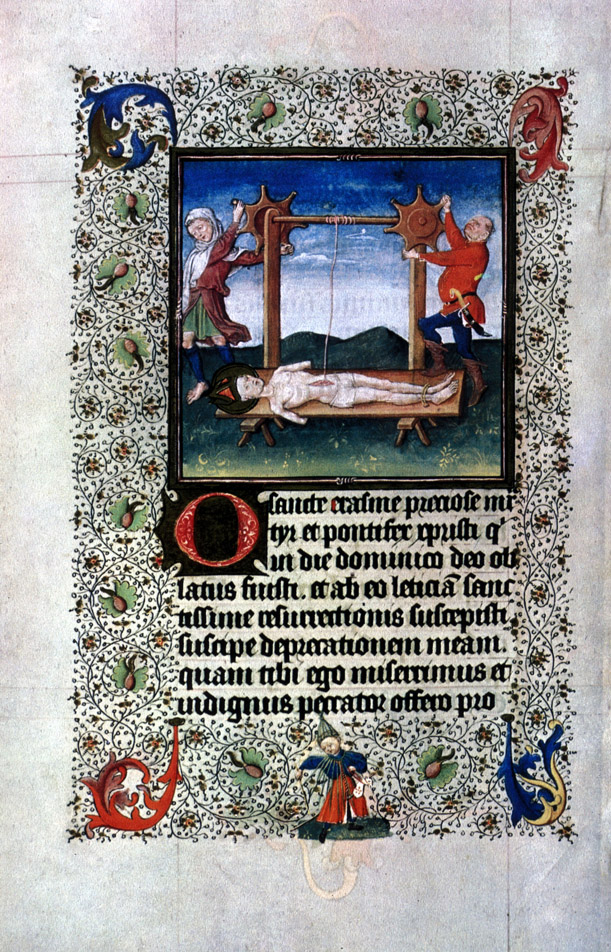
“Martyrdom of Saint Erasmus” (William H. Gass)

week11-0064

There were images that had nowhere to hang but in his head, images he remembered from books but of which he had no other copy; particularly one, from a strangely beautiful illuminated manuscript called The Hours of Catherine of Cleves, that depicted the martyrdom of Saint Erasmus. The presumptive saint lies on a raised plank, naked except for a loincloth. His abdomen has been opened and his intestines attached to a windlass erected above him. Thereupon, like a length of sausage or a length of rope, his innards are being wound by two figures, one male, one possibly female, each working hard to turn the spokes, their faces, however, averted from the scene. The saint does not appear to have wrists or hands. Eight turns have already been taken. The sky is empty except for a few clouds; the earth is empty except for two hills and some small yellow flowers. Around this painting, framed like a picture, is a delicate thin line made of curlicues and a field of tiny petals stalked by imaginary butterflies. At the bottom a small boy wearing a collar of thin sticks is riding a hobbyhorse.

His curiosity aroused by this calamitous vision, Skizzen sought more bio concerning Saint Erasmus. One source simply said that “although he existed, almost nothing is known about him.” This sentence stayed with Skizzen as stubbornly as the piteous illumination. What a blessed condition Erasmus must have enjoyed! Although he existed, almost nothing was known of him. Although nothing was known of him, as a saint, he existed. He existed, yet he had lived such a saintly life there was nothing of him to be known. Still another authority was not as sanguine. It claimed that the cult of Erasmus spread with such success that twelve hundred years later the martyr was invoked as one of the Fourteen Holy Helpers, whoever they were, and had become patron saint of sailors as well as kids who had colic. What was known, during those hundreds of years, was not known of the saint but of some figure he had thrown about himself as you would a ghostly garment or a costume for the dance. Proudly, Professor Skizzen pasted Erasmus in his memory book. A.d. 300. He was sprayed with tar and set alight. He was jailed, rescued by an angel, disemboweled. On a day in a.d. He died for me.

From William H. Gass’s novel  Middle C.

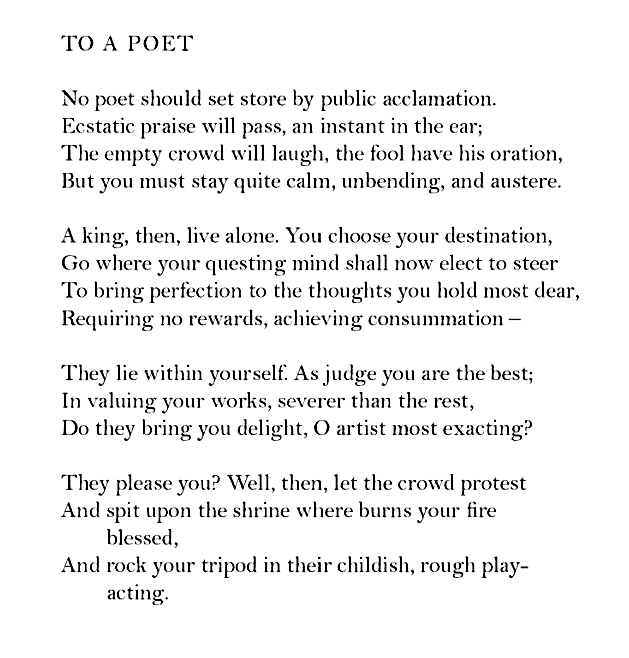
“To a Poet” — Alexander Pushkin

poet

“Good Old Neon” — David Foster Wallace

“Good Old Neon”

by

David Foster Wallace

My whole life I’ve been a fraud. I’m not exaggerating. Pretty much all I’ve ever done all the time is try to create a certain impression of me in other people. Mostly to be liked or admired. It’s a little more complicated than that, maybe. But when you come right down to it it’s to be liked, loved. Admired, approved of, applauded, whatever. You get the idea. I did well in school, but deep down the whole thing’s motive wasn’t to learn or improve myself but just to do well, to get good grades and make sports teams and perform well. To have a good transcript or varsity letters to show people. I didn’t enjoy it much because I was always scared I wouldn’t do well enough. The fear made me work really hard, so I’d always do well and end up getting what I wanted. But then, once I got the best grade or made All City or got Angela Mead to let me put my hand on her breast, I wouldn’t feel much of anything except maybe fear that I wouldn’t be able to get it again. The next time or next thing I wanted. I remember being down in the rec room in Angela Mead’s basement on the couch and having her let me get my hand up under her blouse and not even really feeling the soft aliveness or whatever of her breast because all I was doing was thinking, ‘Now I’m the guy that Mead let get to second with her.’ Later that seemed so sad. This was in middle school. She was a very big-hearted, quiet, self-contained, thoughtful girl — she’s a veterinarian now, with her own practice — and I never even really saw her, I couldn’t see anything except who I might be in her eyes, this cheerleader and probably number two or three among the most desirable girls in middle school that year. She was much more than that, she was beyond all that adolescent ranking and popularity crap, but I never really let her be or saw her as more, although I put up a very good front as somebody who could have deep conversations and really wanted to know and understand who she was inside. Continue reading ““Good Old Neon” — David Foster Wallace” →

Macbeth Consulting the Vision of the Armed Head — Henry Fuseli

“Sonet in Orknay” — William Fowler

sonet

“Fixed moral boundaries are harmful” (Ben Marcus)

—But can you sketch for me a picture of your ethics?

—I think that fixed moral boundaries are harmful, even if they provide momentary comfort and save lives. I think our ethical duty is to eliminate the behavioral corsets that are cinched over children just as their explosive energy is at its most threatening. Is a tantrum disruptive, or does it point to an emotional tunnel we’re afraid of entering? The doctrines of the tantras involve meditation, mantras, ritual, and explosive behavior. We’re talking about ancient ideas that are elementary and obvious to high schoolers. My ethics? I’d like to shed the strictures of adulthood and make maturity an optional result of a freely lived human life, not the necessary path to power and success, lorded over by depressed, overweight, unimaginative corpses. The twenty most central mantras have their roots in baby talk. No one disputes this anymore. A syntax comprised of these mantras, which should not be confused with NASA’s failed language, can marshal the force of an entire infant society, but— and this is key— this syntax is not capable of instructional phrasings, so nothing can be taught, which keeps maturity and its death mask perfectly at bay.

From Ben Marcus’s story “On Not Growing Up.”

Read it at Conjunctions or in Marcus’s latest collection Leaving the Sea: Stories.


“The Death of the Moth” — Virginia Woolf

“The Death of the Moth”

by

Virginia Woolf

Moths that fly by day are not properly to be called moths; they do not excite that pleasant sense of dark autumn nights and ivy-blossom which the commonest yellow-underwing asleep in the shadow of the curtain never fails to rouse in us. They are hybrid creatures, neither gay like butterflies nor sombre like their own species. Nevertheless the present specimen, with his narrow hay-coloured wings, fringed with a tassel of the same colour, seemed to be content with life. It was a pleasant morning, mid-September, mild, benignant, yet with a keener breath than that of the summer months. The plough was already scoring the field opposite the window, and where the share had been, the earth was pressed flat and gleamed with moisture. Such vigour came rolling in from the fields and the down beyond that it was difficult to keep the eyes strictly turned upon the book. The rooks too were keeping one of their annual festivities; soaring round the tree tops until it looked as if a vast net with thousands of black knots in it had been cast up into the air; which, after a few moments sank slowly down upon the trees until every twig seemed to have a knot at the end of it. Then, suddenly, the net would be thrown into the air again in a wider circle this time, with the utmost clamour and vociferation, as though to be thrown into the air and settle slowly down upon the tree tops were a tremendously exciting experience.

The same energy which inspired the rooks, the ploughmen, the horses, and even, it seemed, the lean bare-backed downs, sent the moth fluttering from side to side of his square of the window-pane. One could not help watching him. One was, indeed, conscious of a queer feeling of pity for him. The possibilities of pleasure seemed that morning so enormous and so various that to have only a moth’s part in life, and a day moth’s at that, appeared a hard fate, and his zest in enjoying his meagre opportunities to the full, pathetic. He flew vigorously to one corner of his compartment, and, after waiting there a second, flew across to the other. What remained for him but to fly to a third corner and then to a fourth? That was all he could do, in spite of the size of the downs, the width of the sky, the far-off smoke of houses, and the romantic voice, now and then, of a steamer out at sea. What he could do he did. Watching him, it seemed as if a fibre, very thin but pure, of the enormous energy of the world had been thrust into his frail and diminutive body. As often as he crossed the pane, I could fancy that a thread of vital light became visible. He was little or nothing but life.

Yet, because he was so small, and so simple a form of the energy that was rolling in at the open window and driving its way through so many narrow and intricate corridors in my own brain and in those of other human beings, there was something marvellous as well as pathetic about him. It was as if someone had taken a tiny bead of pure life and decking it as lightly as possible with down and feathers, had set it dancing and zig-zagging to show us the true nature of life. Thus displayed one could not get over the strangeness of it. One is apt to forget all about life, seeing it humped and bossed and garnished and cumbered so that it has to move with the greatest circumspection and dignity. Again, the thought of all that life might have been had he been born in any other shape caused one to view his simple activities with a kind of pity. Continue reading ““The Death of the Moth” — Virginia Woolf” →

“Sonnet” — Elizabeth Bishop

sonnet

Emily Dickinson — Tom Gauld

Reviews Page Redesign (And a Reflection on Sexist Reviewing Habits)

So I updated Biblioklept’s Reviews page.

The page had just been a list of the reviews, riffs, and essays published on the blog, with each new entry stacking up in chronological order. For years I’ve known that this unorganized review dump was essentially useless, and I’d been meaning to turn it into an alphabetical index—and I finally did. (I kept the chronolist too, mostly for myself).

Anyway, as I went through this boring, sort-of-arduous process, I couldn’t help but reflect on a few of the habits that manifest under the surface:

The obvious: The reviews on the blog trend very heavily toward male authors. I already knew this, but counting things up makes it plain:

To date, I’ve run reviews of approximately 221 authors (approximate in the sense that I counted only once); of those reviews, only 36 were books by women. That’s about 16%. (This analysis doesn’t even begin to consider the multiple reviews of authors—for example, there are like a ton of reviews of Roberto Bolaño books, but only one review of a Clarice Lispector book). This ratio runs counter to what I’d like to believe are my principles; the number certainly contrasts with the fiction and poetry that I run on the blog (public domain stuff), which trends toward female authors. The number also contrasts with the ratio of male to female authors — roughly 1:1 — that appear on my course syllabuses.

If my tone sounds defensive, it’s because it is. The Read Women 2014 project has helped to highlight sexist reading habits—including my own. Sexism—any kind of prejudicial ism (and every ism is prejudicial) manifests as a blinding structure: Part of the structuring condition of ideological sexism is that the sexist person usually cannot see that he is sexist (he cannot see that he cannot see). I’m not offering this as a defense of my own habits: I’m not saying, Look, I’m aware of my skewed reviewing habits, and my very awareness of my inherent sexism makes me less sexist, absolves, me, etc. (But look at how I rhetorically dance around simply writing, My reviewing habits are sexist; look at how I’m still unable to simply type I’m probably a sexist, let alone I’m sexist, let me hedge, use parentheses, etc.).

Can I turn attention away from myself and onto the aesthetic critic Harold Bloom? In his Paris Review interview, he claimed:

I do not for a moment yield to the notion that any social, racial, ethnic, or “male” interest could determine my aesthetic choices. I have a lifetime of experience, learning, and insight that tells me this.

Bloom’s statement is a perfect example of I cannot see that I cannot see. (Stephen Colbert essentially ridicules this kind of blindness on his satirical show The Colbert Report by repeatedly claiming that he is not racist because he cannot see color).

I think that (I know that) a certain male interest determines my aesthetic interest. At the same time, I understand Bloom’s resistance to the notion that aesthetics are somehow contingent on gender. Could a man have written “A Good Man Is Hard to Find” or To the Lighthouse or Death Comes to the Archbishop or Their Eyes Were Watching God? (A man didn’t). We’d like to believe that the Great Stuff transcends the material world—that part of its timelessness is that it’s not bound to mortal gendered coils. Etc.

What about now? What about Read Women 2014? I’ve been reading more women authors, I think, but I haven’t been reviewing them. I recently reread Flannery O’Connor’s collection Everything That Rises Must Converge, some Gertrude Stein I’d never read before (including Tender Buttons), and some short stories by Eudora Welty and Willa Cather. I’ve read far less contemporary stuff though, although I did review Jessica Hollander’s excellent collection In These Times the Home Is a Tired Place. In general though, I tend to read less contemporaryish fiction now than I used to—I’m reading three books now, and only one is by a living author (Ben Marcus). Of the three books I’m reading now, only one is by a woman (Zelda Fitzgerald). Of the last ten book reviews published on this site, four are of books by women.

Data and numbers are unappealing—especially when they quantify something we (and when I write we you know I mean I) don’t want to acknowledge. We’d (I’d) rather qualify than quantify. Etc.

I suppose it’s the idea of a conscious effort that so repels some of us (me). The notion that I (we?) might have to make an actual intellectual (not aesthetic, perhaps non-intuitive) effort to differentiate our reading. But that’s what it takes, right? An effort. A recognition. A looking.

The Pervert’s Guide to Cinema — Slavoj Žižek (Full Film)

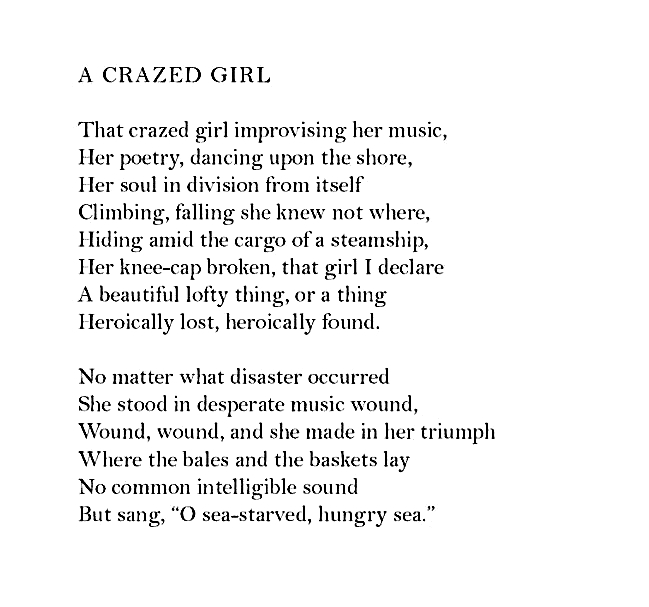
“A Crazed Girl” — William Butler Yeats

wby

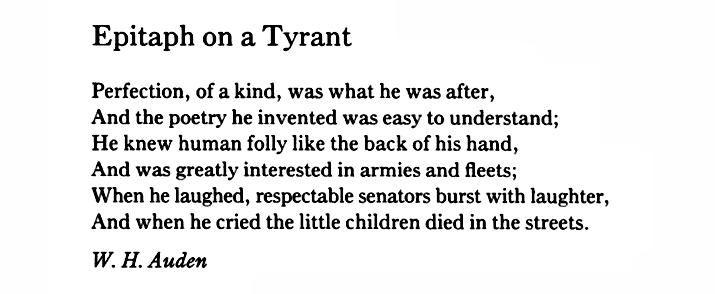
“Epitaph on a Tyrant” — W.H. Auden

tyrant

“The Repairer of Reputations” — Robert W. Chambers

“The Repairer of Reputations”

by Robert W. Chambers

I

“Ne raillons pas les fous; leur folie dure plus longtemps que la nôtre…. Voila toute la différence.”

Toward the end of the year 1920 the Government of the United States had practically completed the programme, adopted during the last months of President Winthrop’s administration. The country was apparently tranquil. Everybody knows how the Tariff and Labour questions were settled. The war with Germany, incident on that country’s seizure of the Samoan Islands, had left no visible scars upon the republic, and the temporary occupation of Norfolk by the invading army had been forgotten in the joy over repeated naval victories, and the subsequent ridiculous plight of General Von Gartenlaube’s forces in the State of New Jersey. The Cuban and Hawaiian investments had paid one hundred per cent and the territory of Samoa was well worth its cost as a coaling station. The country was in a superb state of defence. Every coast city had been well supplied with land fortifications; the army under the parental eye of the General Staff, organized according to the Prussian system, had been increased to 300,000 men, with a territorial reserve of a million; and six magnificent squadrons of cruisers and battle-ships patrolled the six stations of the navigable seas, leaving a steam reserve amply fitted to control home waters. The gentlemen from the West had at last been constrained to acknowledge that a college for the training of diplomats was as necessary as law schools are for the training of barristers; consequently we were no longer represented abroad by incompetent patriots. The nation was prosperous; Chicago, for a moment paralyzed after a second great fire, had risen from its ruins, white and imperial, and more beautiful than the white city which had been built for its plaything in 1893. Everywhere good architecture was replacing bad, and even in New York, a sudden craving for decency had swept away a great portion of the existing horrors. Streets had been widened, properly paved and lighted, trees had been planted, squares laid out, elevated structures demolished and underground roads built to replace them. The new government buildings and barracks were fine bits of architecture, and the long system of stone quays which completely surrounded the island had been turned into parks which proved a god-send to the population. The subsidizing of the state theatre and state opera brought its own reward. The United States National Academy of Design was much like European institutions of the same kind. Nobody envied the Secretary of Fine Arts, either his cabinet position or his portfolio. The Secretary of Forestry and Game Preservation had a much easier time, thanks to the new system of National Mounted Police. We had profited well by the latest treaties with France and England; the exclusion of foreign-born Jews as a measure of self-preservation, the settlement of the new independent negro state of Suanee, the checking of immigration, the new laws concerning naturalization, and the gradual centralization of power in the executive all contributed to national calm and prosperity. When the Government solved the Indian problem and squadrons of Indian cavalry scouts in native costume were substituted for the pitiable organizations tacked on to the tail of skeletonized regiments by a former Secretary of War, the nation drew a long sigh of relief. When, after the colossal Congress of Religions, bigotry and intolerance were laid in their graves and kindness and charity began to draw warring sects together, many thought the millennium had arrived, at least in the new world which after all is a world by itself.

But self-preservation is the first law, and the United States had to look on in helpless sorrow as Germany, Italy, Spain and Belgium writhed in the throes of Anarchy, while Russia, watching from the Caucasus, stooped and bound them one by one.

In the city of New York the summer of 1899 was signalized by the dismantling of the Elevated Railroads. The summer of 1900 will live in the memories of New York people for many a cycle; the Dodge Statue was removed in that year. In the following winter began that agitation for the repeal of the laws prohibiting suicide which bore its final fruit in the month of April, 1920, when the first Government Lethal Chamber was opened on Washington Square. Continue reading ““The Repairer of Reputations” — Robert W. Chambers” →

Go Away | From Thomas Bernhard’s Novel Concrete

If I go away, I said to myself, sitting in the iron chair, I shall simply be leaving a country whose absolute futility utterly depresses me every single day, whose imbecilities daily threaten to stifle me, and whose idiocies will sooner or later be the end of me, even without my illnesses. Whose political and cultural conditions have of late become so chaotic that they turn my stomach when I wake up every morning, even before I am out of bed. Whose indifference to the intellect has long since ceased to cause the likes of me to despair, but if I am to be truthful only to vomit. I shall be going away from a country, I told myself, sitting in my iron chair, in which everything that once gave pleasure to so-called thinking people, or at least made it possible for them to go on existing, has been expelled, expunged and extinguished, in which only the most primitive instinct for survival prevails and the slightest pretension to thought is stifled at birth. In which a corrupt state and a corrupt church join forces to pull at the endless rope which, with the utmost ruthlessness and callousness, they have for centuries wound round the neck of a blind and stupid people, a people imprisoned in its stupidity by its rulers. In which truth is trodden underfoot, and lies are sanctified by all official organs as the only means to any end. I shall be leaving a country, I told myself, sitting in the iron chair, in which truth is not understood or quite simply not accepted, and falsehood is the only legal tender in all transactions. I shall be leaving a country in which the church practises hypocrisy and in which socialism, having come to power, practises exploitation, and in which art says whatever is acceptable to these two. I shall be leaving a country in which a people educated to stupidity allows its ears to be stopped by the church and its mouth by the state, and in which everything I hold sacred has for centuries ended up in the slop pails of the rulers. If I go away, I told myself, sitting in the iron chair, I shall only be going away from a country in which I no longer have any place and in which I have never found happiness. If I go away, I shall be going away from a country in which the towns stink and the inhabitants of the towns have become coarsened. I shall be going away from a country in which the language has become vulgar and the minds of those who speak this vulgar language have for the most part become deranged. I shall be going away from a country, I told myself, sitting in the iron chair, in which the only model of behaviour is set by the so-called wild animals. I shall be going away from a country in which darkest night prevails at noonday, and in which virtually the only people in power are blustering illiterates. If I go away, I told myself, sitting in the iron chair, I shall be leaving the disgusting, depressing and unconscionably filthy public lavatory of Europe. To go away, I told myself, sitting in the iron chair, means leaving behind me a country which for years has done nothing but afflict me with the most damaging depression and has taken every opportunity, no matter where or when, of insidiously and malignantly urinating on my head.

From Thomas Bernhard’s novel Concrete.