“The Food of Death” — Lord Dunsany

death

“By the by, a pretty riddle or fable might be made” | More Notes From Nathaniel Hawthorne

  1. Dandelions and blue flowers are still growing in sunny places. Saw in a barn a prodigious treasure of onions in their silvery coats, exhaling a penetrating perfume.
  2.  How exceeding bright looks the sunshine, casually reflected from a looking-glass into a gloomy region of the chamber, distinctly marking out the figures and colors of the paper-hangings, which are scarcely seen elsewhere. It is like the light of mind thrown on an obscure subject.
  3.  Man’s finest workmanship, the closer you observe it, the more imperfections it shows; as in a piece of polished steel a microscope will discover a rough surface. Whereas, what may look coarse and rough in Nature’s workmanship will show an infinitely minute perfection, the closer you look into it. The reason of the minute superiority of Nature’s work over man’s is, that the former works from the innermost germ, while the latter works merely superficially.
  4. Standing in the cross-road that leads by the Mineral Spring, and looking towards an opposite shore of the lake, an ascending bank, with a dense border of trees, green, yellow, red, russet, all bright colors, brightened by the mild brilliancy of the descending sun; it was strange to recognize the sober old friends of spring and summer in this new dress. By the by, a pretty riddle or fable might be made out of the changes in apparel of the familiar trees round a house adapted for children. But in the lake, beneath the aforesaid border of trees,–the water being not rippled, but its grassy surface somewhat moved and shaken by the remote agitation of a breeze that was breathing on the outer lake,–this being in a sort of bay,–in the slightly agitated mirror, the variegated trees were reflected dreamily and indistinctly; a broad belt of bright and diversified colors shining in the water beneath. Sometimes the image of a tree might be almost traced; then nothing but this sweep of broken rainbow. It was like the recollection of the real scene in an observer’s mind,–a confused radiance.
  5. A whirlwind, whirling the dried leaves round in a circle, not very violently.
  6.  To well consider the characters of a family of persons in a certain condition,–in poverty, for instance,–and endeavor to judge how an altered condition would affect the character of each.
  7.  The aromatic odor of peat-smoke in the sunny autumnal air is very pleasant.

Notations from Nathaniel Hawthorne’s American Note-Books.

William H. Gass Reading From Middle C

“Notes on the Movements of Young Children” — Robert Louis Stevenson

“Notes on the Movements of Young Children” — Robert Louis Stevenson

I wish to direct the reader’s attention to a certain quality in the movements of children when young, which is somehow lovable in them, although it would be even unpleasant in any grown person. Their movements are not graceful, but they fall short of grace by something so sweetly humorous that we only admire them the more. The imperfection is so pretty and pathetic, and it gives so great a promise of something different in the future, that it attracts us more than many forms of beauty. They have something of the merit of a rough sketch by a master, in which we pardon what is wanting or excessive for the sake of the very bluntness and directness of the thing. It gives us pleasure to see the beginning of gracious impulses and the springs of harmonious movement laid bare to us with innocent simplicity.

One night some ladies formed a sort of impromptu dancing-school in the drawing-room of an hotel in France. One of the ladies led the ring, and I can recall her as a model of accomplished, cultured movement. Two little girls, about eight years old, were the pupils; that is an age of great interest in girls, when natural grace comes to its consummation of justice and purity, with little admixture of that other grace of forethought and discipline that will shortly supersede it altogether. In these two, particularly, the rhythm was sometimes broken by an excess of energy, as though the pleasure of the music in their light bodies could endure no longer the restraint of regulated dance. So that, between these and the lady, there was not only some beginning of the very contrast I wish to insist upon, but matter enough to set one thinking a long while on the beauty of motion. I do not know that, here in England, we have any good opportunity of seeing what that is; the generation of British dancing men and women are certainly more remarkable for other qualities than for grace: they are, many of them, very conscientious artists, and give quite a serious regard to the technical parts of their performance; but the spectacle, somehow, is not often beautiful, and strikes no note of pleasure. If I had seen no more, therefore, this evening might have remained in my memory as a rare experience. But the best part of it was yet to come. For after the others had desisted, the musician still continued to play, and a little button between two and three years old came out into the cleared space and began to figure before us as the music prompted. I had an opportunity of seeing her, not on this night only, but on many subsequent nights; and the wonder and comical admiration she inspired was only deepened as time went on. She had an admirable musical ear; and each new melody, as it struck in her a new humour, suggested wonderful combinations and variations of movement. Now it would be a dance with which she would suit the music, now rather an appropriate pantomime, and now a mere string of disconnected attitudes. But whatever she did, she did it with the same verve and gusto. The spirit of the air seemed to have entered into her, and to possess her like a passion; and you could see her struggling to find expression for the beauty that was in her against the inefficacy of the dull, half-informed body. Though her footing was uneven, and her gestures often ludicrously helpless, still the spectacle was not merely amusing; and though subtle inspirations of movement miscarried in tottering travesty, you could still see that they had been inspirations; you could still see that she had set her heart on realising something just and beautiful, and that, by the discipline of these abortive efforts, she was making for herself in the future a quick, supple, and obedient body. It was grace in the making. She was not to be daunted by any merriment of people looking on critically; the music said something to her, and her whole spirit was intent on what the music said: she must carry out its suggestions, she must do her best to translate its language into that other dialect of the modulated body into which it can be translated most easily and fully. Continue reading ““Notes on the Movements of Young Children” — Robert Louis Stevenson”

Oedipus the Wayfarer — Gustave Moreau

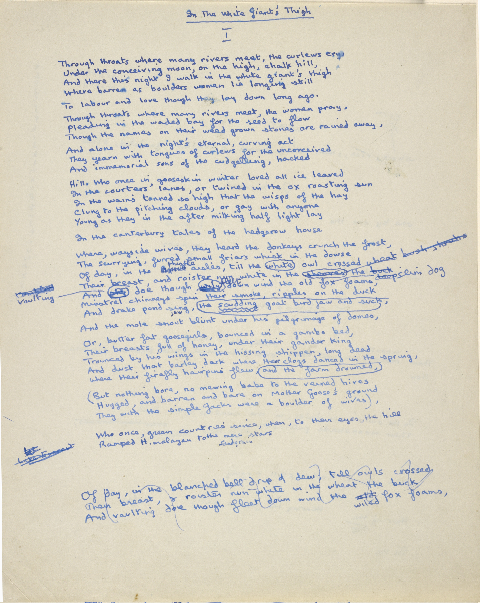
“The White Giant’s Thigh” — Dylan Thomas (Autograph Manuscript)

Dylan-Thomas-whute-giants-Thigh1

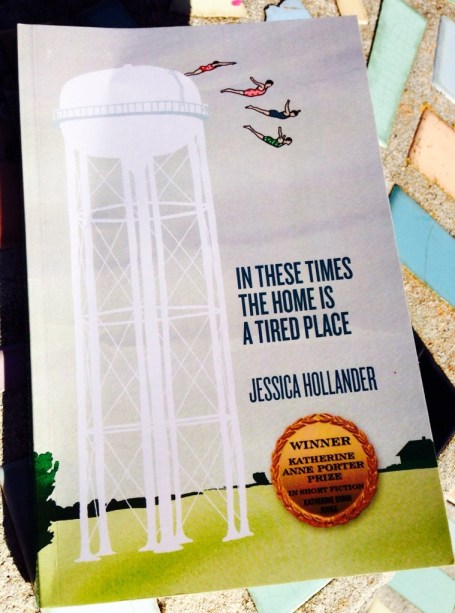
Jessica Hollander’s Collection In These Times the Home Is a Tired Place Reviewed

20140119-145520.jpg

Every story in Jessica Hollander’s début collection In These Times the Home Is a Tired Place feels thoroughly real, deeply authentic, and if we already know the contours of these plots—perhaps having lived some of them ourselves—Hollander makes us experience them anew with her bristling, strange sentences. Hollander writes here of families on the brink and families broken, families fragmenting and families forgetting. She conjures domestic spaces limned with ghosts and memories, children and parents who aren’t quite sure how to be a family, but who nevertheless try—even if trying is really just imagining.

In the strong opener “You Are a Good Girl I Love You,” our narrator Gertrude, about to graduate high school, imagines her future as a kind of do-over, one without interference from her overprotective father, inert mother, and wild child sister:

Of course Pete and I would attend the same school, live in the same dorm, plan classes to start and end together so we would be only briefly apart. We had a dependable timeline mapped out behind the child’s armoire in his room involving dates: graduations, wedding, first jobs, first house, babies raised by smiling parents. Some evenings we practiced smiling thinking the more one does it the more natural it feels.

Many of the stories that follow respond to—and complicate—Gertrude’s dream of an ideal happy family. There’s “girlfriend,” the otherwise-unnamed hero of “This Kind of Happiness,” who imagines alternate titles she might assume: “Single Mother. Pregnant Bride. Gun-toting Madwoman.” In “The Good Luck Doll,” Claudia feigns a pregnancy to keep her boyfriend deluded but happy (if only for a time). She’s happy to imagine the pregnancy along with him. “March On,” like several of the stories here, follows the aftermath of a failed marriage. What happens when a family ceases to take the same form? Are the old appendages, the in-laws now essentially dead to their ex-family members? Waiting outside her father’s mother’s door after having knocked and yelled for Grandma to open, narrator Raimy reflects on these changes:

Then, briefly, I decided she was dead. I imagined her pale on the floor and me making all this noise, and I felt even more disruptive. I stared at the quiet street, thinking about us all dead in some ways: the distance between people and the everyday separation, and maybe we constantly grieved each other and our old lives. The only comfort we had was thinking maybe it was like this for everyone, maybe there was a connection in that.

The connection that Raimy imagines and takes solace in runs through In These Times the Home Is a Tired Place. We find it in one of the strongest stories in the collection, “What Became of What She Had Made,” as mother Lynette grieves her estrangement from her adult daughter Christine. She enlists her other daughter Olivia, “a lush,” to come along on the mission. They head from Michigan to Ohio by taxi, fortifying themselves with morning doses of schnapps. By the time we finally meet Christine, we see why she might want her family to simply pretend she’s dead. Hollander’s restraint pays off, her precise sentences revealing just enough detail for us to fill in the dark gaps.

Sometimes Hollander achieves a near archetypal mode, but one tempered in specificity. Consider how much she packs in to just one paragraph form “I Now Pronounce You”:

In the husband and wife’s third year of marriage, a woman—not the wife—pushed the no-longer-new husband from a third-story window after she’d slightly burnt some chicken and he’d refused to eat it. And also he had refused to leave hi no-longer-new wife for the other woman because he’d realized the other woman was crazy. Besides, it was nice with the wife, who didn’t complain when he watched sports in the morning and who stayed home and became a better cook and took care of their small son, whom he didn’t much like but planned to increasingly as the son came to resemble more a small man than a wild animal.

Hollander’s rhetorical force is perhaps most evident in the title story, which undertakes to describe a divorce from several perspectives. Written as three lists, each one perhaps a year removed from the next, “In These Times the Home Is a Tired Place” merges form and content, its broken, discontinuous structure mirroring the broken, discontinuous family at its non-center. That breaking up also figures in the daughter’s favorite pastime:

The girl spent a Saturday morning cutting snowflakes from a pile of paper she’d found on her mother’s desk. The snowflakes were peppered with sliced negotiations, diamond-pierced words like child and property and alimony, and when the girl finished she strung the flakes together and hung them from her window so they trailed to the berry bush and flapped in the stirred summer wind.

Attempting to mediate (if not ameliorate) the daughter’s trauma is the babysitter:

 “A sad situation,” the babysitter told friends lounging at night on her parents’ screened-in porch. She planned years from now to marry the boy holding her hand, though he’d quit his job and all summer hung around his mother’s pool smoking cigarettes with his mother. Dark ahead; behind them bright inside with television and bills, an electric piano and screwed-together projects. The babysitter said, “Stay together for the child,” and one friend said, “Yes,” and another said, “No,” and another said, “Life is life,” and the boyfriend said nothing.

The babysitter might have stepped out of one of the other stories in this collection. Maybe she’s older in one of those stories. Maybe she’s Gertrude or Olivia or Raimy or girlfriend or wife. She dreams, she imagines, and we know enough—Hollander shows us enough—to see that her imagining the future is not enough.

Tolstoy gave us that famous opener: “Happy families are all alike; every unhappy family is unhappy in its own way.” The unhappy families of Hollander’s collection are unhappy in their own, personal, distinct and distinctly unhappy ways—but our author, by focusing on the capacities of her characters to imagine ways of being happy, also shows us that in many ways unhappy families are all alike. Recommended.

In These Times the Home Is a Tired Place is newish from University of North Texas Press.

“The Young Housewife” — William Carlos Williams

wcw

“Rooms” — Gertrude Stein

“Rooms”

by Gertrude Stein

Act so that there is no use in a centre. A wide action is not a width. A preparation is given to the ones preparing. They do not eat who mention silver and sweet. There was an occupation.

A whole centre and a border make hanging a way of dressing. This which is not why there is a voice is the remains of an offering. There was no rental.

So the tune which is there has a little piece to play, and the exercise is all there is of a fast. The tender and true that makes no width to hew is the time that there is question to adopt.

To begin the placing there is no wagon. There is no change lighter. It was done. And then the spreading, that was not accomplishing that needed standing and yet the time was not so difficult as they were not all in place. They had no change. They were not respected. They were that, they did it so much in the matter and this showed that that settlement was not condensed. It was spread there. Any change was in the ends of the centre. A heap was heavy. There was no change.

Burnt and behind and lifting a temporary stone and lifting more than a drawer.

The instance of there being more is an instance of more. The shadow is not shining in the way there is a black line. The truth has come. There is a disturbance. Trusting to a baker’s boy meant that there would be very much exchanging and anyway what is the use of a covering to a door. There is a use, they are double.

If the centre has the place then there is distribution. That is natural. There is a contradiction and naturally returning there comes to be both sides and the centre. That can be seen from the description.

The author of all that is in there behind the door and that is entering in the morning. Explaining darkening and expecting relating is all of a piece. The stove is bigger. It was of a shape that made no audience bigger if the opening is assumed why should there not be kneeling. Any force which is bestowed on a floor shows rubbing. This is so nice and sweet and yet there comes the change, there comes the time to press more air. This does not mean the same as disappearance.

Continue reading ““Rooms” — Gertrude Stein”

Your Favorite Author as a Cute Little Doll

 Debbie Ritter makes and sells charming dolls of writers (and artists and actors and characters).

“Mount Sinai” — Franz Kafka

k

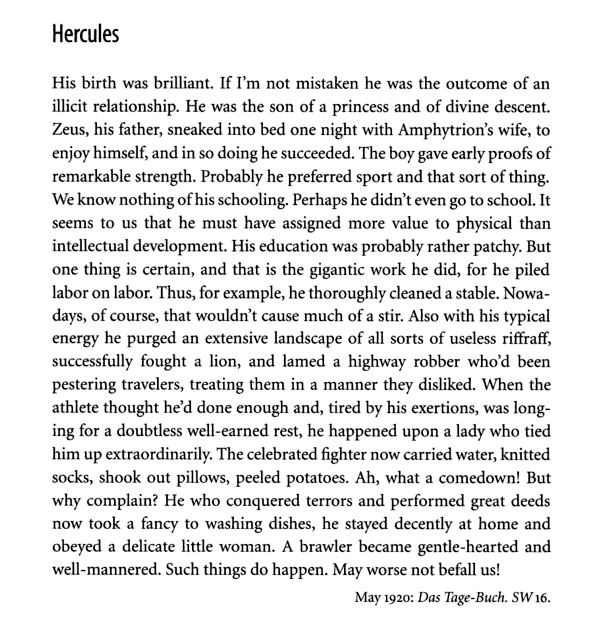
“Hercules” — Robert Walser

herc

Topless W.G. Sebald

wgs

“An Anarchist” — Joseph Conrad

“An Anarchist”

by Joseph Conrad

That year I spent the best two months of the dry season on one of the estates—in fact, on the principal cattle estate—of a famous meat-extract manufacturing company.

B.O.S. Bos. You have seen the three magic letters on the advertisement pages of magazines and newspapers, in the windows of provision merchants, and on calendars for next year you receive by post in the month of November. They scatter pamphlets also, written in a sickly enthusiastic style and in several languages, giving statistics of slaughter and bloodshed enough to make a Turk turn faint. The “art” illustrating that “literature” represents in vivid and shining colours a large and enraged black bull stamping upon a yellow snake writhing in emerald-green grass, with a cobalt-blue sky for a background. It is atrocious and it is an allegory. The snake symbolizes disease, weakness—perhaps mere hunger, which last is the chronic disease of the majority of mankind. Of course everybody knows the B. O. S. Ltd., with its unrivalled products: Vinobos, Jellybos, and the latest unequalled perfection, Tribos, whose nourishment is offered to you not only highly concentrated, but already half digested. Such apparently is the love that Limited Company bears to its fellowmen—even as the love of the father and mother penguin for their hungry fledglings.

Of course the capital of a country must be productively employed. I have nothing to say against the company. But being myself animated by feelings of affection towards my fellow-men, I am saddened by the modern system of advertising. Whatever evidence it offers of enterprise, ingenuity, impudence, and resource in certain individuals, it proves to my mind the wide prevalence of that form of mental degradation which is called gullibility.

In various parts of the civilized and uncivilized world I have had to swallow B. O. S. with more or less benefit to myself, though without great pleasure. Prepared with hot water and abundantly peppered to bring out the taste, this extract is not really unpalatable. But I have never swallowed its advertisements. Perhaps they have not gone far enough. As far as I can remember they make no promise of everlasting youth to the users of B. O. S., nor yet have they claimed the power of raising the dead for their estimable products. Why this austere reserve, I wonder? But I don’t think they would have had me even on these terms. Whatever form of mental degradation I may (being but human) be suffering from, it is not the popular form. I am not gullible.

I have been at some pains to bring out distinctly this statement about myself in view of the story which follows. I have checked the facts as far as possible. I have turned up the files of French newspapers, and I have also talked with the officer who commands the military guard on the Ile Royale, when in the course of my travels I reached Cayenne. I believe the story to be in the main true. It is the sort of story that no man, I think, would ever invent about himself, for it is neither grandiose nor flattering, nor yet funny enough to gratify a perverted vanity. Continue reading ““An Anarchist” — Joseph Conrad”

Mountain fable (Voltaire)

It is a very old, very universal fable that tells of the mountain which, having frightened all the countryside by its outcry that it was in labor, was hissed by all present when it brought into the world a mere mouse. The people in the pit were not philosophers. Those who hissed should have admired. It was as fine for the mountain to give birth to a mouse, as for the mouse to give birth to a mountain. A rock which produces a rat is a very prodigious thing; and never has the world seen anything approaching this miracle. All the globes of the universe could not call a fly into existence. Where the vulgar laugh, the philosopher admires; and he laughs where the vulgar open their big, stupid eyes in astonishment.

From Philosophical Dictionary.

William Burroughs with a brother Sphinx (Photo by Ginsberg)

Gordon Lish’s Goings In Thirteen Sittings (Book Acquired, 1.13.2014)

20140115-151646.jpg

So I read five of the thirteen stories in Gordon Lish’s forthcoming collection Goings In Thirteen Sittings (OR Books) the afternoon it arrived. Each story, told by a narrator named “Gordon,” I could not help but here in Lish’s precise but gruff voice. Great stuff. Full review forthcoming.

Bonus:

Today, Electric Literature is running Lish’s story “In the District, Into the Bargain.” First paragraph:

Here’s a bit for you. It’s an impressive one too. My bet is you are going to be really refreshingly impressed with it, or by it, which I have to tell you is what I myself was when the woman involved in the event disclosed her heart to me. First, as to setting—temporal, spatial, all that. So, fine, so the thing starts maybe all of an hour ago just a block from where I am sitting right this minute typing this up for you to read it and get out of it the same kick I did. She types too—the woman. She is always typing, is my understanding—or was, back when I used to see her somewhat, let us just fancy, social-wise. As a matter of fact, when I said to her, “What’s up? I mean what are you doing here in this neighborhood? Do you have a pass, were you issued a pass, a license maybe, any kind of a permit you can show me authorizing you to come up here into this restricted district of mine?” she laughed. I think she thought I was trying to be funny. Let me tell you something—that’s the one thing I never try to be—namely, funny. No, no, I was just doing what I could to maybe get away with having to snoggle for the usual sort of talk, lay on her a smart-aleck greeting of a sort, which apposition I only went to the bother of just now constructing so I could say sort and sorts, repeating and repeating stuff to stuff the insidious silence with insidious sound, however otiose or bootless or inutile dexterity appears (to be?) on the surface. You get what I’m getting at?—the stressing of the effect of there being something sly down beneath down under things as regards below the surface, see? But which surface, eh wot? Or, anyway, surface of exactly what, eh wot? (You see? Can’t help myself. It’s like this thing I’ve got which is like an irresistibly compulsive thing.) Oh, boy, I am all of a sudden so tired. I, Gordon, son of Reggie, am all of a sudden so suddenly utterly all in, just fucking pooped. Like, you know, like weary, wearied, ausgespielt if you’re German, right? Nap. But, hey, before I fall and hit my head, I’m just going to go ahead and take myself a little teensy tiny nap, fair enough? Be back in a shake, I promise.