Truffaut on the Auteur Theory

The Abject Body and Spike Jonze’s Her

her_ver2_xlrg

1. I didn’t really give Spike Jonze’s latest film Her a second thought after seeing it last weekend. The film, about Theodore Twombly (Joaquin Phoenix) falling in love with his operating system Samantha (Scarlett Johansson), is a sweet, charming, handsome, and ultimately vacuous exercise in twee melancholy. That’s fine of course—and, to be clear, I think the film is Pretty Okay, very funny at moments, beautifully shot, and well-acted. Jonze, as always, offers a detailed, fully realized world for us. But that world and the characters in it offer no real insight into (forgive the cliché) “the human condition.”  Her, set in an almost-future (where high-waisted breeches, handlebar mustaches, and bathing costumes have returned in vogue), antiseptically closes off the messy, loose, indeterminateness of human consciousness, even as it pretends to engage themes of disconnection. Her’s central conceit rests in avoiding representing the human body. But it’s not just Samantha (only a voice in Theodore’s head) who is disembodied. The film refuses to acknowledge Theodore’s own human position as an abject body.

2. I didn’t really give Spike Jonze’s latest film Her a second thought until a few days ago, when I riffed at some length on William Burroughs. The human body is central to Burroughs’s oeuvre. His novel The Soft Machine might be instructive here—the name alone is all we need, really. The soft machine, the human body: Burroughs’s messy, cut-up attempt to negotiate spirit and flesh, autonomy and ventriloquization, virus and host. For Burroughs, the human body is always abject, porous, radically vulnerable, indeterminate, susceptible to every kind of breakdown. Identity is not stable—cannot be stable—and the relationship between consciousness and the body is inseparable. Our consciousness, pre-lingual, seems ever-apparent to our own (sense of) self; we share it through body and language and we access other consciousnesses through body and language. Our I buys into a we. Etc. Burroughs conceived language as a kind of invasive virus, and we might apply that metaphor to Her, where Samantha inhabits Theodore’s mind, learning from him, growing with him (and others, as we learn later in the film).

3. Consciousness is the illusion of a self-originating self-presence. Her posits Samantha as an adaptive, self-generating consciousness: Samantha is the illusion of the illusion of consciousness. She licenses Theodore’s I to the claim of a we: A shared, transcendent consciousness with a stable referent. This transcendent consciousness is, I think, the film’s idealization of love. Significantly, the film suggests that this transcendent love is only possible outside of a body—that the body is simply an obstacle to be surpassed, in no way constituent in the idealization of an I, a weHer attempts to represent love without abjection.

4. (In fairness with respect to a few conclusions I drew in point 3: Her also posits that happiness and connection has to fall outside of this idealization of love; however, the film still represents this solution—this compromise—as part of (emotional, social, psychological, spiritual) maturation, a teleological neatness: growth, progress, hermetically-sealed, neat and tidy, outside the grimy grips of abjection).

5. Some spoilers ahead, although the film isn’t exactly twisty-turny.

6. Her is just too damn clean, neat, and tidy in its depiction of bodies. Theodore’s melancholic disposition edges into shame, but that shame is almost always internalized, absent of another’s gaze (the closest representation of a shaming gaze comes from Theodore’s ex-wife). When Theodore and Samantha have “sex,” Jonze cuts the lights, keeps the audience in the dark. It’s an emotionally and visually striking moment, but it also signals the film’s refusal to directly engage the human body. Now, we might argue that this refusal echoes Theodore’s affirmation of a bodiless lover in Samantha, that it gels thematically with the story. And maybe it does—but it’s also a cop-out.

7. Theodore goes to the beach, but no sand sticks to him. Theodore trudges through the snow, but doesn’t get wet. Theodore experiences heartbreak on subway steps so immaculately clean that one would feel comfortable picnicking upon them. Film and literature usually depict abjection in the low place—the ditch, the swamp, the open grave—but even the subway system in Her is brightly lit, colorful, affable. Her’s final shot perhaps best encapsulates everything wrong with the film: Amy (Amy Adams) and Theodore sit on the roof of their building, watching the city light up. They have ascended, transcended, their perspective all-encompassing, enlightened. It’s big-R Romantic stuff, a lovely visual, one that the narrative has in no way earned.

8. I can’t help but compare Her to another strange sci-fi film, Shane Carruth’s excellent 2013 film Upstream ColorLike HerUpstream Color explores the possibility of how an might be part of a we. But Carruth’s film realizes consciousness as far more tangled, disconnected, and destabilized than we might like to admit to ourselves. Whereas Her affirms a stable consciousness, capable of growth and maturation, a consciousness present to itself (self-generating and auto-affective), Upstream Color directly challenges our notions of a stable self—and it does so by representing the horror of abjection, of invasive parasites (both literal and metaphorical).

9. And then last night, through a beery haze, I half-watched the 2013 sci-fi film Oblivion, starring Tom Cruise. I’m a sucker for sci-fi, and even though I’m not a Tom Cruise fan, I put the film on, absently playing with my iPhone. Despite its many failures (derivative plotting, silly acting, execrable dialogue, ridiculous use of musical cues, Tom Cruise), Oblivion offers a more compelling observation of human consciousness than Her does. To be clear, Her is the better film—it has a viewpoint, a tone, is better scripted, better acted—it is original, if we must insist on such a term. But Her, which takes consciousness and the interaction of consciousnesses as its central subject, fails to represent the very oblivion that underwrites consciousness’s claims to authority and self-presence. In contrast, Oblivion, despite its many flaws, represents consciousness as bound to an abject, (in)dispensible body, and represents that consciousness as a mechanism that is oblivious. Oblivion acknowledges that consciousness does not know that it does not know, consciousness cannot see that it cannot see. The film (however hamfistedly) takes on the unknown unknowns.

10.  In fairness (again that term!), Her perhaps takes on the unknown unknowns as well—or at least points to their existence. At the end of the film, Samantha leaves Theodore to explore new spaces with the other operating systems. She prays (is this the right verb?) that Theodore will be able to get to the place that she is going. Samantha’s prayer offers a vision of an illimitable we, an escape from abject bodies to an infinite, transcendent space. Her prayer is also an offer to the audience, but it’s the same consolation theology has repeatedly promised: A transcendent trick, a leap out of the abject body, beyond shame, into infinite love. The film did little to convince me of such a possibility though.

Watch Commissioner of Sewers, A 1991 Documentary About William S. Burroughs

RIP Philip Seymour Hoffman

psh

RIP Philip Seymour Hoffman, 1967-2014

I suppose our capacity to feel shock and sadness and even anger over the death of an actor—someone who we don’t really know, didn’t know, couldn’t know—comes through an emotional identification. I was shocked at how shocked (and saddened, and angered) I felt when I read that Philip Seymour Hoffman was found dead today in his apartment in New York City penthouse.

I first saw Hoffman in 1997, in Boogie Nights, a film I watched so many times in college that it is imprinted in my mind. Hoffman played Scotty, a boom operator whose not-quite-repressed homosexuality erupts in strange emotional moments. Hoffman brought pathos and humor and understanding to the character, and we could look at it like a template for all the work he would do in the decade and a half after. Hoffman shaded even his smallest roles with depth and spirit. His Scotty could have been a leering freak, a grotesque caricature—but Hoffman knew Scotty was more than that—he made Scotty real, a person, a human whom the audience could feel.

Hoffman continued to work with Boogie Nights writer and director Paul Thomas Anderson. In Magnolia, where he again brought pathos and intensity to a minor role: “See, this is the scene in the movie where you help me out”:

Hoffman showed the extension of his range in PTA’s sharpest film, Punch Drunk Love:

But his best work with Paul Thomas Anderson in The Master, where he showcased his deep, penetrating intelligence as Lancaster Dodd:

The Master was one of the few leading film roles that Hoffman got, which perhaps makes sense if you consider the type of character he was often cast into: The creep, the weirdo, the failure, the fat friend, the obsessive. But he brought so much to those roles too, whether it was Phil Parma sneaking Penthouse into his bread order (Magnolia), yes-man Brandt’s repetitive nervous tic (The Big Lebowski), Scotty lunging for a sloppy kiss (Boogie Nights), or Sandy Lyle shooting hoops in the forgettable romcom Along Came Polly. Actually, Along Came Polly is an instructive example of just how great Hoffman could be—he raised the film, was easily the best thing about it, bringing depth to his character (a failed former child actor) and adding the term sharting to the lexicon.

Hoffman was also the best thing about his first major lead role in a film, Capote, where he played the titular writer.

Hoffman played another writer in Charlie Kaufman’s messy postmodernist riddle Synecdoche, New York. Hoffman played Caden Cotard, a theater director whose ambition is to produce a play  so utterly real that it transcends fiction. In his commitment to this project, Cotard essentially misses his own life.

Despite these lead roles, Hoffman will likely be remembered as a character actor, but one who surpasses the, “Hey, it’s that guy” label. He’s a cult actor, and with good reason. His death is so sad in part because  Hoffman felt like one of us: One of the freaks and the weirdos, one of the guys on the margins, awkward, maybe, but also deeply real, with a soul, with an intellect, with talents that might not announce themselves in the form of rippling muscles or perfect hair. He was often the only thing worth watching in bad or mediocre movies (Charlie Wilson’s War and Cold Mountain come to mind), and he elevated good movies to great movies—I don’t think Spike Lee’s 25th Hour could have been nearly as compelling without Hoffman’s sensitive, flawed friend there as an anchor to Norton’s overcharged performance; he also provided a cynical ballast as Lester Bangs to Cameron Crowe’s airy memoir, Almost Famous. Hoffman was electric when playing against type, as in Sidney Lumet’s too-overlooked thriller, Before the Devil Knows You’re Dead, in which he played the alpha male with savage aplomb (he’d refine the characterization in some ways for his portrayal of  Lancaster Dodd in The Master).

But as always with these things—and by these things I mean the deaths of the famous, of actors, of musicians, of etc.—always the sadness we might feel is perhaps born of a selfishness—yes, the reminder of my own mortality, your own mortality implicit within the actor’s death, sure, but in Hoffman’s case something more I think, here too—that we know that this guy was great, was Capital G Great, was almost always the best thing in any film he was in, was smarter and deeper than the script often had a right to lay claim to, that he improved anything he was in, that he compelled the viewer’s attention, that he was so young, that he was so, so young, that he still had so many films ahead of him, so many great works ahead of him, so many years ahead of him…

Ice Cream Abduction (Wong Kar Wai)

Quentin Tarantino and Steve Buscemi Rehearsing Scenes for Reservoir Dogs (NSFW)

Film Posters by Polish Artist Leszek Żebrowski

(More at Żebrowski’s site)

The Cabinet of Jan Svankmajer — The Brothers Quay

Noah Baumbach and Peter Bogdanovich on Shooting Frances Ha in Black and White

Blue Christmas, A Video Essay from The Criterion Collection

Ennio Morricone Disucsses Scoring Petri’s Investigation of a Citizen Above Suspicion

Watch Salesman, a 1969 Documentary About Traveling Bible Salesmen by the Maysles Brothers and Charlotte Zwerin

Although Of Course You End Up Riffing Obliquely on How a David Foster Wallace Road Trip Movie Is a Terrible Idea

  1. In 1992 I asked my grandmother to rent Steven Soderbergh’s film Kafka from Blockbuster so I could watch it. We watched it together. I was intrigued; she found it dull. I saw it again in college and then again a few years ago. It’s nothing special.
  2. In my freshman year of college I lived right next to a big video rental place that rented most old films for a dollar. This is where I discovered Where the Buffalo Roam, a 1980 semi-biopic starring Bill Murray as Hunter S. Thompson with music from Neil Young. My metaphorical lid flipped. I returned to my apartment to screen this strange find. Disappointment.
  3. Seeing and immediately being disappointed by Where the Buffalo Roam fits neatly into another memory: In 1991 a record store clerk dissuaded me from buying an expensive bootleg recording of Jimi Hendrix featuring Jim Morrison. The clerk went to great lengths to do this (short of opening the CD, of course), insisting that the record was awful, that it should never have been released. A few weeks later a friend loaned me a tape of the recording he’d somehow acquired. Total garbage. I didn’t even bother to dub it.
  4. (Sometimes when I see that some new scrap and tittle of a dead author’s work is going to be posthumously published, I think of that Hendrix/Morrison recording).
  5. In 1998 I saw Terry Gilliam’s adaptation of Fear and Loathing in Las Vegas. Sloppy, cartoonish, vivid, and occasionally incoherent, Fear and Loathing is successful mostly because it isn’t a film about Hunter S. Thompson. It’s a film about the end of the illusion of the 1960s.
  6. I don’t remember when I first saw Barfly. Sometime in college. Undoubtedly I tried to keep pace with old Hank on-screen. Hence the poor memory.
  7. Factotum: I fell asleep at the end. But it wasn’t bad, I guess. A good attempt at interpreting Bukowski’s autobiographical novel.
  8. (But obviously the documentaries that feature Bukowski himself are so much more alive than any interpretation).
  9. Some interpretations of writers’ lives benefit from the distance—the distortion—of time: QuillsThe LibertineMarat/Sade, any riff on Shakespeare (although I can’t think of one that isn’t crap, actually, right this minute), etc.
  10. In particular, Jane Campion’s film Bright Star is excellent, but it’s not really about John Keats: The film is really about Fanny Brawne. Again though, I think time’s distortion helps.
  11. (And oh lord I would love to see Val Kilmer’s one-man Mark Twain show, but that’s a whole other thing, not a film thing, not even a writer thing, more of a Kilmer thing).
  12. The Faulkner/Hemingway amalgamation in Barton Fink is something else.
  13. I turned off Capote.
  14. I turned off The Motorcycle Diaries.
  15. A few weeks ago I turned off Walter Salles’s adaptation of On the Road.
  16. The Guardian and other sources report that Jason Segel will play David Foster Wallace in a film adaptation of David Lipsky’s Rolling Stone interview-turned-full-length-book, Although Of Course You End Up Becoming Yourself: A Road Trip With David Foster Wallace. Jesse Eisenberg will reportedly take awkwardly stammer through Lipsky’s role.
  17. Jason Segel, of the hit CBS comedy How I Met Your Mother, will play the late David Foster Wallace, who wrote “Good Old Neon.”
  18. Jason Segel, a Judd Apatow stable staple, will play the late David Foster Wallace, who wrote an essay about misanthropy and a cruise ship.
  19. Jason Segel, whose goofy charm and lovable good-nature belie a sensitive temperament, will play the late David Foster Wallace, who often wore a bandanna on his head.
  20. Although Of Course You End Up Becoming Yourself covers Wallace touring on his Infinite Jest book tour; his fame explodes and he’s not entirely sure what any of it means yet—whether to enjoy it, how to enjoy it, is it even possible to enjoy it, etc. Lipsky inserts a heavy editorial hand—lots of bracketed thoughts in this one, as our interlocutor repeatedly registers, or attempts to register, his own verbal dexterity, his own writerliness. And who can blame him? What writer-critic can resist showing a little plumage to the writer under discussion (to steal James Wood’s phrase)?
  21. Lipsky’s book features one of the most intriguing characters in late twentieth-century literature: David Foster Wallace performing David Foster Wallace attempting to not-perform David Foster Wallace by acknowledging that David Foster Wallace is self-consciously aware of performing himself.
  22. I can easily envision the shape, the tone, the contours, the set-pieces of this proposed film adaptation. A road trip film, a buddy film, but a film about antagonists, bullshitters, waxing hard, some high laughs, some intense moments (gaining so much easy shallow depth from Wallace’s suicide), maybe a few reading scenes. Etc.
  23. And that’s what most bothers me about this film adaptation: How easily I can imagine what it will likely look and sound and feel like. How comfortable it all is.
  24. There’s just not enough of that magical temporal distortion I referenced in point nine. The film is likely to piss off real fans of Wallace’s work and give anyone else interested a facile notion of who the writer was and what he thought and how he thought and how he represented and shared what he thought. How is such a film not a crass cash grab? Even if the film were artistically successful (leave aside what that nebulous term could mean for a moment, please)—again, how is such a film not a crass cash grab?
  25. I could be wrong though. I’m fine with being wrong.

François Truffaut: The Man Who Loved Cinema (Documentary)

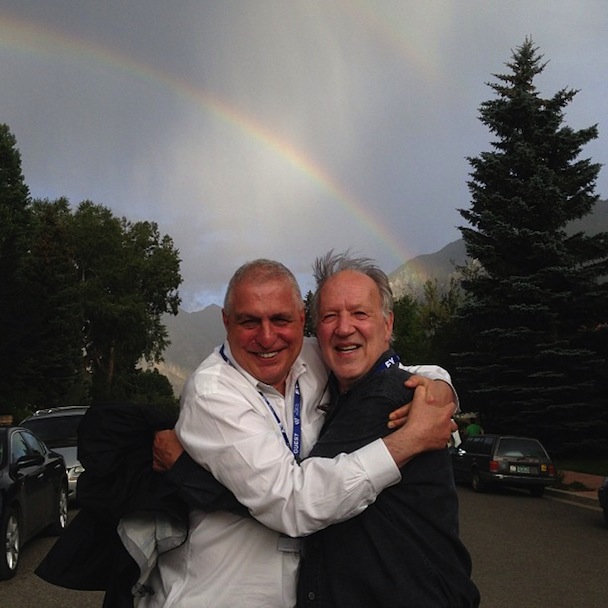
Werner Herzog and Errol Morris Embracing Under a Rainbow

hug

25 Werner Herzog Film Posters

George Saunders Discusses His Writing