With the new Stephen Malkmus & Jicks album set to drop any day now, we thought we’d take a look at the history of SM’s ouvre via his past album covers.
Slanted and Enchanted (1992): Pavement’s first full length defines the so-called lo-fi indie rock sound: scrawling guitars that went to school on Sonic Youth’s Sister, ramshackle percussion (courtesy of original crazy-ass Gary Young), cryptic lyrics, and toneless melodies. The first album also sets the template for the Pavement aesthetic: notebook graffiti, polysemous symbols, postpunk DIY collage work, and lots of scribbling. Key tracks: “Summer Babe,” “In the Mouth a Desert,” “Trigger Cut.”
Westing by Musket and Sextant (1993): The first Pavement record I bought. On tape! From Camelot Music. Because they didn’t have Slanted and Enchanted. The DIY cover is riddled with seemingly cryptic messages that are actually references to songs and albums that Pavement liked (e.g. “Maps and Legends” by REM). Westing takes the DIY look of Slanted to the next level, and helps to inform not just the way Pavement albums and singles will look for the next few years, but also seems to codify the indie rock look in general (see also: Sebadoh). Key tracks: “Box Elder,” “Forklift,” “Debris Slide.”
Crooked Rain, Crooked Rain (1994): This is the first album I remember anticipating coming out. “Luck on every finger”–more cryptology. Was the second song called “Ell Ess Two” or “Elevate Me Later,” or maybe it was “LS2”? Is that SM’s handwriting? An album about rock music. It didn’t leave my CD player for the next three years, and that is no exaggeration. Key tracks: The whole album is perfect. “Gold Soundz” works on any mixtape if you’re in a pinch though. My favorite track might be “Stop Breathin’,” which I think is about the Civil War. For years I thought that Pavement included the only bad track on Crooked Rain, “Hit the Plane Down,” as a kind of purposeful marring, like ancient artisans who included a flaw in their art so as not to displease the gods. Later I just realized that that was the Spiral Staircase track. Continue reading “SM and Pavement: Album Cover Retrospective”→
Sure, founding member Peter Green had a pretty cool guitar style, but really, Lindsay Buckingham and Stevie Nicks made Fleetwood Mac. Buckingham’s guitars achieve a strange, almost paradoxical tone: hard rock chunkiness by way of New Wave-thin; Brian Wilson-influenced melodies by way of punk rock; songs that ache with classic pop harmony but still remain unavoidably dark. Coke-fueled Rumours secured an already great legacy, but my favorite Mac album is, of course, their WhiteAlbum, Tusk.
I hate to admit it, but I prefer this version of “Go Your Own Way” (dig the percussive guitar solo at the end)–
–to this one from the 70s. You tell me which is better.
Genre-defying Junior Brown built his own guitar/steel guitar hybrid, “Big Red,” an improbably shrewd instrument of shred. Brown’s eclectic mix of country, blues, rock and roll, hillbilly, and even classical playing has probably kept him off of more radio stations than is fair, but his brilliant music has led to a huge following. Observe:
Self-confessed one-time Deadhead, Lee Renaldo was the “old guy” in Sonic Youth from the outset. I’ve always imagined that his sense of melody and his quiet, intense disposition are what anchored Thurston Moore’s manic tendencies and Kim Gordon’s dour art poses. Plus, I’ve always liked Renaldo’s solo stuff the best. And then, of course, there’s the Reed Richards look he’s been kickin’ for the past couple of years.
When Les Paul was injured in a terrible car accident in 1948, he had his arm set at a permanent right angle so that he could still play guitar. Now that’s dedication. Les Paul’s flashy, futuristic multi-layered tracks still sound ahead of their time.
Ben Chasny is heir to a tradition that began with Robbie Basho and John Fahey. As Six Organs of Admittance, he makes strange, beautiful psychedelic music that mixes tropes of Western folk with the exotic motifs of Eastern ragas. Very heady stuff. His new album, Shelter from the Ash, set to drop any day now from Drag City records, picks right up where last year’s gorgeous Sun Awakens left off. Great stuff.
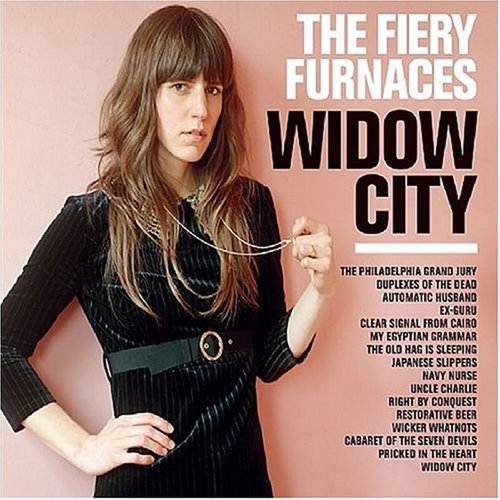
Fiery Furnaces latest, Widow City drops today. I love it. It’s really good rocknroll. It’s great. You should buy it. You’ll love it. Or maybe you hate music? You don’t hate music, do you? Then prove it, sucker.
Also out today: the Vintage paperback edition of Dave Egger’s sorta fictionalized memoir What Is the What? I haven’t read this yet, but my copy should be showing up by next week via Amazon. So I can’t say if you should buy it or not. A lot of folks tend to hate on Eggers without having read his work (I’ve seen people on the net identify his writing as extremely ironic: all one has to do is read A Heartbreaking Work of Staggering Genius (an overrated, completely self-indulgent, but still enjoyable read) to see that this guy is completely earnest. But: many who have read Eggers hate on him as well. So. Granted: McSweeney’s tends to be pretty hipster-smartassed-ironic at times. Still. Earnest, people, earnest). I think it’ll be pretty good though. Will let you know.
If you’re ordering all this stuff online, you might as well pre-order the paperback printing of Chris Adrian’s The Children’s Hospital: it drops later this month. I read it and loved it, despite the fact that my edition was hardback (I find hardback books, particularly those of epic length, awfully difficult to read). You can read all about my love for The Children’s Hospitalhere.
And while I’m completely shilling for McSweeney’s, and championing capitalism in general, I should point out that the October issue of The Believer has a pretty cool interview with Animal Collective’s Panda Bear (or maybe he’s just Panda Bear’s Panda Bear, after the shining genius of Person Pitch) as well as a great essay weighing psychoanalysis against neuroscience. But this is really just a segue to an attempt to redeem my rapacious shilling for the industrial-military complex that is propped up on book and CD and magazine sales. Said segue:
You can read the aforementioned essay without shelling out eight bucks by simply going here, to The Believer‘s website. The current issue’s interview with Optic Nerve writer-artist Adrian Tomine is also up.
But “So what?” you say, “there are plenty of interviews and essays out there. Who cares? Give me something substantial!”
Something substantially funny: Clarke and Michael, the not-so-real-life (but-maybe-sort-of-real-life?) adventures of Clarke and Michael as they shop their screenplay around LA. I love this show.
Also, great archive of free e-books here, if you’re into permanent eye damage.
Finally, you probably don’t know about this yet: Biblioklept has a major scoop: British band Radio Heads plans to release their new album, In Rainbows, tomorrow, for free (technically, you can pay what you want to for it. Which, if you are like me, is probably nothing).
That’s right, folks: you can get music on the internet for free. More italics to emphasize this point. You can get that Radio Heads album here starting tomorrow October 10th.
First off–yes, the entire list could be comprised of Dylan songs. I choose this one simply because it’s one of my favorites, and also from the first Dylan album I ever bought. Dylan visits a psychiatrist and tells him about the awful dreams he’s been having. Dylan is “down in the sewer with some little lover” when the bomb goes off; upon surfacing he discovers a post-apocalyptic world where the survivors aren’t to friendly–in fact, he’s even accused of being a Commie at one point. Even the abandoned Cadillac he finds–a “good car to drive after a war”–brings him no pleasure, and in his loneliness, he takes to calling the automated time update service, but it’s no longer being updated. The doctor cuts him off, saying that he’s been having similar dreams, only he was the only one left alive in his dreams. Dylan ends the song by declaring “I’ll let you be in my dreams if I can be in yours,” the subtlest anti-war slogan I’ve ever heard.
2. Stephen Malkmus, “Jenny and the Ess-Dog”
The tragic story of Jennifer, an 18 year “rich girl,” and her 31 year old boyfriend, “the Ess-dog, or Sean if you wish.” The Ess-Dog plays in a 60s cover band, drives a Volvo, and loves to play frisbee with their dog Trey (um, shades of Malkmus himself?) They love to make out to Dire Straits’ Brothers in Arms and do cocaine (Trey observes their “baby talk voices and post Class-A nasal drip”). Of course, such a romance can’t last: Jenny heads up to college in Boulder and pledges Kappa; the poor Ess-Dog starts waiting tables and even “sells his guitar.” Sad, sad, sad.
3. Roy Orbison, “Running Scared”
In just three verses and under two and a half minutes, Orbison captures all of the paranoia, fear, and triumph of teenage romance. The narrator is always “running scared, feeling low,” afraid that his girl’s ex might show up and try to get her back. Sure enough, his shaky confidence is put to the test: the ex shows up, “so sure of himself, his head up in the air.” The poor narrator’s heart is breaking, but in the final glorious moments, his girl chooses to stay with him. Classic.
4. Kate Bush, “Wuthering Heights”
So you’ve always wanted to read Emily Brontë’s Gothic romance Wuthering Heights but you just don’t have the time? And you don’t even have time to read the Sparknotes version? Or even the Wikipedia entry? Well, never fear–singer-songwriter/space alien Kate Bush recorded a chilling version of the story (okay a tiny little fragment of the story), told from the perspective of poor dead Cathy, pining for Heathcliff–the adoptive brother she spurned (ooh! Incest! uh…sorta). Even if it’s just a take on one part of the novel, it’s still a good story, a great song, and a truly ethereal vocal.
Pretty much every song by my favorite band Fiery Furnaces is some kind of zany adventure narrative, full of places and names and numbers. Blueberry Boat in particular has any number of good narratives–the title track, “Chris Michaels,” “Quay Cur”–but my personal favorite is the rivalry between two brothers at the end of “Chief Inspector Blancheflower.” “Blancheflower,” like many Furnaces’ songs, is a suite; the final segment of the suite is cleverly framed within the rest of the narrative as part of a story told over a “Woodpecker cider with a local fratricider” to the previous narrator. Despite “Mom’s oxycontin and the Amstel light,” the narrator finds that he’s doing all of the talking during a visit to his “younger brother Michael,” prompting him to get “both remotes and turn off the DVD” and confront his brother. It turns out that little Michael is now dating the narrator’s ex, Jenny. “My Jenny?” he asks, dumbfounded, to which little brother replies: “You know damn well she ain’t your Jenny no more.” He confronts Jenny the next day outside her “dad’s bakery,” accusing her of messing with Michael’s head as “some kind of revenge” against him. In the end though, it’s futile. He winds up at a bar, telling the story to the previous narrator.
6. De La Soul, “Millie Pulled a Pistol on Claus”
Dillon, the seemingly benevolent social worker who mentors the fellas in De La Soul, is actually a monster who molests his teenage daughter Millie. She takes her revenge at the local mall, coldly executing her pop who is volunteering as Santa Claus: “Millie bucked him with the quickness/ It was over.” Classic track, classic album.
Unfortunately, no vid for “Millie,” but you can still enjoy “A Rollerskating Jam Named “Saturdays”” (with a sweet Chicago sample, to boot):
7. Public Enemy, “Black Steel in the Hour of Chaos”
“I got a letter from the government the other day/ I opened and read it/ It said they were suckers/ They wanted me for their army or whatever/ Picture me givin’ a damn–I said never.” This is possibly the best opening in the history of rap, but Chuck D only keeps upping the ante: the narrator soon realizes that “the suckers had authority,” and before you can blink, he’s “sittin’ in the state pen,” planning his escape. He attacks a “C-O,” steals his gun, and goes on a prison rampage, “52 brothers” behind him. The faithful S1Ws arrive (with bazookas!) to escort the escapees to northern freedom. Great stuff.
Tricky’s version is pretty good too:
8. Leonard Cohen, “The Partisan”
Cohen adapted “The Partisan” from an old WWII French Resistance song, “La Complainte du Partisan” by Emmanuel D’Astier de la Vigerie and Anna Marly. The historical significance only adds to the song’s haunting melody and diffident spirit. “The Partisan” recounts the sad story of a freedom fighter who has lost his wife and children, but keeps on fighting. “There were three of us this morning,” he says, ominously adding, “I’m the only one this evening.” Grim stuff.
9. Johnny Cash, “Cocaine Blues”
“Cocaine Blues” begins with narrator Willy Lee telling us: “I took a shot of cocaine and I shot my woman down” for messing around on him. He sleeps on the murder, then wakes up the next morning and “takes a shot of cocaine” before taking off. Unfortunately, the cops catch up with him down in Juarez, Mexico. He’s sent to trial, and the “little judge” hands him his sentence “in about five minutes”–“99 years in the Folsom pen.” He laments that he can’t forget the day he “shot that bad bitch down,” warning the listener to “lay off that whiskey, and let that cocaine be.”
I couldn’t find footage of Cash doing the song, but this isn’t so bad:
And if you insist on seeing Cash sing a narrative song:
10. Tom Waits, “Christmas Card from a Hooker in Minneapolis”
The saddest Christmas song ever begins with a junkie whore’s plaintive salutation to her ex-lover: “Hey Charlie I’m pregnant.” She goes on to explain that life now isn’t so bad: her old man, who “works out at the track” knows that the kid isn’t his but promises to “raise him up like he would his own son”; he even gives her a ring that was “worn by his mother” and takes her out dancing “every Saturday night.” Still though, things aren’t great. The hapless narrator delivers one of the saddest lines in any song I’ve ever heard: “I still have that record of Little Anthony and the Imperials/ But someone stole my record player/ How do you like that?” Things get even sadder when the narrator laments: “I wish I had all the money we used to spend on dope.” By the end of the song she comes clean, admitting that she doesn’t have a husband, and that she’s writing because she needs to borrow money. It turns out she’s in prison, and she’ll be “eligible for parole come Valentine’s Day.”
11. New Order, “Love Vigilantes”
“Love Vigilantes” is now over twenty years old and just as relevant as it ever was. This is a love song, a protest song, and a ghost story all in one. The biggest irony isn’t the O. Henry-by-way-of-Poe twist ending, it’s the discrepancy between the ebullient rhythm and pop melody of the music clashing against the mournful lyrics.
12. Belle and Sebastian, “Jonathan David”
On the surface, “Jonathan David” appears to be a song about two guys who like the same girl: “I know you like her/ Well I like her too/ I know she likes you.” However, pick up the Biblical allusion to find the subtext. The narrator says, “I was Jonathan to your David/ You’re still king.” In the Old Testament Book of Samuel, Jonathan takes an extreme liking to future-king David, pledging his undying service to the handsome young hero. For centuries, whether the relationship was platonic, romantic, or sexual has been under debate. Read more here. In the light of the Book of Samuel, Belle and Sebastian’s “Jonathan David” is still about a friendship split by a girl, only it becomes clear now that the narrator is really in love with his friend. In typical B&S fashion, the narrator wavers between hope and despair, declaring at one point that “It’s not like we’ll be parted/ It’s not like we’ll never know love,” before ending on a melancholy note: “You and her in the local newspaper/ You will be married and you’ll be gone.” In the end, his adolescent homosexual infatuation has to give way to public expectation (“local newspaper”), and the simple fact that his friend digs girls.
Although he only played on the first two Allman Brothers albums (“only” does not seem an appropriate modifier here, given how goddamn great those albums are), Duane Allman left behind an enormous legacy in rock and soul music, appearing on singles by King Curtis, Otis Redding, Aretha Franklin, Clarence Carter, along with many others. He also dueled with Eric Clapton on “Layla” (my theory: everything awesome on that track has to do with Allman) and whatever else is on that Derek and the Dominoes album. Allman’s early death by motorcycle accident may have cemented a romantic legacy, but my gut feeling is that he would have been more Neil Young (consistent and relevant) and less fat Elvis (uhmmm…you get the idea) had he had time to produce more music.
Bailey’s avant garde approach to acoustic (and, to a lesser extent, electric) guitar stands out as one of the most challenging and wholly original styles on this list. Bailey is certainly a Not For Everyone type of guitarist: on first listen his music may sound like a stuttering and spewing mess, a series of discontinuous notes that aggravates the ear and angers the blood. But Bailey’s style–besides influencing everyone from Sonic Youth to Fred Frith to Keiji Haino–manages to eschew all the wankery inherent in “free jazz,” replacing it with an odd mix of humor and soul.
Jim O’Rourke is responsible for three of my all-time-favorite-albums: Bad Timing, Eureka, and, along with cohort David Grubbs under the Gastr del Sol moniker, 1996’s Upgrade & Afterlife (an album that I rank along with Pet Sounds, Loveless, and Fear of Music as a slice of sonic perfection). Mr. O’Rourke has produced and mixed more worthy albums than I have space here to mention (although it’s worth pointing out that he is often credited as “saving” Wilco’s Yankee Hotel Foxtrot (see: documentary film I Am Trying to Break Your Heart)), and he was even asked to join Sonic Youth as a fifth member. He’s also done numerous soundtracks, including work with Biblioklept favorite Werner Herzog. Apparently Mr. O’Rourke has quit making albums and has decided to work on making movies instead. Note to Jim: please please please do another solo album–Loose Fur’s Born Again in the USA was good but not great, and we know you have more songs to share! But it seems that I forgot to mention his guitar playing: this is getting long, so suffice to say, he’s better than Slash–a lot better.
O’Rourke plays “The Workplace” (from the EP Halfway to a Threeway) live:
David Pajo was in Slint. He also played guitar for Tortoise on the sublime Millions Now Living Will Never Die album. He’s also one of Will Oldham’s finest partners, adding the guitars for a number of Oldham/Bonnie ‘Prince’ Billy albums, including ‘klept fave Ease Down the Road. I could end there, but Pajo is also the mastermind behind Aerial M and Papa M, two bands responsible for some of the finest “post-rock” this side of the nineties. When Pajo joined Billy Corgan’s ill-fated “comeback” band Zwan (along with Matt Sweeney, of all people), I actually took the time to listen (it wasn’t half bad, really). One of those guys who makes everything he touches a little bit better.
Cool video for “Krusty” from Pajo’s 2001 album, Whatever, Mortal. “Krusty” sounds more like it should come from Pajo’s finest work, ’99’s Live from a Shark Cage–
Dick Dale, surf-rock king, blah blah blah. Dick Dale invented the genre from scratch it seems, providing a template not only for a myriad of copycats from the Ventures to Man or Astroman?, but also some of the basis for flashy heavy metal soloing. And while I’m not a big fan of the genre of “surf rock” anymore (thanks in large part to the mid-nineties overkill of bands like Man or Astroman?), I have to respect Dick Dale’s panache, his verve, and his sheer virtuoso talent on his instrument. Oh, and he’s better than Slash.
“Misirlou” (aka the soundtrack to that ass-rape scene from Pulp Fiction)
I should go on record: Talking Heads are probably my all-time favorite band. When they first started putting out records in the late 70s, the dominant sound on the radio was macho cock-rock; electric twelve-bar blues smothered in wailing and moaning. According to Head’s bassist Tina Weymouth in the liner notes to Sand in the Vaseline, Byrne hated that heavy sound; he wanted his guitar to be as thin, jangly, precise, and rhythmic as possible. Weymouth goes on to point out that Byrne was very proud of his guitar sound, and thought that critics too-often overlooked it, concentrating instead on his odd lyrics and odder dance moves. I think that Byrne doesn’t get enough credit for defining the “indie-jangle” sound: aided by Eno’s treatments, Byrne’s rapid guitar strokes and minimal melodies helped create a template that bands like R.E.M., The Chills, The Feelies, and Luna would continue to refine.
You start a conversation, you can’t even finish it…
Peter Buck was the guy who took jangle to new realms, inflecting his playing with impossible nuance that extended R.E.M.’s sound beyond their basic four-on-the-floor line-up. His spare solos (when there were solos) never impinged on the song’s structure or Michael Stipe’s cryptic vocal, and his mastery of a multitude of other instruments (mandolin, anyone?) helped turn simple pop into musical puzzles. So what if they suck now.
“And that guitar player was no saint”–Mr. Malkmus, “Unseen Power of the Picket Fence”
Responsible for some of the finest cock-rock ever put to tape, Jimmy Page was a real-deal rock star. Don’t believe me? Read Hammer of the Gods. And if you still can’t forgive some of the wankery Led Zep were inadvertently responsible for, remember that this guy was a latter day acolyte of Aleister Crowley. So there’s that.
Who is Jack Rose? I’m not really sure, but he’s unreal on the fretboard. When I first heard Raag Manifestos I flipped my proverbial wig: what was this guy doing? Was this contemporary? Was this ancient? Who is Jack Rose? Like Glenn Jones, Rose is keeping Fahey’s torch burning, playing the finest, ramblingest, finger-pickingest steel-guit-blues-via-raga out there today. But still, who is Jack Rose?
Two words: Dickey Betts. Two words: Allman Brothers. Two words: “Ramblin’ Man.” Two words: Jacksonville native. That’s eight words! Eight words!
About twelve years ago, I went to see Bob Dylan play here in Jacksonville. My uncle had seen Dylan the night before in Tampa. He called me to tell me that Dickey Betts had shown up and played for half the set; it was, of course, just too dang awesome. We waited and waited for Dylan to introduce special secret guest Dickey Betts. I mean, he was from here, ferchrissakes. But that never happened. Regret for something never promised.
As astute reader Nicky Longlunch pointed out in a comment on my last post on 50 Great Guitarists, John Fahey was not only a fantastic guitarist, he was also a published author. Fahey wrote three books–1970’s Charley Patton, a biography of that great blues guitarist (out of print now unless you buy the Charley Patton box set); 2000’s How Bluegrass Music Destroyed My Life, a collection of mostly humorous anecdotes and stories; and the posthumously published Vampire Vultures, a collection of Fahey’s letters, limericks, and interviews. HBMDML and VV are both still in print from Drag City (you can also read a PDF extract from HBMDML there).
I remember enjoying How Bluegrass Music Destroyed My Life back when it was first published, when Mr. Longlunch was kind enough to let me borrow it (I returned it folks!). I recall it as being funny, insightful, and Bukowski-spare; I recall it also exhibiting the same raw pathos that Bukowski infused in his work, but with none of the vulgar meanness. The best parts of the book detail Fahey’s young years in Maryland. I can’t really remember much else. I’d love to read it again, but I can’t really shell out $20 for a paperback right now. And unfortunately, I can’t just borrow it from Longlunch again, because he is no longer in possession.
In his comment, Longlunch griped at me to “Focus!” and he’s right–this blog is supposed to be focused on stolen books, and, poor guy, his copy of HBMDML is (I’m guessing) somewhere in Texas. Or he’s just misplaced it for the past seven years. Or he’s lying about it being MIA because he doesn’t want to loan it out. Which is fair, I guess.
Before I leave, I should also point out that Fahey isn’t the only author I overlooked in yesterday’s post. For years now, Pete Townshend has been doing “research” for his as-yet-unpublished autobiography. So we have that to look forward to.
I’ve been blown away each time I’ve seen Ian Williams play, whether it was in the original monsters of crushing polyrhythmic madness, Don Caballero, the avant-weird hyperkinetic not-jazz of Storm & Stress, or in his current band Battles, where he taps the fretboard with his left hand and plays a keyboard with his right. On top of that, he’s a really nice guy.
Prince is such an extraordinary performer and songwriter that his skills on the axe are often overlooked. The guy is awesome though, displaying a masterful command over his blistering, soul-stinging solos and tight riffage.
Brian May had to invent new instruments and equipment in order to translate the melodic heavy metal pop in his head. His triple-tracked leads, chugging rhythms, and ambient harmonics were certainly showy at times, but Queen was a showy band. Nothing wrong with that–it’s called glam music after all.
Brian May rips up a 10 minute solo from “Brighton Rock”–
Would we care about David Bowie today if Mick Ronson hadn’t been there to boost the one-time fairy-folk singer’s fey melodies and bizarro lyrics with some rocknroll oomph? Maybe, who knows–Bowie was (is) always adept at finding great people to work with (no fewer than three of Bowie’s guitar players will make this list). Besides working with Bowie and the perennially underrated Mott the Hoople, Ronson was always behind the scenes working with all the cool kids–Lou Reed, Bob Dylan, Morrissey, etc.
Ronson tears up the solo from “Moonage Daydream” on the Ziggy Stardust tour–
After making five albums with British folkies Fairport Convention (including my faves Unhalfbricking and Liege and Lief) Richard Thompson set out down the solo path, recording some brilliant albums with his wife Linda, including the classic I Want to See the Bright Lights Tonight. Although he’s best known for his distinctive folk-rock sound and wiry, spare solos, Thompson also made a significant contribution to the new, punk influenced music of the early eighties with his album Shoot Out the Lights–a masterpiece on par with Television’s Marquee Moon and almost as good as anything the Talking Heads ever did.
Check out “Wall of Death” from Shoot Out the Lights—
Frog Eyes are connected to The New Pornographers by way of a band called Swan Lake–Dan Bejar is in both bands. Dan Bejar’s solo stuff as Destroyer kicks ass all day long, and then kicks more ass at night. The New Pornographers have a new record coming out called Challengers, set to drop August 21 on Matador Records. Of course you can’t wait until then to hear Neko Case’s sweet voice. The New Pornographers — “Failsafe.”
We love love love the new Dizzee Rascal album, Maths and English, a big surprise considering his first two albums made no impact on us. Hear Mr. Rascal’s guide to how to succeed in the music industry (play it loud so everyone will know how hardcore you are). Dizzee Rascal — “Hardback (Industry)”
While you wait for the new Black Dice album to drop on Paw Tracks sometime later this year, tide yourself over with the A-side from their latest limited edition 12″ record disc. Black Dice — “Roll Up”
Alog have a new album out on Rune Grammafon called Amateur. It’s the perfect soundtrack for sharpening knives, feeding the azaleas, or just reading stupid magazines. Alog –“Write Your Thoughts in Water”
If you love the Ramones, you really shouldn’t watch the 2003 documentary film End of the Century–it will only break your heart.
I love the Ramones; I’ve loved the Ramones since I was a kid. I was lucky enough to see them in concert about twelve years ago (even then we were hip to the fact that the Ramones without Dee Dee–the C.J. version of Ramones–was not really the real Ramones). My favorite memory of the show was Joey saying that the venue of the show was built on top of a pet cemetery. Then they played “Pet Cemetery.” Genius.
So well and anyway. End of the Century. This is an excellent music documentary, a standout in a genre which is generally hit or miss. Unlike weaker films that rely on narrators or musicians influenced by the subject*, End of the Century is composed entirely of interviews (both archival and original to the film) with the Ramones themselves (Dee Dee, Tommy, Joey, Johnny, Marky, Richie (Richie wears a conservative suit in his interview, and mostly complains about not getting a taste of “that T-shirt money”) and C.J. (C.J. comes across as naive, energetic, and wholly endearing, making me feel kind of bad about my previous opinions of him). In addition to the Ramones’ first-hand accounts, there are plenty of interviews with managers and friends and family and roadies and so on–eyewitnesses who candidly relate the good, the bad, and the ugly in excruciating detail (there is plenty of ugly). Raw live footage dating back to the early 70s brings to life the sheer volume and bizarre intensity of a Ramones show.
So why so heartbreaking? Well, here’s the deal. We know that the John and Paul didn’t like each other. We know that Mick and Keith bicker. We know that bands have “creative differences” and egos get bruised and so and so on. But with the Ramones, well, I guess I always thought of them, as well, cartoons of themselves. But End of the Century makes it very clear that these guys were very, very serious about themselves and what they did. They were in no way cultivating an image: the Ramones really were what you thought they were. And they hated each other. Like, years-of-not-talking-to-each-other hatred, right up until their retirement. They were bitter–they really wanted to be successful. Now, I always thought of the Ramones as legendary, as huge, as the original punk band. But they wanted to be huge, huge like the Beach Boys or the Beatles. Hits on the radio huge (a quick aside: the accounts of working with Phil Spector on the 1980 album End of the Century, in the hopes of gaining a top 10 hit, are hilarious. Apparently Phil held the band plus entourage at gunpoint, threatening to shoot them if they returned to the hotel. The reason for Phil’s hostage-taking: he wanted them to hang out and watch movies. But I’m sure Spector’s like, totally not guilty of murdering that chick in his house). So a lot of the movie is the Ramones lamenting that they “never made it” (again, to me this was ludicrous). But really it’s the hatred, the meanness of their interviews, their complete dismissal of each other that I found most disconcerting (particularly heartbreaking is hearing Johnny’s non-affected nonchalance over Joey’s relatively recent (to the time of the movie’s shooting) death from lymphoma). Maybe I’m just a foolish fan who wanted my cartoons.
The film ends by noting that Dee Dee died of a heroin overdose two months after the film finished shooting. Johnny Ramone died in 2004. The principal members of the band all died within a few short years of each other, like married folks often do.
To end on a lighter note, check out this footage from the film, featuring Dee Dee’s rap project, Dee Dee King’s “Funky Man” (listen for this embarrassing nugget: “I’m a Negro too!”)
* There are one or two very brief interviews (like one or two sentences) with famous fans, including, of course, Thurston Moore, who is contractually obligated to appear in any film about any musician. Check out his prolific (and incomplete–unless my memory fails me he’s also in the 1995 Brian Wilson documentary I Just Wasn’t Made for These Times) filmography here.
This book is as good as you want it to be and there is absolutely no doubt in my mind that David Lee Roth wrote every word of it (no ghostwriters here, pure Roth). I’m not even sure if there was an editor involved, actually. David Lee Roth takes the chronological approach, giving equal time to Van Halen’s earliest days, their 80s success, and his post-Van Halen, big band days. Particularly interesting is David’s illumination of some of the vocal techniques involved in the production of those early Van Halen records (hamburgers and marijuana cigarettes). This book is a treasured gift from a dear friend.
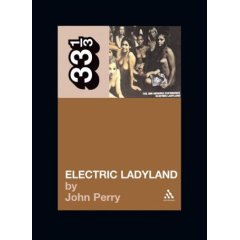
2. Jimi Hendrix’s Electric Ladyland by John Perry.
I read this in like two days. What a great book. Author John Perry was a young eyewitness to many of Jimi’s London gigs; most of the info here is culled from personal memories and observations, as well as discussions with all the people involved. Perry’s style is simple and always focused on the music. The book is divided into seven sections, including a thorough discussion of the instrumentation involved, a detailed track by track review of the album; even a section about the cover. Perry writes from a musician’s point of view, but the most interesting lines to me are about the initial reaction of the American critical press to Jimi Hendrix:
“Behind a whole raft of complaints about Hendrix’s undignified performance and his irritating failure to fit existing critical categories for black performers, lay the essential point that his songs mysteriously failed to punish the audience for being white. Hendrix didn’t play the wounded, angry black man, or the dignified bearer of oppression; he didn’t provide white critics with a handy receptacle for their guilt. They didn’t know quite what role he fulfilled.”
I got this for fifty cents at the Friends of the Library Sale.
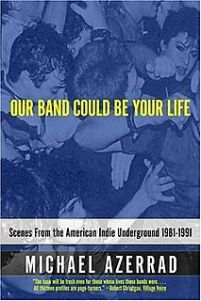
3. Our Band Could Be Your Life by Michael Azerrad.
Your life is probably nothing like any of the sort-of-famous indie bands covered here, unless you basically live in a van. I’m actually not even really sure if this qualifies as a great book. This book is actually just “okay.” Chances are, if you’re a fan of Sonic Youth, Ian McKaye, Dinosaur Jr, or Hüsker Dü you probably know most of this stuff already, or at least the stuff that’s interesting. And if you’re a fan of Beat Happening, well, there you go. This book has a whole chapter on Beat Happening. Actually, if you’re really interested in the whole indie rock thing, 1991: The Year Punk Broke is a much better document. But here I go comparing apples to oranges. I bought Our Band Could Be Your Life at Barnes & Noble for like three or four dollars.
4. Chronicles, Volume 1 by Bob Dylan
It took me a long time to get through this. Let me clarify: I read this in large, fifty page chunks, put it down, picked it up again months later. Dylan’s style is discursive and rambling; he elliptically deconstructs his own myth, picking away at the bits of identity he picked off of other musicians and poets on his way to fame. The book never really gets to that fame–to be clear, it discusses the after-effects of Dylan’s fame in detail: the obsessive fans who showed up at his home unannounced, the bewildering pressure to deliver some kind of messianic answer, the expectations to deliver a specific kind of record–but Chronicles spends most of its pages tracing and retracing Dylan’s youth in Minnesota and his days sleeping on friends’ couches in New York City. Will the second and third volumes ever come out? Who knows with this guy. This book was given to me by my cousin for Christmas a few years ago.
*Also recommended: Anthony Scaduto’s biography Bob Dylan.
5 . Transformer by Victor Bockris
Lou Reed is a weirdo, and Victor Bockris wants you to know about it. Starting with Reed’s Long Island youth (complete with electro-shock therapy), Bockris’s biography covers pretty much everything right up through the Velvet Underground’s early nineties reunion: Reeds early apprenticeship in the Brill Building, the nascent days of the VU (plenty of Warhol anecdotes, of course), punk rock, several doomed romances, his years living with a transvestite, his karate skills, his yoga skills, and his all-bran diet, and of course, the drugs. Oh the drugs. Also, Reed’s solo career is also examined (including plenty of material from guitar god Bob Quine). Bockris seems to feel Magic and Loss is something of a watershed moment in modern rock (anyone who accidentally bought this album knows otherwise).
Bockris’s book employs a bitchy, dishy tone, rife with catty comments from everyone whoever worked with Reed: apparently Lou was a total asshole. Bockris reprints some painful comments (e.g. Reed on Springsteen, 1975: “Isn’t Springsteen over the hill?”); the most awkward moment comes in the book’s appendix, in a transcript of a meeting Bockris arranged between Reed and William Burroughs. Bad idea (Reed can’t remember the name of “that book you published”–Naked Lunch). I can’t remember, but I think I got this for like three or four bucks at Barnes & Noble.
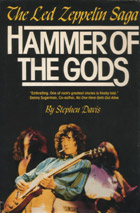
6. Hammer of the Gods by Stephen Davis
“Here’s a red snapper for your red snapper!”
Intrigued? You should be! Burroughs makes a cameo here as well.
I don’t own this one. I read the good bits in high school though.
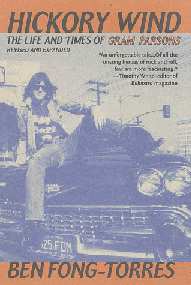
7. Hickory Wind: The Life and Times of Gram Parsons by Ben Fong-Torres
Some jackass made a movie about Gram Parsons’ life a few years ago; I think Johnny Knoxville played Parsons. I didn’t see it, but I’m sure this book is way better. Rolling Stone alum Ben Fong-Torres clearly appreciates Parsons as not only the influential icon that he’s generally recognized as, but also as a truly gifted songwriter. Parsons’ early days in Winterhaven, Waycross, and Jacksonville (he attended the Bolles School) are scrutinized along with his brief stint at Harvard, his time in the Byrds and his days partying with the Rolling Stones in California hippy mansions. Also, another appearance by William Burroughs, who recommended a treatment to help kick the heroin. Parsons’ infamous death in the California desert is also put under the lens, right down to a time-line if I remember correctly. Good stuff. My uncle lent me this book, and yes, I returned it to him. So there.
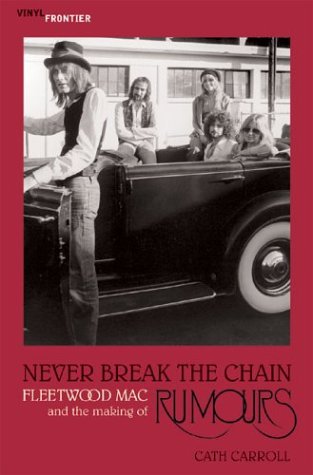
Never Break the Chain: Fleetwood Mac and the Making of Rumours by Cath Carroll (yes, that Cath Carroll) provides an excellent overview of the long, strange career of Mick Fleetwood and company. Like many of you (I’m guessing), I was introduced to Fleetwood Mac via my parents, who played Rumours ad infinitum. It was one of the first albums I “owned”–from the vinyl, I recorded a cassette copy that I played on my Sony Walkman repeatedly. I believe Born on the USA was on the other side. As the years passed, Fleetwood Mac somehow became very uncool to my ears (i.e., they did not rap, there was a paucity of shredding metallic guitar overtures, etc), then slightly cooler, then totally uncool (i.e. the Clintons, the reunion tour), then very very cool (thank you college, thank you Tusk).
Never Break the Chain is organized chronologically, making it easy for readers such as myself to skip around to sections of greater interest. The majority of Carroll’s research comes from previously published articles from magazines like Creem and Rolling Stone, as well as a few interviews. Carroll navigates the Mac’s bizarre history, detailing the numerous personnel changes. Mick Fleetwood is the book’s undisputed hero, the rock(er) who kept the band together through the tumultuous tempest of three decades. It’s fascinating to see how the band transforms from a British blues rock group from the John Mayall school of rock, to the melodic songwriting team that recorded the utterly-Western masterpiece Rumours.
As the title suggests, the making of Rumours becomes the focal point of the book. Carroll explores the bizarre love quadrangles that erupted within the band during that time, although for my taste there wasn’t quite enough VH1’s Behind the Music trashiness to her analysis. Ditto for the legendary cocaine use that supposedly fueled the FM’s late seventies output, which is largely glossed over. However, gearheads who can’t get enough descriptions of studio equipment, instrumentation, and production techniques will love this book. Carroll goes into very detailed accounts of how FM approached songwriting–some of the most interesting passages recount how the band arrived at the album sequences. Plenty of in-fighting, plenty of fights with the studio, and a whole chapter devoted to Tusk. On the whole not bad. However, no substitution for actually listening to the albums.
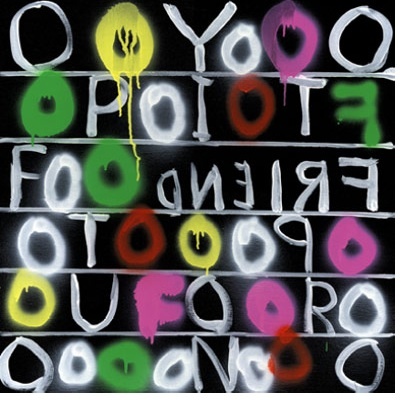
AUDIOKLEPT SPECIAL EDITION: Deerhoof–Friend Opportunity (Kill Rock Stars; releases Jan 23, 2007)
Deerhoof are a kind of paradox–innovators working in a tradition–deconstructing the whole of modern music (as well as not-so-modern-music) with their voices, drums, guitars, and keyboards. With Friend Opportunity, the San Francisco band has distilled the buzz and clatter, the melody, muscle, and grace of their past few albums (2005’s The Runners Four, 2004’s The Milkman, 2003’s Apple O’) into a concise, nearly-perfect 36 minutes. The Runners Four topped a lot of year-end lists last year, but to me it was overlong and undercooked–plenty of good ideas that needed to be edited and refined. With Friend Opportunity,Deerhoof achieves a beautiful balance, reining in chaos and noise in favor of punchy rhythms and hooks that are sure to sink into your mind. Not to say that the vibrant anarchy of past albums has been in anyway discarded or even subdued–Deerhoof have simply gotten better at using chaos as a musical element, a means to an end, rather than an uncontrollable variable. Tracks like album opener “The Perfect Me” and “+81” establish pop ideals, cribbing from classic rock riffs, only to deny, deconstruct and then revive these ideals–all in under three minutes. “The Galaxist” is particularly sweet, opening with Faheyesque guitar picking and breathy melodies, and moving into a joyous beat that would make Fela Kuti proud. If the world had better musical taste, “Matchbook Seeks Maniac” would be on every radio station, the perfect slow dance for the Bizarro World prom. The brevity of these tracks is a plus: most of the tracks on Friend Opportunity lack the repetition common to pop music, moving through several ideas in under three minutes–ideas that stick in the head, causing a listener to hit repeat. The album closer, “Look Away,” is the only track to deviate from this method. Clocking in at over 11 minutes, “Look Away” comprises nearly a third of the album’s content, and will undoubtedly not stand repeated listens by some listeners. The track seems tailor-made for listeners who expect some noise from their Deerhoof, and those listeners won’t be disappointed. Nonetheless, even in an 11 minute anti-epic, Deerhoof controls the chaos and noise, resulting in some challenging and beautiful moments. Despite a 2007 release date, I consider Friend Opportunity one of the best albums of this year. I can’t wait to buy it.
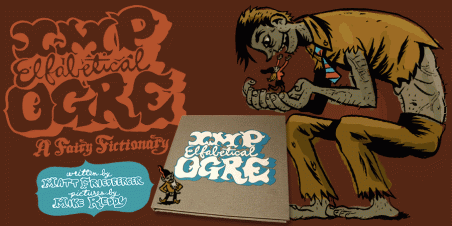
Imp Elfabetical Ogre is “A Fairy Fictionary” written by Matt Friedberger, chief songwriter/musician in my favorite working band, The Fiery Furnaces. Furnaces cover artist Mike Reddy illustrates some of Friedberger’s rhymes about ogres, pixies, elves, and gnomes.
I’m not sure if this is an actual book or just an internet thing or what…it seems incomplete. The pun in the title, and the neologism “Fictionary” seem to suggest a larger, more comprehensive catalog of all things spritely. Just like the Furnaces’ lyrics, the words are highly alliterative and the tales are a little silly. Thanks to RP for sending me the link!
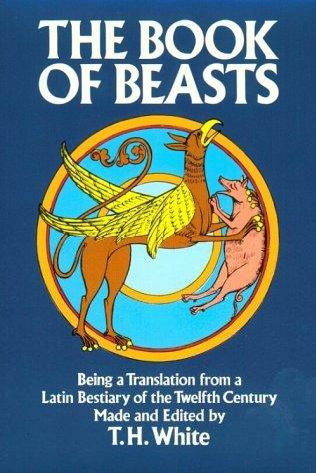
Other recommended bestiaries:
T.H. White? The Twelfth Century? Count me in!
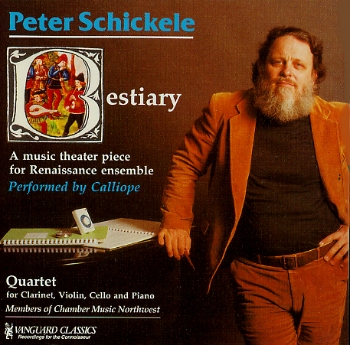
This Peter Shickele (aka PDQ Bach) record looks fantastic, you must admit. Image links to tracklisting, performers, and even some free audio samples! You can also buy this record–on cassette or vinyl only–for a mere $8 (but act fast, “supplies are limited”).
The perfect gift for someone special: check out The Axl Rose and Sidekick Cat Commemorative Dish, available at The Daily Gut.
A few days back this blog reported that Guns n’ Roses are supposed to play Jacksonville on Tuesday, October 31st–Halloween Night. As of now, the tickets are still on sale. For a mere $77.50 a ticket, you will be able to print your own ticket via an internet purchase. For an extra $10 you can even arrange parking ahead of time. Bonus! Has this event been promoted on local radio? I don’t listen to radio, other than 8 minutes of NPR over the morning drive to work. Are the people of Jax psyched? Is Axl Rose a has-been? Will they even play? Who cares?
All the big indie records of 2006: One sentence reviews. Part One.
Bonnie ‘Prince’ Billy–The Letting Go: Who knew he had another record this good in him?
Neko Case–Fox Confessor Brings the Flood: “Star Witness” is the best song of 2006.
Destroyer–Destroyer’s Rubies: Dan Bejar is over the top and this record is gorgeous.
Thom Yorke–The Eraser: […] hmmm […] oh sorry, I must’ve dozed off there […]
The Walkmen–A Hundred Miles Off: I recently heard “The Rat” in the background of an NCAA Football commercial–I enjoyed that more than anything on this record.
The Walkmen–Pussycats: Uhmmm…yeah…uhmmm, okay cool guys, you have your own studio, you can just do whatever you want I guess.
Beck–The Information: Beck’s a fucking scientologist.
Ghostface Killah–Fishscale: I’m supposed to love this, right?
Girl Talk–Night Ripper: This might be the year’s best album…
The Flaming Lips–At War With the Mystics: It seems like they will continue to make these types of records.
The Decemberists–The Crane Wife: This is overrated, boring crap.
The Hold Steady–Boys and Girls in America: …speaking of overrated, boring crap.
The Fiery Furnaces–Bitter Tea: Their prettiest album yet; not as good as Blueberry Boat but better than any record by any other band that came out this year.
Matthew Friedberger–Winter Women: Contains no fewer than four radio gems.
Matthew Friedberger–Holy Ghost Language School: I keep meaning to listen to it again.
Lambchop–Damaged: I’m too busy for this level of subtlety.
Lambchop–The Decline of Country & Western Civilization, Pt. 2: The Woodwind Years: Their title is too long–counts as review.
Mercury Rev–Essential Mercury Rev: Go out and buy the real “essential” Mercury Rev: Yerself is Steam, Bocces, and See You on the Other Side.
Gnarls Barkley–St. Elsewhere: We will all remember this album as fondly as we remember that Chumbawumba album, or possibly our EMF Greatest Hits CD.
Not a book, but nonetheless obtained by extra-legal means. Piracy baby!
SubPop is set to drop The Shins’ third album Wincing The Night Away in January of 2007, but the thing leaked like a sieve this weekend. Similarly, Of Montreal’s album Hissing Fauna, Are You The Destroyer?, set for a January release, leaked over the last two weeks. I don’t understand why these labels delay releases so long after the record’s been mastered. It’s almost impossible these days to keep a record from leaking–although Thom Yorke managed to keep his solo record The Eraser from leaking right up until it was released.
On paper, The Shins are the type of band I would love to hate. They write tight pop songs with keen melodies and spare harmonies with frequent nods to classic 60s acts like The Kinks, The Beatles, The Zombies and The Beach Boys (unlike every other indie band made up of four white guys). They are name-dropped in the epitome of bad indie films, Zach Braff’s Garden State (Natalie Portman’s character declares them “life-changing”). They appeared in an episode of The Gilmore Girls as a band playing to a club full of improbably ecstatic springbreakers in Ft. Lauderdale.
Despite all of this, I like them quite a bit. Their songs are catchy in a good way. They certainly aren’t re-inventing the wheel, but if you’re going to listen to an indie rock band, you might as well listen to The Shins. All that said, I like their new album a lot, much better than their last Chutes Too Narrow actually, which I thought was too airy. Wincing evinces some growth in songwriting and arrangements, and on the whole the production is much fuller than the past two albums. Wincing features a more prominent use of atmospheric sounds. Synthesizers are utilized to greater advantage advantage with respect to both melodies and atmosphere, and the band even brings in what I believe to be a small string section one one song. They even play with vocal loops on this record.
I don’t know if this band will ever top their first record Oh, Inverted World, a record that somehow was simultaneously breezy and profound, and produced at least four songs that can never go wrong on a mixtape. I’ve listened to it a few times, but there doesn’t seem to be a “New Slang” or “Know Your Onion” on this album. Wincing however seems to work better as a whole album than The Shins’ previous efforts, and the stronger production and fuller arrangements will probably earn the group a broader fanbase.










 Biblioklept
