
In his 1978 collection Airships, Barry Hannah sets stories in disparate milieux, from the northern front of the Civil War, to an apocalyptic future, to the Vietnam War, to strange pockets of the late-twentieth century South. Despite the shifts in time and place, Airships is one of those collections of short stories that feels somehow like an elliptical, fragmentary novel. There are the stories that correspond directly to each other — the opener “Water Liars,” for instance, features (presumably, anyway), the same group of old men as “All the Old Harkening Faces at the Rail.” The old men love to crony up, gossip, tell tall tales. An outsider spoils the fun in “Water Liars” by telling a truth more terrible than any lie; in “Harkening,” an old man shows off his new (much younger) bride. These stories are perhaps the simplest in the collection, the homiest, anyway, or at least the most “normal” (whatever that means), yet they are both girded by a strange darkness, both humorous and violent, that informs all of Airships.
We find that humor and violence in an outstanding trio of Civil War stories (or, more accurately, stories set during the Civil War). The narrator of “Dragged Fighting from His Tomb,” a Confederate infantryman relates a tale of heroic slaughter with a hypberbolic, phallic force. Observe—
I knew the blueboys thought they had me down and were about ready to come in. I was in that position at Chancelorsville. There should be about six fools, I thought. I made the repeater, I killed four, and the other two limped off. Some histrionic plumehead was raising his saber up and down on the top of a pyramid of crossties. I shot him just for fun. Then I brought up another repeater and sprayed the yard.
Later, the narrator defects, switches to the Union, and claims he kills Jeb Stuart, a figure that towers over the Civil War tales. The narrator of “Dragged Fighting” hates Stuart; the narrator of “Knowing He Was Not My Kind Yet I Followed” is literally in love with the General. In contrast to the narrator of “Dragged Fighting,” the speaker in “Knowing” — an avowed “sissy” whom the other soldiers openly detest — hates the violence and madness of war—
We’re too far from home. We are not defending our beloved Dixie anymore. We’re just bandits and maniacal. The gleam in the men’s eyes tells this. Everyone is getting crazier on the craziness of being simply too far from home for decent return. It is like Ruth in the alien corn, or a troop of men given wings over the terrain they cherished and taken by the wind to trees they do not know.
He despairs when he learns of Jeb Stuart’s death. In the final Civil War story, “Behold the Husband in His Perfect Agony,” a Union spy is given the task to communicate news of Stuart’s death through enemy lines. Rather than offering further explication, let me instead point you, dear reader, to more of Hannah’s beautiful prose, of which I have not remarked upon nearly enough. From “Behold the Husband” —
Isaacs False Corn, the Indian, the spy, saw Edison, the Negro, the contact, on the column of an inn. His coat was made of stitched newspapers. Near his bare feet, two dogs failed earnestly at mating. Pigeons snatched at the pieces of things in the rushing gutter. The rains had been hard.
The short, descriptive passage rests on my ears like a poem. Hannah, who worked with Gordon Lish, evinces in his writing again and again that great editor’s mantra that writing is putting one sentence after another.
Although set in the Vietnam War, “Midnight and I’m not Famous Yet” seems an extension of the Civil War stories. In it, an officer from a small Southern town goes slowly crazy from all the killing, yet, like the narrator of “Dragged Fighting,” he presents himself as a warrior. Above all though, he laments that the war has robbed him of some key, intermediary phase of his late youth, a phase he can’t even name—
The tears were out of my jaws then. Here we shot each other up. All we had going was the pursuit of horror. It seemed to me my life had gone straight from teen-age giggling to horror. I had never had time to be but two things, a giggler and a killer.
This ironic sense of a “pursuit of horror” pervades Airships, particularly in the collection’s most apocalyptic visions. “Eating Wife and Friends” posits an America where food shortages and material scarcity leads people to eating leaves and grass — and then each other. In “Escape to Newark,” the environment is wildly out of balance—
In August it’s a hundred fifty degrees. In December it’s minus twenty-five and three feet of snow in Mississippi. In April the big trees explode.
A plan is made to “escape” these conditions via a rocket, but of course there’s not enough fuel to get past Newark. In Airships, modes of flight are transcendent but ultimately transient. Gravity’s pull is heavy stuff.
Just as Hannah’s war stories are not really war stories, his apocalypse tales are really about human relationships, which he draws in humor, pathos, and dark cynicism. In “Green Gets It,” an old man repeatedly attempts his suicide, only to fail again and again. His suicide note, written to his daughter, is scathing and shocking and sad and hilarious and wise–
My Beloved Daughter,
Thanks to you for being one of the few who never blamed me for your petty, cheerless and malign personality. But perhaps you were too busy being awful to ever think of the cause. I hear you take self-defense classes now. Don’t you understand nobody could take anything from you without leaving you richer? If I thought rape would change you, I’d hire a randy cad myself. I leave a few dollars to your husband. Bother him about them and suffer the curse of this old pair of eyes spying blind at the minnows in the Hudson.
Your Dad,
Crabfood
Although Hannah explores the darkest gaps of the soul in Airships, he also finds there a shining kernel of love in the face of waste, depravity, violence, and indifference. This love evinces most strongly perhaps in Airships trio of long stories. These tales, which hover around 30 pages, feel positively epic set against the other stories in the collection, which tend to clock in between five and ten pages. The first long story, “Testimony of Pilot,” details the development of a boyhood friendship over a few decades. It captures the strange affections and rivalries and unnameable bonds and distances that connect and disconnect any two close friends. The second of the long tales is “Return to Return,” a tragicomic Southern drama in the Oedipal vein (with plenty of tennis and alcoholism to boot). As in “Testimony of Pilot,” Hannah finds some measure of redemption, or at least solace, for his characters in their loving friendship, yet nothing could be more unsentimental. The final long story, which closes the collection, is “Mother Rooney Unscrolls the Hurt,” a daring work of stream of consciousness that seems to both respond to — and revise — Katherine Anne Porter’s “The Jilting of Granny Weatherall.” The story concludes (and of course concludes the volume) with a vision of love that corresponds to the imagery of The Pietà, a kind of selflessness that ironically confirms the self as an entity that exists in relation to the pain of others.
I could keep writing of course — I’ve barely touched on Hannah’s surrealism, a comic weirdness that I’ve never seen elsewhere; it is Hannahesque, I suppose. Nor have I detailed Hannah’s evocations of regular working class folk, fighting and drinking and divorcing and raising children (not necessarily in that order). Airships is a world too rich and fertile to unpack in just one review, and I’ve already been blathering too long, I fear, when what I really want to do is just outright implore you, kind reader, to find it and start reading it immediately. Very highly recommended.
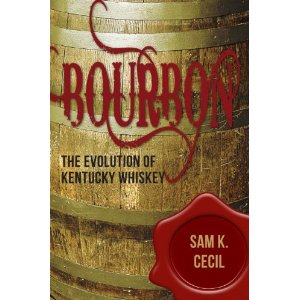 Hey. Do you like bourbon? I like bourbon a lot. It’s always been of a mild shame to me that the men in my family prefer the smoother stylings of Canadian whiskeys to the more robust corn-fueled liquors we produce here in the south. Now, as to whether Kentucky or Tennessee makes the finer product, I abstain from any definitive opinions (although a particular favorite brand of mine comes from Kentucky) because, as Sam K. Cecil’s book Bourbon: The Evolution of Kentucky Whiskey shows, there are many, many, many distilleries of bourbon (and that’s just in Kentucky alone).
 Listening to Gordon Lish read selections from
 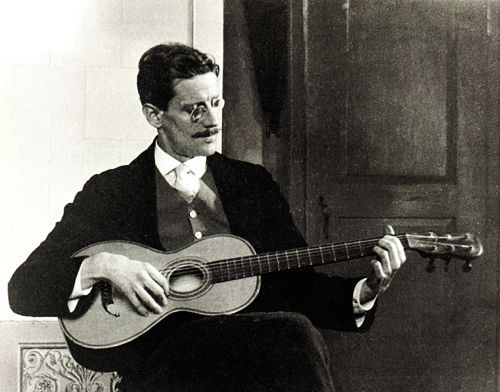 My third (complete) trip through James Joyce’s Ulysses finds me just as (or even more than) stunned as the previous two journeys, a bit (very much) unequal to properly reviewing the book, but this time with an easy out — I listened to an unabridged, full cast audio recording. The aforementioned “easy out” is resting on the received greatness and goodness (and evilness) of the book, which I will hardly contend with and heartily endorse (and do very little real critical work to support my endorsement). Ulysses is fantastic. But what about this audio recording?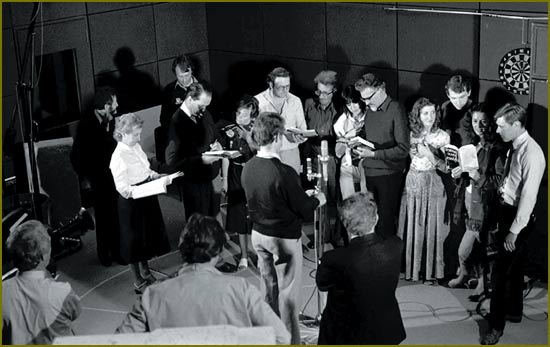
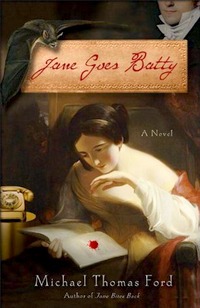 In the past few years we’ve seen a spate of books where public domain characters and historical figures feature in supernatural tales, usually written in an ironic, or at least parodic mode. It seems like a heavy percentage of these books are mixed up somehow with Jane Austen, whose legacy has become grist for a literary cottage industry, with a new “re-imagining” of Pride and Prejudice or Sense and Sensibility coming out every season. Last year, Michael Thomas Ford offered the public the mix of Jane Austen and vampires we had been so desperately clamoring for, Jane Bites Back. By way of a little more context (and pure laziness), I’ll quote
  Jane’s editor decides to become an agent and leaves her with Jessica Abernathy (evil nemesis in Batty); Jane has to run constant interference on her wacky/charming friend Lord Byron (also a vampire, of course); etc., etc., etc. The most ridiculous/campiest plot device of all though is that Jane is converting to Judaism to please her boyfriend Walter’s judgmental mom. Yes. That’s right. We also learn that Jane played Magenta in a traveling production of The Rocky Horror Picture Show in the seventies, a minor detail to be sure, but one that seems to reinforce Ford’s whimsical kitsch. Batty aims for a kind of sassy brevity in its scene constructions, and while its certainly not a book for me, I think that those who want to see Jane Austen as a 21st century vampire will probably enjoy it quite a bit. Jane Goes Batty is new in trade paperback from
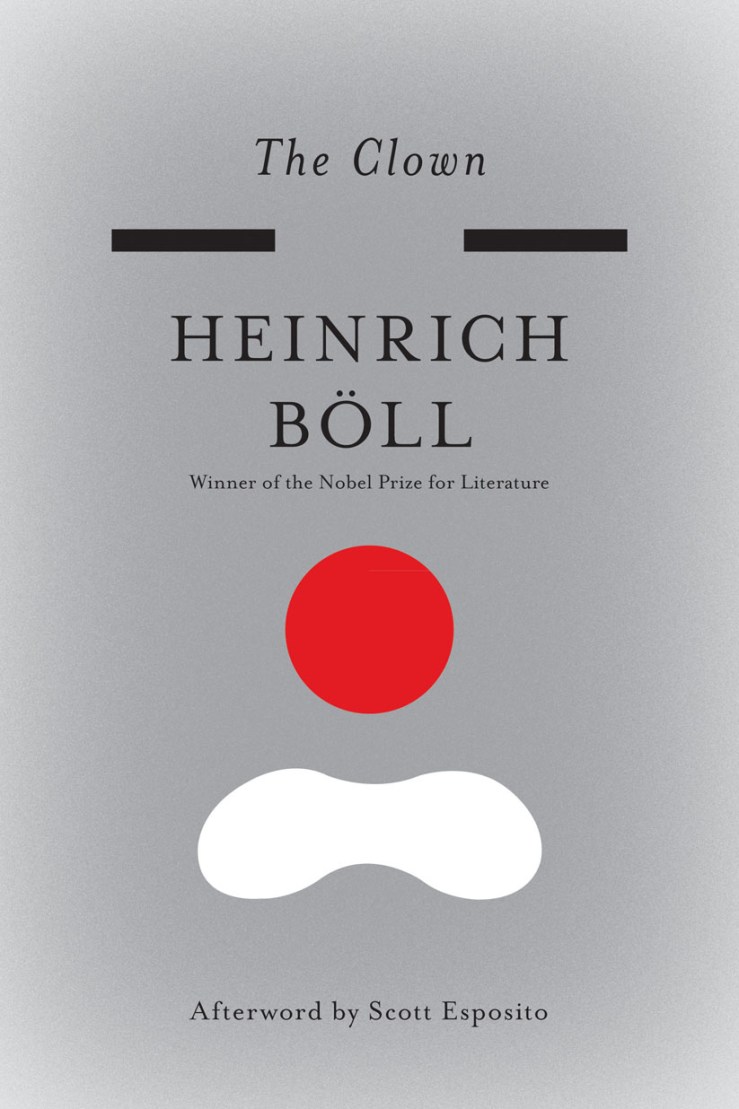 The titular figure in Heinrich Böll’s 1963 novel The Clown is Hans Schnier, a man whose personal and professional life is burning down around him as he howls in (often hilarious) despair. During a performance at a third-rate venue, Hans purposefully injures his knee and retreats to Bonn, where he holes up in his small apartment and makes angry desperate phone calls (and tries not to drink too much brandy) as he reflects on his past.
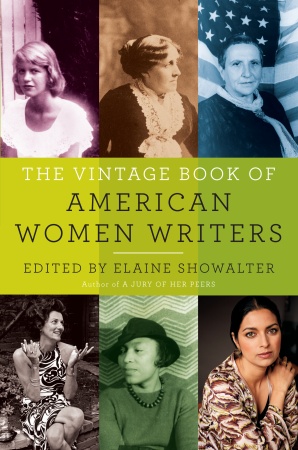 In her introduction to The Vintage Book of American Women Writers, editor Elaine Showalter suggests that “the main reason women do not figure in American literary history is because they have not been the ones to write it.” Showalter sought to amend the fact that women writers, even those who were praised in their own era, “tended to disappear from literary history and national memory” in her earlier volume
  I shouldn’t be reading five novels at once. It’s a terrible idea, a symptom of a bad habit that I thought I’d broken, but after abandoning Levin’s tedious tome
 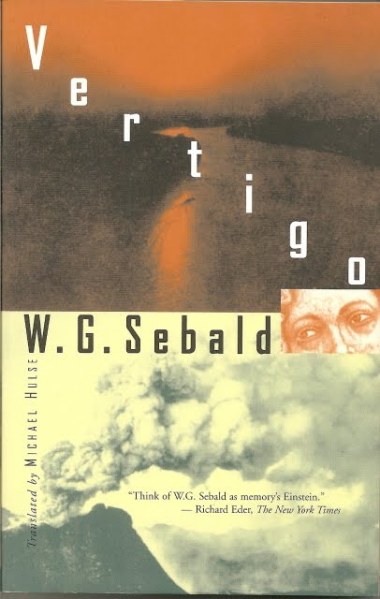 Iyer’s book dovetails nicely with W.G. Sebald’s first novel, Vertigo, which I picked up expressly to get the bad taste of Shteyngart out of my brain. Both books are haunted by Kafka, both blur the lines between fiction and biography, both are works of and about flânerie, and both are melancholy. The book comprises four sections; the first section tells the story of the romantic novelist Stendhal (or, more to the point, a version of Stendhal); the second section details two trips Sebald made to Italy, one in 1980, and one in 1987; the third
  section, which I just read last night, describes a trip Kakfa took to Italy near the end of his life. I’m almost certain that I’ve read this section, “Dr. K Takes the Waters at Riva,” before — but I can’t remember where or when. It was strange reading it, almost as if I were experiencing some of the vertigo that permeates the volume. Full review forthcoming.
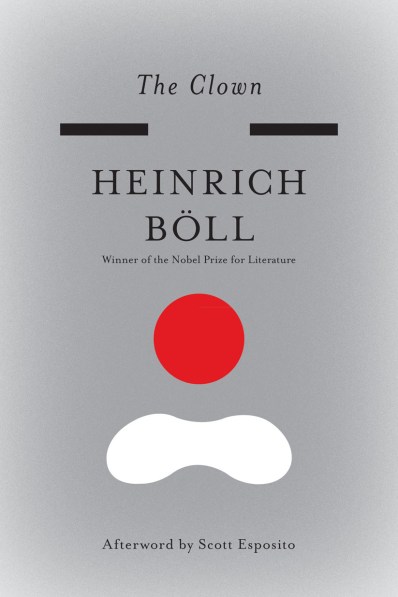 Continuing in this Teutonic vein is Heinrich Böll’s novel The Clown (also Melville House). It’s postwar Germany, and Hans Schnier is a clown who’s crashing and burning. He hurts himself–purposefully–during a performance (at one of the increasingly more provincial venues he finds himself playing for these days) and retreats to Bonn, where he holes up in his small apartment and makes angry desperate phone calls (and tries not to drink too much brandy) and reflects on his past. What’s eating him up? His gal Marie, basically his common-law wife, has reverted back to her Catholic ways and up and left him for some chump named Zupfner. Schnier rants against a complacent and complicit German bourgeoisie, spitting vitriol against Protestants and Catholics alike; some of the best parts of the novel though are his ravings about art and the role of the “artiste” in society. Also: he can smell over the phone. Full review soon.
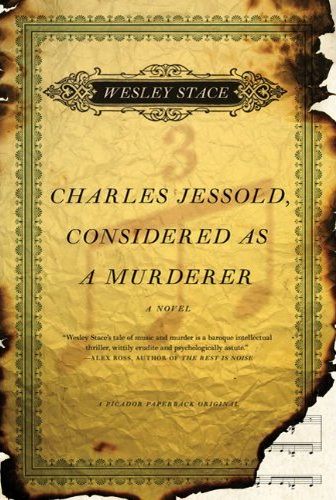 Wesley Stace’s new novel Charles Jessold, Considered as a Murderer (new from Picador) is a musical murder mystery set in the early part of 20th century Britain. Our (seemingly less than reliable) narrator Leslie Shepherd is a music critic with an aristocratic background who likes to spend his weekends collecting folk songs with other rich boys in the towns surrounding their country manors. He’s smitten (platonically, of course) with Charles Jessold, a middle class composer with a spark of avant-garde genius, and wins the younger man’s friendship quickly when he tells the story of Carlo Gesualdo, a fifteenth century composer/lord who kills his wife and her lover. (Notice the etymological connection between their names?) This tale of murder and cuckoldry is doubled in the ballad “
 At a certain point, I was inclined to write a thoughtful review of Gary Shteyngart’s much-lauded, truly awful novel Super Sad True Love Story, the kind of review that might try to weigh Shteyngart’s choked May-December romance against its dystopian background. That was a few chapters in, a point at which I’d gotten past the realization that Shteyngart was going to do nothing new with the dystopian genre I so love, yet still early enough for me to think that he might have something to say about American culture and politics in the early 21st century. There’s nothing there, though — Super Sad True Love Story subscribes to the normal dystopian program of synthesizing 1984 and Brave New World through a contemporary lens, yet what we’re left with is Shteyngart’s observation that people might not like to read as much as they used to.
 to be sure, but hardly an insignificant figure of the Elizabethan era). We identify in the Tudors a certain sexiness (one milked shamelessly by Showtime’s silly series), as well as its corollary intrigue: personal scandal for these royals was politicized; what happened in the bedroom affected the public sphere. There is something strikingly modern about this fact, which perhaps also makes us turn our attention to the Tudors again and again.
 Cecil, Elizabeth’s adviser, an employee of the Duke of Northumberland who meanwhile plots to raise Jane Grey to the throne (a move that would cut Elizabeth out of succession). The Tudor Secret is a tightly-plotted, quick-paced read, stuffed with animated historical characters buzzing around in a world of espionage and intrigue. Setting the stage for the ascendancy of a crafty Elizabeth I, the book is the first in a planned series called the Elizabethan Spymaster Chronicles.
 The Girl with Glass Feet is the début novel from British author Ali Shaw. Set in the remote archipelago of St. Hauda’s Land and steeped in the traditions of English folklore, Shaw’s novel works in the idiom of magical realism. His titular girl Ida Maclaird suffers from a strange affliction: she’s slowly turning into glass. She returns to St. Hauda’s land in the winter (after a previous summer holiday there) in the hopes of finding a cure. There she meets Midas Crook (whose symbolically overdetermined name seems part and parcel of Shaw’s program), a photographer fascinated by his father’s ghost stories about the isolated archipelago who is trying to capture something of its haunted spirit in his pictures. Together (and with the help of some strange locals) the pair tries to find answers against a melancholy and magical backdrop of tiny winged cows, albino crows, and other grotesques. A sample ghost story, one of many in Glass Feet—
 In The Three Weissmanns of Westport, Cathleen Schine transposes the Dashwoods of Jane Austen’s Sense and Sensibility to a dilapidated beach cottage in Westport, Connecticut. When 78 year old Joseph divorces his 75 year old wife Betty, and his mistress essentially forces her from their high-end NYC apartment, Betty rallies by moving to the beach cottage with her daughters, impulsive Miranda, a literary agent, and practical Annie, a library director. The premise may sound like the domain of that most maligned of genres, “chick lit,” a fact that many reviewers tackled when it debuted in hardback last year. Here’s
 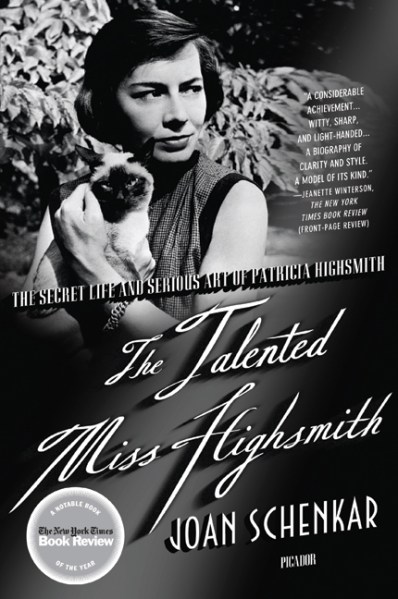 Before looking over Joan Schenkar’s exhaustive biography of Patricia Highsmith, The Talented Miss Highsmith: The Secret Life and Serious Art of Patricia Highsmith, I have to admit that I thought of the writer primarily as a practitioner of pulp fiction, the kind of lurid crime tales at home in airport bookshops. In recent years, I’ve come to reevaluate my stance on crime noir in particular (which I wrote about
  Biblioklept
