Boy oh boy this is great (yes, I am that kind of nerd). A few years ago The New Yorker published an early draft of Raymond Carver’s short story “What We Talk About When We Talk About Love,” which was originally titled “Beginners.”The New Yorker simultaneously published a version of the story showing Gordon Lish’s edits. It’s a fascinating look at the Carver-Lish writing experience. In the sample that follows, strike-throughs are deletions and boldfaced words are Lish’s additions—
My friend MelHerb McGinnis, a cardiologist, was talking. Mel McGinnis is a cardiologist, and sometimes that gives him the right.¶ The four of us were sitting around his kitchen table drinking gin. It was Saturday afternoon. Sunlight filled the kitchen from the big window behind the sink. There were MelHerb and meI and his second wife, Teresa—Terri, we called her—and my wife, Laura. We lived in Albuquerque,then.But but we were all from somewhere else. ¶ There was an ice bucket on the table. The gin and the tonic water kept going around, and we somehow got on the subject of love. MelHerb thought real love was nothing less than spiritual love. He saidWhen he was young he’d spent five years in a seminary before quitting to go to medical school. He He’d left the Church at the same time, but he said he still looked back onto those years in the seminary as the most important in his life.
Terri said the man she lived with before she lived with MelHerb loved her so much he tried to kill her. Herb laughed after she said this. He made a face. Terri looked at him. Then Terrishe said, “He beat me up one night, the last night we lived together. He dragged me around the living room by my ankles. He kept saying,, all the while saying, ‘I love you, don’t you see? I love you, you bitch.’ He went on dragging me around the living room. My , my head kept knocking on things.” TerriShe looked around the table at us and then looked at her hands on her glass. “What do you do with love like that?” she said.¶ She was a bone-thin woman with a pretty face, dark eyes, and brown hair that hung down her back. She liked necklaces made of turquoise, and long pendant earrings. She was fifteen years younger than Herb, had suffered periods of anorexia, and during the late sixties, before she’d gone to nursing school, had been a dropout, a “street person” as she put it. Herb sometimes called her, affectionately, his hippie.
“My God, don’t be silly. That’s not love, and you know it,” MelHerb said. “I don’t know what you’d call it,—madness is what I’d call it—but I sure know you wouldn’t call itit’s sure as hell not love.”
Listening to Gordon Lish read selections from Iambik Audio’s compendium of his Collected Fictions for the fourth time today, it occurred to me that I should just go ahead and review the damn thing. Quit stalling. Get to it. I hope that pointing out that I’ve listened to Lish narrate ten of his odd, funny, gut-wrenching tales four times now (and will surely listen again) is enough to motivate thee, gentle reader, to follow my example—but that’s lazy, wishful thinking, right? There needs to be a proper review. Here goes—
Lish is perhaps more famous as an editor than a writer of short fiction. He worked for years at Vanity Fair and later for Knopf, and the list of writers that he championed reads like a who’s-who of contemporary greats: Don DeLillo, Cynthia Ozick, Amy Hempel, Barry Hannah, David Leavitt, and Harold Brodkey, just to name a few. The writer he is perhaps most associated with though is Raymond Carver. By paring down sentence after sentence, Lish helped Carver develop his spare, minimalist style.
It’s that attention to sentences, to the truth of each sentence, to their individual force, that shines through in the collection. Consider this beauty, from “The Death of Me,” a story about a boy (surely Gordon Lish, hero of all Gordon Lish stories) who peaks too early, winning first place in all five field events at his summer camp one fine day in 1944, and then succumbing to the realization that this apex is, frankly, the end of it all–
I felt like going to sleep and staying asleep until someone came and told me that my parents were dead and that I was all grown up and that there was a new God in heaven and that he liked me better even than the old God had.
This sentence seems to me to be the expression of an emotion that I’ve felt for which I have no name. Lish’s sentences can move through tragedy and pathos to devastating comedy, a kind of comedy that collapses the auditor. Check out a line from “Mr. Goldbaum”–
What if your father was the kind of father who was dying and he called you to him and you were his son and he said for you to come lie down on the bed with him so that he could hold you and so that you could hold him so that you both could be like that hugging with each other like that to say goodbye before you had to actually go leave each other and did it, you did it, you god down on the bed with your father and you got up close to your father and you got your arms around your father and your father was hugging you and you were hugging your father and there was one of you who could not stop it, who could not help it, but who just got a hard-on?
Lish advised, “Don’t have stories — have sentences,” but “The Death of Me” and “Mr. Goldbaum” are more than the sum of their parts, more than just a collection of sculpted, scalpeled syntax. From the 1988 collection Mourner at the Door (the only Lish book I’d read before Collected Fictions), both stories announce Lish’s major theme of death, the absurdity of death, or the absurdity of life against the inevitability of death—but also the heavy truth of death, the ugly truth of death, the powerlessness of language against the finality of death. “Spell Bereavement,” also from Mourner, is essentially a prequel to “Mr. Goldbaum”: Gordon gets the news of his father’s death from his sister and mother. The story takes place over the phone as a sort of switch-hit interrogation, as mom and sis caustically berate the speechless man, who tells us, at the end, “There are not people in my heart of hears. There are just sentences in my heart of hearts.” Why does Gordon the narrator of “Spell Bereavement” fail to respond to the news of his father’s death? He is “too disabled to talk . . . going crazy with pencil and paper so as not to miss one word.”
Lish means to capture the ecstatic truth in death, and truth is at the core of all these stories, even when they are fables of a sort, like “After the Beanstalk,” which features a bewitched princess who has been transmogrified into a dog. The tale is hilarious and cutting and sad. There’s also “Squeak in the Sycamore,” which begins as a child’s list of fears and enumerations of death and longing and nature and ends in a joke and then an insult to the reader for laughing at the joke. (Best line: “Six is: the gardener died from digging up a basilisk”). “How to Write a Poem” is a caustic rant that argues that literary theft is really a matter of stern guts, of facing truth, and “Everything I Know” problematizes the very act of storytelling — it’s a story about how we tell stories, or our versions of stories. By far the most affecting piece that Lish reads though is “Eats with Ozick and Lentricchia,” about which he tells us, before reading it, “there is not a word of it that is not true.” It is a story that hovers around the death, or the dying of, more accurately, Lish’s wife Barbara; its details are almost too cruel, too true to bear.
Lish reads his tales in a bold voice that seems to challenge the auditor at all angles, as if his sentences were prodding you, poking you, pinching you even. He claims, in one of the many asides that precede these tales, to have never really read his work aloud before, and not to have really read the work in years, but his confidence seems to belie this notion; maybe, more accurately, it conveys the intense concentration of his intellect. His tone fascinates, and then he cracks out something like: “It always astonishes me I could have written such a thing” in such a dry honest voice that, while his quip hangs ambiguous, it remains utterly sincere. There’s a wonderful moment in the recording when he moves from reading “Mr. Goldbaum” to “Spell Bereavement” and seems to notice, as if for the first time, their close connection. He then remarks–
It shames me in one kind of way to see that my writing gathers itself into such a rut, but on the other hand it does please me to have spoken again and again and again about that which occurred to me at the time to be of consequence. I haven’t written fiction or anything else really for a great number of years and this occasion, reading these pieces, is an education for me and alien, foreign, in one kind of way, because the sentences are complex, but in another kind of way, I’m reminded of who I am.
Lish’s influence cannot be underestimated, from writers like David Foster Wallace to Denis Johnson to Sam Lipsyte, and all of those who will follow in turn. Readers have a fantastic (and incredibly inexpensive, I must add) starting place in Iambik’s wonderful collection. Do yourself a favor and check this out. Very highly recommended.
Barry Hannah’s fame is of a peculiar kind. Ask people about him, and either they’ll say they’ve never heard the name (despite his nominations for both the National Book Award and the Pulitzer Prize) or they’ll get a feverish, ecstatic look before they seize you by the lapels and start reeling off cherished passages of his work. Echoes of familiar Southern tropes appear in Hannah’s novels and short stories: outlandish violence, catfish, desperate souls driven half mad by lust and drink. But in Hannah’s fiction the South becomes an alien place, narrated in a dark comic poetry you’ve never heard before, peopled with characters that outflank and outwit the flyspecked conventions of Southern lit. A Civil War scribe whose limbs—save his writing arm—are shot off. A serial killer who looks like Conway Twitty and makes his victim suck a football (“moan around on it some”) before beheading him. A Wild West widow who lashes a personal ad to a buzzard in hopes of finding a man. In Hannah’s panoramas, you’ll find hints of William Faulkner, rumbles of Charles Bukowski, and the tongue-in-cheek grotesquerie of David Lynch. But the fierce inventiveness of Hannah’s prose makes him something sui generis entirely, a writer who renders the project of comparison a farce.
Every whole person has ambitions, objectives, initiatives, goals. This one particular boy’s goal was to be able to press his lips to every square inch of his own body.
His arms to the shoulders and most of his legs beneath the knee were child’s play. After these areas of his body, however, the difficulty increased with the abruptness of a coastal shelf. The boy came to understand that unimaginable challenges lay ahead of him. He was six.
There is little to say about the original animus or “motive cause” of the boy’s desire to press his lips to every square inch of his own body. He had been housebound one day with asthma, on a rainy and distended morning, apparently looking through some of his father’s promotional materials. Some of these survived the eventual fire. The boy’s asthma was thought to be congenital.
Roland Barthes on labyrinth-as-metaphor. From The Preparation of the Novel—
. . . let’s imagine a Labyrinth without a central quid (neither Monster nor Treasure), so one that’s a-centric, which basically means a labyrinth without a final signified to discover → Now, that might be the Metaphor for Meaning, in that it disappoints → Interpretation (detours, investigations, orientations) like a kind of mortal game, possibly with nothing at the center; here, again, the path would be equivalent to the goal–but only if you manage to get out (Rosenstiehl: the only mathematical problem presented by the labyrinth is how to find a way out). Imagine Theseus not finding the Minotaur at the center and yet sill turning back in the direction of . . . Ariadne, Love, Infidelity, “Life to no avail.”
It was Sunday–not a day, but rather a gap between two other days. Behind, for all of them, lay sets and sequences, the long waits under the crane that swung the microphone, the hundred miles a day by automobiles to and fro across a county, the struggles of rival ingenuities in the conference rooms, the ceaseless compromise, the clash and strain of many personalities fighting for their lives. And now Sunday, with individual life starting up again, with a glow kindling in eyes that had been glazed with monotony the afternoon before. Slowly as the hours waned they came awake like “Puppenfeen” in a toy shop: an intense colloquy in a corner, lovers disappearing to neck in a hall. And the feeling of “Hurry, it’s not too late, but for God’s sake hurry before the blessed forty hours of leisure are over.”
Joel Coles was writing continuity. He was twenty-eight and not yet broken by Hollywood. He had had what were considered nice assignments since his arrival six months before and he submitted his scenes and sequences with enthusiasm. He referred to himself modestly as a hack but really did not think of it that way. His mother had been a successful actress; Joel had spent his childhood between London and New York trying to separate the real from the unreal, or at least to keep one guess ahead. He was a handsome man with the pleasant cow-brown eyes that in 1913 had gazed out at Broadway audiences from his mother’s face.
When the invitation came it made him sure that he was getting somewhere. Ordinarily he did not go out on Sundays but stayed sober and took work home with him. Recently they had given him a Eugene O’Neill play destined for a very important lady indeed. Everything he had done so far had pleased Miles Calman, and Miles Calman was the only director on the lot who did not work under a supervisor and was responsible to the money men alone. Everything was clicking into place in Joel’s career. (“This is Mr. Calman’s secretary. Will you come to tea from four to six Sunday–he lives in Beverly Hills, number–.”)
I have tried to suggest that in Kafka’s parables and other writings we find brief meditations on the question of going somewhere, of going over, of the impossibility of arrival and the unrealisability of a goal. I want to suggest that many of these parables seem to allegorise a way of checking the desire to emigrate to Palestine, opening instead an infinite distance between the one place and the other – and so constitute a non-Zionist theological gesture.
We might, finally, consider this poetics of non-arrival as it pertains to Kafka’s own final bequest. As should be clear by now, many of Kafka’s works are about messages written and sent where the arrival is uncertain or impossible, about commands given and misunderstood and so obeyed in the breach or not obeyed at all. ‘An Imperial Message’ charts the travels of a messenger through several layers of architecture, as he finds himself caught up in a dense and infinite grid of people: an infinite barrier emerges between the message and its destination. So what do we say about the request that Kafka made of Brod before he died? ‘Dearest Max, My last request: Everything I leave behind me … to be burned unread.’ Kafka’s will is a message sent, to be sure, but it does not become Brod’s will; indeed Brod’s will, figuratively and literally, obeys and refuses Kafka’s will (some of the work will remain unread, but none of it will be burned, at least not by Brod).
From The Paris Review’s interview with Louis-Ferdinand Céline–
INTERVIEWER
If you could have it all over again, would you pick your joys outside literature?
CÉLINE
Oh, absolutely! I don’t ask for joy. I don’t feel joy. To enjoy life is a question of temperament, of diet. You have to eat well, drink well, then the days pass quickly, don’t they? Eat and drink well, go for a drive in the car, read a few papers, the day’s soon gone. Your paper, some guests, morning coffee, my God, it’s lunchtime when you’ve had your stroll, eh? See a few friends in the afternoon and the day’s gone. In the evening, bed as usual and shut-eye. And there you are. And the more so with age, things go faster, don’t they? A day’s endless when you’re young, whereas when you grow old it’s very soon over. When you’re retired, a day’s a flash; when you’re a kid it’s very slow.
When you teach creative writing, you are already on the defensive. People love to poke you in the chest and cry, “But you can’t teach writing!” This is precisely what I think about automobile driving but I let them rant while I rub the sore part where they poked me. I don’t know why people get so worked up about this subject. Nobody has asked them to teach creative writing or even to learn it. Apprenticeship, the sharing of history and technique, has always been a central feature of art-making. Yet people cling to a romantic idea of the self-made genius toiling away in a garret or napping undisturbed in a sleep module. . . .
You can teach sex, can’t you? Why can’t you teach writing? Most people need to be taught sex. That’s why there are books such as the Kama Sutra and The Joy of Sex, not to mention people, like your best friend’s older sister, or places, like the neighbour’s garage. Nothing’s more natural, and more dependent on natural talent for its most transcendent demonstrations, but sex is still best if taught properly. So, what’s so crazy about passing along a few literary tricks and reading tips?
Kim Young Ha animates this otherworldly sentence from Kevin Brockmeier’s “A Fable for the Living,” featured in Electric Literature No. 5. The sentence reads: “She watched them flare and shimmer through their skin, their bones going off like bombs, every limb a magnificent firework of carbon, phosphorus, and calcium.” Single Sentence Animations are creative collaborations. The writer selects a favorite sentence from his or her work and the animator creates a short film in response. Electric Literature is an anthology of short fiction dedicated to reinvigorating the short story using new media and innovative distribution. Visit us at http://www.electricliterature.com/
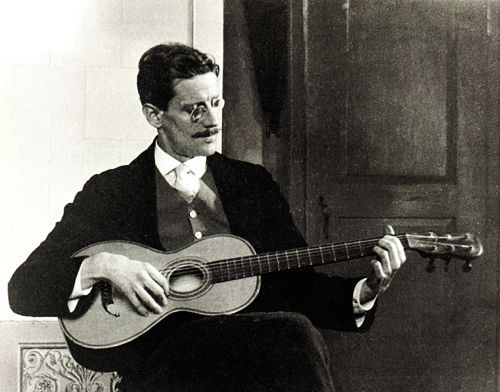
My third (complete) trip through James Joyce’s Ulysses finds me just as (or even more than) stunned as the previous two journeys, a bit (very much) unequal to properly reviewing the book, but this time with an easy out — I listened to an unabridged, full cast audio recording. The aforementioned “easy out” is resting on the received greatness and goodness (and evilness) of the book, which I will hardly contend with and heartily endorse (and do very little real critical work to support my endorsement). Ulysses is fantastic. But what about this audio recording?
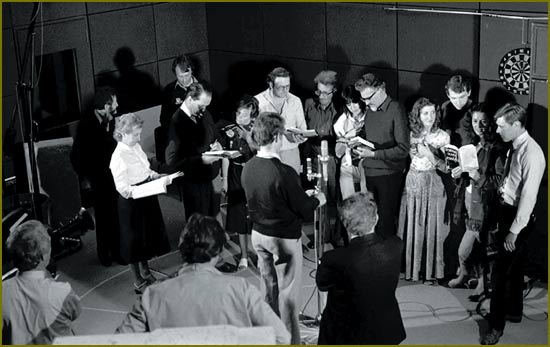
First thing’s first — I listened to, absorbed, choked up at, guffawed about, cackled around, and generally loved RTÉ’s 1982 dramatized, soundtracked, sound-effected, lovingly detailed recording of Ulysses, a work crammed with voices to match (if perhaps not equal) Joyce’s big fat work. This recording is not as widely available as LibriVox’s (free) full cast production or Jim Norton’s Naxos reading, but, after sampling both, I’d argue that it’s better. The Irish players bring sensitivity and humor to their roles, but beyond that pathos, the energy of RTÉ’s troupe is what really makes the book sing. Leopold Bloom gets his own voice, as does Stephen Dedalus and Molly (and all the characters). This innovation propels the narrative forward with dramatic power, and clarifies the oh-so indirectness of Joyce’s free indirect style, making the plot’s pitfalls and pratfalls more distinct and defined. There are songs (and dances) and music (and musing) and humming (and hemming and hawing and reverb). There is chanting and chawing and brouhaha. There is chaos and calamity and confusion. There is brilliance and peace and transcendence. It’s all very good, great, wonderful.
So: Who is a full cast unabridged audio recording of Ulysses for? Say, for instance, can someone who’s never read Ulysses listen to this instead?
I don’t know.
Here’s what I think though: Ulysses begs to be read aloud, is musical, soundical. Beyond obvious chapters like episode 11, “Sirens,” an overtly musical interlude that actually hurt my throat the first (second?) time I read it (even though I read it that time silently) — beyond the obvious musicality of “Sirens,” Ulysses hums and thrums and bristles and thumps with lively, vocal, melodious, rhythmic energy, pulses in sound and vision. The full cast reading, to cling to a hoary cliché, brings this sound and vision to life, animating Joyce’s words with a just vitality. But I’ve tripped into details, put carts before horses — the prime advantage for an audio recording of Ulysses to newbies is probably how clearly (and audibly, ahem) it delineates the book’s plot. But —
At the same time, I think anyone reading the book for the first time will want to read it along with the audio recording. Read along as in literally read along with, or, more likely read first or after — chapter by chapter that is. Yes, I think, yes, that’s what I’d recommend (lagersoaked now as my brain might be) — read a chapter first, then listen, then read another (or reread). Rinse. Lather. Repeat.
The Cast at Work
Now I retreat to that ugly bastard of literary criticism, reader response shtick, the stuff of fellows who can’t make real claims on the work itself but rather hide behind how the book made me feel and think and blah blah blah. Sorry. I break myself against Ulysses. And it’s not even the book, truth be told (to trot out another hoary cliché) — I’ve reviewed books here that sought to rival Ulysses, books that undoubtedly contend with it — it’s more the critical tradition that accompanies Ulysses that daunts me. But enough. Anyone who wishes to read pages of graduate school work on the subject, written by moi, may apply below. Suffice to say for now that I loved loved loved listening to this audio recording.
Perhaps because I was so familiar (or familiar enough) with Joyce’s themes at this reading/auditing, I was able to relax during this odyssey through Joyce’s epic. To put it another way, I felt no need to be “on” — to pick up allusions, to grasp at threads — and trip over them. Instead, I found a human dimension to Joyce’s work, one I’d felt there before, but perhaps not fully experienced (I am not claiming that I have fully experienced Ulysses). I laughed. I angered. I spit. I snarled. I cried (yes, I cried; at the mention of Rudy at the end of “Circes,” and then, again, at the end of the novel, just a bit, when I felt (felt) Molly’s love for her husband). There might have been a stirring at the loins.
I found a confirmation of my favorite episodes: “Circe,” foremost, an apocalyptic carnival brought to a bristling boil in the Irish cast’s capable choir. The aforementioned “Sirens” sings of course; far more pleasant, really, to hear than read. “Telemachus,” sure, who can nay-say an opener like that, although it’s really just the opener to the prelude to the real opener “Calypso” — great stuff. What earthy joy to meet Bloom. “Hades” — a sad treat. “Aeolus” — a funny treat, windily rebounding in vim and vigor and vigorous vim. The library episode — “Scylla and Charybdis” — I’ve always thought of it as Hamlet and Stephen, or grandfathers and ghosts — becomes clearer in the voices of RTÉ’s cast. Clearer not in the sense of: “Now I understand what Stephen’s getting at,” but clearer in the sense: “Now I see where Stephen sees what he is not quite sure he is getting at.” That chapter on pig-headed closemindedness, “The Cyclops” — a triumph, a magnitude, a bold chuckle. And “Penelope.” Well, yes, great stuff.
It’s more remarkable, I suppose, the ways in which RTÉ’s recording illuminated those chapters I’d struggled with, those that had made me yawn. The first, tedious, purposefully clichéd half of “Nausica” tried my patience (get back to Bloom!) — but the actress who reads it highlights the chapter’s tedium, its commonplaces — even as it/she rushes to that juicy climax. “Proteus”: far more manageable than I’d remembered. And “The Oxen of the Sun” (aka that chapter that I never really read properly) — well, with a full band of nasty drunken med students, a bold narrator (and a sympathetic nurse), this stumbling rock becomes a springboard to the madness I so love (and have loved) in “Circe.” In the once-trying catechism of “Ithaca,” the actors find a rhythmic bounce, a dry crunching that explodes in the wet gush of “Penelope.” And didn’t I say, yes, great stuff.
What this audio recording does best is humanize Joyce’s characters. While there is never a doubt that they are set against their mythotypical forebears, I found in Joyce’s characters this time a deep specificity, a concreteness of place, a realness. I found no need to situate a Bloom-as-Odysseus correspondence. Molly did not have to be an earth goddess. Stephen was freed from the burden of Hamlet. Sure, metempsychosis was in play, but it was a backdrop, not a foregrounding, determining analytical program. I think the audio recording helped transmit this humanity, a humanity that was always there, obscured by the clutter of critical tradition.
 Listening to Gordon Lish read selections from
  See Lego versions of your favorite authors at
 My third (complete) trip through James Joyce’s Ulysses finds me just as (or even more than) stunned as the previous two journeys, a bit (very much) unequal to properly reviewing the book, but this time with an easy out — I listened to an unabridged, full cast audio recording. The aforementioned “easy out” is resting on the received greatness and goodness (and evilness) of the book, which I will hardly contend with and heartily endorse (and do very little real critical work to support my endorsement). Ulysses is fantastic. But what about this audio recording?