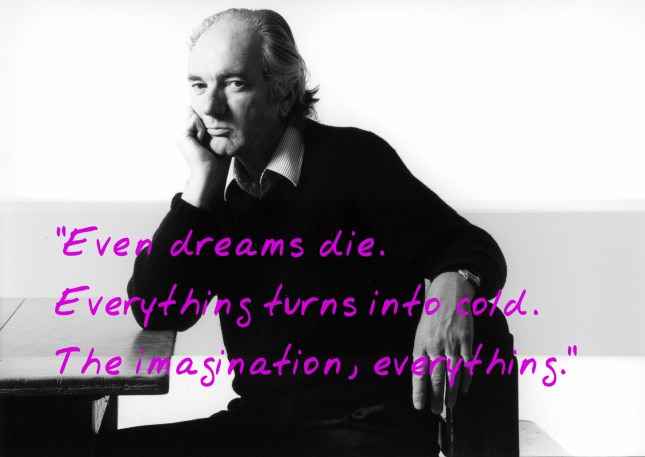
Valentine’s Day Wishes from Thomas Bernhard

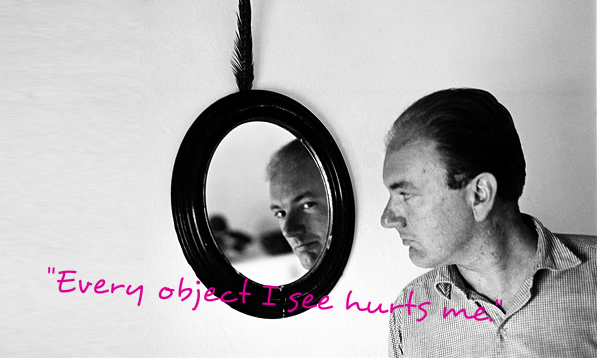
tb1

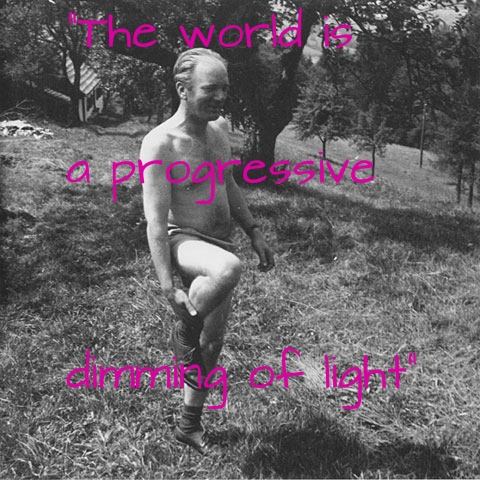
tb2

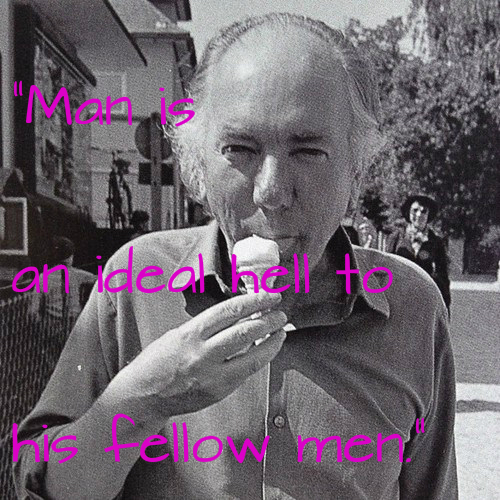
tb3

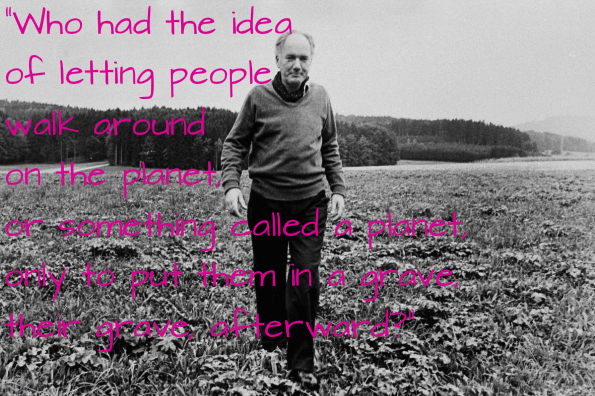
tb5

tb6

ThomasBernhardWalking

Zora Neale Hurston’s Love Spells

Conjure up some last-minute romance. In the appendix to her collection of Florida folktales, Mules and Men, author Zora Neale Hurston offers up a host of Hoodoo, including the following love spells:

TO MAKE A MAN COME HOME

Take nine deep red or pink candles. Write his name three times on each candle. Wash the candles with Van-Van. Put the name three times on paper and place under the candles, and call the name of the party three times as the candle is placed at the hours of seven, nine or eleven.

TO MAKE PEOPLE LOVE YOU

Take nine lumps of starch, nine of sugar, nine teaspoons of steel dust. Wet it all with Jockey Club cologne. Take nine pieces of ribbon, blue, red or yellow. Take a dessertspoonful and put it on a piece of ribbon and tie it in a bag. As each fold is gathered together call his name. As you wrap it with yellow thread call his name till you finish. Make nine bags and place them under a rug, behind an armoire, under a step or over a door. They will love you and give you everything they can get. Distance makes no difference. Your mind is talking to his mind and nothing beats that.

TO BREAK UP A LOVE AFFAIR

Take nine needles, break each needle in three pieces. Write each person’s name three times on paper. Write one name backwards and one forwards and lay the broken needles on the paper. Take five black candles, four red and three green.

Tie a string across the door from it, suspend a large candle upside down, It will hang low on the door; bum one each day for one hour. If you burn your first in the daytime, keep on in the day; if at night, continue at night. A tin plate with paper and needles in it must be placed to catch wax in.

When the ninth day is finished, go out into the street and get some white or black dog dung. A dog only drops his dung in the street when he is running and barking, and whoever you curse will run and bark likewise. Put it in a bag with the paper and carry it to running water, and one of the parties will leave town.

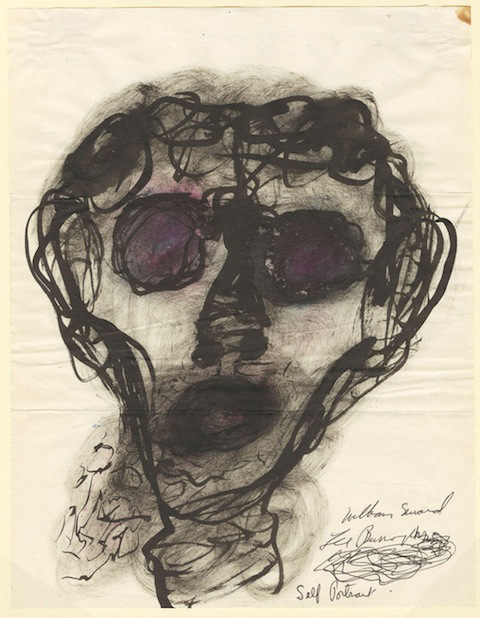
Self-Portrait — William Burroughs

wsb

On the Special Expressions of Cats — Charles Darwin

fig9

Cats.—I have already described the actions of a cat, when feeling savage and not terrified (fig.9). She assumes a crouching attitude and occasionally protrudes her fore-feet, with the claws exserted ready for striking. The tail is extended, being curled or lashed from side to side. The hair is not erected—at least it was not so in the few cases observed by me. The ears are drawn closely backwards and the teeth are shown. Low savage growls are uttered. We can understand why the attitude assumed by a cat when preparing to fight with another cat, or in any way greatly irritated, is so widely different from that of a dog approaching another dog with hostile intentions; for the cat uses her fore-feet for striking, and this renders a crouching position convenient or necessary. She is also much more accustomed than a dog to lie concealed and suddenly spring on her prey. No cause can be assigned with certainty for the tail being lashed or curled from side to side. This habit is common to many other animals—for instance, to the puma, when prepared to spring; but it is not common to dogs, or to foxes, as I infer from Mr. St. John’s account of a fox lying in wait and seizing a hare. We have already seen that some kinds of lizards and various snakes, when excited, rapidly vibrate the tips of their tails. It would appear as if, under strong excitement, there existed an uncontrollable desire for movement of some kind, owing to nerve-force being freely liberated from the excited sensorium; and that as the tail is left free, and as its movement does not disturb the general position of the body, it is curled or lashed about. Continue reading “On the Special Expressions of Cats — Charles Darwin”

Ticket of Admission to a Lecture by Walt Whitman on Abraham Lincoln

Ticket of admission to a lecture by Walt Whitman on Abraham Lincoln,"  initialed by Whitman at lower right. Lecture "to be delivered on Thursday, April 14th [1887], at 4 o'clock P. M., in the Madison Square Theatre, New-York."

(Via/about).

“I would really like to try to do some good in the world” (William T. Vollmann)

I don’t know why it was so strange to hear William T. Vollmann’s voice on NPR as I drove into work this morning. Maybe because I have Vollmann on the brain (I’ve been in the middle of a long email interview with the editors of the recent volume William T. Vollmann: A Critical Companion). Or maybe it’s just that it seems so rare these days to hear the opinions of a novelist given a platform on popular media. Still weird though (even though I heard Vollmann on the radio last year too). Anyway, he was on NPR this morning, speaking to David Greene about his forthcoming article on the aftermath of the Fukushima meltdown in next month’s Harper’s. From their disucssion:

David Greene: William Vollmann, I’m just curious. The last time we spoke we talked about how the FBI thought you might be the Unabomber. You’ve traveled with mujahideen, you’ve smoked crack with prostitutes in California. I mean you have a certain style your reporting where you want to be in the middle of something so to speak and here you’re exposing yourself to radiation. What drives you?


William Vollmann: Well, one time read an E.O. Wilson book about the ants—


DG: E.O. Wilson—you’re talking about the famous Harvard naturalist and professor right?


WV: That’s right, yeah. He says that it’s common in ant colonies for the older female ants to take more and more risks. They’ve already reproduced, and if they don’t come back it’s no real loss to the ant colony. And I’m an older person, I’m 55, I’ve reproduced, I’m going to die in any event, so I have less to fear. And I would really like to try to do some good in the world before I die, and you know, if I get cancer as a result it’s no real loss. The more I see of the disasters that nuclear power can cause, the more I think, I would really like to describe this and help people share my alarm.

(An Incomplete) List of Ridiculous Names in Charles Dickens Novels

Abel Garland

Abel Magwich

Adolphus Tetterby

Alfred Jingle

Affery Flintwinch

Anne Chickenstalker

Anthony Jeddler

Augustus Snodgrass

Barnaby Rudge

Bayham Badger

Bazzard

Bella Wilfer

Bentley Drummle

Betsy Prig

Betsy Quilp

Betsy Trotwood

Brownlow

Bucket

Bumble

Caroline “Caddy” Jellyby

Charity Pecksniff 

Clara Peggotty

Cleopatra Skewton

Clickett

Cornelia Blimber

Canon Crisparkle

Charles Cheeryble

Chevy Slyme

Clarence Barnacle

Clarriker

Creakle Continue reading “(An Incomplete) List of Ridiculous Names in Charles Dickens Novels”

Ernest Hemingway vs. Wallace Stevens (David Markson)

Capture

Reading There Will Be Blood as the expanded epilogue to Blood Meridian

Watching (again) Paul Thomas Anderson’s 2007 film There Will Be Blood last night, it struck me that the film can be read as an expansion of the epilogue to Cormac McCarthy’s 1985 novel Blood Meridian.

Here is that infamously perplexing passage, a strange note that punctuates the devastating infanticidal horror at the novel’s core:

In the dawn there is a man progressing over the plain by means of holes which he is making in the ground. He uses an implement with two handles and he chucks it into the hole and he enkindles the stone in the hole with his steel hole by hole striking the fire out of the rock which God has put there. On the plain behind him are the wanderers in search of bones and those who do not search and they move haltingly in the light like mechanisms whose movements are monitored with escapement and pallet so that they appear restrained by a prudence or reflectiveness which has no inner reality and they cross in their progress one by one that track of holes that runs to the rim of the visible ground and which seems less the pursuit of some continuance than the verification of a principle, a validation of sequence and causality as if each round and perfect hole owed its existence to the one before it there on that prairie upon which are the bones and the gatherers of bones and those who do not gather. He strikes fire in the hole and draws out his steel. Then they all move on again.

I’ve heard numerous interpretations of this passage over the years. Many of the interpretations dwell on the metaphorical power of the epilogue—it’s the final gnostic clue in the Judge’s web of mysteries; it’s the Promethean redemption of humanity against the Judge’s evil; it’s the spirit of civilization that will measure and conquer the bloody West, a progressive new dawn; it’s Cormac McCarthy’s signature, his designation of himself as the writer who carries the fire.

I’m fine with all of these interpretations, for I foolishly take Judge Holden at his word when he points out that, “Your heart’s desire is to be told some mystery. The mystery is that there is no mystery.” Let me eschew the symbolic then, at least momentarily, for the literal.

The epilogue’s literal imagery suggests a man working with post hole diggers: Is he building a fence? Constructing telegraph poles? Exploring? Surveying? Whatever his intentions, he marks and measures the land.

Whether the digger is a leader or not, he has followers, “the wanderers in search of bones” as well as “those who do not search.” Bones of what? Are the searchers hunting relics? (To revert to the metaphorical—sorry—are these bones the dead eyes Emerson warned us not to look through?). Or are the bones something else—dinosaur bones, Texas tea, carbon, fuel?

there will be blood

So There Will Blood and there will be bones: Daniel Day-Lewis’s Daniel Plainview, a misanthropic, near-malevolent, and ultimately murderous oil man—what I want to say is that he is (a failed version of) McCarthy’s Epilogue Digger. Is not There Will Be Blood  a film about digging, about holes, falling in holes, dying in holes, striking fire from holes? And is not There Will Be Blood also a film about the abjection of holes—the oil, the mud, the muck, the blood that coats hands and faces, eyes, lips, ears burst? Of the recapitulation of the hole as the primal space for culture—a fertile, generative, fecund, deadly space? The hole as the space of shame and possibility? Daniel Plainview, surveying California, marking lines for his followers to follow, striking oil, striking fire. No?

There-Will-Be-Blood-daniel-day-lewis-859163_427_321

We might see in Paul Thomas Anderson’s film a repetitious revision of McCarthy’s novel—a recasting of sorts, with Plainview possessed by Glanton’s maniacal spirit—and Glanton in turn possessed by the spirit of the Judge, the dark omnipresent bad father. Both film and novel mediate their Oedipal dramas in an utterly masculine world. Blood Meridian affords more speaking roles to women than There Will Be Blood does, but both see fit to discharge any notion of a mother from the Oedipal contests they depict, rendering the kid in each narrative the warden of strange gangs, strange wanderers. Anderson allows H.W. to suffer but live and perhaps thrive, to find a mate, to escape into new and alien territory, outside of the holes his surrogate father has dug. Our would-be hero of Blood Meridian, the kid, dies in an outhouse, an abject hole.

And Daniel Plainview—he murders the false priest (which the judge failed to do—although Tobin was a true priest though ex-priest), murders a version of himself—another brother, another Abel. He’s not a good guy. If we read McCarthy’s epilogue through his latest novel, The Road, or even through some of the lines in No Country for Old Men, we can see that “the good guys” are charged with carrying the fire—and is this not what the Epilogue Digger is doing? Carrying the fire, freeing the fire from the earth? Plainview would like to carry the fire, to generate new life, new communities, but he fails, he falls, he crumbles. He abandons his child, and then denies his child. “I’m finished!”

Am I finished? I’m now more confused than when I started this riff. The germ of the idea woke with me this morning—the alien landscape of PTA’s film seemed to restage for me moments in McCarthy’s novel in some waking dream—and like a dream seemed perfectly illogically logical. But bound up in my language I’m not so sure. What I did detect in the film, last night, that I had previously perhaps missed, or maybe forgotten, was how admirable Daniel Plainview often is, especially early on in the film—decisive, bold, asserting his own agency and working with his own hands, he’s a Nietzschean figure. But his paranoia gives way to madness and corruption. Okay. I’m finished.
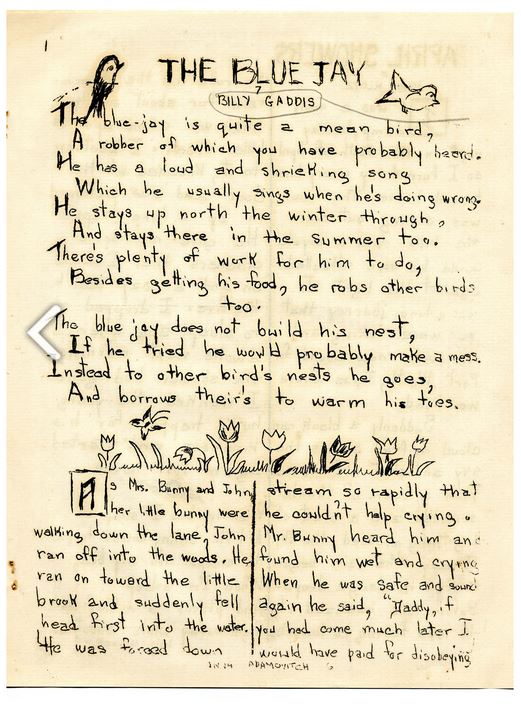
“The Blue Jay” by Billy Gaddis — Juvenilia from William Gaddis

billy

William Gaddis juvenilia from Washington University’s Modern Literature collection. (You can read the entire piece there).

“People often ask me, ‘How can you be so stupid and still proclaim yourself a communist?'” (Slavoj Žižek)

An article on cemeteries, and other ideas from Nathaniel Hawthorne’s Note-Books

The spells of witches have the power of producing meats and viands that have the appearance of a sumptuous feast, which the Devil furnishes: But a Divine Providence seldom permits the meat to be good, but it has generally some bad taste or smell,–mostly wants salt,–and the feast is often without bread.


An article on cemeteries, with fantastic ideas of monuments; for instance, a sundial;–a large, wide carved stone chair, with some such motto as “Rest and Think,” and others, facetious or serious.


“Mamma, I see a part of your smile,”–a child to her mother, whose mouth was partly covered by her hand.


“The syrup of my bosom,”–an improvisation of a little girl, addressed to an imaginary child.


“The wind-turn,” “the lightning-catch,” a child’s phrases for weathercock and lightning-rod.


“Where’s the man-mountain of these Liliputs?” cried a little boy, as he looked at a small engraving of the Greeks getting into the wooden horse.


When the sun shines brightly on the new snow, we discover ranges of hills, miles away towards the south, which we have never seen before.


To have the North Pole for a fishing-pole, and the Equinoctial Line for a fishing-line.

From Nathaniel Hawthorne’s American Note-Books.

No.

B8JlZ-CIQAAIOfZ

I put down notes, I edit it. Writing disappears (Slavoj Žižek)

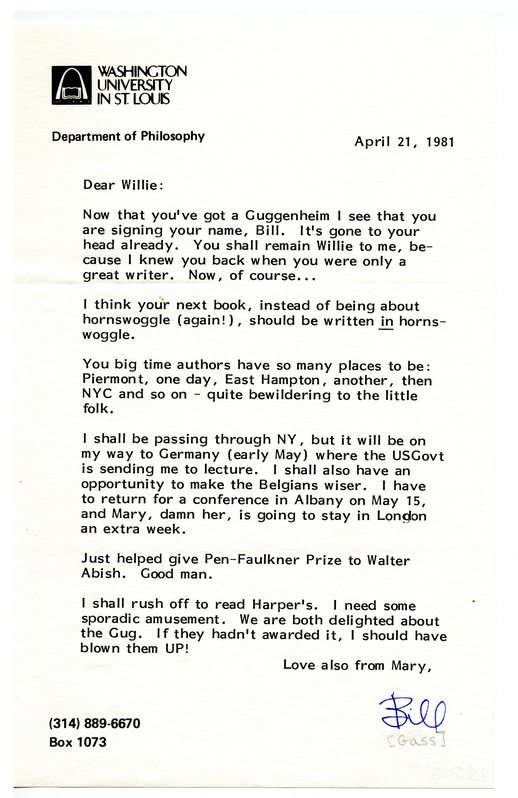
“Dear Willie” — William H. Gass Writes to William Gaddis

dear

From Washington University’s marvelous Modern Literature Collection.


A Scapegoat for Promiscuous Drunks, Friendly Calls, and Humbug Resolutions

mark-twain

From Mark Twain’s January 1st, 1863 column in the Territorial Enterprise:

Now is the accepted time to make your regular annual good resolutions. Next week you can begin paving hell with them as usual. Yesterday, everybody smoked his last cigar, took his last drink, and swore his last oath. To-day, we are a pious and exemplary community. Thirty days from now, we shall have cast our reformation to the winds and gone to cutting our ancient short comings considerably shorter than ever. We shall also reflect pleasantly upon how we did the same old thing last year about this time. However, go in, community. New Year’s is a harmless annual institution, of no particular use to anybody save as a scapegoat for promiscuous drunks, and friendly calls, and humbug resolutions, and we wish you to enjoy it with a looseness suited to the greatness of the occasion.

Read “The Fir-Tree,” Hans Christian Andersen’s Depressing Story About the Existential Fate of a Christmas Tree

“The Fir-Tree” by Hans Christian Andersen

Far down in the forest, where the warm sun and the fresh air made a sweet resting-place, grew a pretty little fir-tree; and yet it was not happy, it wished so much to be tall like its companions— the pines and firs which grew around it. The sun shone, and the soft air fluttered its leaves, and the little peasant children passed by, prattling merrily, but the fir-tree heeded them not. Sometimes the children would bring a large basket of raspberries or strawberries, wreathed on a straw, and seat themselves near the fir-tree, and say, “Is it not a pretty little tree?” which made it feel more unhappy than before. And yet all this while the tree grew a notch or joint taller every year; for by the number of joints in the stem of a fir-tree we can discover its age. Still, as it grew, it complained, “Oh! how I wish I were as tall as the other trees, then I would spread out my branches on every side, and my top would over-look the wide world. I should have the birds building their nests on my boughs, and when the wind blew, I should bow with stately dignity like my tall companions.” The tree was so discontented, that it took no pleasure in the warm sunshine, the birds, or the rosy clouds that floated over it morning and evening. Sometimes, in winter, when the snow lay white and glittering on the ground, a hare would come springing along, and jump right over the little tree; and then how mortified it would feel! Two winters passed, and when the third arrived, the tree had grown so tall that the hare was obliged to run round it. Yet it remained unsatisfied, and would exclaim, “Oh, if I could but keep on growing tall and old! There is nothing else worth caring for in the world!” In the autumn, as usual, the wood-cutters came and cut down several of the tallest trees, and the young fir-tree, which was now grown to its full height, shuddered as the noble trees fell to the earth with a crash. After the branches were lopped off, the trunks looked so slender and bare, that they could scarcely be recognized. Then they were placed upon wagons, and drawn by horses out of the forest. “Where were they going? What would become of them?” The young fir-tree wished very much to know; so in the spring, when the swallows and the storks came, it asked, “Do you know where those trees were taken? Did you meet them?”

The swallows knew nothing, but the stork, after a little reflection, nodded his head, and said, “Yes, I think I do. I met several new ships when I flew from Egypt, and they had fine masts that smelt like fir. I think these must have been the trees; I assure you they were stately, very stately.”

“Oh, how I wish I were tall enough to go on the sea,” said the fir-tree. “What is the sea, and what does it look like?”

“It would take too much time to explain,” said the stork, flying quickly away.

“Rejoice in thy youth,” said the sunbeam; “rejoice in thy fresh growth, and the young life that is in thee.”

And the wind kissed the tree, and the dew watered it with tears; but the fir-tree regarded them not. Continue reading “Read “The Fir-Tree,” Hans Christian Andersen’s Depressing Story About the Existential Fate of a Christmas Tree”