William S. Burroughs’s Walking Stick

(Photograph by Udo Breger).

Jorge Luis Borges, Forgeries, and Book Theft

jlb

Fascinating story today at The Paris Review about a first edition of Jorge Luis Borges’s early poems stolen—and then returned (perhaps?)—to the National Library of Argentina. Forgeries, facsimiles, and book thefts! The following paragraph points out that Borges himself was once director of the library:

The National Library is as old as Argentina: it was created in 1810, together with the first national government, and its first director was Mariano Moreno, one of the greatest national heroes and the founder of the country’s first newspaper. The library was, at one point, something to be proud of, and Borges’s name is inextricably linked to its history; he was its director for eighteen years, between 1955 and 1973. By then, books were already disappearing from its shelves. When asked whether this was true, he replied, in typical fashion, “I can’t tell whether books are being stolen, because I’m blind.”

Read the essay.

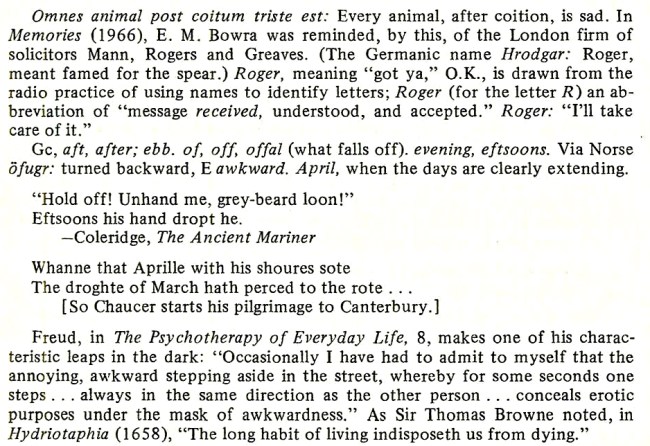
Every animal, after coition, is sad.

etym


From Joseph T. Shipley’s The Origin of English Words: A Discursive Dictionary of Indo-European Roots. I’ve found the book indispensable for years now—its discursiveness is a lunatic joy to get lost in. Anyway, the above passages extend/unwind from the root ap/apo; I found it while looking up the eytmology of poseur.

“Endicott and the Red Cross” — Nathaniel Hawthorne

“Endicott and the Red Cross”

by

Nathaniel Hawthorne

At noon of an autumnal day, more than two centuries ago, the English colors were displayed by the standard-bearer of the Salem trainband, which had mustered for martial exercise under the orders of John Endicott. It was a period, when the religious exiles were accustomed often to buckle on their armour, and practice the handling of their weapons of war. Since the first settlement of New England, its prospects had never been so dismal. The dissensions between Charles the First and his subjects were then, and for several years afterwards, confined to the floor of Parliament. The measures of the King and ministry were rendered more tyrannically violent by an opposition, which had not yet acquired sufficient confidence in its own strength, to resist royal injustice with the sword. The bigoted and haughty primate, Laud, Archbishop of Canterbury, controlled the religious affairs of the realm, and was consequently invested with powers which might have wrought the utter ruin of the two Puritan colonies, Plymouth and Massachusetts. There is evidence on record, that our forefathers perceived their danger, but were resolved that their infant country should not fall without a struggle, even beneath the giant strength of the King’s right arm.

Such was the aspect of the times, when the folds of the English banner, with the Red Cross in its field, were flung out over a company of Puritans. Their leader, the famous Endicott, was a man of stern and resolute countenance, the effect of which was heightened by a grizzled beard that swept the upper portion of his breastplate. This piece of armour was so highly polished, that the whole surrounding scene had its image in the glittering steel. The central object, in the mirrored picture, was an edifice of humble architecture, with neither steeple nor bell to proclaim it,–what nevertheless it was,–the house of prayer. A token of the perils of the wilderness was seen in the grim head of a wolf, which had just been slain within the precincts of the town, and, according to the regular mode of claiming the bounty, was nailed on the porch of the meetinghouse. The blood was still plashing on the door-step. There happened to be visible, at the same noontide hour, so many other characteristics of the times and manners of the Puritans, that we must endeavour to represent them in a sketch, though far less vividly than they were reflected in the polished breastplate of John Endicott.
Continue reading ““Endicott and the Red Cross” — Nathaniel Hawthorne”

The Kindly Ones is simply “Houellebecq does Nazism” (From Laurent Binet’s HHhH)

A poster on an Internet forum expresses the opinion that Max Aue, Jonathan Littell’s protagonist in The Kindly Ones, “rings true because he is the mirror of his age.” What? No! He rings true (for certain, easily duped readers) because he is the mirror of our age: a postmodern nihilist, essentially. At no moment in the novel is it suggested that this character believes in Nazism. On the contrary, he displays an often critical detachment toward National Socialist doctrine—and in that sense, he can hardly be said to reflect the delirious fanaticism prevalent in his time. On the other hand, this detachment, this blasé attitude toward everything, this permanent malaise, this taste for philosophizing, this unspoken amorality, this morose sadism, and this terrible sexual frustration that constantly twists his guts … but of course! How did I not see it before? Suddenly, everything is clear. The Kindly Ones is simply “Houellebecq does Nazism.”

From Laurent Binet’s novel HHhH; English Translation by Sam Taylor.

Enjoyed the novel tremendously.

I’m not sure if Binet’s remarks (or, Binet’s narrator, who is Binet-performing-author-as-narrator) are exactly a literary dis or not (I’m pretty sure he’s dissing Littell, but unsure how Houellebecq fits in there, or what).

(My thoughts on The Kindly Ones; my thoughts on Houellebecq’s The Elementary Particles).

Eudora Welty on Austen, Chekhov, and Woolf

INTERVIEWER

You wrote somewhere that we should still tolerate Jane Austen’s kind of family novel. Is Austen a kindred spirit?

EUDORA WELTY

Tolerate? I should just think so! I love and admire all she does, and profoundly, but I don’t read her or anyone else for “kindredness.” The piece you’re referring to was written on assignment for Brief Lives, an anthology Louis Kronenberger was editing. He did offer me either Jane Austen or Chekhov, and Chekhov I do dare to think is more “kindred.” I feel closer to him in spirit, but I couldn’t read Russian, which I felt whoever wrote about him should be able to do. Chekhov is one of us—so close to today’s world, to my mind, and very close to the South—which Stark Young pointed out a long time ago.

INTERVIEWER

Why is Chekhov close to today’s South?

WELTY

He loved the singularity in people, the individuality. He took for granted the sense of family. He had the sense of fate overtaking a way of life, and his Russian humor seems to me kin to the humor of a Southerner. It’s the kind that lies mostly in character. You know, inUncle Vanya and The Cherry Orchard, how people are always gathered together and talking and talking, no one’s really listening. Yet there’s a great love and understanding that prevails through it, and a knowledge and acceptance of each other’s idiosyncrasies, a tolerance of them, and also an acute enjoyment of the dramatic. Like in The Three Sisters, when the fire is going on, how they talk right on through their exhaustion, and Vershinin says, “I feel a strange excitement in the air,” and laughs and sings and talks about the future. That kind of responsiveness to the world, to whatever happens, out of their own deeps of character seems very southern to me. Anyway, I took a temperamental delight in Chekhov, and gradually the connection was borne in upon me.

INTERVIEWER

Do you ever return to Virginia Woolf?

WELTY

Yes. She was the one who opened the door. When I read To the Lighthouse, I felt, Heavens, what is this? I was so excited by the experience I couldn’t sleep or eat. I’ve read it many times since, though more often these days I go back to her diary. Any day you open it to will be tragic, and yet all the marvelous things she says about her work, about working, leave you filled with joy that’s stronger than your misery for her. Remember—“I’m not very far along, but I think I have my statues against the sky”? Isn’t that beautiful?

From Eudora Welty’s interview with The Paris Review.

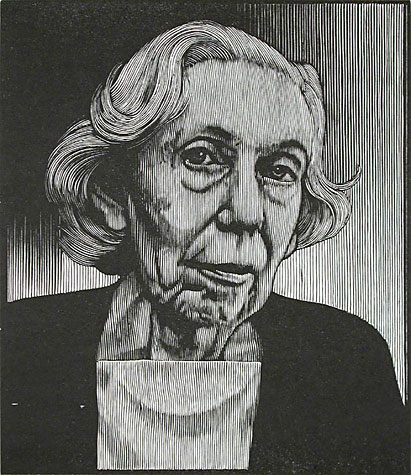
Eudora Welty — Barry Moser

moser-welty

“I Love This White and Slender Body” — Heinrich Heine

Capture

“Lily Daw and the Three Ladies” — Eudora Welty

“Lily Daw and the Three Ladies”

by Eudora Welty

Mrs Watts and Mrs Carson were both in the post office in Victory when the letter came from the Ellisville Institute for the Feeble Minded of Mississippi. Aimee Slocum, with her hand still full of mail, ran out in front and handed it straight to Mrs Watts, and they all three read it together. Mrs Watts held it taut between her pink hands, and Mrs Carson underscored each line slowly with her thimbled finger. Everybody else in the post office wondered what was up now.

“What will Lily say,” beamed Mrs Carson at last, “when we tell her we’re sending her to Ellisville!”

“She’ll be tickled to death,” said Mrs Watts, and added in a guttural voice to a deaf lady, “Lily Daw’s getting in at Ellisville!”

“Don’t you all dare go off and tell Lily without me!” called Aimee Slocum, trotting back to finish putting up the mail.

“Do you suppose they’ll look after her down there?” Mrs Carson began to carry on a conversation with a group of Baptist ladies waiting in the post office. She was the Baptist preacher’s wife.

“I’ve always heard it was lovely down there, but crowded,” said one.

“Lily lets people walk over her so,” said another.

“Last night at the tent show—-” said another, and then popped her hand over her mouth.

“Don’t mind me, I know there are such things in the world,” said Mrs Carson, looking down and fingering the tape measure which hung over her bosom.

“Oh, Mrs Carson. Well, anyway, last night at the tent show, why, the man was just before making Lily buy a ticket to get in.”

“A ticket!”

“Till my husband went up and explained she wasn’t bright, and so did everybody else.”

The ladies all clucked their tongues.

“Oh, it was a very nice show,” said the lady who had gone. “And Lily acted so nice. She was a perfect lady–just set in her seat and stared.”

“Oh, she can be a lady–she can be,” said Mrs Carson, shaking her head and turning her eyes up. “That’s just what breaks your heart.”

“Yes’m, she kept her eyes on–what’s that thing makes all the commotion?–the xylophone,” said the lady. “Didn’t turn her head to the right or to the left the whole time. Set in front of me.”

“The point is, what did she do after the show?” asked Mrs Watts practically. “Lily has gotten so she is very mature for her age.”

“Oh, Etta!” protested Mrs Carson, looking at her wildly for a moment.

“And that’s how come we are sending her to Ellisville,” finished Mrs Watts.

“I’m ready, you all,” said Aimee Slocum, running out with white powder all over her face. “Mail’s up. I don’t know how good it’s up.”

“Well, of course, I do hope it’s for the best,” said several of the other ladies. They did not go at once to take their mail out of their boxes; they felt a little left out.

The three women stood at the foot of the water tank.

“To find Lily is a different thing,” said Aimee Slocum.

“Where in the wide world do you suppose she’d be?” It was Mrs Watts who was carrying the letter.

“I don’t see a sign of her either on this side of the street or on the other side,” Mrs Carson declared as they walked along.

Ed Newton was stringing Redbird school tablets on the wire across the store. Continue reading ““Lily Daw and the Three Ladies” — Eudora Welty”

“Some worm or other lay squirming before being devoured by the hen that humans were going to eat” (Clarice Lispector)

Daddy’s typewriter was tapping out tac-tac..tac-tac-tac… The clock chimed brightly ting-ting… ting-ting… The silence dragged out zzzzzzz. The wardrobe was saying what? clothes — clothes — clothes. No, no. Between the clock, the typewriter and the silence there was an ear listening out, large, flesh-pink and dead. The three sounds were connected by the light of day and by the rustling of tiny leaves on the tree as they joyfully rubbed against each other.

Resting her head against the cold, shiny window-pane, she looked into the neighbour’s yard, at the great world of the chickens-that-did-not-know-they-were-about-to-die. And as if it were right under her nose, she could smell the warm, beaten earth, so fragrant and dry, where she knew perfectly well, she knew perfectly well that some worm or other lay squirming before being devoured by the hen that humans were going to eat.

There was a grand moment, motionless and quite hollow inside. She opened her eyes wide and waited. Nothing happened. Blank. But suddenly with a shudder they wound up the day and they began to function once again, the typewriter tapping, father’s cigarette giving off smoke, silence, tiny leaves, plucked chickens, brightness, things restored to life and as impatient as a kettle on the boil. All that was missing was the ting-ting of the clock which gave so much pleasure. She closed her eyes, pretended to hear it chime, and to the rhythm of that imaginary music, she went up on the tips of her toes. She executed three dance steps, so light and ethereal.

Then suddenly she looked at everything with displeasure, as if she had eaten far too much of that concoction. ‘Hey, hey, hey…’, she murmured wearily and then thought to herself: what will happen now now now? And in the fraction of time that followed, nothing ever happened if she went on waiting for something to happen if you get my meaning? She pushed away this awkward thought, distracting herself with a movement of her bare foot on the dusty wooden floor. She rubbed her foot, looking sideways at her father, awaiting his impatient and nervous smile. But nothing happened. Nothing. It’s difficult to suck in people like the vacuum cleaner does.

— Daddy, I’ve invented a poem.

The first five paragraphs of Clarice Lispector’s novel Near to the Wild Heart.

“Beside Schopenhauer’s Corpse” — Guy De Maupassant

“Beside Schopenhauer’s Corpse”

by

Guy de Maupassant

He was slowly dying, as consumptives die. I saw him each day, about two o’clock, sitting beneath the hotel windows on a bench in the promenade, looking out on the calm sea. He remained for some time without moving, in the heat of the sun, gazing mournfully at the Mediterranean. Every now and then, he cast a glance at the lofty mountains with beclouded summits that shut in Mentone; then, with a very slow movement, he would cross his long legs, so thin that they seemed like two bones, around which fluttered the cloth of his trousers, and he would open a book, always the same book. And then he did not stir any more, but read on, read on with his eye and his mind; all his wasting body seemed to read, all his soul plunged, lost, disappeared, in this book, up to the hour when the cool air made him cough a little. Then, he got up and reentered the hotel.

He was a tall German, with fair beard, who breakfasted and dined in his own room, and spoke to nobody.

A vague, curiosity attracted me to him. One day, I sat down by his side, having taken up a book, too, to keep up appearances, a volume of Musset’s poems.

And I began to look through “Rolla.”

Suddenly, my neighbor said to me, in good French:

“Do you know German, monsieur?”

“Not at all, monsieur.”

“I am sorry for that. Since chance has thrown us side by side, I could have lent you, I could have shown you, an inestimable thing—this book which I hold in my hand.”

“What is it, pray?”

“It is a copy of my master, Schopenhauer, annotated with his own hand. All the margins, as you may see, are covered with his handwriting.”

I took the book from him reverently, and I gazed at these forms incomprehensible to me, but which revealed the immortal thoughts of the greatest shatterer of dreams who had ever dwelt on earth. Continue reading ““Beside Schopenhauer’s Corpse” — Guy De Maupassant”

“In the Reading Room of Hell” — Roberto Bolaño

hell

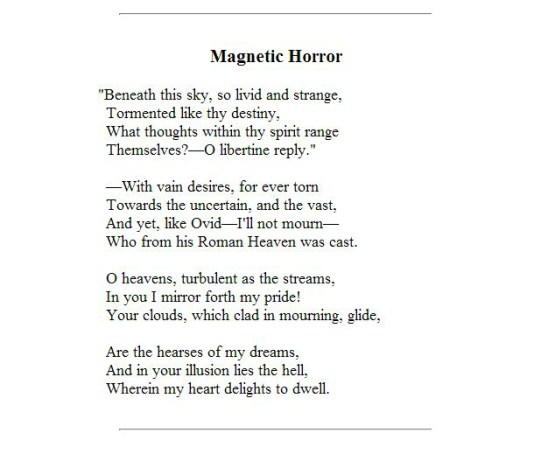
“Magnetic Horror” — Charles Baudelaire

mafg

“Beckett is a very blue man” (William H. Gass)

Remember how the desperate Molloy proceeds:

I took advantage of being at the seaside to lay in a store of sucking stones. They were pebbles but I call them stones I distrutibed them equally between my four pockets, and sucked them turn and turn about. This raised a problem which I first solved in the following way. I had say sixteen stones, four in each of my four pockets these being the two pockets of my trousers and the two pockets of my greatcoat. Taking a stone from the right pockct of my greatcoat, and putting it in mv mouth , I replaced it in the right pocket of my greatcoat bv a stone from the right pocket of my trousers, which I replaced by a stone from the left pocket of my trousers, which I replaced by a stone from the left pocket of my greatcoat, which I replaced by the stone which was in my mouth, as soon as I had fin-ished sucking it. Thus there were still four stones in each of my four pockets , but not quite the same stones…. But this solution did not satisfy me fully. For it did not escape me that, by an extraordinary hazard, the four stones circulating thus might always be the same four. In which case, far from sucking the sixteen stones turn and turn about, I was really only sucking four, always the same, turn and turn about.

Beckett is a very blue man, and this is a very blue passage.

From William H. Gass’s On Being Blue: A Philosophical Inquiry (and of course, Samuel Beckett’s Molloy).

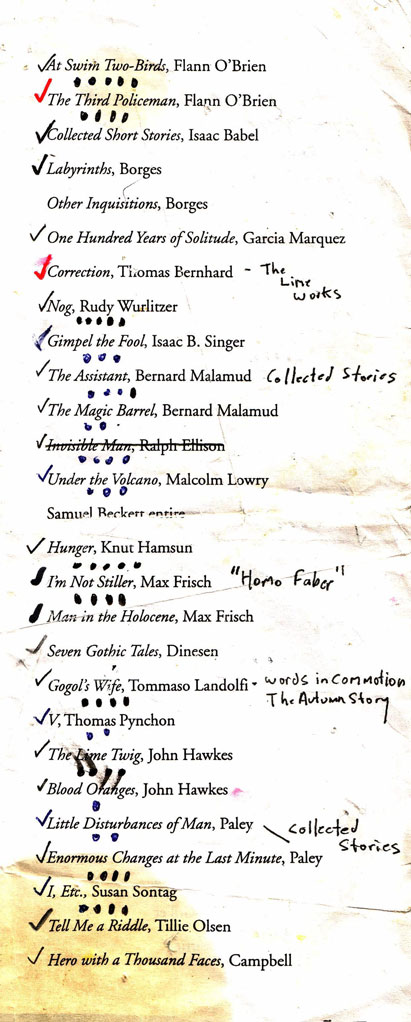
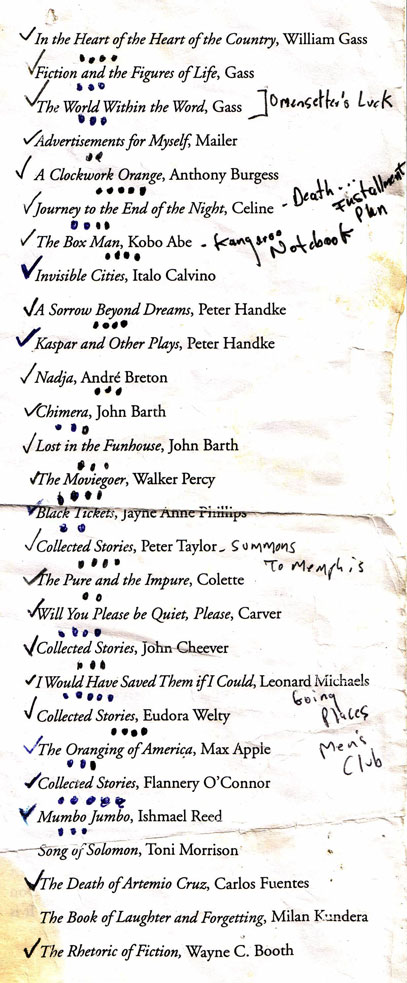
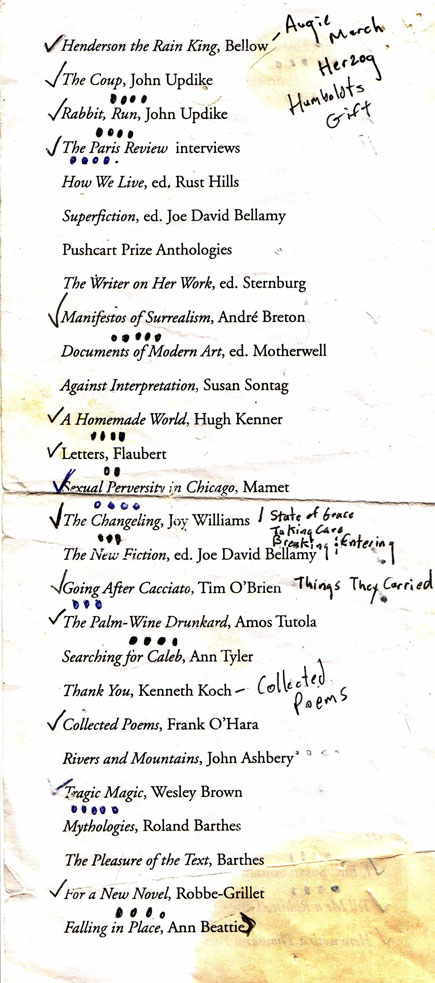
Donald Barthelme’s Book Recommendations

barthelme_1a barthelme_2a barthelme_3a

Sure–okay, sure, you’ve seen this before (or maybe not), I know I have (I’ve even posted it before). But today is D. Barthelme’s birthday (he’s dead of course), and I’ve read or reread (or, more accurately read) most of his stuff (sans The King, which I’ve been saving) over the past year. Anyway, this here list comes via Kevin Moffett who got it off DB’s former student, Padgett Powell, when he (that is Moffett) was finishing up at my alma mater, the University of Gators (where Powell continues to teach today, having replaced Harry Crews, RIP). Anyway (again with that transition!), check out Moffett’s original share-piece at The Believer; he describes Gainesville’s Friends of the Library Sale, which was always fun. I got a copy of John Barth’s Chimera there (on the list, natch), among other books, but I didn’t get any Barthelme. I’ve read 31 of the 81 books on the list (this includes fantastically awarding myself the “Samuel Beckett entire” entry but hell man I think it’s been counted as one work here (at least by Moffett?), which maybe it should be but no I haven’t read all of Beckett but hell I’ve read a lot, if not enough, but anyway (again!)–31).

“Graves were called homes, and apologies known as writing were carved in their surface” (Ben Marcus)

The time was technical summer, a season that had been achieved by nature so many times that a clotted arrangement of birds created splotches of ink called shadows, and whole days passed without gunfire. Shadows were blind spots that everyone shared. Graves were called homes, and apologies known as writing were carved in their surface. Rotten bags were called people. Milk was never sprayed from a fire hose at children until they skittered over the pavement like weevils, but the children wore shields of clothing regardless, and the people who guarded them were often trembling.

From Ben Marcus’s story”Against Attachment,” collected in Leaving the Sea.

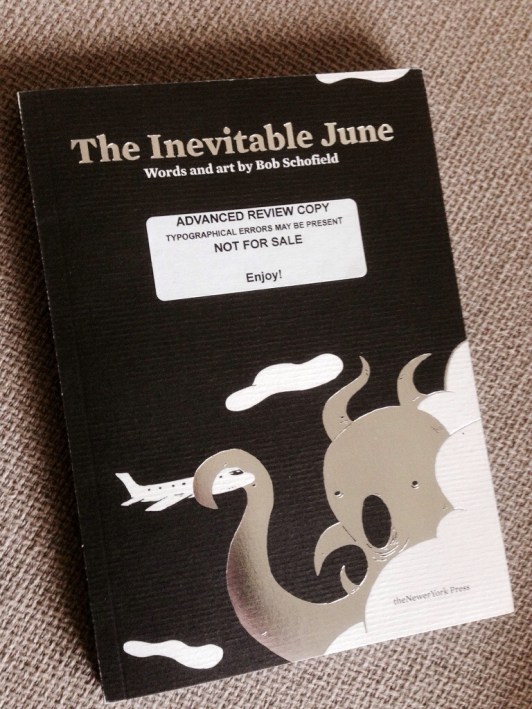
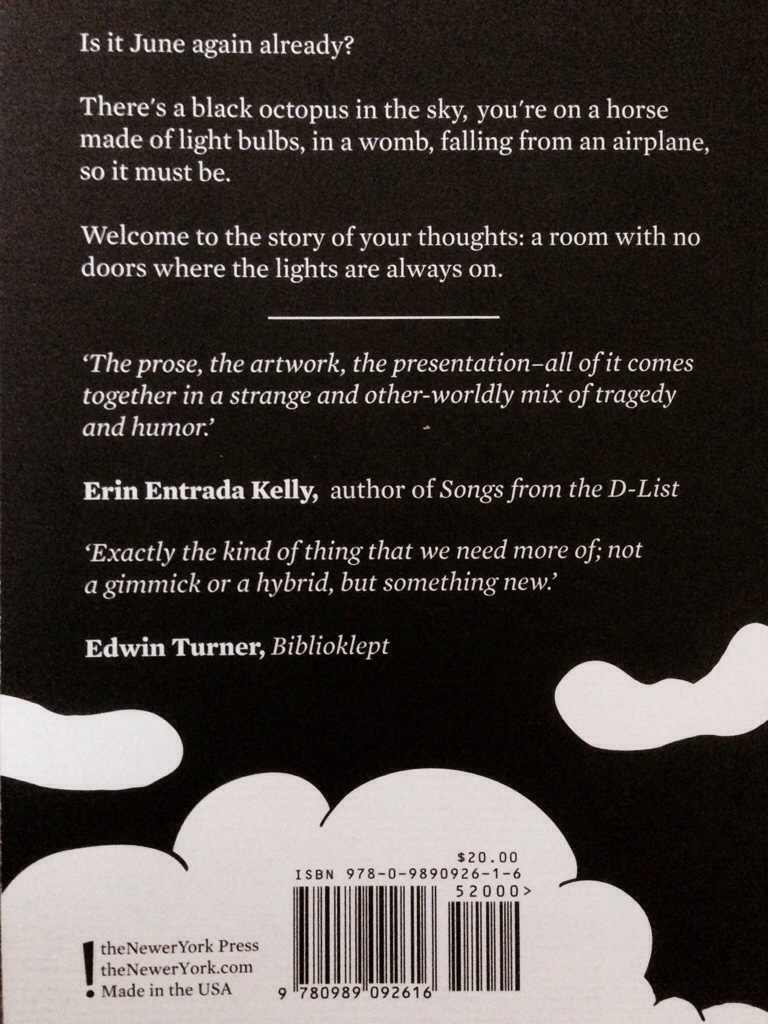
The Inevitable June (Book Acquired, 3.31.2014)

20140407-144637.jpg

20140407-160351.jpg

20140407-144655.jpg

20140407-160358.jpg