that to die is an evil

Capture

I had no idea Luis Buñuel directed the 1954 film adaptation of Robinson Crusoe

…the weird thing is that I actually saw this as a kid. A few years later I saw Belle du jour (thanks to my uncle!) and then of course Un chien andalou and L’age d’or in college…

William T. Vollmann, Profiled at Newsweek, Suggests “We’re a culture of prostitutes”

Newsweek has published a profile/interview of William T. Vollmann by Alexander Nazaryan. It’s a vivid, engaging read. The first two paragraphs of the profile:

If William T. Vollmann ever wins the Nobel Prize in Literature – as many speculate he will – he knows exactly what he will do with the $1.1 million pot the Swedes attach to the award. “It will be fun to give some to prostitutes,” he says, sitting on his futon, chuckling, a half-empty bottle of pretty good bourbon between us.

He is neither flippant nor drunk, though more booze awaits us out there in the temperate Sacramento twilight. Vollmann became famous for fiction that treated the sex worker as muse – especially the street stalker of those days in the Tenderloin of San Francisco when AIDS was just coming to haunt the national psyche and the yuppie invasion was a nightmare not yet hatched. His so-called prostitution trilogy – Whores for GloriaButterfly Stories, and The Royal Family – is overflowing with life and empathy, nothing like the backcountry machismo of Raymond Carver or fruitless experimentation of Donald Barthelme, both oh-so-popular with young writers when Vollmann first came on the scene after graduating from Cornell in 1981. He approached the prostitute like an anthropologist, yet did so without condescension, writing in Whores for Gloria, “The unpleasantnesses of her profession are largely caused by the criminal ambiance in which the prostitute must conduct it.”

Read the rest of it.

Frank O´Hara — Alice Neel

“Home Run” — Steven Millhauser

You can read along here…

“Ubazakura” –Lafcadio Hearn

“Ubazakura” –Lafcadio Hearn

Three hundred years ago, in the village called Asamimura, in the district called Onsengori, in the province of Iyo, there lived a good man named Tokubei. This Tokubei was the richest person in the district, and the muraosa, or headman, of the village. In most matters he was fortunate; but he reached the age of forty without knowing the happiness of becoming a father. Therefore he and his wife, in the affliction of their childlessness, addressed many prayers to the divinity Fudo Myo O, who had a famous temple, called Saihoji, in Asamimura.

At last their prayers were heard: the wife of Tokubei gave birth to a daughter. The child was very pretty; and she received the name of Tsuyu. As the mother’s milk was deficient, a milk-nurse, called O-Sode, was hired for the little one.


O-Tsuyu grew up to be a very beautiful girl; but at the age of fifteen she fell sick, and the doctors thought that she was going to die. In that time the nurse O-Sode, who loved O-Tsuyu with a real mother’s love, went to the temple Saihoji, and fervently prayed to Fudo-Sama on behalf of the girl. Every day, for twenty-one days, she went to the temple and prayed; and at the end of that time, O-Tsuyu suddenly and completely recovered.

Then there was great rejoicing in the house of Tokubei; and he gave a feast to all his friends in celebration of the happy event. But on the night of the feast the nurse O-Sode was suddenly taken ill; and on the following morning, the doctor, who had been summoned to attend her, announced that she was dying.

Then the family, in great sorrow, gathered about her bed, to bid her farewell. But she said to them:—

“It is time that I should tell you something which you do not know. My prayer has been heard. I besought Fudo-Sama that I might be permitted to die in the place of O-Tsuyu; and this great favor has been granted me. Therefore you must not grieve about my death… But I have one request to make. I promised Fudo-Sama that I would have a cherry-tree planted in the garden of Saihoji, for a thank-offering and a commemoration. Now I shall not be able myself to plant the tree there: so I must beg that you will fulfill that vow for me… Good-bye, dear friends; and remember that I was happy to die for O-Tsuyu’s sake.”


After the funeral of O-Sode, a young cherry-tree,—the finest that could be found,—was planted in the garden of Saihoji by the parents of O-Tsuyu. The tree grew and flourished; and on the sixteenth day of the second month of the following year,—the anniversary of O-Sode’s death,—it blossomed in a wonderful way. So it continued to blossom for two hundred and fifty-four years,—always upon the sixteenth day of the second month;—and its flowers, pink and white, were like the nipples of a woman’s breasts, bedewed with milk. And the people called it Ubazakura, the Cherry-tree of the Milk-Nurse.

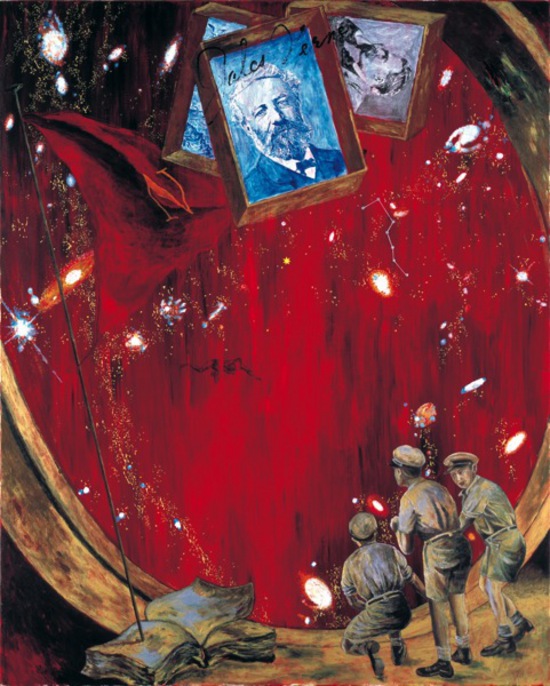
Jules Verne’s Ocean — Tadanori Yokoo

yokoo_tadanori_02-thumb-550xauto-319

“Rites of Melancholy” — W.G. Sebald

This realization of the impossibility of salvation matches the unrelated condition of melancholy which, in developing its own rituals, promises some relief but not release from suffering and the “feral deseases” so often mentioned in Robert Burton’s Anatomy of Melancholy. Among these rituals, in the narrator’s case, are the nocturnal reading of telephone directories and timetables, the unfolding of maps, and the making of plans for imaginary journeys to the most distant of lands, countries that might well lie beyond the sea shown in the background of Dürer’s Melencolia. Like Robert Burton, who was familiar with melancholy all his life, the narrator is a man “who delights in cosmography … but has never travelled except by map and card.” And the summer bed with room enough for seven sleepers where he meditates on stories such as that of the Black Death, with all its paths and coincidences, is of the same century as Burton’s compendium, an era of anxiety when the fear was first uttered “that the great mutations of the world are acted, or time may be too short for our designes.” The narrator’s digressive excursions from the starting point of this realization open up the view—again, a reminiscence from Hamlet—of a world lying far below melancholy, a “dead globe crawling with parasites” whose power of attraction is spent and forfeit. The icy sense of distance as the narrator turns away from all earthly life represents a vanishing point in the dialectic of melancholy. However, the other dimension of the Saturnian circumstances responsible for melancholy does point, as Benjamin has said and in the context of the heavy, dry nature of that planet, to the type of man predestined to hard and fruitless agricultural labor. It is probably no coincidence that the narrator’s only utilitarian occupation seems to be growing herbs. He sends these herbs, dried and in carefully adjusted mixtures, to various delicatessens in Milan and Amsterdam as well as to Germany, to Hamburg and Hannover. Perhaps they bear the words “Rosemary, that’s for remembrance” written in Ophelia’s hand.

From W.G. Sebald’s essay “Constructs of Mourning,” collected in Campo Santo.


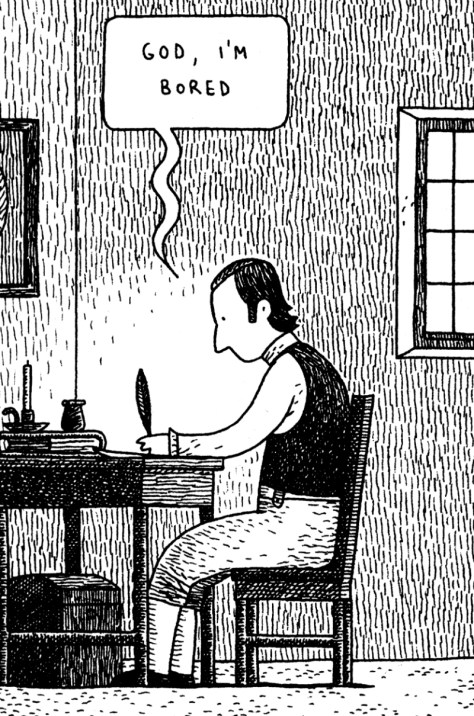
Bored (Tom Gauld)

bored

From Mira Calligraphiæ Monumenta — Joris Hoefnagel

hoefnagel2(Via/about/more).

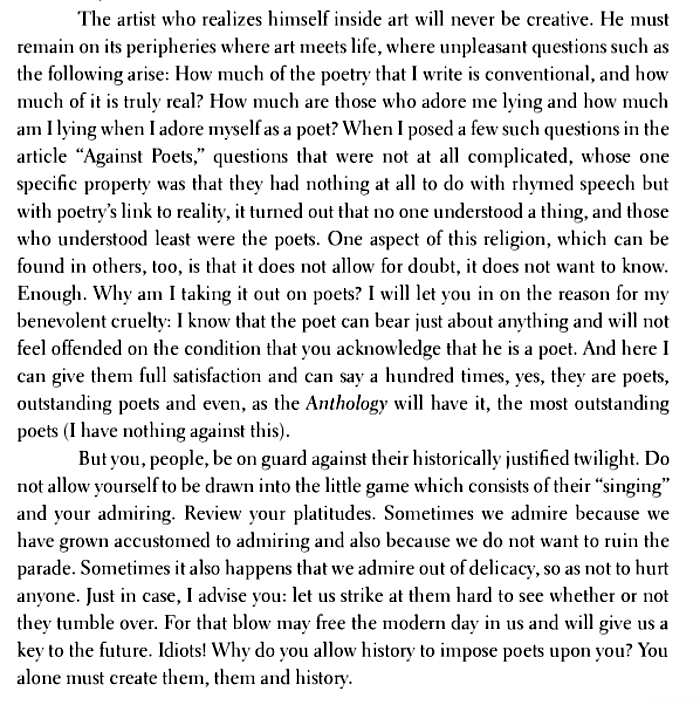
“The artist who realizes himself inside art will never be creative” (Witold Gombrowicz)

wg

“The Beloved,” A Short Surrealist Tale by Leonora Carrington

“The Beloved” by Leonora Carrington

ONE LATE afternoon, passing through a narrow street, I stole a melon. The fruit man who was hidden behind his fruits seized me by the arm and said to me: “Señorita, I’ve been waiting for an occasion like this for forty years. I have spent forty years hidden behind this pile of oranges with the hope that someone would steal a fruit from me. I will tell you why; I need to talk, I need to tell my story. If you don’t listen, I will hand you over to the police.”

“I’ll listen,’ I said. Without letting me go, he took me to the inside of the store, among fruits

Without letting me go, he took me to the inside of the store, among fruits and vegetables. We shut a door at the far end, and we reached a room where there was a bed on which an immovable and probably dead woman lay. It appeared to me that she had been there for a long time since the bed was covered with weeds.

“I water her every day,” said the fruitman with a pensive air. “In 40 years I have not succeeded in knowing whether she is dead or not. She has never moved, nor spoken, nor eaten during that time. But the curious thing is that she remains warm. If you don’t believe me, look.”

The man lifted a corner of the cover, which permitted me to see many eggs and some little chicks recently hatched.

“As you notice,” he said, “I incubate eggs here. I also sell fresh eggs.”

We each sat down on one side of the bed and the fruit man began to tell his story.

“Believe me; I love her so much! I have always loved her! She was so sweet! She had little agile white feet. Would you like to see them?”

“No,” I answered.

“Finally,” he continued, after exhaling a deep breath, “she was so beautiful! My hair was blonde; hers, magnificently black! Now, both of us have white hair. Her father was an extraordinary man. He had a mansion in the country. He was a collector of lamb chops. For that we came to know each other. I have a certain skill in drying meat with a glance. Mr. Pushfoot (so he was called) heard about me. He invited me to his house in order to dry his ribs to keep them from rotting. Agnes was his daughter. We loved each other from the first moment. We departed in a boat by way of the Seine. I rowed. Agnes said to me: ‘I love you so much that I only live for you.’ I answered her with the same words. I believe that it is my love which keeps her warm, perhaps she is dead, but the warmth persists.”

After a short pause, with an absent look, he continued: “Next year I will grow some tomatoes; it wouldn’t surprise me if they would grow well there inside … It became night, and I didn’t know where we would spend our wedding night. Agnes had become very pale, because of fatigue. Finally we had scarcely left Paris behind when I saw an inn that faced the river. I moored the boat and we walked toward an obscure and sinister terrace. There were two wolves there and a fox, who began to walk around us. There was nobody else … I knocked and knocked at the door, on the other side of which a terrible silence prevailed. ‘Agnes is tired! Agnes is very tired!’ I shouted with as much force as I could. Finally, an old lady’s head appeared at the window and said: ‘I don’t know anything. The landlord here is the fox. Let me sleep. You are bothering me.’ Agnes began to cry. There was no other remedy than to direct ourselves to the fox. ‘Have you beds?’ I asked several times. Nobody responded: he didn’t know how to speak. And again the head, older than the other, but which now descended slowly through the window tied to the end of a little cord. ‘Direct yourself to the wolves; I am not the landlord here. Let me sleep! please!’ I understood that that head was crazy and I did not have the heart to continue. Agnes kept crying. I walked around the house a few times and finally, I was able to open a window, through which we entered. Then we found ourselves in a kitchen with a high ceiling; over a large oven made hot by fire were some vegetables that were cooking and they jumped in the boiling water, a thing that much amused us. We ate well and then we laid ourselves down on the floor. I had Agnes in my arms. We did not sleep. That terrible kitchen contained all kinds of things. Many rats had stuck their heads out of their holes and then sang with screeching and disagreeable little voices. Filthy odors expanded and diminished one after the other, and there were air drafts. I believe that it was the air drafts that finished my poor Agnes. She never recovered. From that day, each time she spoke less . . .”

And the fruitman was so blinded by tears that I could escape with my melon.

In These Times the Home Is a Tired Place (Book Acquired, Some Time in Late October)

20131027-125420.jpg

Jessica Hollander’s story collection In These Times the Home Is a Tired Place is good stuff. It came in last month with several other books I was psyched about, so I’ve only gotten to the first three stories here, along with the title story (I’m a sucker for anything resembling a list), but they’ve made me want to read the other fifteen stories. Full review forthcoming.

Here’s Katherine Dunn (Geek Love) on In These Times the Home Is a Tired Place:

These are human tales of vigorously individual characters living with intensity. The author’s ear for revealing dialogue and double-edged humor ground these stories in a reality worth enduring. The characters connect despite suspicion and betrayal, beyond blood, circumstance or embarrassment at their own ridiculous humanity. Each piece is powered by a deep, slow boiling jubilation in the moment-to-moment, line-by-line fact of taking breath.

And here’s the first part of the title story (you can and should read the rest of it at Conjunctions):

1. Only one dream the mother remembered: driving, dead bodies on the road, the word PAPER large and black on a billboard. Sometimes she made up different dreams when she woke panicked in the gray morning, imagining an airport chase, a lake drowning—but they weren’t really hers, only dreams she believed she should have instead of always the one: driving through death and the urge to pull over.

2. The girl spent a Saturday morning cutting snowflakes from a pile of paper she’d found on her mother’s desk. The snowflakes were peppered with sliced negotiations, diamond-pierced words like child and property and alimony, and when the girl finished she strung the flakes together and hung them from her window so they trailed to the berry bush and flapped in the stirred summer wind.

3. Screamed in the kitchen one night. Too many cooks in the saucepan. Too little wine. Granite counters crusted with crushed tomato, sea salt, sausage casing, but no food besides the steaming meal bleeding over the bin. The girl sent to her room— Now. The father’s recipes stacked and chopped to pieces and confettied across the tile. Division always makes less unless one was a fraction to begin with. “Divide by me,” the father said. “Then we both come out ahead.”

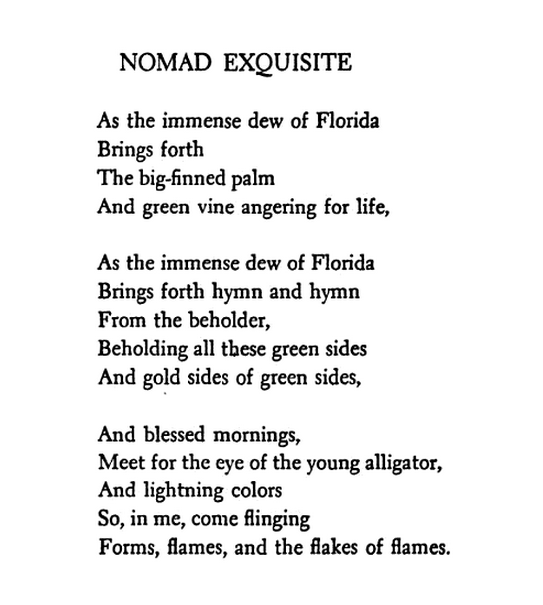
“Nomad Exquisite” — Wallace Stevens

nomad

Don Quixote — Albert Bloch

“Mankind is accursed because our existence on this earth does not tolerate any well-defined and stable hierarchy” (Witold Gombrowicz)

Memories! Mankind is accursed because our existence on this earth does not tolerate any well-defined and stable hierarchy, everything continually flows, spills over, moves on, everyone must be aware of and be judged by everyone else, and the opinions that the ignorant, dull, and slow-witted hold about us are no less important than the opinions of the bright, the enlightened, the refined. This is because man is profoundly dependent on the reflection of himself in another man’s soul, be it even the soul of an idiot. I absolutely disagree with my fellow writers who treat the opinions of the dull-witted with an aristocratic haughtiness and declare: odi profanum vulgus. What a cheap and simplistic way of avoiding reality, what a shoddy escape into specious loftiness! I maintain, on the contrary, that the more dull and narrow-minded they are, the more urgent and compelling are their opinions, just as an ill-fitting shoe hurts us more than a well-fitting one. Oh, those judgments, the bottomless pit of people’s judgments and opinions about your wisdom, feelings, and character, about all the details of your personality—it’s a pit that opens up before the daredevil who drapes his thoughts in print and lets them loose on paper, oh, printed paper, paper, paper! And I’m not even talking about the heartfelt opinions so fondly held by our aunts, no, I mean the opinions of those other aunts—the cultural aunts, those female semi-writers and tacked-on semi-critics who make pronouncements in literary magazines. Indeed, world culture has been beset by a flock of superfluous hens patched-on, pinned-on, to literature, who have become finely tuned to spiritual values and well versed in aesthetics, frequently entertaining views and opinions of their own, who have even caught on to the notions that Oscar Wilde is passé and that Bernard Shaw is a master of paradox. Oh, they are on to the fact that they must be independent, profound, unobtrusively assertive, and filled with auntie kindliness. Auntie, auntie, auntie! Unless you have ever found yourself in the laboratory of a cultural aunt and been dissected, mute and without a groan, by her trivializing mentality that turns all life lifeless, unless you have ever seen an auntie’s critique of yourself in a newspaper, you have no concept of triviality, and auntie-triviality in particular.

Further, let us consider the opinions of men and women of the landed gentry, the opinions of schoolgirls, the narrow-minded opinions of minor office clerks, the bureaucratic opinions of high officials, the opinions of lawyers in the provinces, the hyperbolic opinions of students, the arrogant opinions of little old men, and the opinions of journalists, the opinions of social activists as well as the opinions of doctors’ wives, and, finally, the opinions of children listening to their parents’ opinions, the opinions of underling chambermaids and of cooks, the opinions of our female cousins, the opinions of schoolgirls—a whole ocean of opinions, each one defining you within someone else, and creating you in another man’s soul. It’s as if you were being born inside a thousand souls that are too tight-fitting for comfort!

From Witold Gombrowicz’s novel Ferdydurke.


Slavoj Žižek on Atheism and Christianity