Ishmael praises the “famous whaling house of Enderby & Sons; a house which in my poor whaleman’s opinion, comes not far behind the united royal houses of the Tudors and Bourbons, in point of real historical interest.” He claims that, years after sailing on The Pequod, he enjoyed a “fine gam” with the crew of The Samuel Enderby. The claim interests me, as it seems like pretty clear evidence that Ishmael is not a ghost, which is an idea (namely, Ishmael is a ghost) that I’ve been playing with in these riffs. However, I mean—he could be the ghost at that feast though, right? Maybe?
Anyway.
“The Decanter” is another one of those “transition” chapters in Moby-Dick, where Ishmael subtly shifts from the events of the narrative proper into some other story, only to go back to his quest to measure the whale. Which brings us to—
III. Ch. 102, “A Bower in the Arsacides.”
Ishmael tells us that “it behooves me now to unbutton [the whale] still further.” He will dissect the beast to get to its “unconditional skeleton.”
The word dissect in the previous sentence is not merely metaphorical:
I confess, that since Jonah, few whalemen have penetrated very far beneath the skin of the adult whale; nevertheless, I have been blessed with an opportunity to dissect him in miniature. In a ship I belonged to, a small cub Sperm Whale was once bodily hoisted to the deck for his poke or bag, to make sheaths for the barbs of the harpoons, and for the heads of the lances. Think you I let that chance go, without using my boat-hatchet and jack-knife, and breaking the seal and reading all the contents of that young cub?
Reading all the contents of that young cub—again, Moby-Dick is not about whales; it is a book about reading the phenomenal world (with the aid of the whale as a major, slippery, impregnable metaphor).
IV. How does Ishmael know the measurements of adult whales?
And as for my exact knowledge of the bones of the leviathan in their gigantic, full grown development, for that rare knowledge I am indebted to my late royal friend Tranquo, king of Tranque, one of the Arsacides.
In his “Arsacidean holidays with the lord of Tranquo,” Ishmael is able to take the measure of a sperm whale skeleton which washed up dead on the beach after a storm. The skeleton is a kind of religious relic, surrounded by “a grand temple of lordly palms [which] now sheltered it.”
Ishmael extends the image for us:
The ribs were hung with trophies; the vertebræ were carved with Arsacidean annals, in strange hieroglyphics; in the skull, the priests kept up an unextinguished aromatic flame, so that the mystic head again sent forth its vapory spout; while, suspended from a bough, the terrific lower jaw vibrated over all the devotees, like the hair-hung sword that so affrighted Damocles.
It was a wondrous sight. The wood was green as mosses of the Icy Glen; the trees stood high and haughty, feeling their living sap; the industrious earth beneath was as a weaver’s loom, with a gorgeous carpet on it, whereof the ground-vine tendrils formed the warp and woof, and the living flowers the figures. All the trees, with all their laden branches; all the shrubs, and ferns, and grasses; the message-carrying air; all these unceasingly were active. Through the lacings of the leaves, the great sun seemed a flying shuttle weaving the unwearied verdure.
Ishmael then makes the leap from the physical to the metaphysical world. He addresses god the weaver:
Speak, weaver!—stay thy hand!—but one single word with thee! Nay—the shuttle flies—the figures float from forth the loom; the freshet-rushing carpet for ever slides away. The weaver-god, he weaves; and by that weaving is he deafened, that he hears no mortal voice; and by that humming, we, too, who look on the loom are deafened; and only when we escape it shall we hear the thousand voices that speak through it.
Ishmael ends the paragraph by invoking “great world’s loom,” recalling the title of Moby-Dick’s famous opening chapter “Loomings,” and points back And he ends the novel by escaping—alone—from the wreck of The Pequod, and returns to us to bear witness to and channel the “voices that speak” through the world’s looming.
V. Ch. 102 concludes as a kind of prequel to the next chapter:
The skeleton dimensions I shall now proceed to set down are copied verbatim from my right arm, where I had them tattooed; as in my wild wanderings at that period, there was no other secure way of preserving such valuable statistics.
Ishmael attests that he didn’t record the inches though—he was saving room for a poem on his skin: “I did not trouble myself with the odd inches; nor, indeed, should inches at all enter into a congenial admeasurement of the whale.”
The note is interesting—up until now we did not know that Ish was tattooed, like his brethren Queequeg. His tattoos are again a form of writing about the whale’s body, and this writing is inscribed on his own body. It’s doubly body writing.
VI. Ch. 103, “Measurement of the Whale’s Skeleton.”
I’ve tried to point out in these riffs (and even in this riff) that Moby-Dick constantly moves between the physical and the metaphysical in its attempt to read the whale, by which I mean read the world of observable phenomena. Ch. 103, as its title suggests, is a very physical, numerical chapter, and I will not remark on it at any length, except to suggest that there is something of a parable in its last paragraph:
There are forty and odd vertebræ in all, which in the skeleton are not locked together. They mostly lie like the great knobbed blocks on a Gothic spire, forming solid courses of heavy masonry. The largest, a middle one, is in width something less than three feet, and in depth more than four. The smallest, where the spine tapers away into the tail, is only two inches in width, and looks something like a white billiard-ball. I was told that there were still smaller ones, but they had been lost by some little cannibal urchins, the priest’s children, who had stolen them to play marbles with. Thus we see how that the spine of even the hugest of living things tapers off at last into simple child’s play.
Lovely.
VII. Ch. 104, “The Fossil Whale.”
“To produce a mighty book, you must choose a mighty theme,” Ishmael declares in this gigantifying chapter about old whale bones. Ish moves from the physical/empirical to the historical (and historical adjacent); the chapter’s gigantism extends to a kind of kitchen-sinkism. Ishmael declares himself a geologist (he tells us he’s been “a great digger of ditches, canals and wells, wine-vaults, cellars, and cisterns of all sorts.”)
Ultimately, the whale remains a god to Ishmael, a metaphysical physical god that prefigures and postdates humankind:
Who can show a pedigree like Leviathan? Ahab’s harpoon had shed older blood than the Pharaoh’s. Methuselah seems a school-boy. I look round to shake hands with Shem. I am horror-struck at this antemosaic, unsourced existence of the unspeakable terrors of the whale, which, having been before all time, must needs exist after all humane ages are over.
He leaves us to worship in the “Afric Temple of the Whale.”
VIII. Ch. 105, “Does the Whale’s Magnitude Diminish?—Will He Perish?”
What a title on this one—and what a chapter ironized by the next century’s endangering of the species Ishmael attests “must needs exist after all humane ages are over.”
Perhaps the chapter’s final paragraph points to the landlubber’s peril of rising oceans and rising temperatures though:
…we account the whale immortal in his species, however perishable in his individuality. He swam the seas before the continents broke water; he once swam over the site of the Tuileries, and Windsor Castle, and the Kremlin. In Noah’s flood he despised Noah’s Ark; and if ever the world is to be again flooded, like the Netherlands, to kill off its rats, then the eternal whale will still survive, and rearing upon the topmost crest of the equatorial flood, spout his frothed defiance to the skies.
I hope we might all, we living things, physical things, spout some defiance, frothed or otherwise.
I. In this riff, Chapter 100 of Moby-Dick — “Leg and Arm • The Pequod, of Nantucket, meets the Samuel Enderby, of London.”
II. I probably should’ve rolled this chapter into my last riff.Chapter 100 serves again to underscore Ahab’s monomaniacal monologuing, his inability to read the world through any lens but his singular quest to destroy the White Whale—and it does so by employing one of the novel’s thematic devices, negation. Here, Ahab (the absent, negative leg) meets Captain Boomer (the absent, negative arm). Both captains have lost their limbs to Moby Dick. However, their dispositions could not be more different. After losing his arm while attempting to harpoon Moby Dick, Captain Boomer of the Samuel Enderby runs into the whale two more times, but does not attempt to capture it, to Ahab’s disbelief. Why? Boomer answers jocularly, “ain’t one limb enough?
III. Indeed, the very spirit of “Leg and Arm” is the opposing attitudes of Ahab and Boomer. Ahab is all monomaniacal vengeance, but Boomer is more practical. Ahab is sundered from connection to his fellow man—even his mates limit their discourse with him—while Boomer is a genial and hearty joker. Much of “Leg and Arm” contrasts Ahab’s one-track mind with Boomer’s expansive loquaciousness. Ahab initiates the discourse with the Enderby with his regular hailing: “Hast seen the white whale?” — and the rest of his interrogation focuses solely on this end. He is not interested in conversing with Boomer, nor with Boomer’s first mate and surgeon, who attend their meeting.
The officers of the Enderby are a lively fraternity though, telling their tale with a chummy joy. Consider this exchange between Boomer and his surgeon Bunger:
“It was a shocking bad wound,” began the whale-surgeon; “and, taking my advice, Captain Boomer here, stood our old Sammy—”
“Samuel Enderby is the name of my ship,” interrupted the one-armed captain, addressing Ahab; “go on, boy.”
“Stood our old Sammy off to the northward, to get out of the blazing hot weather there on the Line. But it was no use—I did all I could; sat up with him nights; was very severe with him in the matter of diet—”
“Oh, very severe!” chimed in the patient himself; then suddenly altering his voice, “Drinking hot rum toddies with me every night, till he couldn’t see to put on the bandages; and sending me to bed, half seas over, about three o’clock in the morning. Oh, ye stars! he sat up with me indeed, and was very severe in my diet. Oh! a great watcher, and very dietetically severe, is Dr. Bunger. (Bunger, you dog, laugh out! why don’t ye? You know you’re a precious jolly rascal.) But, heave ahead, boy, I’d rather be killed by you than kept alive by any other man.”
“My captain, you must have ere this perceived, respected sir”—said the imperturbable godly-looking Bunger, slightly bowing to Ahab—“is apt to be facetious at times; he spins us many clever things of that sort. But I may as well say—en passant, as the French remark—that I myself—that is to say, Jack Bunger, late of the reverend clergy—am a strict total abstinence man; I never drink—”
“Water!” cried the captain; “he never drinks it; it’s a sort of fits to him; fresh water throws him into the hydrophobia; but go on—go on with the arm story.”
The scene’s quick-witted bonhomie stands in stark contrast to Ahab’s dour and fear-riddled relation with his own crew and mates.
IV. The episode concludes with Ahab finally snapping—he’s had enough of the Englishmen yapping away—enough of their conviviality. He demands to know which direction they last saw Moby Dick heading. Dr. Bunger tries to intervene, offering Ahab a medical examination, which is swiftly rejected. Ahab gets his answer and departs without a shred of civility:
“Bless my soul, and curse the foul fiend’s,” cried Bunger, stoopingly walking round Ahab, and like a dog, strangely snuffing; “this man’s blood—bring the thermometer!—it’s at the boiling point!—his pulse makes these planks beat!—sir!”—taking a lancet from his pocket, and drawing near to Ahab’s arm.
“Avast!” roared Ahab, dashing him against the bulwarks—“Man the boat! Which way heading?”
“Good God!” cried the English Captain, to whom the question was put. “What’s the matter? He was heading east, I think.—Is your Captain crazy?” whispering Fedallah.
But Fedallah, putting a finger on his lip, slid over the bulwarks to take the boat’s steering oar, and Ahab, swinging the cutting-tackle towards him, commanded the ship’s sailors to stand by to lower.
In a moment he was standing in the boat’s stern, and the Manilla men were springing to their oars. In vain the English Captain hailed him. With back to the stranger ship, and face set like a flint to his own, Ahab stood upright till alongside of the Pequod.
V. The final notation that “Ahab stood upright” is a significant detail. The Enderby is the only ship he meets with in person, and to board it, he must lower himself—quite literally. Ishmael devotes several paragraphs detailing how difficult it is for Ahab to board a ship from his boat. Indeed, the crew of The Enderby have to pull him up in a net. The whole process might be neatly summed up in the notation that, “Ahab now found himself abjectly reduced to a clumsy landsman again.” His abjection feeds his anger, but also shows that he’s willing to abase himself in his quest for the whale—but only for that quest. He will not lower himself to his fellow man’s warmth and empathy.
The invention of the pattern often requires—among other tender elements, subject to the grotesqueries of decollation—a moonlight scene, the foreground inhabited by an animal, a black knot hanging from its throat. But when a bird, disinclined to die, is tied to a child’s collar, outside a schoolhouse, where we might otherwise find—hidden in a fire—a fragment of a jackal: well, this is just another cheerful little game, played in splendid weather. A boy’s face, they used to say, is just a grave atop a collar, the garment perhaps a shade darker than mouse gray, or so I gather from an adjacent phrase, in which the brother draws cloth across a wire.
I. In this riff, Chapter 99 of Moby-Dick — “The Doubloon.”
II. Moby-Dick is a big big book stuffed with big big themes. One of those themes is perspective and interpretation, and Ch. 99, “The Doubloon,” showcases that theme, as various characters stop to inspect and reflect on the coin that Ahab hammered to the masthead back in Ch. 36, “The Quarter-Deck.” This gold piece is the prize for the first man to sight Moby Dick, and thus already symbolically overdetermined in the narrative. It becomes a thing that the sailors translate into ideas, for, as Ishmael points out (again prefiguring William Carlos Williams), “some certain significance lurks in all things, else all things are little worth, and the round world itself but an empty cipher, except to sell by the cartload.”
III. Here is Ishmael’s description (not interpretation) of the coin:
On its round border it bore the letters, REPUBLICA DEL ECUADOR: QUITO. So this bright coin came from a country planted in the middle of the world, and beneath the great equator, and named after it; and it had been cast midway up the Andes, in the unwaning clime that knows no autumn. Zoned by those letters you saw the likeness of three Andes’ summits; from one a flame; a tower on another; on the third a crowing cock; while arching over all was a segment of the partitioned zodiac, the signs all marked with their usual cabalistics, and the keystone sun entering the equinoctial point at Libra.
IV. Enter Ahab, pacing the quarter-deck, as he often does. On this particular morning, “turning to pass the doubloon, [Ahab] seemed to be newly attracted by the strange figures and inscriptions stamped on it, as though now for the first time beginning to interpret for himself in some monomaniac way whatever significance might lurk in them.”
V. Ishmael repeatedly describes Ahab as a “monomaniac.” The crippled captain focuses only on the hated whale. Ahab’s perspective is limited and constrained. Ahab sees and interprets in mono, unlike the whale, who, as Ishmael reminds us in Ch. 74, “The Sperm Whale’s Head—Contrasted View,” sees in stereo. The whale’s eyes are on either side of its head. Ish wonders if the whale “can at the same moment of time attentively examine two distinct prospects, one on one side of him, and the other in an exactly opposite direction.” The passage again recalls Keats’s notion of Negative Capability—to hold two possibly contrasting views in one’s consciousness “without any irritable reaching after fact and reason.”
VI. But Ahab holds only one vision, one mania. He interprets the doubloon (“not unobserved by others,” Ishmael double-negatively observedly informs us):
“There’s something ever egotistical in mountain-tops and towers, and all other grand and lofty things; look here,—three peaks as proud as Lucifer. The firm tower, that is Ahab; the volcano, that is Ahab; the courageous, the undaunted, and victorious fowl, that, too, is Ahab; all are Ahab; and this round gold is but the image of the rounder globe, which, like a magician’s glass, to each and every man in turn but mirrors back his own mysterious self.
In his monomania, Ahab sees himself in the coin. It’s a mirror for a man on a Luciferian quest.
VII. Perspective shifts then to Starbuck, who states, “He goes below; let me read,” as Ahab descends. Starbuck, the good Christian counterbalance to Ahab’s satanic awe—
VIII. —but look, wait. I think I have to stop here a moment and point out again, amid this riff on a chapter of perspective and seeing and being seen and interpreting and outright voyeurism—I feel the need to point out again that Our Dear Ishmael is an Omnipresent Voyeur, a first-person consciousness who attends and interprets the private thoughts of his fellows. How? How? But anyway—
IX. So perspective shifts then to Starbuck, who first interprets Ahab’s interpretation: “The old man seems to read Belshazzar’s awful writing.” Christian Starbuck here refers to Chapter Five of The Book of Daniel, the main message of which has come to us colloquially as The writing on the wall. But it’s really Starbuck who reads the impending doom—he reads Ahab reading the coin.
X. And Starbuck reading the coin:
A dark valley between three mighty, heaven-abiding peaks, that almost seem the Trinity, in some faint earthly symbol. So in this vale of Death, God girds us round; and over all our gloom, the sun of Righteousness still shines a beacon and a hope. If we bend down our eyes, the dark vale shows her mouldy soil; but if we lift them, the bright sun meets our glance half way, to cheer. Yet, oh, the great sun is no fixture; and if, at midnight, we would fain snatch some sweet solace from him, we gaze for him in vain! This coin speaks wisely, mildly, truly, but still sadly to me. I will quit it, lest Truth shake me falsely.
Again, he reads and interprets the sign through his own lens of wisdom, mildness, truth, and, ultimately, sadness. But he elects to “quit it” before he stares too long into its abyss.
XI. Cruel conniving sardonic Stubb then enters the scene, spying his captain and first mate. “I’d not look at it very long ere spending it,” he says of the doubloon, adding, “Humph! in my poor, insignificant opinion, I regard this as queer.” Stubb riffs a bit on the many gold coins he’s seen, complaining that it’s odd—queer—that anyone would take the time to inspect this one: “What then should there be in this doubloon of the Equator that is so killing wonderful?”
XII. Stubb decides to “read it once,” and immediately discerns, “signs and wonders truly.” He gives the following Zodiac reading, which I can’t help but share in full. In the reading, Stubb converts the ideas, the avatars, the signs, into things—people, places, events—life:
Look you, Doubloon, your zodiac here is the life of man in one round chapter; and now I’ll read it off, straight out of the book. Come, Almanack! To begin: there’s Aries, or the Ram—lecherous dog, he begets us; then, Taurus, or the Bull—he bumps us the first thing; then Gemini, or the Twins—that is, Virtue and Vice; we try to reach Virtue, when lo! comes Cancer the Crab, and drags us back; and here, going from Virtue, Leo, a roaring Lion, lies in the path—he gives a few fierce bites and surly dabs with his paw; we escape, and hail Virgo, the Virgin! that’s our first love; we marry and think to be happy for aye, when pop comes Libra, or the Scales—happiness weighed and found wanting; and while we are very sad about that, Lord! how we suddenly jump, as Scorpio, or the Scorpion, stings us in the rear; we are curing the wound, when whang come the arrows all round; Sagittarius, or the Archer, is amusing himself. As we pluck out the shafts, stand aside! here’s the battering-ram, Capricornus, or the Goat; full tilt, he comes rushing, and headlong we are tossed; when Aquarius, or the Water-bearer, pours out his whole deluge and drowns us; and to wind up with Pisces, or the Fishes, we sleep.
XIII. Stubb then plays stage manager, ushering in the next interpreter, Flask, and declares that he will hide behind the boilers to audit the scene unseen: “here comes little King-Post; dodge round the try-works, now, and let’s hear what he’ll have to say. There; he’s before it; he’ll out with something presently. So, so; he’s beginning.”
Flask’s interpretation of the thing is purely economic and transactional—or really, what I want to say, thing based: “I see nothing here, but a round thing made of gold, and whoever raises a certain whale, this round thing belongs to him.” He interprets its thingness in terms of other things: “It is worth sixteen dollars, that’s true; and at two cents the cigar, that’s nine hundred and sixty cigars.”
XIV. Melville-Ishmael-narrator-voyeur-Flask in this moment announces the next player: “But, avast; here comes our old Manxman.” The old Manxman (a “hearse-driver, he must have been, that is, before he took to the sea,” ominously foreshadows Flask) reads the doubloon: “If the White Whale be raised, it must be in a month and a day, when the sun stands in some one of these signs. I’ve studied signs, and know their marks.”
The Manxman underscores the chapter’s theme of textual interpretation: “There’s another rendering now; but still one text. All sorts of men in one kind of world, you see.”
XV. Stubb then announces the next interpreter: “Dodge again! here comes Queequeg—all tattooing—looks like the signs of the Zodiac himself. What says the Cannibal?”
Here, the narrative voyeurism remains at a distance—we do not get into Queeg’s consciousness. Instead, whiteman Stubb reports the scenario: “As I live he’s comparing notes; looking at his thigh bone; thinks the sun is in the thigh, or in the calf, or in the bowels, I suppose, as the old women talk Surgeon’s Astronomy in the back country. And by Jove, he’s found something there in the vicinity of his thigh—I guess it’s Sagittarius, or the Archer.”
The I guess there is key—Melville gives us Ishmael giving us Stubb eading the inscrutable zodiac-tattooed other, Queequeg, reading the doubloon, the central sign of the chapter, nailed to the phallic mast.
XVI. Stubb also delivers his interpretation of the otherly-othered Fedallah’s inspection of the coin: “But, aside again! here comes that ghost-devil, Fedallah; tail coiled out of sight as usual, oakum in the toes of his pumps as usual. What does he say, with that look of his? Ah, only makes a sign to the sign and bows himself; there is a sun on the coin—fire worshipper, depend upon it.”
He cannot read Fedallah, who “only makes a sign to the sign” — but that in itself is a reading.
XVII. And then:
Ho! more and more. This way comes Pip—poor boy! would he had died, or I; he’s half horrible to me. He too has been watching all of these interpreters—myself included—and look now, he comes to read, with that unearthly idiot face. Stand away again and hear him. Hark!
Recall now that Stubb is the author, or at least co-author, of Pip’s “idiot face.” He’s “half horrible” to Stubb because Stubb abandoned him.
And mad sane wonderful abject Pip delivers a grammar of interpretation:
“I look, you look, he looks; we look, ye look, they look.”
Pip traces the mantra three times—this is interpretation, this is reading:
“I look, you look, he looks; we look, ye look, they look.”
This is what Melville nails to the mast in this chapter (the nail is a ghost nail)—perspective, perspective, perspective.
In these chapters, Ishmael (again) describes the business of rendering oil and etcetera from a whale’s corpse. The chapters show again Ishmael’s push-pull narration style, vacillating between the physical/commercial and the metaphysical/philosophical.
Look—I’m gonna quote the hell out of this chapter. Ish and his fellows set to a big ole tub of sperm, by which he means, of course, spermaceti, the vital stuff found in an organ in the sperm whale’s head; the vital stuff that energizes and lights Ishmael’s world. On that self-same sperm:
It had cooled and crystallized to such a degree, that when, with several others, I sat down before a large Constantine’s bath of it, I found it strangely concreted into lumps, here and there rolling about in the liquid part. It was our business to squeeze these lumps back into fluid. A sweet and unctuous duty! No wonder that in old times this sperm was such a favourite cosmetic. Such a clearer! such a sweetener! such a softener! such a delicious molifier! After having my hands in it for only a few minutes, my fingers felt like eels, and began, as it were, to serpentine and spiralise.
The next sentence—a full paragraph—is something else:
As I sat there at my ease, cross-legged on the deck; after the bitter exertion at the windlass; under a blue tranquil sky; the ship under indolent sail, and gliding so serenely along; as I bathed my hands among those soft, gentle globules of infiltrated tissues, woven almost within the hour; as they richly broke to my fingers, and discharged all their opulence, like fully ripe grapes their wine; as I snuffed up that uncontaminated aroma,—literally and truly, like the smell of spring violets; I declare to you, that for the time I lived as in a musky meadow; I forgot all about our horrible oath; in that inexpressible sperm, I washed my hands and my heart of it; I almost began to credit the old Paracelsan superstition that sperm is of rare virtue in allaying the heat of anger; while bathing in that bath, I felt divinely free from all ill-will, or petulance, or malice, of any sort whatsoever.
The sentence above: 161 words, eleven semicolons, fourteen commas, one dash, and of course, one final period. In these words and characters—halts and stops, connections and jumps—Ishmael converts his pain, his “horrible oath,” his drastic hypos, his desire to go about knocking the hats off men, his general misanthropy—he converts all of this into a moment of transcendence.
The moment of transcendence extends into a kind of spermy mindmeld:
Squeeze! squeeze! squeeze! all the morning long; I squeezed that sperm till I myself almost melted into it; I squeezed that sperm till a strange sort of insanity came over me; and I found myself unwittingly squeezing my co-laborers’ hands in it, mistaking their hands for the gentle globules. Such an abounding, affectionate, friendly, loving feeling did this avocation beget; that at last I was continually squeezing their hands, and looking up into their eyes sentimentally; as much as to say,—Oh! my dear fellow beings, why should we longer cherish any social acerbities, or know the slightest ill-humor or envy! Come; let us squeeze hands all round; nay, let us all squeeze ourselves into each other; let us squeeze ourselves universally into the very milk and sperm of kindness.
Here, I think is the the grand thesis of Moby-Dick.
III. But no. That’s not the thesis. That’s the grand ecstatic epiphany of joy, which Ishmael deflates in the next paragraph:
Would that I could keep squeezing that sperm for ever! For now, since by many prolonged, repeated experiences, I have perceived that in all cases man must eventually lower, or at least shift, his conceit of attainable felicity; not placing it anywhere in the intellect or the fancy; but in the wife, the heart, the bed, the table, the saddle, the fireside, the country; now that I have perceived all this, I am ready to squeeze case eternally. In thoughts of the visions of the night, I saw long rows of angels in paradise, each with his hands in a jar of spermaceti.
Locate the epiphany elsewhere than the intellect or the fancy then: wife, bed, saddle, etc.
—Say it, no ideas but in things—, wrote William Carlos Williams not quite a century later.
IV. Ishmael turns from ideas to things. He lists some of the other magic potions in the sperm whale’s body: white-horse, plum pudding, slobgollion, gurry, and nippers.
The chapter ends with Ish describing the process by which a spademan and gaffman cut the whale into pieces. It’s a mechanical, thingy business, one that points back to the reason for Ahab’s revenge quest:
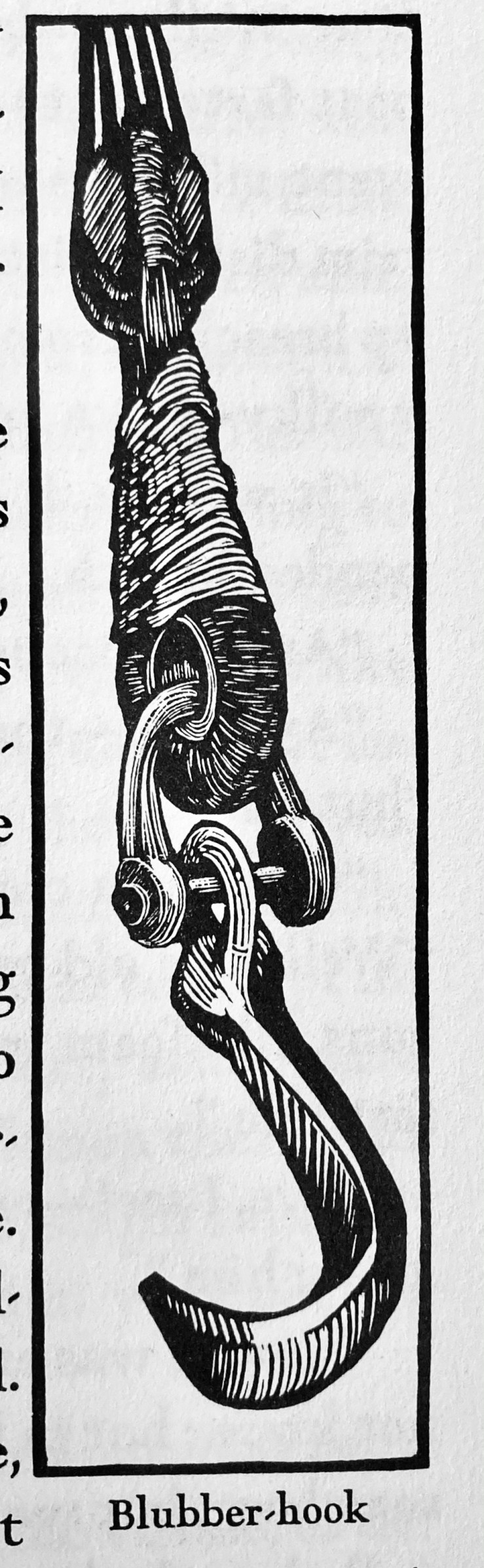
This spade is sharp as hone can make it; the spademan’s feet are shoeless; the thing he stands on will sometimes irresistibly slide away from him, like a sledge. If he cuts off one of his own toes, or one of his assistants’, would you be very much astonished? Toes are scarce among veteran blubber-room men.
Toes are scarce, but perhaps not as vital as legs.
V. Ch. 95, “The Cassock.”
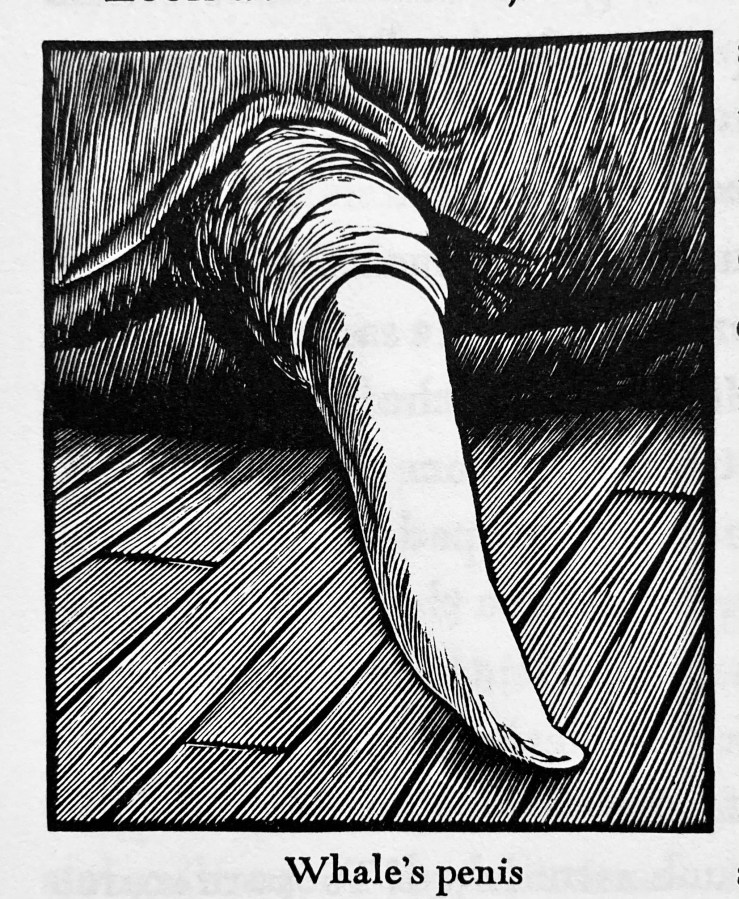
Another short chapter on a long subject. Ishmael describes-but-not-defines “a very strange, enigmatical object . . . lying along lengthwise in the lee scuppers.” His description is an accumulation of negations:
Not the wondrous cistern in the whale’s huge head; not the prodigy of his unhinged lower jaw; not the miracle of his symmetrical tail; none of these would so surprise you, as half a glimpse of that unaccountable cone,—longer than a Kentuckian is tall, nigh a foot in diameter at the base, and jet-black as Yojo, the ebony idol of Queequeg.
And what is that enormous jet black cone? A “grandissimus, as the mariners call it.”
It’s the whale’s dick, natch.
Moby-Dick illustration by Barry Moser
Ishmael compares it to the idol “found in the secret groves of Queen Maachah in Judea” — the Asherah pole — and points out that “King Asa, her son, did depose her, and destroyed the idol, and burnt it for an abomination.”
This is a phallic book full of castrations, cuttings off both figurative and literal.
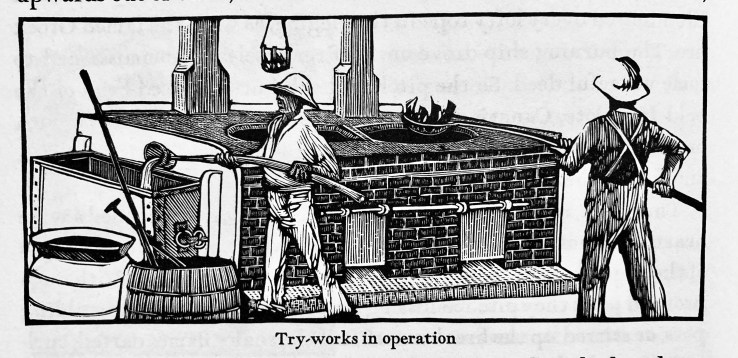
VI. Ch. 96, “The Try-Works”
Another chapter initially focused on the practical business of whaling. In this case, we learn about the try-works, where blubber is cooked down to oil. I’ll let Moser’s illustration stand in here:
Moby-Dick illustration by Barry Moser
And here:
The chapter ends though in a great metaphysical rush, as Ish goes from things back to ideas:
The truest of all men was the Man of Sorrows, and the truest of all books is Solomon’s, and Ecclesiastes is the fine hammered steel of woe. “All is vanity.” ALL. This wilful world hath not got hold of unchristian Solomon’s wisdom yet. But he who dodges hospitals and jails, and walks fast crossing graveyards, and would rather talk of operas than hell; calls Cowper, Young, Pascal, Rousseau, poor devils all of sick men; and throughout a care-free lifetime swears by Rabelais as passing wise, and therefore jolly;—not that man is fitted to sit down on tomb-stones, and break the green damp mould with unfathomably wondrous Solomon.
The chapter concludes with a puzzling set of metaphors:
There is a wisdom that is woe; but there is a woe that is madness. And there is a Catskill eagle in some souls that can alike dive down into the blackest gorges, and soar out of them again and become invisible in the sunny spaces. And even if he for ever flies within the gorge, that gorge is in the mountains; so that even in his lowest swoop the mountain eagle is still higher than other birds upon the plain, even though they soar.
VII. Ch. 97, “The Lamp.”
In this very short (three-paragraph) chapter, Ishmael notes that whalemen light their lamps from the oil of the animals they hunt.
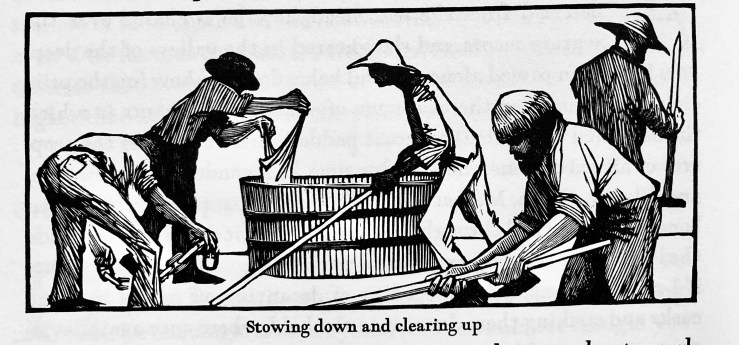
VIII. Ch. 98, “Stowing Down and Clearing Up.”
A chapter about cleaning up. Ish declares that, “were it not for the tell-tale boats and try-works, you would all but swear you trod some silent merchant vessel, with a most scrupulously neat commander. The unmanufactured sperm oil possesses a singularly cleansing virtue.” In other words, despite all the butchery, blood, and bits involved, there’s something in the whale itself that purifies the decks after a good scrub down.
The chapter ends with Ishmael recognizing the mechanical repetition of his business though—no wonder the Modernists revived Moby-Dick!
Yet this is life. For hardly have we mortals by long toilings extracted from this world’s vast bulk its small but valuable sperm; and then, with weary patience, cleansed ourselves from its defilements, and learned to live here in clean tabernacles of the soul; hardly is this done, when—There she blows!—the ghost is spouted up, and away we sail to fight some other world, and go through young life’s old routine again.
Oh! the metempsychosis! Oh! Pythagoras, that in bright Greece, two thousand years ago, did die, so good, so wise, so mild; I sailed with thee along the Peruvian coast last voyage—and, foolish as I am, taught thee, a green simple boy, how to splice a rope!
I. In this riff, Chapters 91, 92, and 93 of Moby-Dick.
II. Ch. 91, “The Pequod Meets The Rose-bud.”
Stubb stars in this humorous chapter in which The Pequod encounters a French vessel which is towing a pair of “what the fishermen call a blasted whale, that is, a whale that has died unmolested on the sea, and so floated an unappropriated corpse.” The smell from these two dead whales is awful. (Ish claims the odor is “worse than an Assyrian city in the plague, when the living are incompetent to bury the departed.”)
We soon learn the French ship bears an ironic name: “Bouton de Rose,”—Rose-button, or Rose-bud; and…this was the romantic name of this aromatic ship.”
Stubb hails the ship to ask Ahab’s famous question to all the ships The Pequod encounter, but the The Rose-bud has not seen the White Whale. Ahab leaves off, letting Stubb take over the chapter with his cruel comedy:
He now perceived that the Guernsey-man, who had just got into the chains, and was using a cutting-spade, had slung his nose in a sort of bag.
“What’s the matter with your nose, there?” said Stubb. “Broke it?”
“I wish it was broken, or that I didn’t have any nose at all!” answered the Guernsey-man, who did not seem to relish the job he was at very much. “But what are you holding yours for?”
“Oh, nothing! It’s a wax nose; I have to hold it on. Fine day, ain’t it? Air rather gardenny, I should say; throw us a bunch of posies, will ye, Bouton-de-Rose?”
“What in the devil’s name do you want here?” roared the Guernsey-man, flying into a sudden passion.
The Guernsey-man is irritated because his captain knows nothing of whales and refuses to discard the rotten animals, which his crew understand to be worthless. Stubb, however, thinks that one of the whales might be full of ambergris, a valuable substance, and he hatches a cunning plan to get the whale for himself. Stubb enlists the Gurnsey-man’s help in his plan: Stubb will appear as an expert witness on whales to The Rose-bud’s captain (ironically, a former perfumier)–only the captain speaks no English—so the Gurnsey-man will translate. However, the Gurnsey-man will simply say whatever he wants (namely, that they should cut the whales loose).
The scene plays out in comedy that I think still holds up today:
“What shall I say to him first?” said he.
“Why,” said Stubb, eyeing the velvet vest and the watch and seals, “you may as well begin by telling him that he looks a sort of babyish to me, though I don’t pretend to be a judge.”
“He says, Monsieur,” said the Guernsey-man, in French, turning to his captain, “that only yesterday his ship spoke a vessel, whose captain and chief-mate, with six sailors, had all died of a fever caught from a blasted whale they had brought alongside.”
Upon this the captain started, and eagerly desired to know more.
“What now?” said the Guernsey-man to Stubb.
“Why, since he takes it so easy, tell him that now I have eyed him carefully, I’m quite certain that he’s no more fit to command a whale-ship than a St. Jago monkey. In fact, tell him from me he’s a baboon.”
The scene continues in this line, with Stubb repeatedly insulting the captain who remains unaware of his abuse. When the captain offers Stubb a glass of wine to thank him for his advice, he replies thus:
“Thank him heartily; but tell him it’s against my principles to drink with the man I’ve diddled. In fact, tell him I must go.”
“He says, Monsieur, that his principles won’t admit of his drinking; but that if Monsieur wants to live another day to drink, then Monsieur had best drop all four boats, and pull the ship away from these whales, for it’s so calm they won’t drift.”
Stubb makes off with the whale and digs into it with his spade. He hits gold:
“I have it, I have it,” cried Stubb, with delight, striking something in the subterranean regions, “a purse! a purse!”
Dropping his spade, he thrust both hands in, and drew out handfuls of something that looked like ripe Windsor soap, or rich mottled old cheese; very unctuous and savory withal. You might easily dent it with your thumb; it is of a hue between yellow and ash colour. And this, good friends, is ambergris, worth a gold guinea an ounce to any druggist.
III. Stubb is the star of “The Pequod Meets The Rose-bud.” The chapter showcases his wit, and affords him all the best lines—lines a far cry from Ahab’s Shakespearean mode.
But this particular chapter also underlines my suspicion that Stubb is the villain of Moby-Dick. He’s cruel and greedy, duplicitous and hardhearted. He’s the opposite of largehearted Ishmael. Stubb has shown his double-edged comic cruelty earlier in the novel—most notably in the way he bullies his boat’s crew with sweethearted insults, but also in Ch. 64, “Stubb’s Supper,” when he plays cruel fun on Fleece, the Black cook of The Pequod. Stubb’s cruel avarice comes to a head in Ch. 93, “The Castaway.” But let’s first attend to Ch. 92, “Ambergris.”
IV. Ch. 92, “Ambergris.”
“Who would think, then, that such fine ladies and gentlemen should regale themselves with an essence found in the inglorious bowels of a sick whale!” Ishmael ponders near the beginning of this short chapter, which again riffs on a major theme of Moby-Dick; namely, how every thing earthly (and unearthly) finds its definition in its opposition.
V. Ch. 93, “The Castaway.”
Right.
So. Anyway. Per point III—I think I was arguing that Stubb is something of an asshole. He’s a bully, a bad boss, and despite the genial empathy in Ishmael’s voice (Melville’s voice?) that extends to all the horribles of The Pequod, he does not acquit himself well in “The Castaway.”
Ish sets the tragic scene from the outset:
It was but some few days after encountering the Frenchman, that a most significant event befell the most insignificant of the Pequod’s crew; an event most lamentable; and which ended in providing the sometimes madly merry and predestinated craft with a living and ever accompanying prophecy of whatever shattered sequel might prove her own.
In other words: The fate of poor Pip, the Black cabin boy, prefigures the fate of all the crew of the damned Pequod—-
and—
VI. (And, parenthetically—
I’ve been falling asleep to an audiobook of Cormac McCarthy’s novel Blood Meridian, which many many many folks have pointed out follows Moby-Dick, both rhetorically and thematically
(I mean hey, consider those opening lines:
“Call me Ishmael”
“See the child.
)
And anyway, I sort of dip into Blood Meridian in random places, finding concurrent moments, motifs, intersections—
And in the Tarot scene of Blood Meridian, the Judge tells the Black Jackson that “In your fortune lie our fortunes all” — an echo here of the fate of poor Pip.
)
VII. And anyway,
—So, “in the ambergris affair Stubb’s after-oarsman chanced so to sprain his hand, as for a time to become quite maimed; and, temporarily, Pip was put into his place.”
Pip was put into his place.
Pip freaks out and jumps from the boat his first time, a jump that results in the loss of a whale. Sadistic Stubb is stern (and more than racist) in his rebuke:
“Stick to the boat, Pip, or by the Lord, I won’t pick you up if you jump; mind that. We can’t afford to lose whales by the likes of you; a whale would sell for thirty times what you would, Pip, in Alabama. Bear that in mind, and don’t jump any more.” Hereby perhaps Stubb indirectly hinted, that though man loved his fellow, yet man is a money-making animal, which propensity too often interferes with his benevolence.
(Old Ishmael (and Old Melville) — what’s with the verb hinted there?)
And so and well—
But we are all in the hands of the Gods; and Pip jumped again. It was under very similar circumstances to the first performance; but this time he did not breast out the line; and hence, when the whale started to run, Pip was left behind on the sea, like a hurried traveller’s trunk. Alas! Stubb was but too true to his word. It was a beautiful, bounteous, blue day; the spangled sea calm and cool, and flatly stretching away, all round, to the horizon, like gold-beater’s skin hammered out to the extremest. Bobbing up and down in that sea, Pip’s ebon head showed like a head of cloves. No boat-knife was lifted when he fell so rapidly astern. Stubb’s inexorable back was turned upon him; and the whale was winged. In three minutes, a whole mile of shoreless ocean was between Pip and Stubb. Out from the centre of the sea, poor Pip turned his crisp, curling, black head to the sun, another lonely castaway, though the loftiest and the brightest.
Ishmael understands the incredible existential loss of being castaway in the wide waste of the sea:
…the awful lonesomeness is intolerable. The intense concentration of self in the middle of such a heartless immensity, my God! who can tell it?
Poor Pip goes mad. His fate will be the fate of the company proper.
And if Ishmael’s sympathy sympathizes the victim, so too does it sympathize the villain—-
For the rest, blame not Stubb too hardly. The thing is common in that fishery; and in the sequel of the narrative, it will then be seen what like abandonment befell myself.
—and yet that sympathy is an empathetic prefiguring gust of our narrator Ish’s ultimate fate.
Detail from a Barry Moser illustration to Moby-Dick
I. In this riff: Chapters 88-90 of Moby-Dick.
II. Ch. 88, “Schools and Schoolmasters.”
In this chapter, Ishmael distinguishes between the two types of “schools” of whales—the harem schools, which are comprised of all adult females and one male (Ish calls the harem-lord the “Grand Turk”), and the all-male schools. Ish points out that these Grand Turks aren’t great dads:
…like certain other omnivorous roving lovers that might be named, my Lord Whale has no taste for the nursery, however much for the bower; and so, being a great traveller, he leaves his anonymous babies all over the world; every baby an exotic.
Ish points out that the all-male schools are far more aggressive than the harem schools. Too, the young males are quick to abandon their wounded fellows:
Another point of difference between the male and female schools is still more characteristic of the sexes. Say you strike a Forty-barrel-bull—poor devil! all his comrades quit him. But strike a member of the harem school, and her companions swim around her with every token of concern, sometimes lingering so near her and so long, as themselves to fall a prey.
III. Ch. 89, “Fast-Fish and Loose-Fish.”
In this marvelous chapter, Ishmael begins in a legal mode and ends in a philosophical one. He gives us the (unofficial but self-legislated) code of all whalers:
I. A Fast-Fish belongs to the party fast to it.
II. A Loose-Fish is fair game for anybody who can soonest catch it.
This doctrine we all may know from our playground days, when it took this form: “Finders keepers, Losers weepers.”
Ever the expansive expander, Ish suggests that “these two laws touching Fast-Fish and Loose-Fish, I say, will, on reflection, be found the fundamentals of all human jurisprudence . . . Is it not a saying in every one’s mouth, Possession is half of the law: that is, regardless of how the thing came into possession?”
He then pivots, sympathetically pointing out that for all of “fundamentals of human jurisprudence,” property and the power over property comes down to coercive force:
But often possession is the whole of the law. What are the sinews and souls of Russian serfs and Republican slaves but Fast-Fish, whereof possession is the whole of the law? What to the rapacious landlord is the widow’s last mite but a Fast-Fish? What is yonder undetected villain’s marble mansion with a door-plate for a waif; what is that but a Fast-Fish? What is the ruinous discount which Mordecai, the broker, gets from poor Woebegone, the bankrupt, on a loan to keep Woebegone’s family from starvation; what is that ruinous discount but a Fast-Fish? What is the Archbishop of Savesoul’s income of £100,000 seized from the scant bread and cheese of hundreds of thousands of broken-backed laborers (all sure of heaven without any of Savesoul’s help) what is that globular £100,000 but a Fast-Fish? What are the Duke of Dunder’s hereditary towns and hamlets but Fast-Fish? What to that redoubted harpooneer, John Bull, is poor Ireland, but a Fast-Fish? What to that apostolic lancer, Brother Jonathan, is Texas but a Fast-Fish? And concerning all these, is not Possession the whole of the law?
Laws and mores are but window dressing, pasteboard masks veiling the brutally true untrue truth that Might makes right.
But Ish isn’t done. He points out that, “if the doctrine of Fast-Fish be pretty generally applicable, the kindred doctrine of Loose-Fish is still more widely so,” and then underlines his application with examples of conquest and imperialism:
What was America in 1492 but a Loose-Fish, in which Columbus struck the Spanish standard by way of waifing it for his royal master and mistress? What was Poland to the Czar? What Greece to the Turk? What India to England? What at last will Mexico be to the United States? All Loose-Fish.
Swept away in his oversoul passions, Ishmael moves from historical and political examples to metaphysical territory, eventually suggesting (in another of the novel’s many metatextual moves) that the relationship between reader and author is but another application of the loose-fish/fast-fish doctrine:
What are the Rights of Man and the Liberties of the World but Loose-Fish? What all men’s minds and opinions but Loose-Fish? What is the principle of religious belief in them but a Loose-Fish? What to the ostentatious smuggling verbalists are the thoughts of thinkers but Loose-Fish? What is the great globe itself but a Loose-Fish? And what are you, reader, but a Loose-Fish and a Fast-Fish, too?
IV. Ch. 90, “Heads or Tails.”
Ish begins with what he claims is a order “from the books of the Laws of England: “De balena vero sufficit, si rex habeat caput, et regina caudam.” Bracton, l. 3, c. 3.” He proceeds to tell us that this law stipulates that
…of all whales captured by anybody on the coast of that land, the King, as Honorary Grand Harpooneer, must have the head, and the Queen be respectfully presented with the tail. A division which, in the whale, is much like halving an apple; there is no intermediate remainder.”
I love that last bit in which we are reminded that power will grab all parts of a substance leaving no intermediate remainder for the powerless.
In this chapter, The Pequod passes by “the long islands of Sumatra, Java, Bally, and Timor; which, with many others, form a vast mole, or rampart, lengthwise connecting Asia with Australia,” but never rows boats to a shore: “But how now? in this zoned quest, does Ahab touch no land? does his crew drink air? Surely, he will stop for water. Nay.” The Pequod is fully stocked for this particular revenge mission.
III. Anticipating what will come in this chapter, Ishmael informs us that,
Sperm Whales, instead of almost invariably sailing in small detached companies, as in former times, are now frequently met with in extensive herds, sometimes embracing so great a multitude, that it would almost seem as if numerous nations of them had sworn solemn league and covenant for mutual assistance and protection.
They soon come upon a great host of whales, which, “beheld through a blending atmosphere of bluish haze, showed like the thousand cheerful chimneys of some dense metropolis.”
IV. “The Grand Armada” plays out in the mode of one of Melville’s earlier romantic adventure. The stakes are heightened when a pirate ship of Malays (“these rascally Asiatics,” Ishmael sounds with a racist note) pursues The Pequod as The Pequod pursues pods upon pods of whales.
Moby-Dick illustration by Barry Moser
V. Ishmael, ever-large-hearted (despite his many faults), compares the whales to sheep, and then to the over-hunted buffalo of the American West, and then, finally, to humankind:
Had these Leviathans been but a flock of simple sheep, pursued over the pasture by three fierce wolves, they could not possibly have evinced such excessive dismay. But this occasional timidity is characteristic of almost all herding creatures. Though banding together in tens of thousands, the lion-maned buffaloes of the West have fled before a solitary horseman. Witness, too, all human beings, how when herded together in the sheepfold of a theatre’s pit, they will, at the slightest alarm of fire, rush helter-skelter for the outlets, crowding, trampling, jamming, and remorselessly dashing each other to death. Best, therefore, withhold any amazement at the strangely gallied whales before us, for there is no folly of the beasts of the earth which is not infinitely outdone by the madness of men.
The lines shift away from the chapter’s romantic tone, instead underlying the philosophical mode of Moby-Dick.
VI. But that adventurous mode returns—Ishmael’s boat—which is to say, Queequeg’s boat, which is to say, Starbuck’s boat—look, the boat the narrator’s in—a particular boat manages to lance two whales with something called a “drugg”:
All whaleboats carry certain curious contrivances, originally invented by the Nantucket Indians, called druggs. Two thick squares of wood of equal size are stoutly clenched together, so that they cross each other’s grain at right angles; a line of considerable length is then attached to the middle of this block, and the other end of the line being looped, it can in a moment be fastened to a harpoon.
A third drugg is unlucky though, striking a note of danger and foreshadowing the disaster at the novel’s conclusion:
But upon flinging the third, in the act of tossing overboard the clumsy wooden block, it caught under one of the seats of the boat, and in an instant tore it out and carried it away, dropping the oarsman in the boat’s bottom as the seat slid from under him. On both sides the sea came in at the wounded planks, but we stuffed two or three drawers and shirts in, and so stopped the leaks for the time.
VII. The scene shifts again. Queequeg’s “jerking harpoon drew out” (everything in this phallic novel is always jerking and pricking and penetrating) “and the towing whale sideways vanished.” Ishmael’s boat then “glided between two whales into the innermost heart of the shoal, as if from some mountain torrent we had slid into a serene valley lake.”
The scene that unfolds is one of the most tender in all of Moby-Dick. “Here the storms in the roaring glens between the outermost whales, were heard but not felt,” declares Ishmael. Remember, our narrator sets out to sea to assuage his homicidal, suicidal impulses. He still remembers the wolfish world in this moment of respite, but he does not feel it. He feels something else:
…we were now in that enchanted calm which they say lurks at the heart of every commotion. And still in the distracted distance we beheld the tumults of the outer concentric circles, and saw successive pods of whales, eight or ten in each, swiftly going round and round, like multiplied spans of horses in a ring; and so closely shoulder to shoulder, that a Titanic circus-rider might easily have over-arched the middle ones, and so have gone round on their backs.
VIII. The boat is walled in by the whales, but Ishmael is not fearful. The whales about them are gentle — “small tame cows and calves; the women and children of this routed host.”
Ish continues:
…these smaller whales—now and then visiting our becalmed boat from the margin of the lake—evinced a wondrous fearlessness and confidence, or else a still becharmed panic which it was impossible not to marvel at. Like household dogs they came snuffling round us, right up to our gunwales, and touching them; till it almost seemed that some spell had suddenly domesticated them. Queequeg patted their foreheads; Starbuck scratched their backs with his lance; but fearful of the consequences, for the time refrained from darting it.
Violence is suspended here. And again, Starbuck, Queequeg, and Ishmael are coded as riders of conscience wrapped up in Ahab’s bloody quest.
IX. The scene intensifies. Actually, intensifies is entirely the wrong verb here, although, to be clear, the episode develops with a particular intensity—but intense seems to suggest anxiety, which here is suspended (even for the briefest of moments), as Ishmael’s boat encounters a “still stranger world” of calm:
But far beneath this wondrous world upon the surface, another and still stranger world met our eyes as we gazed over the side. For, suspended in those watery vaults, floated the forms of the nursing mothers of the whales, and those that by their enormous girth seemed shortly to become mothers. The lake, as I have hinted, was to a considerable depth exceedingly transparent; and as human infants while suckling will calmly and fixedly gaze away from the breast, as if leading two different lives at the time; and while yet drawing mortal nourishment, be still spiritually feasting upon some unearthly reminiscence;—even so did the young of these whales seem looking up towards us, but not at us, as if we were but a bit of Gulfweed in their new-born sight.
X. Queequeg then explodes, believing a whale darted and fastened with a line to a boat: ““Line! line!…him fast! him fast!—Who line him! Who struck?—Two whale; one big, one little!””
The image is of a different tethering though: Queequeg has mistaken a mother and child for two apparent victims:
Starbuck saw long coils of the umbilical cord of Madame Leviathan, by which the young cub seemed still tethered to its dam. Not seldom in the rapid vicissitudes of the chase, this natural line, with the maternal end loose, becomes entangled with the hempen one, so that the cub is thereby trapped. Some of the subtlest secrets of the seas seemed divulged to us in this enchanted pond. We saw young Leviathan amours in the deep.
And yet even after his lovefest, our sailors, our whalemen, will not be above general slaughter.
XI. The episode, as I’ve stated above, is one of the few in Moby-Dick wherein Ishmael overcomes the intense negative feeling he bears for his own world, and instead merges into a kind of Emersonian over-soul. “The Grand Armada” anticipates the novel’s greatest melding moment, Ch. 94, “A Squeeze of the Hand.” I’ve been quoting too much in this riff, but I can’t help it. Here is Ishmael’s joy:
And thus, though surrounded by circle upon circle of consternations and affrights, did these inscrutable creatures at the centre freely and fearlessly indulge in all peaceful concernments; yea, serenely revelled in dalliance and delight. But even so, amid the tornadoed Atlantic of my being, do I myself still for ever centrally disport in mute calm; and while ponderous planets of unwaning woe revolve round me, deep down and deep inland there I still bathe me in eternal mildness of joy.
And let us end this chapter and this riff with a bath of “eternal mildness of joy,” skipping over any predation its final pages might yield.








 Biblioklept