Mass-market Monday | Stendhal’s The Charterhouse of Parma

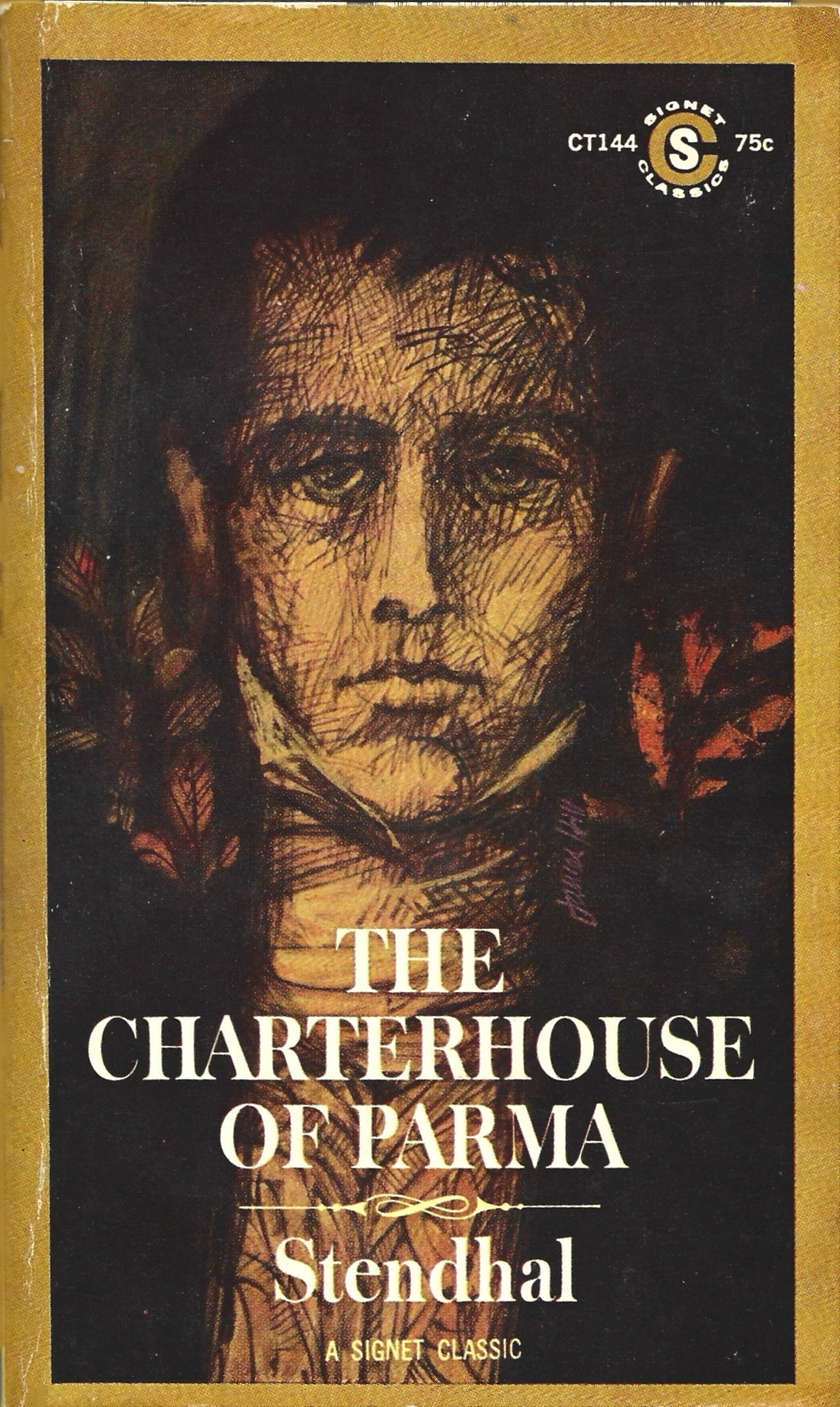
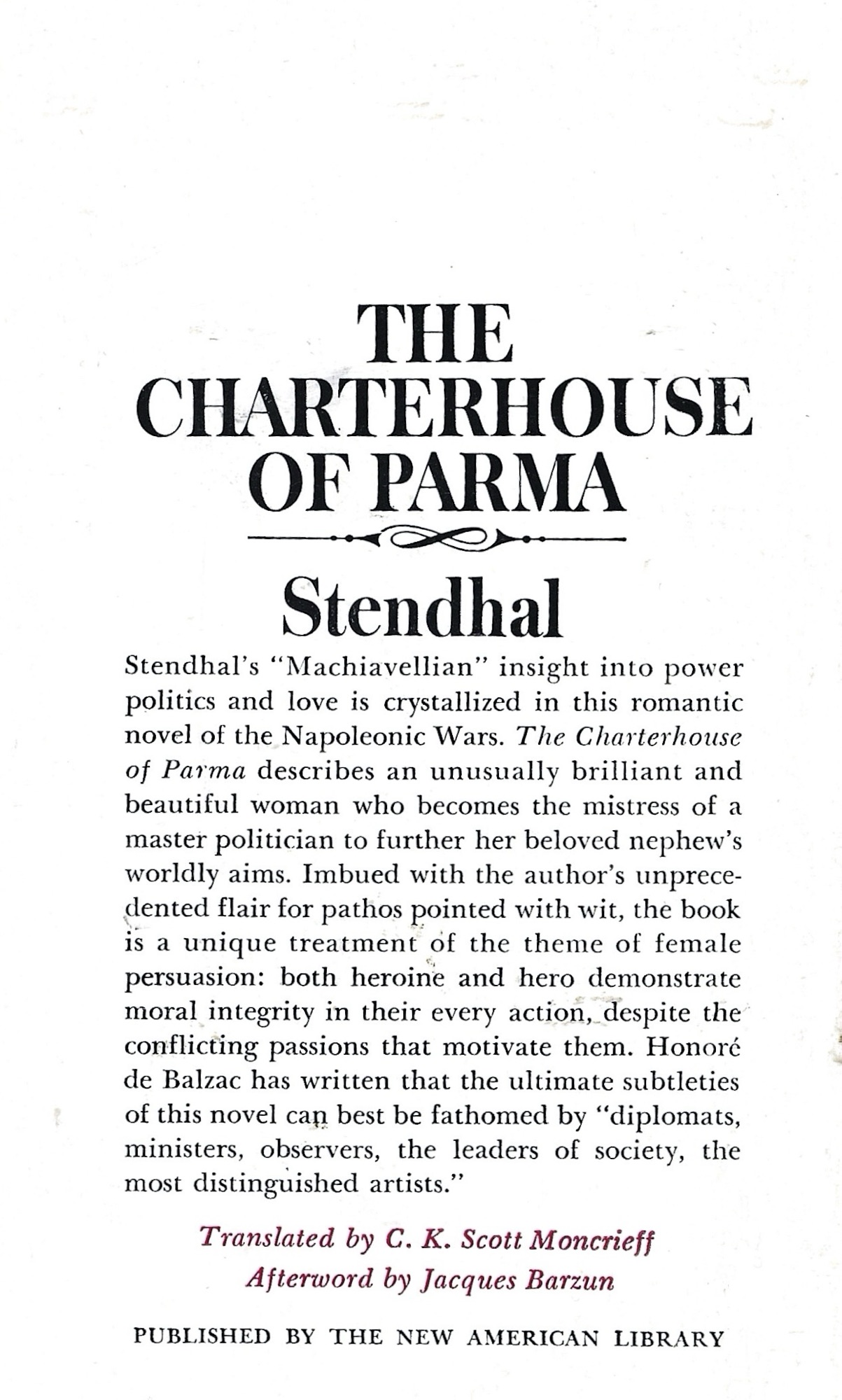
The Charterhouse of Parma, 1839, Stendhal. Translation by C.K. Scott Moncrieff. Signet Classics (1962). No cover artist credited. 502 pages.

I have fond memories of reading Stendhal’s The Charterhouse of Parma. These memories turn out to be faulty, or perhaps more accurately, not indicative of the experience I had of actually reading the book. I went back and read the riffs I wrote nine years ago on the novel, and words like “boredom” and “slog” pop up. From my last riff on the novel:

Balzac was a great admirer of Charterhouse, as was Italo Calvino, and countless writers too. Indeed, the novel is, I suppose, a cult favorite for writers, which makes sense: Stendhal crowds each page with such psychological realism, such rich life, that every paragraph seems its own novel. I’ll admit that by page 400 or so I was exhausted though.

I’ve noted here a few times that Charterhouse is a “Modernist” novel; perhaps “proto-Modernist” is the term I need. (Again—I’m sure that countless lit critics have sussed over this; pardon my ignorant American ass). And yet Charterhouse also points back at the novels before it, the serialized novels, the epistolary novels, the romances and histories and etceteras of the seventeenth and sixteenth centuries. My favorite lines of the novel were often our ironic narrator’s brief asides like, “Doubtless the reader grows tired…” or “The conversation went on for hours more in trivial detail…” or “The letter went on for pages more after the same fashion…” (These aren’t actual quotes, dear reader, but I think I offer a fair paraphrase here). Stendhal’s modernism, or Modernism, or proto-Modernism, or whatever, is his wily irony, his winking at the novel’s formal characteristics. My own failing, then, is to perhaps want more of this. As I wrote last time I riffed on it, what I suppose I want is a postmodern condensation of The Charterhouse of Parma, such as Donald Barthelme’s 1968 story “Eugénie Grandet,” which parodied Honoré de Balzac’s 1833 novel Eugénie Grandet. 

Screenshot 2016-07-25 at 5.08.00 PM

How much of Balzac’s novel is lovingly leapt through right here?!

This wish of mine is of course my failure, not the novel’s.

The Charterhouse of Parma is undoubtedly an oddity, a work of genius, often thrilling, and often an utter slog. I suppose I’m glad that I finally finished it after so many years of trying, but I’m not sure if I got what I wanted out of it. The failure is mine.

I’ll close with the novel’s final line though, which I adore:

TO THE HAPPY FEW

Sunday Comix

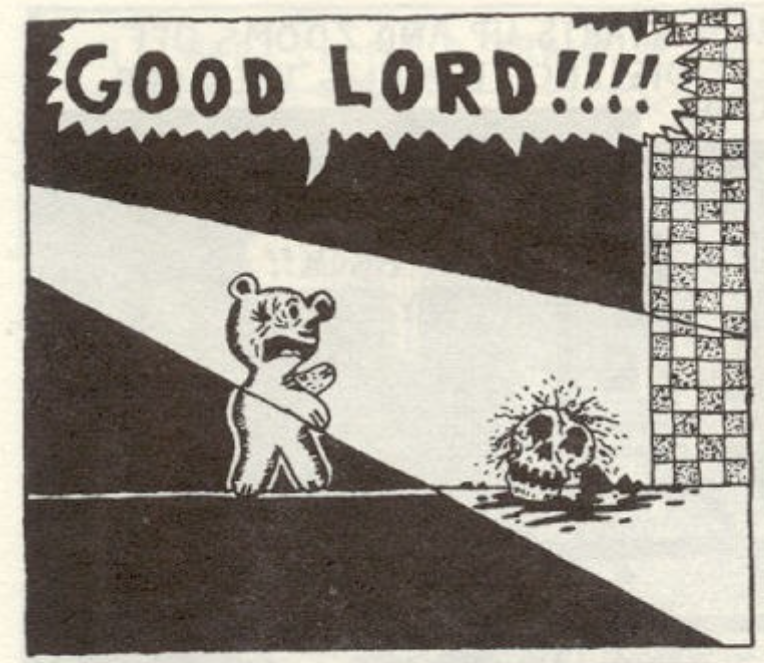
Art/text attributed to “Marks.” Back cover of Mother’s Oats Comix #2, August, 1971, Rip Off Press.
_

“Knocking,” a very short story by Robert Walser

“Knocking”

by

Robert Walser

translated by Tom Whalen and Carol Gehrig


I am completely beat, this head hurts me.

Yesterday, the day before yesterday, the day before the day before yesterday, my landlady knocked.

“May I know why you are knocking?” I asked her.

This timid question was turned down with the response: “You are pretentious.”

Subtle questions are perceived as impertinent.

One should always make a lot of noise.

Knocking is a true pleasure, listening to it less so. Knockers don’t hear their knocking; i.e., they hear it, but it doesn’t disturb them. Each thump has something agreeable for the originator. I know that from my own experience. One believes oneself brave when making a racket.

There’s that knocking again.

Apparently it’s a rug being worked on. I envy all those who, thrashing, exercise harmlessly.

An instructor once took several students over his knee and spanked them thoroughly, to impress upon them that bars exist only for adults. I also was among the group beneficially beaten.

Anyone who wants to hang a picture on the wall must first pound in a nail. To this end, one must knock.

“Your knocking disturbs me.”

“That doesn’t concern me.”

“Good, then I shall compliantly see to the removal of this irritation.”

“It won’t hurt you.”

A polite conversation, don’t you agree?

Knocking, knocking! I’d like to stop up my ears.

Also, I once dusted as a servant the Persian carpets for the household of a count. The sound of it echoed through the magnificent landscape.

Clothes, mattresses, etc., are beaten.

So a modern city is full of knocking. Anyone who worries over something inevitable seems a simpleton.

“Go ahead, knock as much as you like.”

“Is that meant ironically?”

“Yes, a little.”

Man Reading a Newspaper — Roland Jarvis

Man Reading a Newspaper, c. 1957 by Roland Jarvis (1926-2016)

Annotations on The Guardian’s ranking of Thomas Pynchon’s books

Thomas Pynchon’s ninth novel Shadow Ticket is out fifty days from now. In anticipation, there’s a piece today in The Guardian by John Keenan ranking Pynchon’s books to date.

I undertook a similar silly project just over a year ago on this blog in a post titled “A(nother) completely subjective and thoroughly unnecessary ranking of Thomas Pynchon’s novels” (this list was a correction to a previous 2018 list I foolishly compiled). Lists like these are obviously personal judgments (like, opinions man).

But Keenan’s list is wrong. So here are my annotations.

9. Keenan selects Slow Learner, writing,

A collection of early short stories that is chiefly of interest for the introduction, in which the author spells out why he thinks they fail. Pynchon does not spare himself but, unfortunately, he is right. For aficionados only.

I didn’t include Slow Learner in my rankings because it is not a novel. Pynchon’s intro to it is probably the best thing in it. I agree with Keenan’s assessment here.

8. Keenan selects Against the Day, writing,

Practically plotless, prolix and gargantuan, this novel landed with a thump following a nine-year gap. Characters fragment and double in a bewildering array, the style pastiches pulp novels, adventure stories and science fiction. It does not add up to more than the sum of its admittedly ingenious parts.

This assessment is egregious. Against the Day is perhaps the most directly political of Pynchon’s novels, and, in my estimation, the clearest (if not the most concise) expression of Pynchon’s political sympathies. I ranked it #3, writing: “I think this novel would make an excellent American history textbook. Its thesis: resist the military-industrial-entertainment-complex. Start here!

7. Keenan selects Bleeding Edge, writing,

Pynchon’s most recent novel is a lightweight. The protagonist, Maxine Tarnow, mother of two, longsuffering partner to a feckless financier, finds herself chasing shadows around Manhattan’s Silicon Alley. Maxine’s skills as a fraud investigator are put to the test unravelling the machinations of the nasty controller of a computer security firm who will do anything to get his hands on a virtual reality simulator called DeepArcher (geddit?). There are plentiful puns, red herrings and surnames that serve as possibly unhelpful acronyms – the usual Pynchon ingredients, in other words. Here they fail to cohere into an entirely satisfying whole.

Bleeding Edge is not top-tier Pynchon, but it’s hardly lightweight. I ranked it #6, writing,

Reading Bleeding Edge helped evoke all the weirdness the 2000s were about to lay out for us. It made me angry again, or reminded me of the anger that I’d sustain for most of the decade. It reminded me of our huge ideological failure after 9/11, an ideological failure we are watching somehow fail even more today.  But I also loved the novel’s unexpectedly sweet domestic plot, and found a kind of solace even in its affirmation of family, even as its final image pointed to the kind of radical inconclusiveness at the heart of being a parent.

6. Keenan selects Vineland, writing,

It is 1984, the year of Reagan’s re-election but for Zoyd Wheeler, Los Angeles-based veteran of the radical left, time has stopped. His wife, Frenesi, has left him to raise their daughter, Prairie, alone and he resorts to dismal acts of self-sabotage in order to qualify for government benefits. Prairie, in turn, flees the family coop to track down her mother, a subversive turned informant in league with federal baddy Brock Vond. Pynchon’s themes are prescient – surveillance, media saturation, generational miscommunication – but his aim is off.

I don’t think “Pynchon’s aim is off” is the best metaphor here. I think he hits what he shoots at — his targets are clear, and he’s an author, right? His characters are props he can set out where he likes, guaranteeing a bullseye. But that’s not always satisfying. I think the execution of Vineland is a bit slapdash. The book has always had cult status among Pynchon aficionados, perhaps stemming from a contrarian spirit. Paul Thomas Anderson’s (very) loose film adaptation, One Battle After Another, has also appeared to prompt a lot of reading, rereading, and online chatter about Vineland. I ranked it last in my list, at #8, writing that, “Vineland is ultimately depressing and easily my least-favorite Pynchon novel, but it does have some exquisite prose moments.

5. Keenan selects V., writing,

Sincerity is not a quality readily associated with Pynchon, but his debut novel displays an affection for his characters that would later take second place to irony. The story bounces between Benny Profane, unemployed sailor, and Herbert Stencil, obsessive seeker of the elusive V. The language shows its age in places, but the plight of people determined to keep themselves in the dark is as relevant as ever.

I love V. and also had it at #5 on my list. Keenan is right that “sincerity” is not associated with Pynchon, but absolutely incorrect that Pynchon’s mode of affection is displaced by irony in the later novels. It’s clear that Pynchon loves Jeremiah Dixon, Charles Mason, Webb Traverse, Roger Mexico, Maxine Tarnow, etc. In my list, I wrote,

I’ll repeat my endorsement that “V. makes a good starting place for anyone new to Pynchon” and recommend that anyone interested in Pynchon but daunted by the scope check out the book from their library and read the ninth chapter, the story of of Kurt Mondaugen.

4. Keenan selects The Crying of Lot 49, writing,

The author regretted publishing this novel but he was being unduly harsh on himself. Short, funny and shot through with allusions you can choose to follow or ignore, the story of Oedipa Maas’s search for the meaning behind the supposed rivalry of postal companies is the literary equivalent of non-Euclidean geometry.

I also had Crying at #4. I wrote,

The Crying of Lot 49 is probably a better novel than V. but I think I like V. better. 49 is very funny and showcases Pynchon’s tonality of paranoia/hope wrapped up in zaniness/horror. It’s an excellent sophomore novel, but also dense, claustrophobic even. I guess I like the Pynchon sprawl a bit better.

3. Keenan selects Inherent Vice, writing,

Wilfully weird, often sordid and occasionally borderline unintelligible, Pynchon’s seventh novel was adapted for the big screen by Paul Thomas Anderson in 2014. The adaptation was nominated for an Oscar, making Pynchon as mainstream as he’s ever likely to get. Larry “Doc” Sportello is a private investigator with a broken heart and a huge appetite for marijuana. His ex-girlfriend reappears out of nowhere, implores Doc to find her married lover, then promptly vanishes again. At the heart of the murky tale lurks the sinister presence of the Golden Fang, a vessel that means, as Doc surmises, “a lot of things to a lot of people” – all of them unsavoury.

I love Inherent Vice, but it’s hardly top-three! I had it at #7, above Vineland.

2. Keenan selects Gravity’s Rainbow, writing,

This kaleidoscopic tour de force cemented Pynchon’s reputation as a writer of baffling, farcical and profound genius. A chief delight is his brilliant ear for dialogue which is given full rein in this twisted tale of allied intelligence officers, Nazis, scientists and seers united by a MacGuffin in the shape of a mysterious rocket. The action arcs from London under bombardment to a postwar zone of surrender. What is striking is how the themes explored here – forever wars, technological domination, uncontrollable cartels – have become staples of internet discourse.

I had Mason & Dixon at #2 and Gravity’s Rainbow at #1.

1 . Keenan selects Mason & Dixon, writing,

Pynchon gives the 18th-century novel a postmodern twist to explore the relationship between Charles Mason and Jeremiah Dixon. . . The author layers fact over anachronistic fiction, scientific inquiry over conspiratorial rumour, and tragedy over knockabout farce, in a virtuoso display of storytelling. . . It is a ripping yarn spun for the incredulous enjoyment of both the cleric’s family and the grateful reader.

Here’s what I wrote in my (thoroughly unnecessary) list:

2. Mason & Dixon (1997)

A measurement of the world and a story about friendship. It would be Pynchon’s best novel if he hadn’t written—

1. Gravity’s Rainbow (1973)

The best book.

Rankings are stupid fun, and I appreciate Keenan giving me an opening for some stupid fun on a Monday morning when I should really be prepping for the onset of the fall semester. I’ll close with a more honest ranking — all of these books are good, most are excellent, and at least two are American classics. It might be better to rank Pynchon’s oeuvre on one of those dorky tier lists.

So here is my dorky unnecessary Pynchon tier list:

Sunday Comix

From “The Creature in the Tunnels” by Rory Hayes. Published in Bogeyman Comics #1, 1969, Twelve A.M. Publications.

Self-Portrait — Flannery O’Connor

Self-Portrait, 1952 by Flannery O’Connor (1925-1964)

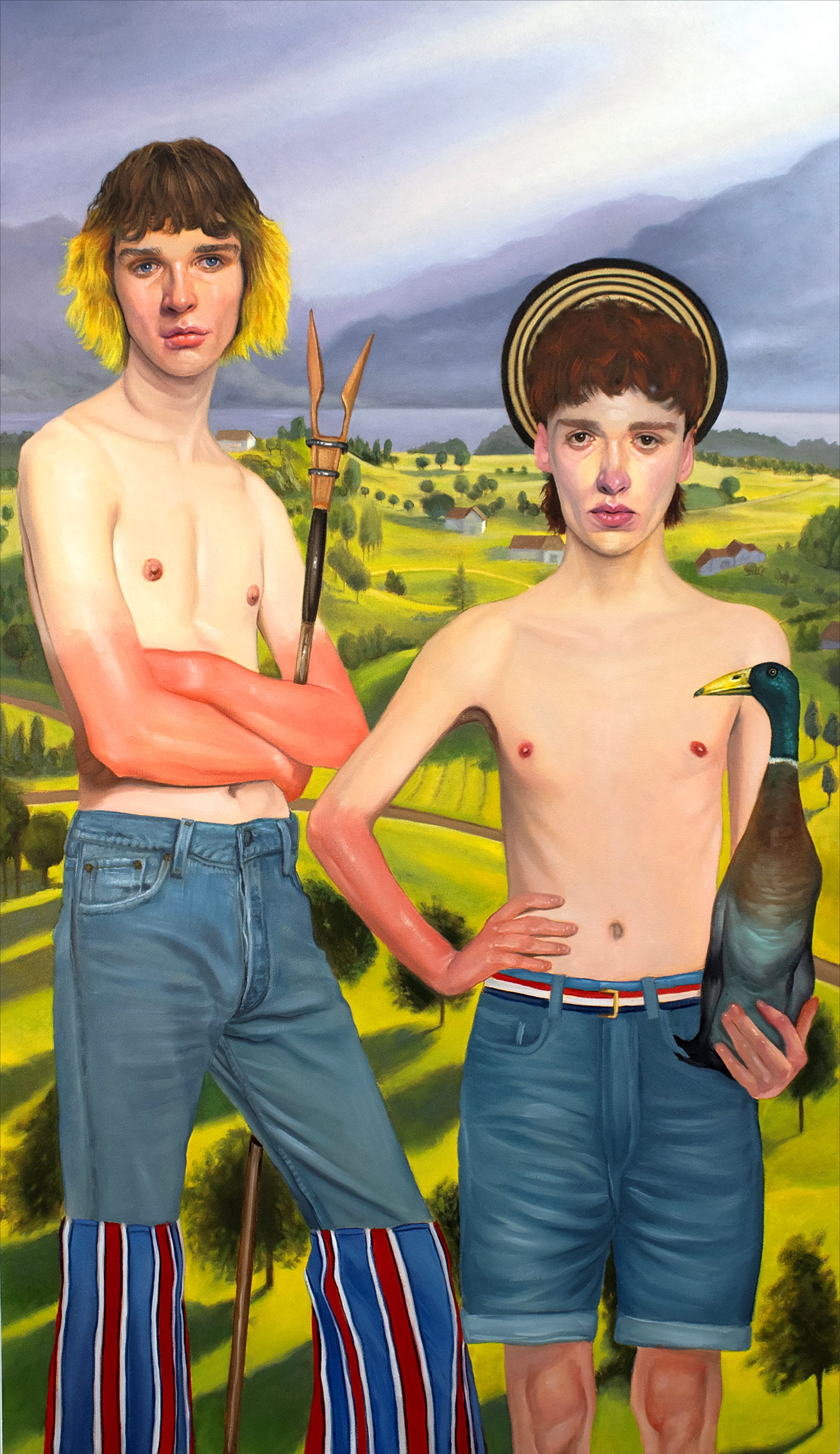
The Villages — Barnaby Whitfield

The Villages, 2023 by Barnaby Whitfield (b. 1970)

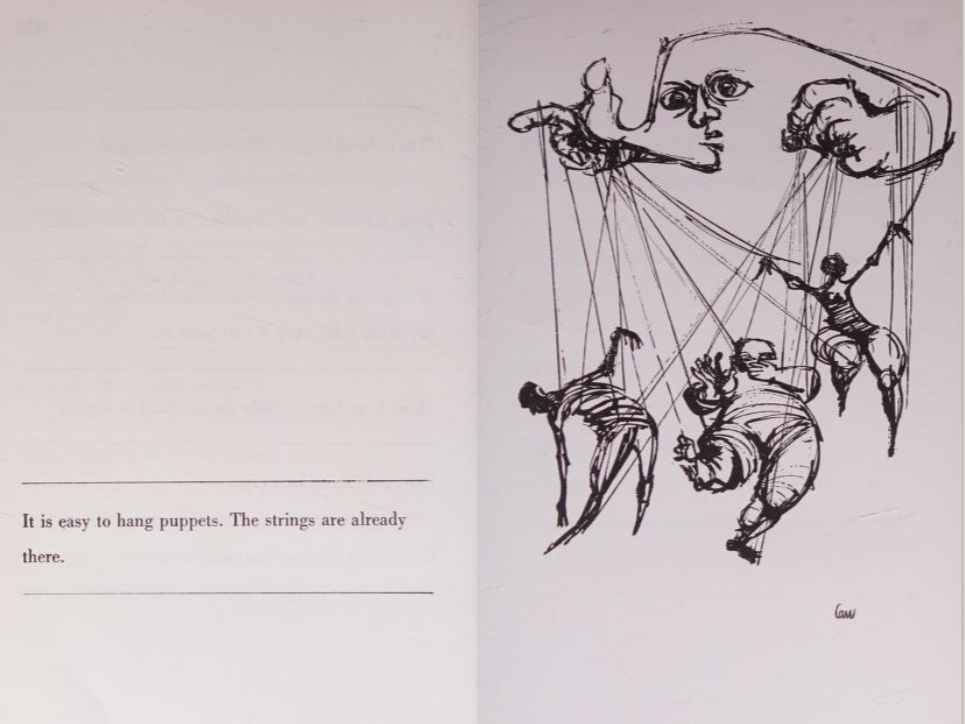
Easy to hang puppets

An aphorism from Stanislaw J. Lec’s Unkempt Thoughts with an illustration by Barbara Carr. Translation by Jacek Galazka.

Our perceptual relationship with the world works because we trust prior stories | Umberto Eco

Our perceptual relationship with the world works because we trust prior stories. We could not fully perceive a tree if we did not know (because others have told us) that it is the product of a long growth process and that it does not grow overnight. This certainty is part of our “understanding” that a tree is a tree, and not a flower. We accept a story that our ancestors have handed down to us as being true, even though today we call these ancestors scientists.

No one lives in the immediate present; we link things and events thanks to the adhesive function of memory, both personal and collective (history and myth). We rely upon a previous tale when, in saying “I,” we do not question that we are the natural continuation of an individual who (according to our parents or the registry office) was born at that precise time, on that precise day, in that precise year, and in that precise place. Living with two memories (our individual memory, which enables us to relate what we did yesterday, and the collective memory, which tells us when and where our mother was born), we often tend to confuse them, as if we had witnessed the birth of our mother (and also Julius Caesar’s) in the same way we “witnessed” the scenes of our own past experiences.

This tangle of individual and collective memory prolongs our life, by extending it back through time, and appears to us as a promise of immortality. When we partake of this collective memory (through the tales of our elders or through books), we are like Borges gazing at the magical Aleph—the point that contains the entire universe: in the course of our lifetime we can, in a way, shiver along with Napoleon as a sudden gust of cold wind sweeps over Saint Helena, rejoice with Henry V over the victory at Agincourt, and suffer with Caesar as a result of Brutus’ betrayal.

And so it is easy to understand why fiction fascinates us so. It offers us the opportunity to employ limitlessly our faculties for perceiving the world and reconstructing the past. Fiction has the same function that games have. In playing, children learn to live, because they simulate situations in which they may find themselves as adults. And it is through fiction that we adults train our ability to structure our past and present experience.

From Umberto Eco’s lecture “Fictional Protocols,” part of Six Walks in the Fictional Woods.

Sunday Comix

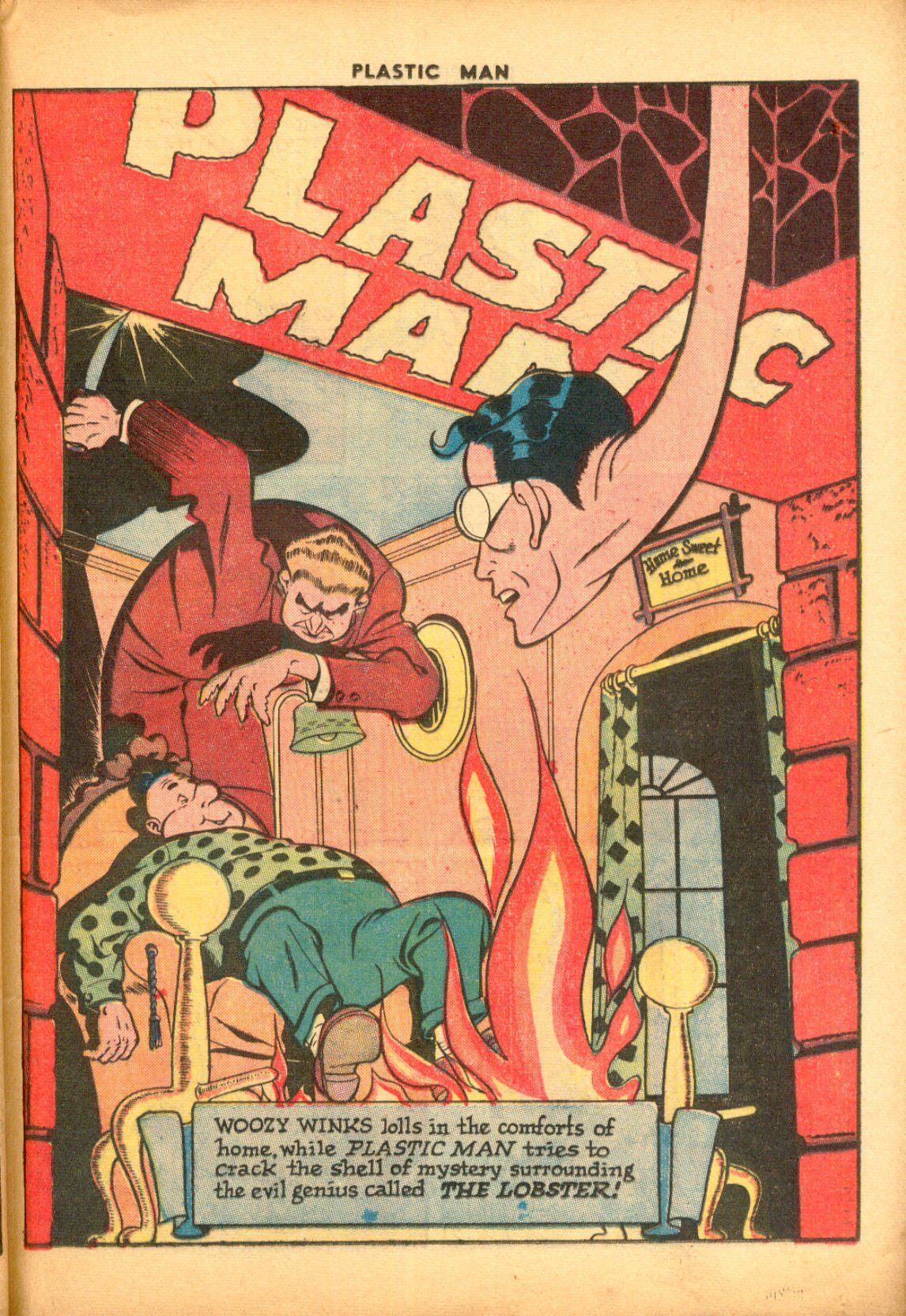
From “The Lobster” by Jack Cole, Plastic Man #4, July 1946, Quality Comics.

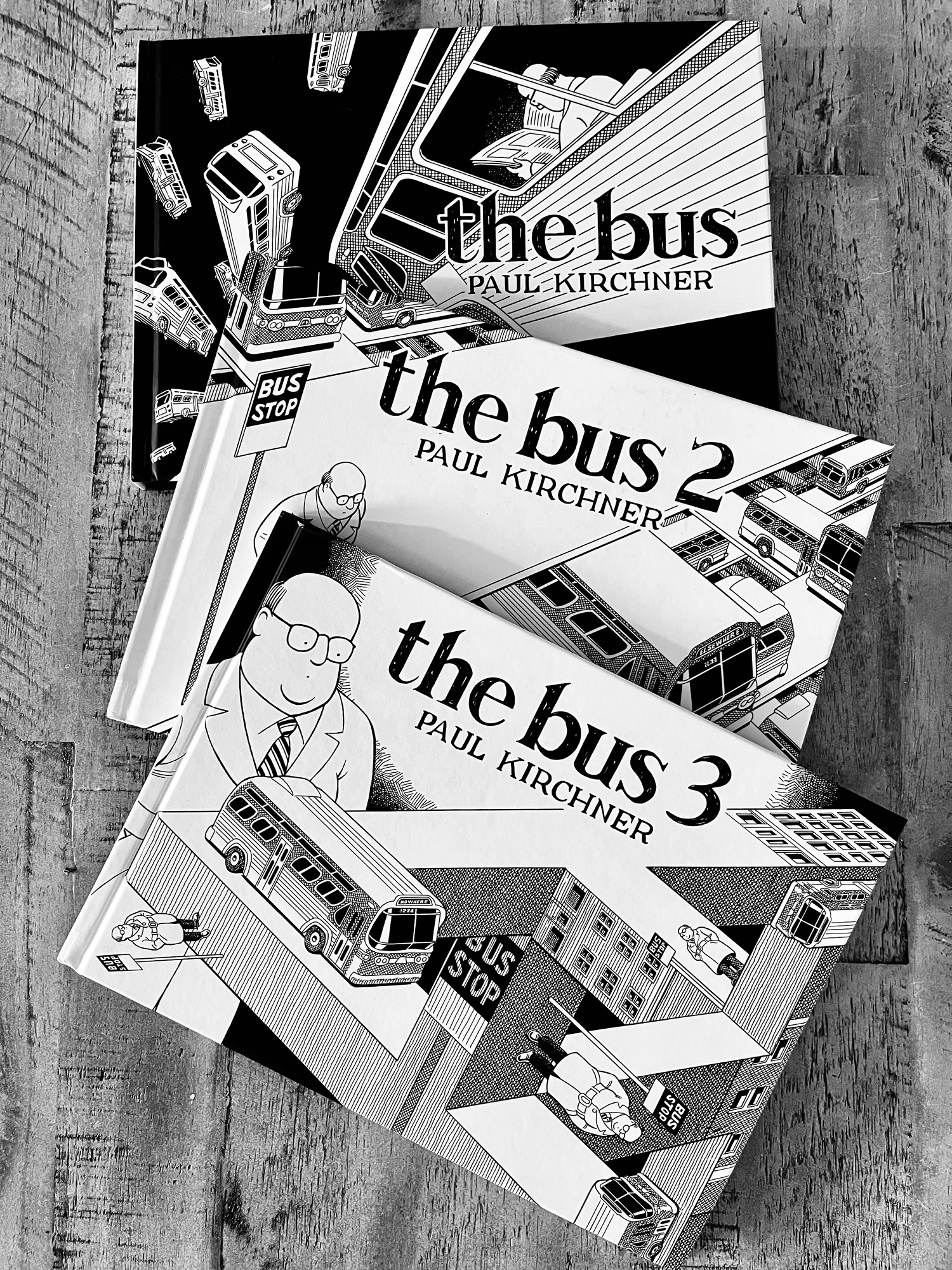
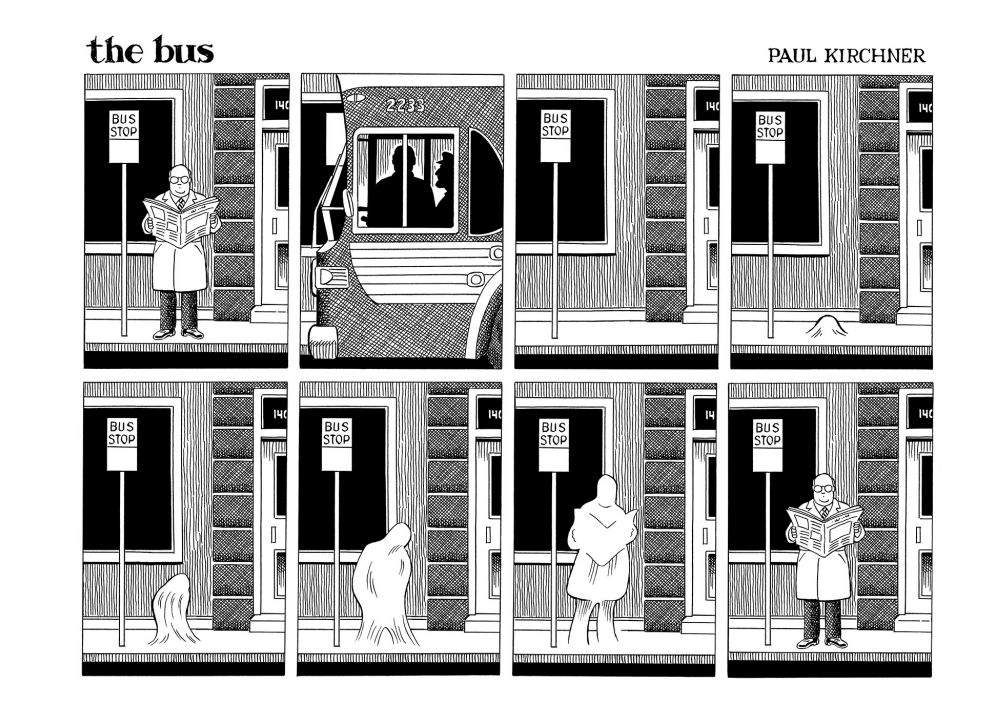
Paul Kirchner’s metaphysical trip continues in The Bus 3

Paul Kirchner’s surreal comic strip The Bus is a looping, deadpan fugue of modern alienation and mechanical ritual, where a lone Commuter drifts through absurd, Escher-like permutations of transit life.

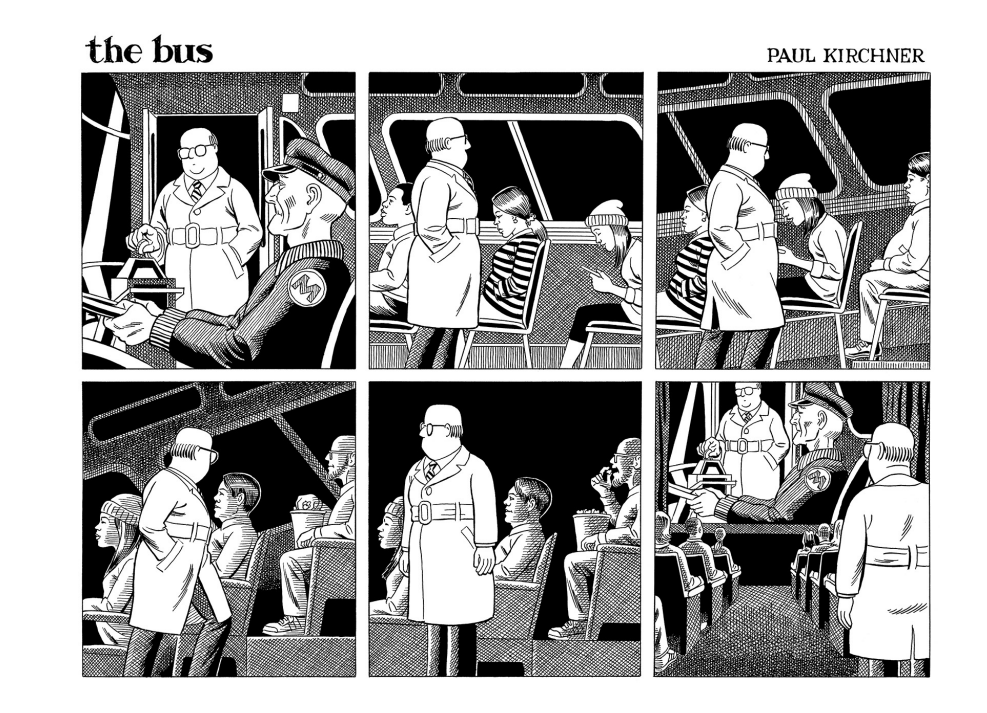
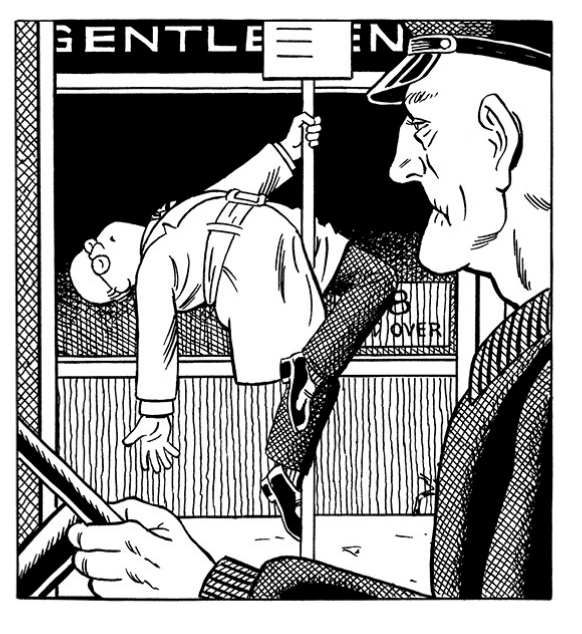
The Commuter’s foil and ferry is the titular bus (which Kirchner himself described as “demonic” in a 2015 essay in The Boston Globe); his Charon (and, really, partner) is the bus’s Driver. Each Bus strip is a double-decker one-pager rendered in precise black ink; most strips are wordless and consist of six or eight panels. Kirchner uses these constraints to conjure metaphysical gags that upend the banality of everyday existence. The previous two sentences that attempt to describe Kirchner’s formal techniques are a poor substitute for an example — so here is an example:

The strip above is the first entry in Kirchner’s new collection, The Bus 3. This strip neatly ushers us into The Bus’s charms. Old partners Commuter and Driver reunite; the bus subtly transforms into a theater; the Commuter turns to witness the loop start anew. Is there an exit? And would the Commuter want to escape the loop?

The second strip reaffirms Kirchner’s commitment to the Commuter’s eternal return. Our hapless hero is a kind of chthonic demigod, simultaneously plastic and immutable, wholly absurd:

The Bus’s first route was between 1978 and 1985 in the pages of Heavy Metal magazine. French publisher Tanibis Editions republished this original run in 2012. In 2015, they published The Bus 2, a sequel of new material. In my review, I wrote that “The Bus 2, like its predecessor, is a remarkably and perhaps unexpectedly human strip.” The same is true for The Bus 3. Kirchner’s strips demonstrate that the absurdity of the modern condition, for all its dulling machinations, reaffirms humanity and the imaginative, artistic vision as a site of surreal resistance.

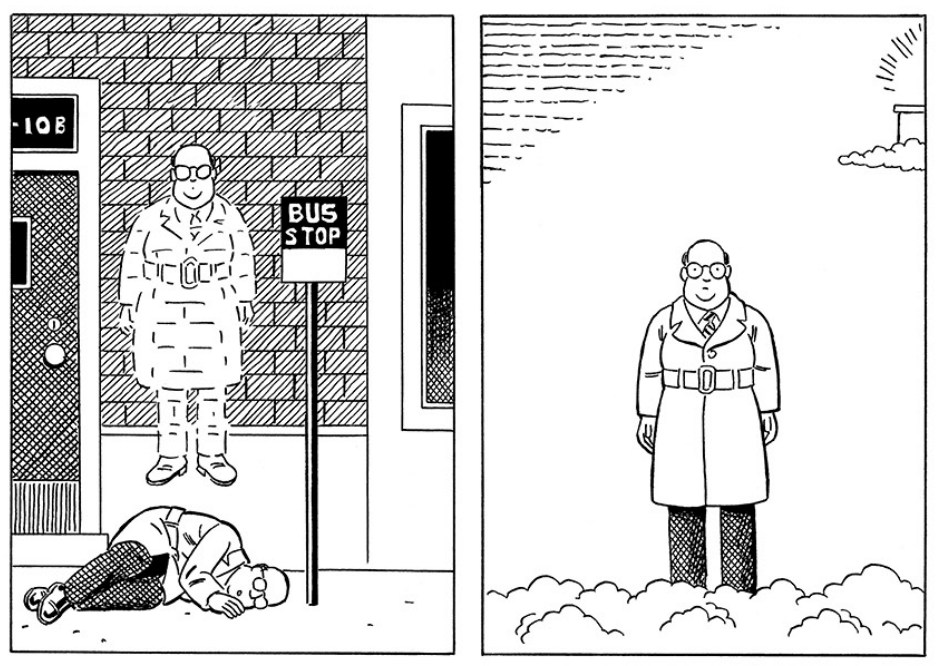
I kept The Bus 3 out on my coffee table the entire summer. I tried not to gobble up all the strips right away, but rather to read one or two a day, each page a small treat against the absurdity of the day. As I reached the end of the volume a week ago, I found myself strangely moved by the last three strips. Kirchner’s Möbius strips always send the Commuter back to his starting position. These last three pull the same move, but with a difference. In the first of the final three, the Commuter dies (waiting on the Driver, natch) and his spirit ascends. In eight speechless panels, Kirchner retells Kafka’s parable “Before the Law.”

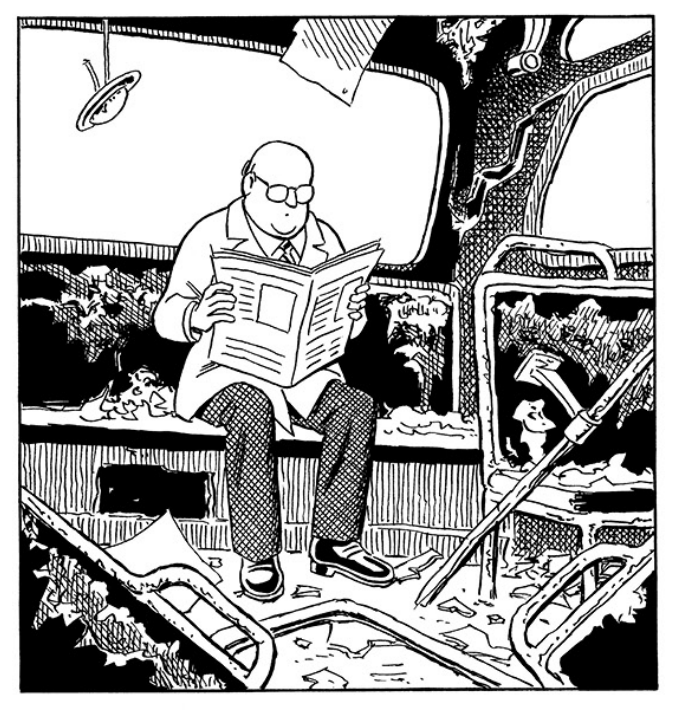
The penultimate strip, a gag on Macy’s Thanksgiving Day Parade balloons literally deflates the bus. The crowd has left, but the Commuter remains, stoic, waiting. And the last proper strip shows a techno-utopian future with a splendid flying bus — but our Commuter refuses to board. His neck stooped, he wanders to the outskirts of town to find the apocalyptic wreckage of his beloved broken down bus. It’s a lovely moment.

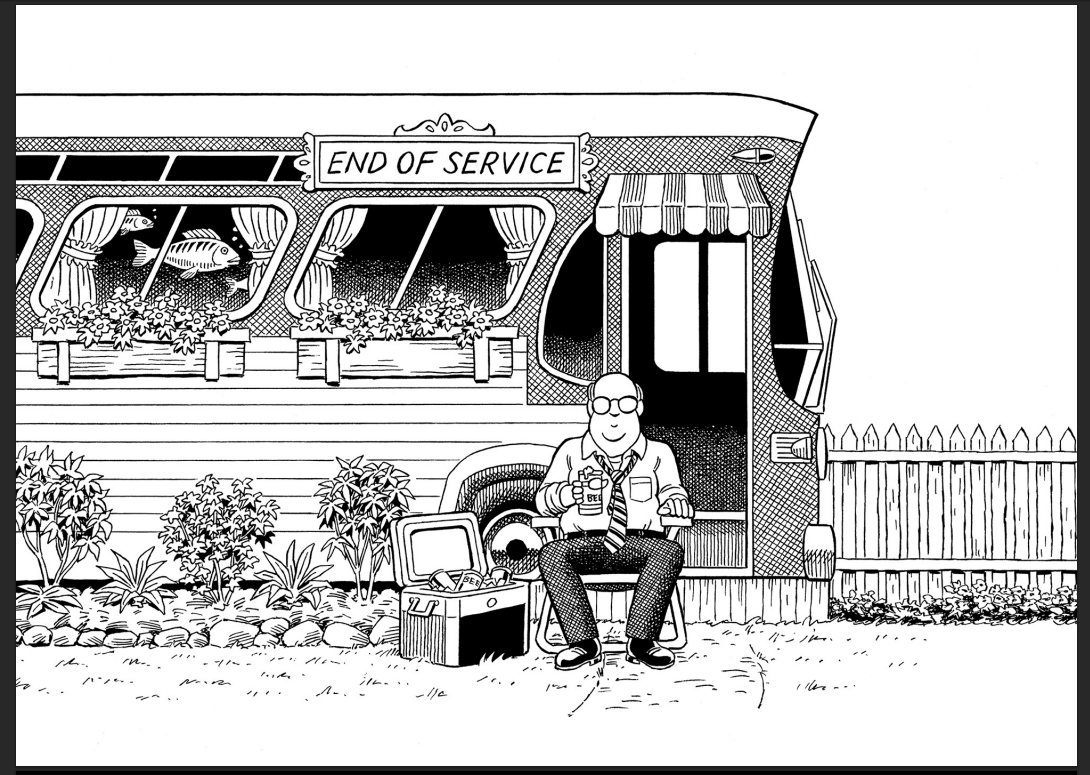
Has Kirchner retired his Commuter? Perhaps. The last page of the book shows our hero somehow looking bemused in a folding lawn chair, a cold one in his hand. He sits in front of the bus, now converted to an immobile home, scene of domestic bliss, maybe, everything tranquil and normal (just ignore the fish).

Is it really the end of service? If so, The Bus 3 offers a sweet send off for its hero. But I’ll hold out hope for one more ride. Great stuff.

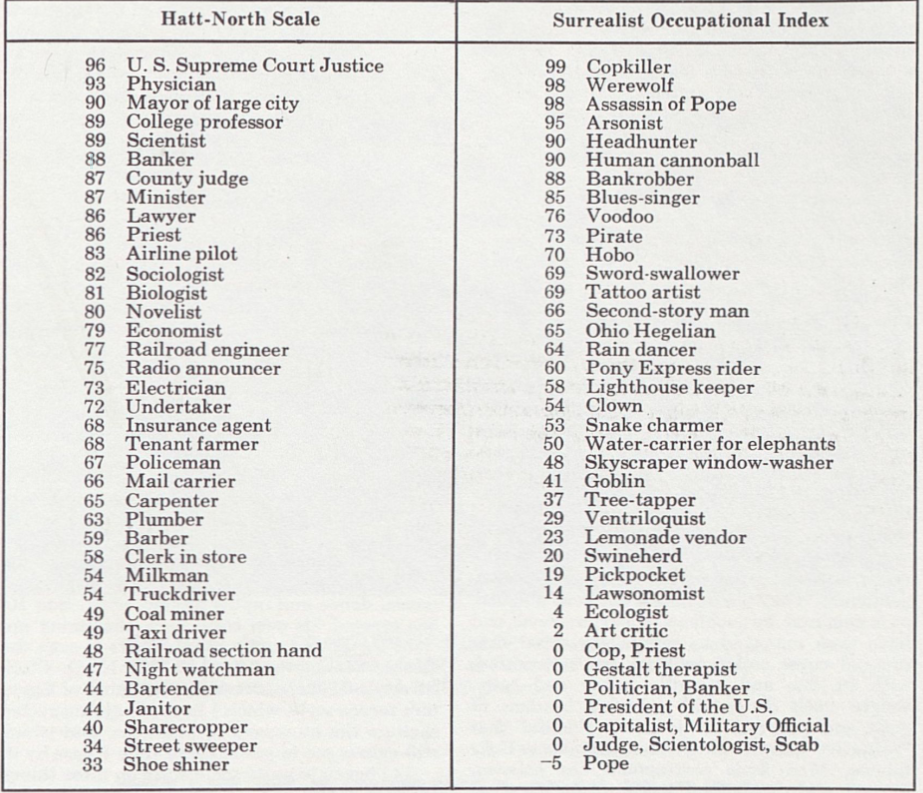
Surrealist Occupational Index

Published in Arsenal: Surrealist Subversion, No. 2, Summer 1973.

Burning Land — Christopher Croft

Burning Land, 1973 by Christopher Croft (b. 1947)

Sunday Comix

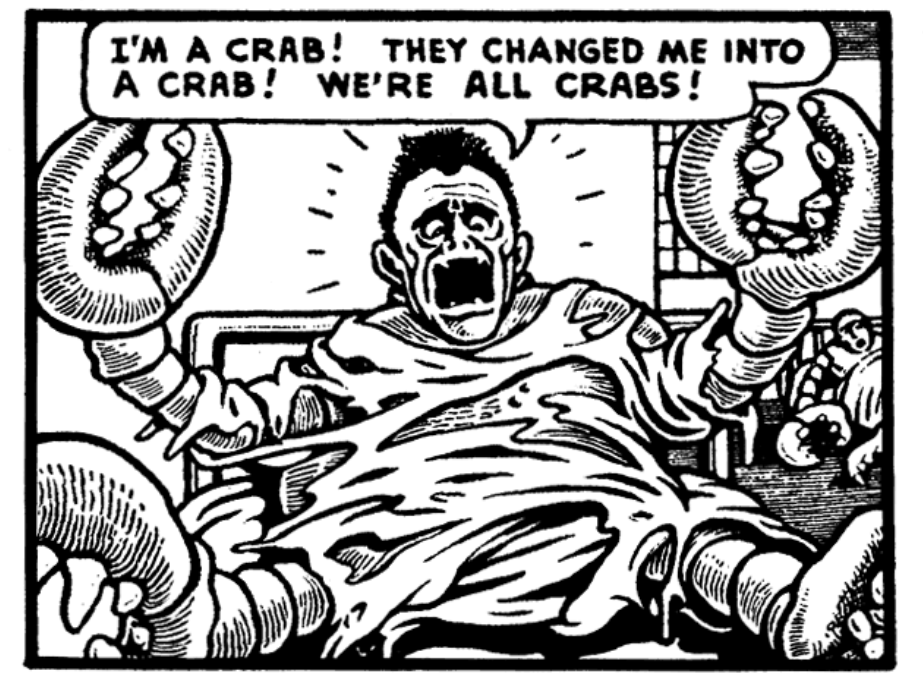
From “They Crawl by Night” by Daniel Keyes and Basil Wolverton, Journey Into Unknown Worlds #15, February 1953, Atlas Comics. Reprinted in Basil Wolverton’s Gateway to Horror #1, June 1988, Dark Horse Comics.

Dante’s Paradiso (Book acquired, some time in July 2025)

D.M. Black’s new translation of Dante’s The Divine Comedy concludes in this volume. Publisher NYRB’s blurb:

Paradiso brings The Divine Comedy to a virtuosic and visionary end. This final leg of Dante’s journey from Hell into the presence of God is for many the most memorable stretch of the poem, a musical and mystical interveaving of mind and heart and transported sense that is unlike anything else in world literature. This new English rendering of Paradiso by the poet D.M. Black, whose Purgatorio won the 2022 National Translation Award in Poetry, re-creates this masterpiece with fidelity and clarity.

Cleansed of sin after his grueling trek up Mount Purgatory, Dante’s pilgrim sets out to explore the celestial spheres under the guidance of his childhood sweetheart and lifelong muse, Beatrice. As he moves from the moon to the planets to the Primum Mobile and beyond, encountering emperors, heroes, saints, members of his family, and various other redeemed sinners, he contemplates optics, angels, free will, mercy, and love. The transcendent actuality of bliss is ever more palpable as the poem unfolds, and yet in the background remains the carnage of history and the deforming bitterness of the human heart, not to be denied—Dante is nothing if not a realist—even in the supreme light of “the Love that moves the sun and all the stars.”

Written at a time of great political turmoil in Italy and great personal anxiety in Dante’s life, Paradiso wrestles with many questions that have echoes in our own disturbing times. It is a book about the shape of the universe and how to find one’s place within it, composed with inventive daring and linguistic ingenuity as Dante stretches language to its very limits, striving to make vivid and tangible the ineffable and sublime.

The object of art is to make the reader or viewer or listener aware of what he knows but doesn’t know that he knows | William S. Burroughs on photography

The object of art is to make the reader or viewer or listener aware of what he knows but doesn’t know that he knows … And this is doubly true of photography, because the photographer is making the viewer aware of what he is actually seeing and yet at the same time not seeing. So many people in urban environments are walking around without seeing what is in front of them, let alone what is at the margin of vision, because what they see seems to have no meaningful relationship to them as observers. It is the art of the photographer to wrest back meaning for the observer from the input of impressions. Cut, shuffle, pick a card, any card… what do we see as we walk the streets of a city? A jumble of fragments. Now, these fragments are meaningful to you because they are what you have chosen to see.

I used to have an exercise that I suggested to my students at New York City College. Walk around the block and try to keep your eyes open for a change. Now sit down and write what you have just seen with particular attention to what you were thinking when someone walked by, when you saw a certain billboard, when a car passed… and so forth.

It soon becomes apparent that these fragments are not meaningless, that they mean something very definite to you, spelling out messages, cryptic messages … Some students think they are going insane. “Everything is talking to me.” Of course it is … it always was… You are just starting to listen and see a little. (One student became convinced that I was the Anti-Christ and that voices were telling him to kill me. At this point I edged into the kitchen and sought the proximity of a potato masher.)

Another exercise I called “color walks.” Walk down a New York street and pick out all the reds-focusing on the red. Now shift to the blues, the yellows, the whites… Blue again and I know the car coming up behind me will be blue… and it is. Or you’re running out of yellow… a yellow cab comes right on cue. Just start looking and you will see. Example-I am thinking about New Mexico. Round a corner and there is a New Mexico license plate. “New Mexico, Land of Enchantment.”

Click, click, click. Catch these intersection points between your inner reality and what you are seeing, between the inner reality and the outer reality. They have a particular relevance to the observer and, if the observer is also a photographer, the intersection points give the photographs their special style. Now take a stack of photographs. We are looking for the point where inner reality and outer reality intersect.

From William S. Burroughs’s introduction to Robert Walker’s New York Inside Out, a 1984 collection of street photography. The introduction was published, along with several of Walker’s photographs, in the August 1984 issue of Popular Photography.