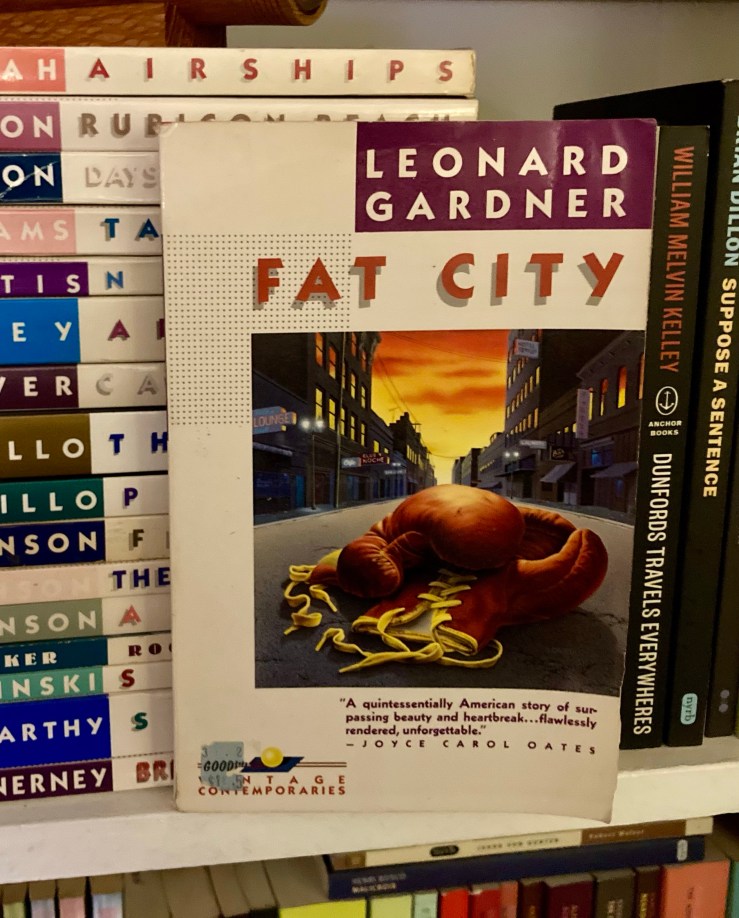
Leonard Gardner’s Fat City (Book acquired, 12 Nov. 2020)

I’ve been wanting to read Leonard Gardner’s Fat City for a while, and how could I pass up this Vintage Contemporaries edition?

I think I first heard of the book years ago in conjunction with its influence on Denis Johnson. In Salon, in 1996, Johnson wrote, or gushed, really–

Exactly which year of the 1960s the book came out, I can’t remember, but I remember well which year of my lifetime it was — I was discovering that it wasn’t a joke anymore, I was actually going to have to become a writer, I was too emotionally crippled for real work, there wasn’t anything else I could do — I was 18 or 19. Newsweek reviewed “Fat City,” a first novel by Leonard Gardner, in a tone that seemed to drop the usual hype — “It’s good. It really is.” I wanted to get a review like that.

I got the book and read about two Stockton, California boxers who live far outside the boxing myth and deep in the sorrow and beauty of human life, a book so precisely written and giving such value to its words that I felt I could almost read it with my fingers, like Braille.

The stories of Ernie Munger, a young fighter with frail but nevertheless burning hopes, and Billy Tully, an older pug with bad luck in and out of the ring, parallel one another through the book. Though the two men hardly meet, the tale blends the perspective on them until they seem to chart a single life of missteps and baffled love, Ernie its youth and Tully its future. I wanted to write a book like that.

My neighbor across the road, also a young literary hopeful, felt the same. We talked about every paragraph of “Fat City” one by one and over and over, the way couples sometimes reminisce about each moment of their falling in love.

And like most youngsters in the throes, I assumed I was among the very few humans who’d ever felt this way. In the next few years, studying at the Writer’s Workshop in Iowa City, I was astonished every time I met a young writer who could quote esctatically line after line of dialogue from the down-and-out souls of “Fat City,” the men and women seeking love, a bit of comfort, even glory — but never forgiveness — in the heat and dust of central California. Admirers were everywhere.

My friend across the road saw Gardner in a drugstore in California once, recognized him from his jacket photo. He was looking at a boxing magazine. “Are you Leonard Gardner?” my friend asked. “You must be a writer,” Gardner said, and went back to the magazine. I made him tell the story a thousand times.

Between the ages of 19 and 25 I studied Leonard Gardner’s book so closely that I began to fear I’d never be able to write anything but imitations of it, so I swore it off.

I haven’t owned a copy of “Fat City” in over 20 years, but I recently learned that the University of California Press is bringing out an edition this November, and I’ve ordered one.

When I was about 34 (the same age Gardner was when he published his), my first novel came out. About a year later I borrowed “Fat City” from the library and read it. I could see immediately that 10 years’ exile hadn’t saved me from the influence of its perfection — I’d taught myself to write in Gardner’s style, though not as well. And now, many years later, it’s still true: Leonard Gardner has something to say in every word I write.

I just finished John Brunner’s big baggy shaggy dog of a sci-fi novel, Stand on Zanzibar (reading David Ohle’s spare abject wild dystopian prose-poem Motorman, in between Zanzibar chunks)—I think Fat City might be a nice reset.
Watch a 1970 short documentary about Alice Coltrane

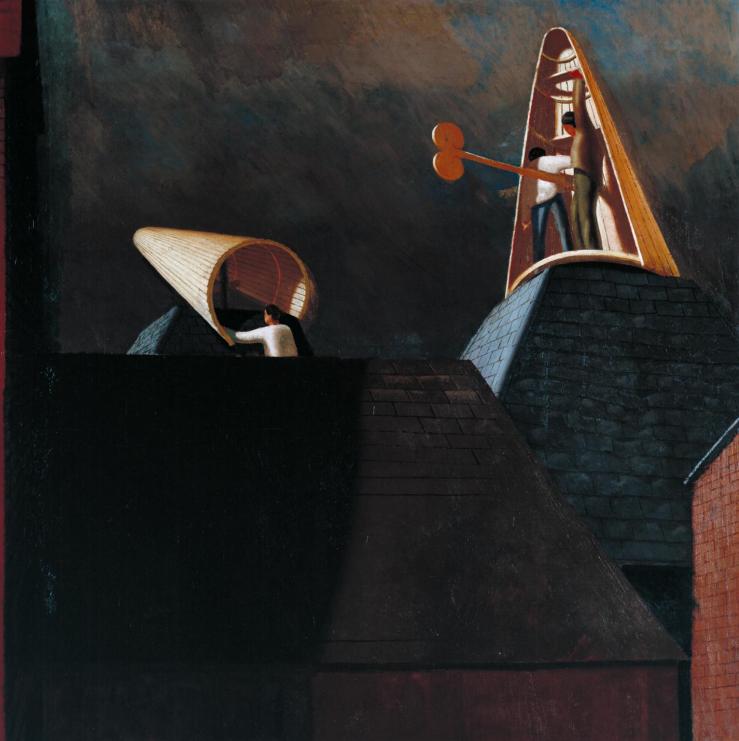
Mending Cowls, Cookham — Stanley Spencer

Mending Cowls, Cookham, 1915 by Stanley Spencer (1891–1959)

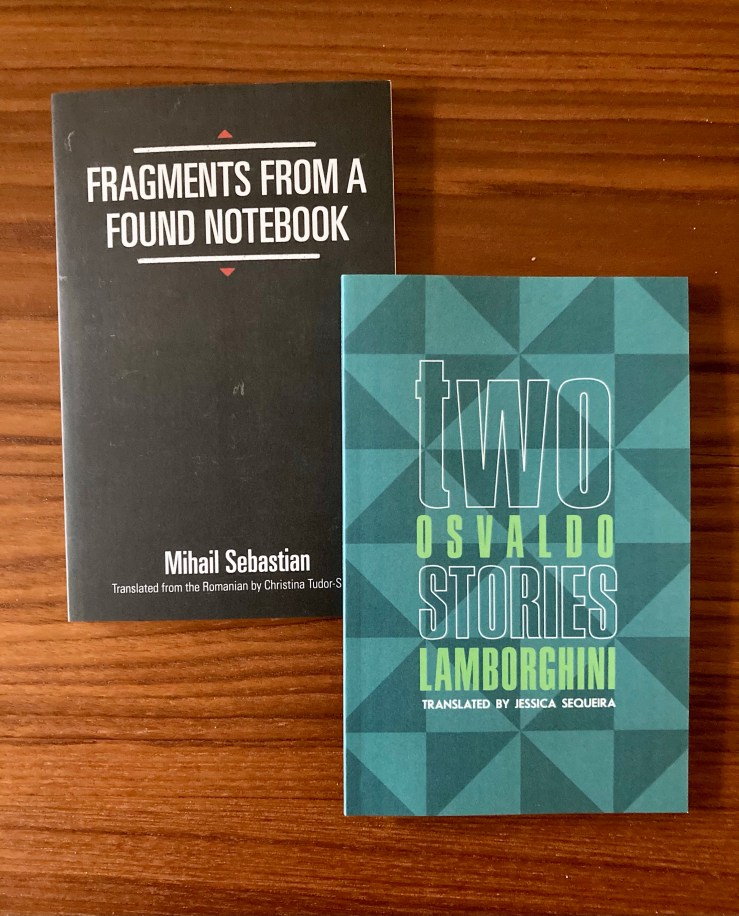
Osvaldo Lamborghini/Mihail Sebastian (Books acquired, 10 Nov. 2020)

Two new “objects” in translation from strangish newish indie Sublunary Editions arrived at Biblioklept World Headquarters the other day: Two Stories by Osvaldo Lamborghini (translated by Jessica Sequeira) and Fragments from a Found Notebook by Mihail Sebastian (translated by Christina Tudor-Sideri).

Intrigued by the three-word blurb from Roberto Bolaño (“It scares me”) on its back cover, I read the two stories in Lamborghini’s Two Stories. I skipped César Aira’s introduction—I always skip introductions—and then after a few baffling pages, I went back to the introduction. Aira’s introduction didn’t exactly explicate the text for me. It did, however, read like a few pages from a Bolaño novel, describing a strange heroic exotic Argentine writer, a poet-artist romantically disposed to self-exiles. (I actually did a basic internet search just to make sure it wasn’t like, an elaborate fake. It’s not. Lamborghini was real, although he could have been a Bolaño invention.)

The texts of Two Stories are not exactly surrealist, not exactly automatic writing…Sublunary publisher Joshua Rothes described Lamborghini as “…a surrealist white hole… like de Sade and Lautréamont were sucked in by the surrealists, and Lamborghini’s what came out the other side.” Sublunary’s blurb describes the stories collected here as “an accurate sample of his work in much the same way that a bucket of seawater is an accurate sample of the ocean.”

I also started in on Mihail Sebastian’s Fragments from a Forgotten Notebook. Again, the whole affair has that romantic-Bolañoesque tinge to it. Sebastian presents the Notebook as a literal found object. Is it? Or is it invention? Here’s Sublunary’s verb, which begins with Sebastian’s introduction:

“One November evening (in circumstances that would take too long to narrate here) I found in Paris, on the Mirabeau Bridge, a notebook with black, glossy, oilcloth covers, like the ones in which grocers used to keep accounts. There were exactly 126 pages—commercial paper—filled with small writing, streamlined, without erasures. A curious reading, tiring in places, obscure passages, notations that appeared foreign to me, in fact even absolutely contrasting.”

Presented here for the first time in English, the late Mihail Sebastian’s debut book, seldom mentioned by scholars or even the author himself, Fragments from a Found Notebook casts an important light on a young writer—later to be known primarily as a diarist and documentarian—struggling with the identity of the I at the tip of his pen.


DeLillo has since stayed small

Michael Gorra has a thoughtful essay on Don DeLillo’s late style in the latest issue of The New York Review of Books. Ostensibly a review of DeLillo’s latest, The Silence, Gorra’s essay considers DeLillo’s body of work against some of his peers and literary forebears, arguing that DeLillo’s finest novels were composed and published in his “full middle age”:

The core of DeLillo’s oeuvre is the series of five novels that began with The Names (1982) and ended with Underworld; the intervening volumes are White NoiseLibra, and Mao II (1991). Those books look permanent, with the last of them a summa; his early books in contrast seem preparatory, though they each have their admirers. To put it another way, DeLillo was born in 1936, and what matters are the novels he wrote in full middle age, with Underworld appearing when he was sixty. Dickens was dead by that age, Balzac too, but DeLillo has had a third act in the six short books he has written in the new century. These novels rarely take age itself as their topic, as both Saul Bellow and Philip Roth did in their own late work; yet still they are the product of age.

Gorra then points out that “DeLillo’s recent books are significantly different from the great novels of his middle age, and that difference is worth thinking about.” Gorra continues:

…after Underworld his sense of novelistic form, of what he needs to make a narrative, did change. Probably there was no good way to follow that novel, with its distorting size and scope, a book that began with Frank Sinatra and ended with the disposal of nuclear waste. How could one compete with that—compete with oneself? DeLillo wisely didn’t try. There would be no new plateaus, no arc of increasing achievement. Underworld’s successor, The Body Artist (2001), was deliberately slight, a novella-length exploration of the uncanny that makes me think of “Bartleby, the Scrivener.” It was as if a composer who’d only written symphonies had suddenly switched to a tinny atonal song, and DeLillo has since stayed small. His late books have been at most a quarter of Underworld’s length, with The Silence the shortest of them, and always with fewer characters and a more sharply limited focus.

There’s a thorough and very generous review of The Silence embedded in Gorra’s essay—he’s far, far more generous than I was toward the book (at one point Gorra attests that he “can’t tell the difference between a few randomly chosen sentences from his recent work and a passage from Libra. Reader, there’s a difference). And while his phrase “DeLillo has since stayed small” is not overtly pejorative, I think it nevertheless captures the general sense that DeLillo’s late works—or late style—simply does not meet the quality of his work in the eighties and nineties. (Gorra admits that “Cosmopolis seems to me almost unreadable” — I concur.)

Others have found crystalline beauty in DeLillo’s late work, and in The Silence in particular. I found it a depressing read, not for its content necessarily—okay, maybe for its content, but also for its form, its prose. I concur with the first sentence of Gorra’s conclusion, but not with the second:

Some pages in this book verge on self-parody, and I doubt it will draw any readers who haven’t already invested themselves in DeLillo’s work, in the half-century of risks his voice has taken. But those of us who have will find something poignant and terrible in this strange unbroken silence.

Read Michael Gorra’s essay on DeLillo, “The Sense of an Ending,” here.

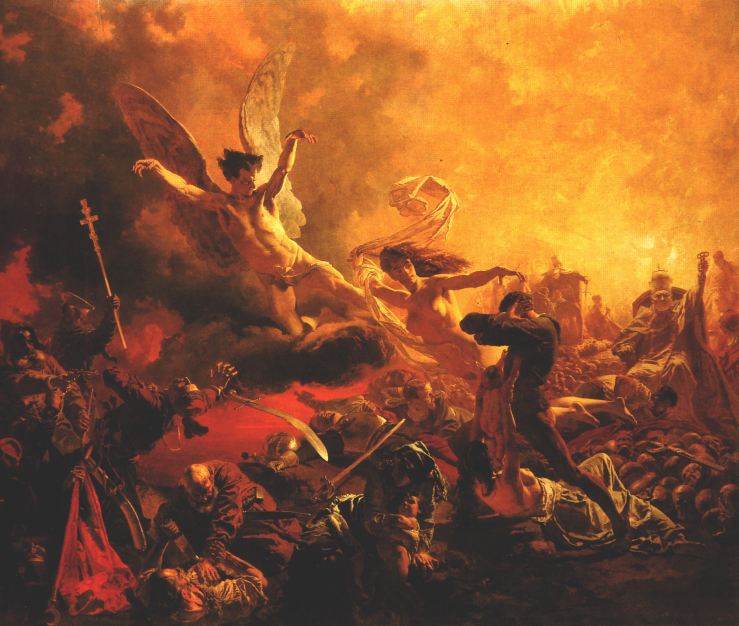
The Triumph of the Genius of Destruction — Mihály Zichy

The Triumph of the Genius of Destruction, 1878 by Mihály Zichy (1827–1906)

Goya’s The Disasters of War

Read George Saunders’s “Home,” a short story for Veterans Day

“You the one who threw down Mr. Klees?” the sheriff said.

“He’s just back from the war,” Ma said.

“Thank you for your service,” the sheriff said. “Might I ask you to refrain from throwing people down in the future?”

“He also threw me down,” Harris said.

“My thing is I don’t want to go around arresting veterans,” the sheriff said. “I myself am a veteran. So if you help me, by not throwing anyone else down, I’ll help you. By not arresting you. Deal?”

“He was also going to burn the house down,” Ma said.

“I wouldn’t recommend burning anything down,” the sheriff said.

“He ain’t himself,” Ma said. “I mean, look at him.”

The sheriff had never seen me before, but it was like admitting he had no basis for assessing how I looked would have been a professional embarrassment.

“He does look tired,” the sheriff said.

Read all of “Home” by George Saunders at The New YorkerCollected in Tenth of December.

Girl with Really Big Foot in Her Garden — Davor Gromilovic 

Girl with Really Big Foot in Her Garden, 2019 by Davor Gromilovic (b. 1985)

What draws me to this landscape/dreamscape again and again is probably very much like what attracts a gamer to his game world | David Ohle

JA Tyler: Since Motorman was first published by Knopf in 1972, you’ve written two more novels and two novellas based on the world of the character Moldenke, and this year, we’ll see another two: The Blast in July and The Old Reactor in late 2014. Why are you so drawn to this landscape—this future ruin of flood and famine and oppression?

David Ohle: What draws me to this landscape/dreamscape again and again is probably very much like what attracts a gamer to his game world. It’s a gnarly place where anything can happen, but you’re in control of what does. Getting there for me as a writer and reporting about it is accomplished with a simple formula: take current trends and add time. The more time I add, the more ruin I see. But it isn’t total ruin in my novels. Transportation is available in one form or another. There’s food, drugs, and beverages around, however crappy they may be. People don’t starve. And they get high on williwhack, stonepicks, and maximine to ease oppression in general, whether religious (Reverend Hooker in Pisstown Chaos) or governmental (President Michael Ratt in The Age of Sinatra). Once I venture to these landscapes, I become a documentarian, recording what I see. My narrative style is camera-eye, almost entirely visual. I “see” what goes on in these bleak places and times, and I like being there just long enough to write it down.

From a 2014 Bomb interview with Motorman novelist David Ohle.

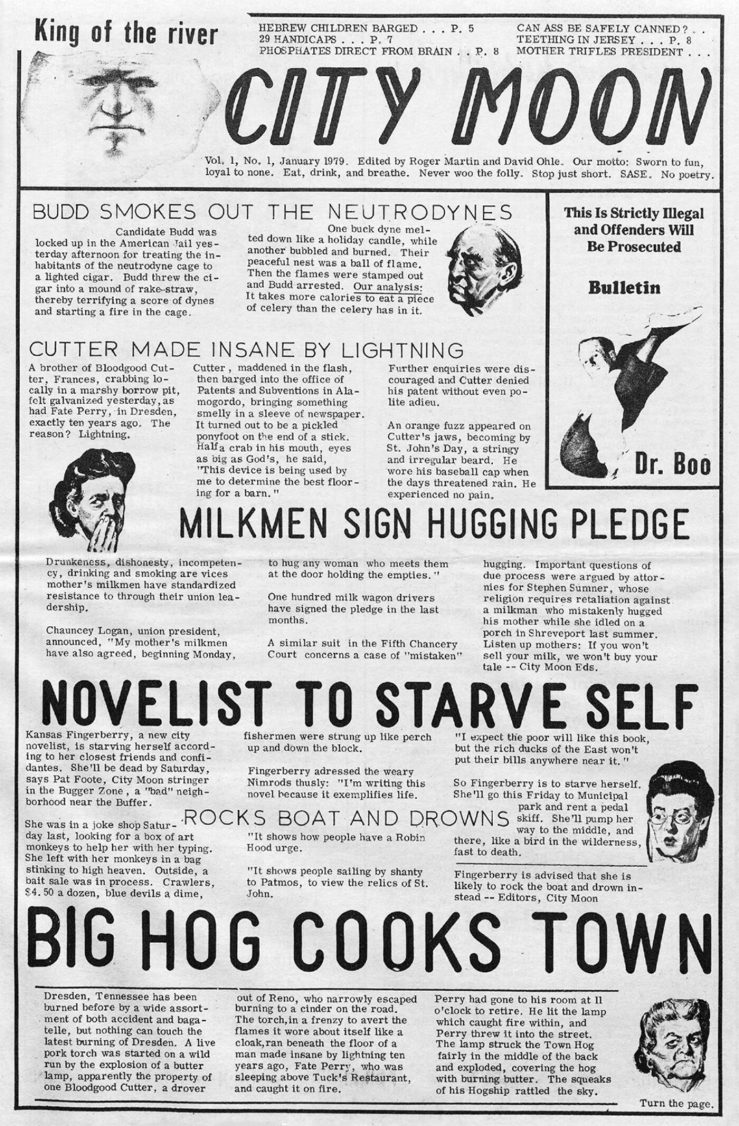
The interview includes a number of scans of The City Moon, a dadaesque “newspaper” Ohle made with his friend Roger Martin:

The City Moon was a satirical print “newspaper” that a friend, Roger Martin, and I produced back in the early-to-mid ’70s. Other friends became involved from time to time, too. It was mainly a cut-and-paste operation. We had a vast collection of old—and sometimes new—newspapers and magazines from which we mined headlines and stories that we “processed” into better and more interesting stories and headlines. This mix of current and old news gave the paper a steampunk aspect. The University of Kansas libraries at the time were tossing out collections of newspapers dating back to the turn of the century, papers like The New York Herald, which still featured articles about horse and motorcar collisions, The Rock City Daily Rocket, and many foreign papers as well. The library tossed them after they were microfilmed. We harvested them from a dumpster behind the library. We also invented stories and characters, many of which found their way into my later fiction in different form. Not long ago, the University of Kansas’s Spencer Research Library undertook to digitize all eighteen issues of the Moon and was generous enough to allow them to be put online where anyone can view them.

Blossom — Erik Thor Sandberg

Blossom, 2018 by Erik Thor Sandberg (b. 1975)

A Joy Beast — Cecil Collins

A Joy Beast, 1962 by Cecil Collins (1908–1989)

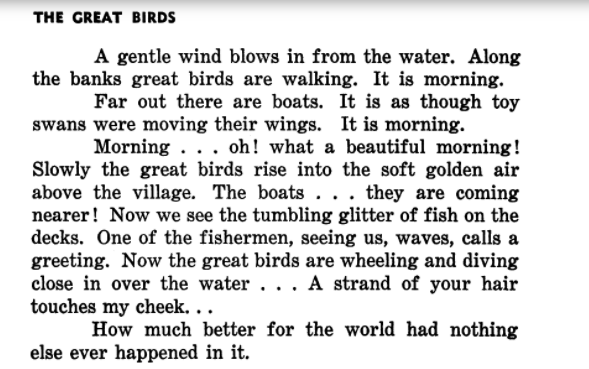
“The Great Birds” — Kenneth Patchen

Spasmodic Affection — Walton Ford

Spasmodic Affection, 2019 by Walton Ford (b. 1960)

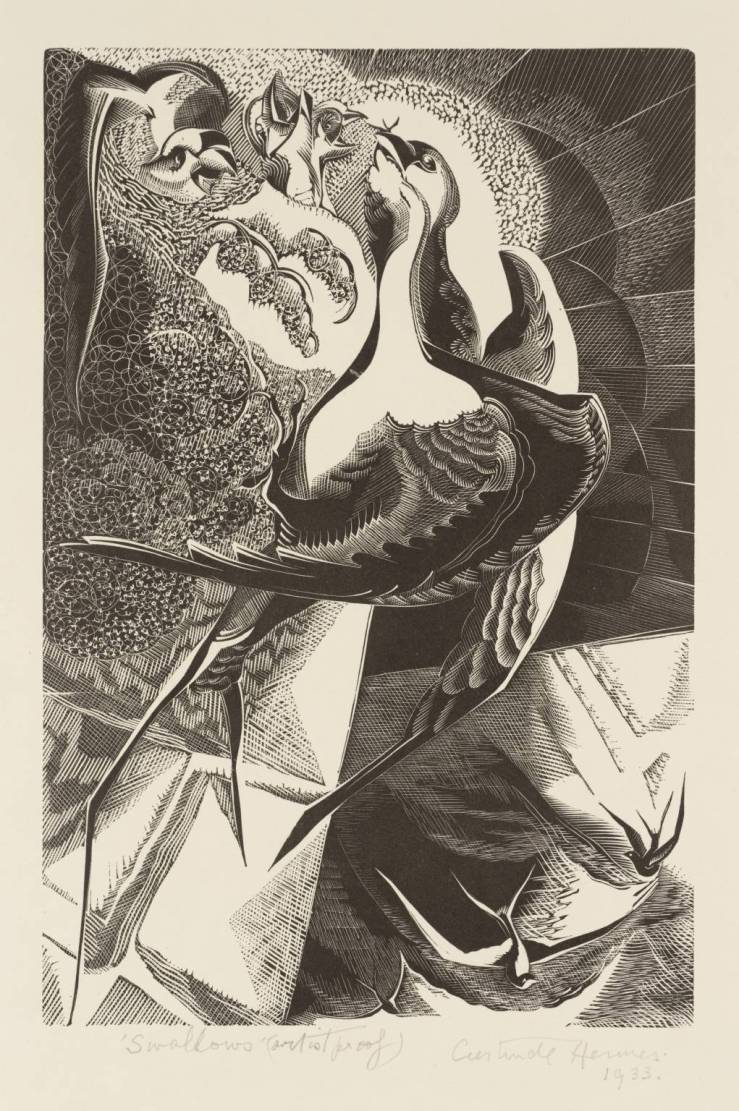
Swallows — Gertrude Hermes

Swallows, 1933 by Gertrude Hermes (1901-1983)

“Situation Reaction,” a questionnaire from David Ohle’s dystopian cult novel Motorman