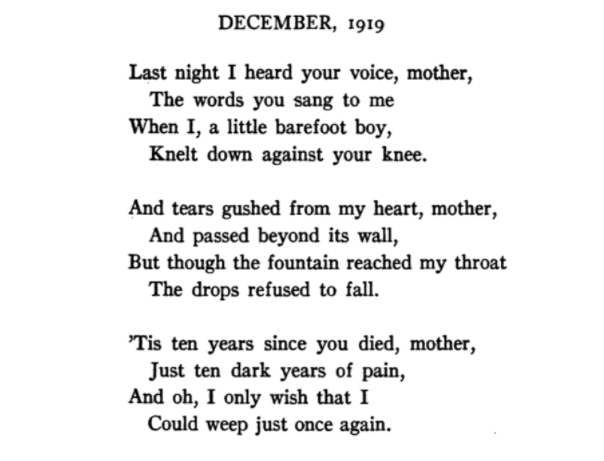
December, 1919 — Claude McKay

Screenshot 2019-12-17 at 5.42.38 PM

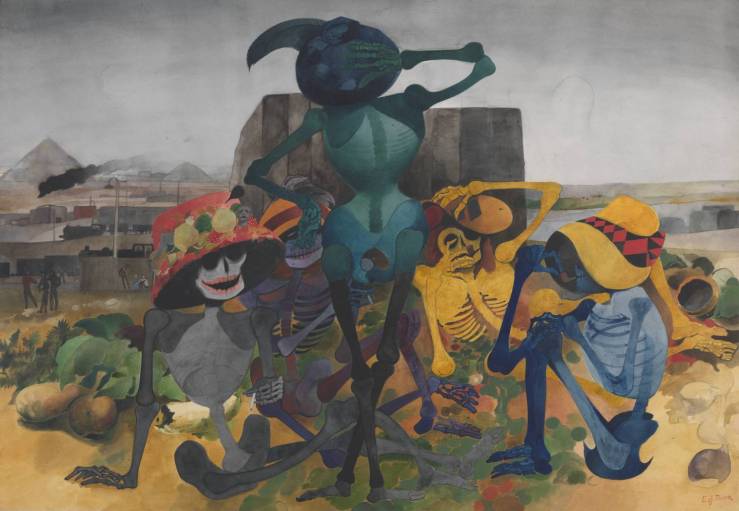
Skeleton Party — Edward Burra

Skeleton Party circa 1952-4 by Edward Burra 1905-1976

Skeleton Party, 1954 by Edward Burra (1905–1976)

List with no name #63

  1. The Tree of Life
  2. Holy Motors
  3. The Master
  4. Upstream Color
  5. Hard to Be a God
  6. Boyhood
  7. Inherent Vice
  8. Inside Llewelyn Davis
  9. The Beach Bum
  10. Blade Runner 2049
  11. Moonrise Kingdom
  12. mother!
  13. Carol
  14. Mad Max: Fury Road
  15. The Tale of the Princess Kaguya
  16. Meek’s Cutoff
  17. Spider-Man: Into the Spiderverse
  18. Blue Caprice
  19. Green Room
  20. Frances Ha
  21. Under the Skin
  22. Samsara
  23. Martha Marcy May Marlene
  24. The Handmaiden
  25. The Hateful Eight
  26. Love & Friendship
  27. The Lobster
  28. Once Upon a Time in Hollywood
  29. Under the Silver Lake
  30. Only Lovers Left Alive
  31. Suspiria 
  32. Zama
  33. Phantom Thread
  34. The Last Jedi
  35. The Favourite
  36. I Heard You Paint Houses
  37. Roma
  38. Edge of Tomorrow
  39. The Turin Horse
  40. Only God Forgives
  41. Lady Bird
  42. Get Out
  43. The Lost City of Z
  44. Your Highness
  45. The Grand Budapest Hotel
  46. Arrival
  47. The Wind Rises
  48. Tale of Tales
  49. Drive
  50. It Follows


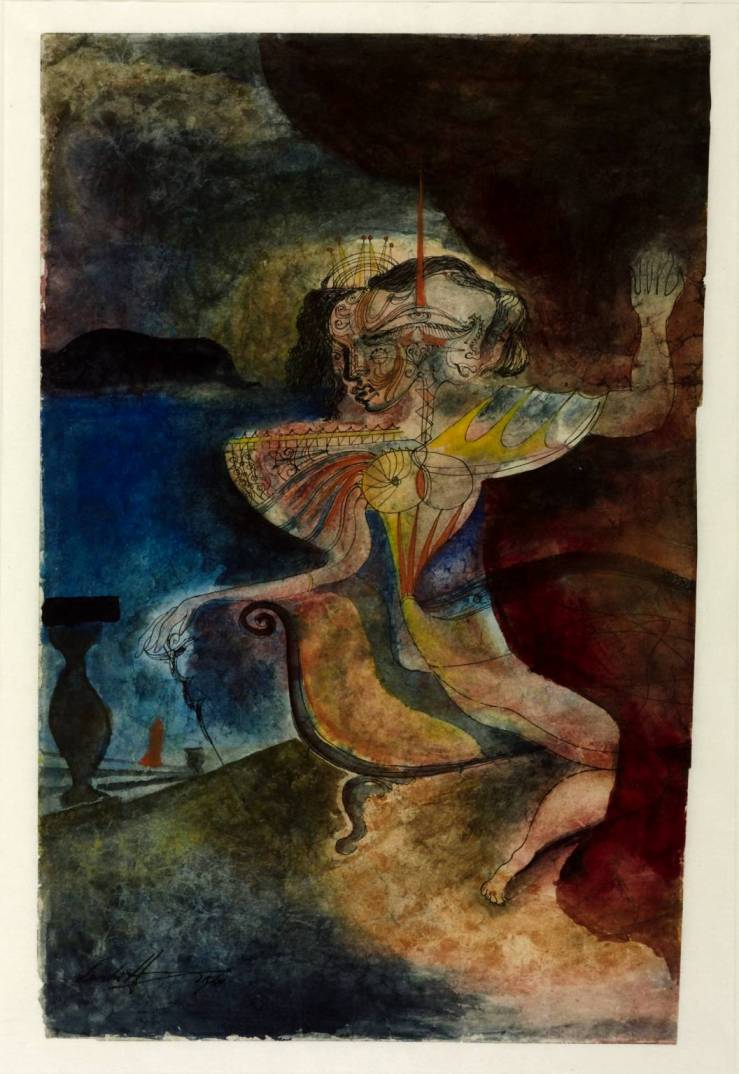
Courtesan — Leslie Hurry

The Courtesan 1941 by Leslie Hurry 1909-1978

Courtesan, 1945 by Leslie Hurry (1909–1978)

Jonathan Buckley’s The Great Concert of the Night (Book acquired, sometime early December 2019)

img_4539

Jonathan Buckley’s novel The Great Concert of the Night is forthcoming from NYRB early next year (like, in a few weeks). NYRB’s blurb:

David has just spent New Year’s Eve alone, watching Le Grand Concert de la Nuit, a film in which his former lover Imogen starred. In the early hours of the new year, consoled and tormented by her ethereal presence, he begins to write. What follows is a brilliantly various journal, chronicling a year in the life of a thinking man. David works as a curator at the ailing Sanderson-Perceval Museum in southern England, whose small collection of porcelain, musical instruments, crystals, velvet mushrooms, and glass jellyfish is as eccentric and idiosyncratic as the long-dead collectors’ tastes. David himself is a connoisseur of the derelict and nonutilitarian, of objects removed from the flow of time. Refusing the imposed order of a straightforward chronology, his journal moves fluidly back and forth in time, filled with fragments of life remembered, imagined, and recorded, from memories of his past life with Imogen or with his ex-wife, Samantha, to reflections on the lives and relics of female saints or the history of medicine. There are quotations from Seneca, Meister Eckhart, and the Goncourt brothers mixed in with the equally compelling imagined words of fictional film directors, actors, and, always, the fascinating Imogen, who is alive now only “in the perpetual present of the sentence.” In The Great Concert of the Night, Jonathan Buckley expertly interweaves sexual despair, cultural critique, the plot lines of one man’s quietly brilliant life, and the problems and paradoxes of writing, especially writing about and to the dead.

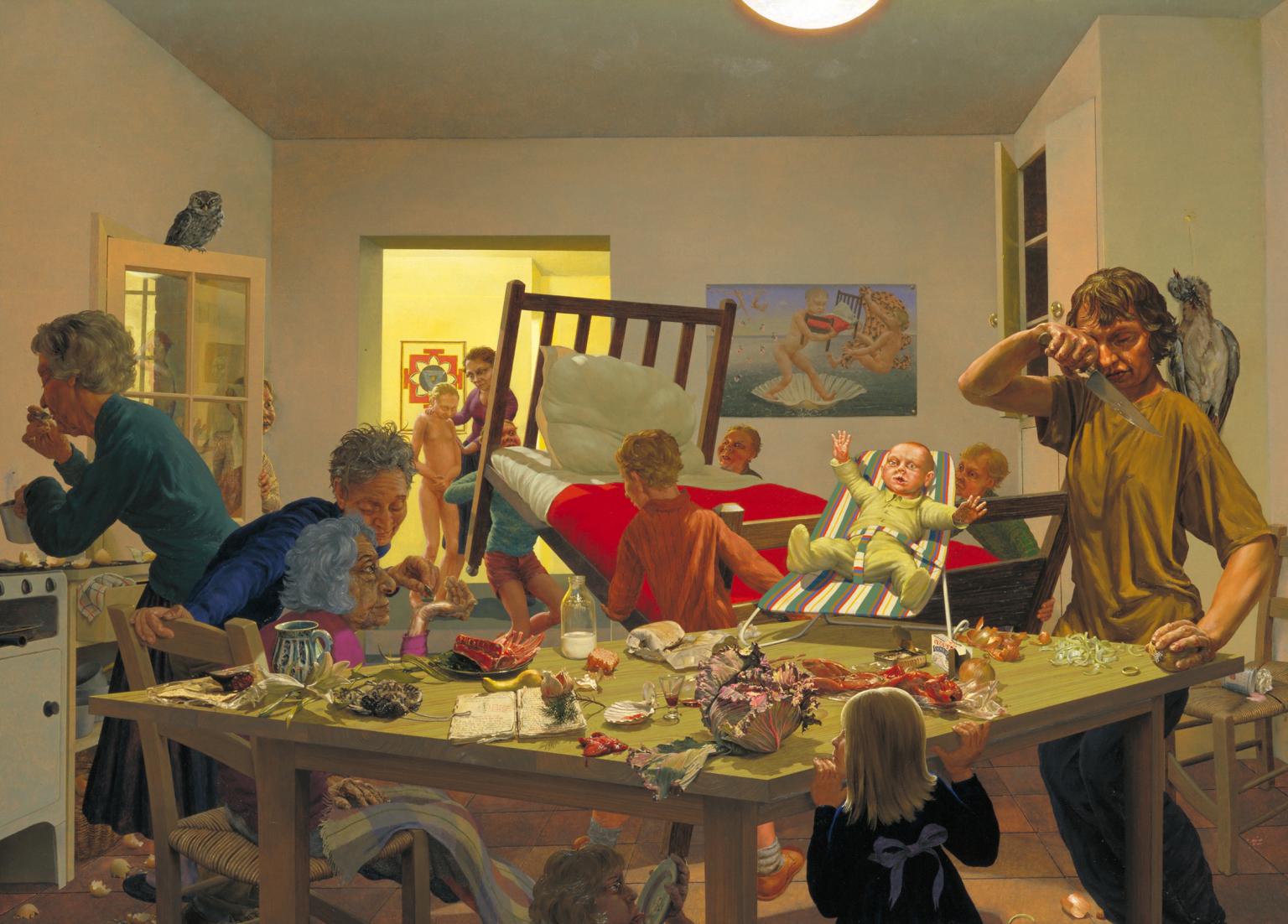
A Jan Steen Kitchen — Jonathan Leaman

A Jan Steen Kitchen 1995-6 by Jonathan Leaman born 1954Screenshot 2019-12-16 at 7.44.35 PMScreenshot 2019-12-16 at 7.44.06 PMScreenshot 2019-12-16 at 7.43.49 PMScreenshot 2019-12-16 at 7.43.22 PM

A Jan Steen Kitchen, 1996 by Jonathan Leaman (b. 1954)

Reclining Man — Mitchell Villa

635480_recliningman-2017-acryliconcanvas-60x48inhces

Reclining Man, 2017 by Mitchell Villa

Blue Bird — Konstantin Somov

blue-bird

Blue Bird, 1918 by Konstantin Somov

Read “The Yellow Rose” a very short story by Jorge Luis Borges

“The Yellow Rose”

by

Jorge Luis Borges

Translated by Andrew Hurley


It was neither that afternoon nor the next that Giambattista Marino died— that illustrious man proclaimed by the unanimous mouths of Fame (to use an image that was dear to him) as the new Homer or the new Dante—and yet the motionless and silent act that took place that afternoon was, in fact, the last thing that happened in his life. His brow laureled with years and glory, the man died in a vast Spanish bed with carven pillars. It costs us nothing to picture a serene balcony a few steps away, looking out toward the west, and, below, marbles and laurels and a garden whose terraced steps are mirrored in a rectangular pool. In a goblet, a woman has set a yellow rose; the man murmurs the inevitable lines of poetry that even he, to tell the truth, is a bit tired of by now:

Porpora de’giardin, pompa de’prato,
Gemmadi primavera, occhio d’aprile…

Then the revelation occurred. Marino saw the rose, as Adam had seen it in Paradise, and he realized that it lay within its own eternity, not within his words, and that we might speakabout the rose, allude to it, but never truly express it, and that the tall, haughty volumes that made a golden dimness in the corner of his room were not (as his vanity had dreamed them) a mirror of the world, but just another thing added to the world’s contents.

Marino achieved that epiphany on the eve of his death, and Homer and Dante may have achieved it as well.

Coffee — Christian Brandl

brandl-kaffee-2006-acryl-on-canvas-160x180cm

Coffee, 2006 by Christian Brandl (b. 1970)

Nervous and excitable persons need to talk a great deal, by way of letting off their steam | Nathaniel Hawthorne’s journal entry for December 13th, 1853

December 13th.—Chill, frosty weather; such an atmosphere as forebodes snow in New England, and there has been a little here. Yet I saw a barefooted young woman yesterday. The feet of these poor creatures have exactly the red complexion of their hands, acquired by constant exposure to the cold air.

At the ferry-room, this morning, was a small, thin, anxious-looking woman, with a bundle, seeming in rather poor circumstances, but decently dressed, and eying other women, I thought, with an expression of slight ill-will and distrust; also, an elderly, stout, gray-haired woman, of respectable aspect, and two young lady-like persons, quite pretty, one of whom was reading a shilling volume of James’s “Arabella Stuart.” They talked to one another with that up-and-down intonation which English ladies practise, and which strikes an unaccustomed ear as rather affected, especially in women of size and mass. It is very different from an American lady’s mode of talking: there is the difference between color and no color; the tone variegates it. One of these young ladies spoke to me, making some remark about the weather,—the first instance I have met with of a gentlewoman’s speaking to an unintroduced gentleman. Besides these, a middle-aged man of the lower class, and also a gentleman’s out-door servant, clad in a drab great-coat, corduroy breeches, and drab cloth gaiters buttoned from the knee to the ankle. He complained to the other man of the cold weather; said that a glass of whiskey, every half-hour, would keep a man comfortable; and, accidentally hitting his coarse foot against one of the young lady’s feet, said, “Beg pardon, ma’am,”—which she acknowledged with a slight movement of the head. Somehow or other, different classes seem to encounter one another in an easier manner than with us; the shock is less palpable. I suppose the reason is that the distinctions are real, and therefore need not be continually asserted.

Nervous and excitable persons need to talk a great deal, by way of letting off their steam.

On board the Rock Ferry steamer, a gentleman coming into the cabin, a voice addresses him from a dark corner, “How do you do, sir?”—”Speak again!” says the gentleman. No answer from the dark corner; and the gentleman repeats, “Speak again!” The speaker now comes out of the dark corner, and sits down in a place where he can be seen. “Ah!” cries the gentleman, “very well, I thank you. How do you do? I did not recognize your voice.” Observable, the English caution, shown in the gentleman’s not vouchsafing to say, “Very well, thank you!” till he knew his man.

What was the after life of the young man, whom Jesus, looking on, “loved,” and bade him sell all that he had, and give to the poor, and take up his cross and follow him? Something very deep and beautiful might be made out of this.

Nathaniel Hawthorne’s journal entry for December 13th, 1853. From Passages from the English Note-Books.

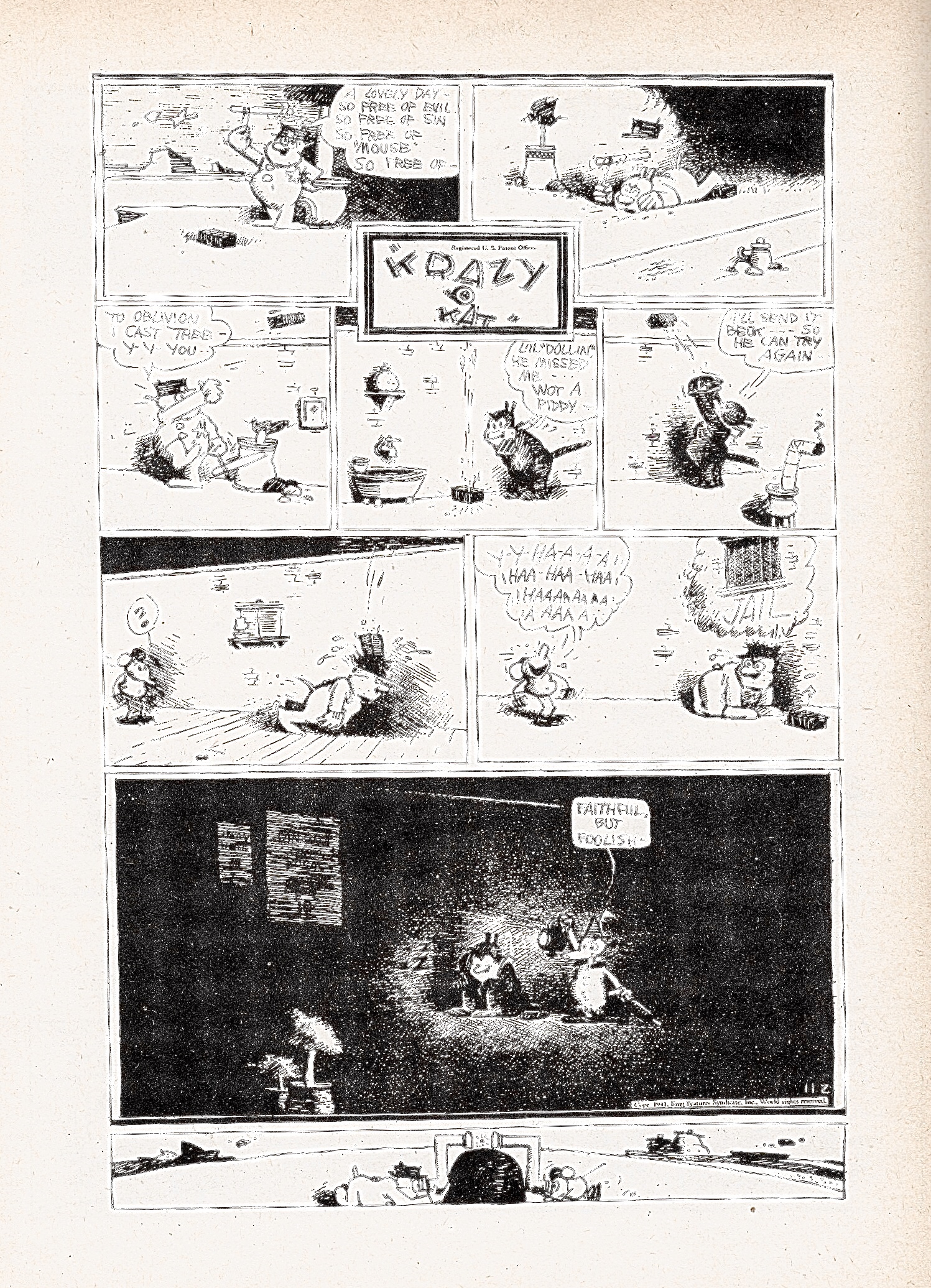
Faithful but foolish (George Herriman’s Krazy Kat)

2019-12-13_171555

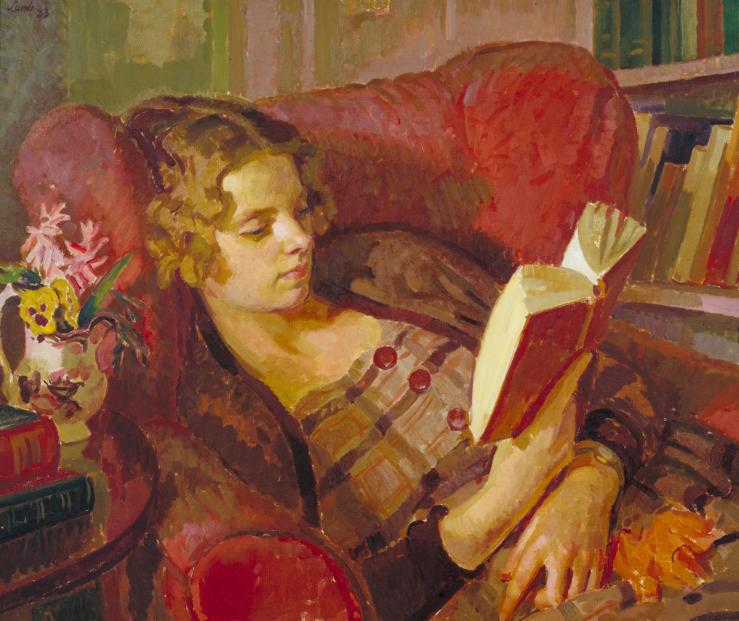
The Artist’s Wife — Henry Lamb

The Artist's Wife 1933 by Henry Lamb 1883-1960

The Artist’s Wife, 1933 by Henry Lamb (1883–1960)

John Barth’s Giles Goat-Boy (Book acquired, 30 Nov. 2019)

img_4536

I couldn’t pass up on this used first edition of John Barth’s 1966 novel Giles Goat-Boy when I visited Haslam’s Book Store in downtown St. Petersburg over the Thanksgiving break. Here’s the back cover:

img_4537

From Eliot Fremont-Smith’s 1966 review of Giles Goat-Boy in The New York Times:

There follows the novel proper, which tells how George Giles was born (possibly a computer accident) into a goat herd, made his way into New Tammany College (the world of men), became Grand Tutor and prophet of the West Campus (the Western world as opposed to the Eastern) and, like Don Quixote, Candide, Leopold Bloom, etc., sought the meaning of good and evil, innocence and existence, action and identity, passion and thought.

The message of the syllabus is ambiguous — except perhaps that absolutes are noncognizable, that thinking is a passion and most passionately expressed in humor, and that, except for these, the world is going to hell. Fortunately, it won’t get there because — Mr. Barth proves once more — old jokes never die, they just lie in wait for resurrection. The jokes here — sexual, scatological, gastronomical, existential, political, linguistic, literary conventions and parodies — can be traced to Rabelais, “Tristram Shandy,” Lewis Carroll, Joyce, Nabokov, the Beatles and Bennett Cerf, among others, which should given an idea of the truly astonishing flavor of this lemon meringue pie of a book.

Self-Portrait with Daughters — Julie Heffernan

58225ec1e19140cc-_spwdaughters

Self-Portrait with Daughters, 2019 by Julie Heffernan (b. 1956)

Unmitigated Blackness (Paul Beatty)

There should be a Stage IV of black identity—Unmitigated Blackness. I’m not sure what Unmitigated Blackness is, but whatever it is, it doesn’t sell. On the surface Unmitigated Blackness is a seeming unwillingness to succeed. It’s Donald Goines, Chester Himes, Abbey Lincoln, Marcus Garvey, Alfre Woodard, and the serious black actor. It’s Tiparillos, chitterlings, and a night in jail. It’s the crossover dribble and wearing house shoes outside. It’s “whereas” and “things of that nature.” It’s our beautiful hands and our fucked-up feet. Unmitigated Blackness is simply not giving a fuck. Clarence Cooper, Charlie Parker, Richard Pryor, Maya Deren, Sun Ra, Mizoguchi, Frida Kahlo, black-and-white Godard, Céline, Gong Li, David Hammons, Björk, and the Wu-Tang Clan in any of their hooded permutations. Unmitigated Blackness is essays passing for fiction. It’s the realization that there are no absolutes, except when there are. It’s the acceptance of contradiction not being a sin and a crime but a human frailty like split ends and libertarianism. Unmitigated Blackness is coming to the realization that as fucked up and meaningless as it all is, sometimes it’s the nihilism that makes life worth living.”

From Paul Beatty’s novel The Sellout


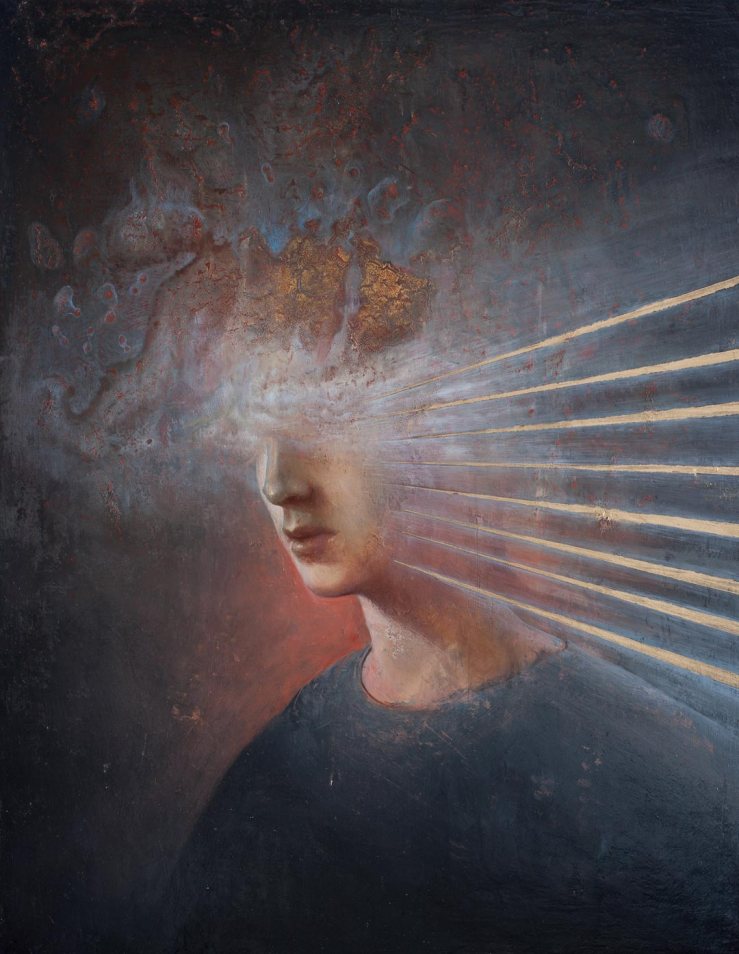
Androginos — Agostino Arrivabene

androginos

Androginos, 2016 by Agostino Arrivabene (b. 1967)