“The King of Owls” — Louise Erdrich

“The King of Owls”

by

Louise Erdrich


It is said that playing cards were invented in 1392 to cure the French king, Charles VI, of madness. The suits in some of the first card packs consisted of Doves, Peacocks, Ravens, and Owls.

They say I am excitable! How could
I not scream? The Swiss monk’s tonsure
spun till it blurred yet his eyes were still.
I snapped my gaiter, hard, to stuff back

my mirth. Lords, he then began to speak.
Indus catarum, he said, presenting the game of cards
in which the state of the world is excellent described
and figured. He decked his mouth

as they do, a solemn stitch, and left cards
in my hands. I cast them down.
What need have I for amusement?
My brain’s a park. Yet your company

plucked them from the ground and began to play.
Lords, I wither. The monk spoke right,
the mealy wretch. The sorry patterns show
the deceiving constructions of your minds.

I have made the Deuce of Ravens my sword
falling through your pillows and rising,
the wing blades still running
with the jugular blood. Your bodies lurch

through the steps of an unpleasant dance.
No lutes play. I have silenced the lutes!
I keep watch in the clipped, convulsed garden.
I must have silence, to hear the messenger’s footfall

in my brain. For I am the King of Owls.
Where I float no shadow falls.
I have hungers, such terrible hungers, you cannot know.
Lords, I sharpen my talons on your bones.


The Weeping Woman — Raúl Anguiano

w1siziisije5mzgwncjdlfsiccisimnvbnzlcnqilcitcmvzaxplidiwmdb4mjawmfx1mdazzsjdxq

The Weeping Woman, 1942 by Raúl Anguiano (1915–2006)

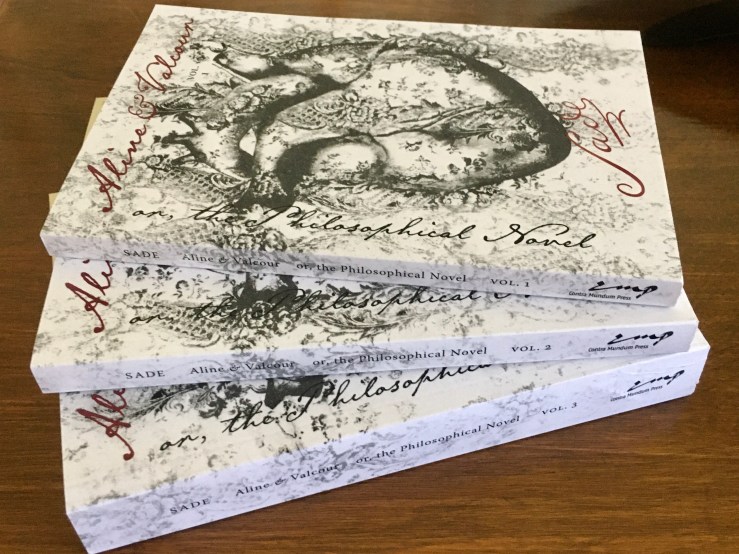
The Marquis de Sade’s Aline and Valcour, or, the Philosophical Novel (Books acquired some time last week)

img_4167

Later this year, indie publisher Contra Mundum Press is releasing a three-volume English translation of the Marquis de Sade’s 1795 epistolary novel Aline and Valcour. The translation is by John Galbraith Simmons and Jocelyne Geneviève Barque.

It looks pretty wild. Here’s Conta Mundum’s blurb:

Set against the impending riptide of the French Revolution and composed while Sade was imprisoned in the Bastille, Aline and Valcour embodies the multiple themes that would become the hallmark of his far more sulfurous works.

This epistolary work combines genres, interweaving the adventure story with the libertine novel and the novel of feelings to create a compelling, unitary tale. Turbulence disrupts virtuous lives when corrupt schemers work incestuous designs upon them that don’t stop with abduction and seduction — as crime imposes tragic obstacles to love and delivers harsh threats to morality and religion.

Embedded within Aline and Valcour are sojourns in unknown lands in Africa and the South Seas: Butua, a cannibalistic dystopia, and Tamoé, a utopian paradise headed by a philosopher-king. In Butua, a lustful chief and callous priesthood rule over a doomed people, with atrocious crimes committed in broad daylight, while in Tamoé happiness and prosperity reign amidst benevolent anarchy.

Although not sexually explicit, Aline and Valcour shared the fate of Sade’s other novels — banned in 1815 and later classified a prohibited work by the French government. Published clandestinely, it did not appear in bookstores until after WWII. Continuously in print in France ever since, today it occupies the first volume of the Pléiade edition of the author’s collected works.

This is the very first rendering of the book into English since its publication in 1795.

Paroxysm — Carlos Raquel Rivera

ee

Paroxysm, 1963 by Carlos Raquel Rivera (1923–1999)

Three Books

2019-10-27_164045

Complete Tales & Poems by Edgar Allan Poe. Fat trade paperback by Vintage; most recent date indicates 1975 but that can’t be right. No designer credited.

You know Poe.

2019-10-27_164045_1-1

Tell My Horse by Zora Neale Hurston. 1983 trade paperback edition from Turtle Island. Neither designer nor photographer are credited.

A wonderful and weird trip to Jamaica and Haiti…and zombies!

2019-10-27_164045_2

From Hell by Alan Moore & Eddie Campbell. 2004 irregular-big trade paperback from Top Shelf. No designer/artist credited, but it’s clearly Campbell’s work.

One of my favorite scary novels ever. I reviewed it like a decade ago on this site. I found this postcard in it, a collage by the surealist Jacques Prévert:

2019-10-27_170449

The postcard, from James Cooke, included this text, a quote of Cormac McCarthy’s horror novel Blood Meridian:

They entered the city haggard and filthy and reeking with the blood of the citizenry for whose protection they had contracted.

James won a postcard-based contest on this site like a decade ago, god love him.


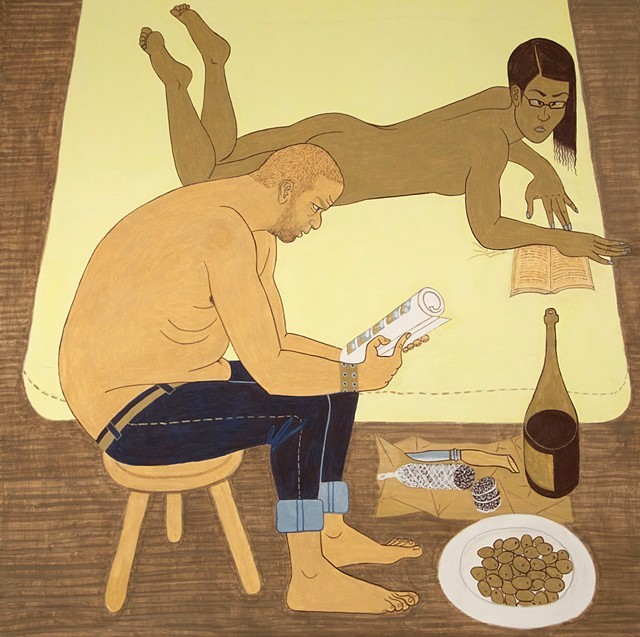
À la Bonne Franquette — Yves Tessier

84605cace9621879f569dfe518bc3dba

À la bonne franquette (A Simple Meal), 2019 by Yves Tessier (b. 1955)

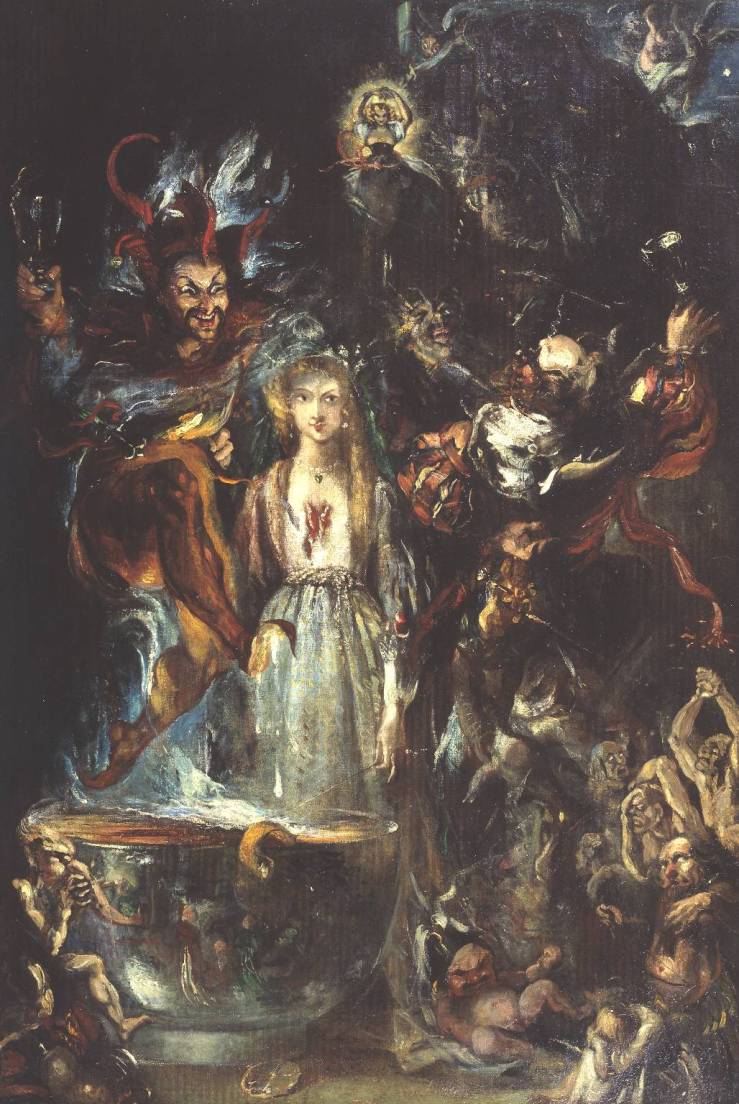
Fantasy Based on Goethe’s Faust — Theodor von Holst

Fantasy Based on Goethe's 'Faust' 1834 by Theodore Von Holst 1810-1844

Fantasy Based on Goethe’s Faust, 1834 by Theodor von Holst (1810–1844)

“Question” — May Swenson

“Question”

by

May Swenson


Body my house
my horse my hound
what will I do
when you are fallen

Where will I sleep
How will I ride
What will I hunt

Where can I go
without my mount
all eager and quick
How will I know
in thicket ahead
is danger or treasure
when Body my good
bright dog is dead

How will it be
to lie in the sky
without roof or door
and wind for an eye

With cloud for shift
how will I hide?

Dead Soldier (Fascism) — Francisco Dosamantes

restricted

Dead Soldier (Fascism), 1940 by Francisco Dosamantes (1911-1986)

Untitled — Marcelo Grassman

aa

Untitled, 1962 by Marcelo Grassman  (1925–2013)

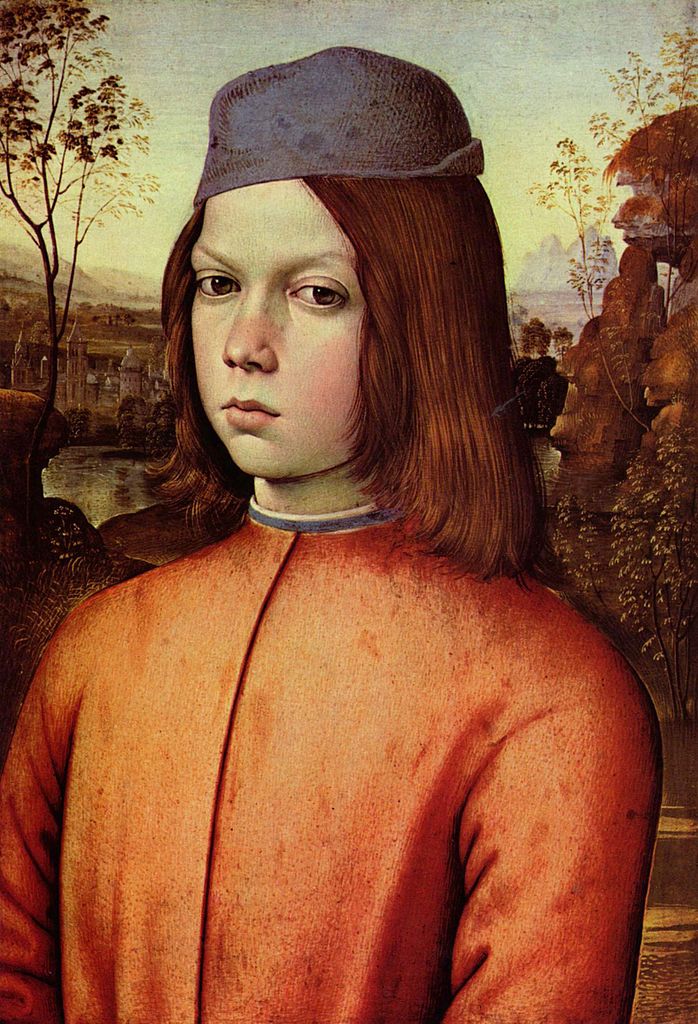
Portrait of a Boy — Pinturicchio

portrait-of-a-boy-1500

Portrait of a Boy, c. 1500 by Pinturicchio (Bernardino di Betto, 1454–1513)

Hallelujah. Hallelujah. Hallelujah. Hallelujah. Hallelujah. Hallelujah. Hallelujah. Hallelujah, lujah, lujah, lujah, hallelujah, lujah, hallelujah.| From Alfred Döblin’s Berlin Alexanderplatz

2019-10-06_172844

And there are mountains, and the old man gets up and says to his son: come with me. Come with me, says the old man to his son, and he goes and his son goes with him, and they walk together into the mountains, up and down, mountains and valleys. How much further, Father? I don’t know, we are walking uphill, downhill, into the mountains, come with me. Are you tired, son, don’t you want to come with me. Oh, I’m not tired, if you want me to come, I’ll come. Yes, come. Up, down, valleys, it’s a long way, it’s midday, we’ve arrived. Look about you, son, is that an altar. Father, I am afraid. Why are you afraid, son? You woke me, we went out early, and we forgot the sheep we meant to sacrifice. Yes, we forgot it. Up and down, the long valleys, we forgot it, the sheep is not with us, there is the altar, I am afraid. I must take off my coat, are you afraid, my son. Yes, Father, I am afraid. I am afraid too, son, come closer, don’t be afraid, we must do it. What must we do? Up and down, the long valleys, I got up so early. Fear not, son, do it willingly, come closer to me, I have taken off my coat, so as not to bloody the sleeves. I am afraid, because you have the knife. Yes, I have the knife, I must slaughter you, I must sacrifice you, the Lord commands it, do it gladly, my son.

No, I cannot do it, I will scream, don’t touch me, I don’t want to be slaughtered. Now you are on your knees, do not scream, my son. Yes, I am screaming. Do not scream; if you don’t want, then I can’t do it, you must want it. Up and down, why should I not go home again. What will you do at home, is not the Lord more than a home. I cannot, yes I can, no I cannot. Move closer, see, I have the knife here, look at it, it is very sharp, it will touch your throat. Will it cut my throat? Yes. Then the blood will bubble forth? Yes. The Lord wills it. Do you want it? I cannot yet, Father. Come quickly, I must not slay you; if I do it, then it must be as though you did it unto yourself. I unto myself? Ah. Yes, and be not afraid. Ah. And not live life, not live your life, because you will give it unto the Lord. Move closer. The Lord our God wills it? Up, down, I got up so early. You surely will not be cowardly. I know, I know, I know! What do you know, my son? Apply the knife to me, wait, let me turn down my collar so that my neck is open. You seem to know something. You must only will it, and I must will it, we will both do it, then the Lord will call, we will both hear Him call: yes, come here, give me your throat. There. I am not afraid, I do it willingly. Up and down, the long valleys, there put the knife to me, and cut, I will not scream.

And the son throws his head back, his father steps behind him, clasps his forehead, and shows him the butcher’s knife in his right hand. The son wills it. The Lord calls. They both fall on their faces.

What calls the voice of the Lord. Hallelujah. Through the mountains, through the valleys. You are obedient unto me, hallelujah. You shall live. Hallelujah. Stop, throw the knife away. Hallelujah. I am the Lord whom you obey, and whom alone you always must obey. Hallelujah. Hallelujah. Hallelujah. Hallelujah. Hallelujah. Hallelujah. Hallelujah. Hallelujah, lujah, lujah, lujah, hallelujah, lujah, hallelujah.

From Berlin Alexanderplatz by Alfred Döblin. English translation by Michael Hoffmann. (NRYB trade paperback, 2018).

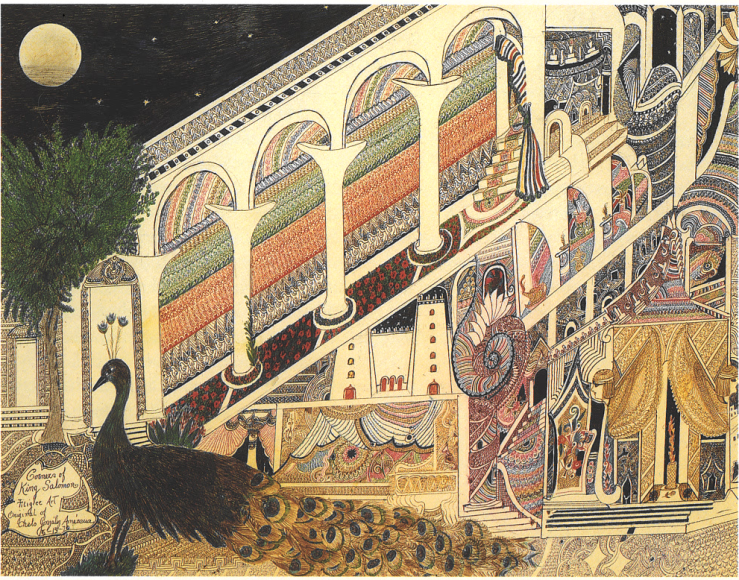
Corners of King Solomon — Consuelo González Amezcua

dd

Corners of King Solomon, 1970 by Consuelo González Amezcua (1903–1975)

The Fortune Teller Was Mistaken — Gregory Ferrand

thefortunetellerwasmistaken

The Fortune Teller Was Mistaken, 2017 by Gregory Ferrand (b. 1975)

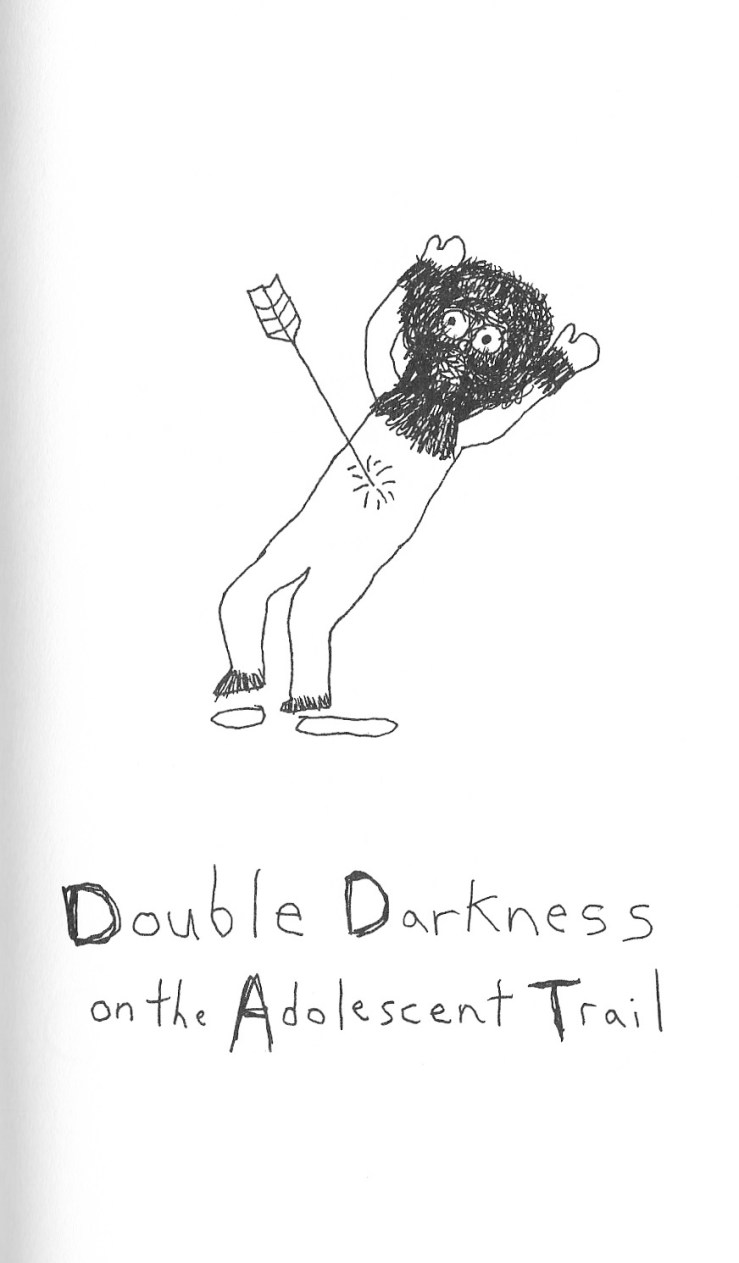
“Double Darkness on the Adolescent Trail” — David Berman

2019-10-22_194010_1

From The Portable February, 2009, Drag City.

Withers, wilts, and drops off | Nathaniel Hawthorne’s journal entry for October 22nd, 1841

October 22d.–A continued succession of unpleasant, Novembery days, and autumn has made rapid progress in the work of decay. It is now somewhat of a rare good fortune to find a verdant, grassy spot, on some slope, or in a dell; and even such seldom-seen oases are bestrewn with dried brown leaves,–which, however, methinks, make the short, fresh grass look greener around them. Dry leaves are now plentiful everywhere, save where there are none but pine-trees. They rustle beneath the tread, and there is nothing more autumnal than that sound. Nevertheless, in a walk this afternoon, I have seen two oaks which retained almost the greenness of summer. They grew close to the huge Pulpit Rock, so that portions of their trunks appeared to grasp the rough surface; and they were rooted beneath it, and, ascending high into the air, overshadowed the gray crag with verdure. Other oaks, here and there, have a few green leaves or boughs among their rustling and rugged shade.

Yet, dreary as the woods are in a bleak, sullen day, there is a very peculiar sense of warmth and a sort of richness of effect in the slope of a bank and in sheltered spots, where bright sunshine falls, and the brown oaken foliage is gladdened by it. There is then a feeling of comfort, and consequently of heart-warmth, which cannot be experienced in summer.

I walked this afternoon along a pleasant wood-path, gently winding, so that but little of it could be seen at a time, and going up and down small mounds, now plunging into a denser shadow, and now emerging from it. Part of the way it was strewn with the dusky, yellow leaves of white-pines,–the cast-off garments of last year; part of the way with green grass, close-cropped, and very fresh for the season. Sometimes the trees met across it; sometimes it was bordered on one side by an old rail-fence of moss-grown cedar, with bushes sprouting beneath it, and thrusting their branches through it; sometimes by a stone-wall of unknown antiquity, older than the wood it closed in. A stone-wall, when shrubbery has grown around it, and thrust its roots beneath it, becomes a very pleasant and meditative object. It does not belong too evidently to man, having been built so long ago. It seems a part of nature.

Yesterday I found two mushrooms in the woods, probably of the preceding night’s growth. Also I saw a mosquito, frost-pinched, and so wretched that I felt avenged for all the injuries which his tribe inflicted upon me last summer, and so did not molest this lone survivor.

Walnuts in their green rinds are falling from the trees, and so are chestnut-burrs.

I found a maple-leaf to-day, yellow all over, except its extremest point, which was bright scarlet. It looked as if a drop of blood were hanging from it. The first change of the maple-leaf is to scarlet; the next, to yellow. Then it withers, wilts, and drops off, as most of them have already done.

Nathaniel Hawthorne’s journal entry for October 22nd, 1841. From Passages from the American Note-Books.

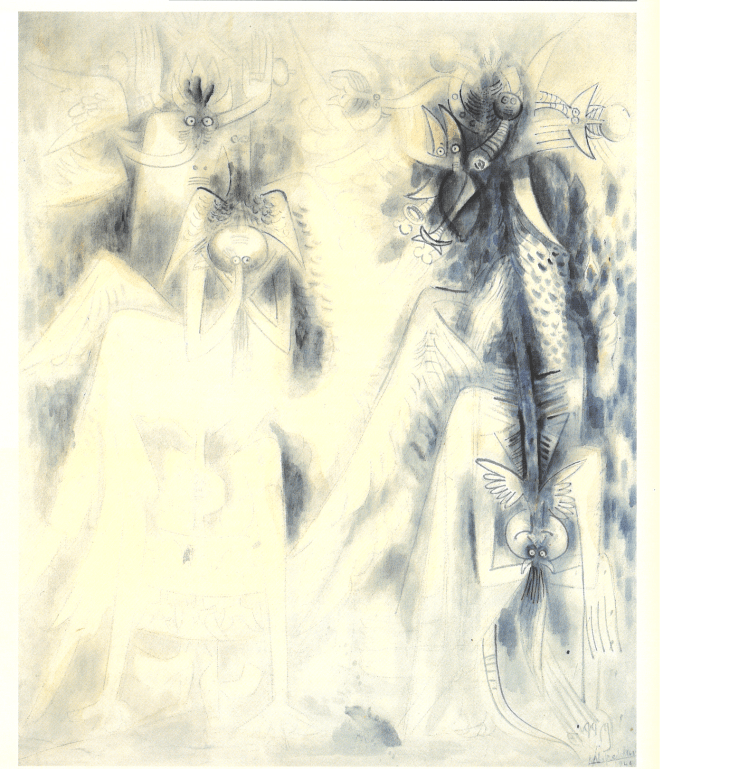
Annunciation — Wilfredo Lam

wilfredo

Annunciation, 1944 by Wilfredo Lam (1902-1982)