Today is Black Friday in America. I don’t think it’s necessary to remark at length on the bizarre disjunction between this exercise in consumerism-as-culture and the intended spirit of the Thanksgiving holiday that precedes it. Indeed, I think that the cognitive dissonance that underwrites Black Friday—the compulsion to suffer (and cause suffering), both physically and mentally, to “save” money on “consumer goods” (sorry for all the scare quotes, but these terms are euphemisms and must be placed under suspicion)—I think that this cognitive dissonance is nakedly apparent to all who choose to (or are forced to) actively engage in Black Friday. The name itself is dark, ominous, wonderfully satanic.
Rereading “The Subliminal Man,” I was struck by how presciently J.G. Ballard anticipated not only the contours of consumerist culture—urban sprawl, a debt-based economy, the mechanization of leisure, the illusion of freedom of choice—but also how closely he intuited the human, psychological responses to the consumerist society he saw on the horizon. Half a century after its publication, “The Subliminal Man” seems more relevant than ever.
The premise of the tale is fairly straightforward and fits neatly with the schema of many other early Ballard stories: Franklin, an overworked doctor, is approached by Hathaway, a “crazy beatnik,” who refuses to take part in the non-stop consumerism of contemporary society. Hathaway can “see” the subliminal messages sent through advertising. He asks for Franklin’s help in stopping the spread of these messages. Hathaway reasons that the messages are intended to enforce consumerist society:
Ultimately we’ll all be working and spending twenty–four hours a day, seven days a week. No one will dare refuse. Think what a slump would mean – millions of lay–offs, people with time on their hands and nothing to spend it on. Real leisure, not just time spent buying things . . .
The fear of a slump. You know the new economic dogmas. Unless output rises by a steady inflationary five per cent the economy is stagnating. Ten years ago increased efficiency alone would raise output, but the advantages there are minimal now and only one thing is left. More work. Subliminal advertising will provide the spur.
Franklin is unconvinced, even though he is already working Saturdays and Sunday mornings to payoff TVs, radios, and other electronic goods that he and his wife replace every few months. Soon, however, he realizes that something is wrong:
He began his inventory after hearing the newscast, and discovered that in the previous fortnight he and Judith had traded in their Car (previous model 2 months old) 2 TV sets (4 months) Power mower (7 months) Electric cooker (5 months) Hair dryer (4 months) Refrigerator (3 months) 2 radios (7 months) Record player (5 months) Cocktail bar (8 months)
Franklin finally sees the truth, but only after Hathaway takes to blowing up signs’ switch boxes (the word “terrorism” is of course not used in the text, although it surely would be today):
Then the flicker of lights cleared and steadied, blazing out continuously, and together the crowd looked up at the decks of brilliant letters. The phrases, and every combination of them possible, were entirely familiar, and Franklin knew that he had been reading them for weeks as he passed up and down the expressway.
BUY NOW BUY NOW BUY NOW BUY NOW BUY NEW CAR NOW NEW CAR NOW NEW CAR NOW
YES YES YES YES YES YES YES YES YES YES
Like many Ballard stories, “The Subliminal Man” ends on a pessimistic note, with Franklin choosing to ignore his brief enlightenment and give in. Ballard drives his criticism home in the final image of the story, with Franklin and his wife heading out to shop:
They walked out into the trim drive, the shadows of the signs swinging across the quiet neighbourhood as the day progressed, sweeping over the heads of the people on their way to the supermarket like the blades of enormous scythes.
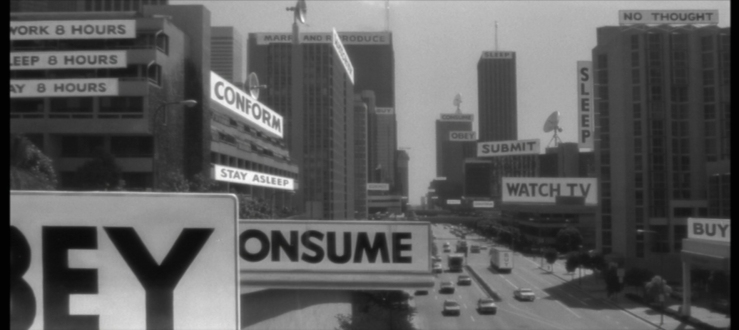
“The Subliminal Man” offers a critique of consumerism that John Carpenter would make with more humor, violence, and force in his 1988 film They Live. In Carpenter’s film, the hero John Nada (played by Roddy Piper) finds a pair of sunglasses that allow him to see through the ads, billboards, and other commercials he’s exposed. What’s underneath? Naked consumerism:
The images here recall the opening lines of “The Subliminal Man”: ‘The signs, Doctor! Have you seen the signs?’ Like Ballard’s story, Carpenter’s film is about waking up, to seeing the controlling messages under the surface.
In his film The Pervert’s Guide to Ideology, Slavoj Žižek offers a compelling critique of just how painfulit is to wake up to these messages:
It’s worth pointing out that Carpenter offers a far more optimistic vision than Ballard. Ballard’s hero gives in—goes back to sleep, shuts his eyes. Carpenter’s hero Nada resists the subliminal messages—he actually takes up arms against them. This active resistance is possible because Carpenter allows his narrative an existential escape hatch: In They Live, there are real, genuine bad guys, body-snatching ugly-assed aliens—others that have imposed consumerism on humanity to enslave them. That’s the big trick to They Live: It’s not us, it’s them.
Ballard understands that there is no them; indeed, even as the story skirts around the idea of a conspiracy to dupe consumers into cycles of nonstop buying, working, and disposing, it never pins that conspiracy on any individual or group. There’s no attack on corporations or government—there’s not even a nebulous “them” or “they” that appears to have controlling agency in “The Subliminal Man.” Rather, Ballard’s story posits ideology as the controlling force, with the only escape a kind of forced suicide.
I don’t think that those who engage in consumerism-as-sport, in shopping-as-a-feeling are as blind as Ballard or Carpenter represent. I think they are aware. Hell, they enjoy it. What I think Ballard and Carpenter (and others, of course) really point to is the deep dissatisfaction that many of us feel with this dominant mode of life. For Ballard, we have resistance in the form of the beatnik Hathaway, an artist, a creator, a person who can perceive what real leisure would mean. For Carpenter, Nada is the resister—an outsider, a loner, a weirdo too. It’s somehow far more satisfying to believe that those who engage in spectacle consumerism are brainwashed by aliens than it is to have to come to terms with the notion that these people are acting through their own agency, of their own will and volition. Happy shopping everyone!
Ed. note: Biblioklept published a version of this post a few years ago. It is offered again now in the spirit of Thanksgiving leftovers.
That morning, the city was celebrating Consumer Thanksgiving Day. This feast came around every year, on a day in November, and had been set up to allow shoppers to display their gratitude toward the god Production, who tirelessly satisfied their every desire. The biggest department store in town organized a parade every year: an enormous balloon in the shape of a garishly colored doll was paraded through the main streets, pulled by ribbons that sequin-clad girls held as they marched behind a musical band. That day, the procession was coming down Fifth Avenue: the majorette twirled her baton in the air, the big drums banged, and the balloon giant, representing the Satisfied Customer, flew among the skyscrapers, obediently advancing on leashes held by girls in kepis, tassels, and fringed epaulets, riding spangly motorcycles.
At the same time, another parade was crossing Manhattan. The flaky, moldy moon was also advancing, sailing between the skyscrapers, pulled by the naked girls, and behind it came a line of beat-up cars and skeletons of trucks, amid a silent crowd that was gradually increasing in size. Thousands of people joined the throng that had been following the moon since the early hours of the morning, people of all colors, whole families with children of every age, especially as the procession filed past the crowded black and Puerto Rican areas of Harlem.
An intriguing and confounding section of Chapter 1 of Part II of William Gaddis’s 1955 novel The Recognitions focuses heavily on Esme, the poet who models for Wyatt Gwyon as he paints his forgeries. The episode eventually reveals Esme as one of the heroes of The Recognitions. It begins with Esme cloistering herself, pinning a sign to her door that reads: “Do Not Disturb Me I Am Working Esme.” She begins her “work” in a manic blur, “delighted to be alone.” As her energy shifts, she sews for a bit, before finally switching to attend to her small library:
But before that sewing was done she was up, rearranging her books with no concern but for size. There was, really, little else their small ranks held in common (except color of the bindings, and so they had been arranged, and so too the reason often enough she’d bought them). Their compass was as casual as books left behind in a rooming house; and this book of stories by Stevenson, with no idea where she’d got it, she hadn’t looked into it for years, now could not put it down, and to her now it was the only book she owned.
Esme’s bookshelving is purely aesthetic, and the aesthetic seems arbitrary (and likely temporary). In this little scene she moves from arrangement by color to arrangement by size. Her aesthetic arrangement leads her back to a collection of Robert Louis Stevenson stories (likely The Merry Men, and Other Tales), her current (arbitrary, temporary) aesthetic obsession. The “Esme working” section of II.1 of The Recognitions actually begins with an entire paragraph a Stevenson story, presumably read aloud by Esme. This long quote goes unattributed, but Steven Moore identifies it in his annotations for The Recognitions as part of the Gothic short story “Olalla.”
The passage from “Olalla” quoted in The Recognitions begins with the phrase “What is mine, then, and what am I?” Olalla poses these questions to the narrator of Stevenson’s tale, a nameless Scottish soldier who recuperates from wounds in a Spanish hospital and then in the home of a fallen noble family (Gaddis cribs from this plot in the first chapter of The Recognitions, where Wyatt’s father, the Reverend Gwyon, recovers in a Spanish monastery).
Olalla’s questions are quite literal. She recognizes herself in the paintings of her ancestors, which line the walls of her family’s house, and claims a part of herself in those paintings in a haunting phrase: “Others, ages dead, have wooed other men with my eyes.” Olalla recognizes something in herself that antecedes her ancestors, some essential element that surpasses death and transcends time. She describes herself as “a transitory eddy” in a stream of time (lines not included in Gaddis’s graft from the story): not the original, but the wave that carries the impulse of origination. Her words challenge the notion of a stable, self-present self.
Olalla’s questions — “What is mine, then, and what am I?” — are essentially Esme’s questions. Esme fragments as the novel progresses, and Gaddis rhetorically highlights her looming madness by employing a daunting elliptical prose style in the sections that wander into her consciousness. Consider here, where we learn about Esme the reader:
Even so she had never read for the reasons that most people give themselves for reading. Facts mattered little, ideas propounded, exploited, shattered, even less, and narrative nothing.
This sentence is fairly straightforward—we see how Esme’s reading might differ from the way most of us read. But let’s see where we go next—what does Esme read for?
Only occasional groupings of words held her,
Esme reads discontinuously, perhaps arbitrarily, aesthetically—but let’s let that sentence unwind:
Only occasional groupings of words held her, and she entered to inhabit them a little while, until they became submerged, finding sanctuary in that part of herself which she looked upon distal and afraid, a residence as separate and alien, real or unreal, as those which shocked her with such deep remorse when the features of others betrayed them. An infinite regret, simply that she had seen, might rise in her then, having seen too much unseen; and it brought her eyes down quick.
I’ll admit I find the lines baffling. Esme inhabits the words, which then, strangely, become submerged within her, or a part of her that she has disassociated from her self-present self. The paragraph ends with a shock of recognition. Is this Esme gazing into the abyss? In any case, we see here Gaddis’s rhetorical skill at conjuring complex instability in his subject.
Let’s continue by moving from Esme the aesthetic reader to Esme the aesthetic writer:
The sole way, it seemed to her often enough when she was working at writing a poem, to use words with meaning, would be to choose words for themselves, and invest them with her own meaning: not her own, perhaps, but meaning which was implicit in their shape, too frequently nothing to do with dictionary definition.
And yet it would be too simple to suggest that Esme’s poetry is utterly meaningless, pure sound and shape without content. Rather, her writing is a writing against: A writing against the cheapness of language in a masscult zeitgeist, against newspapers and memos and comic books and flyers and stock ticker tape and museum guides and informational pamphlets and millions and millions of copies of How to Win Friends and Influence People. The paragraph continues, highlighting Gaddis’s fascination with entropy:
The words which the tradition of her art offered her were by now in chaos, coerced through the contexts of a million inanities, the printed page everywhere opiate, row upon row of compelling idiocies disposed to induce stupor, coma, necrotic convulsion; and when they reached her hands they were brittle, straining and cracking, sometimes they broke under the burden which her tense will imposed, and she found herself clutching their fragments, attempting again with this shabby equipment her raid on the inarticulate.
Esme is one of Gaddis’s heroes. Like Jack Gibbs in J R or McCandless in Carpenter’s Gothic or the narrator of Agapē Agape, she forces her will against an entropic dissolving world, and she does so to make art. And in her art she makes her self, or a version of her self, a self apart from the self-present self that might have to haggle and bustle in the tumult of the masscult midcentury metropolis. Esme strives for transcendence from language through language toward a place of pure recognition:
It was through this imposed accumulation of chaos that she struggled to move now: beyond it lay simplicity, unmeasurable, residence of perfection, where nothing was created, where originality did not exist: because it was origin; where once she was there work and thought in causal and stumbling sequence did not exist, but only transcription: where the poem she knew but could not write existed, ready-formed, awaiting recovery in that moment when the writing down of it was impossible: because she was the poem.
Skin a hare and put it on to roast. Whilst it is cooking, fry in the best English butter two carrots, a head of celery, two onions, two ounces of raw ham, two bay leaves, two cloves, a blade of mace, four shallots, a little thyme and parsley. Fry all these to a brown color in a stew pan.
When the hare has been roasting for an hour, remove the back fillets and pound the remainder in a mortar and add it to the vegetables. Add to this mixture a half pound of brown thickening which has been made with a pound of butter and sifted flour, and cook over a slow fire. The mixture should be moistened with two quarts of good stock and stirred over a fire until it boils. A glass of wine should be added and a small pinch of cayenne.
The recipe comes from the unsigned article “London Chef Explains Dickens’s Hare Soup,” published in The New York Times, 26 Dec. 1926.
According to the article, a “well-known London chef” shared the recipe as “a kind of Christmas card” with his patrons in 1926. Apparently Dickens enjoyed eating this hare soup regularly “a Strand restaurant” in the 1850s.
First check the refrigerator to make certain none of the following are in there: lettuce, butter, margarine, mustard, ketchup or mayo.
Remove the jar of mint jelly from the cupboard. (Marmalade is an acceptable substitution.)
Your bread should be of the diet variety, well-aged and adequately chilled. If the counter is wet, place two slices of bread on it. Press down with the heel of your hand to make sure they lie flat. (If you experience some difficulty in separating two slices of bread from the rest of the loaf, rap the loaf smartly on the edge of the counter.)
Never use presliced bologna. Your bologna should be of the sausage type, with good stout rind on it. Working with a dull knife, hack off what you need. What you’re aiming for here are pieces of bologna that display a certain ragged configuration.
Spread mint jelly on one slice of your dampened bread. On the other slice, distribute chunks of bologna. Lift jellied slice up, jellied side up and lower it over the other slice. (If jellied slice sticks to the counter, use screwdriver to pry it off.)
Still working with the same knife, halve the finished product, cutting from one corner to the other. (Bread should come apart into a number of small pieces all by itself. But if this does not occur, start over again.) Serve immediately. (If this is not possible, store in freezer for later use.) keeps indefinitely if wrapped in a brown paper bag with a rubber band around it.)
From “The Day Mother Invented Junk Food” by Gordon Lish. The full piece was published in The New York Times, 2 Aug. 1978. Thanks to David Winters for sharing it with me years ago.
The First Thanksgiving, 1973 by Warrington Colescott (1921 – 2018)
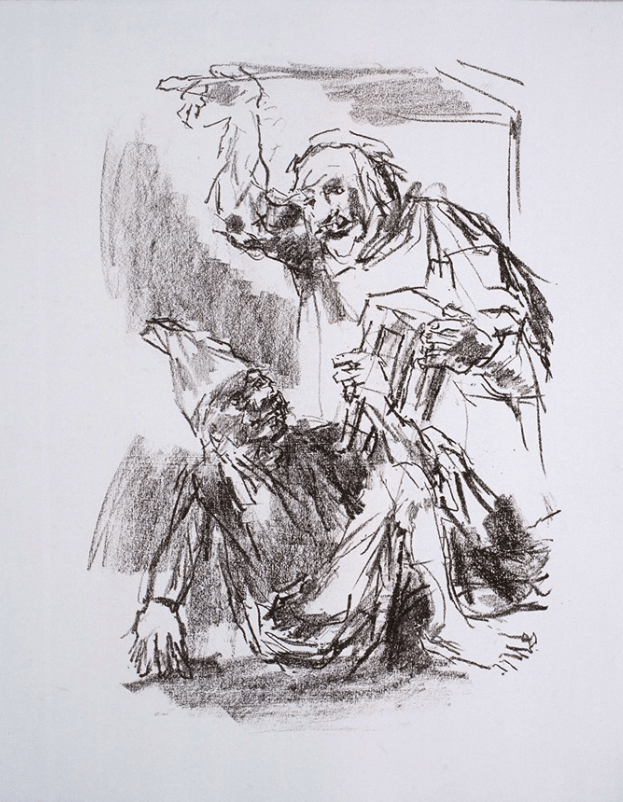
A grave and dark-clad company!” quoth Goodman Brown.
In truth, they were such. Among them, quivering to-and-fro, between gloom and splendor, appeared faces that would be seen, next day, at the council-board of the province, and others which, Sabbath after Sabbath, looked devoutly heavenward, and benignantly over the crowded pews, from the holiest pulpits in the land. Some affirm, that the lady of the governor was there. At least, there were high dames well known to her, and wives of honored husbands, and widows, a great multitude, and ancient maidens, all of excellent repute, and fair young girls, who trembled lest their mothers should espy them. Either the sudden gleams of light, flashing over the obscure field, bedazzled Goodman Brown, or he recognized a score of the church-members of Salem village, famous for their especial sanctity. Good old Deacon Gookin had arrived, and waited at the skirts of that venerable saint, his reverend pastor. But, irreverently consorting with these grave, reputable, and pious people, these elders of the church, these chaste dames and dewy virgins, there were men of dissolute lives and women of spotted fame, wretches given over to all mean and filthy vice, and suspected even of horrid crimes. It was strange to see, that the good shrank not from the wicked, nor were the sinners abashed by the saints. Scattered, also, among their pale-faced enemies, were the Indian priests, or powows, who had often scared their native forest with more hideous incantations than any known to English witchcraft.











 Biblioklept