Saul Steinberg’s The Labyrinth (Book acquired 27 Oct. 2018)

img_1471

Saul Steinberg’s The Labyrinth is new in print again from NYRB, this time with a new introduction by novelist Nicholson Baker. The book is simply gorgeous.

img_1327

My eight-year-old son immediately asked if he might read it (he has been on a sort of comix probation since I caught him reading a R. Crumb collection), and he shuttled through the thing two or three times over half an hour.

img_1474

The Labryinth is 280 or so pages of illustrations with no story or plot, and he was a bit bewildered when I told him I planned to review the thing. “How?” I’ll figure out a way.

img_1472

For now, here’s NYRB’s blurb:

Saul Steinberg’s The Labyrinth, first published in 1960 and long out of print, is more than a simple catalog or collection of drawings— these carefully arranged pages record a brilliant, constantly evolving imagination confronting modern life. Here is Steinberg, as he put it at the time, “discovering and inventing a great variety of events: Illusion, talks, music, women, cats, dogs, birds, the cube, the crocodile, the museum, Moscow and Samarkand (winter, 1956), other Eastern countries, America, motels, baseball, horse racing, bullfights, art, frozen music, words, geometry, heroes, harpies, etc.” This edition, featuring a new introduction by Nicholson Baker, an afterword by Harold Rosenberg, and new notes on the artwork, will allow readers to discover this unique and wondrous book all over again.

img_1473

Portrait of the Physician Ludwig Adler — Oskar Kokoschka

ok

Portrait of the Physician Ludwig Adler, 1914 by Oskar Kokoschka (1886-1980)

The Owl’s Nest — Hieronymus Bosch

1280px-the_owl27s_nest_bosch

The Owl’s Nest, c. 1505-16 by Hieronymus Bosch (c. 1450-1516)

Nineteen still frames from Tarkovsky’s Solaris

solaris-1972-016solaris-1972-023solaris-1972-026solaris-1972-039solaris-1972-046solaris-1972-051solaris-1972-055solaris-1972-067solaris-1972-089solaris-1972-079solaris-1972-094solaris-1972-096solaris-1972-106solaris-1972-102solaris-1972-117solaris-1972-118solaris-1972-123solaris-1972-126solaris-1972-143

From Solaris, 1972. Directed by Andrei Tarkovsky with cinematography by Vadim Yusov. Via Screenmusings.

Tristan Foster’s Letter to the Author of the Letter to the Father (Book acquired, 29 Oct. 2018)

dqsvys2vsaaengd

Attempting to fictionalise things that happened to me or that I observed, even from afar, can be like trying to slip through a gap in a wire fence: shirtsleeves are snagged and threaten to unspool—so bear with me.

From “Music for Church Organs.”

Tristan Foster’s Letter to the Author of the Letter to the Father is new from Transmission Press.

“What does one wear to one’s death? What does the sheep think of the sky? Wrap the disc of soap in the washer. Draw it slow across the flesh, up the arm, up the arm, across the belly. Flesh of the living becomes flesh of the dead. Open the cupboard, doorknob squealing. Finger through coathangers, coats and throwovers and dresses. Pull a skirt out to see, imagine it on the hips, around the legs, hang the hanger back and look for death-clothe again. The water hot brings out the soap’s smell soft and light as feathers. That day on the corner the boys threw eggs. Egg in the hair and ran home. Egg on face means a smile now. Water down back down legs.

From “What the Sheep Thinks of the Sky.”

There are 28 stories in Letter to the Author of the Letter to the Father.

I met the dead man in the only place appropriate: underground. I was in Cappadocia, Turkey, in a tunnel dug more than a millennium ago by Byzantines hiding with their faith. I was—I admit this only reluctantly—lost; I’d separated from the tour group soon after the smiling guide had explained that the network of tunnels stretched out under the countryside for kilometers, and was alone in the ancient hallways for long enough to imagine being trapped in them forever.

From “The Deadest Man in the Underworld.”

I have not read all of the stories in Letter to the Author of the Letter to the Father yet.

While on holiday in Europe you go to a Courbet exhibition with a friend but you are so distracted by the scratching of your shirt’s tag on the base of your neck that later, after you’ve left the gallery, all that will remain with you are memories of idyllic, woodland scenes. A deer maybe. Only when you exit the exhibition do you go into a toilet cubicle, wrestle the back of the shirt around to the front and pluck off the tag, tearing a hole in the collar.

From “Stories About You.”

Some of the stories in Letter to the Author of the Letter to the Father are microfictions; some are not. Most are what could lazily be called experimental, but I don’t think Foster is experimenting. I think he knows what he’s doing. The reader is the one who gets experiment.

To be specific: fire-burnt fingers.

From “Hellhole.”

Tristan Foster’s Letter to the Author of the Letter to the Father is new from Transmission Press.


Inherent Vice (William Gaddis’s The Recognitions)

img_1462

From page 182 of my copy of William Gaddis’s The Recognitions. (See also and also).

Robby Müller on shooting Down By Law

The Tree of Paradise — Séraphine Louis

seraphine-de-senlis_larbre-de-paradis_1930-984x1500

The Tree of Paradise, 1930 by Séraphine Louis (1864–1942)

Saul Steinberg Talks

Chris Power’s Mothers (Book acquired, 23 Oct. 2018)

img_1461

I’ve been reading Chris Power’s series “A Brief Survey of the Short Story” for years now at The Guardian, so I wasn’t surprised when I saw a while back that he was working on his own collection of short fiction. I’ve read the first two in this collection, and so far, it’s Good Stuff. Proper review to come.

Mothers is forthcoming in the U.S. in January of 2019 from FS&G. Their blurb:

Chris Power’s stories are peopled by men and women who find themselves at crossroads or dead ends—characters who search without knowing what they seek. Their paths lead them to thresholds, bridges, rivers, and sites of mysterious, irresistible connection to the past. A woman uses her mother’s old travel guide, aged years beyond relevance, to navigate on a journey to nowhere; a stand-up comic with writer’s block performs a fateful gig at a cocaine-fueled bachelor party; on holiday in Greece, a father must confront the limits to which he can keep his daughters safe. Braided throughout is the story of Eva, a daughter, wife, and mother, whose search for a self and place of belonging tracks a devastating path through generations.

Ranging from remote English moors to an ancient Swedish burial ground to a hedonistic Mexican wedding, the stories in Mothers lay bare the emotional and psychic damage of life, love, and abandonment. Suffused with yearning, Power’s transcendent prose expresses a profound ache for vanished pasts and uncertain futures.

Reclining Woman with Red Blouse — Egon Schiele

reclining-woman-with-red-blouse-1908

Reclining Woman with Red Blouse, 1908 by Egon Schiele (1890-1918)

“Cy est Pourtraicte, Madame Ste Ursule, et les Unze Mille Vierges” — Wallace Stevens

“Cy est Pourtraicte, Madame Ste Ursule, et les Unze Mille Vierges”

by

Wallace Stevens

from Harmonium (1923)


Ursula, in a garden, found
A bed of radishes.
She kneeled upon the ground
And gathered them,
With flowers around,
Blue, gold, pink, and green.

She dressed in red and gold brocade
And in the grass an offering made
Of radishes and flowers.

She said, “My dear,
Upon your altars,
I have placed
The marguerite and coquelicot,
And roses
Frail as April snow;
But here,” she said,
“Where none can see,
I make an offering, in the grass,
Of radishes and flowers.”
And then she wept
For fear the Lord would not accept.
The good Lord in His garden sought
New leaf and shadowy tinct,
And they were all His thought.
He heard her low accord,
Half prayer and half ditty,
And He felt a subtle quiver,
That was not heavenly love,
Or pity.

This is not writ
In any book.

Cover Girl — Frank Bowling

frank-bowling-cover-girl-1963-64-acrylic-on-canvas-149-6-x-101-4-cm

Cover Girl, 1964 by Frank Bowling (b. 1934)

Head of a Peasant (Study for the Potato Eaters) — Vincent van Gogh

head-of-a-peasant-study-for-the-potato-eaters-18851

Head of a Peasant (Study for the Potato Eaters), 1885 by Vincent van Gogh (1853-1890)


A scene from Taxi Driver with commentary from Martin Scorsese and Paul Schrader

Blog about November reading (and blogging) goals

img_1447

For the past few days I’ve felt as if I would never put one word after another again, that I would never put together a sentence, string together clauses and sling them out into the world. This previous statement is hyperbole and I am silly—but even simple emails have seemed the acme of wretched futility to compose. Chalk it up to a mild head cold; chalk it up to too many essays to grade; chalk it up to anxiety of (fear of) writing. But I feel like I used to want to feel like I needed to write, right? On 1 Oct. 2018 I wrote a silly post on this weblog called “Blog about October reading (and blogging) goals,” in which I set a goal to blog “every day, even about nothing,” which I failed to achieve.

did actually achieve some of the reading goals expressed in that October goals blog though: I finished George Eliot’s Silas Marner; I made a bigger dent in Moderan, David R. Bunch’s cult dystopian novel; I finally read William Gaddis’s novel Carpenter’s Gothic; I actually returned and did not keep forever a book I borrowed from a friend; I did not gobble up Paul Kirchner’s Hieronymus & Bosch but rather limited myself to one or two cartoon strips a day (or sometimes, like, five).

So for November—

I’ve read the first two stories in Chris Power’s debut collection Mothers and they are good (the collection is available in the US in January 2019; I should have a full review then).

Tristan Foster’s collection Letter to the Author of the Letter to the Father is very much my weird cup of weird tea.

David Bunch’s Moderan deserves a big proper essay. I’ve suggested that our zeitgeist surpasses the parodic powers of postmodernism’s toolkit, but Moderan anticipates and slices up Our Bad Times.

Part of my anxiety about writing comes from having failed three times now to write a proper review of Conversations with Gordon Lish, which is the kind of self-deconstructing performance of writing about writing that is difficult to describe or analyze; it’s the sort of thing you simply want the reader to read.

I started the audiobook of William Gaddis’s novel The Recognitions, and have ended up not only reading my Penguin edition in tandem—a sort of re-rereading—but have also been flirting with The Gaddis Tapes1 and Letters of William Gaddis.  (This summer I said I’d reread The Recognitions: is this that?). I don’t really know what I want from this material, and I certainly don’t suggest it as anything approaching ancillary or auxiliary “help” with Gaddis’s project—I mean, in his Paris Review interview Gaddis paraphrases his hero and explains why we shouldn’t look for keys to art in the artist:

I’d go back to The Recognitions where Wyatt asks what people want from the man they didn’t get from his work, because presumably that’s where he’s tried to distill this “life and personality and views” you speak of. What’s any artist but the dregs of his work: I gave that line to Wyatt thirty-odd years ago and as far as I’m concerned it’s still valid.

—but hey look I know what I just did—took my cue from the artist in explaining the artist’s art. So. Oh, hey, here’s a great little segment from a letter Gaddis to his mama (from Mexico City) in April, 1947:

Could you then do this?: Send, as soon as it is conveniently possible, to me at Wells-Fargo:

My high-heeled black boots.

My spurs.

a pair of “levis”—those blue denim pants, if you can find a whole pair

the good machete, with bone handle and wide blade—and scabbard—if

this doesn’t distend package too much.

Bible, and paper-bound Great Pyramid book from H—Street.

those two rather worn gabardine shirts, maroon and green.

Incidentally I hope you got my watch pawn ticket, so that won’t be lost.

PS My mustache is so white and successful I am starting a beard.

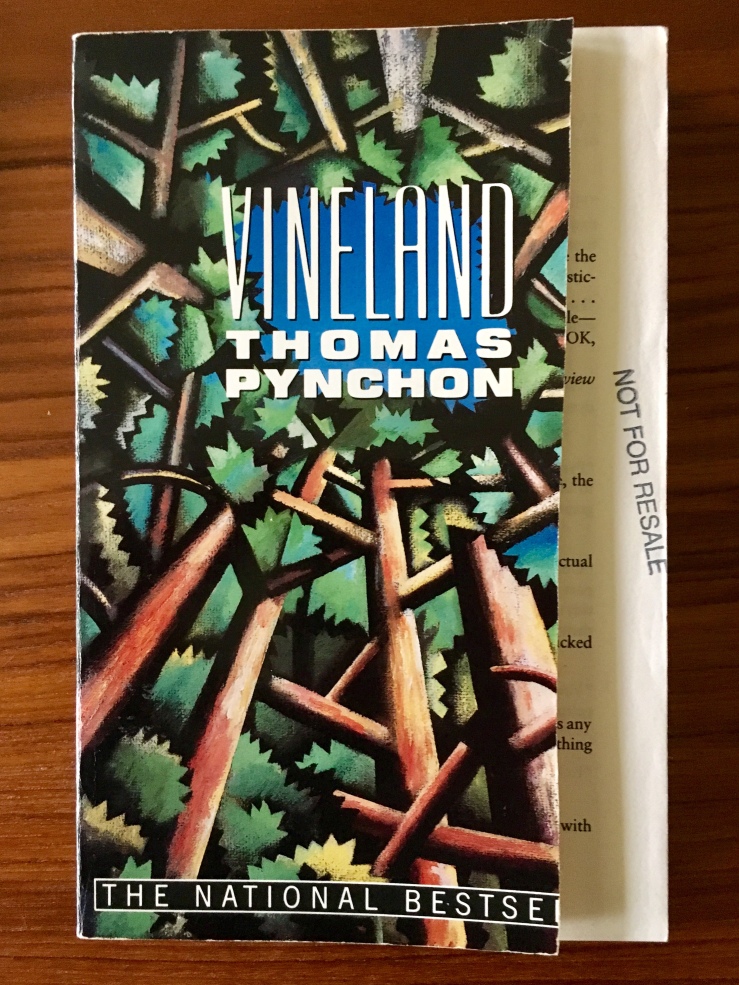
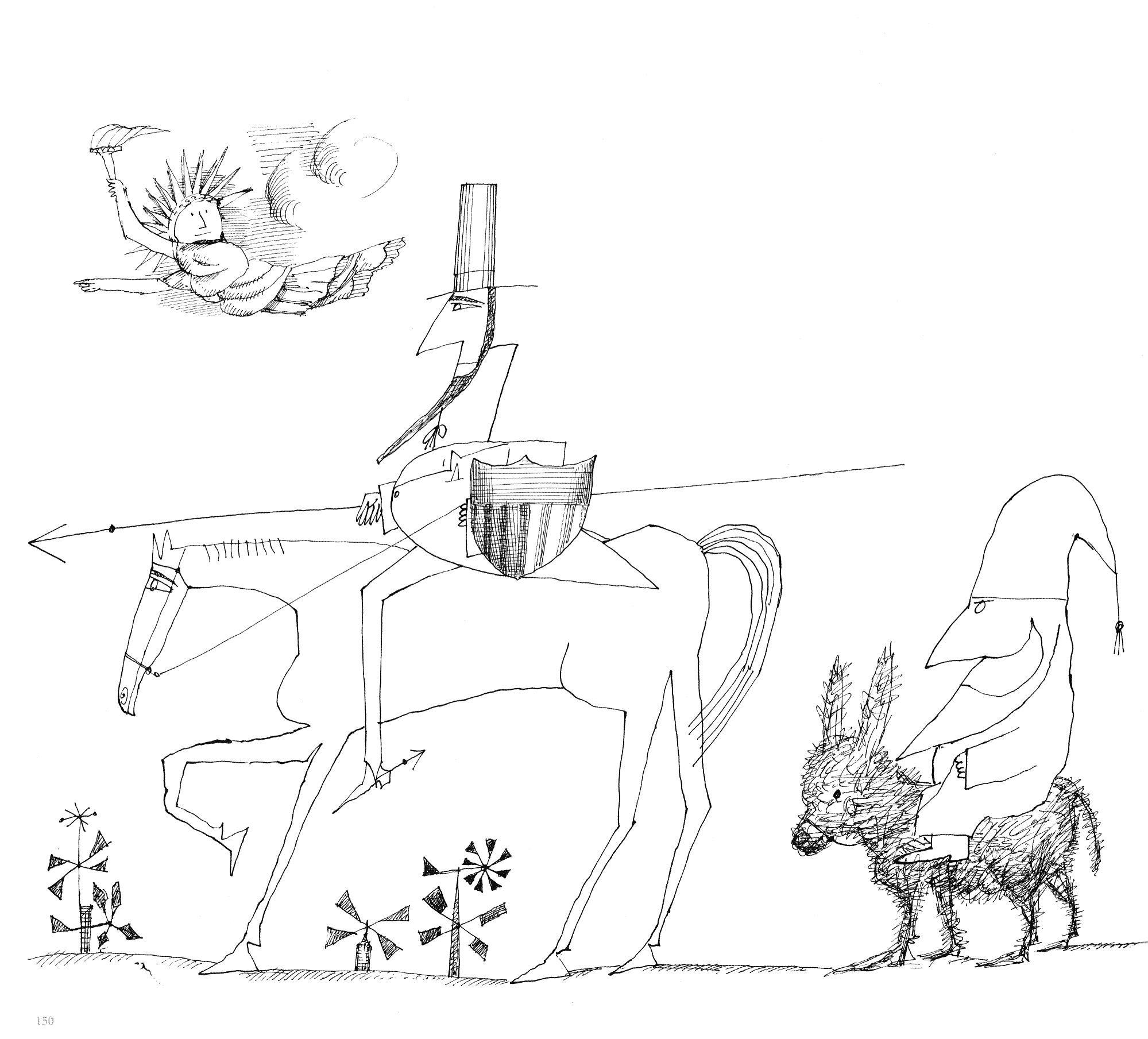
The same day I got The Labyrinth, a collection of mid-century cartooning by Saul Steinberg (new from NYRB, I read a passage in The Gaddis Tapes where Gaddis quotes his friend, Saul Steinberg. That same day my son, eight, went through the whole volume, and asked me what it was, how I was supposed to write about it, etc. Still not sure, but it’s great, heroic, etc. and I hope to post a review at The Comics Journal later this month. Here is Steinberg’s Quixote:

img_1444

And I like to pretend this is his illustration of some Gaddis character at a party in The Recognitions (even if I recognize it is not):

img_1445

Bottom of the stack is Paul Kirchner’s latest Hieronymus & Bosch, a sort of MAD Magazine take on eternal damnation that puts the scatology in eschatology. Great stuff.

Not pictured in the stack is Angela Carter’s 1972 novel The Infernal Desire Machines of Doctor Hoffman, which is by my bed and which I keep falling asleep to. It deserves better from me; or maybe it’s a bit of evidence in the emerging truth that I can’t read before bed most of the time most of these days. (Separate blog post, perhaps—chalk it up to a head cold; chalk it up to too many essays to grade; chalk it up to two kids; chalk it up to too much read wine; chalk chalk chalk).

Hope to do better than this in the next 29 days.


Knight, Christopher J., William Gaddis, and Tom Smith. “The New York State Writers Institute Tapes: William Gaddis.” Contemporary Literature 42, no. 4 (2001): 667-93. doi:10.2307/1209049.