Another Green World — Nicole Eisenman

nicole-eisenman-another-green-world-2015-oil-on-canvas-128-x-106-inches

Another Green World, 2015 by Nicole Eisenman (b. 1965)

Bug (Summer Film Log)

I’ve been meaning to watch William Friedkin’s 2006 film Bug for years but always found an excuse not to until earlier today, when the sky outside was grey and rainy enough for some psychological horror.

Bug’s horror is initially understated, fueled more by queasy tension and psychological drama than gore. Ashley Judd plays the lead, Agnes, who is slowly unraveling. She spends most of her time in a shitty rent-a-room at the Rustic Motel, where she takes drugs and alcohol to cover over the pain of losing her child. The crumpled dollar bills and jar of change we see early on, tips from her waitress job at a lesbian bar, are clearly running low. She can’t afford her cocaine habit. Slovenly and sweaty, her character’s depressed anxiety is neatly summed up in the two seconds she takes to “wash” a dirty plate by running it under the faucet and rubbing it with her naked hand. She then wipes her hand off on her shirt before cracking open a bottle of cheap wine.

Screenshot 2018-05-16 at 5.48.43 PM

She uses the alcohol not only to tamp down her pain, but also to numb herself against the incessant phone calls she gets from what she believes is her violent husband, an ex-con played by Harry Connick Jr. No one ever responds when she answers the phone.

That phone rings throughout the film, and in some ways it’s an organizing principle. It’s the first sound we here in the film—and the last, if we stick around through the credits (I have a theory about that if anyone’s interested).

ylq0k

The ringing phone immediately follows the film’s strange opening shot, a tableaux that doesn’t give the viewer any time get his bearings—it’s a strange neon room with a prone body in it. We eventually get there—and the shot repeats after the film’s credits. After that opening shot, Friedkin gives us a long, slow, gorgeous night time zoom in of the film’s primary setting, the Rustic Motel (in rural Oklahoma). The shot—the most open and free the viewer will be allowed to feel for the rest of Bug’s 100 minutes—parachutes us in gracefully to a weird, paranoid narrative.

Screenshot 2018-05-16 at 5.46.38 PM

Judd’s Agnes finds a partner in paranoid loneliness in Peter, a strange stranger played by Michael Shannon. Agnes’s friend RC introduces her to Peter, who watches the pair party while generally abstaining from drugs and alcohol and conversation. He does however mutter that he’s not a psycho. Shannon initially inhabits his role with a gentle oddity that recalls Billy Bob Thornton in Sling Blade, but his character’s paranoid potential for violence escalates when Agnes’s abusive ex tries to reenter her life. Oh, and the bugs. The bugs make everything worse.

Based on a play by Tracy Betts (who also wrote the screenplay), Bug’s greatest strength is its smallness. After its expansive sky-born opening shot, the film simply contracts into a claustrophobic small hell. There are only four main players, and most of the action is limited to Agnes’s room in the Rustic Motel, which Peter remodels, slowly transforming the room into a neon hell. Friedkin films Bug in lurid neon noir. The film feels of a piece with Denis Johnson’s novel Angels or Yuri Herrera’s recent mythological crime novels, and it undoubtedly found an admirer in Nicolas Winding Refn. His loose neon trilogy of DriveOnly God Forgives, and The Neon Demon share the same dark but vivid color palette that Friedkin conjures in Bug.

The first third of the film is arguably its strongest. Friedkin lets the plot come to slow boil. The narrative tangles into itself with a lugubrious, nervous energy that eventually boils over in a third act that relies heavily on the strength of maniac performances from Judd and Shannon, as well as Friedkin’s claustrophobic shots and wild lighting. How much a viewer likes Bug depends on how much that viewer allows himself to be entangled into the insanity at its end.

I’m glad I finally got around to Bug, but unlike Friedkin’s early films The French Connection and The Exorcist, I doubt I’ll watch it again. (And none of these are in the pantheon of his 1977 masterpiece Sorcerer, which I have literally made house guests watch with me on at least two occasions). It does remind me that I’ve yet to watch his films To Live and Die in L.A. and Killer Joe, which I will make a point of getting to this summer.


How I watched it: At first on an iPad via streaming service with earbuds very late at night, and incompletely (fell asleep or passed out 30 minutes in). Then, full rewatch via streaming service on a large television, with full attention. 

Of Course! (The Takeover) — Kati Heck

08-selbstversta-ndlich-die-u-bernahme-2016-installation-views-tim-van-laere-gallery

Selbstverständlich! (Die Übernahme) (Of Course! ((The Takeover)), 2016 by Kati Heck (b. 1979)

Nathaniel Hawthorne’s journal entry for May 16th, 1851

May 16th.–In our walks now, the children and I find blue, white, and golden violets, the former, especially, of great size and richness. Houstonias are abundant, blue-whitening some of the pastures. They are a very sociable little flower, and dwell close together in communities,–sometimes covering a space no larger than the palm of the hand, but keeping one another in cheerful heart and life,–sometimes they occupy a much larger space. Lobelia, a pink flower, growing in the woods. Columbines, of a pale red, because they have lacked sun, growing in rough and rocky places on banks in the copses, precipitating towards the lake. The leaves of the trees are not yet out, but are so apparent that the woods are getting a very decided shadow. Water-weeds on the edge of the lake, of a deep green, with roots that seem to have nothing to do with earth, but with water only.

Nathaniel Hawthorne’s journal entry for May 16th, 1851. From Passages from the American Note-Books.

All the Goods of the World — F. Scott Hess

76662acbe055e226afffb04fcc1e57ae

All the Goods of the World, 2013 by F. Scott Hess (b. 1955)

Growing Old in the Company of Women — Eric Fischl

2016-028

Growing Old in the Company of Women, 2016 by Eric Fischl (b. 1948)

Miklós Szentkuthy’s Black Renaissance (Book acquired 15 May 2018)

img_9878

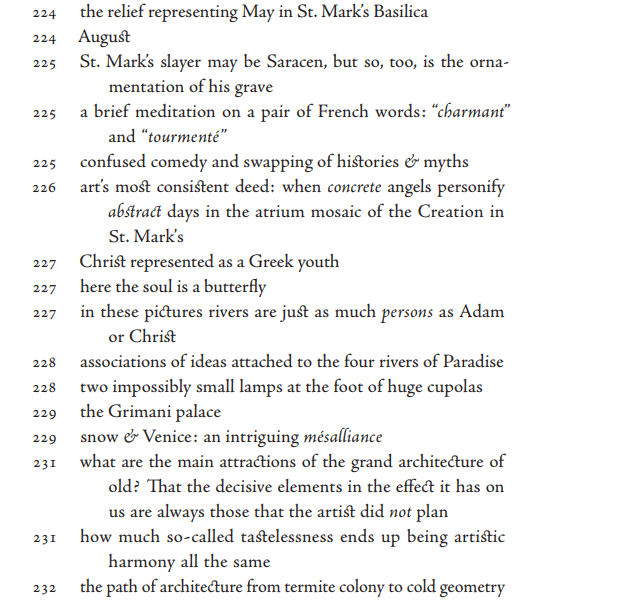
Miklós Szentkuthy’s Black Renaissance is new from Contra Mundum in English translation by Tim Wilkinson. It showed up at the house today. I just read the Table of Contents, which is not a thing I usually read, but…they were compelling. Sample:

Screenshot 2018-05-15 at 4.37.34 PM

You can read a sample of Black Renaissance at Contra Mundum’s website.

Here is the publisher’s blurb:

Black Renaissance, the second volume of the St. Orpheus Breviary, is the continuation of Miklós Szentkuthy’s synthesis of 2,000 years of European culture. St. Orpheus is Szentkuthy’s Virgil, an omniscient poet who guides us not through hell, but through all of recorded history, myth, religion, and literature, albeit reimagined as St. Orpheus metamorphosizes himself into kings, popes, saints, tyrants, and artists. At once pagan and Christian, Greek and Hebrew, Asian and European, St. Orpheus is a mosaic of history and mankind in one supra-person and veil, an endless series of masks and personae, humanity in its protean, futural shape, an always changing function of discourse, text, myth, & mentalité.

Through St. Orpheus’ method, disparate moments of history become synchronic, are juggled to reveal, paradoxically, their mutual difference and essential similarity. “Orpheus wandering in the infernal regions,” says Szentkuthy, “is the perennial symbol of the mind lost amid the enigmas of reality. The aim of the work is, on the one hand, to represent the reality of history with the utmost possible precision, and on the other, to show, through the mutations of the European spirit, all the uncertainties of contemplative man, the transiency of emotions and the sterility of philosophical systems.”

In Black Renaissance, the dramatic scenes and philosophical passages (never a fog of abstractions, more the world and tone of Nietzsche’s Zarathustra) parade before the reader ostensibly as three characters, by way of three Orphean masks: Renaissance and baroque composer Claudio Monteverdi, architect and engineer Filippo Brunelleschi, and a tutor to the young Elizabeth Tudor. From Monteverdi’s impassioned search for an opera subject in the works of Tacitus to his meditations on divinities, to Brunelleschi’s diving into the works of Herodotus so as to illustrate Greek history, Szentkuthy veers through the Renaissance, sounding a pessimistic ‘basso continuo’ on psychology, sin, metaphysics, truth and relativism.

Through Orpheus’ final mask, that of the tutor of Elizabeth, it is eros and theology, two of Szentkuthy’s fundamental concerns, that receive yet another complex and engrossing dramatization. Metaphysics, Rationalism, and existentialist despair all spin through the author-narrator’s kaleidoscope as he closes his Black Renaissance by discoursing on the Revelation of St. John the Divine. A thousand attempts at defining physical and spiritual, heavenly and earthly love all fail.

The Running Man (Summer Film Log)

the-running-man

Is The Running Man a good film?

I have no idea, but I’ve watched it at least a dozen times in the past 20 years, and I’ll watch it again. The 1987 film is certainly not the singular artistic vision of a supremely gifted auteur; it is not well-acted; the set design is imitative at best and terribly cheesy at worst; the costumes are silly; the music sucks. But The Running Man is zany fun, not least of all because its clumsy satire of a society clamoring to be entertained at any cost is as relevant as ever.  Ironically though, The Running Man’s satire inevitably reproduces the exact thing it aims to critique: a loud, violent, silly distracting entertainment.

The Running Man foreground’s its plot in a (now retro-)futuristic font scroll at the film’s outset:

img-0188_orig

Those “high-tech gladiators” (dressed in ridiculous outfits and bearing ridiculous names like “Subzero” and “Captain Freedom”) stalk “contestants on a TV show called The Running Man. The show is hosted by Damon Killian, played by Richard Dawson (who you may know from reruns of Family Feud). Dawson fits into the film better than any other player—indeed his loose, improvisational, menacing charm is part and parcel of an entertainment empire built on attractive deception. He’s the consummate Master of Ceremonies, presiding over every aspect of his media empire. Dawson’s nemesis is Arnold Schwarzenegger, who plays Ben Richards, a former cop framed for a massacre. There’s a lot of fake news in Running Man, including an extended sequence of digital editing where faces are mapped onto body doubles. Schwarzenegger winds up on The Running Man, kills a bunch of stalkers, clears his name, and becomes a figurehead of the resistance.

Director Paul Michael Glasser (who played Starsky on Starsky and Hutch and later directed the Shaq-vehicle Kazaam) brings a workman-like approach to the film. His shots are often clumsy, and moments that should telegraph horror often come off as funny or just silly, as early in the film when a prisoner’s head explodes when he tries to escape a labor camp. Glasser makes no attempt to rein in Schwarzenegger’s ham. We get scenes where Schwarzenegger tries to imbue his character with a small measure of realism or pathos, and yet his mugging one-liners undercut any character building. He’s a cartoon of a cartoon, which is as it should be.

Schwarzenegger’s campy performance is balanced by María Conchita Alonso, who invests her foil Amber with a soul that belies the cheesy lines she’s forced to deliver.  Alonso has the closest thing to a character arc in The Running Man, and arguably, she anchors the film—she’s a stand-in for the film’s viewer, a normal person who gets swept up into adventure. Yaphet Kotto also stars in The Running Man, but he’s woefully underused, perhaps because his acting is simply too good; his naturalism doesn’t mesh in the film’s campy tone. Other bit players work wonderfully though. Mick Fleetwood and Dweezil Zappa try to play it cool as resistance fighters, but the effect on screen is endearingly goofy. Mick Fleetwood would have been about 40 when the film came out, but he looks like he’s about 70…which is how old he is now. (There is a fan theory about this, of course). Dweezil wears a goddamn beret. The stalkers include professional wrestlers Professor Tanaka and Jesse “The Body” Ventura, professional wrestler and opera singer Erland Van Lidth De Jeude, and NFL great Jim Brown. Ventura apparently could not be restrained from eating the scenery around him. He twitches and snarls, and delivers his lines as if he were speaking to Mean Gene Okerlund. It seems if director Glasser simply let his actors play versions of themselves. This is reality TV, after all.

The real success of Glasser’s direction is, ironically, the limitations of his aesthetic vision. The film looks like a TV show, and indeed, the strongest shots approximate TV shows and their live audiences. The Running Man is at its best when blending its satire of cheap Hollywood elements into the film proper, as in the ludicrous reality TV clips interspersed throughout (like Climbing for Dollars), or in the repeated montages set to cheesy wailing keytar jams, featuring a troupe of sassy flash dancers, the camera ogling their buns of steel. Ironically too, the fight scenes between the stalkers and Schwarzenegger’s team are actually the dullest element of the film—they look like bad TV (which is basically what they are). The Running Man wants to satirize the way cheap entertainments distract a populace and cheapen human worth, but it uses the same tools as the cheap entertainments it wants to skewer.

The Running Man is about spectacle culture, and is hence larded with shots of crowds reacting to what they see on screens. The film’s viewer can see the silly crowds cheering the stalkers or booing Schwarzenegger or enjoying Dawson’s charms, but the viewer is also a spectator himself. In the words of Dawson’s Killian, the film strives to “give the people what they want” — which here means an uplifting ending—Viva La Resistance!—a zany horrific comedy that simultaneously critiques and condones our worst impulses And yet the resistance uses the same tools to defeat the oppressive entertainment empire—video editing designed for mass consumption by a spectacle society. It’s Pop Art without the “Art.”

The Running Man is slightly stupid, which is a great part of its enduring charm. Its greatest stupidity is in its attempts to be clever—but again, there’s the charm of it. It’s a film about Bad TV that actually looks and feels like Bad TV. The film is like the less-talented but affable little cousin of Paul Verhoeven’s Robocop, which came out the same year. Both films satirize an emerging media-driven dystopian culture, but Robocop is actually a good film. The Running Man winks a bit too much (in contrast to, say, 1989’s Road House, probably the best film I can think of that plays its satire so straight that it potentially confounds its viewers).

And yet for all its silly weaknesses and bad hyperbole, The Running Man’s prognosis of American culture is painfully accurate. Fake news, bad actors, a TV president, lives thoroughly mediated by media, degradation of the human condition as entertainment—the Omnipresent Screen as the Ultimate Authority. The Running Man‘s 1987 vision of the future seems more accurate than the future posited in the film I watched yesterday, 1984And yet 1984 captures an emotional truth that The Running Man sets out to crush or gloss over or convert into something artificial, the idea or representation of a feeling, but not the feeling itself. That’s what entertainment does.

How I watched it: On a large television, via a streaming service, with semi-full attention.

RIP Glenn Branca

branca-glenn-usa

RIP Glenn Branca, 1948–2018

I have a very specific memory of shoplifting a Glenn Branca CD from Camelot Music in the mall and then trying to approximate what he was doing with my band with a four track plugged into a second amp. Turn it up!

1984 (Summer Film Log)

1984

Grim grey double plus unfun, Michael Radford’s 1984 adaptation of George Orwell’s 1948 novel 1984 is painful to watch. I think I first saw the film when I was in high school, in the mid-nineties, probably after I read the book, and I never bothered to watch it again until this morning. (It’s probably not a morning film). I might wait another 20 years to watch it again.

1984 is about as faithful to its source novel as it could be, capturing Orwell’s grim vision in relentlessly bleak (and occasionally gorgeous) shots of a dystopian post-war London.  The film’s initial “worldbuilding” scenes are some of its most intriguing, including scenes of Winston Smith not fully participating in the Two Minutes Hate, looking for black market razors, prowling among the proles, and generally not fitting in among his peers. John Hurt is perfect as Winston Smith. His eyes convey an intelligent soul in despair, a soul slowly pulsing under a stoic mask that Winston has to wear to survive. Surviving isn’t enough though, and Winston finds his soul ignited by Julia (Suzanna Hamilton). The pair’s illicit love affair is doomed, and the great tragedy of 1984 is their ultimate betrayals of each other and themselves.

Roger Deakins’ cinematography is a highlight of 1984, particularly in the rare scenes in which gray gives way to green. The Eurythmics soundtrack is hardly intrusive, and the music they made was quite good, but the film would have done better to dispense with extra-diegetic music altogether. Radford’s direction is remarkably understated; drama evolves from setting and vibe. And even in more direct moments, Radford is subtle, as when Winston scratches out his own thoughts (thoughtcrimes!) on paper. Some directors might feel compelled to underline such moments, drive the thesis in—but Radford shows us Winston in the process of discovering his own thoughts and feelings.

Faithful to its source material, 1984 is in no way a fun film, but it conveys the book’s central message and core humanity admirably. I’ve always preferred Brave New World to 1984—not that the two need to be in a contest—but Huxley’s book, with its zany details and wild contours is simply more engaging. There’s more complexity to its flavors (if not its argument). Sure, 1984 has its strong flavors too, but a big bitter bite with sour notes is not something one returns to again and again.

Screenshot 2018-05-14 at 12.07.42 PM

How I watched it: On a large television, via a streaming service, with full attention.

With People — Pat Perry

withpeople-sample

With People by Pat Perry

Nelly with Toy — Otto Dix

ottodix-nellywithtoy

Nelly with Toy, 1924 by Otto Dix (1891-1969)

“To Any Reader” — Robert Louis Stevenson

wildsmith

Mother’s Kiss — Mary Cassatt

mothers-kiss-1891

Mother’s Kiss, 1891 by Mary Cassatt (1844-1926)

“Mothers” — William Gaddis

“Mothers” by William Gaddis

When Ralph Waldo Emerson informed—or rather, perhaps, warned us—that we are what our mothers made us, we might dismiss it as received opinion and let it go at that, like the broken clock which is right twice a day, like the self-evident answer contained in Freud’s oft-quoted query “What do women want?” when, as nature’s handmaid, she must want what nature wants which is, quite simply, More. But which woman? Whose mother, Emerson’s? A woman so in thrall to religion that we confront another dead end; or Freud’s? or even one’s own, even mine, offering an opportune bit of wisdom to those of us engaged in the creative arts, where paranoia is almost an occupational hazard: “Bill, just try to remember,” she said, “there is much more stupidity than there is malice in the world,” an observation lavish with possibilities recalling Anatole France finding the fool more dangerous than the rogue because “the rogue does at least take a rest sometimes, the fool never.”

This is hardly to see stupidity and malice as mutually exclusive: look at your morning paper, where their combined forces explode exponentially (women and children first) from Bosnia to Belfast, unlike the international “intelligence community” so self-contained in its malice-free exercises that it generally ensnares only its own dubious cast of players. Of further importance is the distinction between stupidity and ignorance, since ignorance is educable, while stupidity’s self-serving mission is the cultivation and exploitation of ignorance, as politicians are keenly aware.

How, then, might Emerson’s mother have seen herself stumbling upon Thomas Carlyle’s vision of her son as a “hoary-headed and toothless baboon”? Or Freud’s, in the gross unlikelihood of her reading the Catholic World’s review of her son’s book Moses and Monotheism as “poorly written, full of repetitions . . . and spoiled by the author’s atheistic bias and his flimsy psychoanalytic fancies”? Goethe’s Wilhelm Meister dismissed as “sheer nonsense” by the Edinburgh Review and, a good century later, the hero of Saul Bellow’s Dangling Man ridiculed as a “pharisaical stinker” in Time magazine, John Barth’s The End of the Road recommended by Kirkus Reviews “for those schooled in the waste matter of the body and the mind,” and William Faulkner’s Absalom, Absalom! shrugged off as the “final blowup of what was once a remarkable, if minor, talent” by The New Yorker magazine where, just forty years later, “a group of avant-garde critics has put forward the idea that books should be made unreadable. This movement has manifest advantages. Being unreadable, the text repels reviewers, critics, anthologists, academic literati, and other parasitical forms of life,” indicting the author of the novel J R wherein “to produce an unreadable text, to sustain this foxy purpose over 726 pages, demands rare powers. Mr. Gaddis has them.” “You’re a fool, a fool!” the distraught mother of Dostoevski’s ill-fated hero Nikolay Stavrogin cries out at the “parasitical forms of life” surrounding her. “You’re all ungrateful fools. Give me my umbrella!”

(“Mothers” is collected in The Rush to Second Place).

Ugolino — Isaac McCaslin

a12bisaac2bmccaslin252c2bugolino252c2boil2bon2bcanvas252c2b602bx2b502b2528framed2b612bx2b522bin-25292b25247-8k252c2b2016

Ugolino, 2016 by Isaac McCaslin (b. 1989)

No. 893, from the Fountains and Alligators Series — Ruth Marten

0a7f61295843acbdb31c68adc63d7410

No. 893, 2015 by Ruth Marten