
From “Shaman” by Paul Kirchner. Originally published in Heavy Metal vol. 4 #6, Sept. 1980. Republished in Awaiting the Collapse, Tanibis Editions.

From “Shaman” by Paul Kirchner. Originally published in Heavy Metal vol. 4 #6, Sept. 1980. Republished in Awaiting the Collapse, Tanibis Editions.
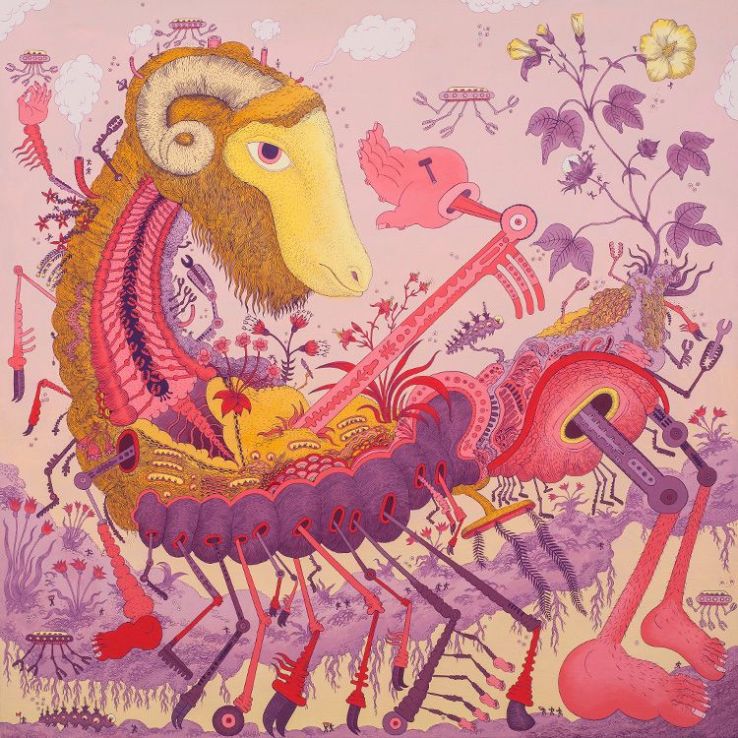
Ludditebot,2017 by Peter Hamlin
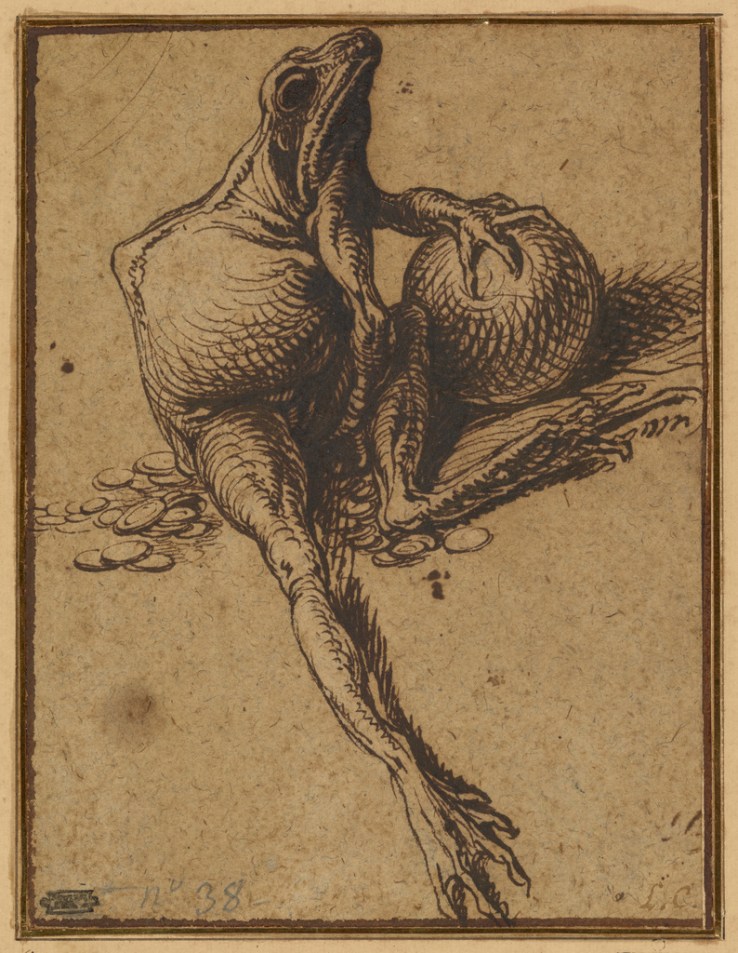
A Frog Sitting on Coins and Holding a Sphere: Allegory of Avarice, 1609 by Jacques de Gheyn II (1565-1629)
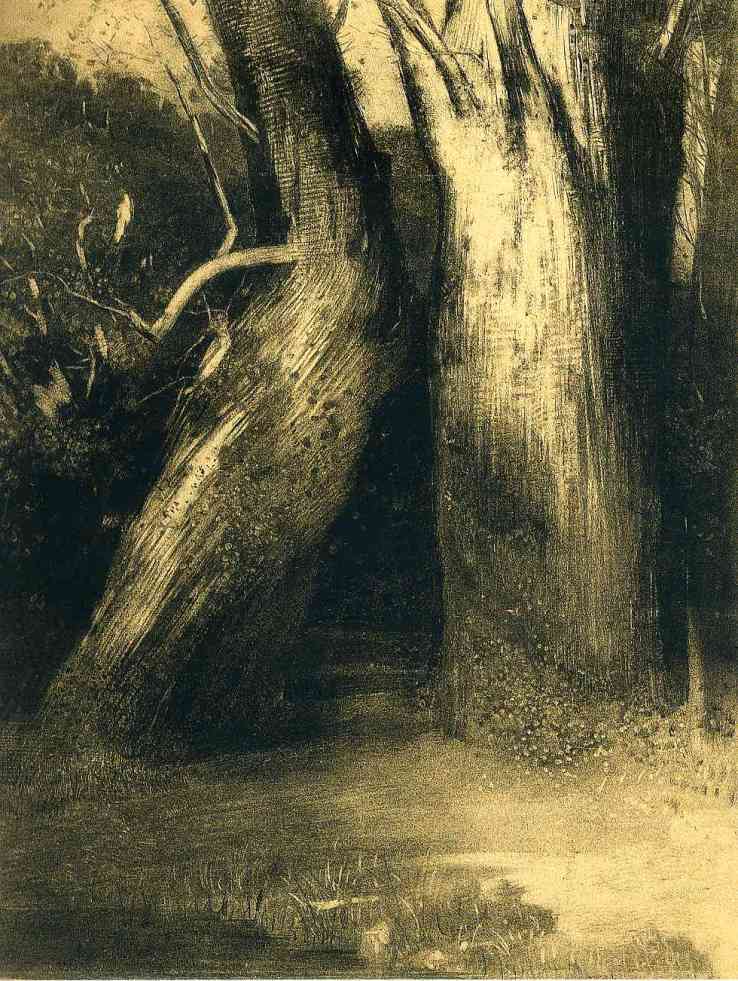
Two Trees, 1875 by Odilon Redon (1840-1916)
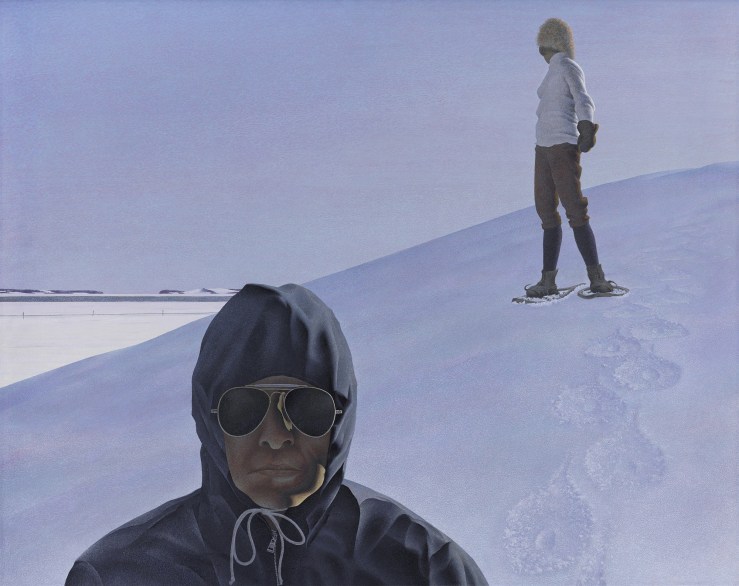
January, 1971 by Alex Colville (1920-2013)

Happy 2018.
Around the New Year, I usually dig out some shelved books (or books in tbr stacks) to make a good-intentions reading list for the forthcoming year. Here are those books, from top to bottom in the pic above:
Philip K. Dick and Roger Zelazny’s Deus Irae: I picked up the old Daw paperback a few months ago—a habit I’ve gotten into with any old Dick—and haven’t gotten to it yet. I read a lot of PKD in 2017 though, so that mood may carry over into early 2018. Curious about the co-authorship—we’ll see.
I’ll admit that I bought Hugh Trevor-Roper’s Hermit of Peking for its Arcimboldosque cover, but dipping into it back in October intrigued me.
I tried to read Elizabeth Hardwick’s Sleepless Nights a few years ago and got distracted by something else, but a lot of folks I admire have praised it, so I’ll give it another shot this year.
I read, “Cutting It Short,” the first novella in Bohumil Hrabal’s The Little Town Where Time Stood Still, but saved the titular second novella for later. Later is now, or nowish, or down the linish. 2018ish.
I stumbled getting into DeLillo’s The Names a few times last year, so maybe I’ll stumble again, but maybe not.
Aberrant, the début novel by Czech author Marek Šindelka, showed up at Biblioklept World Headquarters at the end of my spring semester when I was swamped with term papers, so it sort of got shuffled aside, but it looks so wonderfully weird that I’ll need to carve out space for it this year.
Svetlana Lavochkina’s Zap is new from Whiskey Tit. More to come.
Leon Forrest’s Two Wings to Veil My Face was on last year’s good intentions reading list (I went 6 of 13 by the way).
I read a lot of Paul Bowles in 2016 and 2017, but fizzled out—too much at once. But I want to read The Spider’s House this year.
Four novels that I want to read that I don’t actually own and will thus have to go buy:
Wish me luck. Or not. Either way, I hope your 2018 is the good good stuff.
All times are changing times, but ours is one of massive, rapid moral and mental transformation. Archetypes turn into millstones, large simplicities get complicated, chaos becomes elegant, and what everybody knows is true turns out to be what some people used to think.
It’s unsettling. For all our delight in the impermanent, the entrancing flicker of electronics, we also long for the unalterable.
We cherish the old stories for their changelessness. Arthur dreams eternally in Avalon. Bilbo can go “there and back again,” and there is always the beloved familiar Shire. Don Quixote sets out forever to kill a windmill… So people turn to the realms of fantasy for stability, ancient truths, immutable simplicities.
And the mills of capitalism provide them. Supply meets demand. Fantasy becomes a commodity, an industry.
Commodified fantasy takes no risks: it invents nothing, but imitates and trivializes. It proceeds by depriving the old stories of their intellectual and ethical complexity, turning their action to violence, their actors to dolls, and their truth- telling to sentimental platitude. Heroes brandish their swords, lasers, wands, as mechanically as combine harvesters, reaping profits. Profoundly disturbing moral choices are sanitized, made cute, made safe. The passionately conceived ideas of the great story-tellers are copied, stereotyped, reduced to toys, molded in bright-colored plastic, advertised, sold, broken, junked, replaceable, interchangeable.
What the commodifiers of fantasy count on and exploit is the insuperable imagination of the reader, child or adult, which gives even these dead things life—of a sort, for a while.
Imagination like all living things lives now, and it lives with, from, on true change. Like all we do and have, it can be co-opted and degraded; but it survives commercial and didactic exploitation. The land outlasts the empires. The conquerors may leave desert where there was forest and meadow, but the rain will fall, the rivers will run to the sea. The unstable, mutable, untruthful realms of Once-upon-a-time are as much a part of human history and thought as the nations in our kaleidoscopic atlases, and some are more enduring.
We have inhabited both the actual and the imaginary realms for a long time. But we don’t live in either place the way our parents or ancestors did. Enchantment alters with age, and with the age.
We know a dozen different Arthurs now, all of them true. The Shire changed irrevocably even in Bilbos lifetime. Don Quixote went riding out to Argentina and met Jorge Luis Borges there. Plus c’est la meme chose, plus fa change.
From Ursula K. LeGuin’s foreword to her 2001 collection Tales from Earthsea.
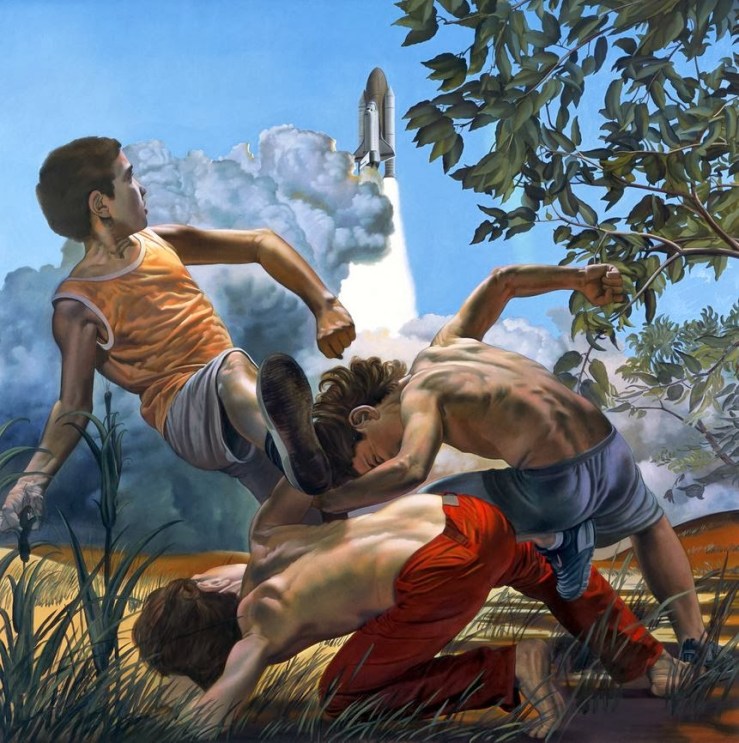
The Anthropic Principle, 2003 by Nicola Verlato (b. 1965)
“The Sister-Years”
by
Nathaniel Hawthorne
Last night, between eleven and twelve o’clock, when the Old Year was leaving her final footprints on the borders of Time’s empire, she found herself in possession of a few spare moments, and sat down—of all places in the world—on the steps of our new city-hall. The wintry moonlight showed that she looked weary of body and sad of heart, like many another wayfarer of earth. Her garments, having been exposed to much foul weather and rough usage, were in very ill condition, and, as the hurry of her journey had never before allowed her to take an instant’s rest, her shoes were so worn as to be scarcely worth the mending. But after trudging only a little distance farther this poor Old Year was destined to enjoy a long, long sleep. I forgot to mention that when she seated herself on the steps she deposited by her side a very capacious bandbox in which, as is the custom among travellers of her sex, she carried a great deal of valuable property. Besides this luggage, there was a folio book under her arm very much resembling the annual volume of a newspaper. Placing this volume across her knees and resting her elbows upon it, with her forehead in her hands, the weary, bedraggled, world-worn Old Year heaved a heavy sigh and appeared to be taking no very pleasant retrospect of her past existence.
While she thus awaited the midnight knell that was to summon her to the innumerable sisterhood of departed years, there came a young maiden treading lightsomely on tip-toe along the street from the direction of the railroad dépôt. She was evidently a stranger, and perhaps had come to town by the evening train of cars. There was a smiling cheerfulness in this fair maiden’s face which bespoke her fully confident of a kind reception from the multitude of people with whom she was soon to form acquaintance. Her dress was rather too airy for the season, and was bedizened with fluttering ribbons and other vanities which were likely soon to be rent away by the fierce storms or to fade in the hot sunshine amid which she was to pursue her changeful course. But still she was a wonderfully pleasant-looking figure, and had so much promise and such an indescribable hopefulness in her aspect that hardly anybody could meet her without anticipating some very desirable thing—the consummation of some long-sought good—from her kind offices. A few dismal characters there may be here and there about the world who have so often been trifled with by young maidens as promising as she that they have now ceased to pin any faith upon the skirts of the New Year. But, for my own part, I have great faith in her, and, should I live to see fifty more such, still from each of those successive sisters I shall reckon upon receiving something that will be worth living for. Continue reading ““The Sister-Years,” Nathaniel Hawthorne’s allegorical New Year’s tale”

Surrogate, 2016 by Cynthia Sitton
This is the first part of the behind-the-scenes features for Twin Peaks: The Return. The other nine parts are up on YouTube as well (for now anyway).

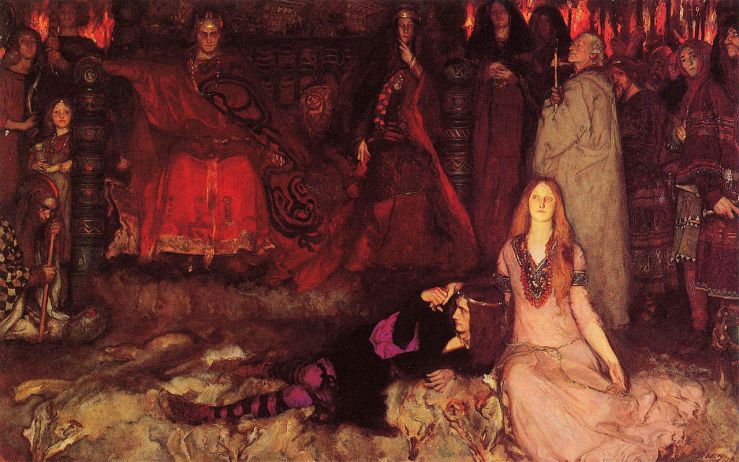
The Play Scene in Hamlet, 1897 by Edwin Austin Abbey (1852-1911)

L’Aventure Permanente (The Permanent Adventure),1944 by Félix Labisse (1905-1982)

Later, toward dusk, several enormous water bugs, a very dark reddish brown, emerge like elves from the wainscoting, and go lumbering toward the larder—pregnant mother bugs too, with baby translucent outrider bugs flowing along like a convoy escort. At night, in the very late silences between bombers, ack-ack fire and falling rockets, they can be heard, loud as mice, munching through Gwenhidwy’s paper sacks, leaving streaks and footprints of shit the color of themselves behind. They don’t seem to go in much for soft things, fruits, vegetables, and such, it’s more the solid lentils and beans they’re into, stuff they can gnaw at, paper and plaster barriers, hard interfaces to be pierced, for they are agents of unification, you see. Christmas bugs. They were deep in the straw of the manger at Bethlehem, they stumbled, climbed, fell glistening red among a golden lattice of straw that must have seemed to extend miles up and downward—an edible tenement-world, now and then gnawed through to disrupt some mysterious sheaf of vectors that would send neighbor bugs tumbling ass-over-antennas down past you as you held on with all legs in that constant tremble of golden stalks. A tranquil world: the temperature and humidity staying nearly steady, the day’s cycle damped to only a soft easy sway of light, gold to antique-gold to shadows, and back again. The crying of the infant reached you, perhaps, as bursts of energy from the invisible distance, nearly unsensed, often ignored. Your savior, you see… .
From Thomas Pynchon’s novel Gravity’s Rainbow.
“Christmas Eve” by Anne Sexton
Oh sharp diamond, my mother!
I could not count the cost
of all your faces, your moods-
that present that I lost.
Sweet girl, my deathbed,
my jewel-fingered lady,
your portrait flickered all night
by the bulbs of the tree.
Your face as calm as the moon
over a mannered sea,
presided at the family reunion,
the twelve grandchildren
you used to wear on your wrist,
a three-months-old baby,
a fat check you never wrote,
the red-haired toddler who danced the twist,
your aging daughters, each one a wife,
each one talking to the family cook,
each one avoiding your portrait,
each one aping your life.
Later, after the party,
after the house went to bed,
I sat up drinking the Christmas brandy,
watching your picture,
letting the tree move in and out of focus.
The bulbs vibrated.
They were a halo over your forehead.
Then they were a beehive,
blue, yellow, green, red;
each with its own juice, each hot and alive
stinging your face. But you did not move.
I continued to watch, forcing myself,
waiting, inexhaustible, thirty-five.
I wanted your eyes, like the shadows
of two small birds, to change.
But they did not age.
The smile that gathered me in, all wit,
all charm, was invincible.
Hour after hour I looked at your face
but I could not pull the roots out of it.
Then I watched how the sun hit your red sweater, your withered neck,
your badly painted flesh-pink skin.
You who led me by the nose, I saw you as you were.
Then I thought of your body
as one thinks of murder-
Then I said Mary-
Mary, Mary, forgive me
and then I touched a present for the child,
the last I bred before your death;
and then I touched my breast
and then I touched the floor
and then my breast again as if,
somehow, it were one of yours
 Biblioklept