Almost no memory | A review of Kazuo Ishiguro’s The Buried Giant

In Kazuo Ishiguro’s 2015 novel The Buried Giant, a metaphysical mist engulfs sixth-century Britain, clouding the memories of all who inhabit the land. Saxons and Britons alike cannot recall their bellicose past. Against this mist, elderly Britons Axl and Beatrice seek their long-lost son. They meet a Saxon warrior who hunts an ancient she-dragon he’s vowed to slay. He’s aided by a youth, Edwin, who’s been exiled from his village after being bitten by a mythic creature. King Arthur’s aged nephew Sir Gawain lingers as a courtly protector, a figure from an already-bygone era; the mist seems to slowly rot his brain and his conscience, pushing him into paranoia and madness. There are Charonic ferrymen and awful ogres; there are mad monks and terrible pixies. A hellhound, a dragon, a poisoned goat. Rivers and mountains and crypts and villages. But most of all that mist.

Charon, Joachim Patinir

Ishiguro makes the reader experience that mist. He obscures. The action that occurs—and yes, there’s action here, measured action (often measured in a literal sense)—the action that occurs in The Buried Giant is almost always oblique, shadowed, indistinct, but also very mechanical. The memory-mist renders the world treacherous, immediate, a dark, vague place that offers its travelers no purchase of reference. Deceptive.

Forgive me for quoting at such length, but I think a longish passage here shows how and what Ishiguro is doing. Almost all of our principals are here, underground—note their procession, their movement—a constant motif in the novel, movement, single file or side by side—and the presence of a light, illumination—also a motif. Note the variety of interpretations of not knowingnot seeing, note the simple horror:

They went on into the tunnel, Sir Gawain leading, Axl following with the flame, Beatrice holding his arm from behind, and Edwin now at the rear. There was no option but to go in single file, the passage remaining narrow, and the ceiling of dangling moss and sinewy roots grew lower and lower until even Beatrice had to stoop. Axl did his best to hold the candle high, but the breeze in the tunnel was now stronger, and he was often obliged to lower it and cover the flame with his other hand. Sir Gawain though never complained, and his shape going before them, sword raised over his shoulder, seemed never to vary. Then Beatrice let out an exclamation and tugged Axl’s arm.

“What is it, princess?”

“Oh, Axl, stop! My foot touched something then, but your candle moved too quickly.”

“What of it, princess? We have to move on.”

“Axl, I thought it a child! My foot touched it and I saw it before your light passed. Oh, I believe it’s a small child long dead!”

“There, princess, don’t distress yourself. Where was it you saw it?”

“Come, come, friends,” Sir Gawain said from the dark. “Many things in this place are best left unseen.”

Beatrice seemed not to hear the knight. “It was over here, Axl. Bring the flame this way. Down there, Axl, shine it down there, though I dread to see its poor face again!”

Despite his counsel, Sir Gawain had doubled back, and Edwin too was now at Beatrice’s side. Axl crouched forward and moved the candle here and there, revealing damp earth, tree roots and stones. Then the flame illuminated a large bat lying on its back as though peacefully asleep, wings stretched right out. Its fur looked wet and sticky. The pig-like face was hairless, and little puddles had formed in the cavities of the outspread wings. The creature might indeed have been sleeping but for what was on the front of its torso. As Axl brought the flame even closer, they all stared at the circular hole extending from just below the bat’s breast down to its belly, taking in parts of the ribcage to either side. The wound was peculiarly clean, as though someone had taken a bite from a crisp apple.

“What could have done work like this?” Axl asked.

He must have moved the candle too swiftly, for at that moment the flame guttered and went out.

Ishiguro gives us mystery, interpretation, and then an incomplete, ambiguous revelation. (This is the basic structure of the novel). Beatrice never relents in her belief that she’s stumbled over a dead child. Brimming with lost children and lost parents and orphans, The Buried Giant is a novel of erasures. But an erasure leaves a trace, a violent, visceral marking into the page’s blankness. Revelation through absence.

We would have no plot, not really, without some overcoming of blankness, and Axl in particular overcomes the mist in his quest. A backstory fleshes out, in watery strokes albeit. The Buried Giant, as far as fantasy epics go, is awfully indistinct. Or rather, Ishiguro offers only mechanical and immediate glimpses into this world, a Britain on the cusp of the Middle Ages. Through Axl’s consciousness (and conscience), we see the vital precision in hand-to-hand combat, for example. Its patience, its slowness, its dependence on muscle memory. Or perhaps (dare I say) more boringly, we feel the very real peril involved in walking in the wild dark as an elderly person. The thrills in The Buried Giant come not from its sword and sorcery costumes, but from its Kafkaesque edges and gaps. This is a novel about not knowing.

And it’s here that The Buried Giant is most successful—as an evocation of not knowing. Axl and Beatrice’s quest unfolds as a series of choices and consequences severed, for the most part, from the anchor of memory. There’s an episodic vibe to the novel, a sense that it’s making itself up as it goes along. (It’s not). The novel strongly reminded me of some of the old RPGs I’d play on a Commodore 64 as a kid. The graphics weren’t great and I had to use my imagination a lot. The games were sometimes frustrating and slow. But perhaps you want a more, uh, literary comparison? Something more recent too? The Buried Giant recalls Ishiguro’s short story “A Village after Dark” a lot more than, say, A Game of Thrones or The Lord of the Rings. It’s a fantasy novel, but one that feels etiolated, its vivid colors drained. More Gustave Doré than Gustave Moreau.

While a precise indistinctness (forgive the oxymoron) is part of The Buried Giant’s program, there’s nothing indistinct about its heroes’ love for each other. Axl and Beatrice, A & B—can I say I came to love them? Or if I didn’t quite love them, I was rooting for them, say? Rooting for their survival, but specifically their survival as a they, a shared survival. Ishiguro successfully communicates their intimacy, their romance, their love, a love threatened by both the natural world and the supernatural return of lost memory. Their relationship is the heart of the novel upon which Ishiguro fixes his themes of memory, justice, vengeance, and love. Ishiguro’s commentary on those themes ultimately may feel pessimistic to many readers, particularly in the novel’s conclusion.

Excepting the ones that we love and return to and obsess over, we retain little of the novels that we read. What memories remain are kernels—the outline of a plot, a strange lingering phrase or detail, a bright or bold character, a theme, an idea, an image. It’s the love between Axl and Beatrice that I’ll likely recall most strongly from the shadows of The Buried Giant. If we can’t remember, we can at least experience.

[Editorial note: Biblioklept originally published this review in October, 2015],
Kazuo Ishiguro’s subtle and unsettling short story, “A Village After Dark”

There was a time when I could travel England for weeks on end and remain at my sharpest—when, if anything, the travelling gave me an edge. But now that I am older I become disoriented more easily. So it was that on arriving at the village just after dark I failed to find my bearings at all. I could hardly believe I was in the same village in which not so long ago I had lived and come to exercise such influence.

There was nothing I recognized, and I found myself walking forever around twisting, badly lit streets hemmed in on both sides by the little stone cottages characteristic of the area. The streets often became so narrow I could make no progress without my bag or my elbow scraping one rough wall or another. I persevered nevertheless, stumbling around in the darkness in the hope of coming upon the village square—where I could at least orient myself—or else of encountering one of the villagers. When after a while I had done neither, a weariness came over me, and I decided my best course was just to choose a cottage at random, knock on the door, and hope it would be opened by someone who remembered me.

I stopped by a particularly rickety-looking door, whose upper beam was so low that I could see I would have to crouch right down to enter. A dim light was leaking out around the door’s edges, and I could hear voices and laughter. I knocked loudly to insure that the occupants would hear me over their talk. But just then someone behind me said, “Hello.”

Read the rest of Kazuo Ishiguro’s story “A Village After Dark” at The New Yorker; you can also hear Ben Marcus read and discuss the story on The New Yorker’s fiction podcast.


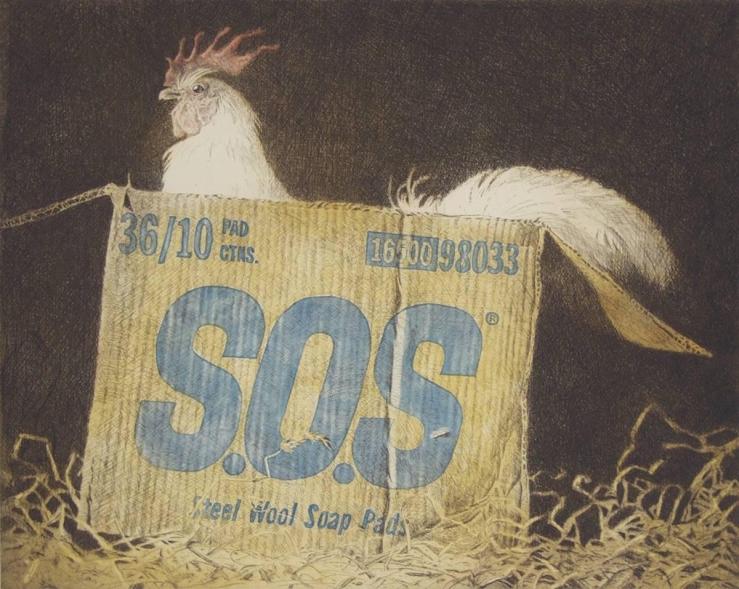
S.O.S. — Jamie Wyeth

wyeth_sos_ded_proof_3_5_z

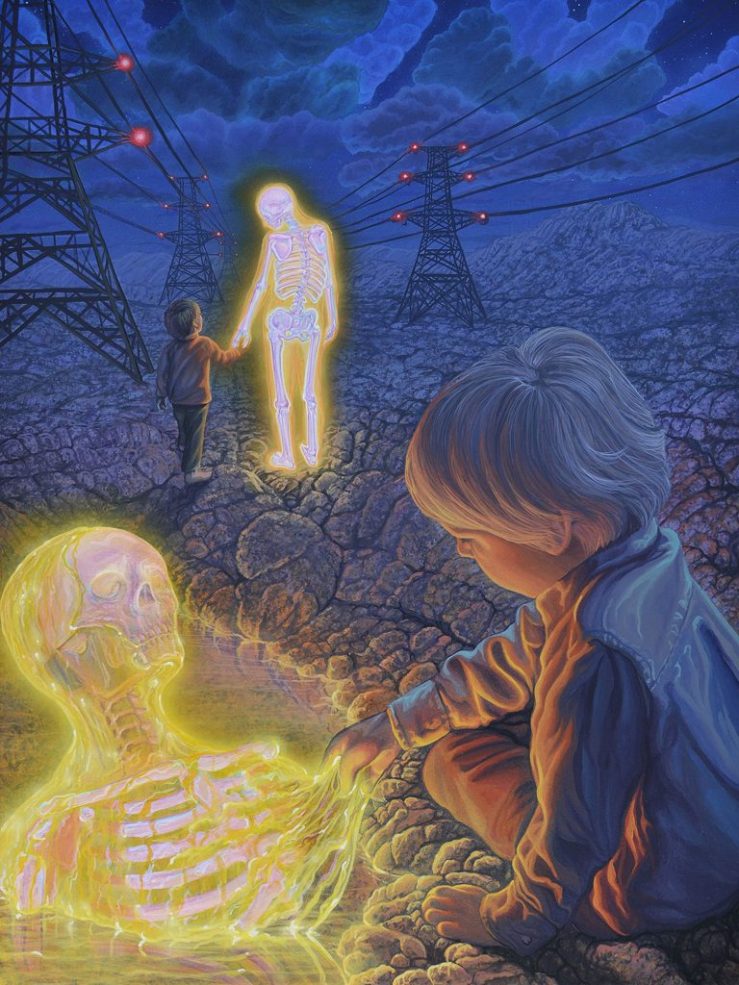
S.O.S, 1981 by Jamie Wyeth (b. 1946)

The Empress of Sorrow — Eric Fischl

the-empress-of-sorrow

The Empress of Sorrow, 1992 by Eric Fischl (b. 1948)

Growing Together — Wiley Wallace

wileywallace03_3-grow-together-wiley-wallace-small-768x1024

Grow Together, 2016 by Wiley Wallace

Girl on a Hill — Prudence Heward

6fa382ab0bdc5857c238d4ea96ad972d

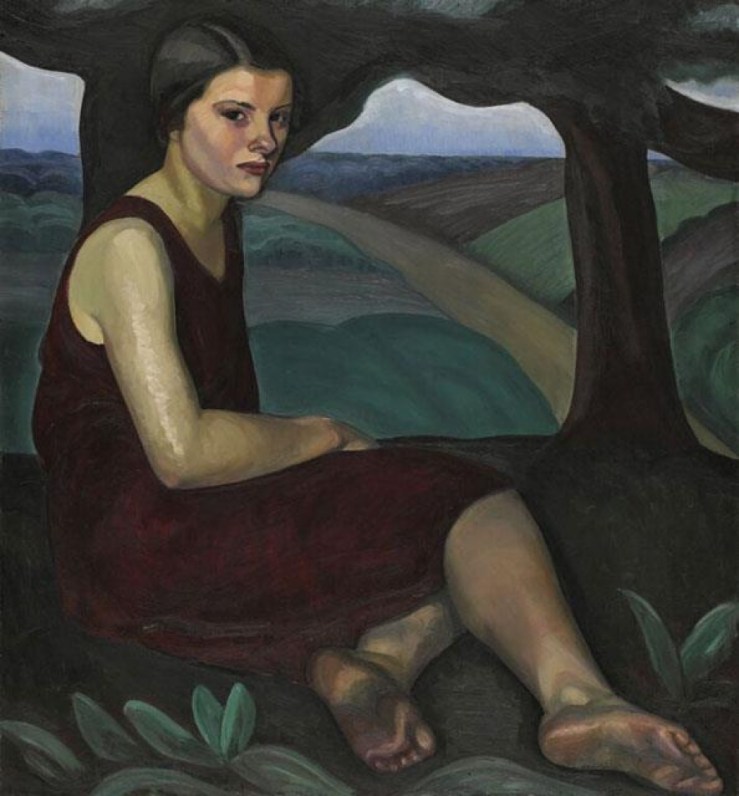
Girl on a Hill, 1928 by Prudence Heward (1896-1947)

Aurora — Artemisia Gentileschi

aurora-1627

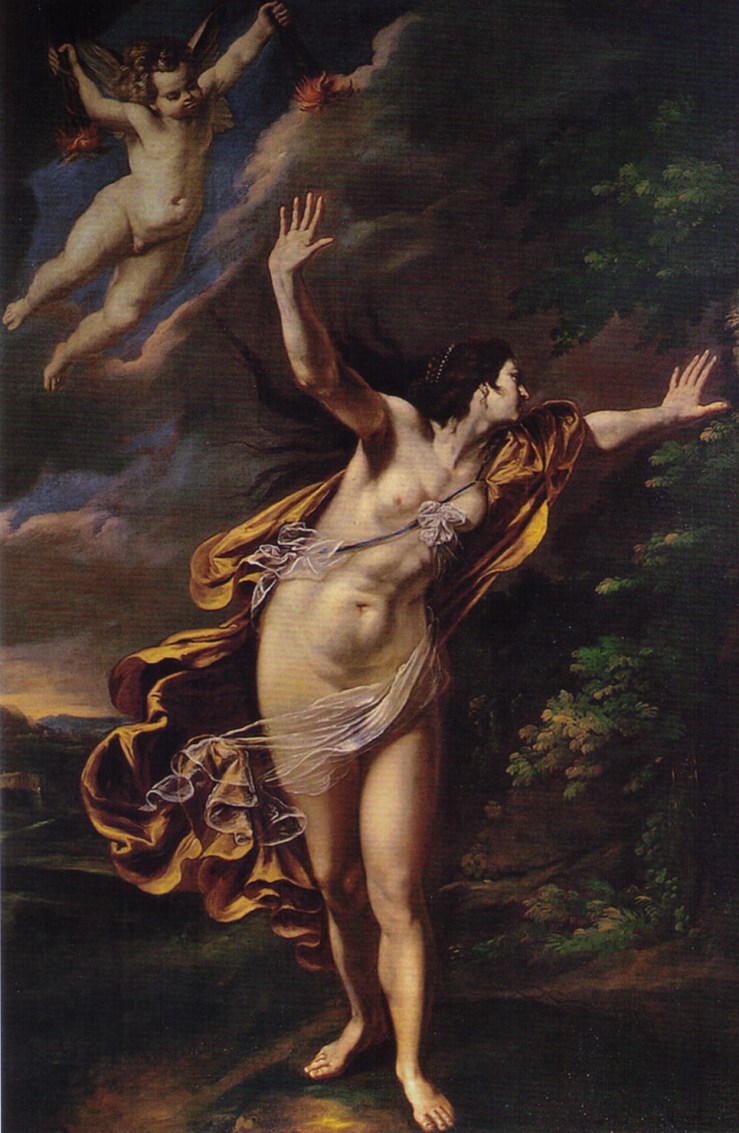
Aurora, 1627 by Artemisia Gentileschi (1610-1656)

“October” — May Swenson

“October”
by
May Swenson

1
A smudge for the horizon
that, on a clear day, shows
the hard edge of hills and
buildings on the other coast.
Anchored boats all head one way:
north, where the wind comes from.
You can see the storm inflating
out of the west. A dark hole
in gray cloud twirls, widens,
while white rips multiply
on the water far out.
Wet tousled yellow leaves,
thick on the slate terrace.
The jay’s hoarse cry. He’s
stumbling in the air,
too soaked to fly.
       2
Knuckles of the rain
on the roof,
chuckles into the drain-
pipe, spatters on
the leaves that litter
the grass. Melancholy
morning, the tide full
in the bay, an overflowing
bowl. At least, no wind,
no roughness in the sky,
its gray face bedraggled
by its tears.
       3
Peeling a pear, I remember
my daddy’s hand. His thumb
(the one that got nipped by the saw,
lacked a nail) fit into
the cored hollow of the slippery
half his knife skinned so neatly.
Dad would pare the fruit from our
orchard in the fall, while Mother
boiled the jars, prepared for
“putting up.” Dad used to darn
our socks when we were small,
and cut our hair and toenails.
Sunday mornings, in pajamas, we’d
take turns in his lap. He’d help
bathe us sometimes. Dad could do
anything. He built our dining table,
chairs, the buffet, the bay window
seat, my little desk of cherry wood
where I wrote my first poems. That
day at the shop, splitting panel
boards on the electric saw (oh, I
can hear the screech of it now,
the whirling blade that sliced
my daddy’s thumb), he received the mar
that, long after, in his coffin,
distinguished his skilled hand.
       4
I sit with braided fingers
and closed eyes
in a span of late sunlight.
The spokes are closing.
It is fall: warm milk of light,
though from an aging breast.
I do not mean to pray.
The posture for thanks or
supplication is the same
as for weariness or relief.
But I am glad for the luck
of light. Surely it is godly,
that it makes all things
begin, and appear, and become
actual to each other.
Light that’s sucked into
the eye, warming the brain
with wires of color.
Light that hatched life
out of the cold egg of earth.
       5
Dark wild honey, the lion’s
eye color, you brought home
from a country store.
Tastes of the work of shaggy
bees on strong weeds,
their midsummer bloom.
My brain’s electric circuit
glows, like the lion’s iris
that, concentrated, vibrates
while seeming not to move.
Thick transparent amber
you brought home,
the sweet that burns.
       6
“The very hairs of your head
are numbered,” said the words
in my head, as the haircutter
snipped and cut, my round head
a newel poked out of the tent
top’s slippery sheet, while my
hairs’ straight rays rained
down, making pattern on the neat
vacant cosmos of my lap. And
maybe it was those tiny flies,
phantoms of my aging eyes, seen
out of the sides floating (that,
when you turn to find them
full face, always dissolve) but
I saw, I think, minuscule,
marked in clearest ink, Hairs
#9001 and #9002 fall, the cut-off
ends streaking little comets,
till they tumbled to confuse
with all the others in their
fizzled heaps, in canyons of my
lap. And what keeps asking
in my head now that, brushed off
and finished, I’m walking
in the street, is how can those
numbers remain all the way through,
and all along the length of every
hair, and even before each one
is grown, apparently, through
my scalp? For, if the hairs of my
head are numbered, it means
no more and no less of them
have ever, or will ever be.
In my head, now cool and light,
thoughts, phantom white flies,
take a fling: This discovery
can apply to everything.
       7
Now and then, a red leaf riding
the slow flow of gray water.
From the bridge, see far into
the woods, now that limbs are bare,
ground thick-littered. See,
along the scarcely gliding stream,
the blanched, diminished, ragged
swamp and woods the sun still
spills into. Stand still, stare
hard into bramble and tangle,
past leaning broken trunks,
sprawled roots exposed. Will
something move?—some vision
come to outline? Yes, there—
deep in—a dark bird hangs
in the thicket, stretches a wing.
Reversing his perch, he says one
“Chuck.” His shoulder-patch
that should be red looks gray.
This old redwing has decided to
stay, this year, not join the
strenuous migration. Better here,
in the familiar, to fade.


October — Alex Colville

october-1979large

October, 1979 by Alex Colville (1920-2013)

Tether Book — Jen Mazza

tetherbookdec2010

Tether Book, 2011 by Jen Mazza (b. 1972)

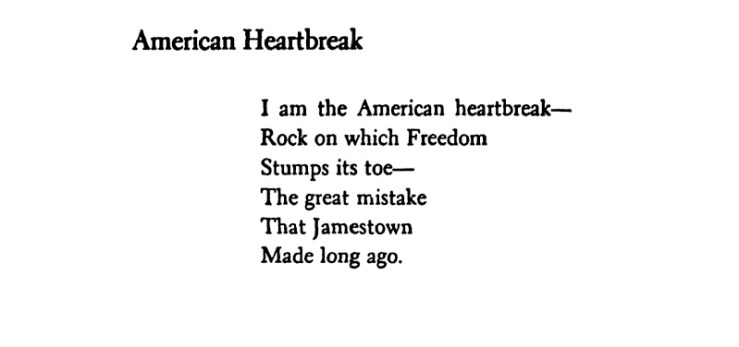
“American Heartbreak” — Langston Hughes

american heartbreak

The Flight of the Soul — Louis Janmot

1280px-louis_janmot_-_po25c325a8me_de_l252725c325a2me_16_-_le_vol_de_l25e22580259925c325a2me

Poème de l’âme 16: Le Vol de l’âme Louis Janmot (Poem of the Soul 16: The Flight of the Soul), 1855 by Louis Janmot (1814-1892)

Lynch wasn’t somebody who you could schedule with

Trees Laden with Parasites and Epiphytes in a Brazilian Garden — Marianne North

trees-laden-with-parasites-and-epiphytes-in-a-brazilian-garden-1873

Trees Laden with Parasites and Epiphytes in a Brazilian Garden, 1873 by Marianne North (1830-90)

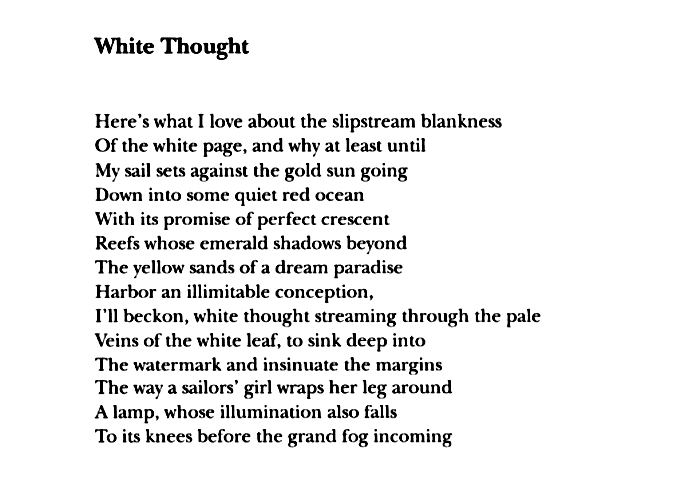
“White Thought” — Tom Clark

white thought

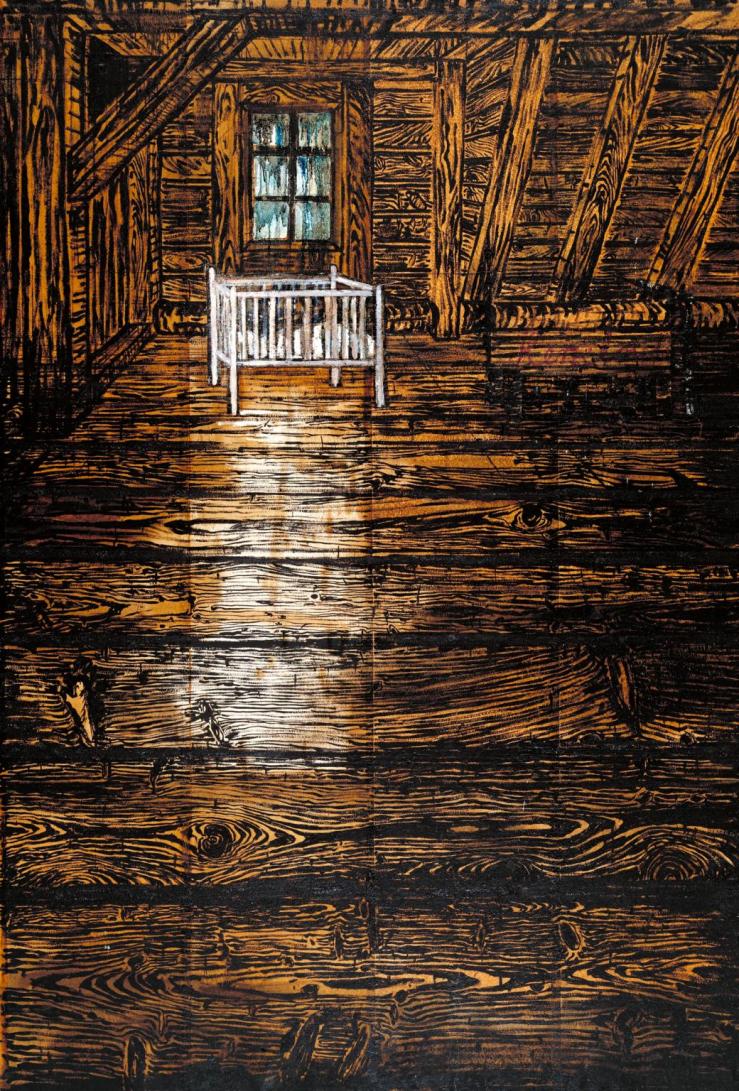
Parsifal I — Anselm Kiefer

Parsifal I 1973 by Anselm Kiefer born 1945

Parsifal I, 1973 by Anselm Kiefer (b. 1945)