Hurricane Irma reading riff

img_7920

I first started getting a tad—just a tad—nervous about Hurricane Irma on Monday, September 4th. This was Labor Day. I had the day off from work, and it was a good day: beer, barbecue, swimming. Etc. Hurricane Irma was already enormous, a monstropolous beast for the record books looming in the Atlantic to eat up our beloved Florida.

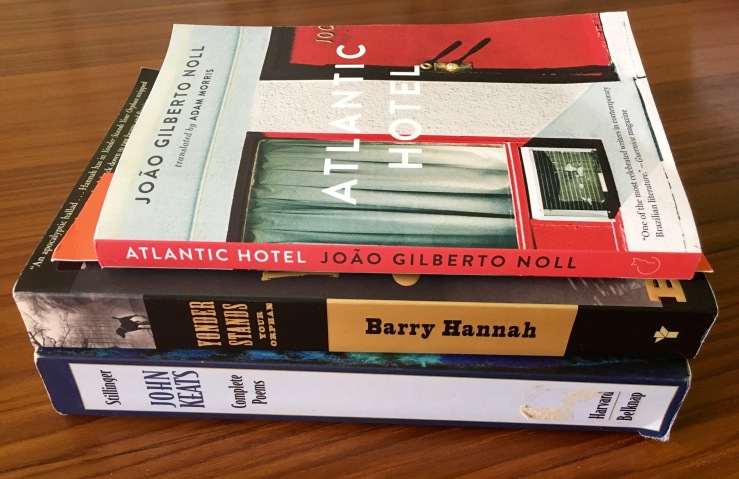
I was still reading Barry Hannah’s last novel Yonder Stands Your Orphan that day; I’d finish it up a few days later. It was excellent, full of great sentences, vignettes, riffs, rants, etc. I’d say it unraveled at the end but “unravel” implies a cohesiveness that maybe isn’t quite there—I’d have to read it again to see, and it’s worth a reread. Actually, in a sense, it coheres in that it collects a number of Hannah’s former characters into a picaresque of grotesque misadventures, hung loosely on a pimp-pornographer-outcast named Man Mortimer. Man Mortimer is the closest thing to a hero the novel has, and he’s pretty evil. Let me crib from an actual review; from Christopher Tayler’s 2001 write-up in the 2001 LRB:

The plot, such as it is, revolves around the depredations of a demonic big-city outsider called Man Mortimer, ‘a gambler, a liaison for stolen cars and a runner of whores, including three Vicksburg housewives’. Mortimer starts to take an interest in cutting people when he finds out that his sort-of girlfriend, Dee Allison – a single mother, nurse and ‘nun of apathy’ – has been unfaithful to him. Dee’s feral twin sons, meanwhile, find in a dried-up sinkhole a car containing the skeletons of Mortimer’s former lover and her child; they clean the skeletons up and take to carting them round the woods. Mortimer is initially concerned with avenging himself on Dee and reclaiming the evidence, but he soon graduates to fairly random attacks on all who cross his path – all, that is, except the poisonous Sidney Farté, who is delighted when Mortimer chops his father’s head off and replaces it with a football, since this speeds his inheritance of the family bait store.

Yonder Stands Your Orphan is often surreal and always dark; it often reminded me of David Lynch’s crime stories, with their grotesque gangsters and abject phantoms. Hell, there’s even a character named Frank Booth.

But where was I? Sorry. This riff is in part a way for me to collect the past few days into something coherent, to figure out what day it is, to prevent an unraveling. Yes, I was nervous on Labor Day, a tad. I had made a list at the beginning of that weekend of five items, chores, I mean, of which I’d accomplished four, including Clean gutters and roof. I did not complete the item I had listed as Hurricane audit.

I picked up a few flats of bottled water before my first class on Tuesday, September 5th. The shelves were already looking bare. I stopped by a Walmart and then a Lowe’s on the way home, failing to get a second gas can. Other people were starting to get a tad nervous. (Nervousness spreads like an infection).

By September 6th, it was nigh impossible to buy a generator in Jacksonville or any of its satellite cities. The college where I teach closed on Thursday, September 7th; my kids’ school closed. Everything started shutting down. There were lots of texts and calls between friends and family, basically amounting to, Should I stay or should I go? Back up plans, hotel reservations to hopefully cancel, etc.

I managed to get a generator on September 8th, which I’d crank up two days later. At this point it seemed clear, or relatively clear, that we were staying, and that family from Tampa Bay would be staying with us. September 8th was long: Trimming back suspicious branches, securing loose items from around the house’s perimeter, busting up an old playhouse that my kids really didn’t play on any more. Cooking meals that could be reheated on a grill. Rehashing plans, piling up supplies. Etc.

djogd1dvyaa_ul5

I finally got tired of listening to the radio (scaring the hell out of me) during this hurricane prep, and picked up the audiobook of Arkady and Boris Strugatsky’s Roadside Picnic, translated by Olena Bormashenko, and read by Robert Forster. I basically listened to each chapter twice over the next few days. The translation is inspiring—witty and raw, noir and smart, and Robert Forster’s narration is perfect—wry, dry, sad, and profound. I need to rewatch Tarkovsky’s Stalker now. I’m a bit ashamed that I haven’t read this one before, and I found its final moments especially moving (exhausted as I was). Highly recommended.

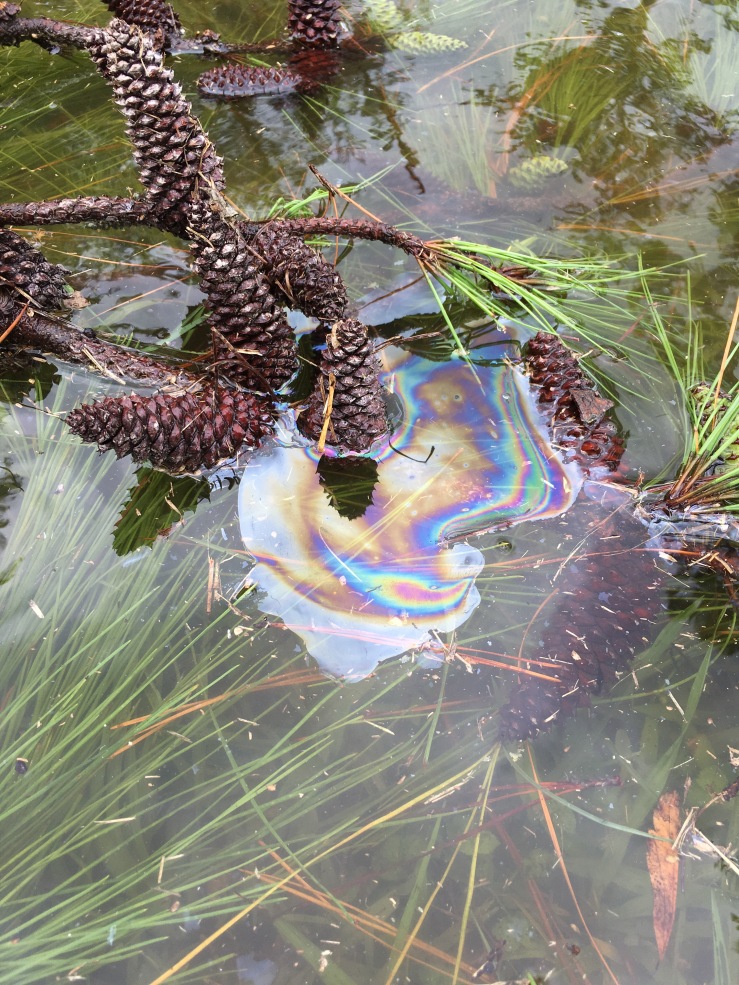
My evacuees arrived early September 9th. The next few days are a soggy blur. A nor’easter saturated northeast Florida; the St. Johns River was already, like, full, and the peninsula I live on (a peninsula on a peninsula), was loose. Like, not firm. Irma’s big bands started hitting the First Coast with a frank sincerity. We watched the local NFL team beat Houston’s team. There’s no symbolism or irony there. I was alternating vodka with coffee with green tea. Two twin pines lord over my house, one in the back, one in the front, maybe five decades old. They swayed and swayed, pelting fresh green pine cones onto the roof for the next 24 hours or so with an admirable consistency. By 10pm Sunday night I realized that I wouldn’t be able to sleep. We lost electrical  power, put the kids to bed. Branches started coming down, thudding with scary force, kick drums for the pine cones’ tight snare raps. Limbs like something heavier, thick bass notes. How did the kids sleep through it all?
img_7941

By candlelight, I read the first 66 pages of João Gilberto Noll’s novella Atlantic Hotel (English translation by Adam Morris) at some point that night. Atlantic Hotel is a picaresque nightmare, one weird horror turning into another. In a way, it was perfect reading for Irma’s approach, ominous and eerie. I also don’t know how much I registered, as I kept going out in the hard wind and slanted thick rain to put a big flashlight on my backyard, where the water kept creeping up and up, eventually getting too high for my gumboot but thankfully never spilling into my house. The feeling of reading Atlantic Hotel registered—the tone, the mood, the rhythm—but not the plot or the anonymous lead character. I’ll have to hit Reset on it.

By 3:00am the brunt of the storm cascaded over my own personal house (yes); the pine cones hailed down in a rhythm like hard rain, punctuated by larger crashes of pine limbs and other debris. For unreasonable reasons I will never know, I pulled out Keats and read Lamia with a bigass flashlight. The storm band somewhat subsided; I rested my eyes for an hour or two, then the whole thing commenced again. By nine in the morning it seemed the worst of the storm had passed, and I slept. Lamia snaked into my dreams, coiled into Irma. My son woke me up at 10:30am—a house down the street was on fire. Some asshole had cranked his generator in his garage—his closed garage!—next to his gas cans and propane tank and car. The garage burned; the car exploded, along with the other car in the driveway.
img_7930

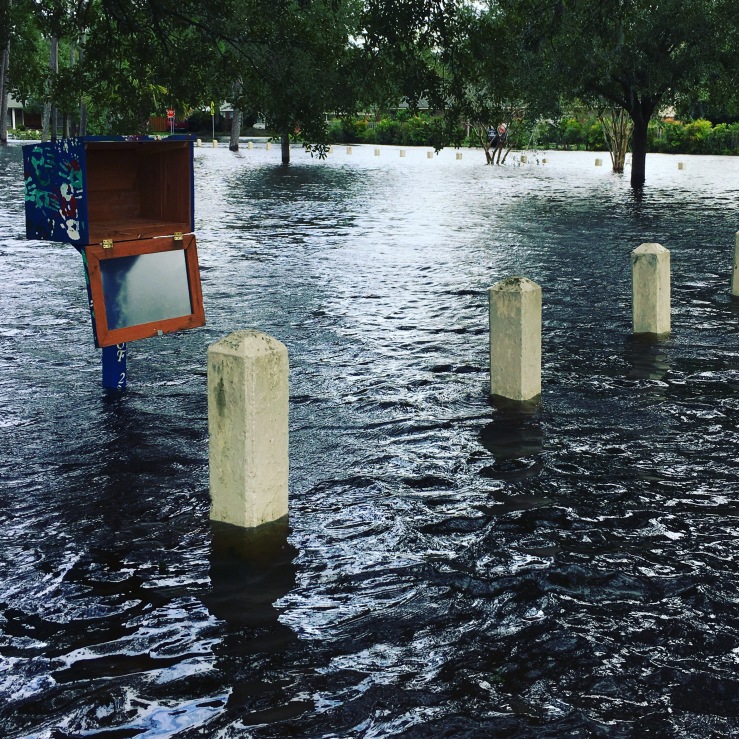
That Sunday, September 11th saw historic flooding in the urban core of Jacksonville. My kids’ school, about a third of a mile from my house, flooded. While trudging around in the late afternoon in our gumboots, happy to be free of our sweltering house for a bit, we saw two teams of Army Rangers paddle up a canal, onto the street, there to evacuate stranded old folks. Surreal. Word traveled about other locations underwater—a flooded Publix, a ruined boatyard, Memorial Park a lake. The worst rumor, to me anyway, was that my beloved used bookstore, Chamblin Bookmine, was underwater. I still can’t bring myself to go over there. I know where it is and how high the water got.

These past few days, I listened to my favorite audiobook during much of the cleanup—Richard Poe’s recording of Cormac McCarthy’s Blood Meridian. What a strange awful comfort. A tree fell on my carport and shed, but they held, sorta. My lawn is a stinking mess, the blazing sun pulling out the water in humid reeking waves. The squelch of it all is something damn else. The pine trees dropped plenty of enormous limbs, but none did real damage. Up on the roof yesterday, clearing one off, I shuddered at its size and weight. I shuddered because of course It could have been so much worse. I’m thankful.


“Pink Turns to Blue” (Live in ’87) –Hüsker Dü

RIP Grant Hart, 1961-2017

We sat and talked of ghosts and kindred subjects | Nathaniel Hawthorne’s journal entry for September 13th, 1851

September 13th.–I spent last evening, as well as part of the evening before, at Mr. Thaxter’s. It is certainly a romantic incident to find such a young man on this lonely island; his marriage with the pretty Miranda is true romance. In our talk we have glanced over many matters, and, among the rest, that of the stage, to prepare himself for which was his first motive in coming hither. He appears quite to have given up any dreams of that kind now. What he will do on returning to the world, as his purpose is, I cannot imagine; but, no doubt, though all their remaining life, both he and she will look back to this rocky ledge, with its handful of soil, as to a Paradise.

Last evening we (Mr., Mrs., and Miss Thaxter) sat and talked of ghosts and kindred subjects; and they told me of the appearance of a little old woman in a striped gown, that had come into that house a few months ago. She was seen by nobody but an Irish nurse, who spoke to her, but received no answer. The little woman drew her chair up towards the fire, and stretched out her feet to warm them. By and by the nurse, who suspected nothing of her ghostly character, went to get a pail of water; and, when she came back, the little woman was not there. It being known precisely how many and what people were on the island, and that no such little woman was among them, the fact of her being a ghost is incontestable. I taught them how to discover the hidden sentiments of letters by suspending a gold ring over them. Ordinarily, since I have been here, we have spent the evening under the piazza, where Mr. Laighton sits to take the air. He seems to avoid the within-doors whenever he can. So there he sits in the sea-breezes, when inland people are probably drawing their chairs to the fire-side; and there I sit with him,–not keeping up a continual flow of talk, but each speaking as any wisdom happens to come into his mind.

The wind, this morning, is from the northwestward, rather brisk, but not very strong. There is a scattering of clouds about the sky; but the atmosphere is singularly clear, and we can see several hills of the interior, the cloud-like White Mountains, and, along the shore, the long white beaches and the dotted dwellings, with great distinctness. Many small vessels spread their wings, and go seaward.

I have been rambling over the southern part of the island, and looking at the traces of habitations there. There are several enclosures,–the largest, perhaps, thirty yards square,–surrounded with a rough stone-wall of very mossy antiquity, built originally broad and strong, two or three large stones in width, and piled up breast-high or more, and taking advantage of the extending ledge to make it higher. Within this enclosure there is almost a clear space of soil, which was formerly, no doubt, cultivated as a garden, but is now close cropt by the sheep and cattle, except where it produces thistles, or the poisonous weed called mercury, which seems to love these old walls, and to rot itself in or near them. These walls are truly venerable, gray, and mossy; and you see at once that the hands that piled the stones must have been long ago turned to dust. Close by the enclosure is the hollow of an old cellar, with rocks tumbled into it, but the layers of stone at the side still to be traced, and bricks, broken or with rounded edges, scattered about, and perhaps pieces of lime; and weeds and grass growing about the whole. Several such sites of former human homes may be seen there, none of which can possibly be later than the Revolution, and probably they are as old as the settlement of the island. The site has Smutty Nose and Star opposite, with a road (that is, a water-road) between, varying from half a mile to a mile. Duck Island is also seen on the left; and, on the right, the shore of the mainland. Behind, the rising ground intercepts the view. Smith’s monument is visible. I do not see where the inhabitants could have kept their boats, unless in the chasms worn by the sea into the rocks. 

One of these chasms has a spring of fresh water in the gravelly base, down to which the sea has worn out. The chasm has perpendicular, though irregular, sides, which the waves have chiselled out very square. Its width varies from ten to twenty feet, widest towards the sea; and on the shelves, up and down the sides, some soil has been here and there accumulated, on which grow grass and wild-flowers,–such as goldenrod, now in bloom, and raspberry-bushes, the fruit of which I found ripe,–the whole making large parts of the sides of the chasm green, its verdure overhanging the strip of sea that dashes and foams into the hollow. Sea-weed, besides what grows upon and shags the submerged rocks, is tossed into the harbor, together with stray pieces of wood, chips, barrel-staves, or (as to-day) an entire barrel, or whatever else the sea happens to have on hand. The water rakes to and fro over the pebbles at the bottom of the chasm, drawing back, and leaving much of it bare, then rushing up, with more or less of foam and fury, according to the force and direction of the wind; though, owing to the protection of the adjacent islands, it can never have a gale blowing right into its mouth. The spring is situated so far down the chasm, that, at half or two thirds tide, it is covered by the sea. Twenty minutes after the retiring of the tide suffices to restore to it its wonted freshness.

In another chasm, very much like the one here described, I saw a niche in the rock, about tall enough for a person of moderate stature to stand upright. It had a triangular floor and a top, and was just the place to hold the rudest statue that ever a savage made.

Many of the ledges on the island have yellow moss or lichens spread on them in large patches. The moss of those stone walls does really look very old. 

“Old Bab,” the ghost, has a ring round his neck, and is supposed either to have been hung or to have had his throat cut, but he steadfastly declines telling the mode of his death. There is a luminous appearance about him as he walks, and his face is pale and very dreadful.

The Fanny arrived this forenoon, and sailed again before dinner. She brought, as passenger, a Mr. Balch, brother to the country trader who has been spending a few days here. On her return, she has swept the islands of all the non-residents except myself. The wind being ahead, and pretty strong, she will have to beat up, and the voyage will be anything but agreeable. The spray flew before her bows, and doubtless gave the passengers all a thorough wetting within the first half-hour.

The view of Star Island or Gosport from the north is picturesque,–the village, or group of houses, being gathered pretty closely together in the centre of the island, with some green about them; and above all the other edifices, wholly displayed, stands the little stone church, with its tower and belfry. On the right is White Island, with the light-house; to the right of that, and a little to the northward, Londoner’s Rock, where, perhaps, of old, some London ship was wrecked. To the left of Star Island, and nearer Hog, or Appledore, is Smutty Nose. Pour the blue sea about these islets, and let the surf whiten and steal up from their points, and from the reefs about them (which latter whiten for an instant, and then are lost in the whelming and eddying depths), the northwest-wind the while raising thousands of white-caps, and the evening sun shining solemnly over the expanse,–and it is a stern and lovely scene. 

The valleys that intersect, or partially intersect, the island are a remarkable feature. They appear to be of the same formation as the fissures in the rocks, but, as they extend farther from the sea, they accumulate a little soil along the irregular sides, and so become green and shagged with bushes, though with the rock everywhere thrusting itself through. The old people of the isles say that their fathers could remember when the sea, at high tide, flowed quite through the valley in which the hotel stands, and that boats used to pass. Afterwards it was a standing pond; then a morass, with cat-tail flags growing in it. It has filled up, so far as it is filled, by the soil being washed down from the higher ground on each side. The storms, meanwhile, have tossed up the shingle and paving-stones at each end of the valley, so as to form a barrier against the passage of any but such mighty waves as that which thundered through a year or two ago.

The old inhabitants lived in the centre or towards the south of the island, and avoided the north and east because the latter were so much bleaker in winter. They could moor their boats in the road, between Smutty Nose and Hog, but could not draw them up. Mr. Laighton found traces of old dwellings in the vicinity of the hotel, and it is supposed that the principal part of the population was on this island. I spent the evening at Mr. Thaxter’s, and we drank a glass of his 1820 Scheidam. The northwest-wind was high at ten o’clock, when I came home, the tide full, and the murmur of the waves broad and deep.

Nathaniel Hawthorne’s journal entry for September 13th, 1851. Collected in Passages from the American Note-Books.

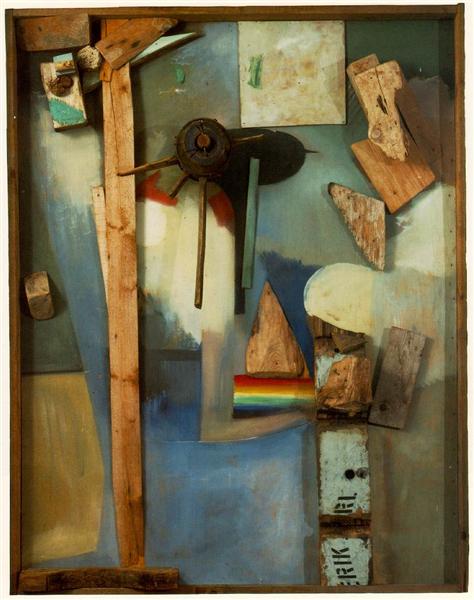
Merzbild mit Regenbogen — Kurt Schwitters

merzpicture-with-rainbow-1939.jpg!Large

Merzbild mit Regenbogen (Merz Picture with Rainbow), c. 1939 by Kurt Schwitters (1887–1948)

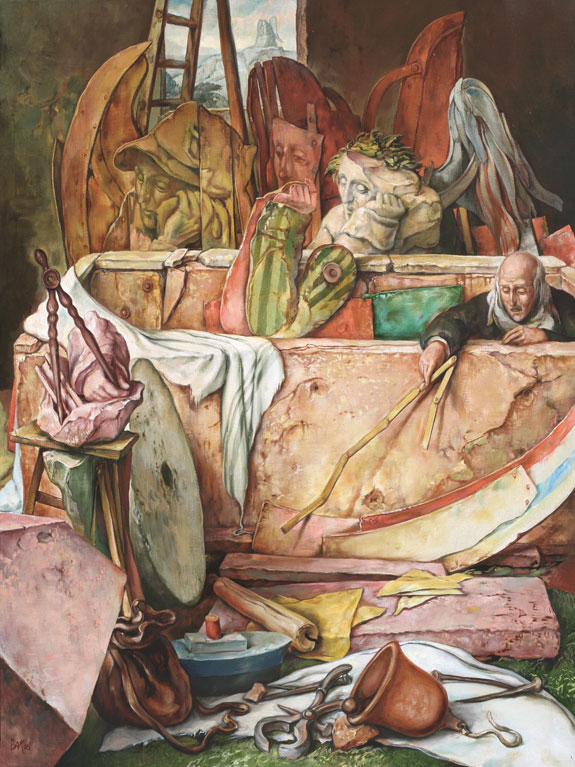
How to Remember — Samuel Bak

bk1134_images

How to Remember, 2006 by Samuel Bak (b. 1933)

Portrait of the Late Mrs Partridge — Leonora Carrington

009987be76eca0a4bf34eca486e34822-partridge-the-late

Portrait of the Late Mrs Partridge, 1947 by Leonora Carrington (1917-2011)

Tomorrow’s already the 10th

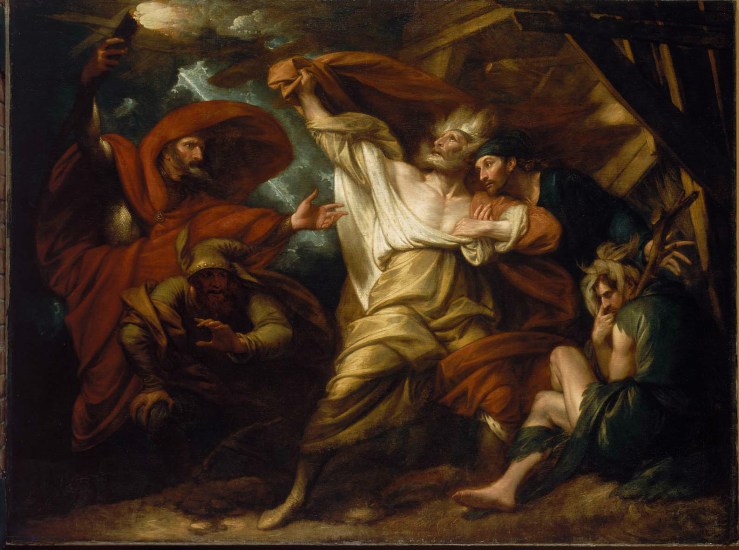
Blow, winds, and crack your cheeks! rage! blow!

Blow, winds, and crack your cheeks! rage! blow!
You cataracts and hurricanoes, spout
Till you have drench’d our steeples, drown’d the cocks!
You sulphurous and thought-executing fires,
Vaunt-couriers to oak-cleaving thunderbolts,
Singe my white head! And thou, all-shaking thunder,
Smite flat the thick rotundity o’ the world!
Crack nature’s moulds, an germens spill at once,
That make ingrateful man!

King Lear, Act 3, Scene 2

lear

King Lear, 1788/1806 by Benjamin West (1738–1820)

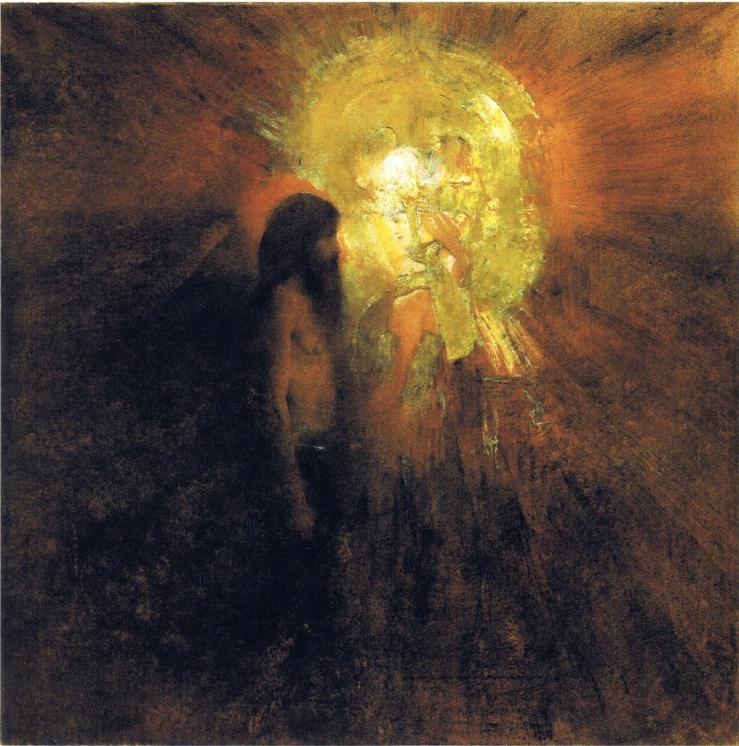
The Temptation of St. Anthony — Fernand Khnopff

kh

The Temptation of St. Anthony, 1883 by Fernand Khnopff (1858–1921)

Griffin — Martin Schongauer

griffin-1485

Griffin, c.1475-85 by Martin Schongauer (c. 1445–1491)

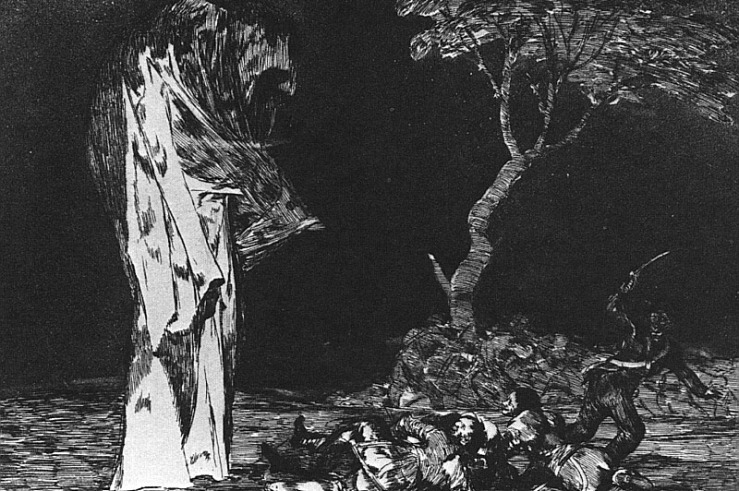
The Madness of Fear — Francisco Goya

the-madness-of-fear

La locura del miedo (The Madness of Fear), 1819-1823 — Francisco Goya

“The Hurricane,” a very short fable by Lord Dunsany

“The Hurricane”

by

Lord Dunsany

from The Sword of Welleran and Other Stories


One night I sat alone on the great down, looking over the edge of it at a murky, sullen city. All day long with its smoke it had troubled the holy sky, and now it sat there roaring in the distance and glared at me with its furnaces and lighted factory windows. Suddenly I became aware that I was not the only enemy of that city, for I perceived the colossal form of the Hurricane walking over the down towards me, playing idly with the flowers as he passed, and near me he stopped and spake to the Earthquake, who had come up mole-like but vast out of a cleft in the earth.

‘Old friend,’ said the Hurricane, ‘rememberest when we wrecked the nations and drave the herds of the sea into new pasturage?’

‘Yes,’ said the Earthquake, drowsily; ‘Yes, yes.’

‘Old friend,’ said the Hurricane, ‘there are cities everywhere. Over thy head while thou didst sleep they have built them constantly. My four children the Winds suffocate with the fumes of them, the valleys are desolate of flowers, and the lovely forests are cut down since last we went abroad together.’

The Earthquake lay there, with his snout towards the city, blinking at the lights, while the tall Hurricane stood beside him pointing fiercely at it.

‘Come,’ said the Hurricane, ‘let us fare forth again and destroy them, that all the lovely forests may come back and the furry creeping things. Thou shalt whelm these cities utterly and drive the people forth, and I will smite them in the shelterless places and sweep their desecrations from the sea. Wilt thou come forth with me and do this thing for the glory of it? Wilt thou wreck the world again as we did, thou and I, or ever Man had come? Wilt thou come forth to this place at this hour tomorrow night?’

‘Yes,’ said the Earthquake, ‘Yes,’ and he crept to his cleft again, and head foremost waddled down into the abysses.

When the Hurricane strode away, I got up quietly and departed, but at that hour of the next night I came up cautiously to the same spot. There I found the huge grey form of the Hurricane alone, with his head bowed in his hands, weeping; for the Earthquake sleeps long and heavily in the abysses, and he would not wake.

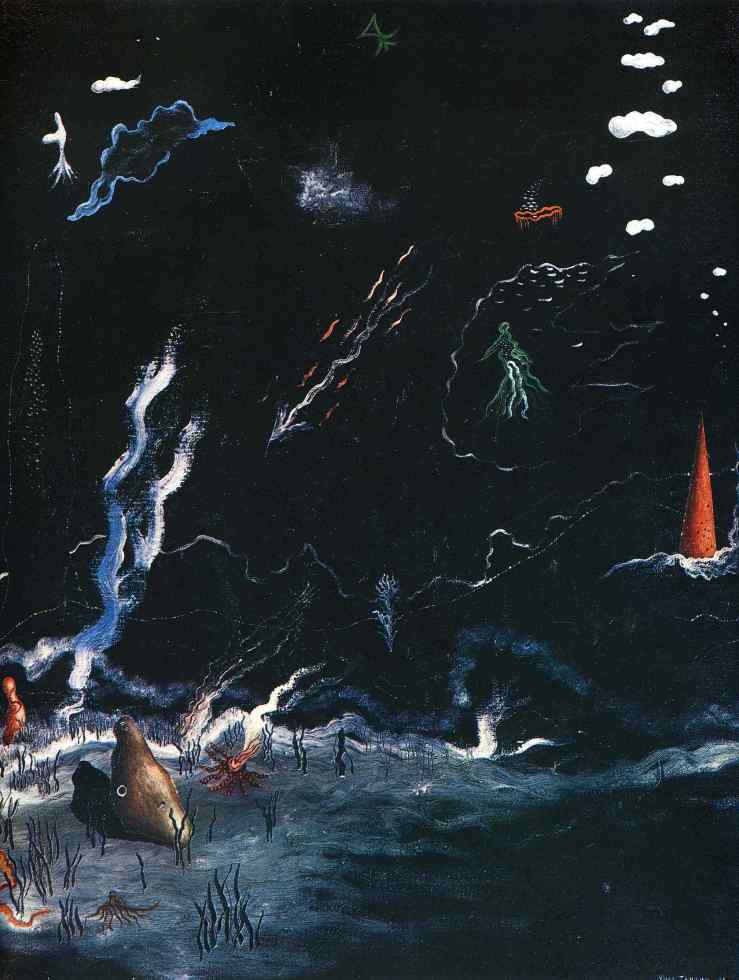
The Storm (Black Landscape) — Yves Tanguy

storm-black-landscape-1926

The Storm (Black Landscape), 1926  — Yves Tanguy (1900-1955)

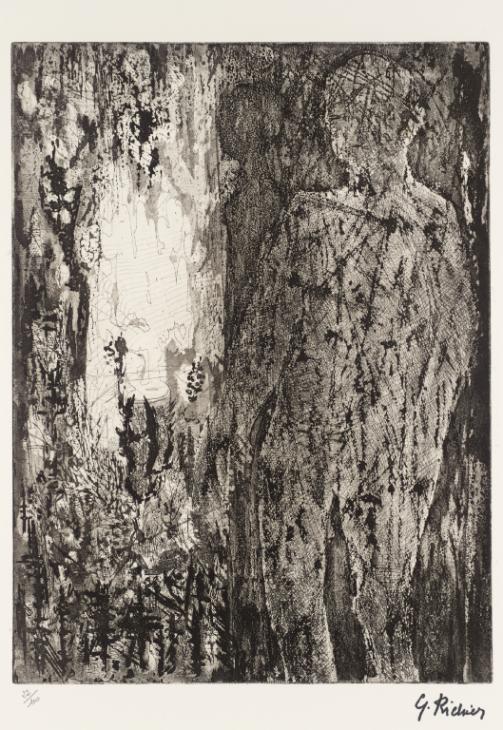
The Hurricane — Germaine Richier

The Hurricane 1955, published 1961 by Germaine Richier 1902-1959

The Hurricane, 1955 by Germaine Richier (1902-1959)

RIP Holger Czukay

holger-czukay-770x470

RIP Holger Czukay, 1938-2017

Yesterday, Rolling Stone and other sources reported the death of musician Holger Czukay.

Czukay is probably most famous as the throbbing heart of Can, but he also recorded many solo albums and was a frequent collaborator with other artists across many genres.

It’s hard to find another run of albums as perfect as Can’s output in the early 1970s—Tago MagoEge Bamyasi, and Future Days are flawless in my book.

These albums have brought me good times and good grooves for decades now. I’ll always be especially thankful to Czukay for one particular moment in my life—I was 19, relaxing in a bathtub, blaring Monster Movie on my stereo—a particular bass frequency rumbled a bar of soap and sent it smoothly sliding into the water. The moment was somehow epiphanic for me, illustrating a relationship between time, space, and matter. And music.


The Temptation of St. Anthony — Otto Dix

Otto Dix (1891-1969), 'La tentazione di sant'Antonio II', 1940

The Temptation of St. Anthony, 1940 by Otto Dix (1891-1969)

Little or nothing except to roam | Nathaniel Hawthorne’s journal entry for September 5th, 1852

Sunday, September 5th.–To-day I have done little or nothing except to roam along the shore of the island, and to sit under the piazza, talking with Mr. Laighton or some of his half-dozen guests; and about an hour before dinner I came up to my room, and took a brief nap. Since dinner I have been writing the foregoing journal. I observe that the Fanny Ellsler, our passenger and mail boat, has arrived from Portsmouth, and now lies in a little cove, moored to the rocky shore, with a flag flying at her main-mast. We have been watching her for some hours, but she stopped to fish, and then went to some other island, before putting in here. I must go and see what news she has brought.

“What did you fire at?” asked one of the Yankees just now of a boy who had been firing a gun. “Nothing,” said the boy. “Did you hit it?” rejoined the Yankee.

The farmer is of a much ruder and rougher mould than his brother,–heavier in frame and mind, and far less cultivated. It was on this account, probably, that he labored as a farmer, instead of setting up a shop. When it is warm, as yesterday, he takes off his coat, and, not minding whether or no his shirt-sleeves be soiled, goes in this guise to meals or wherever else,–not resuming his coat as long as he is more comfortable without it. His shoulders have a stoop, and altogether his air is that of a farmer in repose. His brother is handsome, and might have quite the aspect of a smart, comely young man, if well dressed.

This island is said to be haunted by a spectre called “Old Bab.” He was one of Captain Kidd’s men, and was slain for the protection of the treasure. Mr. Laighton said that, before he built his house, nothing would have induced the inhabitant of another island to come to this after nightfall. The ghost especially haunts the space between the hotel and the cove in front. There has, in times past, been great search for the treasure.

Mr. Thaxter tells me that the women on the island are very timid as to venturing on the sea,–more so than the women of the mainland,–and that they are easily frightened about their husbands. Very few accidents happen to the boats or men,–none, I think, since Mr. Thaxter has been here. They are not an enterprising set of people, never liking to make long voyages. Sometimes one of them will ship on a voyage to the West Indies, but generally only on coast-wise trips, or fishing or mackerel voyages. They have a very strong local attachment, and return to die. They are now generally temperate, formerly very much the contrary.

September 5th.–A large part of the guests took their departure after an early breakfast this morning, including Mr. Titcomb, Mr. Weiss, the two Yankees, and Mr. Thaxter,–who, however, went as skipper or supercargo, and will return with the boat. I have been fishing for cunners off the rocks, but with intolerably poor success. There is nothing so dispiriting as poor fishing, and I spend most of the time with my head on my hands, looking at the sea breaking against the rocks, shagged around the bases with seaweed. It is a sunny forenoon, with a cool breeze from the south-west. The mackerel craft are in the offing. Mr. Laighton says that the Spy (the boat which went to the mainland this morning) is now on her return with all her colors set; and he thinks that Pierce is on board, he having sent Mr. Thaxter to invite him to come in this boat.

Pierce arrived before dinner in the Spy, accompanied by Judge Upham and his brother and their wives, his own wife, Mr. Furness, and three young ladies. After dinner some of the gentlemen crossed over to Gosport, where we visited the old graveyard, in which were monuments to Rev. Mr. Tucke (died 1773, after forty years’ settlement) and to another and later minister of the island. They were of red freestone, lying horizontally on piles of the granite fragments, such as are scattered all about. There were other graves, marked by the rudest shapes of stones at head and foot. And so many stones protruded from the ground, that it was wonderful how space and depth enough was found between them to cover the dead. We went to the house of the town clerk of Gosport (a drunken fisherman, Joe Caswell by name), and there found the town records, commencing in 1732, in a beautiful style of penmanship. They. are imperfect, the township having been broken up, probably at the time of the Revolution. Caswell, being very drunk, immediately put in a petition to Pierce to build a sea-mole for the protection of the navigation of the island when he should be President. He was dressed in the ordinary fisherman’s style,–red-baize shirt, trousers tucked into large boots, which, as he had just come ashore, were wet with salt water.

He led us down to the shore of the island, towards the east, and showed us Betty Moody’s Hole. This Betty Moody was a woman of the island in old times. The Indians came off on a depredating excursion, and she fled from them with a child, and hid herself in this hole, which is formed by several great rocks being lodged so as to cover one of the fissures which are common along these shores. I crept into the hole, which is somewhat difficult of access, long, low, and narrow, and might well enough be a hiding-place. The child, or children, began to cry; and Betty, fearful of discovery, murdered them to save herself. Joe Caswell did not tell the latter part of the story, but Mr. Thaxter did.

Not far from the spot there is a point of rocks extending out farther into the ocean than the rest of the island. Some four or five years ago there was a young woman residing at Gosport in the capacity of school-teacher. She was of a romantic turn, and used to go and sit on this point of rock to view the waves. One day, when the wind was high, and the surf raging against the rocks, a great wave struck her, as she sat on the edge, and seemed to deprive her of sense; another wave, or the reflex of the same one, carried her off into the sea, and she was seen no more. This happened, I think, in 1846.

Passing a rock near the centre of the island, which rose from the soil about breast-high, and appeared to have been split asunder, with an incalculably aged and moss-grown fissure, the surfaces of which, however, precisely suited each other, Mr. Hatch mentioned that there was an idea among the people, with regard to rocks thus split, that they were rent asunder at the time of the Crucifixion. Judge Upham observed that this superstition was common in all parts of the country.

Mr. Hatch said that he was professionally consulted the other day, by a man who had been digging for buried treasure at Dover Point, up the Piscataqua River; and, while he and his companions were thus engaged, the owner of the land came upon them, and compelled Hatch’s client to give him a note for a sum of money. The object was to inquire whether this note was obligatory. Hatch says that there are a hundred people now resident in Portsmouth, who, at one time or another, have dug for treasure. The process is, in the first place, to find out the site of the treasure by the divining-rod. A circle is then described with the steel rod about the spot, and a man walks around within its verge, reading the Bible, to keep off the evil spirit while his companions dig. If a word is spoken, the whole business is a failure. Once, the person who told him the story reached the lid of the chest, so that the spades plainly scraped upon it, when one of the men spoke, and the chest immediately moved sideways into the earth. Another time, when he was reading the Bible within the circle, a creature like a white horse, but immoderately large, came from a distance towards the circle, looked at him, and then began to graze about the spot. He saw the motion of the jaws, but heard no sound of champing. His companions saw the gigantic horse precisely as he did, only to them it appeared bay instead of white.

The islanders stared with great curiosity at Pierce. One pretty young woman appeared inclined to engross him entirely to herself.

There is a bowling-alley on the island, at which some of the young fishermen were rolling.

Nathaniel Hawthorne’s journal entry for September 5th, 1852. Collected in Passages from the American Note-Books.