Beekeeper Girl — Anthony Goicolea

W1siZiIsIjE1ODExMiJdLFsicCIsImNvbnZlcnQiLCItcmVzaXplIDIwMDB4MjAwMFx1MDAzZSJdXQ.jpg

There is also an imperial head of Julius Cæsar | Nathaniel Hawthorne’s journal entry for March 15th, 1858

March 15th.–A week ago we went to the Vatican, to the halls of sculpture. They commence by a very long narrow gallery, the first part of which is devoted principally to inscriptions, inserted into or fastened upon the walls–on the right hand, pagan, on the left, Christian. All along the gallery of inscriptions there are sarcophagi, vases, torsos, capitals of columns, cippi, and various bas-reliefs of fine workmanship–cornices, and specimens of everything picked up and dug up about Rome. The second part of the gallery contains busts, and figures of heroes, gods, goddesses, emperors, philosophers, poets, children, and women. Here is the colossal head of Minerva, with the strange black eyes and black lashes, while the rest is snowy marble–the grand, colossal, sitting figure of Tiberius, with the civic crown. He seems to have been carved out for a god, though he became unworthy even of the name of man. Here also is the newly-discovered and only true Cicero. The Cicero that has hitherto been called the orator, is now supposed to be his brother, who was a soldier. It is only a year ago that this was found. It is very satisfactory–a refined, intellectual, penetrating head, with a mouth of wonderful beauty. Its authenticity is proved by its exact resemblance to a medal in the Vatican, inscribed with his name, and which the long-accepted Cicero does not at all resemble. It is delightful really to have seen Cicero. Here, too, is the celebrated young Augustus, of a delicate, poetic, musing beauty, with a lovely mouth and a perplexed brow. The trouble on his brow seems a prophetic shadow of his anxiety, at the close of his life, to know “whether he had played his part well.”

There is also an imperial head of Julius Cæsar, as Pontifex Maximus, with a folded drapery, and another fine Cæsar, not veiled. These are both far superior to the head in the Hall of the Emperors, at the Capitol, though still like that. A baby Nero was very interesting. It is not a pretty child, but it is not evil in its expression. I was disappointed in Scipio Africanus. I expected him to be very noble. It is an earnest, strong head, and full of care, and in nero antico. Praxiteles’ charming Faun is here also,–a happy smile embodied. There is an astonishing grace in the figure, and a cheerfulness, like a sunny afternoon. I became acquainted with this ever-enchanting creation in the Capitol. He stands in an attitude of easy rest, making multitudes of curves. Sunshine on rippling water is like the gleam on his face and form. The dolce far niente was never so exquisitely expressed. He is perfect bonhommie, idealized with a thousand fine amenities. It is one of those master-pieces of antiquity, in which “the marble flows like a wave.”

About half-way in the long gallery, the Braccio Nuovo leads off to the left,–a gallery with mosaic floor, and marble columns and arched niches, in which full-length statues stand–and half-columns of red, oriental granite, surmounted with busts: If it were not for what they contain, the halls of the Vatican would be visited for their own intrinsic splendor and state. But who minds the setting of diamonds? In the Braccio Nuovo is the Minerva Medica, which alone is worthy of a pilgrimage to Rome. I had never heard of this “statue in America, and first saw a cast of it, a very fine cast of it, in the Crystal Palace last autumn, pointed out to us by Mr. Silsbee, who greatly estimated it. Even then, in the disguise, and through the obstruction of plaster, it seemed to me the most majestic expression of profound and pensive” thought I had ever imagined. The plaster was as much as I could comprehend at first, and I am glad I saw it first; and now to see the marble is a privilege, for which I trust I am sufficiently thankful. There is a grand sorrow in the countenance and air, but it is the sorrow of an immortal–the pensiveness of profound insight–not a human emotion. The drapery is in fine folds, and falls round the feet in solemn flow. The expression is entirely introspective. The features are of perfect beauty, of a very high order of beauty–with no prettiness. She is the sister of the Apollo Belvedere. He is all immortal action, while Minerva is immortal Thought, and both heroic.

From Nathaniel Hawthorne’s journal entry for March 15th, 1858. Collected in the “Roman Notebook” of Notes in England and Italy.

The Eye of God — Georgiana Houghton

The-Eye-of-God-web

Beware

beware

Italo Calvino: “There are two wrong ways of thinking of a possible political use for literature”

In a word, what I think is that there are two wrong ways of thinking of a possible political use for literature. The first is to claim that literature should voice a truth already possessed by politics; that is, to believe that the sum of political values is the primary thing, to which literature must simply adapt itself. This opinion implies a notion of literature as ornamental and superfluous, but it also implies a notion of politics as fixed and self-confident: an idea that would be catastrophic. I think that such a pedagogical function for politics could only be imagined at the level of bad literature and bad politics.

The other mistaken way is to see literature as an assortment of eternal human sentiments, as the truth of the human language that politics tends to overlook, and that therefore has to be called to mind from time to time. This concept apparently leaves more room for literature, but in practice it assigns it the task of confirming what is already known, or maybe of provoking in a naïve and rudimentary way, by means of the youthful pleasures of freshness and spontaneity. Behind this way of thinking is the notion of a set of established values that literature is responsible for preserving, the classical and immobile idea of literature as the depository of a given truth. If it agrees to take on this role, literature confines itself to a function of consolation, preservation, and regression – a function that I believe does more harm than good.

From Italo Calvino’s essay “Right and Wrong Uses of Political Uses of Literature.” Translation by Patrick Creagh. Collected in The Uses of Literature.

The Explanation — Rene Magritte

tumblr_olbsovdMvT1vl4qnqo1_1280

Virginia Woolf — Vanessa Bell

original (1)

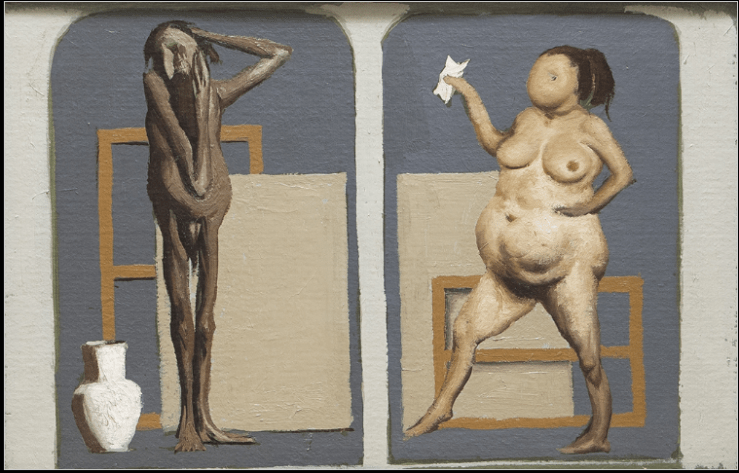
In the Artist’s Studio — Gely Korzhev

Screenshot 2017-03-13 at 4.02.25 PM

Read a previously-unpublished F.Scott Fitzgerald story at The New Yorker

The New Yorker has published “The I.O.U.,” an F. Scott Fitzgerald short story from 1920 that hasn’t been published until now.

First two paragraphs:

The above is not my real name—the fellow it belongs to gave me his permission to sign it to this story. My real name I shall not divulge. I am a publisher. I accept long novels about young love written by old maids in South Dakota, detective stories concerning wealthy clubmen and female apaches with “wide dark eyes,” essays about the menace of this and that and the color of the moon in Tahiti by college professors and other unemployed. I accept no novels by authors under fifteen years old. All the columnists and communists (I can never get these two words straight) abuse me because they say I want money. I do—I want it terribly. My wife needs it. My children use it all the time. If someone offered me all the money in New York I should not refuse it. I would rather bring out a book that had an advance sale of five hundred thousand copies than have discovered Samuel Butler, Theodore Dreiser, and James Branch Cabell in one year. So would you if you were a publisher.

Six months ago I contracted for a book that was undoubtedly a sure thing. It was by Harden, the psychic-research man—Dr. Harden. His first book—I published it in 1913—had taken hold like a Long Island sand crab and at that time psychic research had nowhere near the vogue it has at present. We advertised his new one as being a fifty-heart-power document. His nephew had been killed in the war and Dr. Harden had written with distinction and reticence an account of his psychic communion through various mediums with this nephew, Cosgrove Harden.

Read the rest of Fitzgerald’s “The I.O.U.”

Sunday Comics (A riff on FX’s show Legion)

I had no interest in watching the Legion television show.

Bill Sienkiewicz is my favorite comic book artist of all time.

I like Sienkiewicz so much I can spell his last name correctly without looking it up. I like Sienkiewicz so much that he was the first artist I featured when I first started this silly Sunday Comics thing last year.

Sienkiewicz, along with Chris Claremont, created the character of David Haller (“Legion,” Professor X’s son). David first appeared in the last page of The New Mutants #25, Marvel Comics, March, 1985. (The issue is about the underrated duo Cloak & Dagger).

The New Mutants was/is my favorite childhood comic book. (By which I mean: Sienkiewicz’s run on The New Mutants was/is my favorite childhood comic book).

Here’s David’s début:
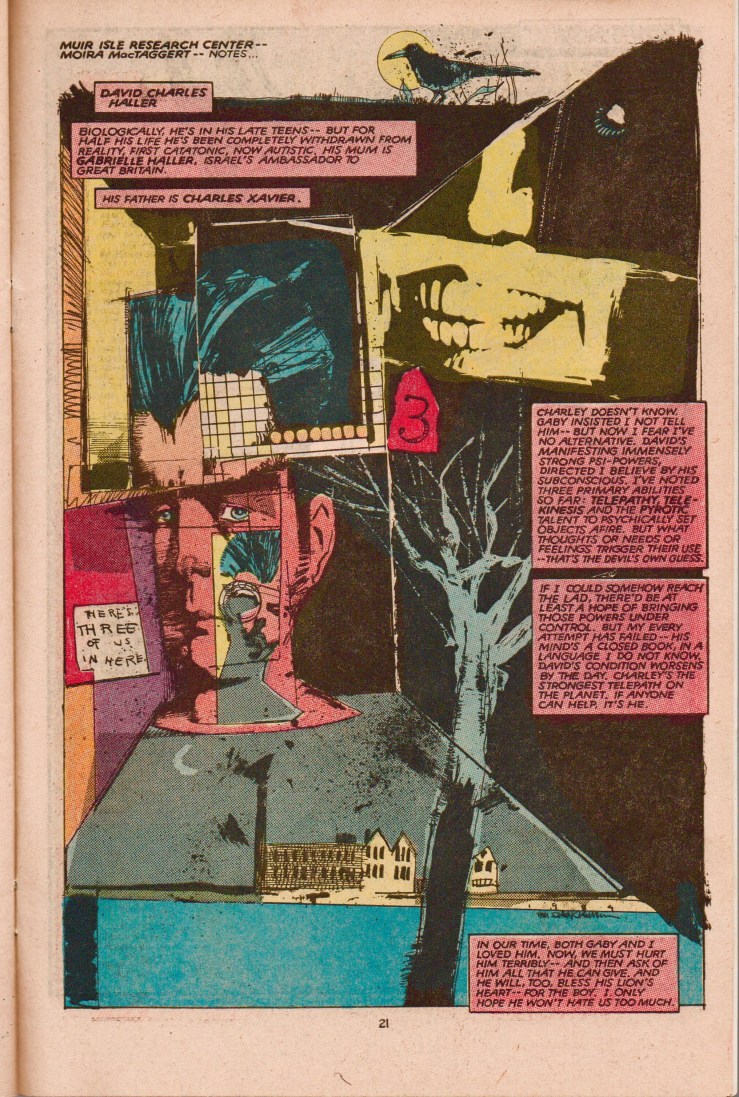
The next three issues of The New Mutants (27-29) tell the Legion story line.

I recall liking the Legion story of The New Mutants, although it never stood out as strongly as The Demon Bear Saga, or the issues where Magneto took over The New Mutants’ leadership. But that isn’t why I had no interest in watching the Legion television show.

I had no interest in watching the Legion television show because every single Marvel television show that I’ve seen so far has been boring, or garbage, or boring garbage. And don’t even get me started on the execrable X-Men films, which have squandered so many good storylines. (Although I thought Deadpool was great, which sort of counts as an X-Men film, and I do have an interest in seeing Logan).

Anyway, after a few critics and authors I admire tweeted that Legion was, like, actually really good/excellent/thrilling/etc., I looked up the show, and saw that the showrunner and creator is Noah Hawley. That’s the dude who did FX’s Fargo, another TV show I was also wary of which also turned out to be excellent.
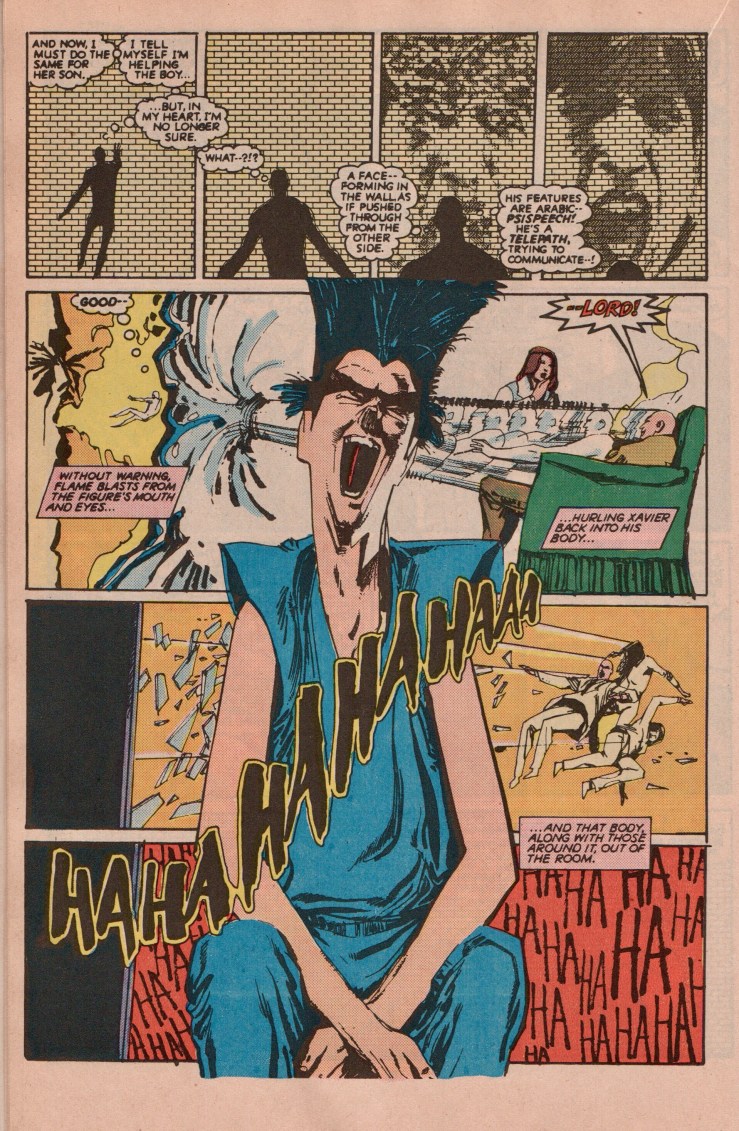
So, over the past four nights, I’ve watched the first four episodes of Legion. (I’ll watch the fifth tonight).

The show is fantastic.

It’s the first “superhero” show I’ve seen that succeeds not just in its script, casting, and themes, but aesthetically as well. Hawley smuggles in references to the original New Mutants run in a way that doesn’t feel like fanservice—but the other reference points here go past comic books and into film: Legion openly steals from Charlie Kaufman, Michel Gondry, Alfonso Cuaron, and Wes Anderson. (I mean this as a compliment). Hell, there’s something Pynchonesque about the show too, in its themes of paranoia, its treatment of the concept of reality, its streak of dark but somehow zany humor, and its subversive sexiness.

The casting for Legion is pretty great too. The guy who played the guy who died in the car crash on Downton Abbey so he could leave that show and get better shows does an admirable job as David. The temptation would be to play David as batshit crazy, but the portrayal is measured, often archly comical, and ultimately sympathetic. (Shit, I just looked that guy’s name up—I saw him on a web episode of High Maintenance as a stay-at-home dad who enjoyed wearing women’s clothes and thought he was great, but also thought, Damn, hope Matthew Crawley can get some higher-profile gigs—anyway, that dude, Dan Stevens, is in that new Disney live action Beauty and the Beast film with Hermione Hogwarts, so I guess he’s doing fine).

Where was I? Oh, casting—yeah, there are solid performances here. Aubrey Plaza plays a dead junkie who may or may not be a ghost in David’s head. Jean Smart (aka my least favorite Designing Woman) plays the not-Moira MacTaggart/not-Prof. X character Melanie Bird. Smart was smart in the second season of Hawley’s other FX show, Fargo, which also featured Rachel Keller, who is basically the second lead on Legion as Sydney Barrett (not subtle, I know), David’s untouchable girlfriend. And the show basically had me when Bill Irwin showed up. Like I said, it’s great stuff.

Probably my favorite thing about the show so far though is that it doesn’t seem particularly interested in being anyone’s franchise. It stays true to the paranoid spirit of mid-eighties Claremont X-Men, and seamlessly combines plot and aesthetics in a way that a show about a telepathic and telekinetic mutant would have to to succeed. It’s also dark without being self-serious or self-important. (So many superhero films and shows fail utterly here).

Anyway, I’ve loved the first few episodes, and even if the showrunners fuck it all up, hey, it’s just TV, right?

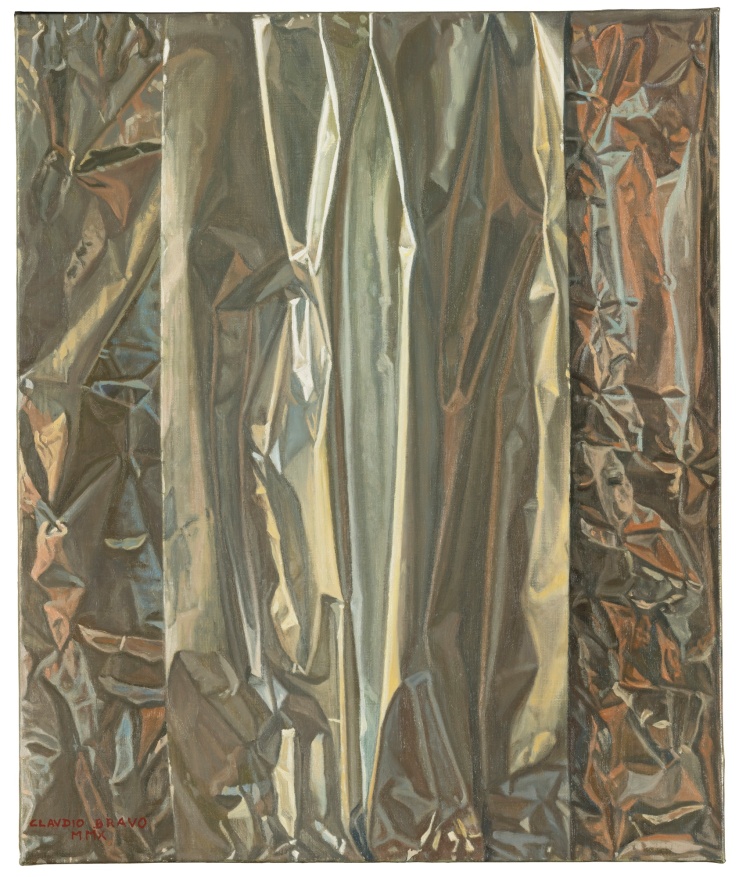
Silver Paper — Claudio Bravo

174N09152_79HBT

Untitled — Richard Müller

rm087g

The Pilgrim — Gwen John

the-pilgrim

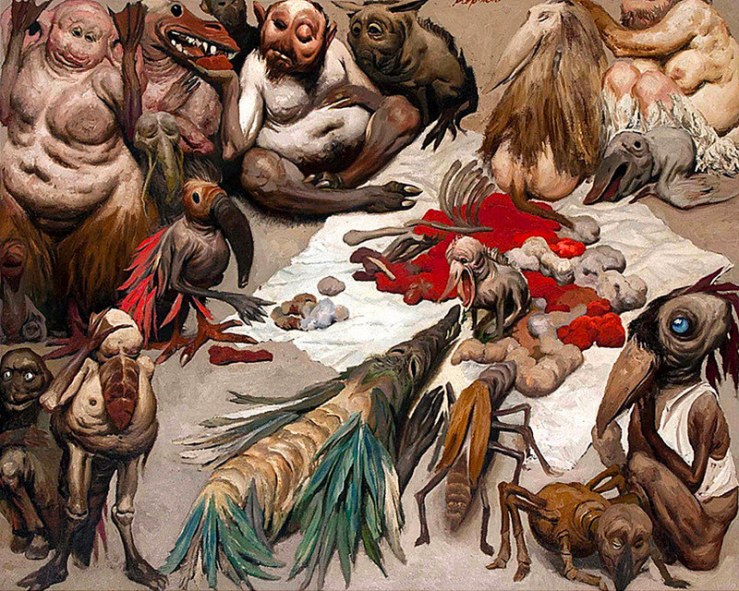
Feast — Gely Korzhev

feast

Roberto Bolaño’s Recipe for Brussels Sprouts with Lemon

In Roberto Bolaño’s sprawling opus 2666 (specifically, in “The Part About Fate”), founding member of the Black Panthers/cookbook author Barry Seaman offers the following recipe during a lecture at a Detroit church–

The name of the recipe is: Brussels Sprouts with Lemon. Take note, please. Four servings calls for: two pounds of brussels sprouts, juice and zest of one lemon, one onion, one sprig of parsley, three tablespoons of butter, black pepper, and salt. You make it like so. One: Clean sprouts well and remove outer leaves. Finely chop onion and parsley. Two: In a pot of salted boiling water, cook sprouts for twenty minutes, or until tender. Then drain well and set aside. Three: Melt butter in frying pan and lightly sauté onion, add zest and juice of lemon and salt and pepper to taste. Four: Add brussels sprouts, toss with sauce, reheat for a few minutes, sprinkle with parsley, and serve with lemon wedges on the side. So good you’ll be licking your fingers, said Seaman. No cholesterol, good for the liver, good for the blood pressure, very healthy.

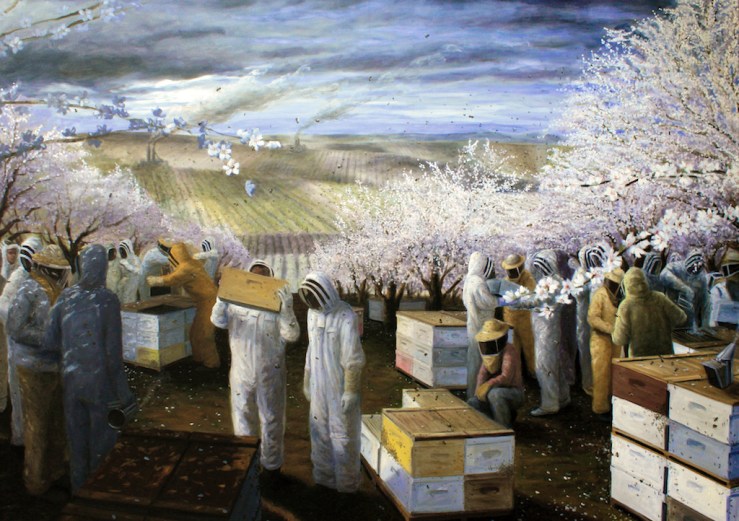
Monoculture Pollination — David Pettibone

835441683a4be2bd-05_David_Pettibone

I say madness is too pure like mother sky