Gravity’s Rainbow — annotations and illustrations for page 539 | There is a terrible possibility now, in the World

1 think that there is a terrible possibility now, in the World 2. We may not brush it away, we must look at it. It is possible that They 3 will not die. That it is now within the state of Their art to go on forever 4—though we, of course, will keep dying as we always have. Death 5 has been the source of Their power. It was easy enough for us to see that. If we are here once, only once 6, then clearly we are here to take what we can while we may 7. If They have taken much more, and taken not only from Earth but also from us 8 —well, why begrudge Them, when they’re just as doomed to die as we are? All in the same boat, all under the same shadow…yes…yes. But is that really true? Or is it the best, and the most carefully propagated, of all Their lies, known and unknown? 9

The speaker here is Father Rapier, a very minor character, one of Pynchon’s heroes of the Counterforce, the Preterite who rally (if that is the right verb, which it isn’t) around the unraveling spirit of Slothrop against the Elect.

Father Rapier is “a Jesuit . . . here to preach, like his colleague Teilhard de Chardin, against return. Here to say that critical mass cannot be ignored. Once the technical means of control have reached a certain size, a certain degree of being connected one to another, the chances for freedom are over for good.”

Rapier preaches his “Critical Mass” in a cottage in the bizarro-Limbo headquarters of the Counterforce; his shack is appropriately beshingled with the sign “DEVIL’S ADVOCATE.”

Pynchon’s Counterforce points to a coming community. Indeed, Gravity’s Rainbow might be seen as an imaginative study of postwar communities, of new forms of social organization (social organizations tellingly organized against the They): The Counterforce of disaffected rebels; the Sudwest Hereros assembling their 00001 rocket; the Argentine anarchists; the homosexuals liberated from Dora; the Anubis orgiasts (orgiers? orgy-goers? What’s the word for orgy participants?)—etc. Each of these coming communities attempts to synthesize the detritus of the War into Something New. And speaking of synthesis—

Rapier’s “colleague [Pierre] Teilhard de Chardin” (1881-1955) tried to synthesize science and spirituality in what he called an Omega Point, a spiritual/physical singularity, a condensation of spirit and mass into a “supreme consciousness”: Christ: God: Logos. Or, in Pynchon’s Rapier wit: Critical Mass.

Rapier rails against systems of control: The Elect will not fight the coming postWar Preterite communities directly, but rather enslave them via byzantine bureaucracies.

img_4346
The World tarot card by Pamela Colman Smith, 1909

Cf. A.E. Waite’s The Pictorial Key to Tarot (1910), one of Pynchon’s sources for Gravity’s Rainbow. Some of the language here (which I’ve taken the liberty of highlighting) echoes Rapier’s Critical Mass/de Chardin’s Omega Point:

It represents also the perfection and end of the Cosmos, the secret which is within it, the rapture of the universe when it understands itself in God. It is further the state of the soul in the consciousness of Divine Vision, reflected from the self-knowing spirit. But these meanings are without prejudice to that which I have said concerning it on the material side. It has more than one message on the macrocosmic side and is, for example, the state of the restored world when the law of manifestation shall have been carried to the highest degree of natural perfection. But it is perhaps more especially a story of the past, referring to that day when all was declared to be good, when the morning stars sang together and all the Sons of God shouted for joy.

The World is what Pynchon and Gravity’s Rainbow are most interested in—both its past and its coming communities.

Significantly, The World is the final card in Captain Dominus Blicero Weissmann’s tarot (see page 746):

Weissmann's tarot
Weissmann’s tarot

In his thorough physical description of the World tarot card, A.E. Waite describes the central figure surrounded by “an elliptic garland…a chain of flowers intended to symbolize all sensible things.” I cannot help but see in the card an impossible ouroboros; an ouroboros with four heads corresponding to the “four living creatures of the Apocalypse and Ezekiel’s vision, attributed to the evangelists in Christian symbolism” which we find in the card’s corners. The ouroboros is minor trope in Gravity’s Rainbow.

The Elect. The baddies.

Rapier will, a few lines later, compare Them to vampires.

Here—and elsewhere in Pynchon (most clearly and perhaps most cogently in Against the Day)—the Elect—the They—manipulate and monopolize the earth’s resources in order to prolong their dominance. Those resources include humans: The Preterite: the low: the feebs.

5  
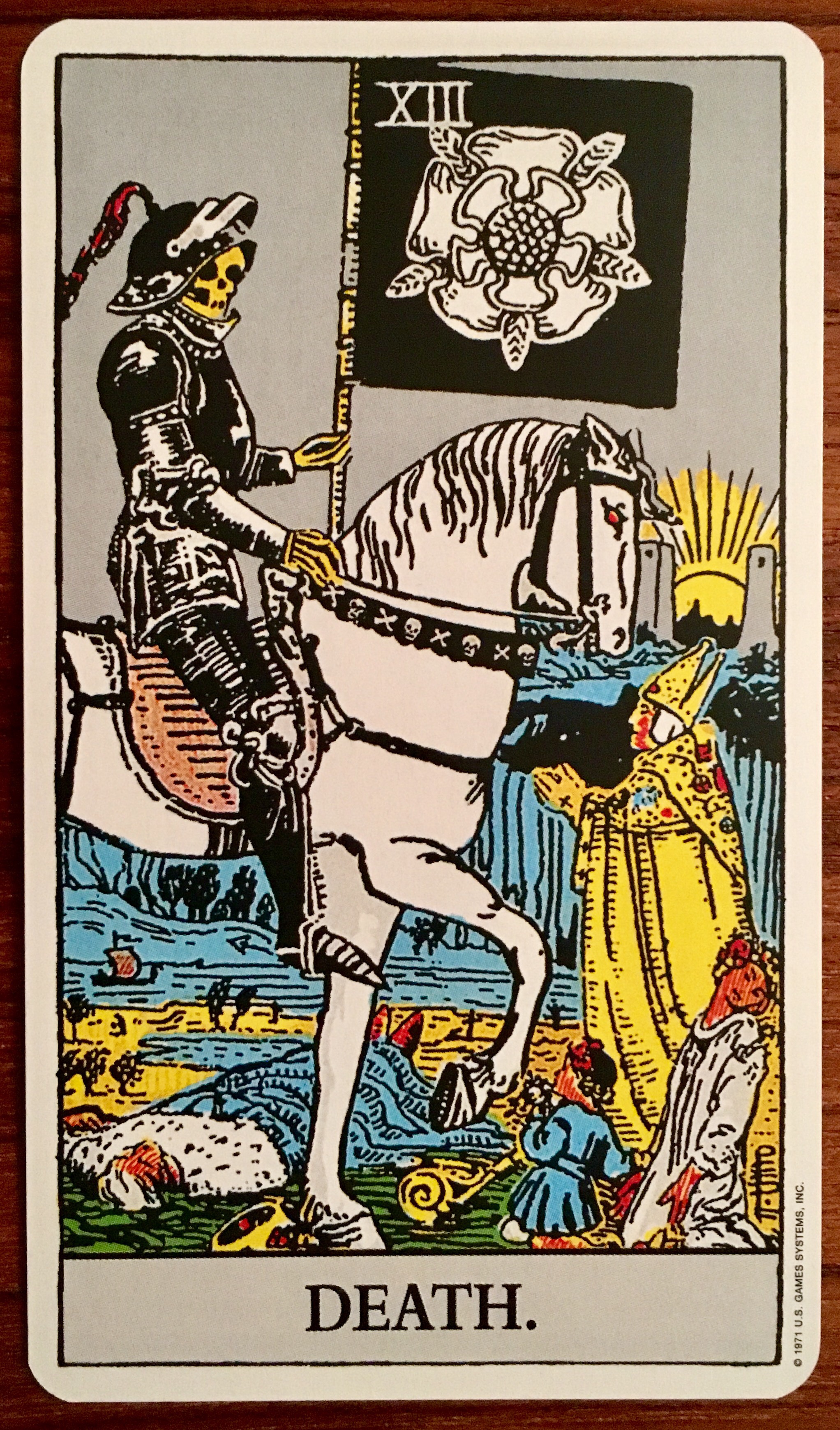
Death tarot card by Pamela Colman Smith, 1909

A.E. Waite again; again, I’ve highlighted in boldface phrases that suit my own purposes for this riff:

The veil or mask of life is perpetuated in change, transformation and passage from lower to higher, and this is more fitly represented in the rectified Tarot by one of the apocalyptic visions than by the crude notion of the reaping skeleton. Behind it lies the whole world of ascent in the spirit. The mysterious horseman moves slowly, bearing a black banner emblazoned with the Mystic Rose, which signifies life. Between two pillars on the verge of the horizon there shines the sun of immortality. The horseman carries no visible weapon, but king and child and maiden fall before him, while a prelate with clasped hands awaits his end. … The natural transit of man to the next stage of his being either is or may be one form of his progress, but the exotic and almost unknown entrance, while still in this life, into the state of mystical death is a change in the form of consciousness and the passage into a state to which ordinary death is neither the path nor gate. The existing occult explanations of the 13th card are, on the whole, better than usual, rebirth, creation, destination, renewal, and the rest.

If we are here once (only once), then eternal recurrence is a nonstarter.

The phrase clearly echoes lines from one of Pynchon’s major GR sources, Rainer Maria Rilke’s mystical Duino Elegies (1923). From “Ninth Elegy”:

Everyone once, once only. Just once and no more.
And we also once, Never again. But this having been
once, although only once, to have been of the earth,
seems irrevocable.

Pynchon’s phrasing also echoes William Bright’s 1866 hymn, “Once, Only Once, and Once for All,” which begins:

Once, only once, and once for all,
his precious life he gave;
before the cross in faith we fall,
and own it strong to save.

In “To the Virgins, to Make Much of Time, Robert Herrick (1591-1674) advised

Gather ye rosebuds while ye may,
Old Time is still a-flying;
And this same flower that smiles today
Tomorrow will be dying.

Seems like a Preterite Sermon.

Cf. note 4. Throughout GR, the exploitation of the earth’s natural resources is a persistent if minor theme. Gravity’s Rainbow’s ecological critiques are overlooked perhaps because it’s a given in Pynchon’s critique that They would use ecological capital and human capital without regard. Consider the Slothrop family, which made its non-fortune by milling trees into “Money, shit, and The Word” — papers the real value of which Pynchon invites us to interrogate.

Pynchon’s mouthpieces often hedge their bets in eithers and ors, zeroes and ones. We systems and They systems, in the parlance of the Counterforce. Are we all under the same shadow (of Death? of the falling rocket?) Are we all in the same boat?—which is to say, are we all working together toward the same coming community—are we rowing in the same direction?

Oh I think you know the answer.

Food, a surreal short film by Jan Švankmajer

Allegory of Desire from the Fourth Freedom — Marc Dennis

marc-dennis-allegory-of-desire-from-the-fourth-freedom_2014_oil-on-linen_44x52inches

That morning, the city was celebrating Consumer Thanksgiving Day (Italo Calvino)

A few paragraphs from Italo Calvino’s 1968 story “The Daughters of the Moon”:

That morning, the city was celebrating Consumer Thanksgiving Day. This feast came around every year, on a day in November, and had been set up to allow shoppers to display their gratitude toward the god Production, who tirelessly satisfied their every desire. The biggest department store in town organized a parade every year: an enormous balloon in the shape of a garishly colored doll was paraded through the main streets, pulled by ribbons that sequin-clad girls held as they marched behind a musical band. That day, the procession was coming down Fifth Avenue: the majorette twirled her baton in the air, the big drums banged, and the balloon giant, representing the Satisfied Customer, flew among the skyscrapers, obediently advancing on leashes held by girls in kepis, tassels, and fringed epaulets, riding spangly motorcycles.

At the same time, another parade was crossing Manhattan. The flaky, moldy moon was also advancing, sailing between the skyscrapers, pulled by the naked girls, and behind it came a line of beat-up cars and skeletons of trucks, amid a silent crowd that was gradually increasing in size. Thousands of people joined the throng that had been following the moon since the early hours of the morning, people of all colors, whole families with children of every age, especially as the procession filed past the crowded black and Puerto Rican areas of Harlem.

The lunar procession zigzagged around uptown, then started down Broadway, and came quickly and silently to converge with the other procession, which was dragging its balloon giant along Fifth Avenue.

At Madison Square, one procession met the other; or, more precisely, the two became a single procession. The Satisfied Customer, perhaps owing to a collision with the moon’s jagged surface, deflated into a rubber rag. On the motorcycles now were the Dianas, pulling the moon with multicolored ribbons; or, rather, since the number of naked women had at least doubled, the female motorcyclists must have thrown away their uniforms and kepis. A similar transformation had overtaken the motorcycles and the cars in the parade. You could no longer tell which were the old cars and which were the new: the twisted wheels, the rusty fenders were mixed together with bodywork as shiny as a mirror and paint that gleamed like enamel.

Read “The Daughters of the Moon” in full at The New Yorker (translation by Martin McLaughlin) (or have novelist Robert Coover read it to you, also via The New Yorker).

Happy Thanksgiving! Here’s a bunch of literary recipes and a painting

Merry Family, Jan Steen, 1688

F. Scott Fitzgerald’s Turkey Twelve Ways

Gordon Lish’s Chicken Soup

Zora Neale Hurston’s Mulatto Rice

Roberto Bolaño’s Brussels Sprouts with Lemon

Ian McEwan’s Fish Stew

James Joyce’s Burnt Kidney Breakfast

Herman Melville’s Whale Steaks

Ernest Hemingway’s Absinthe Cocktail, Death in the Afternoon

Vladimir Nabokov’s Eggs à la Nabocoque

Thomas Pynchon’s Banana Breakfast

Cormac McCarthy’s Turtle Soup

Robert Crumb’s Macaroni Casserole

Truman Capote’s Caviar-Smothered Baked Potatoes with 80-Proof Russian Vodka

Emily Dickinson’s Cocoanut Cake

Thomas Jefferson’s Vanilla Ice Cream

Charles Dickens’s Own Punch

Ben Jonson’s Egg Wine

Willam Faulkner’s Hot Toddy

Christmas Bonus:  George Orwell’s Recipes for Plum Cake and Christmas Pudding

Unexpected View — Remedios Varo

Read “John Inglefield’s Thanksgiving,” a short story by Nathaniel Hawthorne

“John Inglefield’s Thanksgiving”

by

Nathaniel Hawthorne


On the evening of Thanksgiving day, John Inglefield, the blacksmith, sat in his elbow-chair, among those who had been keeping festival at his board. Being the central figure of the domestic circle, the fire threw its strongest light on his massive and sturdy frame, reddening his rough visage, so that it looked like the head of an iron statue, all aglow, from his own forge, and with its features rudely fashioned on his own anvil. At John Inglefield’s right hand was an empty chair. The other places round the hearth were filled by the members of the family, who all sat quietly, while, with a semblance of fantastic merriment, their shadows danced on the wall behind then. One of the group was John Inglefield’s son, who had been bred at college, and was now a student of theology at Andover. There was also a daughter of sixteen, whom nobody could look at without thinking of a rosebud almost blossomed. The only other person at the fireside was Robert Moore, formerly an apprentice of the blacksmith, but now his journeyman, and who seemed more like an own son of John Inglefield than did the pale and slender student.

Only these four had kept New England’s festival beneath that roof. The vacant chair at John Inglefield’s right hand was in memory of his wife, whom death had snatched from him since the previous Thanksgiving. With a feeling that few would have looked for in his rough nature, the bereaved husband had himself set the chair in its place next his own; and often did his eye glance thitherward, as if he deemed it possible that the cold grave might send back its tenant to the cheerful fireside, at least for that one evening. Thus did he cherish the grief that was dear to him. But there was another grief which he would fain have torn from his heart; or, since that could never be, have buried it too deep for others to behold, or for his own remembrance. Within the past year another member of his household had gone from him, but not to the grave. Yet they kept no vacant chair for her.

While John Inglefield and his family were sitting round the hearth with the shadows dancing behind them on the wall, the outer door was opened, and a light footstep came along the passage. The latch of the inner door was lifted by some familiar hand, and a young girl came in, wearing a cloak and hood, which she took off, and laid on the table beneath the looking-glass. Then, after gazing a moment at the fireside circle, she approached, and took the seat at John Inglefield’s right hand, as if it had been reserved on purpose for her. Continue reading “Read “John Inglefield’s Thanksgiving,” a short story by Nathaniel Hawthorne”

Four Strings of the Violin — Edward Okuń

The Train — Leonor Fini

I bought this for the cover (Book acquired, 11.22.2016)

I was looking for something else today—a book that might have been one of Pynchon’s sources for the Kabbalah stuff in Gravity’s Rainbow—when I came across this Penguin edition, Witchcraft and Sorcery, 1970, ed. Max Marwick. (I found a Pynchonian connection—easy to do, I know—when I opened the book to an essay entitled “Witchcraft amongst the Germanic and Slavonic Peoples”).

Alla Tha’s All Right, but – June Jordan

june-jordan

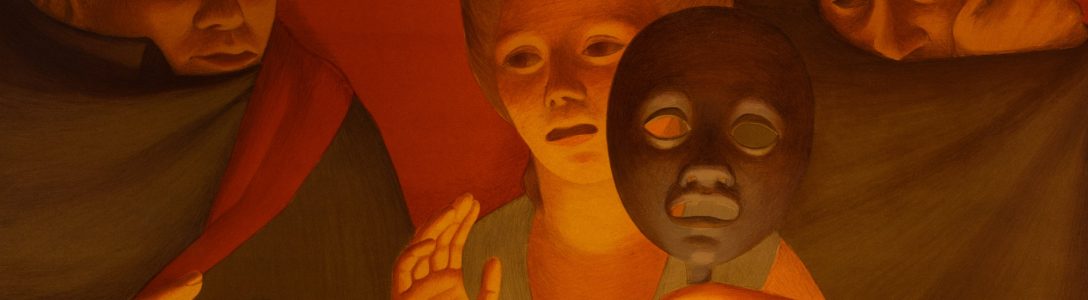
Untitled (Death Mask) — Arnulf Rainer

A U.S.A. that would die for the so-called perfect Entertainment (Infinite Jest)


The sky of U.S.A.’s desert was clotted with blue stars. Now it was deep at night. Only above the U.S.A. city was the sky blank of stars; its color was pearly and blank. Marathe shrugged. ‘Perhaps in you is the sense that citizens of Canada are not involved in the real root of the threat.’

Steeply shook the head in seeming annoyance. ‘What’s that supposed to mean?’ he said. The lurid wig of him slipped when he moved the head with any abrupt force.

The first way Marathe betrayed anything of emotion was to smooth rather too fussily at the blanket on his lap. ‘It is meaning that it will not of finality be Québecers making this kick to l’aine des Etats Unis. Look: the facts of the situation speak loudly. What is known. This is a U.S.A. production, this Entertainment cartridge. Made by an American man in the U.S.A. The appetite for the appeal of it: this also is U.S.A. The U.S.A. drive for spectation, which your culture teaches. This I was saying: this is why choosing is everything. When I say to you choose with great care in loving and you make ridicule it is why I look and say: can I believe this man is saying this thing of ridicule?’ Marathe leaned slightly forward on his stumps, leaving the machine pistol to use both his hands in saying. Steeply could tell this was important to Marathe; he really believed it.

Marathe made small emphatic circles and cuts in the air while he spoke: ‘These facts of situation, which speak so loudly of your Bureau’s fear of this samizdat: now is what has happened when a people choose nothing over themselves to love, each one. A U.S.A. that would die — and let its children die, each one — for the so-called perfect Entertainment, this film. Who would die for this chance to be fed this death of pleasure with spoons, in their warm homes, alone, unmoving: Hugh Steeply, in complete seriousness as a citizen of your neighbor I say to you: forget for a moment the Entertainment, and think instead about a U.S.A. where such a thing could be possible enough for your Office to fear: can such a U.S.A. hope to survive for a much longer time? To survive as a nation of peoples? To much less exercise dominion over other nations of other peoples? If these are other peoples who still know what it is to choose? who will die for something larger? who will sacrifice the warm home, the loved woman at home, their legs, their life even, for something more than their own wishes of sentiment? who would choose not to die for pleasure, alone?’

From David Foster Wallace’s novel Infinite Jest.


Read “The Hanging of the Schoolmarm,” new fiction from Robert Coover

Robert Coover’s short story “The Hanging of the Schoolmarm” is new in this week’s New Yorker. It’s of a piece with the last Coover story The New Yorker published, “Invasion of the Martians.”

Here are the first few paragraphs of “The Hanging of the Schoolmarm”:

The schoolmarm is playing poker in the town saloon. The stake is the saloon itself. As she is preparing to deal the cards, one of the men demands that she cut the fuckin’ deck, and she shoots him from her lap. “Sorry, but I simply cannot allow . . .”

The others tip their crumpled hats. “No, ma’am, you just go ahead and deal.”

The men of the town find the schoolmarm difficult but are awed by her refined and lofty character, and generally do what she tells them to do. The sheriff likes to say that she’s as pure as the spotless lily of the lake, though they have no lake, and there are no lilies in it. No damn lilies. The men cuss a lot—in fact, all the time—but never around the schoolmarm. Cussing doesn’t go together with the schoolmarm. It’s like salting your coffee, to put it politely.

After winning the saloon in the poker hand, the schoolmarm has the deceased removed and turns the card tables into school desks. The bar becomes an altar on Sundays, but there’s no preacher, so the schoolmarm provides temperance lectures from it, which the men are obliged to attend. In their minds, it’s still the old bar, the old saloon, so they carry along hip flasks and beef jerky to ease themselves through the unholy tedium, belching and snorting noisily.

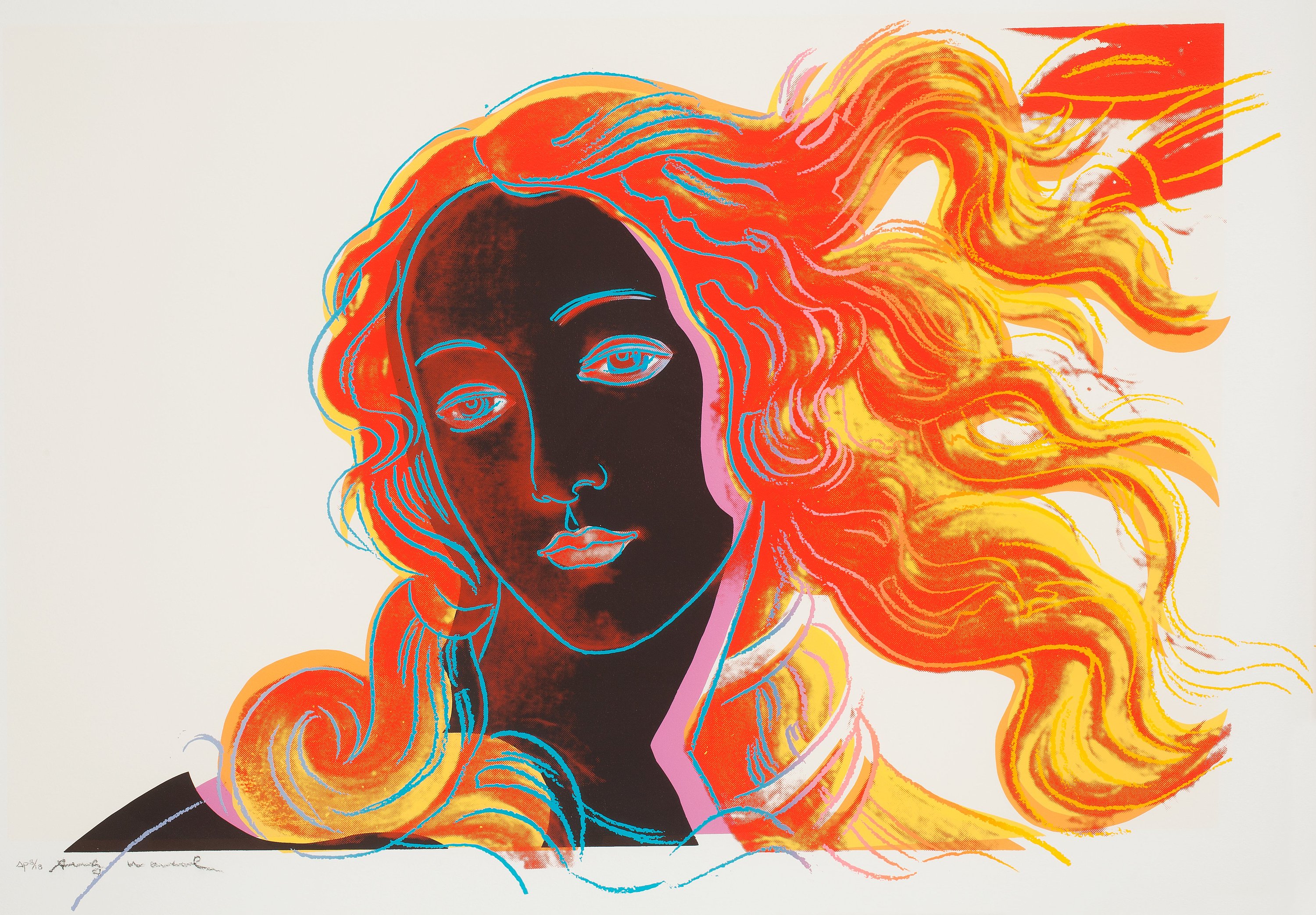
Venus (detail) — Andy Warhol

venus

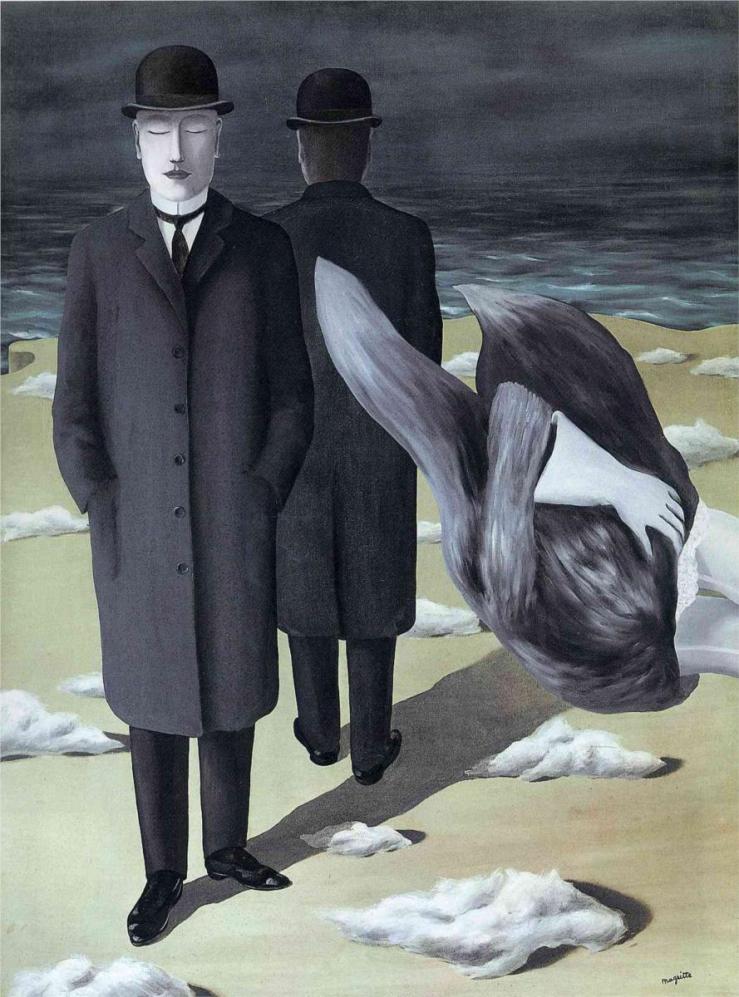
The Meaning of Night — Rene Magritte

6a3ca69f23dc4d81057c7d162a2339aa

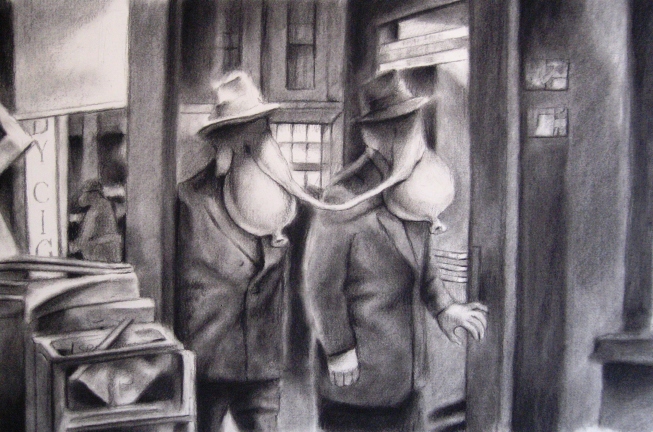
What Else Have You Got Left — Samuel Branton

np5