“Dante and the Lobster,” a short story by Samuel Beckett

“Dante and the Lobster”

by

Samuel Beckett


It was morning and Belacqua was stuck in the first of the canti in the moon. He was so bogged that he could move neither backward nor forward. Blissful Beatrice was there, Dante also, and she explained the spots on the moon to him. She shewed him in the first place where he was at fault, then she put up her own explanation. She had it from God, therefore he could rely on its being accurate in every particular. All he had to do was to follow her step by step. Part one, the refutation, was plain sailing. She made her point clearly, she said what she had to say without fuss or loss of time. But part two, the demonstration, was so dense that Belacqua could not make head or tail of it. The disproof, the reproof, that was patent. But then came the proof, a rapid shorthand of the real facts, and Belacqua was bogged indeed. Bored also, impatient to get on to Piccarda. Still he pored over the enigma, he would not concede himself conquered, he would understand at least the meanings of the words, the order in which they were spoken and the nature of the satisfaction that they conferred on the misinformed poet, so that when they were ended he was refreshed and could raise his heavy head, intending to return thanks and make formal retraction of his old opinion.

He was still running his brain against this impenetrable passage when he heard midday strike. At once he switched his mind off its task. He scooped his fingers under the book and shovelled it back till it lay wholly on his palms. The Divine Comedy face upward on the lectern of his palms. Thus disposed he raised it under his nose and there he slammed it shut. He held it aloft for a time, squinting at it angrily, pressing the boards inwards with the heels of his hands. Then he laid it aside.

He leaned back in his chair to feel his mind subside and the itch of this mean quodlibet die down. Nothing could be done until his mind got better and was still, which gradually it did and was. Then he ventured to consider what he had to do next. There was always something that one had to do next. Three large obligations presented themselves. First lunch, then the lobster, then the Italian lesson. That would do to be going on with. After the Italian lesson he had no very clear idea. No doubt some niggling curriculum had been drawn up by someone for the late afternoon and evening, but he did not know what. In any case it did not matter. What did matter was: one, lunch; two, the lobster; three, the Italian lesson. That was more than enough to be going on with. Continue reading ““Dante and the Lobster,” a short story by Samuel Beckett”
Netherlandish Proverbs (detail) — Pieter Bruegel the Elder

Screenshot 2016-06-26 at 10.57.18 AM

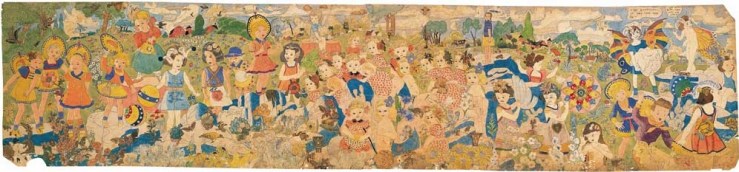
We Will Slam Them with Our Wings — Henry Darger

darger-8

It was September now (Cormac McCarthy’s Suttree)

It was September now, a season of rains. The gray sky above the city washed with darker scud like ink curling in a squid’s wake. The blacks can see the boy’s fire at night and glimpses of his veering silhouette slotted in the high nave, outsized among the arches. All night a ruby glow suffuses the underbridge from his garish chancel lamps. The city’s bridges all betrolled now what with old ventriloquists and young melonfanciers. The smoke from their fires issues up unseen among the soot and dust of the city’s right commerce.

Sometimes in the evening Suttree would bring beers and they’d sit there under the viaduct and drink them. Harrogate with questions of city life.

You ever get so drunk you kissed a nigger?

Suttree looked at him. Harrogate with one eye narrowed on him to tell the truth. I’ve been a whole lot drunker than that, he said.

Worst thing I ever done was to burn down old lady Arwood’s house.”

“You burned down an old lady’s house?

Like to of burnt her down in it. I was put up to it. I wasnt but ten year old.

Not old enough to know what you were doing.

Yeah.–Hell no that’s a lie. I knowed it and done it anyways.

Did it burn completely down?

Plumb to the ground. Left the chimbley standin was all. It burnt for a long time fore she come out.

Did you not know she was in there?

I disremember. I dont know what I was thinkin. She come out and run to the well and drawed a bucket of water and thowed it at the side of the house and then just walked on off towards the road. I never got such a whippin in my life. The old man like to of killed me.

Your daddy?

Yeah. He was alive then. My sister told them deputies when they come out to the house, they come out there to tell her I was in the hospital over them watermelons, she told em I didnt have no daddy was how come I got in trouble. But shit fire I was mean when I did have one. It didnt make no difference.

Were you sorry about it? The old lady’s house I mean.

Sorry I got caught.

Suttree nodded and tilted his beer. It occurred to him that other than the melon caper he’d never heard the city rat tell anything but naked truth.

Another vignette from Cormac McCarthy’s Suttree—a transition scene perhaps, but one that draws Suttree and Harrogate closer, even as it underlines their differences.

In my review of Suttree a few years back, I argued that the novel is a grand synthesis of American literature, brimming with literary allusions. I singled out Faulkner’s “A Rose for Emily” as the basis for a later scene with Harrogate, so I can’t help but think of Faulkner’s “Barn Burning” here.

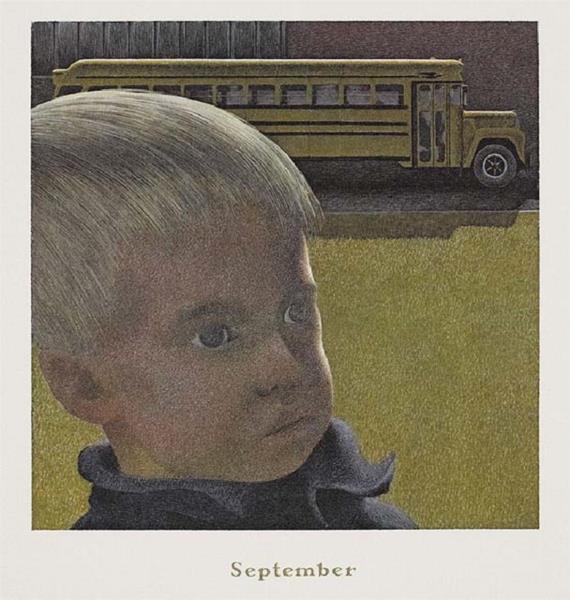
September — Alex Colville

september-1979large

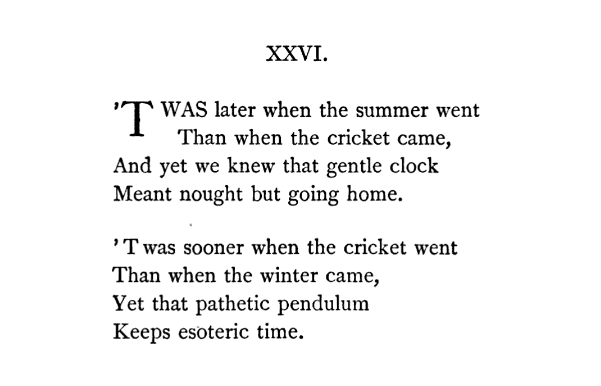
Esoteric time (Emily Dickinson)

Screenshot 2016-08-31 at 8.54.14 PM

A Gray Day — Robert Spencer

a-gray-day-1912

The Lantern Bearers — Maxfield Parrish

untitled-25

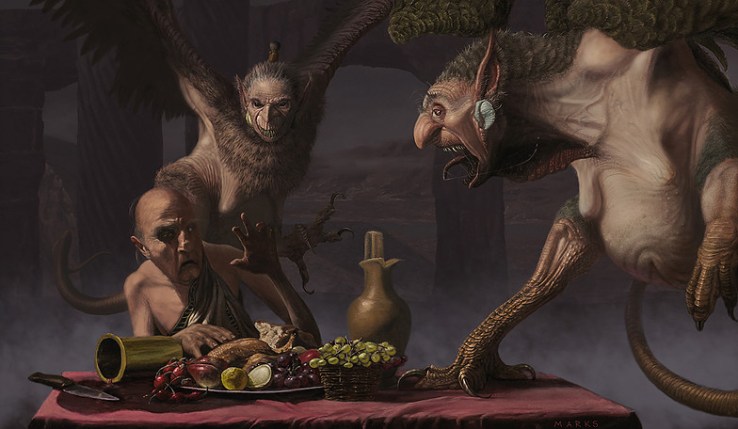
Phineus Tormented by the Harpies — Russell Marks

b0a99d_25e7f3f482734a7590b3a27204196669

All gloom is but a dream and a shadow (Nathaniel Hawthorne’s journal entry for Tuesday, August 30th, 1842)

Tuesday, August 30th.–I was promised, in the midst of Sunday’s rain, that Monday should be fair, and, behold! the sun came back to us, and brought one of the most perfect days ever made since Adam was driven out of Paradise. By the by, was there ever any rain in Paradise? If so, how comfortless must Eve’s bower have been! and what a wretched and rheumatic time must they have had on their bed of wet roses! It makes me shiver to think of it. Well, it seemed as if the world was newly created yesterday morning, and I beheld its birth; for I had risen before the sun was over the hill, and had gone forth to fish. How instantaneously did all dreariness and heaviness of the earth’s spirit flit away before one smile of the beneficent sun! This proves that all gloom is but a dream and a shadow, and that cheerfulness is the real truth. It requires many clouds,long brooding over us, to make us sad, but one gleam of sunshine always suffices to cheer up the landscape. The banks of the river actually laughed when the sunshine fell upon them; and the river itself was alive and cheerful, and, by way of fun and amusement, it had swept away many wreaths of meadow-hay, and old, rotten branches of trees, and all such trumpery. These matters came floating downwards, whirling round and round in the eddies, or hastening onward in the main current; and many of them, before this time, have probably been carried into the Merrimack, and will be borne onward to the sea. The spots where I stood to fish, on my preceding excursion, were now under water; and the tops of many of the bushes, along the river’s margin, barely emerged from the stream. Large spaces of meadow are overflowed.

There was a northwest-wind throughout the day; and as many clouds, the remnants of departed gloom, were scattered about the sky, the breeze was continually blowing them across the sun. For the most part, they were gone again in a moment; but sometimes the shadow remained long enough to make me dread a return of sulky weather. Then would come the burst of sunshine, making me feel as if a rainy day were henceforth an impossibility. . . .

In the afternoon Mr. Emerson called, bringing Mr. —-.

He is a good sort of humdrum parson enough, and well fitted to increase the stock of manuscript sermons, of which there must be a fearful quantity already in the world. Mr. —-, however, is probably one of the best and most useful of his class, because no suspicion of the necessity of his profession, constituted as it now is, to mankind, and of his own usefulness and success in it, has hitherto disturbed him; andtherefore, he labors with faith and confidence, as ministers did a hundred years ago.

After the visitors were gone, I sat at the gallery window, looking down the avenue; and soon there appeared an elderly woman,–a homely, decent old matron, dressed in a dark gown, and with what seemed a manuscript book under her arm. The wind sported with her gown, and blew her veil across her face, and seemed to make game of her, though on a nearer view she looked like a sad old creature, with a pale, thin countenance, and somewhat of a wild and wandering expression. She had a singular gait, reeling, as it were, and yet not quite reeling, from one side of the path to the other; going onward as if it were not much matter whether she went straight or crooked. Such were my observations as she approached through the scattered sunshine and shade of our long avenue, until, reaching the door, she gave a knock, and inquired for the lady of the house. Her manuscript contained a certificate, stating that the old woman was a widow from a foreign land, who had recently lost her son, and was now utterly destitute of friends and kindred, and without means of support. Appended to the certificate there was a list of names of people who had bestowed charity on her, with the amounts of the several donations,–none, as I recollect, higher than twenty-five cents. Here is a strange life, and a character fit for romance and poetry. All the early part of her life, I suppose, and much of her widowhood, were spent in the quiet of a home, with kinsfolk around her, and children, and the lifelong gossiping acquaintances that some women always create about them. But in her decline she has wandered away from all these, and from her native country itself, and is a vagrant, yet with something of the homeliness and decency of aspect belonging to one who has been a wife and mother, and has had a roof of her own above her head,–and, with all this, a wildness proper to her present life. I have a liking for vagrants of all sorts, and never, that I know of, refused my mite to a wandering beggar, when I had anything in my own pocket. There is so much wretchedness in the world, that we may safely take the word of any mortal professing to need our assistance; and, even should we be deceived, still the good to ourselves resulting from a kind act is worth more than the trifle by which we purchase it. It is desirable, I think, that such persons should be permitted to roam through our land of plenty, scattering the seeds of tenderness and charity, as birds of passage bear the seeds of precious plants from land to land, without even dreaming of the office which they perform.

Nathaniel Hawthorne’s journal entry for August 30th, 1842. From Passages from the American Note-Books.

would should could — Maira Kalman

wcs

From The Elements of Style by William Strunk and E.B. White. Illustrated by Maira Kalman. Penguin Press, 2005.

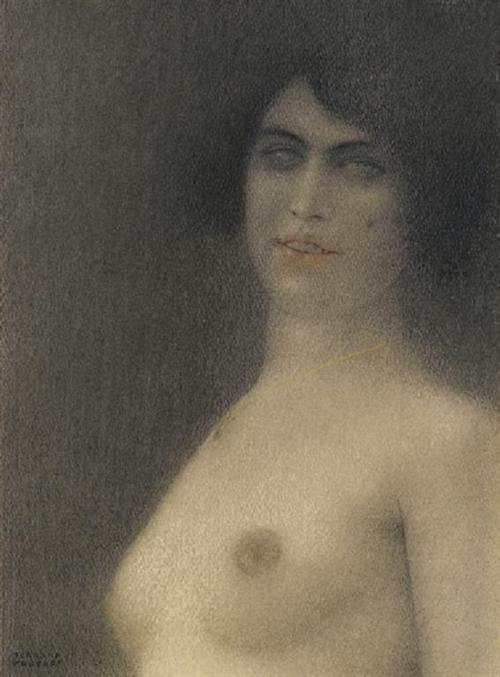
Nude with Dark Hair — Fernand Khnopff

nu-aux-cheveux-noirs-1922

The Twins — Boris Grigoriev

the-twins-1923

Gene Wilder at the 92nd Street Y in 2013


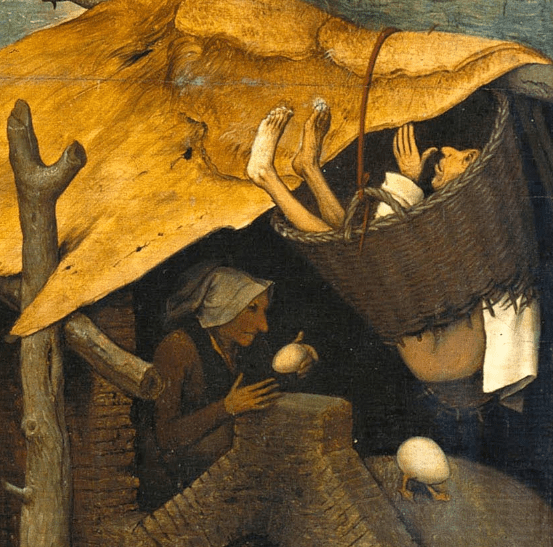
Netherlandish Proverbs (detail) — Pieter Bruegel the Elder

Screenshot 2016-06-26 at 12.24.16 PM

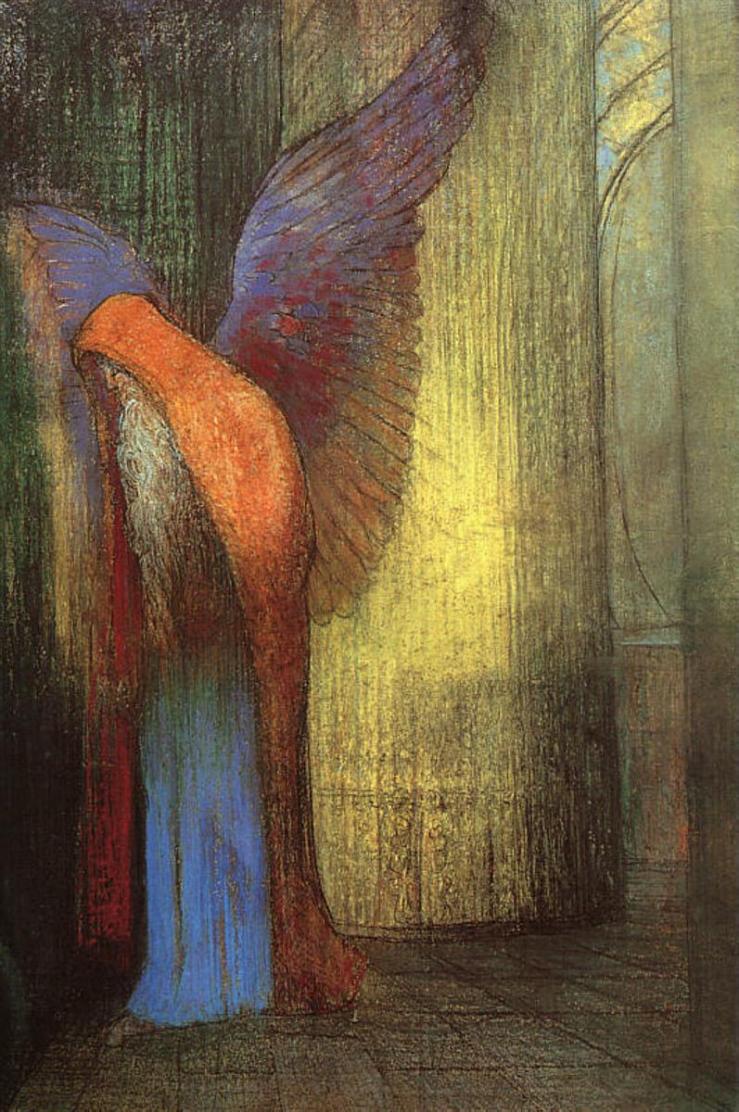
Winged Old Man with a Long White Beard — Odilon Redon

winged-old-man-with-a-long-white-beardhd

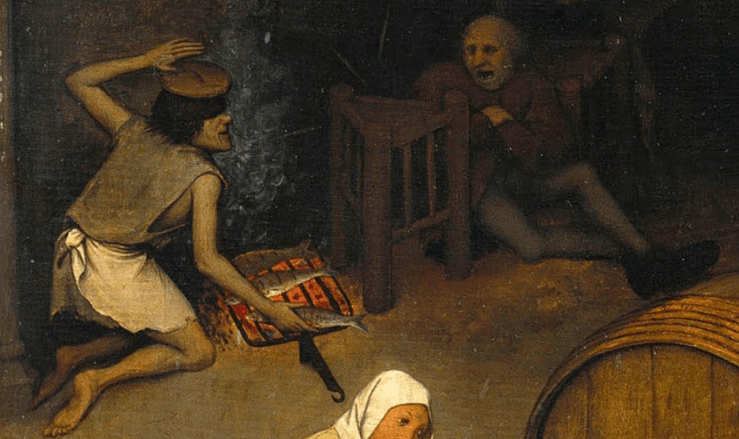
Netherlandish Proverbs (detail) — Pieter Bruegel the Elder

Screenshot 2016-06-26 at 12.21.30 PM