Wheat and Wormwood — Hilma af Klint

wheat-and-wormwood-1922halfhd

“God to Hungry Child” — Langston Hughes

god to hungry child

Crews/DeLillo/Gardner/Murdoch (Books acquired, 5.12.2016)

img_2315

The Sunbather — Ken Danby

sunbather-1972

List of writers mentioned in Gordon Lish’s Paris Review interview

A list of writers mentioned in Gordon Lish’s Winter 2015 (No. 215) Paris Review interview

Jean Baudrillard

Harold Bloom

Harold Brodkey

William F. Buckley

William S. Burroughs

Raymond Carver

Neal Cassady

Cormac McCarthy

Don DeLillo

Jacques Derrida

Denis Donoghue

Tess Gallagher

Leonard Gardner

Jack Gilbert

Allen Ginsberg

Barry Hannah

Giles Harvey

 Victor Herman

Noy Holland

John Clellon Holmes

Jack Kerouac

Ken Kesey

Stephen King

Romulus Linney

Sam Lipsyte

Atticus Lish

Gary Lutz

Norman Mailer

Ben Marcus

Patty Marx

Cynthia Ozick

Grace Paley

James Purdy

J.D. Salinger

Christine Schutt

Jason Schwartz

Allan Temko

Joy Williams

Tom Wolfe

Sadko the Green Monster — Leon Bakst

sadko-the-green-monster-1917halfhd

Beckett critique (From Elena Ferrante’s novel The Story of a New Name)

“Have you ever been to the theater?”

“A few times.”

“Did you like it?”

“It was all right.”

“I’ve never been, but I’ve seen it on television.”

“It’s not the same thing.”

“I know, but better than nothing.”

And at that point she took out of her bag the book I had given her, the volume of Beckett’s plays, and showed it to him.

“Have you read this?”

Nino took the book, examined it, admitted uneasily, “No.”

“So there is something you haven’t read.”

“Yes.”

“You should read it.”

Lila began to talk to us about the book. To my surprise she was very deliberate, she talked the way she used to, choosing the words so as to make us see people and things, and also the emotion she gave them, portraying them anew keeping them there, present, alive. She said that we didn’t have to wait for nuclear war, in the book it was as if it had already happened. She told us at length about a woman named Winnie who at a certain point announced, another happy day, and she herself declaimed the phrase, becoming so upset that, in uttering it, her voice trembled slightly: another happy day, words that were insupportable, because nothing, nothing, she explained, in Winnie’s life, nothing in her gestures, nothing in her head, was happy, not that day or the preceding days. But, she added, the biggest impression had been made on her by a Dan Rooney. Dan Rooney, she said, is blind but he’s not bitter about it, because he believes that life is better without sight, and in fact he wonders whether, if one became deaf and mute, life would not be still more life, life without anything but life.

“Why did you like it?” Nino asked.

“I don’t know yet if I liked it.”

“But it made you curious.”

“It made me think. What does it mean that life is more life without sight, without hearing, even without words?”

“Maybe it’s just a gimmick.”

“No, what gimmick. There’s a thing here that suggests a thousand others, it’s not a gimmick.”

From Elena Ferrante’s 2012 novel The Story of a New Name. English translation by Ann Goldstein.

Ferrante’s so-called Neapolitan Novels do at least two things successfully that so many contemporary novels of “literary” fiction attempt and fail to do:

One, Ferrante harnesses and demonstrates the intellectual force of her two protagonists/antagonists. Many contemporary novelists insist on the brilliance of a particular character, but fail to capture and convey any sense of brilliance.

Two, Ferrante uses metatextual literary references adroitly and meaningfully, where other contemporary writers often clunkily throw in references to greater works of literature as a means to offer ballast to an otherwise-lite offering.

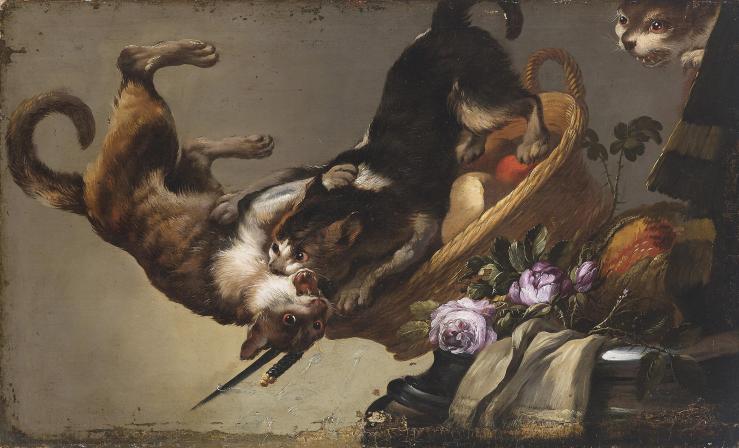
Still Life with Fighting Cats — Workshop of Frans Snyders

frans_snyders_workshop_kc3a4mpfende_katzen

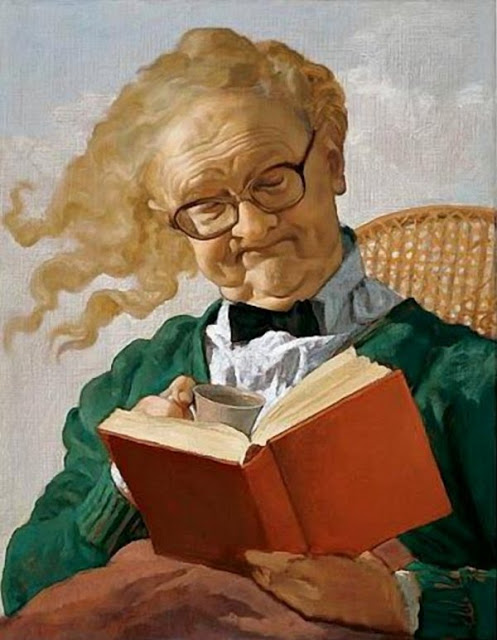
2070 — John Currin

john2bcurrin2b-2bold2bwoman2breading

Nathaniel Hawthorne’s journal entry for May 11, 1838

May 11, 1838.–At Boston last week. Items:–A young man, with a small mustache, dyed brown, reddish from its original light color. He walks with an affected gait, his arms crooked outwards, treading much on his toes. His conversation is about the theatre, where he has a season ticket,–about an amateur who lately appeared there, and about actresses, with other theatrical scandal.–In the smoking-room, two checker and backgammon boards; the landlord a great player, seemingly a stupid man, but with considerable shrewdness and knowledge of the world.– F—-, the comedian, a stout, heavy-looking Englishman, of grave deportment, with no signs of wit or humor, yet aiming at both in conversation, in order to support his character. Very steady and regular in his life, and parsimonious in his disposition,–worth $50,000, made by his profession.–A clergyman, elderly, with a white neck-cloth, very unbecoming, an unworldly manner, unacquaintance with the customs of the house, and learning them in a childlike way. A ruffle to his shirt, crimped.–A gentleman, young, handsome, and sea-flushed, belonging to Oswego, New York, but just arrived in port from the Mediterranean: he inquires of me about the troubles in Canada, which were first beginning to make a noise when he left the country,–whether they are all over. I tell him all is finished, except the hanging of the prisoners. Then we talk over the matter, and I tell him the fates of the principal men,–some banished to New South Wales, one hanged, others in prison, others, conspicuous at first, now almost forgotten.–Apartments of private families in the hotel,–what sort of domesticity there may be in them; eating in public, with no board of their own. The gas that lights the rest of the house lights them also, in the chandelier from the ceiling.–A shabby-looking man, quiet, with spectacles, at first wearing an old, coarse brown frock, then appearing in a suit of elderly black, saying nothing unless spoken to, but talking intelligently when addressed. He is an editor, and I suppose printer, of a country paper. Among the guests, he holds intercourse with gentlemen of much more respectable appearance than himself, from the same part of the country.–Bill of fare; wines printed on the back, but nobody calls for a bottle. Chairs turned down for expected guests. Three-pronged steel forks. Cold supper from nine to eleven P.M. Great, round, mahogany table, in the sitting-room, covered with papers. In the morning, before and soon after breakfast, gentlemen reading the morning papers, while others wait for their chance, or try to pick out something from the papers of yesterday or longer ago. In the forenoon, the Southern papers are brought in, and thrown damp and folded on the table. The eagerness with which those who happen to be in the room start up and make prize of them. Play-bills, printed on yellow paper, laid upon the table. Towards evening comes the “Transcript.”

Nathaniel Hawthorne’s journal entry for May 11, 1848. From Passages from the American Note-Books.

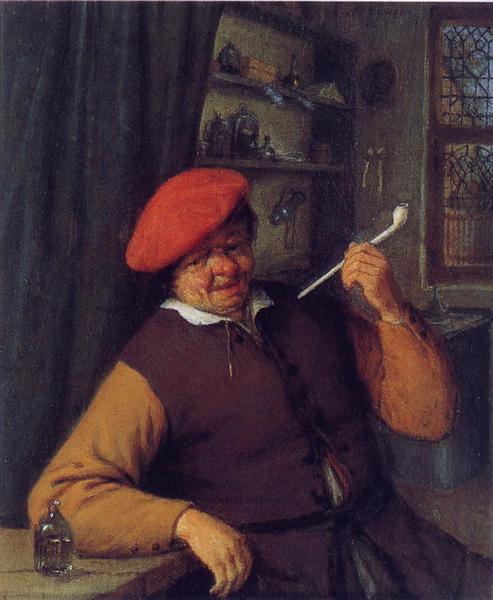
A Peasant in a Red Beret Smoking a Pipe — Adriaen van Ostade

a-peasant-in-a-red-beret-smoking-a-pipe.jpg!Large

Friendship — Egon Schiele

schiele_-_freundschaft_-_1913

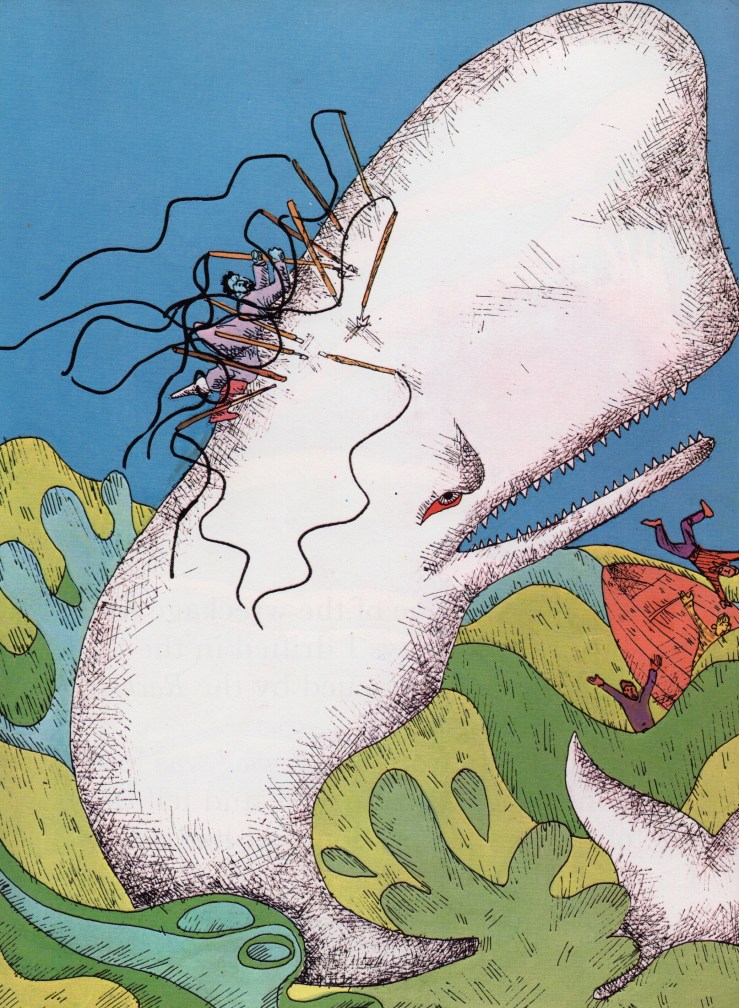
Moby Dick — Hieronimus Fromm

img_2273

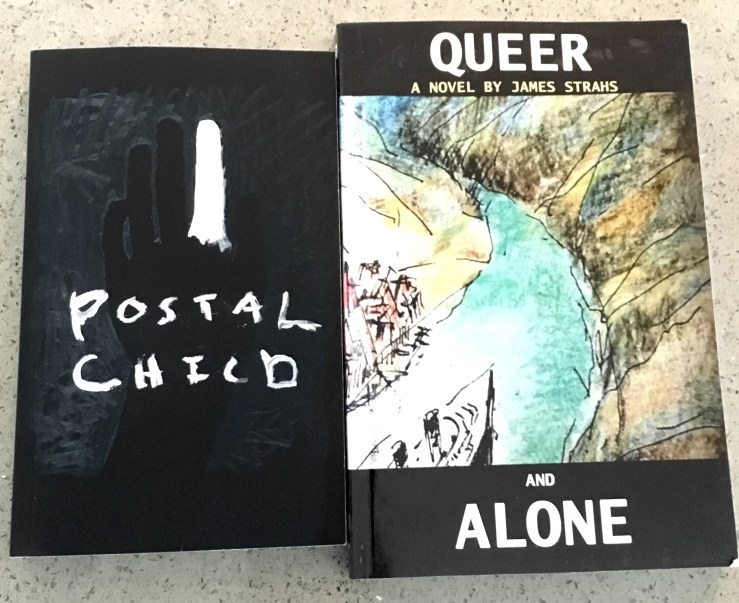
Postal Child / Queer and Alone (Books acquired, 05.05.2016)

img_2181

I love the covers of these two new titles from new indie Whisk(e)y Tit.

Here’s the not-blurb for Joey Truman’s Postal Child:

Whitey Whitlock had an ear for the birds. He could whistle their songs as well as they could. He did so on his route. He talked to the birds.The birds talked back.

Whitey was a black man. He was called Whitey because the index finger on his left hand was white. A birthmark. His first name was Esmerelda. Middle name Torno. His last name was Whitlock because his mom’s last name was Whitlock.

His mom was high when Whitey was born. She was also high when she named him. Esmerelda was the name of her sister, the only person in the world who ever treated her decently, and Torno was short for tornado, because that’s how it felt when Whitey came out.

Whitey’s mom had a penchant for the cocaine.

She was a good mom though. Albeit an inconsistent mom.Whitey learned how to deal with her mood swings and her ever-present hangovers. By the time he was three he could make his own breakfasts. By the time he was eight he could get himself to school. By the time he was ten he was doing all the shopping and housework. By the time he was twelve he could do all the paperwork that allowed him and his mom not to starve or be homeless. On one of the pubescent days leading up to his thirteenth birthday he woke up to find his mom dead on the couch.

And the blurb-blurb for James Strah’s Queer and Alone (which about, by the way, Whisk(e)y Tit publisher Miette threatens/offers to “tattoo the entire text to your torso while smoking clove cigarettes” (not sure who’s doing the smoking there)):

Monrovia. Bali. Bombay. Cayman Islands. Hollywood. The names of faraway places dot the pages of Queer and Alone like thousands of islands in a deep blue sea. Indeed, the hero – or is he an ironic anti-hero? – of this novel is a man literally at sea. He is Desmond Farrquahr who boards a steamer bound for Hong Kong by way of the Cape of Good Hope. Looking for experience, taking in the sights, hoping. For what?

Queer and Alone is a wildly exuberant travelogue as monologue, an eccentric American’s view of tourism. One might call it a “scatalogical romance,” with a story and a girl in every port. “It’s all part of the novel experience of being there,” Farrquahr wordplays with the reader. As narrator of the novel he shows off incredibly sly linguistic gifts that turn even the slightest image or sound into the dazzling rhythms of word magic.

Whether it’s describing racial fantasy films in Africa, investigating murder in Bombay, or seducing stately women in staterooms, Farrquahr manages to have the most ingenious takes on culture. In one of the most funny scenes in the novel the narrator is seen eating several (dis)courses of a chopstick dinner that makes the ideologies of both East and West seem like entangled sesame noodles. Tourism moves closer to zany anthopology whenever Farrquahr acts as guide.

Desmond Farrquahr is a very queer fellow if judged by any conventional standards. But isn’t the world itself a queer place these days?

The Annunciation (Detail) — Jan van Eyck

anunc14

The body of the bride Lila appeared cruelly shredded (From Elena Ferrante’s novel The Story of a New Name)

It was a beautiful warm evening; the brilliant lights of the shop’s interior spread their glow into the square. The gigantic image of Lila in her wedding dress could be seen at a distance, leaning against the center wall. Stefano parked, we went in, making our way among the boxes of shoes, piled up haphazardly, cans of paint, ladders. Marcello, Rino, Gigliola, and Pinuccia were visibly irritated: for varying reasons they had no wish to submit yet again to Lila’s caprices. The only one who greeted us cordially was Michele, who turned to my friend with a mocking laugh. “Lovely signora, will you let us know, at last, what you have in mind or do you just want to ruin the evening?”

Lila looked at the panel leaning against the wall, asked them to lay it on the floor. Marcello said cautiously, with the dark timidity that he always showed toward Lila, “What for?”

“I’ll show you.”

Rino interrupted: “Don’t be an idiot, Lina. You know how much this thing cost? If you ruin it, you’re in trouble.”

The Solaras laid the image on the floor. Lila looked around, with her brow furrowed, her eyes narrowed. She was looking for something that she knew was there, that perhaps she had bought herself. In a corner she spied a roll of black paper, and she took a pair of big scissors and a box of drawing pins from a shelf. Then, with that expression of extreme concentration which enabled her to isolate herself from everything around her, she went back to the panel. Before our astonished and, in the cases of some, openly hostile eyes, she cut strips of black paper, with the manual precision she had always possessed, and pinned them here and there to the photograph, asking for my help with slight gestures or quick glances.

I joined in with the devotion that I had felt ever since we were children. Those moments were thrilling, it was a pleasure to be beside her, slipping inside her intentions, to the point of anticipating her. I felt that she was seeing something that wasn’t there, and that she was struggling to make us see it, too. I was suddenly happy, feeling the intensity that invested her, that flowed through her fingers as they grasped the scissors, as they pinned the black paper.

Finally, she tried to lift the canvas, as if she were alone in that space, but she couldn’t. Marcello readily intervened, I intervened, we leaned it against the wall. Then we all backed up toward the door, some sneering, some grim, some appalled. The body of the bride Lila appeared cruelly shredded. Much of the head had disappeared, as had the stomach. There remained an eye, the hand on which the chin rested, the brilliant stain of the mouth, the diagonal stripe of the bust, the line of the crossed legs, the shoes.

Gigliola began, scarcely containing her rage: “I cannot put a thing like that in my shop.”

“I agree,” Pinuccia exploded. “We have to sell here, and with that grotesque thing people will run away. Rino, say something to your sister, please.”

Rino pretended to ignore her, but he turned to Stefano as if his brother-in-law were to blame for what was happening. “I told you, you can’t reason with her. You have to say yes, no, and that’s it, or you see what happens? It’s a waste of time.”

Stefano didn’t answer, he stared at the panel leaning against the wall and it was evident that he was looking for a way out. He asked me, “What do you think, Lenù?”

I said in Italian, “To me it seems very beautiful. Of course, I wouldn’t want it in the neighborhood, that’s not the right place for it. But here it’s something else, it will attract attention, it will please. In Confidenze just last week I saw that in Rossano Brazzi’s house there is a painting like this.”

Hearing that, Gigliola got even angrier. “What do you mean? That Rossano Brazzi knows what’s what, that you two know everything, and Pinuccia and I don’t?”

At that point I felt the danger. I had only to glance at Lila to realize that, if when we arrived at the shop she had really felt willing to give in should the attempt prove fruitless, now that the attempt had been made and had produced that image of disfigurement she wouldn’t yield an inch. Those minutes of work on the picture had broken ties: at that moment she was overwhelmed by an exaggerated sense of herself, and it would take time for her to retreat into the dimension of the grocer’s wife, she wouldn’t accept a sigh of dissent. In fact, while Gigliola was speaking, she was already muttering: Like this or not at all. And she wanted to quarrel, she wanted to break, shatter, she would have happily hurled herself at Gigliola with the scissors.


From Elena Ferrante’s 2012 novel The Story of a New Name. English translation by Ann Goldstein. I’m not sure how well the passage stands free of any context—I know there are a lot of characters here with backgrounds that won’t be clear to anyone who hasn’t read Ferrante’s novel (read it!)—but I love this passage, where brilliant friends Lila and Lenù collaborate to turn advertising into art, to artistically—and violently, perhaps—erase Lila’s body from the patriarchal order into which she has been inscribed.

William T. Vollmann talks sex and death; reads from Last Stories and Other Stories