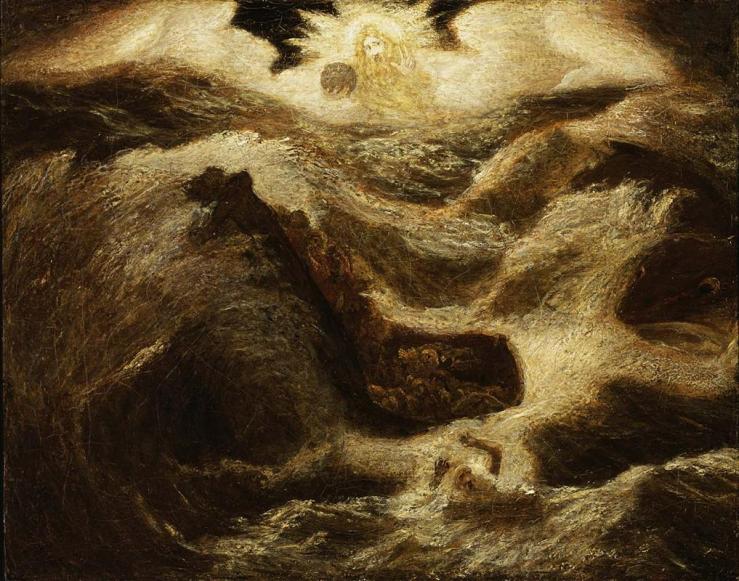
Jonah — Albert Pinkham Ryder

jonah-1895halfhd

And here is “The Sermon,” Ch. IX of Herman Melville’s great novel Moby-Dick, in which Father Mapple gives us the tale of Jonah—


Father Mapple rose, and in a mild voice of unassuming authority ordered the scattered people to condense. “Starboard gangway, there! side away to larboard—larboard gangway to starboard! Midships! midships!”

There was a low rumbling of heavy sea-boots among the benches, and a still slighter shuffling of women’s shoes, and all was quiet again, and every eye on the preacher.

He paused a little; then kneeling in the pulpit’s bows, folded his large brown hands across his chest, uplifted his closed eyes, and offered a prayer so deeply devout that he seemed kneeling and praying at the bottom of the sea.

This ended, in prolonged solemn tones, like the continual tolling of a bell in a ship that is foundering at sea in a fog—in such tones he commenced reading the following hymn; but changing his manner towards the concluding stanzas, burst forth with a pealing exultation and joy—

     "The ribs and terrors in the whale,
     Arched over me a dismal gloom,
     While all God's sun-lit waves rolled by,
     And lift me deepening down to doom.

     "I saw the opening maw of hell,
     With endless pains and sorrows there;
     Which none but they that feel can tell—
     Oh, I was plunging to despair.

     "In black distress, I called my God,
     When I could scarce believe him mine,
     He bowed his ear to my complaints—
     No more the whale did me confine.

     "With speed he flew to my relief,
     As on a radiant dolphin borne;
     Awful, yet bright, as lightning shone
     The face of my Deliverer God.

     "My song for ever shall record
     That terrible, that joyful hour;
     I give the glory to my God,
     His all the mercy and the power."

Nearly all joined in singing this hymn, which swelled high above the howling of the storm. A brief pause ensued; the preacher slowly turned over the leaves of the Bible, and at last, folding his hand down upon the proper page, said: “Beloved shipmates, clinch the last verse of the first chapter of Jonah—’And God had prepared a great fish to swallow up Jonah.'”

“Shipmates, this book, containing only four chapters—four yarns—is one of the smallest strands in the mighty cable of the Scriptures. Yet what depths of the soul does Jonah’s deep sealine sound! what a pregnant lesson to us is this prophet! What a noble thing is that canticle in the fish’s belly! How billow-like and boisterously grand! We feel the floods surging over us; we sound with him to the kelpy bottom of the waters; sea-weed and all the slime of the sea is about us! But what is this lesson that the book of Jonah teaches? Shipmates, it is a two-stranded lesson; a lesson to us all as sinful men, and a lesson to me as a pilot of the living God. As sinful men, it is a lesson to us all, because it is a story of the sin, hard-heartedness, suddenly awakened fears, the swift punishment, repentance, prayers, and finally the deliverance and joy of Jonah. As with all sinners among men, the sin of this son of Amittai was in his wilful disobedience of the command of God—never mind now what that command was, or how conveyed—which he found a hard command. But all the things that God would have us do are hard for us to do—remember that—and hence, he oftener commands us than endeavors to persuade. And if we obey God, we must disobey ourselves; and it is in this disobeying ourselves, wherein the hardness of obeying God consists. Continue reading “Jonah — Albert Pinkham Ryder”

Another misty morning | Nathaniel Hawthorne’s journal entry for April 27, 1843

Thursday, April 27th.–I took a walk into the fields, and round our opposite hill, yesterday noon, but made no very remarkable observation. The frogs have begun their concerts, though not as yet with a full choir. I found no violets nor anemones, nor anything in the likeness of a flower, though I looked carefully along the shelter of the stone-walls, and in all spots apparently propitious. I ascended the hill, and had a wide prospect of a swollen river, extending around me in a semicircle of three or four miles, and rendering the view much finer than in summer, had there only been foliage. It seemed like the formation of a new world; for islands were everywhere emerging, and capes extending forth into the flood; and these tracts, which were thus won from the watery empire, were among the greenest in the landscape. The moment the deluge leaves them Nature asserts them to be her property by covering them with verdure; or perhaps the grass had been growing under the water. On the hill-top where I stood, the grass had scarcely begun to sprout; and I observed that even those places which looked greenest in the distance were but scantily grass-covered when I actually reached them. It was hope that painted them so bright.

Last evening we saw a bright light on the river, betokening that a boat’s party were engaged in spearing fish. It looked like a descended star,–like red Mars,–and, as the water was perfectly smooth, its gleam was reflected downward into the depths. It is a very picturesque sight. In the deep quiet of the night I suddenly heard the light and lively note of a bird from a neighboring tree,–a real song, such as those which greet the purple dawn, or mingle with the yellow sunshine. What could the little bird mean by pouring it forth at midnight? Probably the note gushed out from the midst of a dream, in which he fancied himself in Paradise with his mate; and, suddenly awakening, he found he was on a cold, leafless bough, with a New England mist penetrating through his feathers. That was a sad exchange of imagination for reality; but if he found his mate beside him, all was well.

This is another misty morning, ungenial in aspect, but kinder than it looks; for it paints the hills and valleys with a richer brush than the sunshine could. There is more verdure now than when I looked out of the window an hour ago. The willow-tree opposite my study window is ready to put forth its leaves. There are some objections to willows. It is not a dry and cleanly tree; it impresses me with an association of sliminess; and no trees, I think, are perfectly satisfactory, which have not a firm and hard texture of trunk and branches. But the willow is almost the earliest to put forth its leaves, and the last to scatter them on the ground; and during the whole winter its yellow twigs give it a sunny aspect, which is not without a cheering influence in a proper point of view. Our old house would lose much were this willow to be cut down, with its golden crown over the roof in winter, and its heap of summer verdure. The present Mr. Ripley planted it, fifty years ago, or thereabouts.

Nathaniel Hawthorne’s journal entry for April 27, 1843. From Passages from the American Note-Books.

Illustration for “The Beautiful Girl of the Moon Tower” — Leo and Diane Dillon

img_2091

From The People Could Fly: American Black Folktales told by Virginia Hamilton.

Circe — Claudio Bravo

circe-1986

Human flower-shrubs, if they will grow old on earth | Nathaniel Hawthorne’s journal entry for April 26, 1843

April 26th.–Here is another misty day, muffling the sun. The lilac-shrubs under my study window are almost in leaf. In two or three days more, I may put forth my hand and pluck a green bough. These lilacs appear to be very aged, and have lost the luxuriant foliage of their prime. Old age has a singular aspect in lilacs, rose-bushes, and other ornamental shrubs. It seems as if such things, as they grow only for beauty, ought to flourish in immortal youth, or at least to die before their decrepitude. They are trees of Paradise, and therefore not naturally subject to decay; but have lost their birthright by being transplanted hither. There is a kind of ludicrous unfitness in the idea of a venerable rose-bush; and there is something analogous to this in human life. Persons who can only be graceful and ornamental–who can give the world nothing but flowers–should die young, and never be seen with gray hairs and wrinkles, any more than the flower-shrubs with mossy bark and scanty foliage, like the lilacs under my window. Not that beauty is not worthy of immortality. Nothing else, indeed, is worthy of it; and thence, perhaps, the sense of impropriety when we see it triumphed over by time. Apple-trees, on the other hand, grow old without reproach. Let them live as long as they may, and contort themselves in whatever fashion they please, they are still respectable, even if they afford us only an apple or two in a season, or none at all. Human flower-shrubs, if they will grow old on earth, should, beside their lovely blossoms, bear some kind of fruit that will satisfy earthly appetites; else men will not be satisfied that the moss should gather on them.

Winter and Spring are now struggling for the mastery in my study; and I yield somewhat to each, and wholly to neither. The window is open, and there is a fire in the stove. The day when the window is first thrown open should be an epoch in the year; but I have forgotten to record it. Seventy or eighty springs have visited this old house; and sixty of them found old Dr. Ripley here,–not always old, it is true, but gradually getting wrinkles and gray hairs, and looking more and more the picture of winter. But he was no flower-shrub, but one of those fruit-trees or timber-trees that acquire a grace with their old age. Last Spring found this house solitary for the first time since it was built; and now again she peeps into our open windows and finds new faces here. . . .

It is remarkable how much uncleanness winter brings with it, or leaves behind it, . . . The yard, garden, and avenue, which should be my department, require a great amount of labor. The avenue is strewed with withered leaves,–the whole crop, apparently, of last year,–some of which are now raked into heaps; and we intend to make a bonfire of them. . . –There are quantities of decayed branches, which one tempest after another has flung down, black and rotten. In the garden are the old cabbages which we did not think worth gathering last autumn, and the dry bean-vines, and the withered stalks of the asparagus-bed; in short, all the wrecks of the departed year,–its mouldering relics, its dry bones. It is a pity that the world cannot be made over anew every spring. Then, in the yard, there are the piles of firewood, which I ought to have sawed and thrown into the shed long since, but which will cumber the earth, I fear, till June, at least. Quantities of chips are strewn about, and on removing them we find the yellow stalks of grass sprouting underneath. Nature does her best to beautify this disarray. The grass springs up most industriously, especially in sheltered and sunny angles of the buildings, or round the doorsteps,–a locality which seems particularly favorable to its growth; for it is already high enough to bend over and wave the wind. I was surprised to observe that some weeds (especially a plant that stains the fingers with its yellow juice) had lived, and retained their freshness and sap as perfectly as in summer, through all the frosts and snows of last winter. I saw them, the last green thing, in the autumn; and here they are again, the first in the spring.

Nathaniel Hawthorne’s journal entry for April 26, 1843. From Passages from the American Note-Books.

The Annunciation (Detail) — Jan van Eyck

annunc7

Stanley Elkin and William Gass on the mythic mode, Faulkner, etc.

From Washington University’s marvelous Modern Literature Collection YouTube channel.

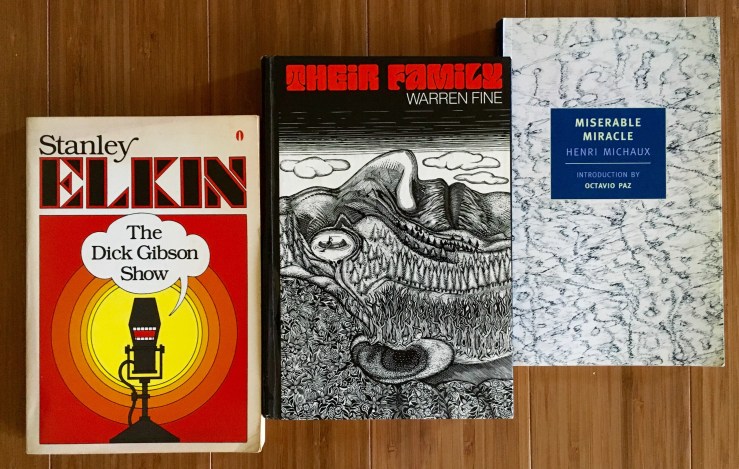
Books acquired, almost for their covers alone, 4.25.2016 (Elkin, Fine, Michaux)

img_2066

I swung by my favorite used bookstore this afternoon; it’s right near the grocery store and I needed to pick up some mint and some ricotta. I was hoping to pick up Elena Ferrante’s novel My Brilliant Friend at the bookstore. I started the audiobook of My Brilliant Friend today, after finishing the audiobook of Adrian Jones Pearson’s novel Cow Country  this weekend. (Full review of Cow Country forthcoming but a real quick review: great performance/reading of a very strange book which I enjoyed very much, but which I also suspect will have very limited appeal. Cow cult classic to come). But so anyway, I’m really digging the Ferrante, and decided I wanted to obtain a physical copy to reread passages (and maybe share some on this blog). My store had several copies of four of Ferrante’s novels–but no Friend. While scanning the section, my eye alighted (alit?) on a strange-looking hardback spine—Warren Fine’s Their Family. I turned it around and the cover…well, I knew I was gonna leave with it. Knopf, 1972—a few years before Gordon Lish was to become editor there, sure, but interesting bona fides I suppose. Fine does not seem to be beloved by anyone on the internet, and his books seem to have failed to go into second printings of any kind. The Fs are near the Es, and I glanced over the works of Mr. Stanley Elkin, who has his own section there, somehow. I finally broke through the second chapter of his novel The Franchiser this weekend (it’s all unattributed dialog, that chapter, sorta like Gaddis’s JR); I’m really digging The Franchiser now that I’ve tuned into the voice. (It also helps to not try reading it exclusively at night after too many bourbons or wines). Again, the spine of the novel looked interesting so I flipped The Dick Gibson Show around and, again, I knew I was gonna leave with it. Henri Michaux’s Miserable Miracle I found in the “Drugs” section—which I was not perusing (because I am no longer 19)—well I guess I was perusing it, but that’s only because it happens to be right next to this particular bookshop’s collection of Black Sparrow Press titles, which I always scan over. Anyway, the Michaux’s Miserable Miracle was turned face out; NYRB titles always deserve a quick scan, and the cover reminded me of a Cy Twombly painting. Flicking through it revealed a strange structure, full of marginal side notes and doodles and diagrams and drawings. And oh, it’s about a mescaline trip, I think. You can actually read it here, but this version is missing all the drawings and sidenotes.

Oh, and so then I forgot to go pick up the ricotta and the mint.

Crows visited us | Nathaniel Hawthorne’s journal entry for April 25, 1843

April 25th. Spring is advancing, sometimes with sunny days, and sometimes, as is the case now, with chill, moist, sullen ones. There is an influence in the season that makes it almost impossible for me to bring my mind down to literary employment; perhaps because several months’ pretty constant work has exhausted that species of energy,–perhaps because in spring it is more natural to labor actively than to think. But my impulse now is to be idle altogether,–to lie in the sun, or wander about and look at the revival of Nature from her death-like slumber, or to be borne down the current of the river in my boat. If I had wings, I would gladly fly; yet would prefer to be wafted along by a breeze, sometimes alighting on a patch of green grass, then gently whirled away to a still sunnier spot. . . . Oh, how blest should I be were there nothing to do! Then I would watch every inch and hair’s-breadth of the progress of the season; and not a leaf should put itself forth, in the vicinity of our old mansion, without my noting it. But now, with the burden of a continual task upon me, I have not freedom of mind to make such observations. I merely see what is going on in a very general way. The snow, which, two or three weeks ago, covered hill and valley, is now diminished to one or two solitary specks in the visible landscape; though doubtless there are still heaps of it in the shady places in the woods. There have been no violent rains to carry it off: it has diminished gradually, inch by inch, and day after day; and I observed, along the roadside, that the green blades of grass had sometimes sprouted on the very edge of the snowdrift the moment that the earth was uncovered.

The pastures and grass-fields have not yet a general effect of green; nor have they that cheerless brown tint which they wear in later autumn, when vegetation has entirely ceased. There is now a suspicion of verdure,–the faint shadow of it,–but not the warm reality. Sometimes, in a happy exposure,–there is one such tract across the river, the carefully cultivated mowing-field, in front of an old red homestead,–such patches of land wear a beautiful and tender green, which no other season will equal; because, let the grass be green as it may hereafter, it will not be so set off by surrounding barrenness. The trees in our orchard, and elsewhere, have as yet no leaves; yet to the most careless eye they appear full of life and vegetable blood. It seems as if, by one magic touch, they might instantaneously put forth all their foliage, and the wind, which now sighs through their naked branches, might all at once find itself impeded by innumerable leaves. This sudden development would be scarcely more wonderful than the gleam of verdure which often brightens, in a moment, as it were, along the slope of a bank or roadside. It is like a gleam of sunlight. Just now it was brown, like the rest of the scenery: look again, and there is an apparition of green grass. The Spring, no doubt, comes onward with fleeter footsteps, because Winter has lingered so long that, at best, she can hardly retrieve half the allotted term of her reign.

The river, this season, has encroached farther on the land than it has been known to do for twenty years past. It has formed along its course a succession of lakes, with a current through the midst. My boat has lain at the bottom of the orchard, in very convenient proximity to the house. It has borne me over stone fences; and, a few days ago, Ellery Channing and I passed through two rails into the great northern road, along which we paddled for some distance. The trees have a singular appearance in the midst of waters. The curtailment of their trunks quite destroys the proportions of the whole tree; and we become conscious of a regularity and propriety in the forms of Nature, by the effect of this abbreviation. The waters are now subsiding, but gradually. Islands become annexed to the mainland, and other islands emerge from the flood, and will soon, likewise, be connected with the continent. We have seen on a small scale the process of the deluge, and can now witness that of the reappearance of the earth.

Crows visited us long before the snow was off. They seem mostly to have departed now, or else to have betaken themselves to remote depths of the woods, which they haunt all summer long. Ducks came in great numbers, and many sportsmen went in pursuit of them along the river; but they also have disappeared. Gulls come up from seaward, and soar high overhead, flapping their broad wings in the upper sunshine. They are among the most picturesque birds that I am acquainted with; indeed, quite the most so, because the manner of their flight makes them almost stationary parts of the landscape. The imagination has time to rest upon them; they have not flitted away in a moment. You go up among the clouds, and lay hold of these soaring gulls, and repose with them upon the sustaining atmosphere. The smaller birds, –the birds that build their nests in our trees, and sing for us at morning-red,–I will not describe.. . But I must mention the great companies of blackbirds–more than the famous “four-and-twenty” who were baked in a pie–that congregate on the tops of contiguous trees, and vociferate with all the clamor of a turbulent political meeting. Politics must certainly be the subject of such a tumultuous debate; but still there is a melody in each individual utterance, and a harmony in the general effect. Mr. Thoreau tells me that these noisy assemblages consist of three different species of blackbirds; but I forget the other two. Robins have been long among us, and swallows have more recently arrived.

Nathaniel Hawthorne’s journal entry for April 25, 1843. From Passages from the American Note-Books.

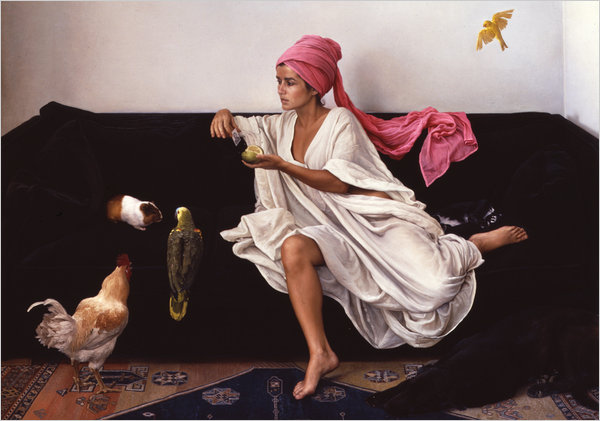
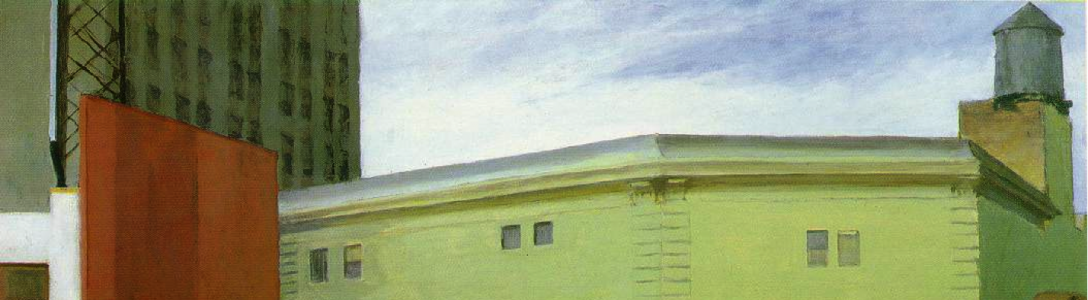
Untitled — William Eggleston

24-eggleston_womenonsofa

Three (Purple) Books

img_2050

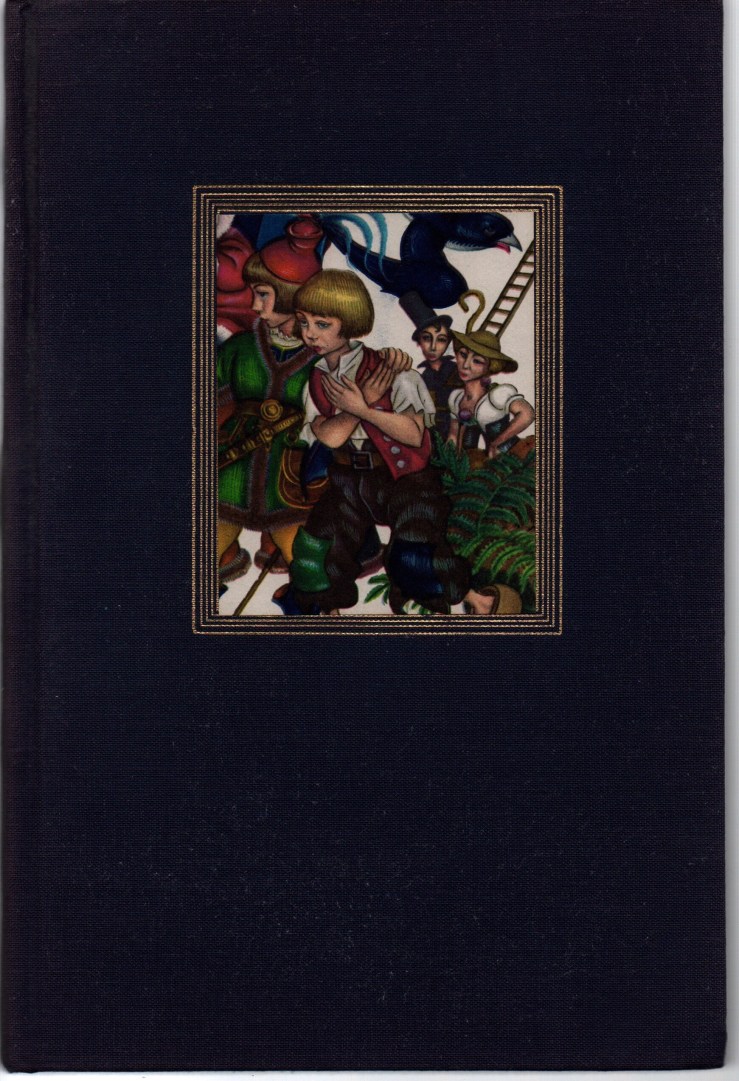
Andersen’s Fairy Tales translated by E.V. Lucas and H.B. Paull. Illustrations by Arthur Syzk. First edition cloth-bound hardback by Grosset & Dunlop, 1945. No designer credited, but the cover illustration is by Syzk. This was a gift from a former student.

img_2051

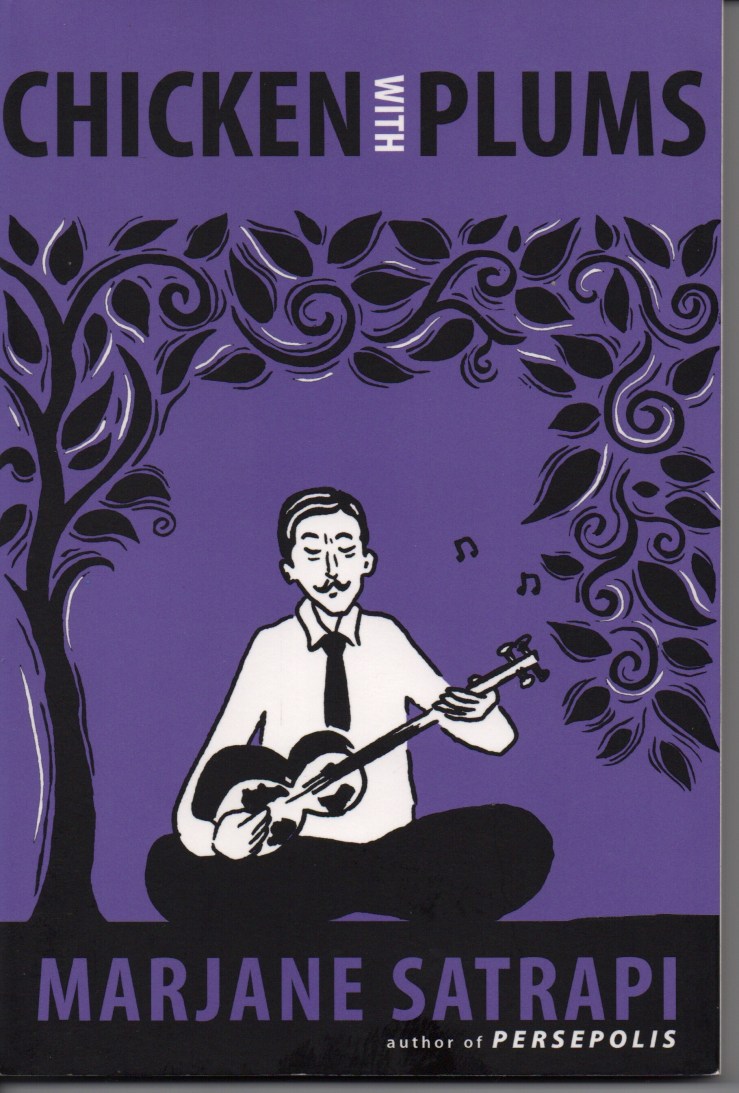
Chicken with Plums by Marjane Satrapi. English translation by Anjali Singh. First Pantheon paperback printing, 2009. Cover image by Satrapi; cover design credited to Brian Barth. I reviewed Plums some years back.

img_2052

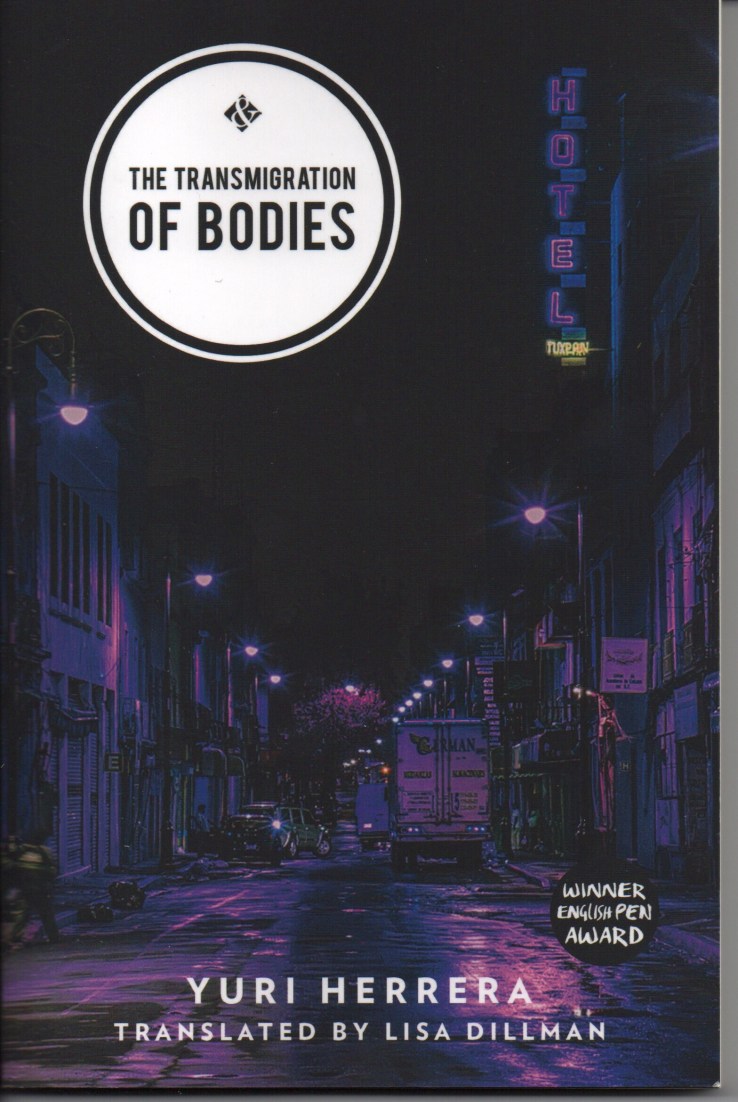
The Transmigration of Bodies by Yuri Herrera. English translation by Lisa Dillman. 2016 paperback by And Other Stories. Cover design by Hannah Naughton from an image credited to iivangm. I wrote a bit about Bodies here; full review next month closer to its publish date.

I finished Herrera’s novella The Transmigration of Bodies a few days before Prince died. The book’s neon purple cover seemed to glare at me from my coffee table when I returned home on the afternoon of April 21, 2016, stunned—yes, stunned is the right word—at learning of the death of one of my heroes. Not just stunned—but stunned at how stunned I was, how sad I felt, how awful and sick Prince’s unexpected, uncalled for, fucking cosmically unjust death was and is. —Wait, I didn’t sign on for this, you protest, eh, dear reader? —No, I didn’t ask for another remembrance or whatever this is, especially not from some blog dude who never knew the guy; look, Biblioklept, the internet’s seams are burstin’ with other, more interesting folks’ thoughts and memories on Prince, you don’t need to—Well I know but I need to. I loved Prince—I loved his music, sure, 1999 and Purple Rain in particular, every song of those records grooved into my mental ear, I can call them up at will—but I loved Prince as an artist, as the Artist, as an aesthetic—which is what I think we, the Big We, all mourn when we mourn Prince. I could go through litany of personal anecdotes about Prince—tell you in detail about first seeing the video for “When Doves Cry” as a child and just totally losing my shit; I could tell you about buying the Batman soundtrack on tape (one of my first album purchases); I could tell you about the summer and fall of 1991, when I was an impressionable twelve years strong, when MTV dared to air Prince’s video for “Gett Off”—I could tell you about how that video accelerated my puberty (I see you plug your ears, reader); I could tell you about discovering that Prince and I shared the same birthday (we are Gemini!) and I could tell you that I always thought about Prince on our birthday, even after I learned that he didn’t celebrate his birthday; I could tell you that my high school band made an album and we named it Prince (it sounded nothing like Prince; nothing sounded like Prince); I could tell you about the year 1999, when I was a junior in college, and how we wore the apocalyptic vinyl thin; I could tell you about djing at a small coffee shop and playing “I Would Die 4 U” five times in one night because I fucking love that song; I could tell you about pulling over the car, late at night, to cry while I listened to “Purple Rain”; I could tell you about dancing to Prince songs at my wedding, at other weddings; I could tell you about how sad I now feel that I never got to go to a Prince concert but how happy I am that I got to see a few on TV, got to see him play and dance and sing; I could tell you I could tell you I could tell you…but I won’t tell you. Maybe you know—maybe you have your own details, your own I could tell yous (forgive me my rhetorical conceits; sometimes it seems that they are all that licenses me to write)—I think you know, I think you have your own I could tell yous. Prince was a fucking genius and he shared that with us (sometimes he shared his genius with us by withholding it from us). Prince was his own genre, his own aesthetic, his own art. How wonderful to have lived on the planet at the same time that he did.

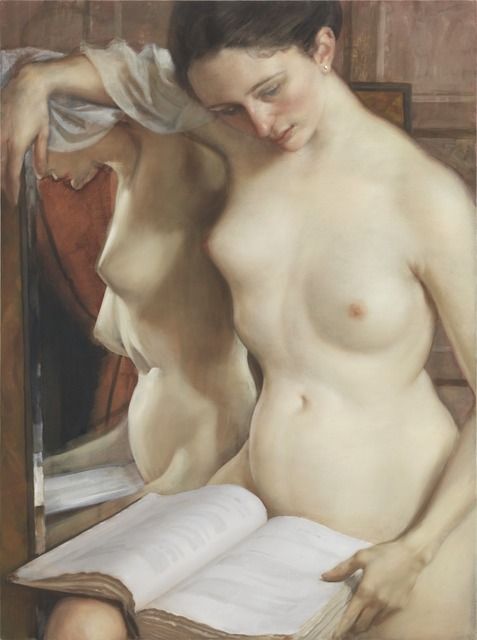
The Reader — John Currin

large

List with no name #56

  1. King Lear
  2. Henry IV, Part I/II
  3. The Tempest
  4. Othello
  5. A Midsummer Night’s Dream
  6. Hamlet
  7. Antony and Cleopatra
  8. Twelfth Night
  9. Much Ado about Nothing
  10. Macbeth

The Annunciation (Detail) — Jan van Eyck

annunc5

Our irreceptivity to a certain light (E.M. Cioran)

img_2047

From Anathemas and Admirations. Translated by Richard Howard.