“Unmasking a Confidence Trickster” — Franz Kafka

“Unmasking a Confidence Trickster”

by

Franz Kafka

English translation by the Muirs


At last, about ten o’clock at night, I came to the doorway of the fine house where I was invited to spend the evening, after the man beside me, whom I was barely acquainted with and who had once again thrust himself unasked upon me, had marched me for two long hours around the streets.

“Well!” I said, and clapped my hands to show that I really had to bid him goodbye. I had already made several less explicit attempts to get rid of him. I was tired out.

“Are you going straight in?” he asked. I heard a sound in his mouth that was like the snapping of teeth.

“Yes.”

I had been invited out, I told him when I met him. But it was to enter a house where I longed to be that I had been invited, not to stand here at the street door looking past the ears of the man before me. Nor to fall silent with him, as if we were doomed to stay for a long time on this spot. And yet the houses around us at once took a share in our silence, and the darkness over them, all the way up to the stars. And the steps of invisible passers-by, which one could not take the trouble to elucidate, and the wind persistently buffeting the other side of the street, and a gramophone singing behind the closed windows of some room-they all announced themselves in this silence, as if it were their own possession for the time past and to come.

And my companion subscribed to it in his own name and–with a smile–in mine too, stretched his right arm up along the wall and leaned his cheek upon it, shutting his eyes.

But I did not wait to see the end of that smile, for shame suddenly caught hold of me. It had needed that smile to let me know that the man was a confidence trickster, nothing else. And yet I had been months in the town and thought I knew all about confidence tricksters, how they came slinking out of side streets by night to meet us with outstretched hands like tavernkeepers, how they haunted the advertisement pillars we stood beside, sliding round them as if playing hide-and-seek and spying on us with at least one eye, how they suddenly appeared on the curb of the pavement at cross streets when we were hesitating! I understood them so well, they were the first acquaintances I had made the town’s small taverns, and to them I owed my first inkling of a ruthless hardness which I was now so conscious of, everywhere on earth, that I was even beginning to feel it in myself. How persistently they blocked our way, even when we had long shaken ourselves free, even when, that is, they had nothing more to hope for! How they refused to give up, to admit defeat, but kept shooting glances at us that even from a distance were still compelling! And the means they employed were always the same: they planted themselves before us, looking as large as possible, tried to hinder us from going where we purposed, offered us instead a habitation in their own bosoms, and when at last all our balked feelings rose in revolt they welcomed that like an embrace into which they threw themselves face foremost.

And it had taken me such a long time in this man’s company to recognize the same old game. I rubbed my finger tips together to wipe away the disgrace. My companion was still leaning there as before, still believing himself a successful trickster, and his self-complacency glowed pink on his free cheek.

“Caught in the act!” said I, tapping him lightly on the shoulder. Then I ran up the steps, and the disinterested devotion on the servants’ faces in the hall delighted me like an unexpected treat. I looked at them all, one after another, while they took my greatcoat off and wiped my shoes clean.

With a deep breath of relief and straightening myself to my full height I then entered the drawing room.

Melancholia (detail) — Albrecht Dürer

Screenshot 2016-03-12 at 12.54.29 PM

From “Reflections on American Violence” by Richard Hofstadter

I reread Richard Hofstadter’s remarkable essay “Reflections on American Violence” this morning. The essay was first published as “The Future of American Violence” in Harper’s in April of 1970 and as the introduction to American Violence: A Documentary History, a book edited by Hofstadter and Michael Wallace. You can read the whole thing at The Baffler. First three paragraphs:

The United States, it has been said, has a history but not a tradition of domestic violence. A history, because violence has been frequent, voluminous, almost commonplace in our past. But not precisely a tradition, for two reasons: First, our violence lacks both an ideological and a geographical center; it lacks cohesion; it has been too various, diffuse, and spontaneous to be forged into a single, sustained, inveterate hatred shared by entire social classes. Second, we have a remarkable lack of memory where violence is concerned and have left most of our excesses a part of our buried history. . . .

For historians violence is a difficult subject, diffuse and hard to cope with. It is committed by isolated individuals, by small groups, and by large mobs; it is directed against individuals and crowds alike; it is undertaken for a variety of purposes (and at times for no discernible rational purpose at all), and in a variety of ways ranging from assassinations and murders to lynchings, duels, brawls, feuds, and riots; it stems from criminal intent and from political idealism, from antagonisms that are entirely personal and from antagonisms of large social consequence. Hence it has been hard to conceive of violence as a subject at all. . . .

Today we are not only aware of our own violence; we are frightened by it. We are now quite ready to see that there is far more violence in our national heritage than our proud, sometimes smug, national self-image admits of. Our violence frightens us, as it frightens others, because in our singular position uncontrolled domestic violence coincides with unparalleled national power, and thus takes on a special significance for the world. It is not only shocking but dangerous for a primary world power to lose three of its most important and valuable public leaders within a few years, and with them to lose an immeasurable part of its political poise. Violence in Colombia or Guatemala is of life-or-death concern to Colombians and Guatemalans. Violence in the United States has become of life-or-death concern to everyone. It is, again, disturbing to many Americans that the recent outbreaks coincided with the most sustained economic boom we have ever had. Although the American creed has been built upon the efficacy of riches, it has now become alarmingly clear that some of our social discontents, instead of being relieved by prosperity, are exacerbated by it. Although Americans are richer than ever, they have not found a way to buy themselves out of trouble.

Read the rest of “Reflections on American Violence”

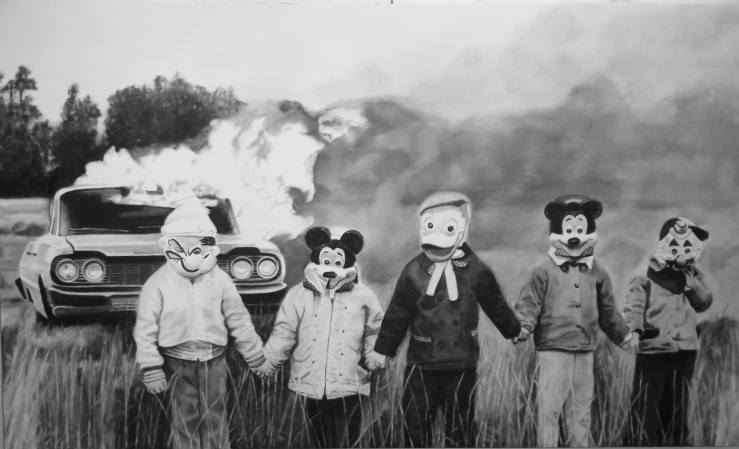
This Ends Here — David Lyle

410531-8

The Werl Triptych (detail) — Robert Campin

e

Read a 1970 microfiction by Thomas Bernhard, new in English translation by Douglas Robertson

Thomas Bernhard’s (short) short story “The Woman from the Foundry and the Man with the Rucksack” (“Die Frau aus dem Gusswerk und der Mann mit dem Rucksack”) is new in translation from Douglas Robertson.The story was first published (in Bernhard’s German, of course) in 1970. Robertson’s ongoing project to bring untranslated Bernhard into English is marvelous. Here are the first four (of fourteen) sentences—read the whole thing here.

THE WOMAN FROM THE FOUNDRY AND THE MAN WITH THE RUCKSACK

The woman, who is employed at the foundry, found her eye caught by a fairly old man who, with a fully-packed rucksack was pacing up and down the riverbank, a man who was wearing buckskin lederhosen tied up at the ankles, a pair of high-topped lace-up boots, a coat made of milled cloth, and a sturdy felt hat on his head.  She thought there was something terrifying about the face of the man, who seemed, like her, to be impatiently awaiting the arrival of the train, this man who now and then would quite unwarrantably shove another person out of the way in order to keep his own path clear.  She had already observed the man on her way to the stop and begun forming thoughts about him.  The man was a complete stranger to her.

Spring fever (Flannery O’Connor)

img_1692

Flannery O’Connor’s “Now Comes Spring Fever” was originally published on April 25, 1941 in The Peabody Palladium, O’Connor’s high school student newspaper. O’Connor served as the paper’s art director starting in 1940. O’Connor was 16 when she published this comic. Her comics are reprinted in Flannery O’Connor: The Cartoons, Fantagraphics, 2012.

The Necessity of Judgment — Marc Dennis

marc-dennis-the-necessity-of-judgment_2013_oil-on-linen_44x46-inches

Melancholia (detail) — Albrecht Dürer

melancolia

People have always distrusted the classics (William H. Gass)

Oddly enough, people have always distrusted the classics, but it is now publicly acceptable to take pride in such distrust. We all dislike intimidation, so we worry about being overwhelmed by these tomes above which halos hover as over the graves of the recently sainted, because we wrongly believe they are fields full of esoteric knowledge worse than nettles, of specialized jargon, seductive rhetoric, and swarms of stinging data, and that the purpose of all this unpleasantness is to show us up, put us in our place, make fun of our lack of understanding; but the good books are notable for their paucity of information—a classic is as careful about what it picks up as about what it puts down; it introduces new concepts because fresh ideas are needed; and only if the most ordinary things are exotic is it guilty of a preoccupation with the out-of-the-way, since the ordinary, the everyday, is their most concentrated concern: What could be more familiar than a child rolling for fun down a grassy slope—that is, when seen by Galileo, a body descending an inclined plane? What could be more commonplace than Bertrand Russell’s penny, lying naked on an examining table, awaiting the epistemologist’s report on the problems of its perception? What could be less distinguished a subject for Maynard Keynes’s ruminations on the source of its value than such a modest coin? Why should the question—What good is that?—alarm us, or why, in an age when most of the world worships money but calls its chosen God Father instead of Chairman, Lord instead of Coach, Most High instead of Star, should we shy from the same questions Plato asked, and not ask them about our business, about our love affairs, about our lip-served gods, about democracy?

From William H. Gass’s “To A Young Friend Charged with Possession of the Classics”; collected in A Temple of Texts (Knopf, 2006). For fun, pretend you are the young friend in the title.

Neither More Nor Less — Francisco Goya

goya_-_ni_mas_ni_menos_neither_more_nor_less

Crossing the Sea with Syrians on the Exodus to Europe (Book acquired, 2.22.2016)

wimg_1652

Crossing the Sea with Syrians on the Exodus to Europe by Wolfgang Bauer (in English translation by Sarah Prybus) is new in hardback this month from And Other Stories. Their blurb:

Award-winning journalist Wolfgang Bauer and photographer Stanislav Krupař were the first undercover reporters to document the journey of Syrian refugees from Egypt to Europe. Posing as English teachers in 2014, they were direct witnesses to the brutality of smuggler gangs, the processes of detainment and deportation, the dangers of sea-crossing on rickety boats, and the final furtive journey through Europe. Combining their own travels with other eyewitness accounts in the first book of reportage of its kind, Crossing the Sea brings to life both the systemic problems and the individual faces behind the crisis, and is a passionate appeal for more humanitarian refugee policies.

Land Reform IV — Hans Georg Rauch

41

Ecclesia — Konrad Witz

ecclesia-1440

“Beehive” — Jean Toomer

beehive

Favorable Omens — Rene Magritte

favorable-omens-19441

Read Gertrude Stein’s prose poem “Miss Furr and Miss Keene”

“Miss Furr and Miss Keene”

by

Gertrude Stein

from

Geography and Plays (1922)


Helen Furr had quite a pleasant home. Mrs. Furr was quite a pleasant woman. Mr. Furr was quite a pleasant man. Helen Furr had quite a pleasant voice a voice quite worth cultivating. She did not mind working. She worked to cultivate her voice. She did not find it gay living in the same place where she had always been living. She went to a place where some were cultivating something, voices and other things needing cultivating. She met Georgine Skeene there who was cultivating her voice which some thought was quite a pleasant one. Helen Furr and Georgine Skeene lived together then. Georgine Skeene liked travelling. Helen Furr did not care about travelling, she liked to stay in one place and be gay there. They were together then and travelled to another place and stayed there and were gay there.

They stayed there and were gay there, not very gay there, just gay there. They were both gay there, they were regularly working there both of them cultivating their voices there, they were both gay there. Georgine Skeene was gay there and she was regular, regular in being gay, regular in not being gay, regular in being a gay one who was one not being gay longer than was needed to be one being quite a gay one. They were both gay then there and both working there then.

They were in a way both gay there where there were many cultivating something. They were both regular in being gay there. Helen Furr was gay there, she was gayer and gayer there and really she was just gay there, she was gayer and gayer there, that is to say she found ways of being gay there that she was using in being gay there. She was gay there, not gayer and gayer, just gay there, that is to say she was not gayer by using the things she found there that were gay things, she was gay there, always she was gay there.

They were quite regularly gay there, Helen Furr and Georgine Skeene, they were regularly gay there where they were gay. They were very regularly gay. Continue reading “Read Gertrude Stein’s prose poem “Miss Furr and Miss Keene””