He Wants (Book acquired, some time in February 2016)

img_1651

British author Alison Moore’s novel He Wants is getting a release on this side of the Atlantic from Canadian publisher Biblioasis.

From novelist Rachel Cusk’s review of He Wants two years ago in The Guardian:

Following her Booker-shortlisted The Lighthouse, Alison Moore’s artistically pleasing second novel is a sort of Midlands Death in Venice, a story of ageing and thwarted desire in which a man drifts away from his moorings into Dionysian impulses, after a lifetime spent serving the values of the humdrum contemporary community in which he lives.

He Wants evokes a world that is purposefully pedestrian – the Dionysian impulses pertain to halves of shandy and the desire to taste a Swiss liqueur called Goldschläger – but its themes of self-realisation, identity and mortality are grand enough. Moore’s protagonist, a widower RE teacher who is approaching retirement, is intimately captured in the midst of a disintegration brought about by the loss of the structures that have thus far formed and maintained his personality: work, marriage and certain relationships that have created or reinforced his sense of existence.

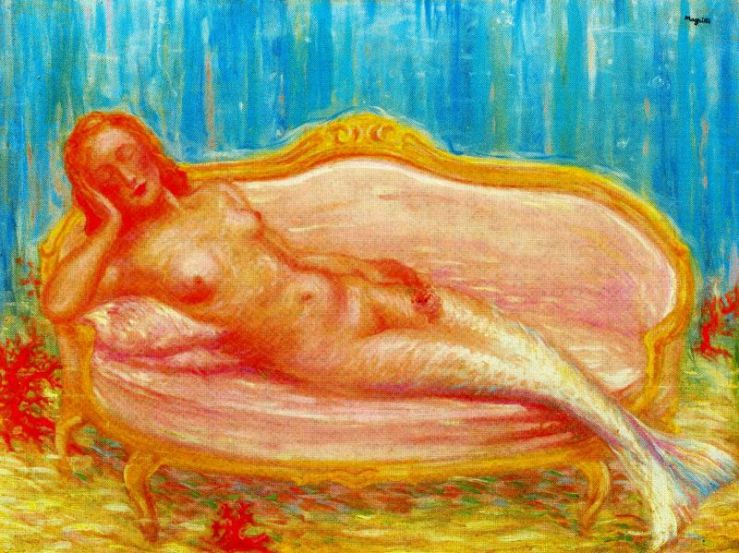
The Forbidden World — Rene Magritte

the-forbidden-world-19491

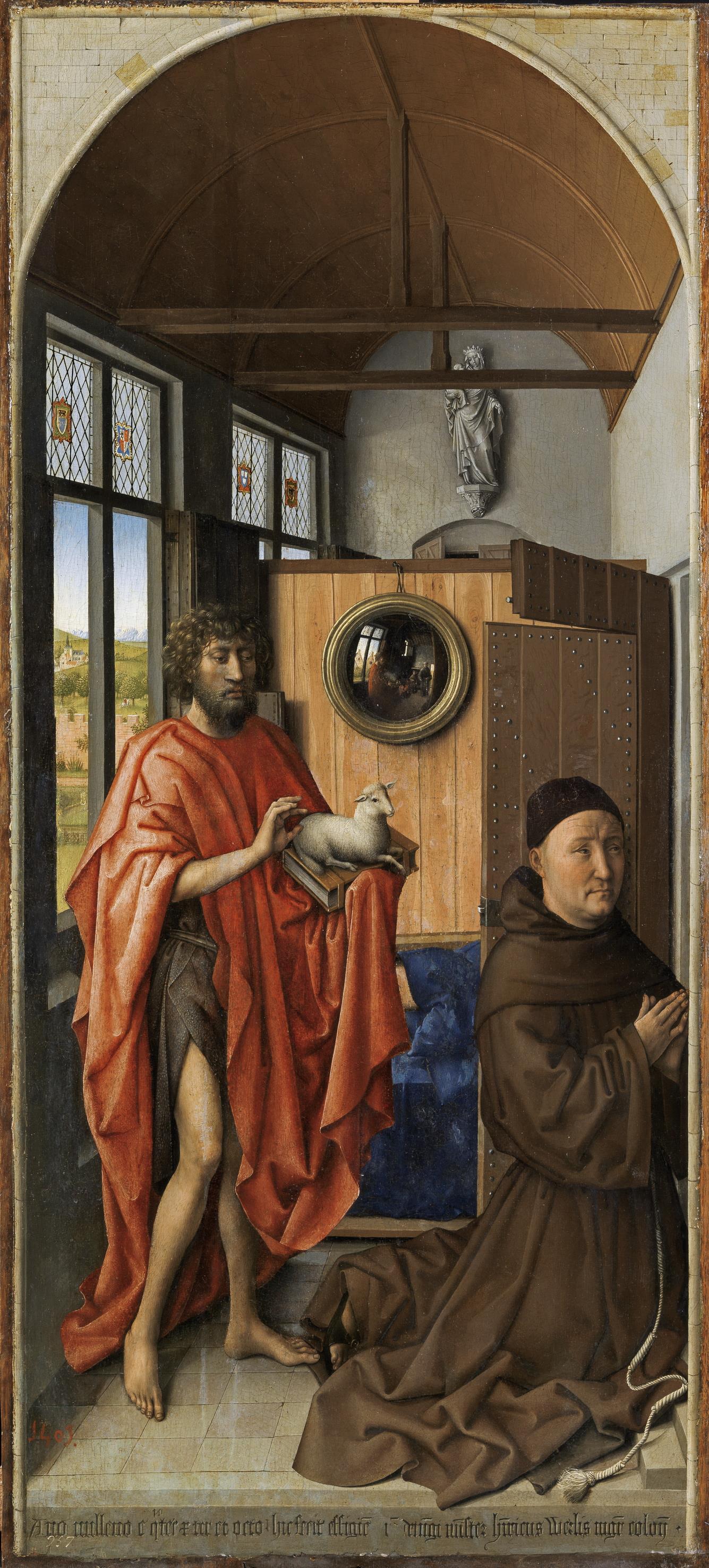
The Werl Triptych (detail) — Robert Campin

a

“The Auction,” a very short story by Stephen Crane

“The Auction”

by

Stephen Crane


Some said that Ferguson gave up sailoring because he was tired of the sea. Some said that it was because he loved a woman. In truth it was because he was tired of the sea and because he loved a woman.

He saw the woman once, and immediately she became for him the symbol of all things unconnected with the sea. He did not trouble to look again at the grey old goddess, the muttering slave of the moon. Her splendours, her treacheries, her smiles, her rages, her vanities, were no longer on his mind. He took heels after a little human being, and the woman made his thought spin at all times like a top; whereas the ocean had only made him think when he was on watch.

He developed a grin for the power of the sea, and, in derision, he wanted to sell the red and green parrot which had sailed four voyages with him. The woman, however, had a sentiment concerning the bird’s plumage, and she commanded Ferguson to keep it in order, as it happened, that she might forget to put food in its cage.

The parrot did not attend the wedding. It stayed at home and blasphemed at a stock of furniture, bought on the installment plan, and arrayed for the reception of the bride and groom.

As a sailor, Ferguson had suffered the acute hankering for port; and being now always in port, he tried to force life to become an endless picnic. He was not an example of diligent and peaceful citizenship. Ablution became difficult in the little apartment, because Ferguson kept the wash-basin filled with ice and bottles of beer: and so, finally, the dealer in second-hand furniture agreed to auction the household goods on commission. Owing to an exceedingly liberal definition of a term, the parrot and cage were included. “On the level?” cried the parrot, “On the level? On the level? On the level?”

On the way to the sale, Ferguson’s wife spoke hopefully. “You can’t tell, Jim,” she said. “Perhaps some of ’em will get to biddin’, and we might get almost as much as we paid for the things.”

The auction room was in a cellar. It was crowded with people and with house furniture; so that as the auctioneer’s assistant moved from one piece to another he caused a great shuffling. There was an astounding number of old women in curious bonnets. The rickety stairway was thronged with men who wished to smoke and be free from the old women. Two lamps made all the faces appear yellow as parchment. Incidentally they could impart a lustre of value to very poor furniture.

The auctioneer was a fat, shrewd-looking individual, who seemed also to be a great bully. The assistant was the most imperturbable of beings, moving with the dignity of an image on rollers. As the Fergusons forced their way down the stair-way, the assistant roared: “Number twenty-one!”

“Number twenty-one!” cried the auctioneer. “Number twenty-one! A fine new handsome bureau! Two dollars? Two dollars is bid! Two and a half! Two and a half! Three? Three is bid. Four! Four dollars! A fine new handsome bureau at four dollars! Four dollars! Four dollars! F-o-u-r d-o-l-l-a-r-s! Sold at four dollars.”

“On the level?” cried the parrot, muffled somewhere among furniture and carpets. “On the level? On the level?” Every one tittered.

Mrs. Ferguson had turned pale, and gripped her husband’s arm. “Jim! Did you hear? The bureau—four dollars—”

Ferguson glowered at her with the swift brutality of a man afraid of a scene. “Shut up, can’t you!”

Mrs. Ferguson took a seat upon the steps; and hidden there by the thick ranks of men, she began to softly sob. Through her tears appeared the yellowish mist of the lamplight, streaming about the monstrous shadows of the spectators. From time to time these latter whispered eagerly: “See, that went cheap!” In fact when anything was bought at a particularly low price, a murmur of admiration arose for the successful bidder.

The bedstead was sold for two dollars, the mattresses and springs for one dollar and sixty cents. This figure seemed to go through the woman’s heart. There was derision in the sound of it. She bowed her head in her hands. “Oh, God, a dollar-sixty! Oh, God, a dollar-sixty!”

The parrot was evidently under heaps of carpet, but the dauntless bird still raised the cry, “On the level?”

Some of the men near Mrs. Ferguson moved timidly away upon hearing her low sobs. They perfectly understood that a woman in tears is formidable.

The shrill voice went like a hammer, beat and beat, upon the woman’s heart. An odour of varnish, of the dust of old carpets, assailed her and seemed to possess a sinister meaning. The golden haze from the two lamps was an atmosphere of shame, sorrow, greed. But it was when the parrot called that a terror of the place and of the eyes of the people arose in her so strongly that she could not have lifted her head any more than if her neck had been of iron.

At last came the parrot’s turn. The assistant fumbled until he found the ring of the cage, and the bird was drawn into view. It adjusted its feathers calmly and cast a rolling wicked eye over the crowd.

“Oh, the good ship Sarah sailed the seas,And the wind it blew all day—”

This was the part of a ballad which Ferguson had tried to teach it. With a singular audacity and scorn, the parrot bawled these lines at the auctioneer as if it considered them to bear some particular insult.

The throng in the cellar burst into laughter. The auctioneer attempted to start the bidding, and the parrot interrupted with a repetition of the lines. It swaggered to and fro on its perch, and gazed at the faces of the crowd, with so much rowdy understanding and derision that even the auctioneer could not confront it. The auction was brought to a halt; a wild hilarity developed, and every one gave jeering advice.

Ferguson looked down at his wife and groaned. She had cowered against the wall, hiding her face. He touched her shoulder and she arose. They sneaked softly up the stairs with heads bowed.

Out in the street, Ferguson gripped his fists and said: “Oh, but wouldn’t I like to strangle it!”

His wife cried in a voice of wild grief: “It—it m—made us a laughing-stock in—in front of all that crowd!”

For the auctioning of their household goods, the sale of their home—this financial calamity lost its power in the presence of the social shame contained in a crowd’s laughter.
Mater Dolorosa — Hans Memling

mater-dolorosa

Sex ed (Glen Baxter)

tumblr_o3daxjPaNw1r5zbdgo1_1280

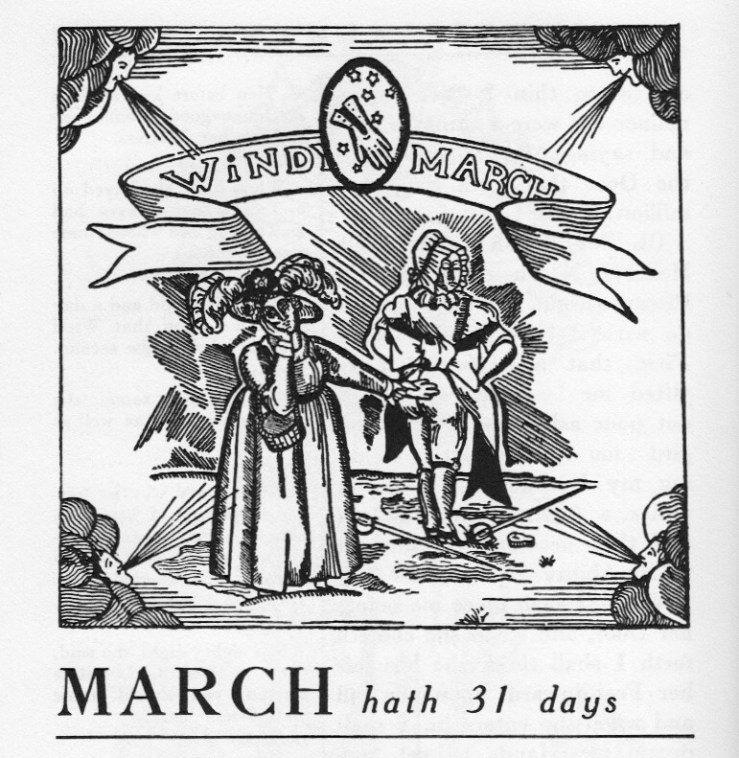
March — Djuna Barnes

img_1649

From Djuna Barnes’s Ladies Almanack.

A Mossy Glen — John Atkinson Grimshaw

a-mossy-glen

“Your Hard Work is About to Pay Off. Keep On Keeping On.” — Bitchin Bajas & Bonnie ‘Prince’ Billy

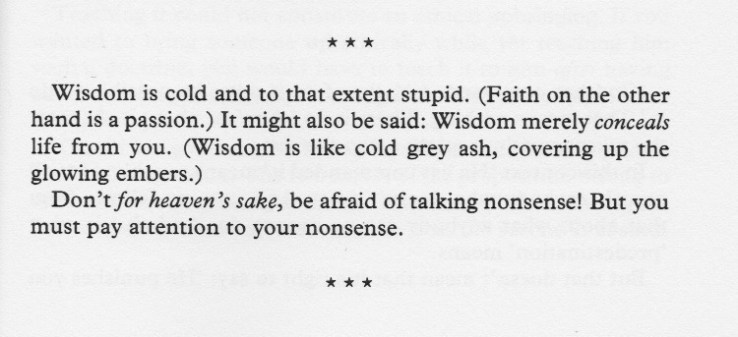
Wisdom is cold (Wittgenstein)

img_1616-1

From The Wittgenstein Reader, Blackwell (1994). Edited by Anthony Kenny; English translation by Peter Winch.

Leaping Children — Charles Blackman

leaping-children-1968

Read William Faulkner’s short story “Hair”

“Hair”

by

William Faulkner


THIS GIRL, this Susan Reed, was an orphan. She lived with a family named Burchett, that had some more children, two or three more. Some said that Susan was a niece or a cousin or something; others cast the usual aspersions on the character of Burchett and even of Mrs. Burchett: you know.

Women mostly, these were.

She was about five when Hawkshaw first came to town.

It was his first summer behind that chair in Maxey’s barber shop that Mrs Burchett brought Susan in for the first time.

Maxey told me about how him and the other barbers watched Mrs Burchett trying for three days to get Susan (she was a thin little girl then, with big scared eyes and this straight, soft hair not blonde and not brunette) into the shop. And Maxey told how at last it was Hawkshaw that went out into the street and worked with the girl for about fifteen minutes until he got her into the shop and into his chair: him that hadn’t never said more than Yes or No to any man or woman in the town that anybody ever saw. “Be durn if it didn’t look like Hawkshaw had been waiting for her to come along,” Maxey told me.

That was her first haircut. Hawkshaw gave it to her, and her sitting there under the cloth like a little scared rabbit.

But six months after that she was coming to the shop by herself and letting Hawkshaw cut her hair, still looking like a little old rabbit, with her scared face and those big eyes and that hair without any special name showing above the cloth. If Hawkshaw was busy, Maxey said she would come in and sit on the waiting bench close to his chair with her legs sticking straight out in front of her until Hawkshaw got done. Maxey says they considered her Hawkshaw’s client the same as if she had been a Saturday night shaving customer. He says that one time the other barber, Matt Fox, offered to wait on her, Hawkshaw being busy, and that Hawkshaw looked up like a flash. “I’ll be done in a minute,” he says. “I’ll tend to her.” Maxey told me that Hawkshaw had been working for him for almost a year then, but that was the first time he ever heard him speak positive about anything.

That fall the girl started to school. She would pass the barber shop each morning and afternoon. She was still shy, walking fast like little girls do, with that yellow-brown head of hers passing the window level and fast like she was on skates. She was always by herself at first, but pretty soon her head would be one of a clump of other heads, all talking, not looking toward the window at all, and Hawkshaw standing there in the window, looking out. Maxey said him and Matt would not have to look at the clock at all to tell when five minutes to eight and to three o’clock came, because they could tell by Hawkshaw. It was like he would kind of drift up to the window without watching himself do it, and be looking out about the time for the school children to begin to pass. When she would come to the shop for a haircut, Hawkshaw would give her two or three of those peppermints where he would give the other children just one, Maxey told me.

No; it was Matt Fox, the other barber, told me that. He was the one who told me about the doll Hawkshaw gave her on Christmas. I don’t know how he found it out. Hawkshaw never told him. But he knew some way; he knew more about Hawkshaw than Maxey did. He was a married man himself, Matt was. A kind of fat, flabby fellow, with a pasty face and eyes that looked tired or sad something. A funny fellow, and almost as good a barber as Hawkshaw. He never talked much either, and I don’t know how he could have known so much about Hawkshaw when a talking man couldn’t get much out of him. I guess maybe a talking man hasn’t got the time to ever learn much about anything except words.

Anyway, Matt told me about how Hawkshaw gave her a present every Christmas, even after she got to be a big girl. Continue reading “Read William Faulkner’s short story “Hair””

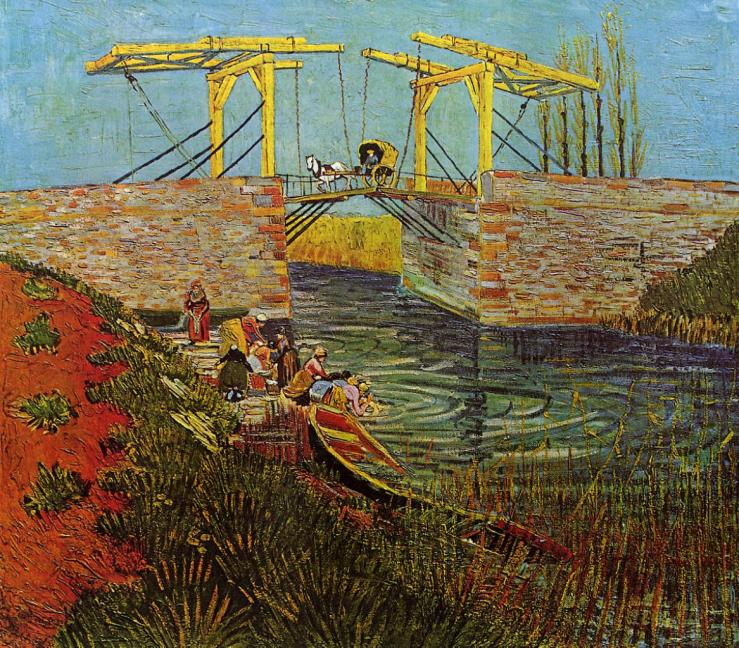
The Langlois Bridge at Arles — Vincent van Gogh

the-langlois-bridge-at-arles-1888-1

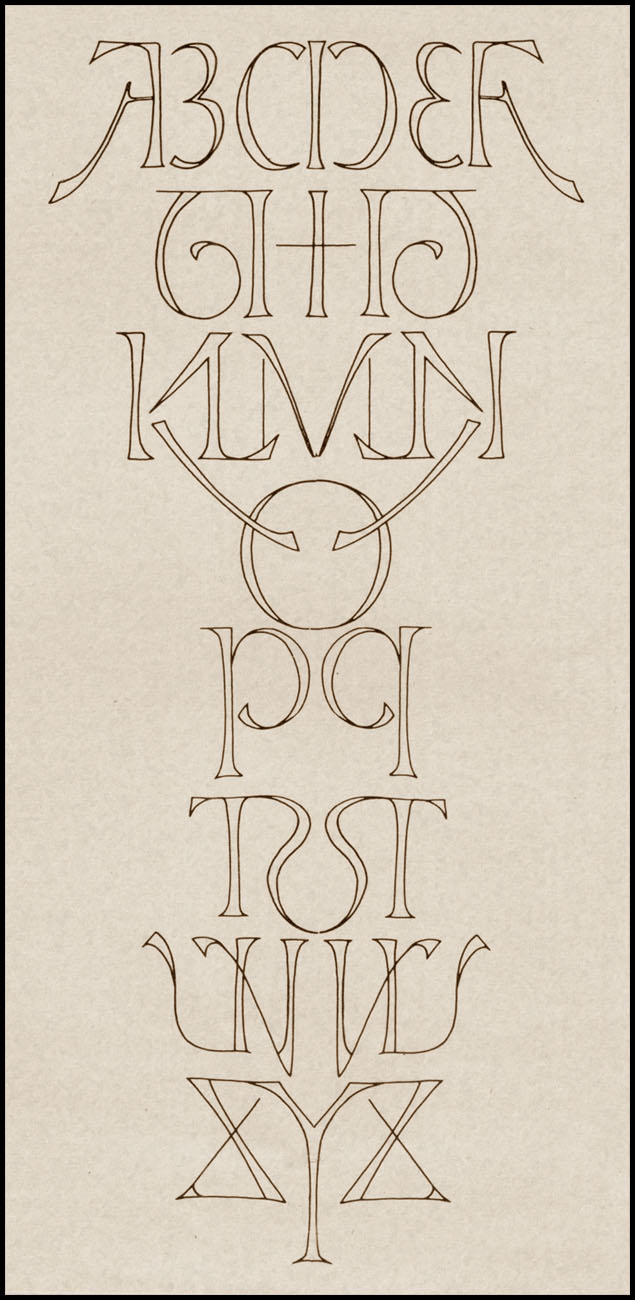
Ambigram Alphabet — Scott Kim

7a6sf

(By Scott Kim; via Stan Carey).

Three Books

img_1640

The Adventures of Huckleberry Finn by Mark Twain. Mass market paperback by Bantam, 10th ed., 1986. No designer credited, but the cover illustration is a 1981 painting by Doug Johnson, and it is the sole reason that I’ve held onto this copy for over a decade now, since I first used it as part of a class set for an eleventh grade English class I used to teach. Perhaps from a technical standpoint, I stole this book.

img_1642

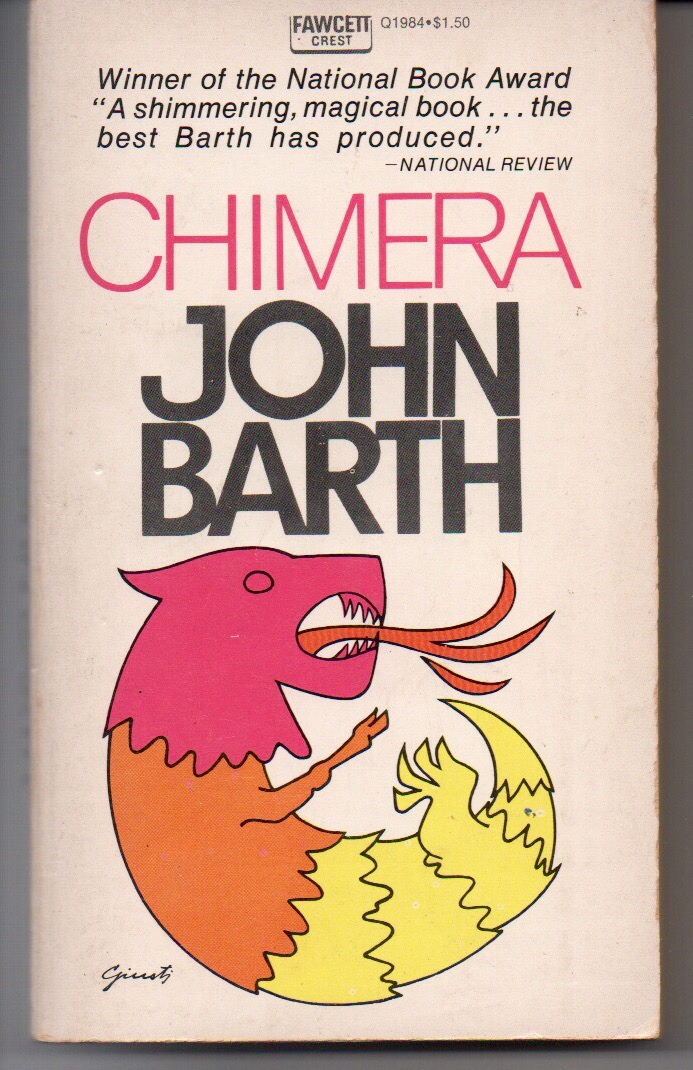
Chimera by John Barth. Mass market paperback by Fawcett Crest, 1973.  No designer credited, and the cover artist isn’t named in the colophon or on the back–but the cover is signed. Perhaps the original hardback, which shares this illustration, credited the artist. I read this book in the right place and at the right time—I was a junior or senior in college, obsessed with postmodernism as a technique (rather than postmodernism as a description), and Chimera’s intense gamesmanship enchanted me. I’m pretty sure I read it after Lost in the Funhouse, and that after Wallace’s Westward the Course of Empire Takes Its Way. I bought this copy eight or nine years ago (having read it first as a library book), and attempted a reread and was…less impressed. Still, it would be hard for me to overstate how much Chimera did for me—how much it showcased the possibilities of literature and storytelling.

img_1639

The Ballad of the Sad Cafe and Other Stories by Carson McCullers. Mass market paperback edition by Bantam. No designer or cover artist credited—which is too bad because I love the image. The most recent date on the colophon is 1971 but I am pretty sure the book was published in 1996. I bought it in 1997. It was assigned reading for a creative writing class, and that—along with Johnson’s Jesus’ Son—were the only good things to come out of that misery. (My instructor would not shut the fuck up about “craft,” and he singled out the simile I was most proud of in one of my stories as “a bit much”).

Today’s Three Books’ mass market paperbacks are part of a small cadre of a once-large selection, winnowed away over the years, usually given away to students, etc. (I have an extra copy of Adventures of Huckleberry Finn in my car, should you need one).

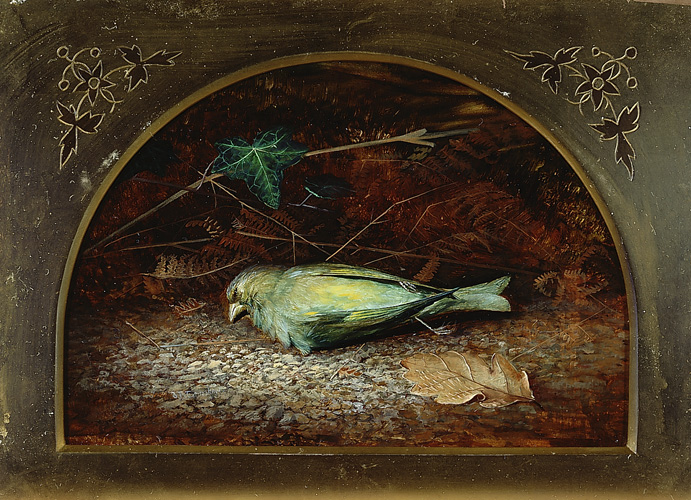
A Dead Linnet — John Atkinson Grimshaw

a-dead-linnet-1862