Three Books

img_1392

J R by William Gaddis. 1993 trade paperback edition by Penguin. Cover art is a detail of an Associated Gas and Electric Company stock certificate “Courtesy of William Gaddis.” No designer credited.

img_1391

Infinite Jest by David Foster Wallace. 1997 first paperback printing edition by Abacus (Great Britain). No designer credited.

img_1394

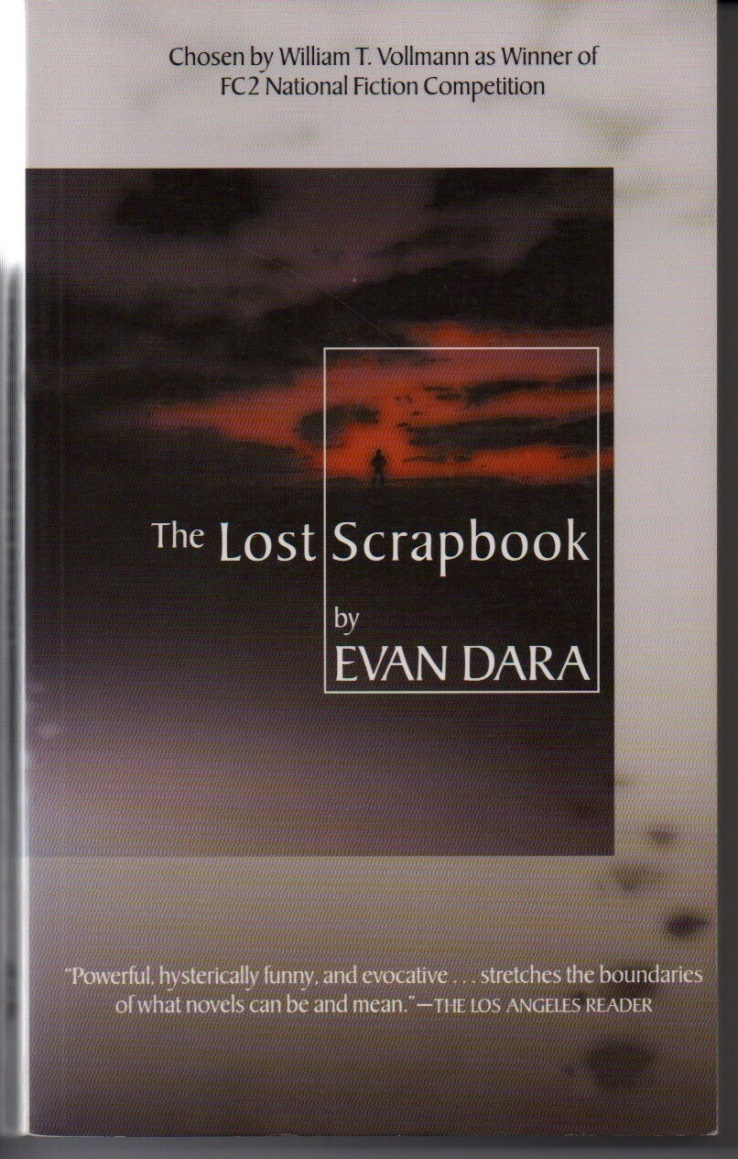
The Lost Scrapbook by Evan Dara. First paperback printing by Aurora, 1998. Cover design by Todd Michael Bushman.

Does anything good happen in The Hateful Eight?

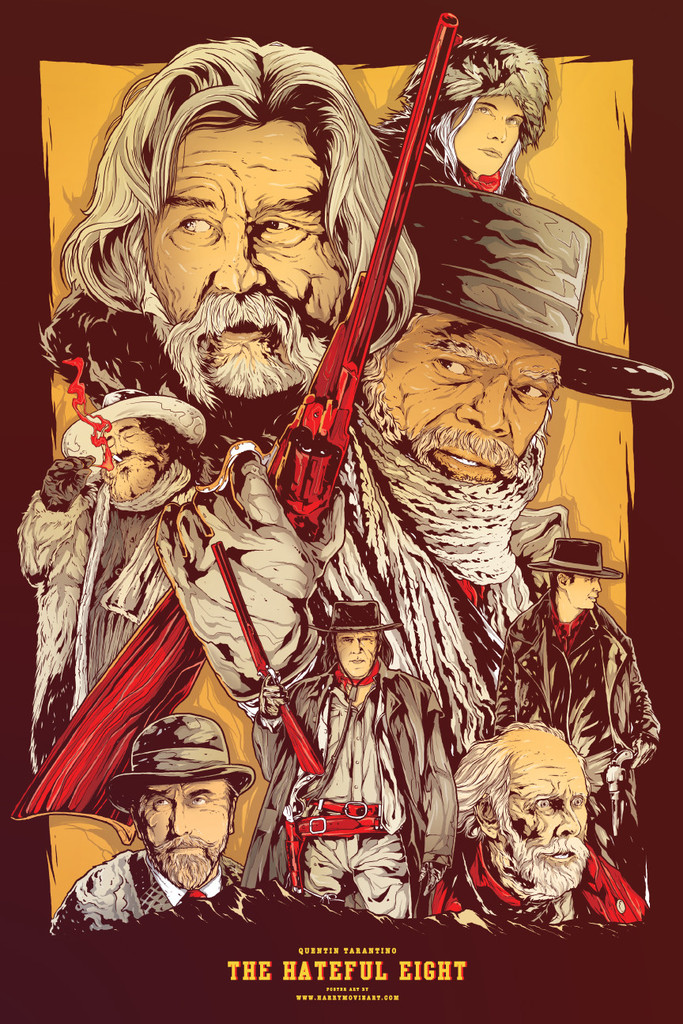
Hateful-eight-12x18_1024x1024

I don’t like films where nothing good happens, my wife told me years ago. I can’t remember the film that occasioned this remark, and I don’t find myself beholden to her rubric, but I still find myself applying it to films now and then. Especially after watching Quentin Tarantino’s The Hateful Eight.

Does anything good happen in The Hateful Eight?

(This is not the right question to ask about a film, but—).

This question isn’t the same as, say, Is any part of The Hateful Eight good?—because so many of the elements are good—excellent even—Ennio Morricone’s score, Robert Richardson’s cinematography, Yohei Taneda’s set design.

And the acting is great, or sorta great, or it’s hard to tell, maybe. Let’s say the performances are great. I mean, it’s Tarantino, so the acting is always at least one level removed from reality—even in Sam Jackson, the realest dude, the dude who carries the film as former Union officer, Major Marquis Warren. Sam Jackson is Tarantino’s main man, his star of hyperreality, and his performance is electric here.

But for hyperreality, it’s Jennifer Jason Leigh who stands out in The Hateful Eight. Her portrayal of prisoner Daisy Domergue is refined Looney Tunes slapstick. Cartoon soul. Watching Walton Goggins (vile racist ex-Confederate marauder Chris Mannix) or Kurt Russell (bounty hunter John Ruth)—both of whom get lots and lots of lines and screen time—one can’t help but realize one is seeing an actor acting—or, more Tarantinoesque—a character acting.

But Jennifer Jason Leigh, remanded to a punching bag for much of the film—or even stranger, a chained work-wife to Kurt Russell’s John Wayne parody (via Kurt Russell’s John Wayne parody as Jack Burton in Big Trouble in Little Trouble)—JJL imbues her Daisy Domergue with a wily pathos that surpasses both the script she’s made to read and her Seussian name.

Not that JJL’s Daisy Domergue’s isn’t vile, nasty, deeply racist, and hateful…but her hatefulness points towards something, I dunno, complex. Real. True. (I should mention now Laura Bogart’s essay “Hipster Misogyny: The Betrayal of The Hateful Eight,” which I think offers an intriguing read on the film. Bogart seems to argue that JJL’s DD is not complex enough, or not given enough complexity, which, hey, okay, fair enough—but I think also that Bogart was disturbed by the film’s conclusion—which I was too, disturbed). 

But: Does anything good happen in The Hateful Eight?

What do I mean here by good? Should I just admit I don’t know “good,” but rather feel “good”? Okay. I don’t know good through definition, but rather by example. Fuzzy precis. Good: Perhaps a moment of redemption, but like, say, an earned one, a real one, one not forced through a Hollywood formula. Good might be kernel of hope—a real moment of hope, not just an up established for a foreshadowed down. Or maybe by good I just mean something aesthetically true.

Tarantino’s best films—the Kill Bill films, Pulp FictionJackie Brown, and Reservoir Dogs—point to something good in their conclusions—and by conclusions I mean both literal endings and thesis statements. I’m not sure if I find this same “goodness” evident in the conclusion of The Hateful Eight, or, if it is there, it’s awfully ambiguous.

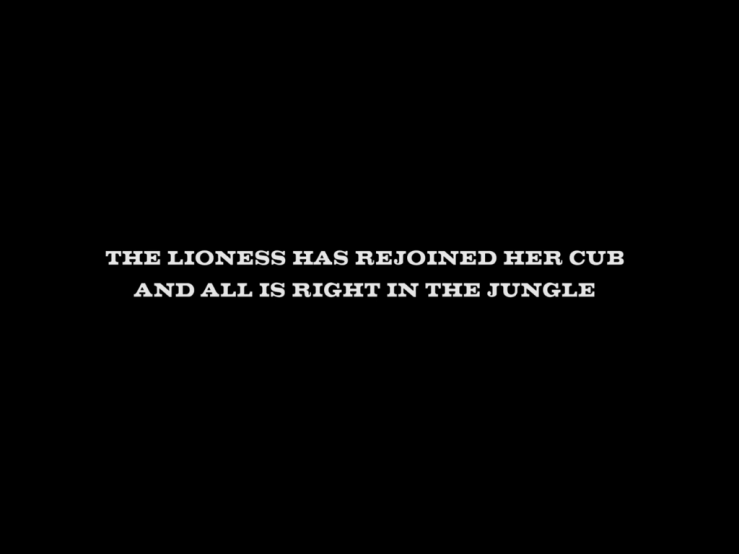
The conclusion of The Hateful Eight is the not-exact opposite of the end of my favorite Tarantino conclusion, the end of Kill Bill 2:

img_0370

And The Hateful Eight’s conclusion is the not-exact opposite of the ending of Jackie Brown’s bittersweet take on redemption, loss, and escape—American lives that earn second acts.

And The Hateful Eight’s conclusion is the not-exact opposite of the ending Pulp Fiction, a film that resurrects Vincent Vega and sees Sam Jackson’s Jules Winnfield suspend wrathful violence and judgment on Tim Roth’s Ringo (or Pumpkin. Or whatever his name was).

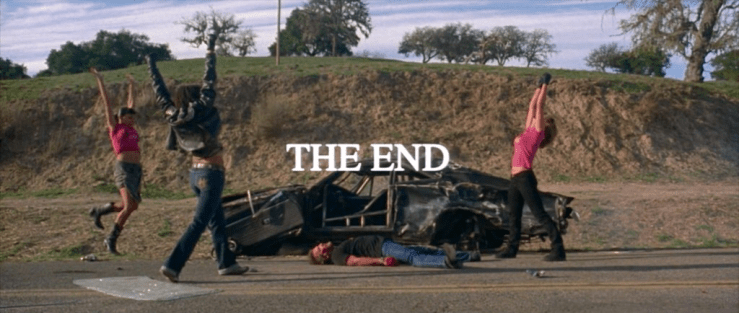
And what about those films that didn’t make my silly little list of “Best Tarantino” — Inglorious Basterds (which is one of my faves, actually, just to watch for like, pure entertainment), Django Unchained, and Death Proof (which actually belongs on that best-of list, maybe, or at least the final sequence)? Shoshanna Dreyfus using film as weapon to end the Nazis? Django’s righteous rampage against slavery? Or the ecstatic violence of “the girls” destroying serial killer Stuntman Mike?

img_0372

What most of QT’s conclusions share in common is that they somehow mediate the relationship between revenge and justice, and do so in a way that’s aesthetically convincing. The Hateful Eight also seeks to be a film about the relationship between revenge and justice. Its final moments attempt to aesthetically recapitulate much of American history into a morbid sequence of violence.

[Fair warning: There’s a discussion of the conclusion of The Hateful Eight coming up, including what some folks might call spoilers].

Continue reading “Does anything good happen in The Hateful Eight?”

A New York Blizzard — Childe Hassam

a-new-york-blizzard

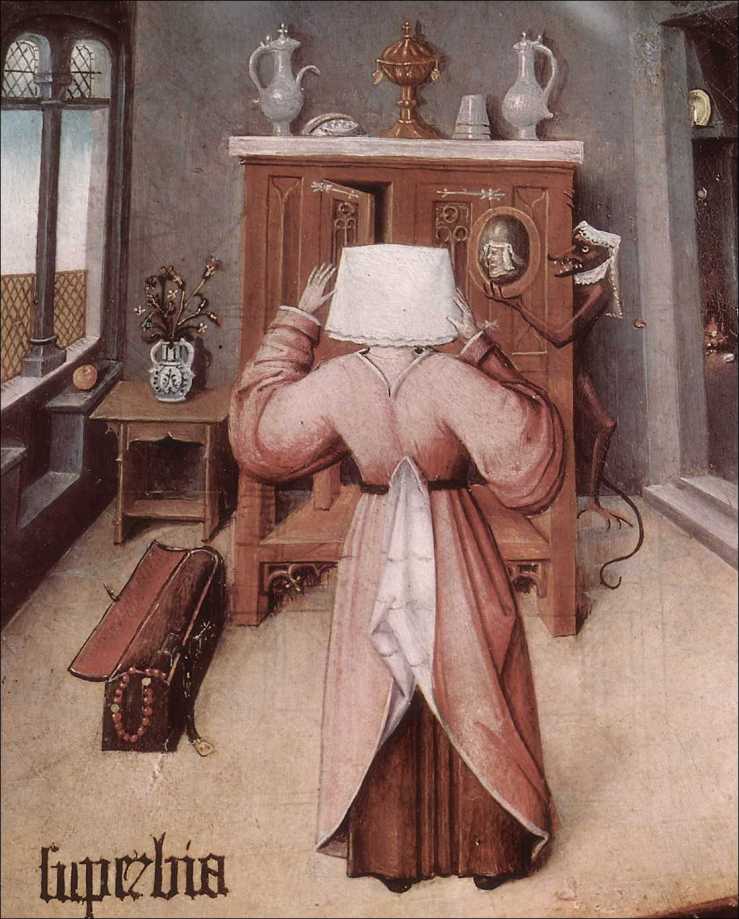
Pride — Hieronymus Bosch

1480-1520-c2b7-hieronymus-bosch-c2b7-superbia

“When Thy Song Flows Through Me” — Bonnie ‘Prince’ Billy

The Bridge — Mike Davis

the bridge

A Jester — Marx Reichlich

1520-MARX-REICHLICH-A-JESTER

Nothing music (William Gaddis)

—No it’s all right . . . he’d brought his eyes up sharply from the loose collar of her blouseless suit, more the appeal of asking a favor than granting one in his tone—that was when he was old though, Wagner I mean, when Wagner was old and . . .

—Yes but that’s what you meant isn’t it, about creating an entirely different world when you write an opera, about asking the audience to suspend its belief in the . . .

—No not asking them making them, like that E flat chord that opens the Rhinegold goes on and on it goes on for a hundred and thirty-six bars until the idea that everything’s happening under water is more real than sitting in a hot plush seat with tight shoes on and . . .

—Mrs Joubert could I have a dime?

—I think you’ve had enough to eat Debby, we’re . . .

—It’s Linda.

—Linda yes I’m sorry, where’s your sweater.

—Over on the table, I don’t want to eat they said it costs a dime to go to the toilet here, you have to put a dime in to get in the . . .

—Yes yes all right if, oh thank you again we must be taking every penny you.

—No no it’s all right I’ve, I’d put some aside for the union and when they wouldn’t take me, when you say you’re a concert pianist they give you as hard a score as they can find there was a drummer there and all they asked for was give us a paradiddle . . .

—But why must you join at all, if you simply want to compose . . .

—No well since this teaching was, since it didn’t really work out too well I thought if I could find some work playing I could keep on with my . . .

—Mrs Jou . . .

—Here . . .! he thrust a dime at the figure shifting rapidly foot to foot beside her,—that I could keep working on my . . .

—But couldn’t you earn something writing music for, I don’t know but there must be somewhere you could . . .

—Yes well that’s what I did, what I’m doing I mean somebody I met there, a bass player, he was on standby he’s getting paid not to play at a Broadway show they say is a musical just because it . . .

—Mis . . .

—Excuse me, boys please! You’ve just had a dollar J R you don’t need . . .

—No I know, I just wondered if Mister Bast wants me to change some nickels from a dollar for him.

—Not, no but if you’d like something?

—Some, just some tea I think, I don’t feel awfully well . . .

—Yes wait, here . . . he peeled away a bill under the table.

—And he found you something? this bass player?

—No well yes sort of indirectly, he said he wanted to help me out and sent me to a place over on the West Side where they said they wanted some nothing music, three minutes of nothing music it’s for television or something, they said they had three minutes of talk on a track or a tape they needed music behind it but it couldn’t have any real form, anything distinctive about it any sound anything that would distract from this voice this, this message they called it, they . . .

—But of all things how absurd, paying a composer to . . .

—Yes well they didn’t, I couldn’t do it I mean, they were in a hurry they would have paid me three hundred dollars and I tried and all I could, everything I did they said was too . . .

—And that’s hardly what I meant, someone being paid not to play who sends you somewhere to write nothing mus . . .

—Well what do you think I . . .! he caught one hand back with the other,—I’m sorry I, three hundred dollars all I could think of was that concerto of Mozart’s the D-minor, that’s more than he got paid for the whole series and I couldn’t even . . .

—But I think it’s marvelous, that you couldn’t write their nothing music? I mean just because you can’t get paid to play Chopin or even write music that’s . . .

—No but I am though, I didn’t finish . . . he looked up from her fingertips touching his hands clenched there,—when I left somebody else there said he’d like to help me out and sent me downtown to see some dancers who want their own music for . . .

—Boys . . .! her hand was gone,—settle down! she called after the collision at the marbled cashier’s cage—I’m sorry, we . . .

—Do you like Chopin?

—Oh of course I do yes, that ballade the Ballade in G? it’s simply the most roman . . .

—In G-minor yes that’s on the program if I could get tickets would you, it’s next week would you like to go if I can get the tickets it’s a recital by . . .

—That’s awfully sweet Mister Bast I . . .

—No well I guess I, I mean you’re married I didn’t think of that I just . . .

—That’s hardly the reason no but, I’m just afraid I can’t, I’m . . .

—No that’s all right I just, I just thought you, you wanted some tea yes I’m sorry I’ll get it . . .

—Thank you I’d, oh be careful! she’d seized his wrist.

—No I’m all right . . . he came up slowly as her hand fell away,—I’ll get it . . . he righted the chair and stood looking, turned toward the figures huddled at a table near the telephone booths foreheads almost touching, hands churning coins.
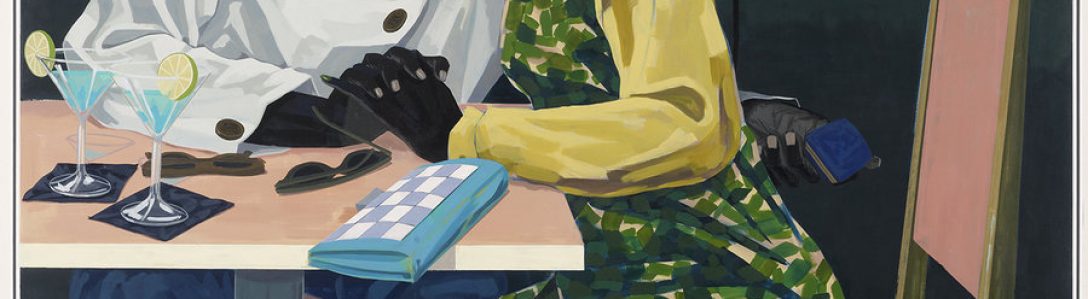
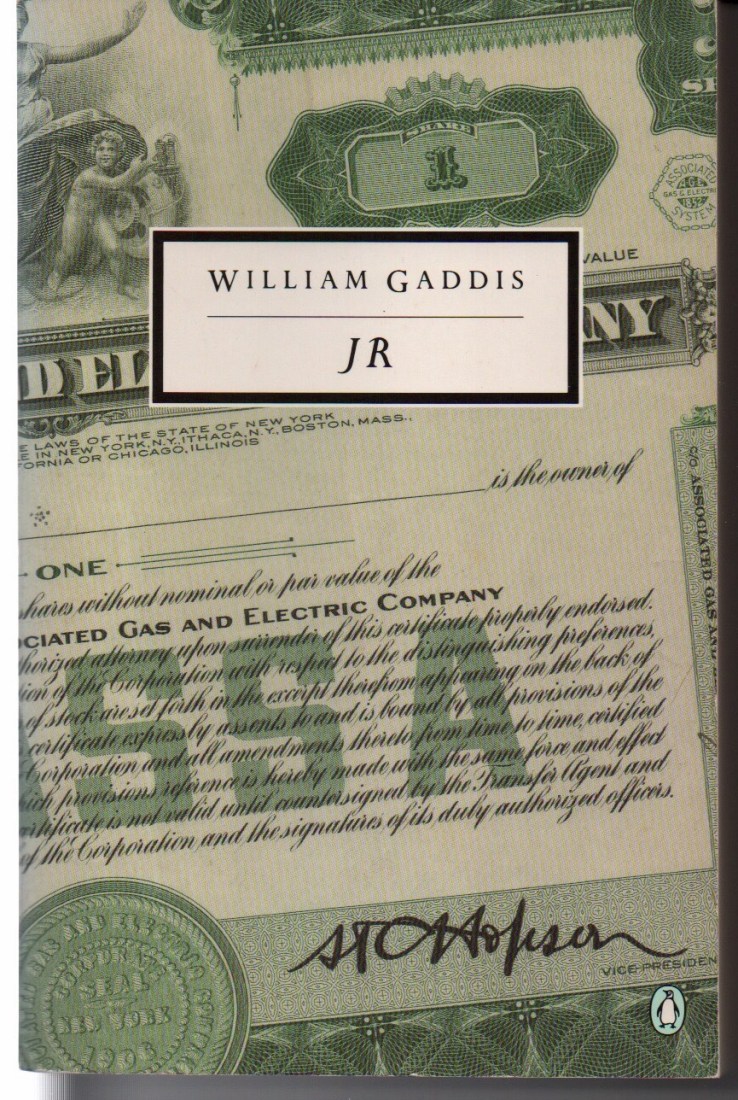
Another intersection of art and commerce in William Gaddis’s novel J R.

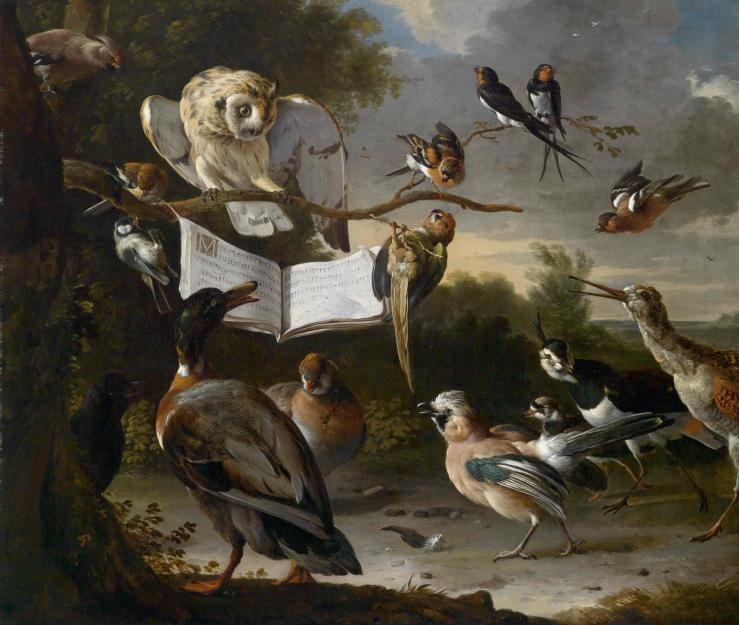
The Morning Birds — Melchior d’Hondecoeter

melchior_de_hondecoeter_-_das_vogelkonzert

The Coen Brothers talk with Guillermo del Toro about Inside Llewyn Davis

Order is simply a thin, perilous condition we try to impose on the basic reality of chaos (William Gaddis)

Before we go any further here, has it ever occurred to any of you that all this is simply one grand misunderstanding? Since you’re not here to learn anything, but to be taught so you can pass these tests, knowledge has to be organized so it can be taught, and it has to be reduced to information so it can be organized do you follow that? In other words this leads you to assume that organization is an inherent property of the knowledge itself, and that disorder and chaos are simply irrelevant forces that threaten it from the outside. In fact it’s the opposite. Order is simply a thin, perilous condition we try to impose on the basic reality of chaos . . .

So I’m going through William Gaddis’s novel J R again (via Nick Sullivan’s amazing audiobook recording-performance)…

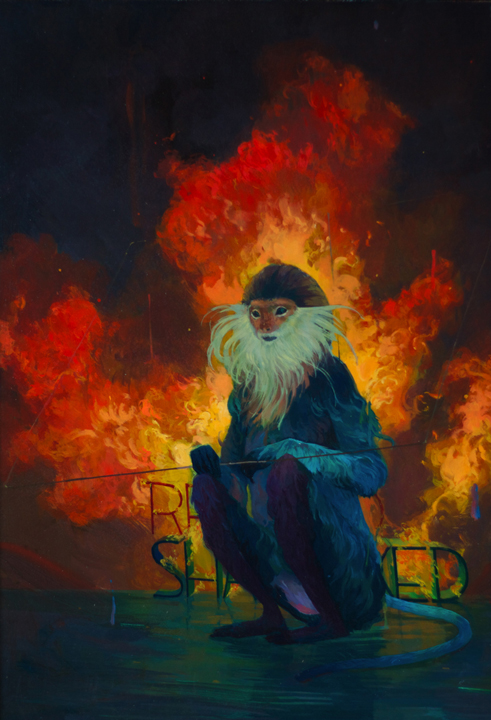
Red Got Shanked — Andrew Hem

49_redshankedlo

Sybil — Cecil Collins

Sybil 1960 by Cecil Collins 1908-1989

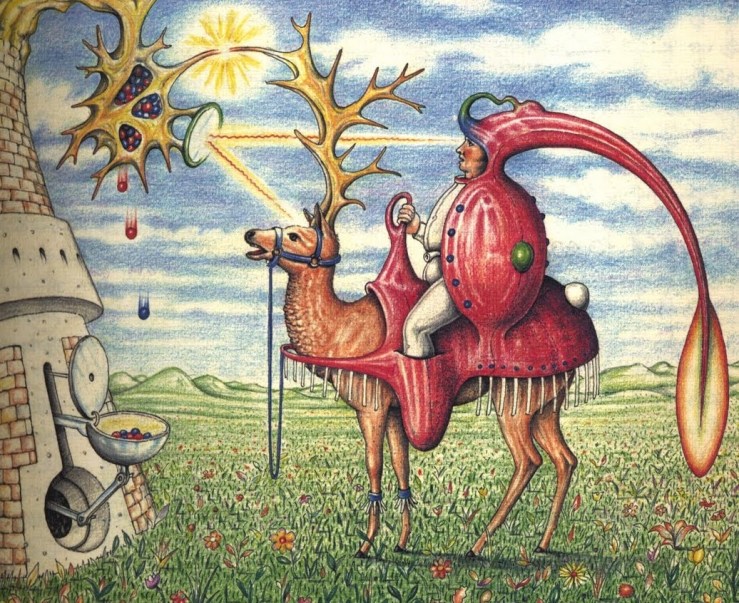
…from Codex Seraphinianus

tumblr_lxdfgkJT9s1qgwtuco1_1280

Hawksbill Turtle — Mark Catesby

catesby_natural_history_of_carolina_plate_139_hawksbill_turtle

Nile Rodgers talks about the riff for David Bowie’s “Let’s Dance”