Sebald/Purdy/Baxter (Books acquired, 1.05.2016)

img_1288

László Hunyadi on the Bier — Viktor Madarász

2hunyadi

“All art constantly aspires towards the condition of music”

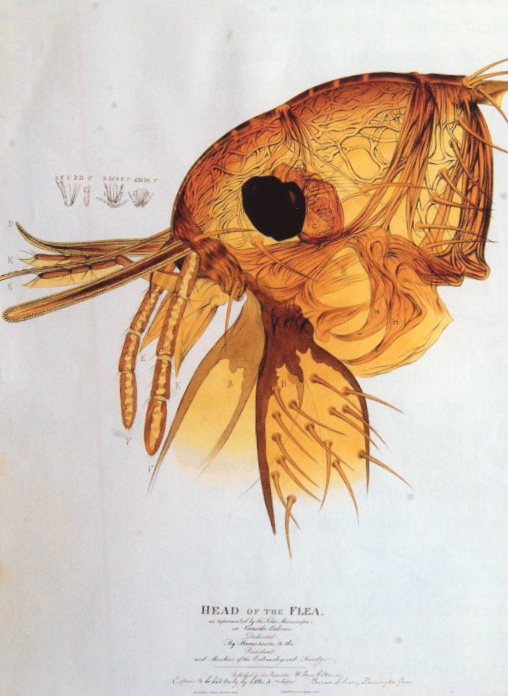
Head of the Flea — W. Lens Aldous

flea

“We’ve Only Just Begun,” more new fiction from Anne Carson

They got into our car at a stoplight. It was cold. We never lock the doors in back. There were two of them. At the apartment they terrorized us. It took all day, most of the night. There was beating and thrashing and scorn and damage and fear. Sounds I didn’t know could come out of us. Above all it was boring. In the sense that it was all actions and all bad; there is no life of the mind available amid beating and thrashing and scorn and damage and fear, no space at the back of oneself to go to and think anything else. Long stretches of boredom that fill up with something like thinking but there is nothing to think except what it is, what it is to be in this, and what it is to be in this is simply and utterly nothing but what it is, no volume around it, no beach, no reverie. At one point Washington raised his arms to me and blood ran down both arms to the floor. I watched it hit the tiles, it would have been something to think about, cleaning blood off tiles. Sometimes it’s better to just replace them. Eventually in fact that’s what we would do, replace the white ones. We kept the black ones, which were sort of speckled anyway. But “eventually” is not a concept of mind that exists amid beating and thrashing and scorn and damage and fear. Even when they had Washington dance in the red-hot shoes, I wasn’t imagining analogies, Snow White, I was soaked into Washington’s dread, it had no edge. That is what boredom is, the moment with no edge.

To survive you need an edge.

Read the rest of “We’ve Only Just Begun” at Harper’s.

Twelfth Night — Pieter Brueghel the Younger

twelfth

One gets put in a drawer which says Thomas Bernhard, a follower of Thomas Bernhard, etc. (W.G. Sebald)

Michael Silverblatt: It seems to me that this book is truly the first to pay extended stylistic respects to the writer who, it’s been said, has been your mentor and model, Thomas Bernhard. I wondered, was it after three books that one felt comfortable in creating a work that could be compared to the writing of a master and a mentor?

W.G. Sebald: Yes, I was always, as it were, tempted to declare openly from quite early on my great debt of gratitude to Thomas Bernhard. But I was also conscious of the fact that one oughtn’t to do that too openly, because then immediately one gets put in a drawer which says Thomas Bernhard, a follower of Thomas Bernhard, etc., and these labels never go away. Once one has them they stay with one. But nevertheless, it was necessary for me eventually to acknowledge his constant presence, as it were, by my side. What Thomas Bernhard did to postwar fiction writing in the German language was to bring to it a new radicality which didn’t exist before, which wasn’t compromised in any sense. Much of German prose fiction writing, of the fifties certainly, but of the sixties and seventies also, is severely compromised, morally compromised, and because of that, aesthetically frequently insufficient. And Thomas Bernhard was in quite a different league because he occupied a position which was absolute. Which had to do with the fact that he was mortally ill since late adolescence and knew that any day the knock could come at the door. And so he took the liberty which other writers shied away from taking. And what he achieved, I think, was also to move away from the standard pattern of the standard novel. He only tells you in his books what he heard from others. So he invented, as it were, a kind of periscopic form of narrative. You’re always sure that what he tells you is related, at one remove, at two removes, at two or three. That appealed to me very much, because this notion of the omniscient narrator who pushes around the flats on the stage of the novel, you know, cranks things up on page three and moves them along on page four and one sees him constantly working behind the scenes, is something that I think one can’t do very easily any longer. So Bernhard, single-handedly I think, invented a new form of narrating which appealed to me from the start.

From W.G. Sebald’s December 2001 interview with Michael Silverblatt; republished in The Emergence of Memory: Conversations with W.G. Sebald (Lynne Sharon Schwartz ed.).

The King Drinks — Jacob Jordaens

beankin

Distress Call — Kit Williams

distress-call-1979

There are a number of difficulties with dirty words, the first of which is that there aren’t nearly enough of them (William H. Gass)

There are a number of difficulties with dirty words, the first of which is that there aren’t nearly enough of them; the second is that the people who use them are normally numskulls and prudes; the third is that in general they’re not at all sexy, and the main reason for this is that no one loves them enough. Contrary to those romantic myths which glorify the speech of mountain men and working people, Irish elves and Phoenician sailors, the words which in our language are worst off are the ones which the worst-off use. Poverty and isolation produce impoverished and isolated minds, small vocabularies, a real but fickle passion for slang, most of which is like the stuff which Woolworths sells for ashtrays, words swung at random, wildly, as though one were clubbing rats, or words misused in an honest but hopeless attempt to make do, like attacking tins with toothpicks; there is a dominance of cliché and verbal stereotype, an abundance of expletives and stammer words: you know, man, like wow! neat, fabulous, far-out, sensaysh. I am firmly of the opinion that people who can’t speak have nothing to say. It’s one more thing we do to the poor, the deprived: cut out their tongues . . . allow them a language as lousy as their lives.

Thin in content, few in number, constantly abused: what chance do the unspeakables have? Change is resisted fiercely, additions are denied. I have introduced ‘squeer,’ ‘crott,’ ‘kotswinkling,’ and ‘papdapper,’ with no success. Sometimes obvious substitutes, like ‘socksucker,’ catch on, but not for long. What we need, of course, is a language which will allow us to distinguish the normal or routine fuck from the glorious, the rare, or the lousy one—a fack from a fick, a fick from a fock—but we have more names for parts of horses than we have for kinds of kisses, and our earthy words are all . . . well . . . ‘dirty.’ It says something dirty about us, no doubt, because in a society which had a mind for the body and other similarly vital things, there would be a word for coming down, or going up, words for nibbles on the bias, earlobe loving, and every variety of tongue track. After all, how many kinds of birds do we distinguish?

We have a name for the Second Coming but none for a second coming. In fact our entire vocabulary for states of consciousness is critically impoverished.

From William H. Gass’s On Being Blue.

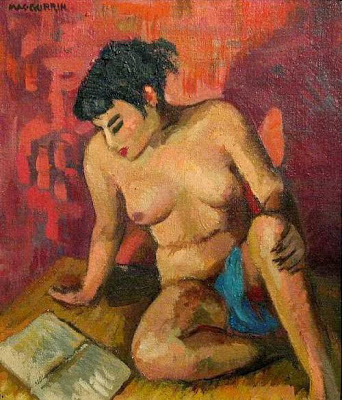
Amanda Reading — Buckley MacGurrin

macgurrin-buckley-amanda-reading

Spelling (Glen Baxter)

tumblr_o04n2sl5wz1r5zbdgo1_500

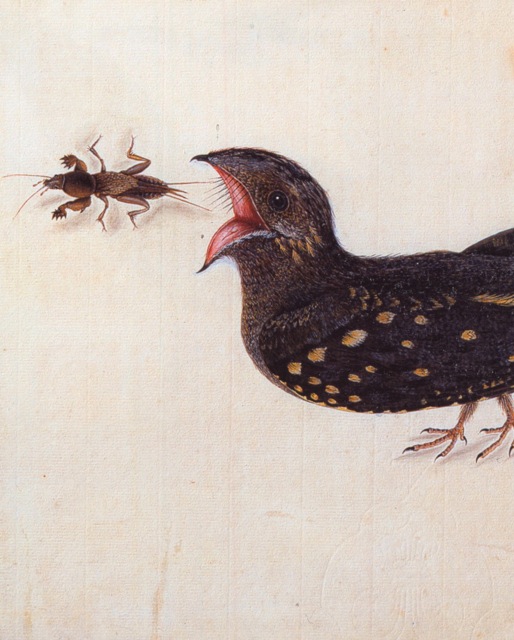
Nightjar and Mole Cricket (Detail) — Mark Catesby

catesby4

“1 = 1,” new fiction from Anne Carson

She visits others. Before they’re up, dawn, she walks to the lake, listening to Bach, the first clavichord exercise, which she plans to have played at her funeral someday, has had this plan since she first heard the music and, thinking of it, she weeps lightly. The lake is whipped by wind and tides (big lake) doing what tides do, she never knows in or out. There is a man standing on shore and a big dog swimming back to him with stick in mouth. This repeats. The dog does not tire. She peels a swim cap onto her head, goggles, enters the water, which is cold but not shocking. Swims. High waves in one direction. The dog is gone. Now she is alone. There is a pressure to swim well and to use this water correctly. People think swimming is carefree and effortless. A bath! In fact, it is full of anxieties. Every water has its own rules and offering. Misuse is hard to explain. Perhaps involved is that commonplace struggle to know beauty, to know beauty exactly, to put oneself right in its path, to be in the perfect place to hear the nightingale sing, see the groom kiss the bride, clock the comet. Every water has a right place to be, but that place is in motion. You have to keep finding it, keep having it find you. Your movement sinks into and out of it with each stroke. You can fail it with each stroke. What does that mean, fail it.

Read the rest of Anne Carson’s short story “1 = 1” at The New Yorker.

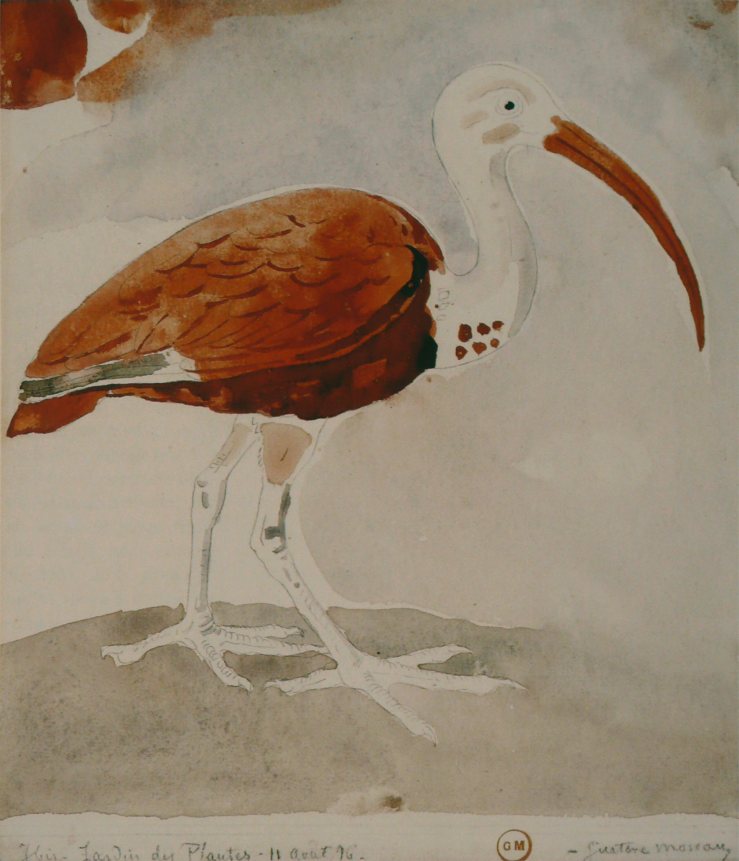
Ibis — Gustave Moreau

ibis-1876