But why, one is driven to ask, why has the tale of terror so special an appeal to Americans? Surely its success must be derived in part from the failure of love in our fiction; the death of love left a vacuum at the affective heart of the American novel into which there rushed the love of death. The triumph of the genteel sentimental incapacitated even our most talented writers, left them incapable of dealing with the relations of men and women as subtly and convincingly as the prose writers in the great novelistic tradition of France. Our novelists, deprived of the subject that sustained Stendhal or Constant, Flaubert or Proust, that seemed indeed to them the subject of the novel, turned to fables of loneliness and terror.
Moreover, in the United States, certain special guilts awaited projection in the gothic form. A dream of innocence had sent Europeans across the ocean to build a new society immune to the compounded evil of the past from which no one else in Europe could ever feel himself free. But the slaughter of the Indians, who would not yield their lands to the carriers of utopia, and the abominations of the slave trade, in which the black man, rum, and money were inextricably entwined in a knot of guilt, provided new evidence that evil did not remain with the world that had been left behind—but stayed alive in the human heart, which had come the long way to America only to confront the horrifying image of itself. Finally, there was the myth of Faust and of the diabolic bargain, which, though not yet isolated from gothic themes of lesser importance (that isolation was to be the word of American writers!), came quite soon to seem identical with the American myth itself.
How could one tell where the American dream ended and the Faustian nightmare began; they held in common the hope of breaking through all limits and restraints, of reaching a place of total freedom where one could with impunity deny the Fall, live as if innocence rather than guilt were the birthright of all men. In Huck’s blithe assertion, “All right, I’ll go to Hell,” is betrayed a significant undermeaning of the Faustian amor fati, at least in its “boyish” American form: the secret belief that damnation is not all it is cracked up to be.
From Leslie Fiedler’s Love and Death in the American Novel (1960).
The night was hot and overcast, the sky red, rimmed with the lingering sunset of mid-summer. They sat at the open window, trying to fancy the air was fresher there. The trees and shrubs of the garden stood stiff and dark; beyond in the roadway a gas-lamp burnt, bright orange against the hazy blue of the evening. Farther were the three lights of the railway signal against the lowering sky. The man and woman spoke to one another in low tones.
“He does not suspect?” said the man, a little nervously.
“Not he,” she said peevishly, as though that too irritated her. “He thinks of nothing but the works and the prices of fuel. He has no imagination, no poetry.”
“None of these men of iron have,” he said sententiously.
“They have no hearts.”
“He has not,” she said. She turned her discontented face towards the window. The distant sound of a roaring and rushing drew nearer and grew in volume; the house quivered; one heard the metallic rattle of the tender. As the train passed, there was a glare of light above the cutting and a driving tumult of smoke; one, two, three, four, five, six, seven, eight black oblongs—eight trucks—passed across the dim grey of the embankment, and were suddenly extinguished one by one in the throat of the tunnel, which, with the last, seemed to swallow down train, smoke, and sound in one abrupt gulp. Continue reading ““The Cone” — H.G. Wells”→
‘Make it new,’ Ezra Pound commanded, and ‘innovative’ is a good name for some kinds of fiction; however, most newness is new in all the same old ways: falsely, as products are said to be new by virtue of minuscule and trivial additions; or vapidly, when the touted differences are pointless; or opportunistically, when alterations are made simply in order to profit from imaginary improvements; or differentially, when newness merely marks a moment, place, or person off from others and gives it its own identity, however dopey.
From William H. Gass’s essay “Anywhere but Kansas.” Collected in Tests of Time.
Lina Wolff’s novel Bret Easton Ellis and the Other Dogs is coming out early next year from And Other Stories. Their blurb:
At a run-down brothel in Caudal, Spain, the prostitutes are collecting stray dogs. Each is named after a famous male writer: Dante, Chaucer, Bret Easton Ellis. When a john is cruel, the dogs are fed rotten meat. To the east, in Barcelona, an unflappable teenage girl is endeavouring to trace the peculiarities of her life back to one woman: Alba Cambó, writer of violent short stories, who left Caudal as a girl and never went back.
Mordantly funny, dryly sensual, written with a staggering lightness of touch, the debut novel in English by Swedish sensation Lina Wolff is a black and Bolaño-esque take on the limitations of love in a dog-eat-dog world.
Terms like space-warp, telekinesis, teleportation give to that latest avatar of the gothic, science fiction (even its name adapted to modern times), the most respectable of cachets. The blasphemous hope of Faustian man: the re-ordering of nature, the canceling out of the effects of original sin, the creation of life become the daily business of the laboratory, if not on today’s agenda, at least on tomorrow’s. Why should magic seem a problem when nothing is more magical than radar or earth satellites or the transistor, and when these are explained monthly in Scientific American? The wildest imaginings of ancient sorcery become the staples of science fiction (defended by reminding cavilers that the atomic bomb itself was only yesterday a mere fantasy of neo-gothic writers): dybbuk and golem, demons who possess and artificial men who remember and make choices, finally contest with their creators the rule of this world; such legendary creatures are called, however, “invaders from outer space” and “android robots,” so that no reader need feel his sense of fact offended by what thrills his nerves.
From Leslie Fiedler’s Love and Death in the American Novel.
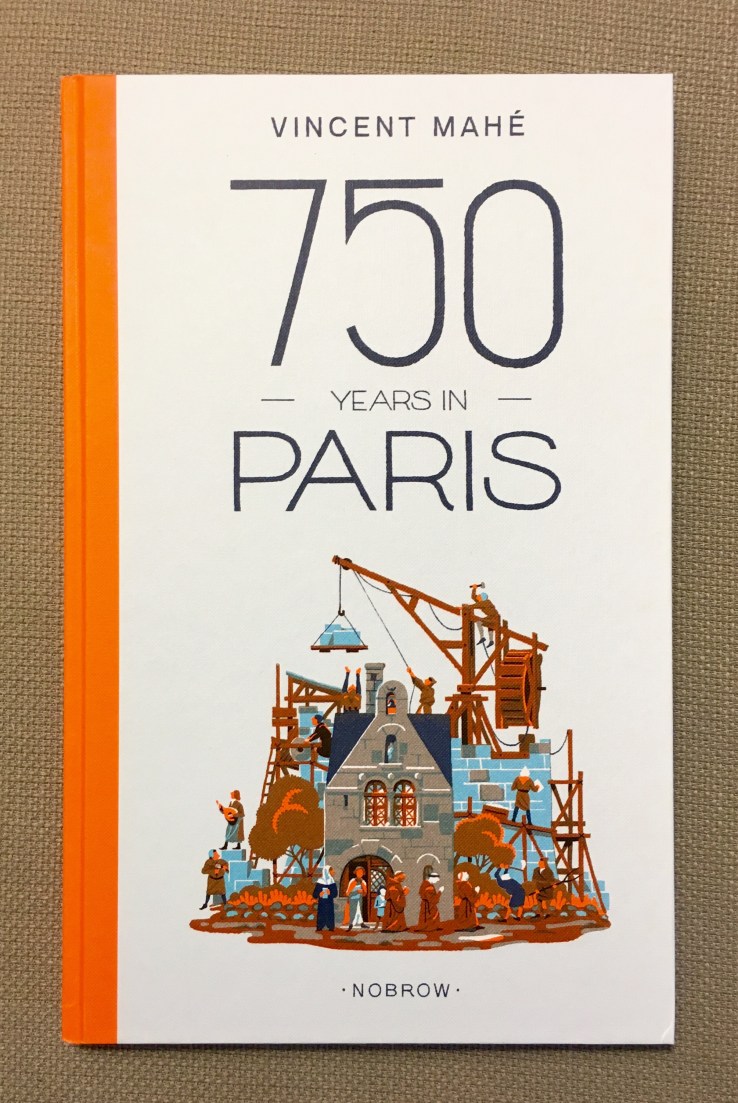
I’ve said it before, but the good people at Nobrow are making some of the best literary objects I’ve seen in years—the graphic novels they publish are smart, beautiful, strange, and witty. The last time I wrote about a Nobrow title, it was Jon McNaught’s Birchwood Close, which I read after a weekend of (very) primitive island camping. In a little coincidence (or not), Nobrow’s new title, Vincent Mahé’s 750 Years in Paris showed up as I was packing my Subaru for a camping trip with my family. I couldn’t help but fly too-quickly through the pages, before relinquishing it to my daughter, who tried to take it camping with us. “I need something to read on the beach,” she claimed, but I told her it was too big to take along (it’s about the height of a wine bottle). In truth, I just didn’t want to risk the book’s getting damaged. We read it again a few times when we got home—first very quickly, then more slowly. Fun.
I owe the thing a proper review, but for now here’s Nobrow’s blurb:
If you could stand still for 750 years, what could you learn about the world? It’s time to find out.
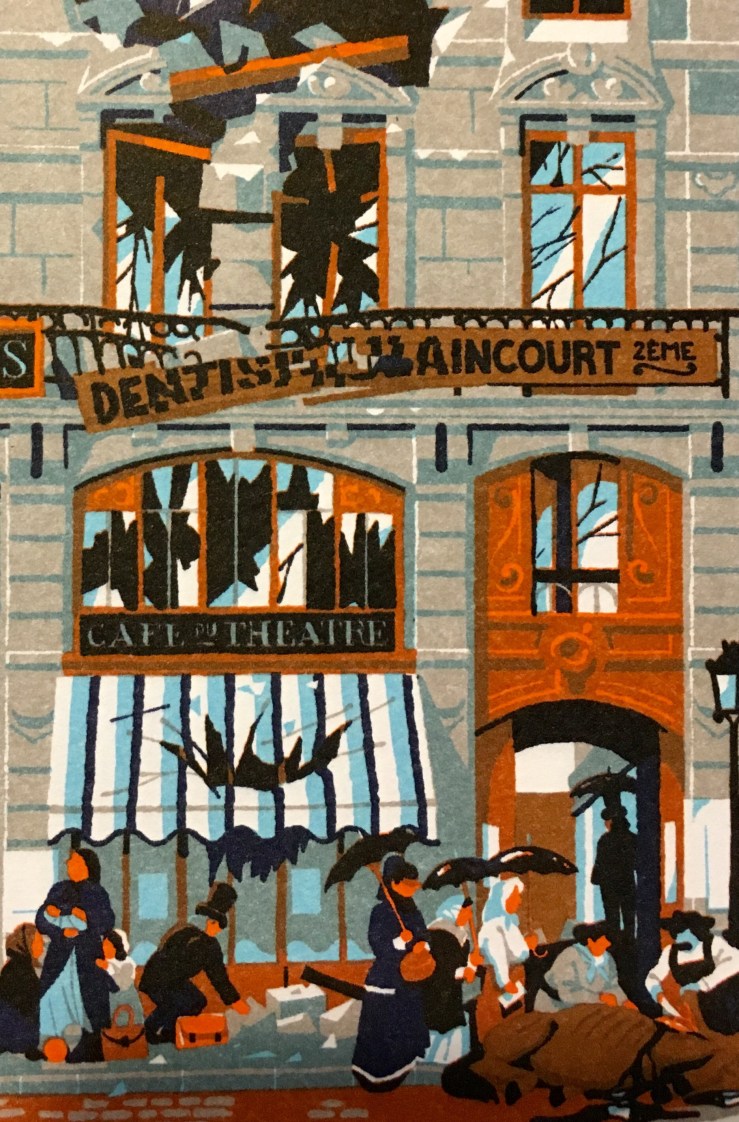
A literary graphic novel unlike anything else on the racks, 750 Years tells the story of our time, focusing on one single building in France as it sees its way through the upheavals of history. Beginning in the 13th Century and making its way towards today, this historically accurate story is the eagerly anticipated debut from Vincent Mahé.





 Biblioklept