There are two tortoises on the patio: a male and a female. Zlack! Zlack! Their shells strike each other. It is their mating season.
The male pushes the female sideways, all around the edge of the paving. The female seems to resist his attack, or at least she opposes it with inert immobility. The male is smaller and more active; he seems younger. He tries repeatedly to mount her, from behind, but the back of her shell is steep and he slides off.
Now he must have succeeded in achieving the right position: he thrusts with rhythmic, cadenced strokes; at every thrust he emits a kind of gasp, almost a cry. The female has her foreclaws flattened against the ground, enabling her to raise her hind part. The male scratches with his foreclaws on her shell, his neck stuck out, his mouth gaping. The problem with these shells is that there’s no way To get a hold; in fact, the claws can find no purchase.
Now she escapes him; he pursues her. Not that she is faster or particularly determined to run away: to restrain her he gives her some little nips on a leg, always the same one. She does not rebel. Every time she stops, the male tries to mount her; but she takes a little step forward and he topples off, slamming his member on the ground. This member is fairly long, hooked in a way that apparently makes it possible for him to reach her even though the thickness of the shells and their awkward positioning separates them. So there is no telling how many of these attacks achieve their purpose or how many fair, or how many are theater, play-acting.
It is summer; the patio is bare, except for one green jasmine in a corner. The courtship consists of making so many turns around the little patch of grass, with pursuits and flights and skirmishing not of the claws but of the shells, which strike in a dull clicking. The female tries to find refuge among the stalks of the jasmine; she believes—or wants to make others believe—that she does this to hide; but actually this is the surest way to remain blocked by the male, held immobile with no avenue of escape. Now he has most likely managed to introduce his member properly; but this time they are both completely still, silent.
The sensations of the pair of mating tortoises are something Mr. Palomar cannot imagine. He observes them with a cold attention, as if they were two machines: two electronic tortoises programmed to mate. What does eros become if there are plates of bone or horny scales in the place of skin? But what we call eros—is it perhaps only a program of our corporeal bodies, more complicated because the memory receives messages from every cell of the skin, from every molecule of our tissues, and multiplies them and combines them with the impulses transmitted by our eyesight and with those aroused by the imagination? The difference lies only in the number of circuits involved: from our receptions billions of wires extend, linked with the computer of feelings, conditionings, the ties between one person and another. . . . Eros is a program that unfolds in the electronic clusters of the mind, but the mind is also skin: skin touched, seen, remembered. And what about the tortoises, enclosed in their insensitive casing? The poverty of their sensorial stimuli perhaps drives them to a concentrated, intense mental life, leads them to a crystalline inner awareness. . . . Perhaps the eros of tortoises obeys absolute spiritual laws, whereas we are prisoners of a machinery whose functioning remains unknown to us, prone to clogging up, stalling, exploding in uncontrolled automatisms. . . .
Do the tortoises understand themselves any better? After about ten minutes of mating, the two shells separate. She ahead, he behind, they resume their circling of the grass. Now the male remains more distanced; every now and then he scratches his claw against her shell, he climbs on her for a little, but without much conviction. They go back under the jasmine. He gives her a nip or two on a leg, always in the same place.
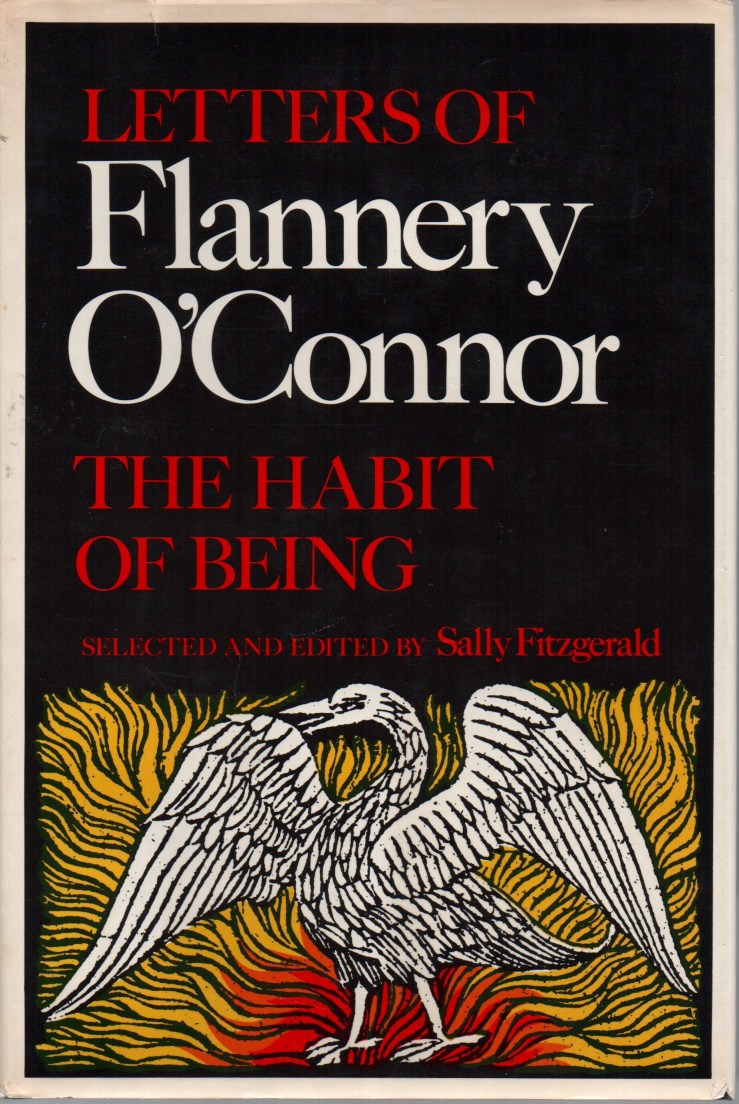
The Habit of Being: Letters of Flannery O’Connor. Edited by Sally Fitzgerald. 1979 2nd edition hardback from FS&G. Jacket design by Janet Halverson. A marvelous book—Fitzgerald’s editing is wonderful here—there’s a rich index that makes this book a pick me up and read me anytime kind of resource. Particularly great are O’Connor’s letters to ‘A,’ a smart reader whom O’Connor struck up a friendship with in letters.
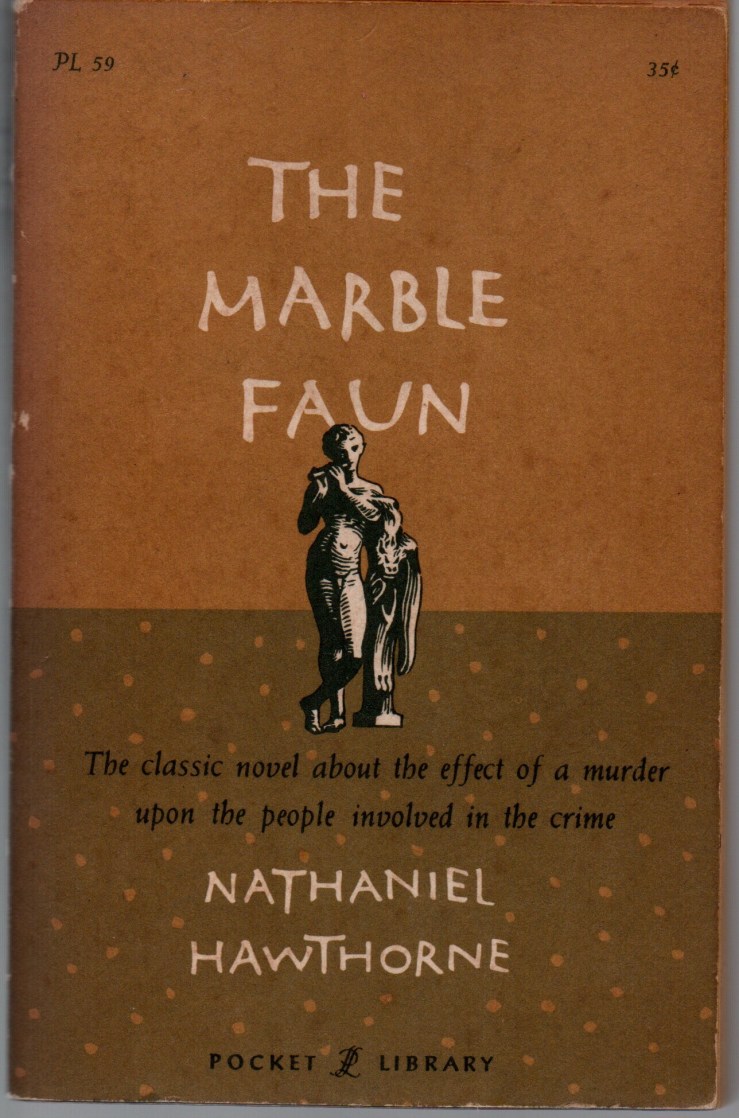
The Marble Faun; or The Romance of Monte Beni by Nathaniel Hawthorne. 1958 mass market paperback by Pocket Books. No designer credited. I love this cover and design—simple and elegant. The Marble Faun is the only Hawthorne novel (book, really) that I’ve yet to read.
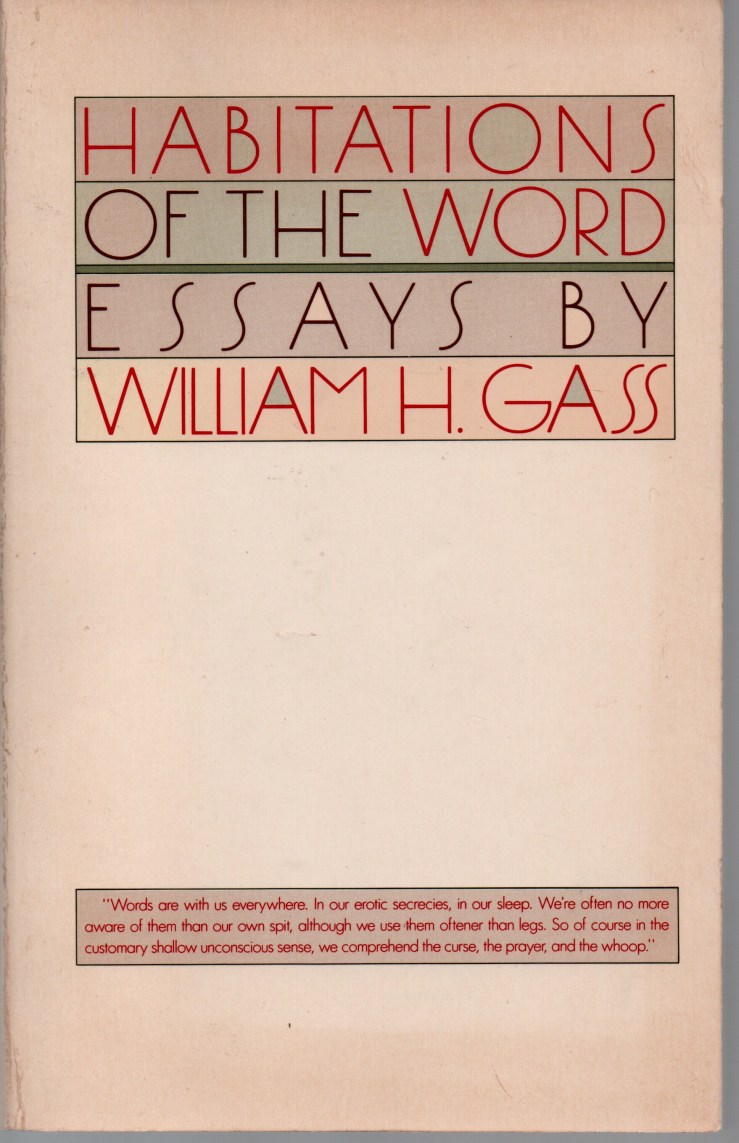
Habitations of the Word: Essays by William H. Gass. 1985 trade paperback by Touchstone/Simon and Schuster. Cover design by Koppel & Scher—and what a great design! (The quotation on the cover is from Gass’s essay “The Soul Inside the Sentence”). I had pulled this book out to find some lines from the first essay, “Emerson and the Essay,” for an American lit class I’m teaching. The essays collected here are brilliant stuff—literary criticism that surpasses “literary criticism.”
I also read Autobiography of Red and Red Doc> by Anne Carson during September-October, but erased everything I tried to write on them. I found Autobiography particularly excellent—a real How is this possible? kind of read.
FOUND AMONG THE PAPERS
OF THE LATE DIEDRICH KNICKERBOCKER.
        A pleasing land of drowsy head it was,
          Of dreams that wave before the half-shut eye;
        And of gay castles in the clouds that pass,
          Forever flushing round a summer sky.
                                         CASTLE OF INDOLENCE.
In the bosom of one of those spacious coves which indent the eastern shore of the Hudson, at that broad expansion of the river denominated by the ancient Dutch navigators the Tappan Zee, and where they always prudently shortened sail and implored the protection of St. Nicholas when they crossed, there lies a small market town or rural port, which by some is called Greensburgh, but which is more generally and properly known by the name of Tarry Town. This name was given, we are told, in former days, by the good housewives of the adjacent country, from the inveterate propensity of their husbands to linger about the village tavern on market days. Be that as it may, I do not vouch for the fact, but merely advert to it, for the sake of being precise and authentic. Not far from this village, perhaps about two miles, there is a little valley or rather lap of land among high hills, which is one of the quietest places in the whole world. A small brook glides through it, with just murmur enough to lull one to repose; and the occasional whistle of a quail or tapping of a woodpecker is almost the only sound that ever breaks in upon the uniform tranquillity.
I recollect that, when a stripling, my first exploit in squirrel-shooting was in a grove of tall walnut-trees that shades one side of the valley. I had wandered into it at noontime, when all nature is peculiarly quiet, and was startled by the roar of my own gun, as it broke the Sabbath stillness around and was prolonged and reverberated by the angry echoes. If ever I should wish for a retreat whither I might steal from the world and its distractions, and dream quietly away the remnant of a troubled life, I know of none more promising than this little valley.
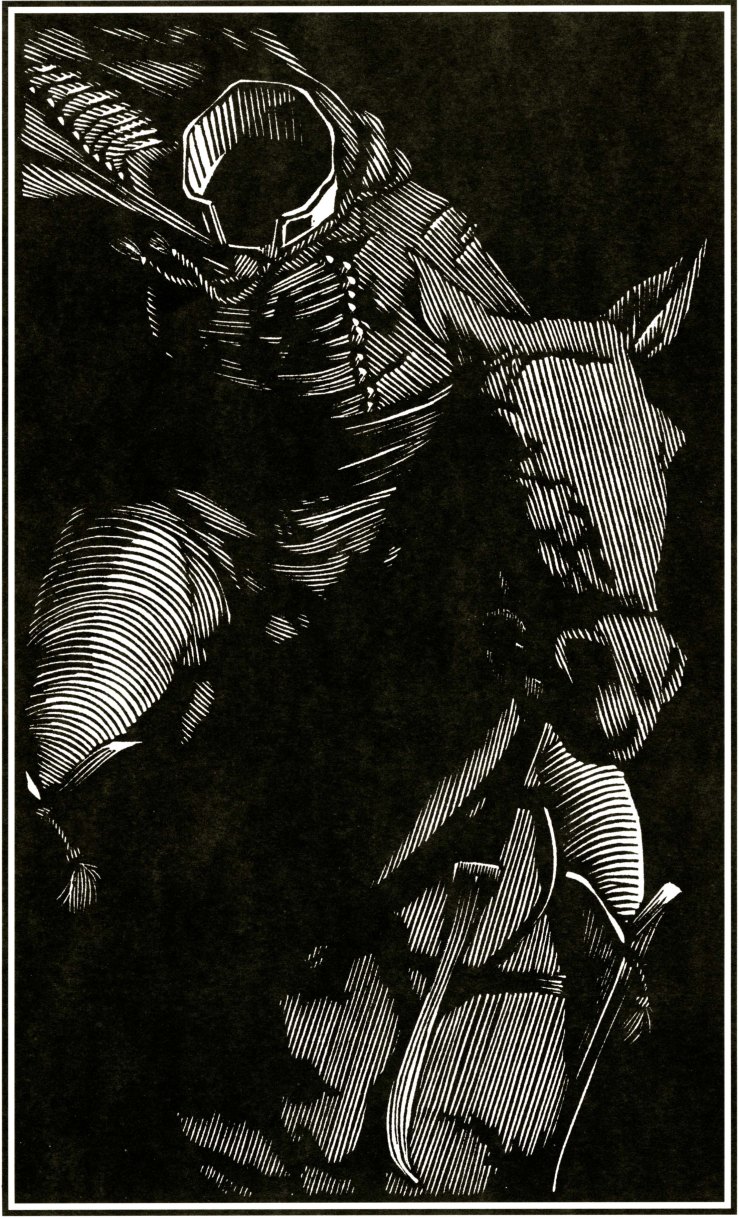
From the listless repose of the place, and the peculiar character of its inhabitants, who are descendants from the original Dutch settlers, this sequestered glen has long been known by the name of SLEEPY HOLLOW, and its rustic lads are called the Sleepy Hollow Boys throughout all the neighboring country. A drowsy, dreamy influence seems to hang over the land, and to pervade the very atmosphere. Some say that the place was bewitched by a High German doctor, during the early days of the settlement; others, that an old Indian chief, the prophet or wizard of his tribe, held his powwows there before the country was discovered by Master Hendrick Hudson. Certain it is, the place still continues under the sway of some witching power, that holds a spell over the minds of the good people, causing them to walk in a continual reverie. They are given to all kinds of marvellous beliefs, are subject to trances and visions, and frequently see strange sights, and hear music and voices in the air. The whole neighborhood abounds with local tales, haunted spots, and twilight superstitions; stars shoot and meteors glare oftener across the valley than in any other part of the country, and the nightmare, with her whole ninefold, seems to make it the favorite scene of her gambols.







 Biblioklept