MISERY is manifold. The wretchedness of earth is multiform. Overreaching the wide horizon as the rainbow, its hues are as various as the hues of that arch—as distinct too, yet as intimately blended. Overreaching the wide horizon as the rainbow! How is it that from beauty I have derived a type of unloveliness?—from the covenant of peace, a simile of sorrow? But as, in ethics, evil is a consequence of good, so, in fact, out of joy is sorrow born. Either the memory of past bliss is the anguish of to-day, or the agonies whichare, have their origin in the ecstasies which might have been.
My baptismal name is Egaeus; that of my family I will not mention. Yet there are no towers in the land more time-honored than my gloomy, gray, hereditary halls. Our line has been called a race of visionaries; and in many striking particulars—in the character of the family mansion—in the frescos of the chief saloon—in the tapestries of the dormitories—in the chiselling of some buttresses in the armory—but more especially in the gallery of antique paintings—in the fashion of the library chamber—and, lastly, in the very peculiar nature of the library’s contents—there is more than sufficient evidence to warrant the belief.
The recollections of my earliest years are connected with that chamber, and with its volumes—of which latter I will say no more. Here died my mother. Herein was I born. But it is mere idleness to say that I had not lived before—that the soul has no previous existence. You deny it?—let us not argue the matter. Convinced myself, I seek not to convince. There is, however, a remembrance of aerial forms—of spiritual and meaning eyes—of sounds, musical yet sad—a remembrance which will not be excluded; a memory like a shadow—vague, variable, indefinite, unsteady; and like a shadow, too, in the impossibility of my getting rid of it while the sunlight of my reason shall exist.
In that chamber was I born. Thus awaking from the long night of what seemed, but was not, nonentity, at once into the very regions of fairy land—into a palace of imagination—into the wild dominions of monastic thought and erudition—it is not singular that I gazed around me with a startled and ardent eye—that I loitered away my boyhood in books, and dissipated my youth in reverie; but it is singular that as years rolled away, and the noon of manhood found me still in the mansion of my fathers—it is wonderful what stagnation there fell upon the springs of my life—wonderful how total an inversion took place in the character of my commonest thought. The realities of the world affected me as visions, and as visions only, while the wild ideas of the land of dreams became, in turn, not the material of my every-day existence, but in very deed that existence utterly and solely in itself.
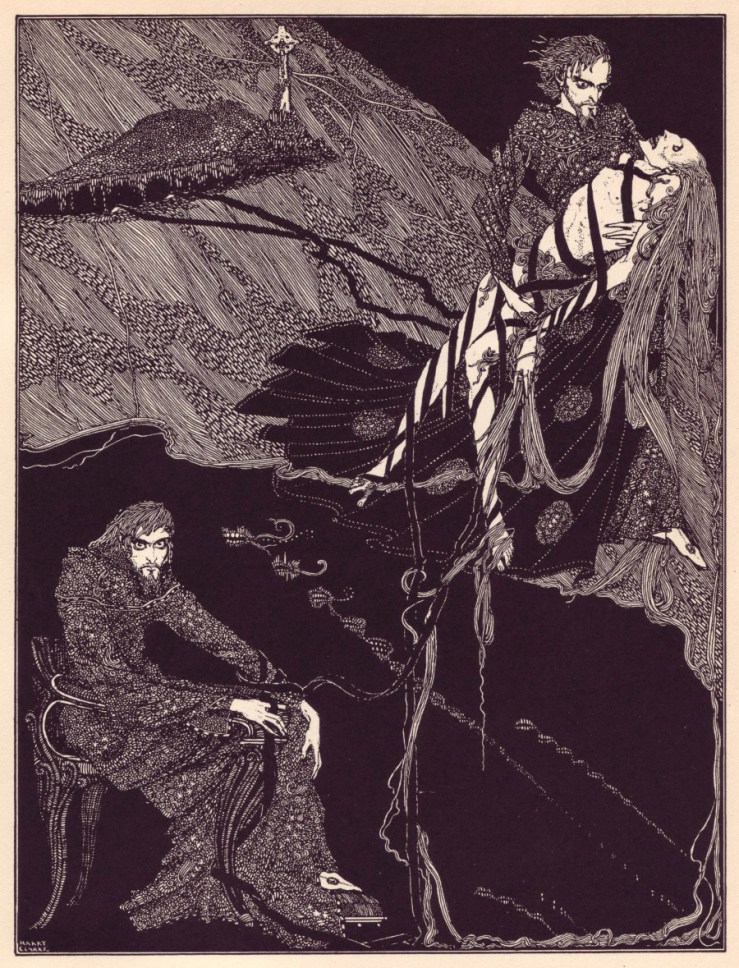
Berenice and I were cousins, and we grew up together in my paternal halls. Yet differently we grew—I, ill of health, and buried in gloom—she, agile, graceful, and overflowing with energy; hers, the ramble on the hill-side—mine the studies of the cloister; I, living within my own heart, and addicted, body and soul, to the most intense and painful meditation—she, roaming carelessly through life, with no thought of the shadows in her path, or the silent flight of the raven-winged hours. Berenice!—I call upon her name—Berenice!—and from the gray ruins of memory a thousand tumultuous recollections are startled at the sound! Ah, vividly is her image before me now, as in the early days of her light-heartedness and joy! Oh, gorgeous yet fantastic beauty! Oh, sylph amid the shrubberies of Arnheim! Oh, Naiad among its fountains! And then—then all is mystery and terror, and a tale which should not be told. Disease—a fatal disease, fell like the simoon upon her frame; and, even while I gazed upon her, the spirit of change swept over her, pervading her mind, her habits, and her character, and, in a manner the most subtle and terrible, disturbing even the identity of her person! Alas! the destroyer came and went!—and the victim—where is she? I knew her not—or knew her no longer as Berenice. Continue reading ““Berenice” — Edgar Allan Poe”→
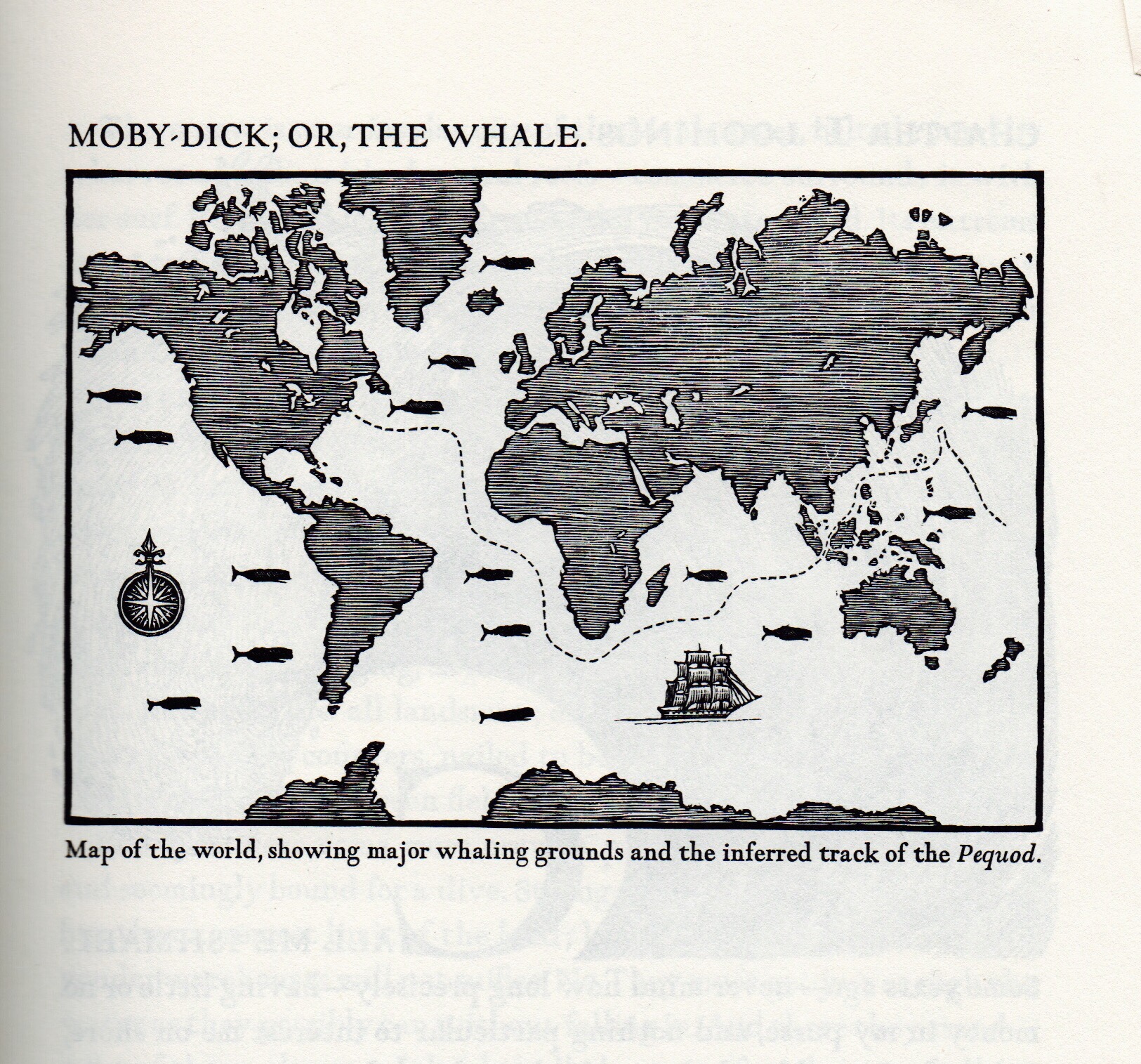
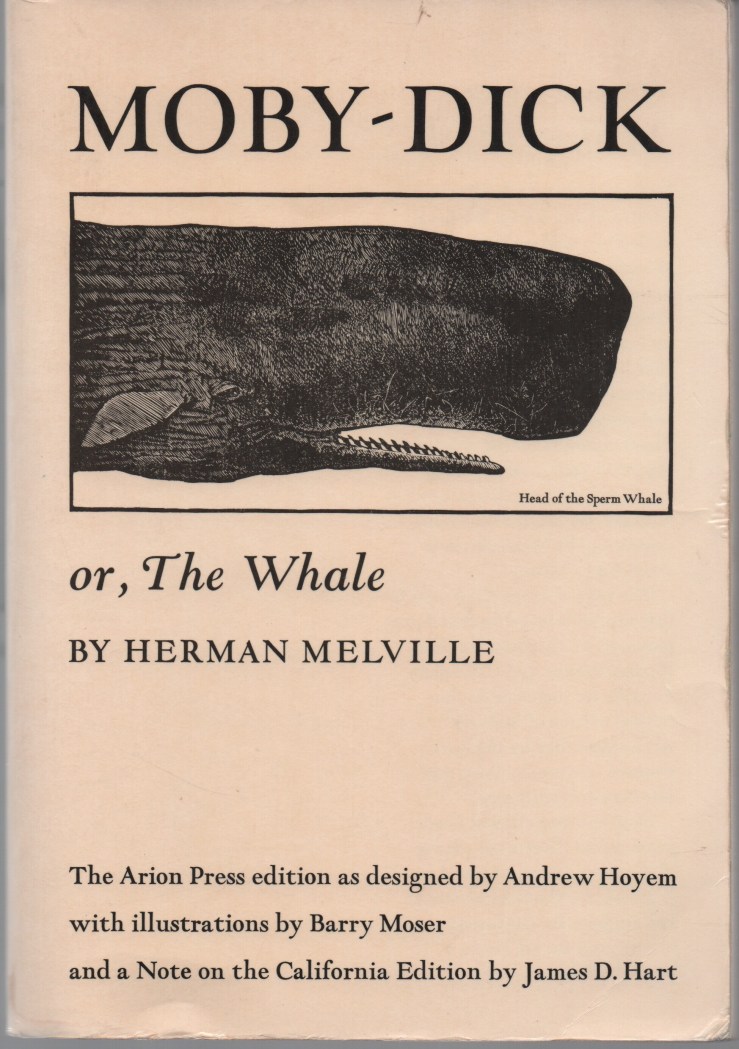
Moby-Dick by Herman Melville. First edition trade paperback by The University of California Press, based on the 1979 Arion Press edition. Cover illustration by Barry Moser. I have too many copies of Moby-Dick.
Selected Tales and Poems of Herman Melville (Richard Chase, editor). 1950 Rinehart Editions trade paperback by Holt, Rinehart and Winston. I’m a big fan of these midcentury Rinehart Editions paperbacks—they have an odd signature look to them.
Daydream, which is to thought as the nebula is to the star, borders on sleep, and is concerned with it as its frontier. An atmosphere inhabited by living transparencies: there’s a beginning of the unknown. But beyond it the Possible opens out, immense. Other beings, other facts, are there. No supernaturalism, only the occult continuation of infinite nature … Sleep is in contact with the Possible, which we also call the improbable. The world of the night is a world. Night, as night, is a universe … The dark things of the unknown world become neighbors of man, whether by true communication or by a visionary enlargement of the distances of the abyss … and the sleeper, not quite seeing, not quite unconscious, glimpses the strange animalities, weird vegetations, terrible or radiant pallors, ghosts, masks, figures, hydras, confusions, moonless moonlights, obscure unmakings of miracle, growths and vanishings within a murky depth, shapes floating in shadow, the whole mystery which we call Dreaming, and which is nothing other than the approach of an invisible reality. The dream is the aquarium of Night.
— VICTOR HUGO, LES TRAVAILLEURS DE LA MER
The Hugo citation comes from Ursula K. Le Guin’s 1971 novel The Lathe of Heaven—Le Guin uses it as a preface to the seventh chapter. It’s beautiful on its own; it also functions as a kind of poetic summary of The Lathe of Heaven.








.jpg)


 Biblioklept