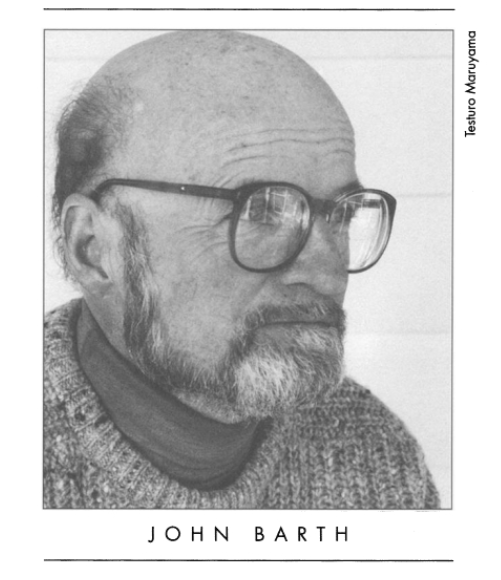
You don’t consciously see yourself as John Barth, the postmodernist?

Q: You don’t consciously see yourself as John Barth, the postmodernist?

JOHN BARTH: Oh no, no, and the term now has become so stretched out of shape. I did a good deal of reading on the subject for a postmodernist conference in Stuttgart back in 1991, and I think I had a fairly solid grasp of the term then. At the time, there seemed to be a general agreement that, whatever postmodernism was, it was made in America and studied in Europe. At my end, I would say the definitions advanced by such European intellectuals as Jean Baudrillard and Jean- Francois Lyotard have only a kind of a grand overlap with what I think I mean when I am talking about it.g about it. They apply the term to disciplines and fields other than art-their thoughts about postmodern science, for instance, are very interesting-but when the subject is postmodern American fiction, things get murkier. So often we’re told, “You know, it’s Coover, Pynchon, Barth, and Barthelme,” but that’s just pointing at writers. Perhaps that’s all you can do. It led me to say once, “If postmodern is what I am, then postmodernism is whatever I do.” You get a bit wary about these terms. When The Floating Opera came out, Leslie Fiedler called it “provincial American existentialism.” With End of the Road, I was most often described as a black humorist, and with The Sot-Weed Factor, Giles Goat-Boy, and Lost in the Funhouse, I became a fabulist. Bill Gass resists the term “postmodernist,” and I understand his resistance. But we need common words to talk about anything. “Impressionism” is a very useful term which helps describe the achievements of a number of important artists. But when you begin to look at individual impressionist painters, the term becomes less meaningful. You find yourself contemplating a group of artists who probably have as many differences as similarities. I recall a wonderful old philosophy professor of mine who used to talk about the difference between the synthetic temperament and the analytical temperament. With the synthetic, the similarities between things are more impressive than the differences; with the analytical, the differences are more impressive than the similarities. We need them both; you can’t do without either. In that context, once you’ve come up with some criteria that describe what has been going on in a certain type of fiction composed during the sixties, seventies, eighties, and nineties, I think the differences among Donald Barthelme, Angela Carter, and Italo Calvino are probably more interesting than the similarities.

From an interview with Barth conducted by Charlie Reilly in the journal Contemporary Literature, Vol. 41, No. 4 (Winter, 2000).

“Good-bye to the Fruits” — John Barth

“Good-bye to the Fruits”

by

John Barth

I agreed to die, stipulating only that I first be permitted to rebehold and bid good-bye to those of Earth’s fruits that I had particularly enjoyed in my not-extraordinary lifetime.
What I had in mind, in the first instance, was such literal items as apples and oranges. Of the former, the variety called Golden Delicious had long been my favorite, especially those with a blush of rose on their fetchingly speckled yellow-green cheeks. Of the latter–but then, there’s no comparing apples to oranges, is there, nor either of those to black plums: truly incomparable, in my opinion, on the rare occasions when one found them neither under- nor overripe. Good-bye to all three, alas; likewise to bananas, whether sliced transversely atop unsweetened breakfast cereal, split longitudinally under scoops of frozen yogurt, barbecued in foil with chutney, or blended with lime juice, rum, and Cointreau into frozen daiquiris on a Chesapeake August late afternoon.
Lime juice, yes: Farewell, dear zesty limes, squeezed into gins-and-tonics before stirring and over bluefish filets before grilling; adieu too to your citric cousins the lemons, particularly those with the thinnest of skins, always the most juiceful, without whose piquance one could scarcely imagine fresh seafood, and whose literal zest was such a challenge for us kitchen-copilots to scrape a half-tablespoonsworth of without getting the bitter white underpeel as well. Adieu to black seedless grapes for eating with ripe cheeses and to all the nobler stocks for vinting, except maybe Chardonnay. I happened not to share the American yuppie thirst for Chardonnay; too over-flavored for my palate. Give me a plain light dry Chablis any time instead of Chardonnay, if you can find so simple a thing on our restaurant wine-lists these days. And whatever happened to soft dry reds that don’t cost an arm and a leg on the one hand, so to speak, or, on the other, taste of iron and acetic acid? But this was no time for such cavils: Good-bye, blessed fruit of the vineyard, a dinner without which was like a day without et cetera. Good-bye to the fruits of those other vines, in particular the strawberry, if berries are properly to be called fruits, the tomato, and the only melon I would really miss, our local cantaloupe. Good-bye to that most sexual of fruits, the guava; to peaches, plantains (fried), pomegranates, and papayas; to the fruits of pineapple field and coconut tree, if nuts are fruits and coconuts nuts, and of whatever it is that kiwis grow on. As for pears, I had always thought them better canned than fresh, as Hemingway’s Nick Adams says of apricots in the story “Big Two-Hearted River”–but I couldn’t see kissing a can good-bye, so I guessed that just about did the fruits (I myself preferred my apricots sun-dried rather than either fresh or canned).

Read the rest of “Goodbye to the Fruits” — and two other John Barth shorts — in the Spring ’94 issue of Conjunctions.

Posted in Art

Study of Patin — Félicien Rops

Study of Patin — Félicien Rops (1833–1898)

“Hell,” a cold tale by Virgilio Piñera

“Hell”

by

Virgilio Piñera

translated by Mark Schaffer


When we are children, hell is nothing more than the devil’s name on our parent’s lips. Later, this notion becomes more complicated, and we toss in our beds through the interminable nights of adolescence, trying to extinguish the flames that burn us — the flames of imagination! Still later, when we no longer look in the mirror because our faces have begun to resemble that of the devil, the notion of hell is reduced to an intellectual fear, and in order to escape so much anguish, we attempt to describe it. Now, in old age, hell is so close at hand that we accept it as a necessary evil and even show our anxiety about suffering it. Even later (and now we’re in its flames), while we burn, we begin to see that perhaps we could adjust. After a thousand years, a somber-faced devil asks us if we’re still suffering. We tell him that there is far more routine than suffering. At last, the day arrives when we are free to leave, but we emphatically refuse the offer, for who gives up a cherished habit?

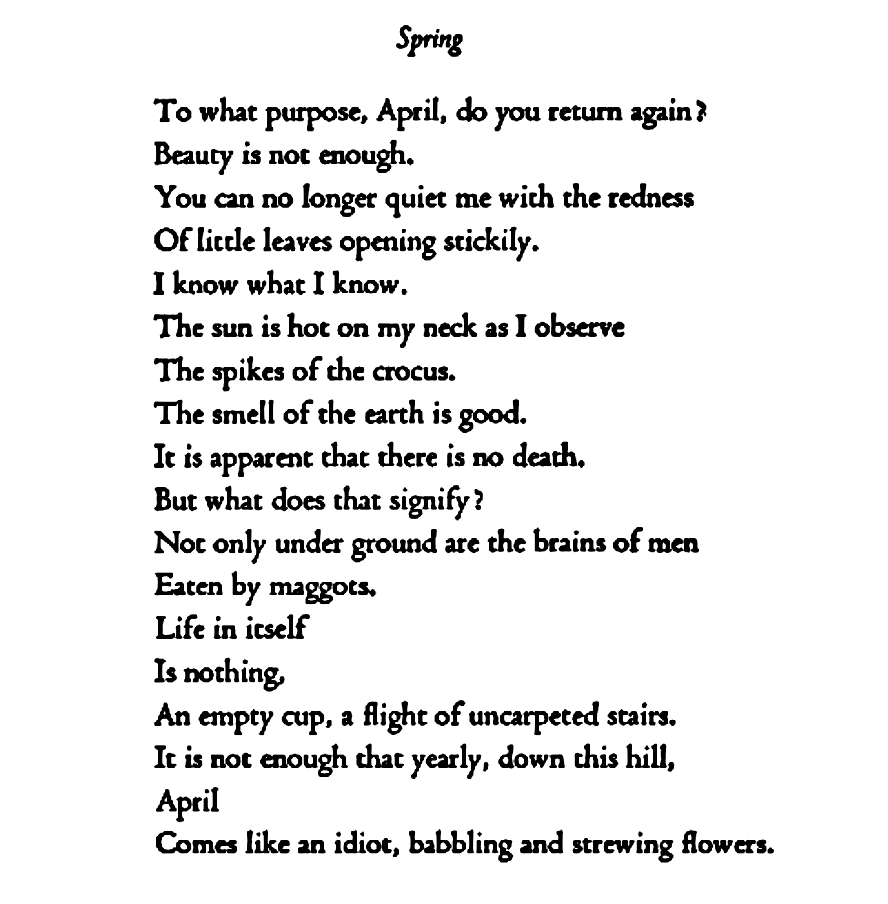
April comes like an idiot, babbling and strewing flowers | Edna St. Vincent Millay

spring

Crucifixion — Ivan Milev

Crucifixion, 1923 by Ivan Milev (1897–1927)

Plagiarism

Summer of ’99

In the summer of 1799, John Cummings, a 23-year old American sailor, crewed on a ship to France.

The Mountebank’s Nefarious Influence

Stationed there, he witnessed a mountebank pretending to swallow knives in a circus near Havre de-Grace.

An Astonishing Claim

The sailors returned to the ship after the show was over; most had had too much to drink that night.

While discussing the events of the night, particularly the knife-swallowing Frenchman, he made an astonishing claim.

Under the alcohol influence, he claimed to possess the same knife-swallowing skill.

He swallowed four knives with no obvious ill effect, although only three of the four knives were seen again.

He washed the knives down with more alcohol.

His Movements

The next morning, his bowel movements were uneventful.

However, he passed one of the knives in his stool.

Moreover, he passed two more knives in his stool the next day.

The fourth and final knife never made its way out of his bowels and also did not prove to be of any inconvenience for him.

On Not Practicing His Skill

Over the next six years, the young man did not practice this skill again.

In Boston

Six years later he was stationed in Boston.

While drinking in a gathering of sailors, he boasted about his former knife-swallowing skills.

His current shipmates did not believe his story and under the influence of grog he began again, he demanded a knife be brought to him to swallow.

He swallowed it instantly.

Throughout the evening he swallowed five more knives.

Obligations

The following morning, word had spread about his tactics the previous night.

Many visited him during the day, and he was obliged to swallow eight more!

The Tally

The tally of the total knives he had swallowed now stood at fourteen!

First Admission

He was admitted to Charleston Hospital with abdominal pain.

After a few days the knives had all passed safely through and his symptoms resolved, just in time for him to sail back with his ship to France.

Pressed on to the HMS Isis

His next ship was the Betty of Philadelphia. Early in the voyage back from France to the USA she was stopped by the Royal Navy and he was impressed into service aboard HMS Isis.

Drunk Once Again

On 4 December 1805, drunk once again, he swallowed his final twenty knives and two days later he reported to the ship’s surgeon, Benjamin Lara.

His Treatments

He was given castor oil and enemas of thick water-gruel, and opium for the pain.

When the symptoms continued, a dose of 30 or 40 drops of sulphuric acid daily was tried in an attempt to dissolve the iron.

Finally he was given murinated tincture of iron, but this made his pain worse.

When the Knives Dropped

After remaining on the sick list for three months he felt the knives drop into his bowel and felt much relieved and was discharged back to light duties.

Summer, Fall, and Winter, 1806-1807

In June 1806, he vomited one side of a knife handle.

In November and again the following February he passed more pieces.

Dr. Lara Kept Informed

Although Lara was transferred off HMS Isis in November 1806 his successor, Mr Peter Kelly, kept him informed of the patient’s progress.

Discharge

He continued to pass pieces of iron and knife handles; each ejection was accompanied by considerable pain and in one instance the vomiting of two pounds of blood. He was finally discharged from the ship, as unfit, in June 1807.

Disbelief

After leaving HMS Isis, he traveled immediately to London and presented himself to Guy’s Hospital for treatment. His admitting physician, Dr. Babbington, did not believe his story and discharged him after a few days.

Readmission and Deterioration

He was readmitted in August, however, his condition much deteriorated. Examining the patient with Sir Astley Cooper, Babbington asked for the opinion of the surgeon Mr Lucas.

What Dr. Lucas Found

Lucas performed a rectal examination and felt one of the knives in the rectum.

Under the Care of Dr. Curry

Although he was again discharged on 28 October 1807, Cummings was readmitted in September 1808, this time under the care of Dr. Curry.

He was given more acid, mucilage and opium but slowly deteriorated, suffering bouts of pain and indigestion and having difficulty eating.

Incurable

Over the course of three and a half years, he consulted several doctors and was admitted to the hospital on numerous occasions.

During this period, he vomited and defecated many knife fragments.

In his final moments, he was sent home and was deemed “incurable” by the doctors.

His Death

He finally died in March 1809 in a state of extreme emaciation.

Blog about some books acquired, other stuff

My family and I took our Florida asses to the West Coast for a wonderful week earlier this month. We flew into LA, stayed in Santa Monica for a few days and nights, riding bikes up and down the beautiful coast and visiting proximal neighborhoods. We later drove east to Joshua Tree, where we stayed in a lovely little house for a few days, visiting the National Park as well as nearby towns and sites, like Twentynine Palms, Palm Springs, and Mt. San Jacinto State Park. We saw coyotes and roadrunners and lots of little desert cottontails. Famous times.

While in Santa Monica, I could not convince my family (or frankly myself) to trek the hour or so south to visit Thomas Pynchon’s old apartment in Manhattan Beach. We did, however, stop by Small World Books in Venice Beach. Small World is right across from the Venice Beach Skatepark, where we watched kids of all ages skate for almost an hour while someone blasted nineties hip-hop from a boombox (one of the nicest hours of the trip for me).

Small World is a well-stocked bookshop with an emphasis on literature and the arts; it carries plenty of indie titles and a handsome stable of standards. There was a nice cat in there too. Founded in 1969 by Mildred Gates and Mary Goodfader, Small World seems to retain some of the older vibes of Venice Beach, which is generally pretty touristy (in a fun, tacky way). It seems a bit out of place among the keychains and bad art and nasty tee shirts of Venice, what with its stock of NYRB translations, poetry zines, and novels by indie imprints like And Other Stories. But it’s clear that locals come to buy books there.

I picked up three: Lydia Davis’s Our Strangers, June-Alison Gibbons’s The Pepsi-Cola Addict, and Ann Quin’s Three. I’d been looking to buy Davis’s collection for a while now–you can buy it online, but I wanted to get it from an indie bookshop, per Davis’s intentions. Three is the only Ann Quin book I haven’t read yet; I loved her novels Berg and Passages, and I guess I wanted to leave something in the Quin take for later. The highlight purchase though for me has been Gibbons’s The Pepsi-Cola Addict, which was Small World’s featured book (I think they did a book club on it this month). I had never heard of the book or its author, but the pop art cover and goofy title caught my attention, followed by an even goofier blurb which started by describing the Pepsi-Cola Addict as the “legendary lost novel in which fourteen-year-old Preston Wildey-King must choose between his all-consuming passion for Pepsi Cola and his love for schoolmate Peggy.” The novel is not goofy though—it’s abject and odd and distressing and also very well-written, somehow naive and sophisticated, raw and refined, resoundingly truthful and plainly artificial. Here’s the full blurb:

Written by June-Alison Gibbons when she was only 16, The Pepsi Cola Addict is considered one of the great works of twentieth-century outsider literature. More than just a literary curiosity, however, this tale of a teenager whose passion for a well-known cola drink threatens to ruin his life is the uniquely vivid expression of a young woman trying to make sense of the confusing, often brutal world she in which found herself.

Published in 1982 by a vanity press who took £500 from its young author and gave her only a single book in return, it’s thought that fewer than ten original copies still exist in the world.

Shortly after its publication, June-Alison and her sister Jennifer would become infamous as “The Silent Twins” and find themselves cruelly incarcerated for over a decade in Broadmoor Hospital. This author-approved edition makes June-Alison Gibbon’s remarkable vision widely available for the first time.

I hope to have a full review to come. I read The Pepsi-Cola Addict in Joshua Tree and absolutely loved it (even though (and I guess because) it made me feel odd and ill).

Unfortunately, I didn’t make it to Angel City Books & Records in Santa Monica. I had also wanted to visit Space Cowboy Books in Joshua Tree, but didn’t realize it was closed midweek. I did drop by The Best Bookstore in Palm Springs, and was again pleasantly surprised by the rich stock of titles, which eschewed the bestseller list stuff I might have expected for a somewhat touristy area. My son conned me into buying him a Taschen volume of Michelangelo drawings and studies; he’s been copying them into his notebooks for days now.

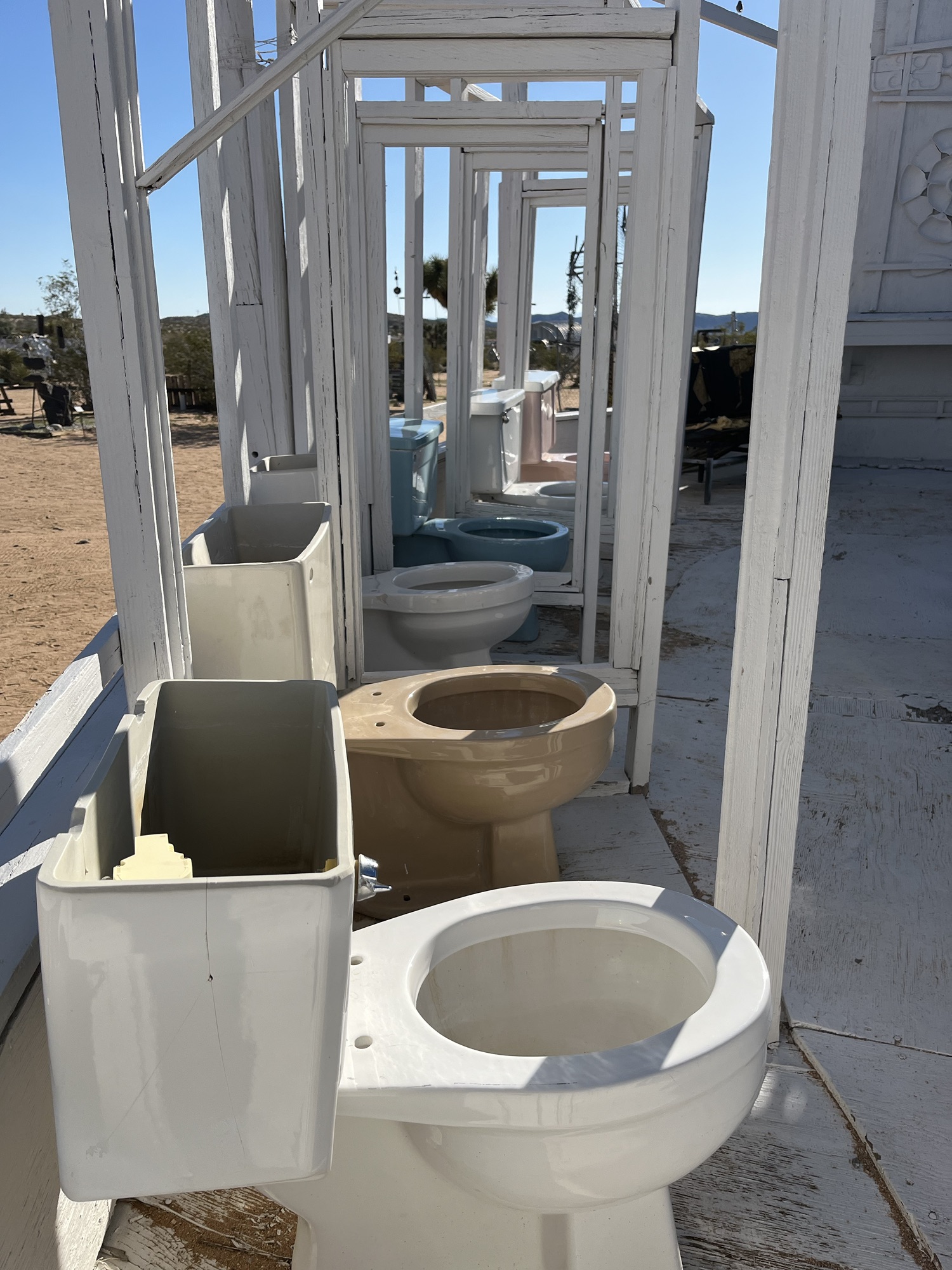
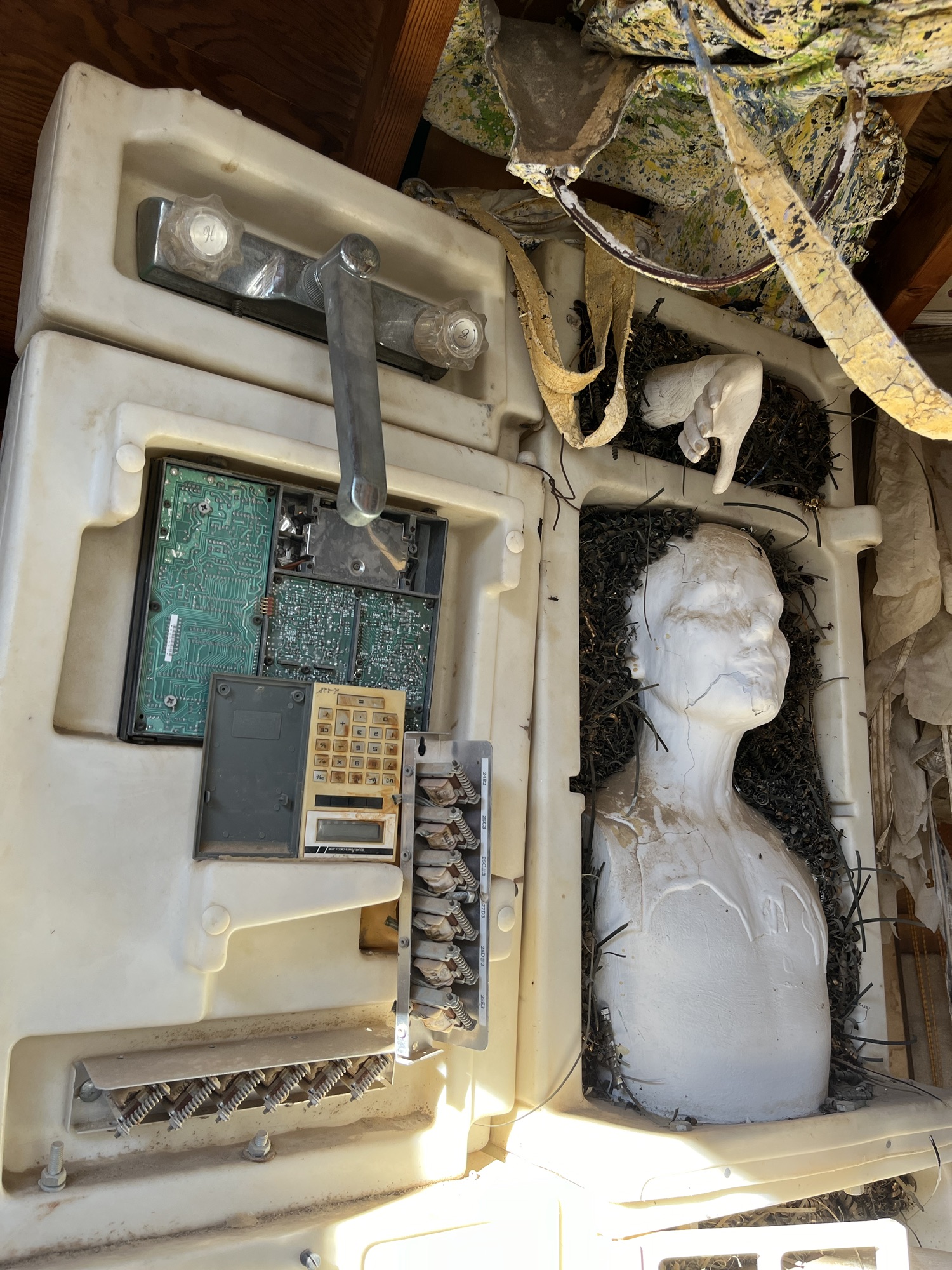
We loved Joshua Tree (park and city), and one highlight was the Noah Purifoy Outdoor Museum, a loose, sprawling collection of sculptures, installations, and buildings cobbled together out of the detritus of the twentieth century. Walking through the Museum is kind of like being on the disused set of a post-apocalyptic film, under the beautiful clear California sun filled sky. Cottontails and roadrunners hopped about as we wandered among Purifoy’s deconstructed constructions, sometimes apprehensive to enter or touch, before the sun and wind and arid sky itself reminded us that the whole tableau was naked, exposed, raw on the earth, open for contact.

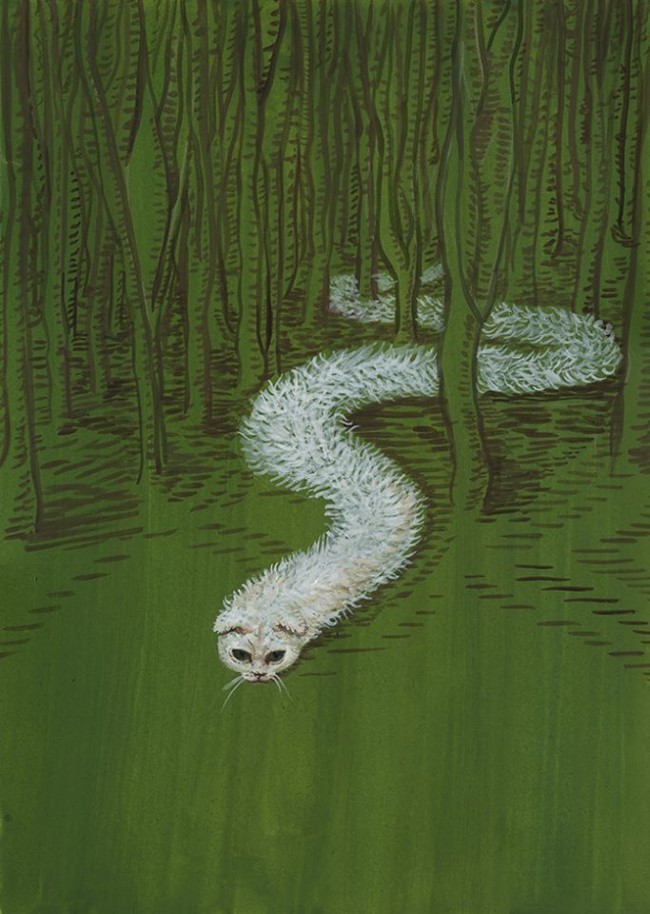
Untitled (Mitusia) — Aleksandra Waliszewska

Untitled (Mitusia) by Aleksandra Waliszewska, b. 1976

Vuelo Villa — Xul Solar

Vuelo Villa, 1936 by Xul Solar (1887-1963)

“Lifeguard,” a very short story by Diane Williams

“Lifeguard”

by

Diane Williams


We had tried we had tried my mother and I to get someone to help us stop the flood in the house. We had tried to get some man. So that when my father and the man who guards my father returned, but when they were not yet inside the house, I went out to them.

That man who guards my father was sizing me up like he was wild. His head was on its side in midair bouncing, his shoulder all dipped down because I was forcing him to leave me alone with my father, and I was forcing him to go into the house to deal with the flood and with my mother, so that I was the one left guarding my father, who was wearing those shoes, who was taking those small steps toward the house. I was say­ing to my father, “It’s not so bad, the flood. You’ll see,” and I was talking as slowly as he was walking in those shoes.

Those shoes on my father were the worst things I saw when I was getting him into the house, not getting him into the house, guarding him while he inched his way toward it.

Those shoes did not look like shoes that could hold a foot. There did not look to be room for a foot of flesh inside them, just a foot of bone, long like a pipe and they were forcing their way to the door of his house which was open, but from which we could not hear yet the rushing of water that I had felt rushing inside of the pipe—the hot rushing that I had seen blur the floor so that the floor was no longer a clear thing to see, so that the ceiling of our house was shedding through its lights the way rain comes down out from under a bright sun.

So that of course we were wet, my mother and I, with water binding like bracelets on our wrists, up and down our arms, like extra hair on our foreheads, on our clothes extra shapes, in our shoes which made my feet feel larger and heavier than they had ever felt.

At the door with my father, it was as if everything was hotter and wetter and louder in the house than I had remembered and was getting more so, just with us about ready to enter—and my mother and the man who guards my father must have been the cause. They had had so much time, I thought they had, and together they had not stopped it.

And then, before we ever entered, my father was telling me what we should do, even though I could not make it out, not the words, but I knew he was telling me how to stop the flood, if we wanted to.

Plagiarism

died of joy

poisoned arrow

struck by a pear

swallowed hot coals

executed by scaphism

choked on molten lead

drowned in a barrel of wine

horse tripped over a black pig

murdered with a poisoned toothpick

killed by a tortoise dropped by an eagle

rolled up in a rug and trampled by horses

died on the spot through holding his breath

broke his neck by tripping over his own beard

devoured by wolves (or, in later versions, lions)

died of laughter after he saw a donkey eating his figs

leaped into an active volcano to prove his immortality

died in a drinking contest against a Georgian nobleman

distraught over the lateness of seafood delivery, he killed himself with his sword

sewn into a linen sheet soaked in distilled spirits which later caught fire

devoured by dogs after smearing himself with cow manure

wrapped in cotton wool soaked in oil and set on fire

exposed to the taunts of sailors and flayed alive

died of laughter while painting an elderly woman

smothered to death by gifts of cloaks and hats

carried off and then killed by a hippopotamus

drowned in excrement after porch collapse

choked to death on a grape stone

died while playing with a pear

assassinated with a bucket

indigestion and laughter

dragged on deer antlers

ate too many lampreys

crucified upside-down

dancing mania

died laughing

pit of snakes

sawn in half

roasted alive


“Kienast,” a very short story by Robert Walser

“Kienast”

by

Robert Walser

translated by Tom Whalen and Carol Gehrig


Kienast was the name of a man who wanted nothing to do with anything. Even in his youth he stood out unpleasantly as an unwilling sort. As a child he gave his parents much grief, and later, as a citizen, his fellow citizens. It didn’t matter what time of day you wanted to talk to him, you would never get from him a friendly or fellowly word. Indignant, invidious was his behavior, and his conduct was repulsive. Guys like this Kienast probably believed it a sacrilege if they were kind or obliging to people. But have no fear: he was neither kind nor courteous. Of that he wanted to hear nothing. “Nonsense,” he grumbled at everything desiring his attention. “I’m really sorry, but I have no time,” he was in the habit of angrily mumbling as soon as someone came to him with a request. Those were duped folks who went to Kienast with a request. They didn’t get much from him, because there was no trace of considerateness to be found in him. He didn’t want to know even the least of it. Should Kienast once have done something good for somebody, something which, so to say, was in the general interest, he would have said coldheartedly, “Goodbye, au revoir,” by which he meant to say, “Please leave me alone.” He was interested only in personal gain, and he had eyes only for his supreme profit. Everything else concerned him little or preferably not at all. Of it he wanted to know absolutely nothing. Should anyone expect a willingness or even a sacrifice of him, he nasaled, “What next, I wonder?” by which he meant to say, “If you will be so kind as not to molest me with such matters.” Or he said, “Remember me, please, it will make me happy,” or very simply just, “Bonsoir.” Community, church, and country seemed in no way to concern him. In his opinion, community affairs were looked after solely by jackasses; whoever needed the church in any way was in Kienast’s eyes a sheep, and for those who loved their country, he possessed not the least understanding. Tell me, dear readers, you who are aglow with patriotism for fatherland and motherland, what do you think should be done with the Kienasts? Wouldn’t it be a splendid, yes even a sublime task to beat them in great haste and with the proper carefulness to a pulp? Gently! It has been seen to that such gentlemen will not remain eternally undisturbed. One day someone knocked at Kienast’s door, someone who evidently did not allow himself to be turned away with a “Bonjour” or with a “Bonsoir” or with a “What next!” or with a “Sorry, I’m in a real hurry,” or with a “Please leave me alone.” “Come, I can use you,” said the peculiar stranger. “You are really exquisite. But what’s the matter with you? Do you think I have time to lose? That’s the limit! Remember me, it will make me happy. Sorry I have no time, so goodbye, au revoir.” Such or similar things Kienast wanted to answer; however, as he opened his mouth to say what he was thinking, he became sick to death, he was deathly pale, it was too late to say anything else, not one more word passed over his lips. It was Death who had come to him, it was all no use. Death makes its work brief. All his “Nonsenses” did no more good and all his beautiful “Bonjours” and “Bonsoirs” had an end. It was all over with scorn and mockery and with cold-heartedness. Oh, God, is such living a life? Would you like to live so lifelessly, so godlessly? To be so inhuman among human beings? Could someone cry out about you or about me if we had lived like Kienast? Could someone regret my death? Might it not be then that this or that person could almost be delighted about my departure?

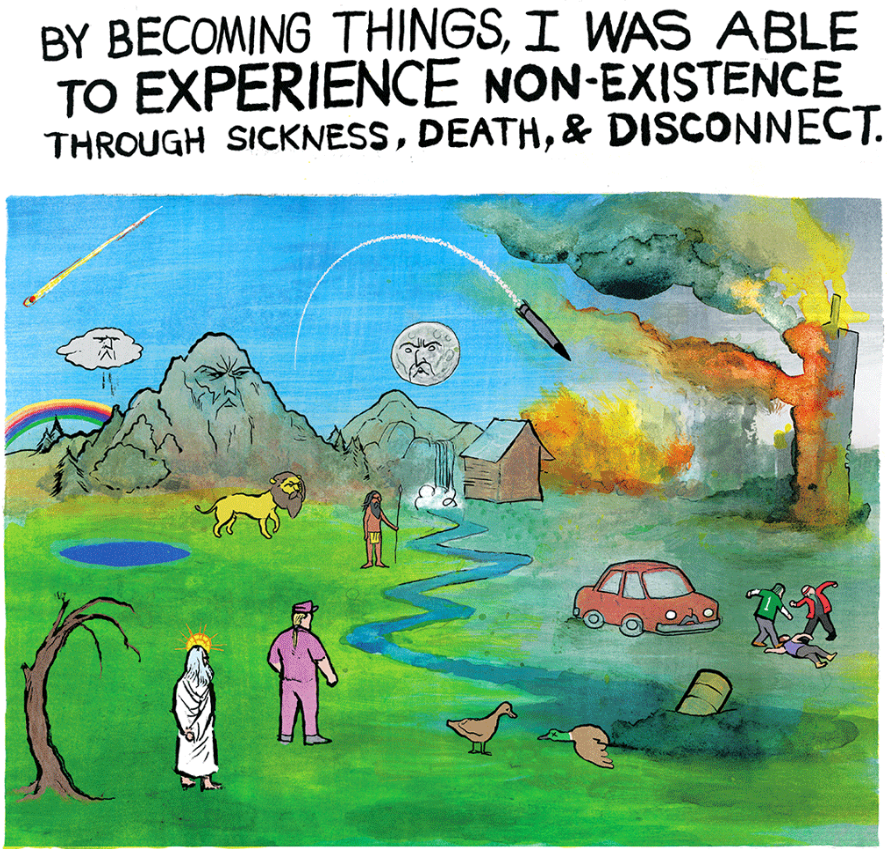
Experience non-existence | From Nicholas Gurewitch’s “Trauma Trooper”

A panel from Nicholas Gurewitch’s “Trauma Trooper.”

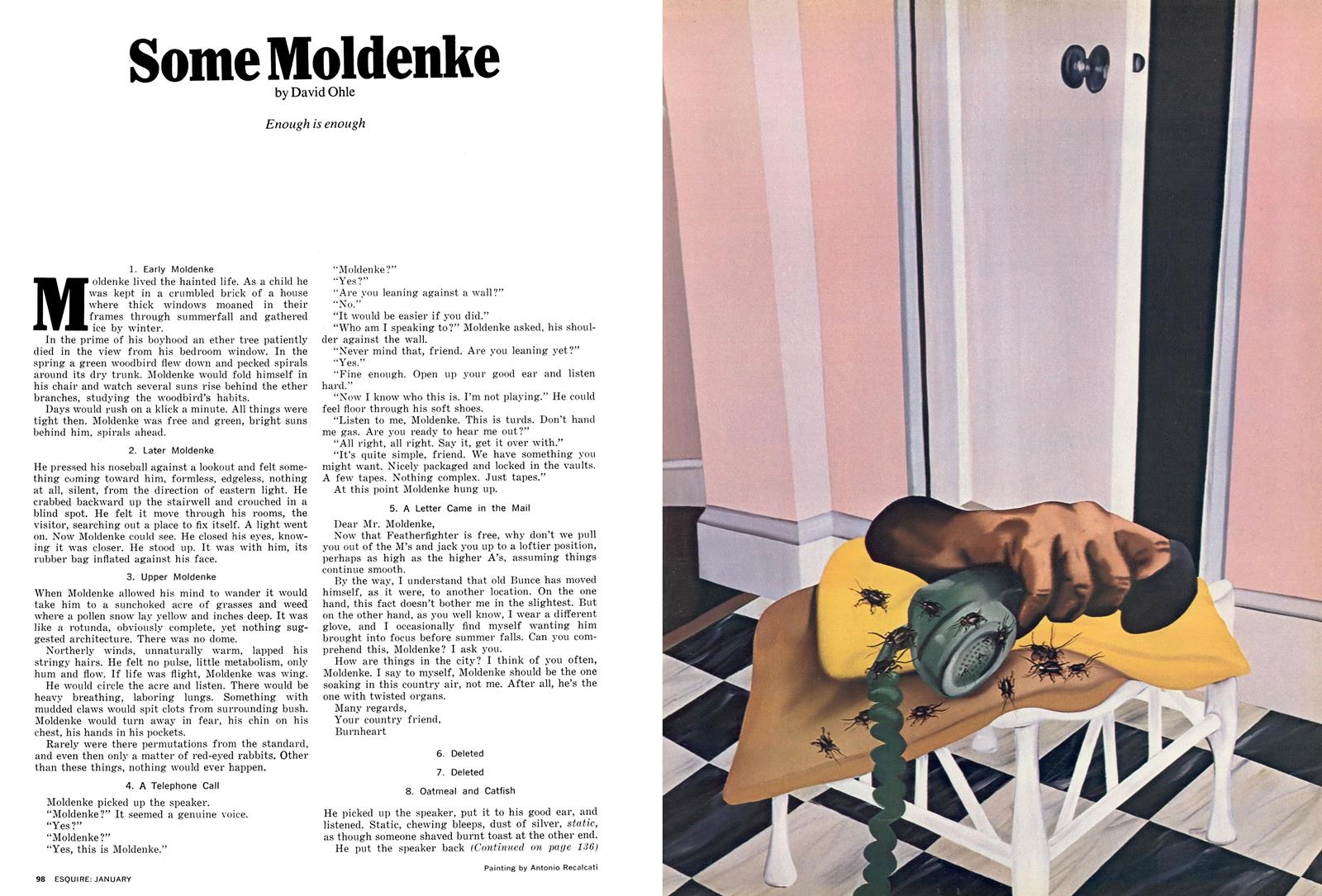
“Some Moldenke” — David Ohle


1. Early Moldenke

Moldenke lived the hainted life. As a child he was kept in a crumbled brick of a house where thick windows moaned in their frames through summerfall and gathered ice by winter.

In the prime of his boyhood an ether tree patiently died in the view from his bedroom window. In the spring a green woodbird flew down and pecked spirals around its dry trunk. Moldenke would fold himself in his chair and watch several suns rise behind the ether branches, studying the woodbird’s habits.

Days would rush on a klick a minute. All things were tight then. Moldenke was free and green, bright suns behind him, spirals ahead.

Read the rest of the excerpt from David Ohle’s cult classic Motorman published in the 1 Jan. 1972 issue of Esquire.

St. Patrick and the Druid, an episode from Finnegans Wake (with explication from Joseph Campbell)

On pages 611-613 of James Joyce’s Finnegans Wake, St. Patrick meets the archdruid Balkelly:

Tunc. Bymeby, bullocky vampas tappany bobs topside joss pidgin fella Balkelly, archdruid of islish chinchinjoss in the his heptachromatic sevenhued septicoloured roranyellgreenlindigan mantle finish he show along the his mister guest Patholic with alb belongahim the whose throat hum with of sametime all the his cassock groaner fellas of greysfriaryfamily he fast all time what time all him monkafellas with Same Patholic, quoniam, speeching, yeh not speeching noh man liberty is, he drink up words, scilicet, tomorrow till recover will not, all too many much illusiones through photoprismic velamina of hueful panepiphanal world spectacurum of Lord Joss, the of which zoantholitic furniture, from mineral through vegetal to animal, not appear to full up to-gether fallen man than under but one photoreflection of the several iridals gradationes of solar light, that one which that part of it (furnit of heupanepi world) had shown itself (part of fur of huepanwor) unable to absorbere, whereas for numpa one pura —— duxed seer in seventh degree of wisdom of Entis–Onton he savvy inside true inwardness of reality, the Ding hvad in idself id est, all objects (of panepiwor) allside showed themselves in trues coloribus resplendent with sextuple gloria of light actually re-tained, untisintus, inside them (obs of epiwo). Rumnant Patholic, stareotypopticus, no catch all that preachybook, utpiam, tomorrow recover thing even is not, bymeby vampsybobsy tap — panasbullocks topside joss pidginfella Bilkilly–Belkelly say pat — fella, ontesantes, twotime hemhaltshealing, with other words verbigratiagrading from murmurulentous till stridulocelerious in a hunghoranghoangoly tsinglontseng while his comprehen-durient, with diminishing claractinism, augumentationed himself in caloripeia to vision so throughsighty, you anxioust melan-cholic, High Thats Hight Uberking Leary his fiery grassbelong- head all show colour of sorrelwood herbgreen, again, nigger- blonker, of the his essixcoloured holmgrewnworsteds costume the his fellow saffron pettikilt look same hue of boiled spinasses,other thing, voluntary mutismuser, he not compyhandy the his golden twobreasttorc look justsamelike curlicabbis, moreafter, to pace negativisticists, verdant readyrainroof belongahim Exuber High Ober King Leary very dead, what he wish to say, spit of superexuberabundancy plenty laurel leaves, after that com-mander bulopent eyes of Most Highest Ardreetsar King same thing like thyme choppy upon parsley, alongsidethat, if please-sir, nos displace tauttung, sowlofabishospastored, enamel Indian gem in maledictive fingerfondler of High High Siresultan Em-peror all same like one fellow olive lentil, onthelongsidethat, by undesendas, kirikirikiring, violaceous warwon contusiones of facebuts of Highup Big Cockywocky Sublissimime Autocrat, for that with pure hueglut intensely saturated one, tinged uniformly, allaroundside upinandoutdown, very like you seecut chowchow of plentymuch sennacassia Hump cumps Ebblybally! Sukkot?

Punc. Bigseer, refrects the petty padre, whackling it out, a tumble to take, tripeness to call thing and to call if say is good while, you pore shiroskuro blackinwhitepaddynger, by thiswis aposterioprismically apatstrophied and paralogically periparo-lysed, celestial from principalest of Iro’s Irismans ruinboon pot before, (for beingtime monkblinkers timeblinged completamen-tarily murkblankered in their neutrolysis between the possible viriditude of the sager and the probable eruberuption of the saint), as My tappropinquish to Me wipenmeselps gnosegates a handcaughtscheaf of synthetic shammyrag to hims hers, seeming-such four three two agreement cause heart to be might, saving to Balenoarch (he kneeleths), to Great Balenoarch (he kneeleths down) to Greatest Great Balenoarch (he kneeleths down quite-somely), the sound salse sympol in a weedwayedwold of the firethere the sun in his halo cast. Onmen.

That was thing, bygotter, the thing, bogcotton, the very thing, begad! Even to uptoputty Bilkilly–Belkelly-Balkally. Who was for shouting down the shatton on the lamp of Jeeshees. Sweating on to stonker and throw his seven. As he shuck his thumping fore features apt the hoyhop of His Ards.

Thud.

Good safe firelamp! hailed the heliots. Goldselforelump! Halled they. Awed. Where thereon the skyfold high, trampa-trampatramp. Adie. Per ye comdoom doominoom noonstroom. Yeasome priestomes. Fullyhum toowhoom.


Continue reading “St. Patrick and the Druid, an episode from Finnegans Wake (with explication from Joseph Campbell)”

An alternative list to The Atlantic’s “The Great American Novels” list (Part II, 1975-1999)

I left off fifty years ago, in 1974, in my silly response list to The Atlantic’s silly list of “The Great American Novels.”  Today, here’s the rest of my run, spanning 1975-1999.

1975

The Atlantic selected

Corregidora, Gayl Jones

Biblioklept selects

J R, William Gaddis

The Dead Father, Donald Barthelme

1976

The Atlantic selected

Speedboat, Renata Adler

Biblioklept selects

Roots, Alex Haley

Speedboat, Renata Adler

1977

The Atlantic selected

Ceremony, Leslie Marmon Silko

Song of Solomon, Toni Morrison

Biblioklept selects

The Public Burning, Robert Coover

Song of Solomon, Toni Morrison

Players, Don DeLillo

1978

The Atlantic selected

A Contract With God, Will Eisner

Dancer From the Dance, Andrew Holleran

The Stand, Stephen King

Biblioklept selects

An Armful of Warm Girl, W.M Spackman

Airships, Barry Hannah

(It might as well be a novel.)

1979

The Atlantic selected

The Dog of the South, Charles Portis

Kindred, Octavia E. Butler

Biblioklept selects

Suttree, Cormac McCarthy

The Dog of the South, Charles Portis

1980

The Atlantic selected

Housekeeping, Marilynne Robinson

The Salt Eaters, Toni Cade Bambara

Biblioklept selects

Great Expectations, Kathy Acker

The Shadow of the Torturer, Gene Wolfe

1981

The Atlantic selected

Little, Big: Or, the Fairies’ Parliament, John Crowley

Biblioklept selects

Cities of the Red Night, William S. Burroughs

1982

The Atlantic selected

Oxherding Tale, Charles Johnson

Biblioklept selects

The Terrible Twos, Ishmael Reed

1983

The Atlantic selected

nothing.

Biblioklept selects

Angels, Denis Johnson

1984

The Atlantic selected

Machine Dreams, Jayne Anne Phillips

Biblioklept selects

Blood and Guts in High School, Kathy Acker

Neuromancer, William Gibson

1985

The Atlantic selected

Blood Meridian, Cormac McCarthy

Biblioklept selects

Blood Meridian, Cormac McCarthy

Masters of Atlantis, Charles Portis

Days Between Stations, Steve Erickson

1986

The Atlantic selected

A Summons to Memphis, Peter Taylor

Watchmen, Alan Moore and Dave Gibbons

Biblioklept selects

Hatchet, Gary Paulsen

1987

The Atlantic selected

Beloved, Toni Morrison

Dawn, Octavia E. Butler

Biblioklept selects

Beloved, Toni Morrison

1988

The Atlantic selected

nothing

Biblioklept selects

Breaking and Entering, Joy Williams

Wittgenstein’s Mistress, David Markson

1989

The Atlantic selected

Geek Love, Katherine Dunn

Tripmaster Monkey, Maxine Hong Kingston

Biblioklept selects

Geek Love, Katherine Dunn

1990

The Atlantic selected

Dogeaters, Jessica Hagedorn

Biblioklept selects

Tehanu, Ursula K. Le Guin

1991

The Atlantic selected

American Psycho, Bret Easton Ellis

How the García Girls Lost Their Accents, Julia Alvarez

Mating, Norman Rush

Biblioklept selects

Gringos, Charles Portis

1992

The Atlantic selected

Bastard Out of Carolina, Dorothy Allison

The Secret History, Donna Tartt

Biblioklept selects

Jesus’ Son, Denis Johnson

Negrophobia, Darius James

Snow Crash, Neal Stephenson

1993

The Atlantic selected

So Far From God, Ana Castillo

Stone Butch Blues, Leslie Feinberg

The Shipping News, Annie Proulx

Biblioklept selects

Palestine, Joe Sacco

1994

The Atlantic selected

nothing

Biblioklept selects

A Frolic of His Own, William Gaddis

The Crossing, Cormac McCarthy

1995

The Atlantic selected

Native Speaker, Chang-rae Lee

Sabbath’s Theater, Philip Roth

Under the Feet of Jesus, Helena María Viramontes

Biblioklept selects

The Lost Scrapbook, Evan Dara

1996

The Atlantic selected

Infinite Jest, David Foster Wallace

Biblioklept selects

Infinite Jest, David Foster Wallace

1997

The Atlantic selected

I Love Dick, Chris Kraus

Underworld, Don DeLillo

Biblioklept selects

Mason & Dixon, Thomas Pynchon

Underworld, Don DeLillo

1998

The Atlantic selected

nothing

Biblioklept selects

Cartesian Sonata, William H. Gass

1999

The Atlantic selected

The Intuitionist, Colson Whitehead

Biblioklept selects

Motherless Brooklyn, Jonathan Lethem

2000 and after…

The Atlantic’s list for books post-2000 contains some books that I think will hold up decades from now, but I’d predict more misses than hits. There are a handful of novels I would’ve added or substituted from the post-1999 selections, but I see no reason to go forward. Ultimately, I enjoyed going through the Atlantic list, taking note of some titles I was unfamiliar with as well as ones I’ve been overdue to check out. I’ve undoubtedly missed so, so many titles from my own list; if anything’s absence is egregious, let me know in a comment.