Read Ursula K. Le Guin’s short story “The Stars Below”

“The Stars Below”

by

Ursula K. Le Guin

The wooden house and outbuildings caught fire fast, blazed up, burned down, but the dome, built of lathe and plaster above a drum of brick, would not burn. What they did at last was heap up the wreckage of the telescopes, the instruments, the books and charts and drawings, in the middle of the floor under the dome, pour oil on the heap, and set fire to that. The flames spread to the wooden beams of the big telescope frame and to the clockwork mechanisms. Villagers watching from the foot of the hill saw the dome, whitish against the green evening sky, shudder and turn, first in one direction then in the other, while a black and yellow smoke full of sparks gushed from the oblong slit: an ugly and uncanny thing to see.

It was getting dark, stars were showing in the east. Orders were shouted. The soldiers came down the road in single file, dark men in dark harness, silent.

The villagers at the foot of the hill stayed on after the soldiers had gone. In a life without change or breadth, a fire is as good as a festival. They did not climb the hill, and as the night grew full dark they drew closer together. After a while they began to go back to their villages. Some looked back over their shoulders at the hill, where nothing moved. The stars turned slowly behind the black beehive of the dome, but it did not turn to follow them.

About an hour before daybreak a man rode up the steep zigzag, dismounted by the ruins of the workshops, and approached the dome on foot. The door had been smashed in. Through it, a reddish haze of light was visible, very dim, coming from a massive support-beam that had fallen and had smoldered all night inward to its core. A hanging, sour smoke thickened the air inside the dome. A tall figure moved there and its shadow moved with it, cast upward on the murk. Sometimes it stooped, or stopped, then blundered slowly on.

The man at the door said: “Guennar! Master Guennar!”

The man in the dome stopped still, looking towards the door. He had just picked up something from the mess of wreckage and half-burnt stuff on the floor. He put this object mechanically into his coat pocket, still peering at the door. He came towards it. His eyes were red and swollen almost shut, he breathed harshly in gasps, his hair and clothes were scorched and smeared with black ash.

“Where were you?”

The man in the dome pointed vaguely at the ground. Continue reading “Read Ursula K. Le Guin’s short story “The Stars Below””

Film Poster for Terrence Malick’s Badlands — Tomer Hanuka

badlands_blue_72

Woman Reading — Julio González

AS02966

Eleanor — Harry Callahan

???????????????????????????????????????????????????????????????????????????????????????????????????????

Literature is like an ear that can hear things beyond the understanding of the language of politics (Italo Calvino)

Literature is necessary to politics above all when it gives a voice to whatever is without a voice, when it gives a name to what as yet has no name, especially to what the language of politics excludes or attempts to exclude. I mean aspects, situations, and languages both of the outer and of the inner world, the tendencies repressed and individuals and in society. Literature is like an ear that can hear things beyond the understanding of the language of politics; it is like an eye that can see beyond the color spectrum perceived by politics. Simply because of the solitary individualism of his work, the writer may happen to explore areas that no one has explored before, within himself or outside, and to make discoveries that sooner or later turn out to be vital areas of collective awareness.


This is still a very indirect, deliberate, and fortuitous use for literature. The writer follows his own road, and chance or social and psychological factors lead him to discover something that may become important for political and social action as well. It is the responsibility of the sociopolitical observer not to leave anything to chance, and to apply his own method to the business of literature in such a way as not to allow anything to escape him.


But there is also, I think, another sort of influence that literature can exert, perhaps not more direct but certainly more intentional on the part of the writer. This is the ability to impose patterns of language, of vision, imagination, mental effort, of the correlation of facts, and in short the creation (and by creation I mean selection and organization) of a model of values that is at the same time aesthetic and ethical, essential to any plan of action, especially in political life.


So it comes about that, having excluded political education from the functions of literature, I find myself stating that I do believe in a type of education by means of literature; a type of education they can yield results only if it is difficult and indirect, if it implies the arduous attainment of literary stringency.


Any results attained by literature, as long as it is stringent and rigorous, may be considered firm ground for all practical activities for anyone who aspires to the construction of a mental order solid and complex enough to contain the disorder of the world within itself; for anyone aiming to establish a method subtle and flexible enough to be the same thing as an absence of any method whatever.

From Italo Calvino’s essay “Right and Wrong Uses of Political Uses of Literature.” Translation by Patrick Creagh. Collected in The Uses of Literature.

Lydia Davis’s Can’t and Won’t (Book acquired, 3.6.2015)

IMG_5568 Almost finished with this bad boy, or as “finished” as one can be with Davis’s stuff, which I tend to linger on, return to. Full review forthcoming.
IMG_5570

Deckard and Pris among the Dolls (Blade Runner)

A Song of Springtime — John William Waterhouse

The Heart of the World, a short film by Guy Maddin

There are two wrong ways of thinking of a possible political use for literature (Italo Calvino)

In a word, what I think is that there are two wrong ways of thinking of a possible political use for literature. The first is to claim that literature should voice a truth already possessed by politics; that is, to believe that the sum of political values is the primary thing, to which literature must simply adapt itself. This opinion implies a notion of literature as ornamental and superfluous, but it also implies a notion of politics as fixed and self-confident: an idea that would be catastrophic. I think that such a pedagogical function for politics could only be imagined at the level of bad literature and bad politics.

The other mistaken way is to see literature as an assortment of eternal human sentiments, as the truth of the human language that politics tends to overlook, and that therefore has to be called to mind from time to time. This concept apparently leaves more room for literature, but in practice it assigns it the task of confirming what is already known, or maybe of provoking in a naïve and rudimentary way, by means of the youthful pleasures of freshness and spontaneity. Behind this way of thinking is the notion of a set of established values that literature is responsible for preserving, the classical and immobile idea of literature as the depository of a given truth. If it agrees to take on this role, literature confines itself to a function of consolation, preservation, and regression – a function that I believe does more harm than good.

From Italo Calvino’s essay “Right and Wrong Uses of Political Uses of Literature.” Translation by Patrick Creagh. Collected in The Uses of Literature.

The Bus — Paul Kirchner

H7SyH6D - Imgur

“The thought beneath so slight a film” — Emily Dickinson

ed

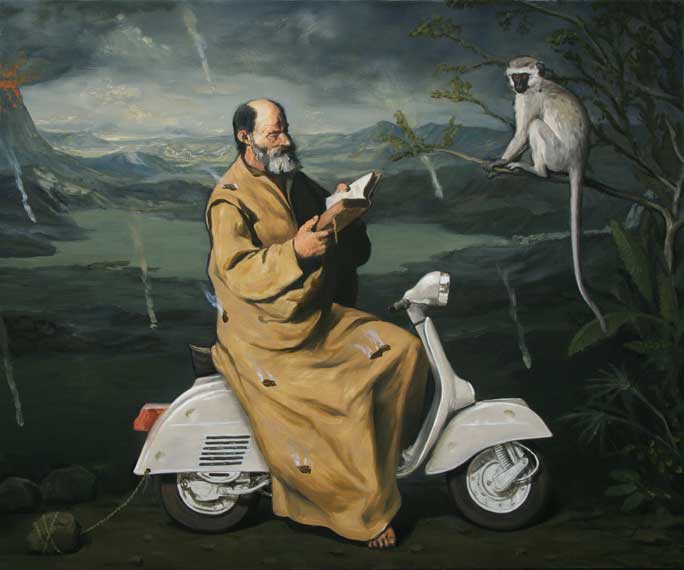
St. Jerome in His Study — Marinus van Reynerswale

tumblr_lurmyzIcd91r5569zo1_1280

Maya Angelou (Books Acquired, 3.18.2015)

IMG_5573

Random House is reissuing Maya Angelou’s seminal memoir I Know Why the Caged Bird Sings in both hardback and paperback with the original 1970 cover (love love love the cover). The Complete Poetry is also new (in hardback); love how the cover matches Caged Bird.

The paperback reissue of Caged Bird features a new foreword by Oprah Winfrey.

IMG_5575

From The Complete Poetry:

IMG_5576

Read “Springtime à la Carte,” a short story by O. Henry

“Springtime à la Carte”

by

O. Henry

It was a day in March.

Never, never begin a story this way when you write one. No opening could possibly be worse. It is unimaginative, flat, dry and likely to consist of mere wind. But in this instance it is allowable. For the following paragraph, which should have inaugurated the narrative, is too wildly extravagant and preposterous to be flaunted in the face of the reader without preparation.

Sarah was crying over her bill of fare.

Think of a New York girl shedding tears on the menu card!

To account for this you will be allowed to guess that the lobsters were all out, or that she had sworn ice-cream off during Lent, or that she had ordered onions, or that she had just come from a Hackett matinee. And then, all these theories being wrong, you will please let the story proceed.

The gentleman who announced that the world was an oyster which he with his sword would open made a larger hit than he deserved. It is not difficult to open an oyster with a sword. But did you ever notice any one try to open the terrestrial bivalve with a typewriter? Like to wait for a dozen raw opened that way?

Sarah had managed to pry apart the shells with her unhandy weapon far enough to nibble a wee bit at the cold and clammy world within. She knew no more shorthand than if she had been a graduate in stenography just let slip upon the world by a business college. So, not being able to stenog, she could not enter that bright galaxy of office talent. She was a free-lance typewriter and canvassed for odd jobs of copying. Continue reading “Read “Springtime à la Carte,” a short story by O. Henry”