Girl — Tsuguharu Foujita

Some notes on beginning Evan Dara’s novel Flee

B8jFz0WCYAAghDz

A. What a cover on Evan Dara’s 2013 novel Flee, don’t you agree?

B. From the back cover:

IMG_5030

C. That’s all there is. Well, okay, there’s an ISBN too. But no blurbs, no other text.

D. “Something always going on—” is the first line of Flee. It’s also an apt description of Dara’s formal technique, a constantly-shifting series of dialogues, monologues, overlapping, cross-cutting, diverging—always out there ahead of the reader. That dash there—that dash is the simple summative signal of it all, a little typographic pole that simultaneously connects and interrupts.

E. The most obvious point of comparison for Dara’s technique (besides his amazing debut novel The Lost Scrapbook) is William Gaddis’s stuff, particularly J Rthe verbal dazzle, the few stray lines of poetic stage-setting in lieu of traditional exposition—the throw-the-reader-in-the-deep-end stuff. David Foster Wallace frequently attempted the same rhetorical mode, most successfully in §19 of The Pale King. (It’s entirely likely that The Lost Scrapbook could have had the same following that Infinite Jest achieved had Dara done anything to promote the book. But here I think of Gaddis in his Paris Review interview: “I’d go back to The Recognitions where Wyatt asks what people want from the man they didn’t get from his work, because presumably that’s where he’s tried to distill this ‘life and personality and views’ you speak of. What’s any artist but the dregs of his work: I gave that line to Wyatt thirty-odd years ago and as far as I’m concerned it’s still valid”).

F. The point of contrast though is Dara’s abrupt transition, sometimes it seems mid-sentence, from one speaker to the next. Just as we feel (nearly) comfortable with who this particular narrator might be, another voice interjects, or rather continues, or re-trajects the discourse—as in the second chapter of Flee (“38,842”), where a college student driving home in snowy weather to pick up a book by Paul Krugman gives over to a number of speakers all describing the closing of the local university, Pitkinson (this closing’s being the presumable, like, plot of Flee so far I suppose)—faculty and staff and townies and residents—until a grad student takes over to report the speech of one Professor Gray, himself bearing witness to the downfall of the school (Ghost Sociology is the issue)—and then of course the chapter gives over to more rumor, more speculation. “Something always going on—.”

G. So I’ve read the first three chapters (“38,839,” “38,842,” “36,551”). But wait: The next chapter (“35,717”–do the titles reflect the dwindling population of the town (Anderburg)?)—but wait the next chapter, I see by scanning, offers some new, perhaps, rhetorical gesture—a section in a different font? Chunkier paragraphs?

I have to go see about this. (More to come).

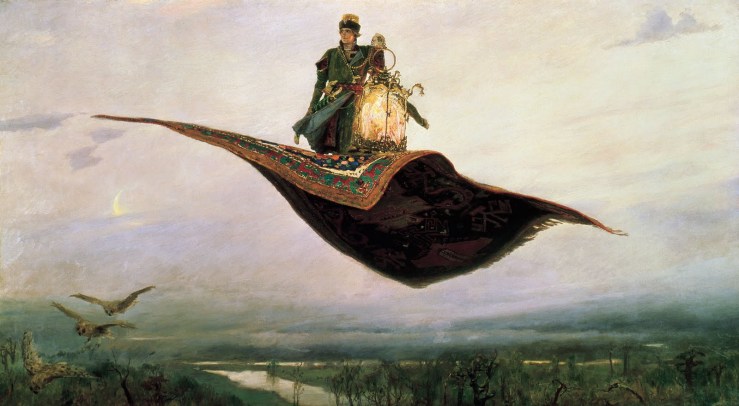
Flying Carpet — Viktor Vasnetsov

Viktor Mikhailovich Vasnetsov Flying Carpet

The Poet — Adrian Gottlieb

The_Poet_internet

A girl discovers the whole world in a leaf in Angela Steffen’s animated short film Lebensader

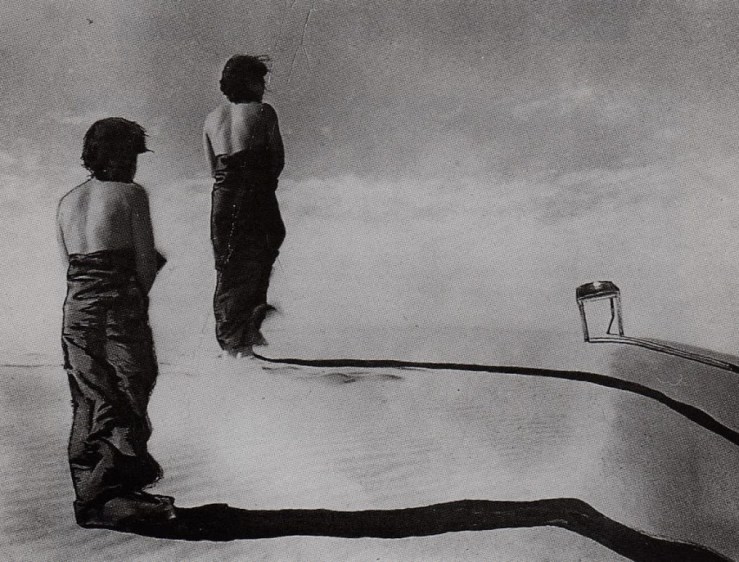
Untitled (Two Women) — Kansuke Yamamoto

EPSON035

Two Women — Tsuguharu Foujita

二人の女-Two-women-1918

Jane Bowles’s novel Two Serious Ladies confounds with sinister humor and dark delight

Two Women, Gwen John

Here’s a short review of Jane Bowles’s only novel, Two Serious Ladies: The book is amazing, a confounding, energetic picaresque suffused with sinister humor and dark delight. I read it knowing nothing about the plot on the recommendation of Ben Marcus, who described it as “so insane, so beautiful, and in some sense, unknowable to me. On the surface, it’s not really about much, but the arrangement of words does something chemical to me.” My recommendation is to dispense with the rest of my review and read Bowles’s novel.

“Unknowable” is a fair description, and Two Serious Ladies was met with bewilderment when it was first published in 1943, as Negar Azimi points out in the comprehensive essay “The Madness of Queen Jane”:

Edith Walton, writing in the Times Book Review, called the book senseless and silly: “To attempt to unravel the plot of ‘Two Serious Ladies’ would be to risk, I am sure, one’s own sanity.” Another reviewer said, simply, “The book is about nothing.” Jane’s family, in the meantime, found it unseemly in its stark depiction of lesbianism. Its characters, who have goals and motivations that are hard to grasp, were difficult to relate to. Yet another critic wrote, “The only shocking thing about this novel is that it ever managed to find its way to print.” Jane was only twenty-four.

The notion that “The book is about nothing,” is corrected by Marcus’s qualifier about its “surface”: Two Serious Ladies moves through the phenomenological world that its characters experience, but it does not mediate the concrete contours of that world in a way that its characters can name for the reader. When the characters, those two serious ladies, do stumble into language that might name, pin down, or otherwise fix their experience, fix their consciousness into a stable relation with the world, Bowles spins the wheel again, flings her characters into new scenarios. Moments of epiphany are transitory and hard-purchased. A (perhaps) illustrating passage, offered without context:

Mrs. Copperfield started to tremble after the girl had closed the door behind her. She trembled so violently that she shook the bed. She was suffering as much as she had ever suffered because she was going to do what she wanted to do. But it would not make her happy. She did not have the courage to stop from doing what she wanted to do. She knew that it would not make her happy, because only the dreams of crazy people come true. She thought that she was only interested in duplicating a dream, but in doing so she necessarily became the complete victim of a nightmare.

The free indirect style here still hides so much from the reader, who must suss the characters’ unnamed desires from bewildering details alone. The passage above shows us fear and trembling, dream, nightmare—and crazy people. What does Copperfield want to do? One subtext here is a lesbian desire seemingly comprehended by everyone but Mrs. Copperfield herself. (In some of the book’s strangest moments, Mr. Copperfield leaves his near-mad wife in a dangerous part of a foreign city to encounter hookers of every stripe). Two Serious Ladies is about women searching for something, but something they can’t name, can’t conceive in language—but can perhaps imagine. Continue reading “Jane Bowles’s novel Two Serious Ladies confounds with sinister humor and dark delight”

The Bus — Paul Kirchner

DGsYlDA

Vanitas of the Angels — Martinho Correia

tumblr_ltrk52Z9CG1r5569zo1_1280 (1)

We have to articulate ourselves, otherwise we would be cows in the field (Werner Herzog)

(An Incomplete) List of Ridiculous Names in Charles Dickens Novels

Abel Garland

Abel Magwich

Adolphus Tetterby

Alfred Jingle

Affery Flintwinch

Anne Chickenstalker

Anthony Jeddler

Augustus Snodgrass

Barnaby Rudge

Bayham Badger

Bazzard

Bella Wilfer

Bentley Drummle

Betsy Prig

Betsy Quilp

Betsy Trotwood

Brownlow

Bucket

Bumble

Caroline “Caddy” Jellyby

Charity Pecksniff 

Clara Peggotty

Cleopatra Skewton

Clickett

Cornelia Blimber

Canon Crisparkle

Charles Cheeryble

Chevy Slyme

Clarence Barnacle

Clarriker

Creakle Continue reading “(An Incomplete) List of Ridiculous Names in Charles Dickens Novels”

The Complete Short Stories of Mark Twain

TheCompleteShortStoriesOfMarkTwain

1971 Bantam edition.

The Moment of Birth — Alfred Kubin

Doc Sportello’s Interstellar Trip (Pynchon’s Inherent Vice)

It had all begun, apparently, some 3 billion years ago, on a planet in a binary star system quite a good distance from Earth. Doc’s name then was something like Xqq, and because of the two suns and the way they rose and set, he worked some very complicated shifts, cleaning up after a labful of scientist-priests who invented things in a gigantic facility which had formerly been a mountain of pure osmium. One day he heard some commotion down a semiforbidden corridor and went to have a look. Ordinarily sedate and studious personnel were running around in uncontrolled glee. “We did it!” they kept screaming. One of them grabbed Doc, or actually Xqq. “Here he is! The perfect subject!” Before he knew it he was signing releases, and being costumed in what he would soon learn was a classic hippie outfit of the planet Earth, and led over to a peculiarly shimmering chamber in which a mosaic of Looney Tunes motifs was repeating obsessively away in several dimensions at once in vividly audible yet unnamable spectral frequencies. . . . The lab people were explaining to him meanwhile that they’d just invented intergalactic time travel and that he was about to be sent across the universe and maybe 3 billion years into the future. “Oh, and one other thing,” just before throwing the final switch, “the universe? it’s been, like, expanding? So when you get there, everything else will be the same weight, but bigger? with all the molecules further apart? except for you—you’ll be the same size and density. Meaning you’ll be about a foot shorter than everybody else, but much more compact. Like, solid?”


“Can I walk through walls?” Xqq wanted to know, but by then space and time as he knew it, not to mention sound, light, and brain waves, were all undergoing these unprecedented changes, and next thing he knew he was standing on the corner of Dunecrest and Gordita Beach Boulevard, and watching what seemed to be an endless procession of young women in bikinis, some of whom were smiling at him and offering thin cylindrical objects whose oxidation products were apparently meant to be inhaled. . . .


As it turned out, he was able to go through drywall construction with little discomfort, although, not having X-ray vision, he did run into some disagreeable moments with wall studs and eventually curtailed the practice. His new hyperdensity also allowed him sometimes to deflect simple weapons directed at him with hostile intent, though bullets were another story, and he also learned to avoid those when possible. Slowly the Gordita Beach of his trip merged with the everyday version, and he began to assume that things were back to normal, except for when, now and then, he’d forget and lean against a wall and suddenly find himself halfway through it and trying to apologize to somebody on the other side.

From Thomas Pynchon’s novel Inherent Vice.