Read “Entropy,” a short story by Thomas Pynchon

“Entropy”

by

Thomas Pynchon

Boris has just given me a summary of his views. He is weather prophet. The weather will continue bad, he says. There will be more calamities, more death, more despair. Not the slightest indication of a change anywhere…. We must get into step, a lockstep toward the prison of death. There is no escape. The weather will not change. – Tropic of Cancer

Downstairs, Meatball Mulligan’s lease-breaking party was moving into its 40th hour. On the kitchen floor, amid a litter of empty champagne fifths, were Sandor Rojas and three friends, playing spit in the ocean and staying awake on Heidseck and benzedrine pills. In the living room Duke, Vincent, Krinkles and Paco sat crouched over a 15-inch speaker which had been bolted into the top of a wastepaper basket, listening to 27 watts’ worth of The Heroes’ Gate at Kiev. They all wore hornrimmed sunglasses and rapt expressions, and smoked funny-looking cigarettes which contained not, as you might expect, tobacco, but an adulterated form of cannabis sativa. This group was the Duke di Angelis quartet. They recorded for a local label called Tambú and had to their credit one 10″ LP entitled Songs of Outer Space. From time to time one of them would flick the ashes from his cigarette into the speaker cone to watch them dance around. Meatball himself was sleeping over by the window, holding an empty magnum to his chest as if it were a teddy bear. Several government girls, who worked for people like the State Department and NSA, had passed out on couches, chairs and in one case the bathroom sink.

This was in early February of’57 and back then there were a lot of American expatriates around Washington, D.C., who would talk, every time they met you, about how someday they were going to go over to Europe for real but right now it seemed they were working for the government. Everyone saw a fine irony in this. They would stage, for instance, polyglot parties where the newcomer was sort of ignored if he couldn’t carry on simultaneous conversations in three or four languages. They would haunt Armenian delicatessens for weeks at a stretch and invite you over for bulghour and lamb in tiny kitchens whose walls were covered with bullfight posters. They would have affairs with sultry girls from Andalucía or the Midi who studied economics at Georgetown. Their Dôme was a collegiate Rathskeller out Wisconsin Avenue called the Old Heidelberg and they had to settle for cherry blossoms instead of lime trees when spring came, but in its lethargic way their life provided, as they said, kicks.

At the moment, Meatball’s party seemed to be gathering its second wind. Outside there was rain. Rain splatted against the tar paper on the roof and was fractured into a fine spray off the noses, eyebrows and lips of wooden gargoyles under the eaves, and ran like drool down the windowpanes. The day before, it had snowed and the day before that there had been winds of gale force and before that the sun had made the city glitter bright as April, though the calendar read early February. It is a curious season in Washington, this false spring. Somewhere in it are Lincoln’s Birthday and the Chinese New Year, and a forlornness in the streets because cherry blossoms are weeks away still and, as Sarah Vaughan has put it, spring will be a little late this year. Generally crowds like the one which would gather in the Old Heidelberg on weekday afternoons to drink Würtzburger and to sing Lili Marlene (not to mention The Sweetheart of Sigma Chi) are inevitably and incorrigibly Romantic. And as every good Romantic knows, the soul (spiritus, ruach, pneuma) is nothing, substantially, but air; it is only natural that warpings in the atmosphere should be recapitulated in those who breathe it. So that over and above the public components—holidays, tourist attractions—there are private meanderings, linked to the climate as if this spell were a stretto passage in the year’s fugue: haphazard weather, aimless loves, unpredicted commitments: months one can easily spend in fugue*, because oddly enough, later on winds, rains, passions of February and March are never remembered in that city, it is as if they had never been.

Read the rest of “Entropy” online here—alongside a Spanish translation and explanatory notes—or read it in the collection of early Pynchon shorties Slow Learner.

A Young Girl Reading by Candlelight — Philip Mercier

tumblr_nfocfu0dSZ1rrnekqo1_1280

“Welt” — Georgia Douglas Johnson

welt

Hong Chau as Jade (Inherent Vice film poster)

inherent_vice_jade

(More stylized Inherent Vice posters).


City of Fire: The Street — Geof Darrow and Moebius

tumblr_nawbnhIlO51qld9yio10_1280

Read “Schrödinger’s Cat” by Ursula K. Le Guin

“Schrödinger’s Cat”

by Ursula K. Le Guin

As things appear to be coming to some sort of climax, I have withdrawn to this place. It is cooler here, and nothing moves fast.

On the way here I met a married couple who were coming apart. She had pretty well gone to pieces, but he seemed, at first glance, quite hearty. While he was telling me that he had no hormones of any kind, she pulled herself together and, by supporting her head in the crook of her right knee and hopping on the toes of her right foot, approached us shouting, “Well what’s wrong with a person trying to express themselves?” The left leg, the arms, and the trunk, which had remained lying in the heap, twitched and jerked in sympathy. “Great legs,” the husband pointed out, looking at the slim ankle. “My wife had great legs.”

A cat has arrived interrupting my narrative. It is a striped yellow tom with white chest and paws. He has long whiskers and yellow eyes. I never noticed before that cats had whiskers above their eyes; is that normal? There is no way to tell. As he has gone to sleep on my knee, I shall proceed.

Where?

Nowhere, evidently. Yet the impulse to narrate remains. Many things are not worth doing, but almost anything is worth telling. In any case, I have a severe congenital case of Ethica laboris puritanica,1 or Adam’s Disease. It is incurable except by total decapitation. I even like to dream when asleep, and to try and recall my dreams: it assures me that I haven’t wasted seven or eight hours just lying there. Now here I am, lying, here. Hard at it.

Read the rest. 

Twilight — Angelo Morbelli

images158

Angel Piping to the Souls in Hell — Evelyn de Morgan

Elms

Alex Cox defines “cult film” and introduces The Wicker Man for BBC’s Moviedrome

A German Picturesque (Book acquired, 1.23.2014)

2015/01/img_4947.jpg

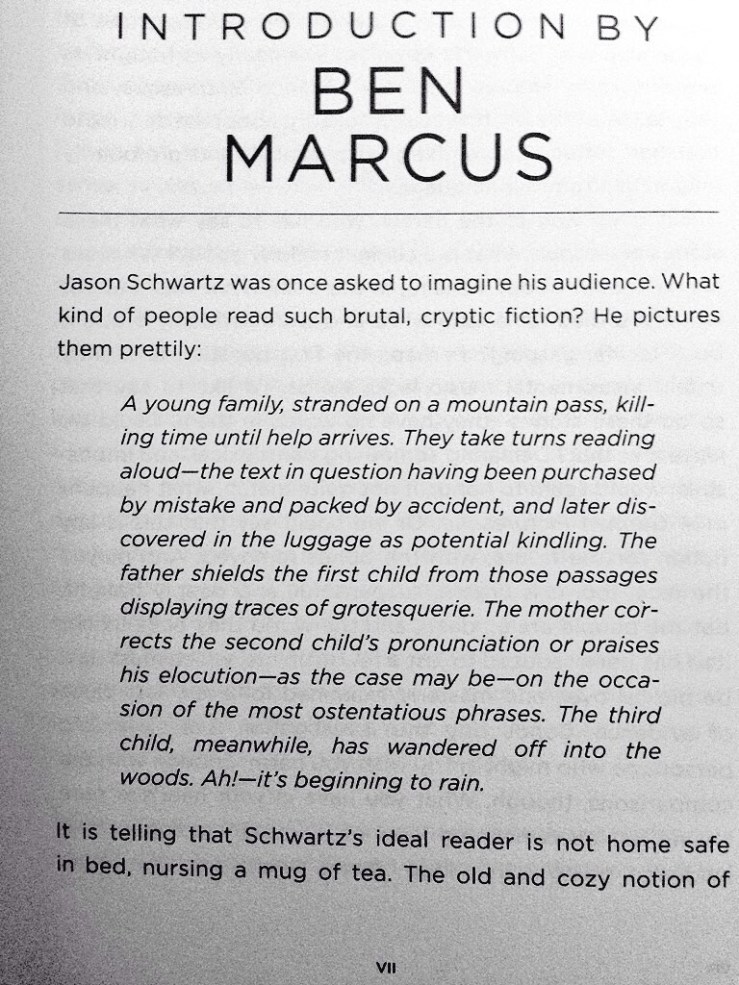
Pharos is reissuing Jason Schwartz’s debut collection A German Picturesque, pictured on the right, above, by the original. The title was selected and introduced by Ben Marcus, who quotes from the interview Schwartz granted me last year—

2015/01/img_4923.jpg

I actually think that it was this review which led to Ben Marcus consenting to talk with me over the phone for an hour in December. I’ve been typing that interview very slowly and swear it’s on the horizon. Painful dreadful anxious work. Interview with Marcus to come. Review of Schwartz to come.

Bertalda, Assailed by Spirits — Theodor von Holst

Theodor_von_Holst_Bertalda_Assailed_Spirits

An article on cemeteries, and other ideas from Nathaniel Hawthorne’s Note-Books

The spells of witches have the power of producing meats and viands that have the appearance of a sumptuous feast, which the Devil furnishes: But a Divine Providence seldom permits the meat to be good, but it has generally some bad taste or smell,–mostly wants salt,–and the feast is often without bread.


An article on cemeteries, with fantastic ideas of monuments; for instance, a sundial;–a large, wide carved stone chair, with some such motto as “Rest and Think,” and others, facetious or serious.


“Mamma, I see a part of your smile,”–a child to her mother, whose mouth was partly covered by her hand.


“The syrup of my bosom,”–an improvisation of a little girl, addressed to an imaginary child.


“The wind-turn,” “the lightning-catch,” a child’s phrases for weathercock and lightning-rod.


“Where’s the man-mountain of these Liliputs?” cried a little boy, as he looked at a small engraving of the Greeks getting into the wooden horse.


When the sun shines brightly on the new snow, we discover ranges of hills, miles away towards the south, which we have never seen before.


To have the North Pole for a fishing-pole, and the Equinoctial Line for a fishing-line.

From Nathaniel Hawthorne’s American Note-Books.

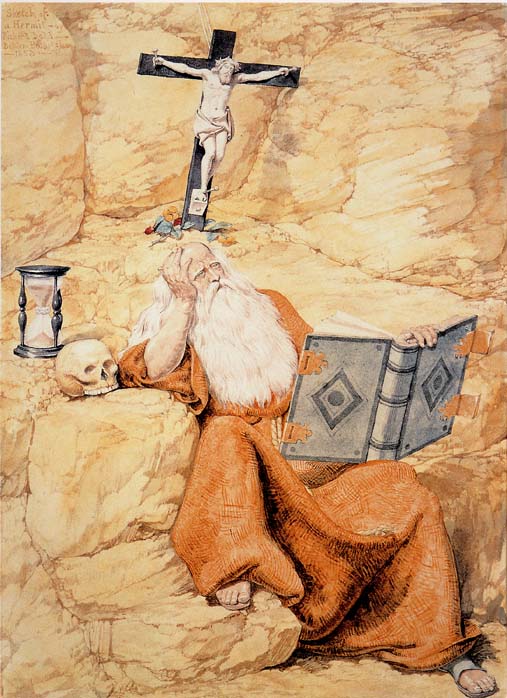
A Hermit — Richard Dadd

a_hermit-large

Transformation of St. George — Judson Huss

Judson_Huss_TransformationofStGeorge

The Bus — Paul Kirchner

IfawPYE

A (probably incomplete) list of films mentioned in Thomas Pynchon’s novel Inherent Vice

Below: A (probably incomplete) list of films mentioned in Thomas Pynchon’s novel Inherent Vice.

I’ve listed them in the order in which they show up, and also in the editorial style in which they appear—initially, Pynchon separates the release year with a comma or doesn’t give a year at all, before settling on parenthetical citations—with the one quirk of A Summer Place—its year is indicated in brackets. Obviously this inconsistency is actually some kind of super-meaningful clue, a key that will unlock any unresolved mysteries of Inherent Vice—right?

Black Narcissus, 1947

Caligari

Metropolis

Dr. No, 1962

Now, Voyager (1942)

Fort Apache (1948)

He Ran All the Way (1951)

I Walked with a Zombie (1943)

Ghidrah, the Three-Headed Monster (1964)

Roman Holiday (1953)

The Wizard of Oz (1939)

Vertigo (1958)

The Big Bounce (1969)

Champion (1949)

The Postman Always Rings Twice (1946)

A Summer Place [1959]

The Sea Wolf (1941)

Little Miss Broadway (1938)