The final test of truth is ridicule. Very few religious dogmas have ever faced it and survived. Huxley laughed the devils out of the Gadarene swine. Dowie’s whiskers broke the back of Dowieism. Not the laws of the United States but the mother-in-law joke brought the Mormons to compromise and surrender. Not the horror of it but the absurdity of it killed the doctrine of infant damnation…. But the razor edge of ridicule is turned by the tough hide of truth. How loudly the barber-surgeons laughed at Harvey—and how vainly! What clown ever brought down the house like Galileo? Or Columbus? Or Jenner? Or Lincoln? Or Darwin?… They are laughing at Nietzsche yet…
From H.L. Mencken’s Damn! A Book of Calumny.
A dedicated storyteller, though – a true lie-minded man – will serve his history best, and guarantee its popularity, not by imitating nature, since nature’s no source of verisimilitude, but by following as closely as he can our simplest, most direct and unaffected forms of daily talk, for we report real things, things which intrigue and worry us, and such resembling gossip in a book allows us to believe in figures and events we cannot see, shall never touch, with an assurance of safety which sets our passions free. He will avoid recording consciousness since consciousness is private – we do not normally “take it down” – and because no one really believes in any other feelings than his own. However, the moment our writer concentrates on sound, the moment he formalizes his sentences, the moment he puts in a figure of speech or turns a phrase, shifts a tense or alters tone, the moment he carries description, or any account, beyond need, he begins to turn his reader’s interest away from the world which lies among his words like a beautiful woman among her slaves, and directs him toward the slaves themselves. This illustrates a basic principle: if I describe my peach too perfectly, it’s the poem which will make my mouth water…while the real peach spoils.


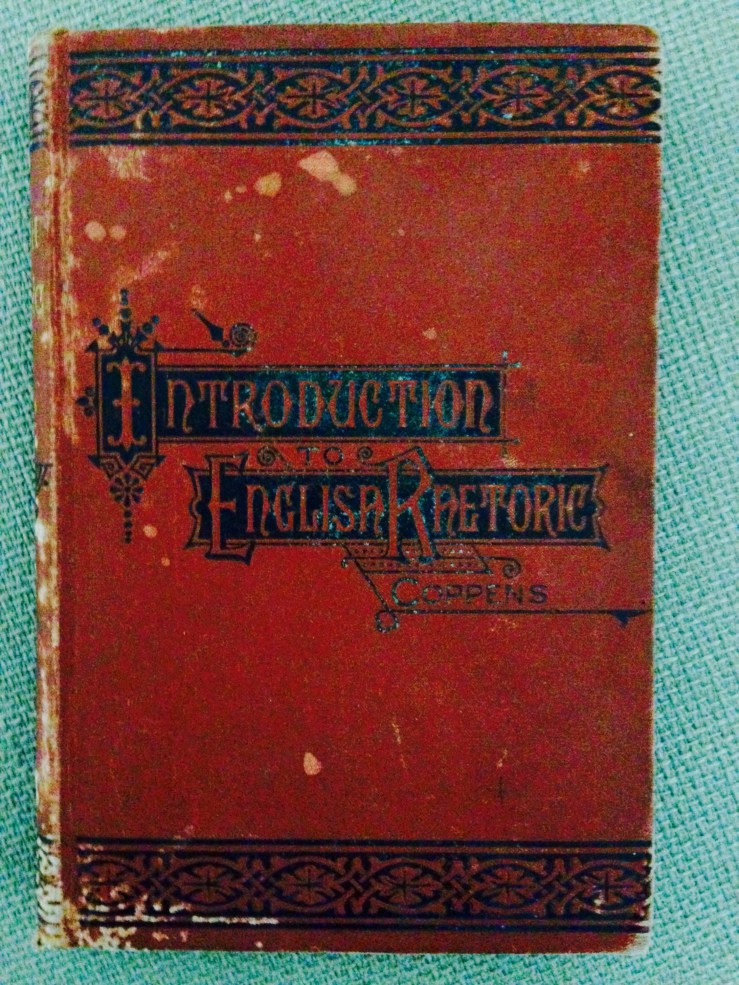
For Christmas, my mother-in-law gave me Introduction to English Rhetoric (1886) by the Rev. Charles Coppens, SJ. You can read the book here.
“Small Fry”
by
Anton Chekhov
“HONORED Sir, Father and Benefactor!” a petty clerk called Nevyrazimov was writing a rough copy of an Easter congratulatory letter. “I trust that you may spend this Holy Day even as many more to come, in good health and prosperity. And to your family also I…”
The lamp, in which the kerosene was getting low, was smoking and smelling. A stray cockroach was running about the table in alarm near Nevyrazimov’s writing hand. Two rooms away from the office Paramon the porter was for the third time cleaning his best boots, and with such energy that the sound of the blacking-brush and of his expectorations was audible in all the rooms.
“What else can I write to him, the rascal?” Nevyrazimov wondered, raising his eyes to the smutty ceiling.
On the ceiling he saw a dark circle—the shadow of the lamp-shade. Below it was the dusty cornice, and lower still the wall, which had once been painted a bluish muddy color. And the office seemed to him such a place of desolation that he felt sorry, not only for himself, but even for the cockroach.
“When I am off duty I shall go away, but he’ll be on duty here all his cockroach-life,” he thought, stretching. “I am bored! Shall I clean my boots?”
And stretching once more, Nevyrazimov slouched lazily to the porter’s room. Paramon had finished cleaning his boots. Crossing himself with one hand and holding the brush in the other, he was standing at the open window-pane, listening.
“They’re ringing,” he whispered to Nevyrazimov, looking at him with eyes intent and wide open. “Already!”
Nevyrazimov put his ear to the open pane and listened. The Easter chimes floated into the room with a whiff of fresh spring air. The booming of the bells mingled with the rumble of carriages, and above the chaos of sounds rose the brisk tenor tones of the nearest church and a loud shrill laugh.
“What a lot of people!” sighed Nevyrazimov, looking down into the street, where shadows of men flitted one after another by the illumination lamps. “They’re all hurrying to the midnight service…. Our fellows have had a drink by now, you may be sure, and are strolling about the town. What a lot of laughter, what a lot of talk! I’m the only unlucky one, to have to sit here on such a day: And I have to do it every year!”
“Well, nobody forces you to take the job. It’s not your turn to be on duty today, but Zastupov hired you to take his place. When other folks are enjoying themselves you hire yourself out. It’s greediness!”
“Devil a bit of it! Not much to be greedy over—two roubles is all he gives me; a necktie as an extra…. It’s poverty, not greediness. And it would be jolly, now, you know, to be going with a party to the service, and then to break the fast…. To drink and to have a bit of supper and tumble off to sleep…. One sits down to the table, there’s an Easter cake and the samovar hissing, and some charming little thing beside you…. You drink a glass and chuck her under the chin, and it’s first-rate…. You feel you’re somebody…. Ech h-h!… I’ve made a mess of things! Look at that hussy driving by in her carriage, while I have to sit here and brood.”
“We each have our lot in life, Ivan Danilitch. Please God, you’ll be promoted and drive about in your carriage one day.”
“I? No, brother, not likely. I shan’t get beyond a ‘titular,’ not if I try till I burst. I’m not an educated man.”
“Our General has no education either, but…”
“Well, but the General stole a hundred thousand before he got his position. And he’s got very different manners and deportment from me, brother. With my manners and deportment one can’t get far! And such a scoundrelly surname, Nevyrazimov! It’s a hopeless position, in fact. One may go on as one is, or one may hang oneself…”
He moved away from the window and walked wearily about the rooms. The din of the bells grew louder and louder…. There was no need to stand by the window to hear it. And the better he could hear the bells and the louder the roar of the carriages, the darker seemed the muddy walls and the smutty cornice and the more the lamp smoked.
“Shall I hook it and leave the office?” thought Nevyrazimov.
But such a flight promised nothing worth having…. After coming out of the office and wandering about the town, Nevyrazimov would have gone home to his lodging, and in his lodging it was even grayer and more depressing than in the office…. Even supposing he were to spend that day pleasantly and with comfort, what had he beyond? Nothing but the same gray walls, the same stop-gap duty and complimentary letters….
Nevyrazimov stood still in the middle of the office and sank into thought. The yearning for a new, better life gnawed at his heart with an intolerable ache. He had a passionate longing to find himself suddenly in the street, to mingle with the living crowd, to take part in the solemn festivity for the sake of which all those bells were clashing and those carriages were rumbling. He longed for what he had known in childhood—the family circle, the festive faces of his own people, the white cloth, light, warmth…! He thought of the carriage in which the lady had just driven by, the overcoat in which the head clerk was so smart, the gold chain that adorned the secretary’s chest…. He thought of a warm bed, of the Stanislav order, of new boots, of a uniform without holes in the elbows…. He thought of all those things because he had none of them.
“Shall I steal?” he thought. “Even if stealing is an easy matter, hiding is what’s difficult. Men run away to America, they say, with what they’ve stolen, but the devil knows where that blessed America is. One must have education even to steal, it seems.”
The bells died down. He heard only a distant noise of carriages and Paramon’s cough, while his depression and anger grew more and more intense and unbearable. The clock in the office struck half-past twelve.
“Shall I write a secret report? Proshkin did, and he rose rapidly.”
Nevyrazimov sat down at his table and pondered. The lamp in which the kerosene had quite run dry was smoking violently and threatening to go out. The stray cockroach was still running about the table and had found no resting-place.
“One can always send in a secret report, but how is one to make it up? I should want to make all sorts of innuendoes and insinuations, like Proshkin, and I can’t do it. If I made up anything I should be the first to get into trouble for it. I’m an ass, damn my soul!”
And Nevyrazimov, racking his brain for a means of escape from his hopeless position, stared at the rough copy he had written. The letter was written to a man whom he feared and hated with his whole soul, and from whom he had for the last ten years been trying to wring a post worth eighteen roubles a month, instead of the one he had at sixteen roubles.
“Ah, I’ll teach you to run here, you devil!” He viciously slapped the palm of his hand on the cockroach, who had the misfortune to catch his eye. “Nasty thing!”
The cockroach fell on its back and wriggled its legs in despair. Nevyrazimov took it by one leg and threw it into the lamp. The lamp flared up and spluttered.
And Nevyrazimov felt better.

What does Slavoj Zizek mean when he says that the Lacanian Symoblic carries the “stain of the Real”? During a talk I once saw him deliver, we watched a clip from David Lean’s Brief Encounter. The plot is as follows: disaffected middle-class wife Celia Johnson falls in love with one Dr. Alec Harvey, both unhappily married with children, both finding in each other a means of escape from their droll realities. They can’t avoid running into people from their shared social circles, forcing them to lie, ultimately delivering us to the final scene. At the train station, the precipice of their final good-bye, Johnson and Harvey are interrupted not only by a nagging friend of the former, but the whistle of Harvey’s train, preventing a passionate farewell (note: they also have not consummated their affair).
The point is that there is a Symbolic laid over a Symbolic — the first are Johnson’s and Harvey’s individual marriages, the illusion that the ritual provides access to the Real of intimacy (the failure of this accomplishment is signed by the crushingly boring misery of their lives); the second are the lies that overlap the marriages, a futile attempt to circumvent the trap of middle-class marriage. The point to this point: Johnson’s friend, the whistle, and the progressive threat of discovery with each new lie are policemen of the Real. Even in the myth of love we are not truly connected; the stain of the Real interrupts to remind us that there is no signifier of the Real without the Symbolic.
Implicit in this construction is that there is no capital-T Truth, that the Symbolic always leaks the Real through its pores as it tries to envelop it. Such is the dilemma of Jon Michaels, the protagonist in Lee Rourke’s new novel Vulgar Things. Michaels, a mid-level editor at a small academic publisher, hungover from the funerary-celebratory bender of his recent sacking that shuttles against the wounds of a fresh divorce, is told by his perpetually unavailable brother Cal that their estranged Uncle Rey, lost to “‘wacky baccy and strange ways,'” has committed suicide in his caravan on Canvey Island, a tucked-away seatown in the Thames estuary in East London where people–mainly idealistic men–used to believe could restart their lives. Instead, it became a place to simply die. “I’ve always understood, deep down, beneath the laughter,” Jon says during his first few steps on Canvey, “why the locals refer to it as the island, deep down it’s always made perfect sense to me: to feel dislocated, to feel lost and forgotten.”
It’s my disadvantage that I’m not English and know nothing about the UK’s geography, the cultural codes built into words like Southend or Queensway. To know, however vaguely, centuries of history through the mediation of businesses coming and going, hundreds-year-old buildings crammed up against new condos. The beaten bricks giving way to municipal sidewalk-grade cement. The phasing out of regional accents, the arrival of RP and other posh accents (this is the extent of my knowledge of the UK) to the grimace and chagrin of the locals, who know all the stories and histories of Canvey. Because Vulgar Things is a text built on and from the echoes of these stories, and of stories in general, the highways and throughways of mediation.
Vulgar Things‘s plot is far from compelling. Jon has to go clean out a dead uncle’s Caravan, becomes obsessed with a woman he sees on the pier, discovers something reality-shattering about himself and Rey. For the first fifty pages or so, I was struggling to find something in this limp plot, in Rourke’s signature flat prose (which is what got me jazzed on him in his last novel, The Canal). At first it seemed to be nothing; I was worried, but Rourke’s deliberately unremarkable and at times sophomoric prose points us to something else entirely: the desire to have desire, the desire for agency within a plot, and the inherent failure at attaining truth. In Canvey, “the sea and sky above [him], everything else behind [him, it] makes immediate sense, [his] being here, to help decipher things, to tie up all the loose ends of Uncle Rey’s life.”
Canvey is a space in which Jon is underneath the atmosphere, the systems of reality that fix Jon’s life in apathy: his overpriced London apartment, the dissatisfaction he found in his work, a failed marriage. The messy task of deciphering and reassembling Rey’s life through his papers loses Jon between temporalities. For here is a man surrendered to aimlessness, wanting anything that can fix him to a desire and thus a meaning and thus a truth. Jon’s and Rey’s wanderings collide wonderfully when, like a good mystery, Jon finds amidst the detritus of Rey’s life a manuscript titled Vulgar Things, a reassemblage of Petrarch’s sonnets, the only poet, according to Rey, who got anything right. Rourke’s Vulgar Things becomes a palimpsest of Rey’s “Vulgar Things,” itself a palimpsest of Petrarch’s Rerum Vulgarium Fragmenta (Fragments of Common Things). The elevation of the banal is reflected in this mediation through the form of the book — the days of the week are built from ordinary phrases, seemingly forgetful perceptions: “such a long time”; “afternoon drinking”; “pointless”; “part of the furniture.” As if these are the forgettable shots in a film, the necessary moves that help get us from Point A to Point B. The limp conceit I mentioned above becomes a kind of mystery-thriller, not unlike the strange turns that Rourke’s last novel takes, when Jon becomes animated by Rey’s “Vulgar Things,” the secrets he points to in his strange video recordings. The startling coincidences of Laura throughout the three media (Petrarch, Rey and Jon).
Sort of unsure how to end this, much like how Jon is unsure how to integrate the revelations he has at the end of the book. He doesn’t keep anything; which is to say, we’re prevented an ending that Symbolically ties up the trajectories of desire that Vulgar Things elicits (perhaps solicits) from us. Again, this is much of the book’s thesis. We need language, but language is a medium, and these mediums are haunted by its linguistic and media forebears and continually fail at providing a truth beyond its Symbolic functions. Yet we are caught in desire, caught in language, and can do little else than to contend with that failure.