Reading/Have Read/Should Write About

2015/01/img_4843.jpg

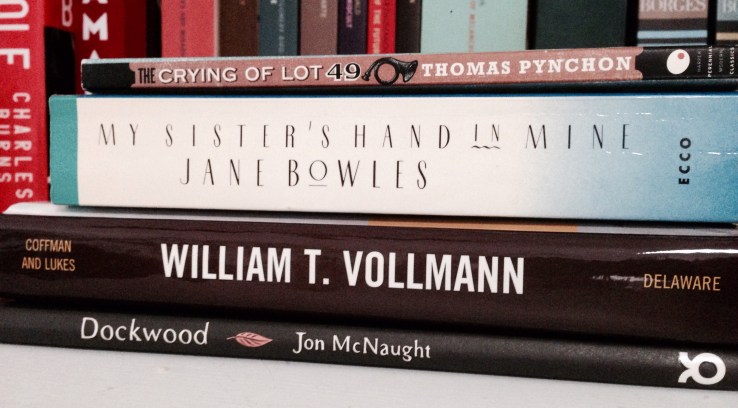
The Crying of Lot 49 by Thomas Pynchon

After a few false starts over the last decade, I finally submerged myself in Thomas Pynchon’s Mason & Dixon in those bourbon-soaked weeks between Thanksgiving and New Year. I read the book as a sort of sequel to the book Pynchon wrote after it, Against the Daysimply because I read Against the Day in 2013, before M&D. Both books are excellent, and seem to me more achieved in their vision than Inherent Vice or V or Vineland. The obvious comparison point for the pair though is Pynchon’s other big book (and, by reputation, his Big Book) Gravity’s Rainbow which I haven’t read since my freshman year of college—which is almost the same as not having read it at all. I intend to read it later this year (or maybe earlier?), but I also haven’t read The Crying of Lot 49 since my undergrad days either (which is to say, like, coming up on twenty years jesus). I’m about half way through and not zapped by it really—there are some funny jokes, but it’s just not as rich as Mason & Dixon or Against the Day (which is not meant to be a complaint, just an observation. And while I’m observing stuff parenthetically: What most bothers my attention most as I read are the reminders of David Foster Wallace’s The Broom of the System, which I have reread more recently than TCoL49).

Two Serious Ladies by Jane Bowles (collected in My Sister’s Hand in Mine)

What to say about Jane Bowles’s only novel? It goes: Propelled on its own sinister energy it goes, its vignettes flowing (or jerking or shifting or pitching wildly or dipping or soaring or sneaking) into each other with wonderfully dark comic force. I’ve sketched a full review I hope to be able to write, but for now let me excerpt a paragraph from Negar Azimi’s essay “The Madness of Queen Jane” from last summer in The New Yorker:

When it was first published, in 1943, “Two Serious Ladies” received lukewarm, even baffled, reviews. Edith Walton, writing in the Times Book Review, called the book senseless and silly: “To attempt to unravel the plot of ‘Two Serious Ladies’ would be to risk, I am sure, one’s own sanity.” Another reviewer said, simply, “The book is about nothing.” Jane’s family, in the meantime, found it unseemly in its stark depiction of lesbianism. Its characters, who have goals and motivations that are hard to grasp, were difficult to relate to. Yet another critic wrote, “The only shocking thing about this novel is that it ever managed to find its way to print.” Jane was only twenty-four.

Wharton’s line should intrigue, not repel readers. And: “The book is about nothing” — well, okay, that’s completely untrue—the book is about women searching for something, but something they can’t name, can’t conceive in language but can perhaps imagine. These women are on the brink of all those things one can be brinked upon: abysses, madness, abysses of madness, etc. But: “The book is about nothing” — well, okay, Two Serious Ladies resists unfolding in the way in which we expect narratives to be about something—Bowles withholds exposition, clarification, and motivation—well, okay, not withholds, but rather hides, or obscures, or enshadows.

I don’t have the verbs for this book.

But I loved reading it, feeling estranged from it while simultaneously invited into its darkness, bewildered by its transpositions, as Jane Bowles moves her verbal camera from one character to another—Wait, what? Okay, I guess we’re going over here now?!—its picaresque energy a strange dark joy. More to come.

William T. Vollmann: A Critical Companion, a collection of essays edited by Christopher K. Coffman and Daniel Lukes

I’ve been dipping into this kind of at random, but it’s very rewarding, and I think it would make a surprisingly good introduction to Vollmann. To be clear, academic criticism is never a substitute for, y’know, reading the author’s actual texts, the range here covers voluminous Vollmann. And look, I’ll be honest, I’ll probably never read Argall, so I very much appreciated Buell Wisner situating it for me in his essay. One of the treats of this book is how an academic essay like Wisner’s—a well-researched close reading with 64 reference notes—is followed by a reflective and informal piece by Carla Bolte on designing Vollmann’s books (“Bill’s books are not for everyone. We all know that,” she offers at one point). Good stuff, more to come.

Dockwood by Jon McNaught

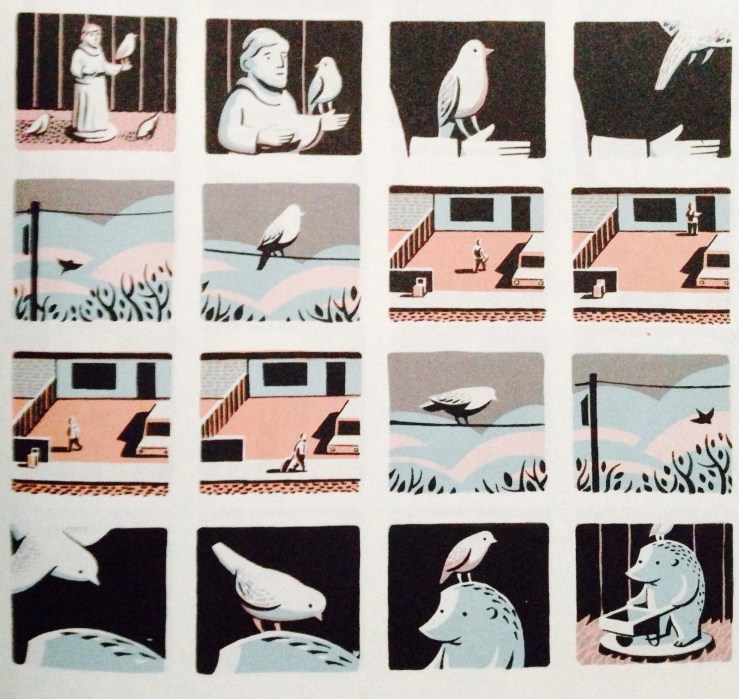
I owe this marvelous book a proper review. Dockwood is a kind of visual prose-poem, tranquil, meditative, autumnal. The book is its own total aesthetic; McNaught uses color and form to evoke feeling here, with minimal, unobtrusive dialogue that functions more as ambiance than exposition. Lovely.
IMG_4849

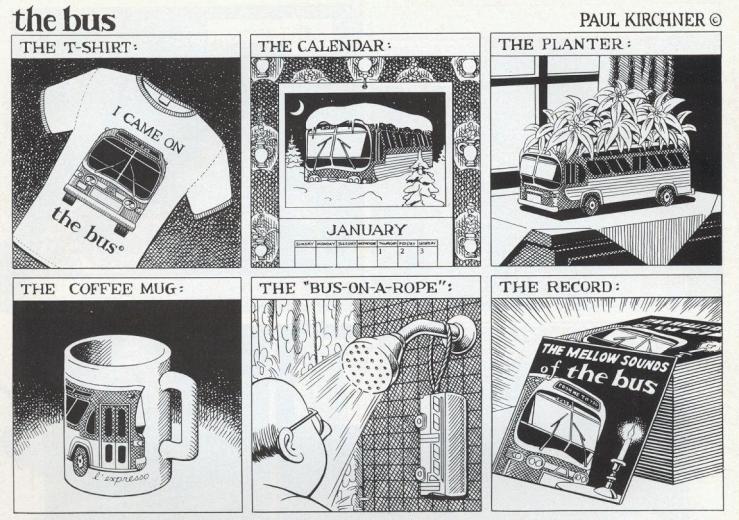
The Bus — Paul Kirchner

Q9zIEJM

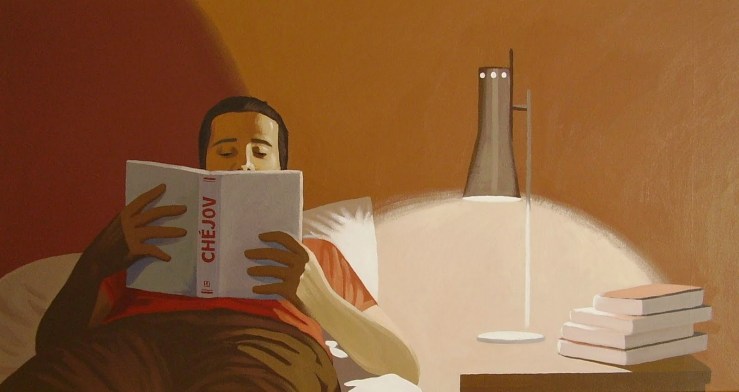
In Bed with Chekhov — Pablo Gallo

En la cama con Chejov -Pablo Gallo

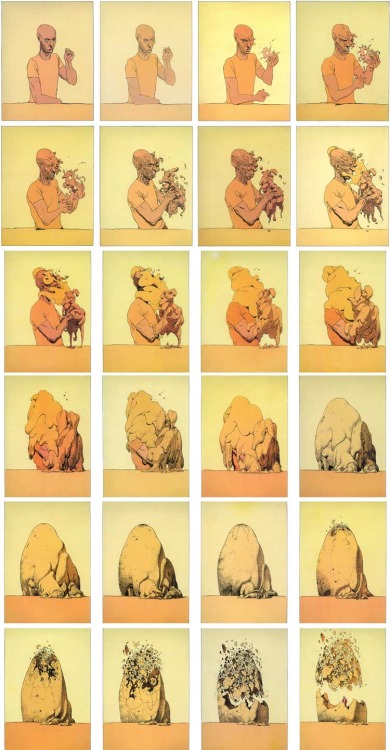
Metamorphosis — Moebius

tumblr_nf6x505Uzv1r49df9o1_500

You can safely ignore the reader’s taste, but you can’t ignore his nature (Flannery O’Connor)

The problem of the novelist who wishes to write about a man’s encounter with this God is how he shall make the experience—which is both natural and supernatural—understandable, and credible, to his reader. In any age this would be a problem, but in our own, it is a well-nigh insurmountable one. Today’s audience is one in which religious feeling has become, if not atrophied, at least vaporous and sentimental. When Emerson decided, in 1832, that he could no longer celebrate the Lord’s Supper unless the bread and wine were removed, an important step in the vaporization of religion in America was taken, and the spirit of that step has continued apace. When the physical fact is separated from the spiritual reality, the dissolution of belief is eventually inevitable.

The novelist doesn’t write to express himself, he doesn’t write simply to render a vision he believes true, rather he renders his vision so that it can be transferred, as nearly whole as possible, to his reader. You can safely ignore the reader’s taste, but you can’t ignore his nature, you can’t ignore his limited patience. Your problem is going to be difficult in direct proportion as your beliefs depart from his.

When I write a novel in which the central action is a baptism, I am very well aware that for a majority of my readers, baptism is a meaningless rite, and so in my novel I have to see that this baptism carries enough awe and mystery to jar the reader into some kind of emotional recognition of its significance. To this end I have to bend the whole novel—its language, its structure, its action. I have to make the reader feel, in his bones if nowhere else, that something is going on here that counts. Distortion in this case is an instrument; exaggeration has a purpose, and the whole structure of the story ‘or novel has been made what it is because of belief. This is not the kind of distortion that destroys; it is the kind that reveals, or should reveal.

From Flannery O’Connor’s essay “Novelist and Believer.”

Gloom/Gravity (Pound/Sterne)

2015/01/img_4832.png

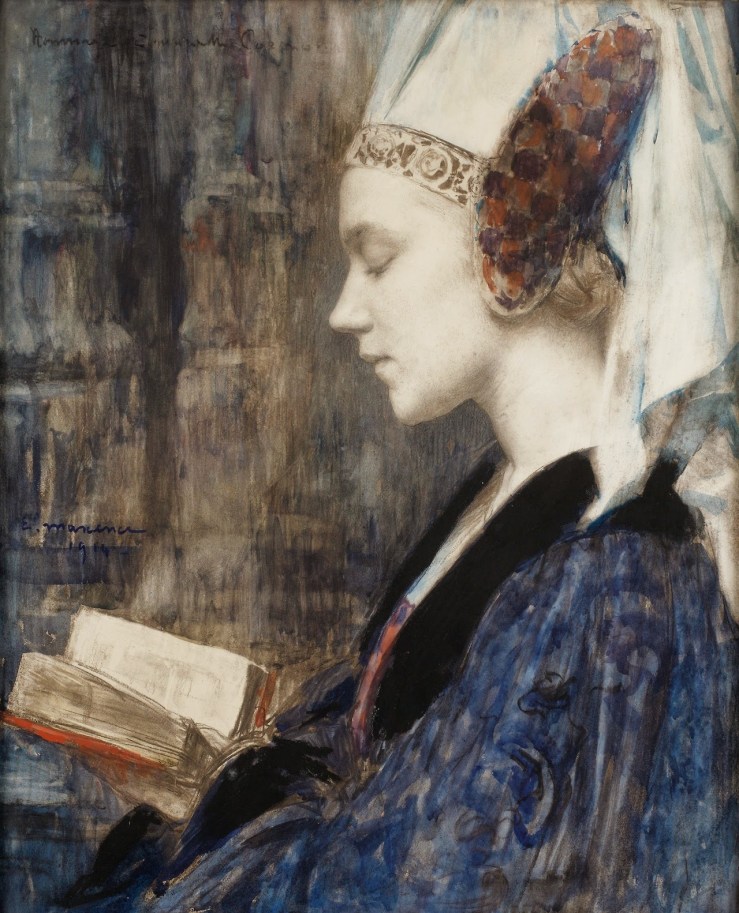
Woman Reading (Profile) — Edgar Maxence

Edgar_Maxence_034

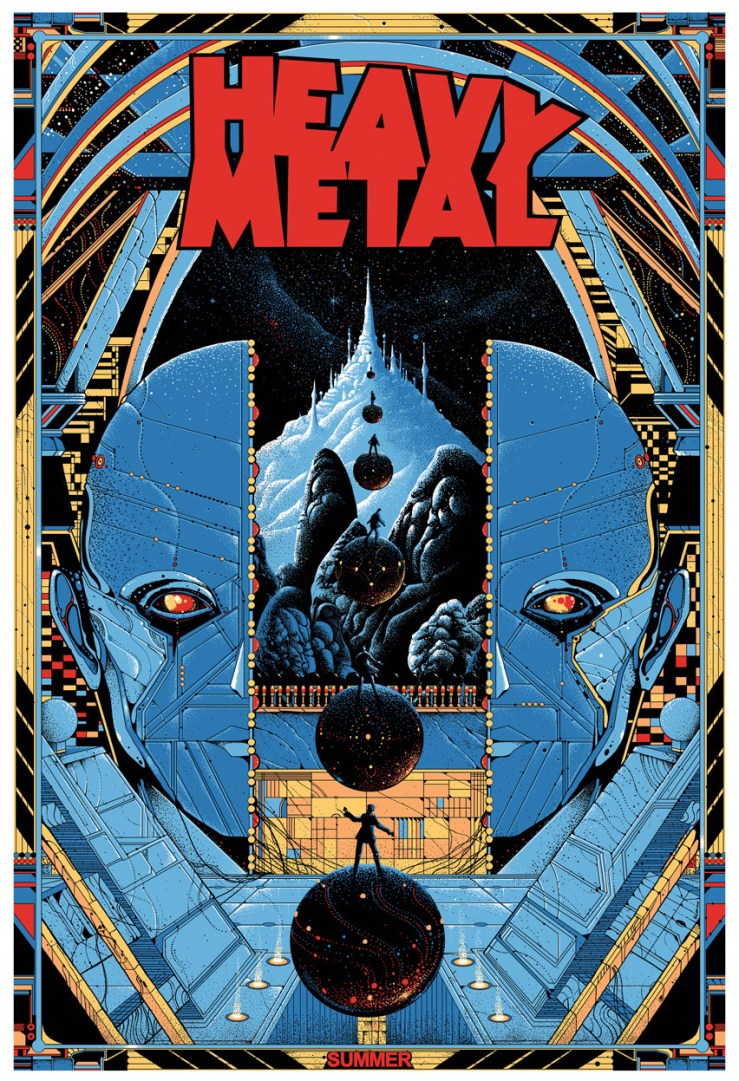
Heavy Metal — Kilian Eng

tumblr_n9acsdAPzs1qbluruo1_1280

2001: A Space Odyssey Posters by Kilian Eng

z00c

Read a new short story by Evan Lavender-Smith

Husband and wife’s children finally grown, starting their own families, etc. Out of the house at long last.

Life is all good.

Husband returns to his home improvement projects, etc., wife returns to her writing, etc.

Finally socializing again, etc.

Life is pretty good.

Life becoming less good.

Life worsening with each passing week. Husband and wife grow bored.

With each other? With monogamy? Maybe.

Go see a marriage counselor, like they did way back when. Same counselor, now older, wiser, or, at least, more confident.

Marriage counselor insists on vacuum created by kids’ absence, etc. Makes silly suggestions re how to fill vacuum. Gives them worksheets, etc.

Husband and wife diligently follow suggestions, complete worksheets. Obviously in love, or, at least, obviously committed to the idea of being in love, they try their best to make it work.

Go on vacation? A cruise? Yes.

Still bored.

Have a threeway? Maybe? No.

Still bored, etc.

Read the rest of Evan Lavender-Smith’s “Short Story Idea (The Macaque)” at BOMB.

Books Acquired (1.8.2015)

_20150108_212440

I am taking a class titled 21st-Century Fiction: What Is The Contemporary? and three of the books in this photograph are part of the reading list. Absent titles are by Dan Chaon, Kathryn Davis, Ben Marcus, Blake Butler, Sheila Heti. Some others. Wanted titles: Tao Lin’s Taipei (which I am reading now, which is surprisingly good).

I don’t know anything about Dodie Bellamy beyond the fact that she is often grouped with Kathy Acker, who are both often grouped with Dennis Cooper, who are all New Narrative people. New Narrators make the author present, her body and sexuality usually the prime subject. Letters of Mina Harker is a “sequel” to Dracula, except Mina Harker is a young woman who lives in 1980s San Francisco. On conceit alone, it reminds me of Kathy Acker’s Don Quixote: Which Was a Dream.

Richard Powers and Evan Dara are often grouped together, mainly because Powers blurbed his first book, The Lost Scrapbook, and that both of them write books that weave disparate discourses into their fiction. Also, there is speculation that Powers is Dara (Or Dara is Powers). Flee is, according to its publisher Aurora Books, about “in which a New England town does just that.” I’ve read the first chapter, titled “38,839,” and it reeks of Gaddis (in a good way). Disembodied voices colliding into each other, a cacophonous plot; the absurd & banal drama of everyday, throwaway conversation. An Australian book show on Triple R Radio, who have a good and very rare interview with Gerald Murnane (whose book Inland I was really, really jazzed on), also really loves Dara. I’m pretty excited to read this one.

Evan Dara and Richard Powers are often grouped together, mainly because Dara’s first book was blurbed by Richard Powers, and that both of them write books that weave disparate discourses into their fiction. Dara might be Powers (or Powers might be Dara?), but that doesn’t really matter. The Echo Maker is supposed to be one of those Big, Important American Books (as noted by the shallow, embossed seal on my used copy of the book). As I write this, I am listening to Powers read from The Echo Maker from an old Lannan Foundation talk (who also really love Gass) and I am really intrigued. I haven’t flipped through this, so I will reproduce the back copy.

On a winter night on a remote Nebraska road, twenty-seven-year-old Mark Schluter has a near-fatal car accident. His older sister, Karin, returns reluctantly to their hometown to nurse Mark back from a traumatic head injury. But when Mark emerges fro a coma, he believes that this woman–who looks, acts, and sounds just like his sister–is really an imposter. When Karin contacts the famous cognitive neurologist Gerald Weber for help, he diagnoses Mark as having Capgras syndrome. The mysterious nature of the disease, combined with the strange circumstances surrounding Mark’s accident, threaten to change all of their lives beyond recognition.


Can Xue (which roughly translates from Chinese, according to my mother, to “persistent & dirty snow”) is hailed by western critics to be the Chinese avant-garde heir to Kafka and Borges. Can Xue is a pen name for Deng Xiaohua. She is of my mother’s generation and her class, which means she grew up persecuted during the Cultural Revolution, which means she was sent to a “re-education camp” in the Chinese sticks and learned to farm. She taught herself English, has written criticism on Kafka and Borges. The strangeness of Kafka echoes in Xue. While the former’s strangeness arrives in the narrative with a kind of grim inevitability, the discovery of a debilitating truth lands like an obvious punchline that the reader stupidly forgets (or realizes too late, like the classic Seinfeld episode “The Comeback“), Xue’s arrives with a kind of startling innocence against the backdrop of dramatic irony. It is like watching, in Michael Haneke’s words in his great interview in The Paris Review,  a tragedy from the perspective of an idiot. The title story, “Vertical Motion,” can be read here.

Meditation on the History of Italy — Francesco Hayez

“All art constantly aspires towards the condition of music”