I’ve been a fan of Roman Muradov’s strange and wonderful illustrations for a while now, so I was excited late this summer to get my hands on his début graphic novella, (In a Sense) Lost and Found (Nobrow Press). In my review, I wrote: “I loved Lost and Found, finding more in its details, shadowy corners, and the spaces between the panels with each new reading.” The book is a beauty, so I was thrilled when Roman agreed to discuss it with me over a series of emails. We also discussed his influences, his audience, his ongoing Yellow Zine projects, his recent cover for Joyce’s Dubliners, and his reaction to some of the confused Goodreads reviews his novella received. Check out Roman’s work at his website. You won’t be disappointed.
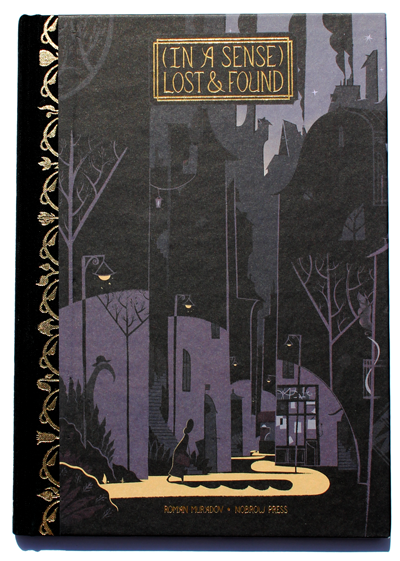
Biblioklept: When did you start working on (In a Sense) Lost and Found? Did you always have the concept kicking around?
Roman Muradov: The idea came to me in 2010 in the form of the title and the image of a protracted awakening. I wrote it as a short story, which had a much more conventional development and actually had some characters and plot movements, all of them completely dropped one by one on the way to the final version apart from the basic premise. I didn’t have a clear understanding of what was to be done with that premise, but the idea kept bothering me for some time, until I rewrote it a few times into a visual novella when Nobrow asked me if I wanted to pitch them something. Since then it went through several more drafts and even after everything was drawn and colored I had to go back and edit most of the dialogues, which is a nightmarish task in comics, since it involved re-lettering everything by hand.
Biblioklept: When you say you wrote it as a short story, I’m intrigued—like, do you mean as a sketch, or a set of directions, or as a tale with imagery? Part of the style of the book (and your style in general) is a confidence in the reader and the image to work together to make the narrative happen. When you were editing the dialogues, were you cutting out exposition, cues, contours?
RM: No, I mean a traditional pictureless short story. I was struggling with forms at the time and didn’t feel confident with any of them. In a way this still persists, because my comics are often deliberately deviating from the comics form, partially in my self-published experiments. The story itself was still ambiguous, I never considered showing what she lost, or how. With time I edited down all conversation to read as one self-interrupting monologue.
Biblioklept: I want to circle back to (In a Sense) Lost and Found, but let’s explore the idea that your work intentionally departs from the conventions of cartooning. When did you start making comics? What were the early comics that you were reading, absorbing, understanding, and misunderstanding?
RM: I came to comics pretty late; I only discovered Chris Ware & co around 2009. As a child I spent one summer drawing and writing little stories, ostensibly comics, then I stopped for a couple of decades. I’m not really sure why I started or stopped. In general my youth was marked by extraordinary complacency and indifference. I followed my parents’ advice and studied petroleum engineering, then worked as a petroleum engineer of sorts for a year and a half, then quit and decided to become an artist. I still feel that none of these decisions were made by me. Occasionally certain parts of my work seem to write themselves and I grow to understand them much later, which is weird.
Biblioklept: Was Ware a signal figure for you? What other comic artists did you find around that time?
Ware, Clowes & Jason were the first independent cartoonist I discovered and I ended up ripping them off quite blatantly for a year or so. Seth was also a big influence, particularly his minute attention to detail and his treatment of time, the way he stretches certain sequences into pages and pages, then skips entire plot movements altogether. Reading Tim Hensley’s Wally Gropius was a huge revelation, it felt like I was given permission to deviate from the form. Similarly, I remember reading Queneau’s “Last Days” in Barbara Wright’s translation, and there was the phrase “the car ran ovaries body” or something like that, and I thought “oh, I didn’t know this was allowed.”

Biblioklept: Your work strikes me as having more in common with a certain streak of modernist and postmodernist prose literature than it does with alt comix. Were you always reading literature in your petroleum engineer days?
RM: That’s certainly true, nowadays I’m almost never influenced by other cartoonists. I wasn’t a good reader until my mid-twenties, certainly not back in Russia. I stumbled upon Alfred Jarry (not in person) while killing time in the library, and then it was a chain reaction to Quenau, Perec and Roussel, then all the modernists and postmodernists, particularly Kafka, Joyce, Nabokov and Proust.
Biblioklept: How do you think those writers—the last four you mention in particular—influence your approach to framing your stories?
RM: From Nabokov I stole his love for puzzles and subtle connections, a slightly hysterical tone, his shameless use of puns and alliteration, from Kafka–economy of language and a certain mistrust of metaphors–it always seems to me that his images and symbols stretch into an infinite loop defying straightforward interpretation by default, from Joyce and Proust the mix of exactitude and vagueness, and the prevalence of style over story, the choreography of space and time. I should’ve say “I’m in the process of stealing,” I realize that all of these things are far too complex, and I doubt that I’ll ever feel truly competent with any of these authors as a reader, let alone as a follower.
Biblioklept:(In a Sense) Lost and Found begins with a reference to Kafka’s Metamorphosis, and then plunges into a Kafkaesque—to use your phrasing—“infinite loop defying straightforward interpretation.” How consciously were you following Kafka’s strange, skewed lead?
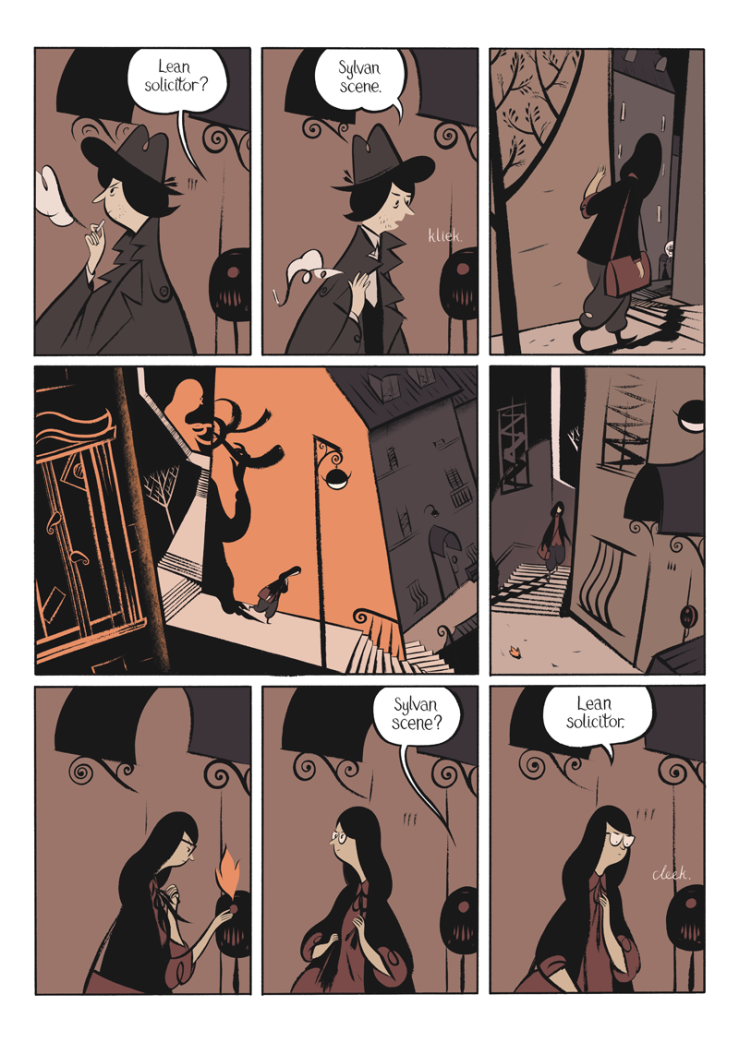
RM: I wanted the reference to be as obvious as possible, almost a direct copy, as if it’s placed there as an act of surrender–I’m not going to come up with a story, here’s one of most famous opening lines that you already know. Usually I know the beginning and the ending and I often downplay their importance, so that the work becomes focused mostly on the process and so that readers don’t expect any kind of resolution or satisfactory narrative development. In the password scene the phrases are copied directly from Eliot’s Wasteland, which itself refers to Paradise Lost in these passages. It’s a bit like a broken radio, shamelessly borrowing from the narrator’s visual and literary vocabulary, the way it happens in a dream.
 Continue reading ““The Absence of Any Purpose Is the Starting Point for My Work” | An Interview with Roman Muradov” →