Six Notes from Nathaniel Hawthorne’s American Note-Books

A letter, written a century or more ago, but which has never yet been unsealed.

A partially insane man to believe himself the Provincial Governor or other great official of Massachusetts. The scene might be the Province House.

A dreadful secret to be communicated to several people of various characters,–grave or gay, and they all to become insane, according to their characters, by the influence of the secret.

Stories to be told of a certain person’s appearance in public, of his having been seen in various situations, and of his making visits in private circles; but finally, on looking for this person, to come upon his old grave and mossy tombstone.

The influence of a peculiar mind, in close communion with another, to drive the latter to insanity.

To look at a beautiful girl, and picture all the lovers, in different situations, whose hearts are centred upon her.

From Nathaniel Hawthorne’s American Note-Books.

Portrait of a Man Writing in His Study — Gustave Caillebotte

The Apparition — Gustave Moreau

“There were many towers, just as in this world there are many perfect books” (William T. Vollmann)

So he lent her books. After all, one of life’s best pleasures is reading a book of perfect beauty; more pleasurable still is rereading that book; most pleasurable of all is lending it to the person one loves: Now she is reading or has just read the scene with the mirrors; she who is so lovely is drinking in that loveliness I’ve drunk.

Amidst the other grey, red, greenish, black and orange volumes of various heights, this white book with the black lettering was perfectly proportioned in every way, neither showy nor insignificant. It was one of his favorite books (we can’t say his favorite since his life wasn’t over yet). He mentioned it, and she was willing to accept it; she was that kind, to read the book which he loved.

At the moment that it actually passed from his hand to hers they were sitting across from each other in one of the three or four restaurants where they usually met; and she, having gazed into his face with her usual richly intelligent seriousness, studied the book she now held with the same air of happy possession which he would have hoped to find had she been looking over his body before making love with him, which she would never, ever do no matter how long they both lived, a fact which made him want to utter a sound much softer and more leaden than any scream; and then, sitting within touching distance of her beautiful hands which he could not touch, he watched her open the book to the title page with its half-calligraphic brush-rendering by an unknown artist of a Buddhist pongmalai garland, probably of jasmine flowers, which was draped across a woman’s naked thigh. This was the most intimate moment that he and she would ever have (unless of course his one percent became a hundred, and she accepted him forever). He would not be at her side when she began to actually read the book; but from their frequent conversations he thought he could keep abreast of where she’d arrived each day. She’d promised to begin it that very night, when she was home with the other man, which meant that she would at least cross the frontier of the half-title page, followed by the dramatic double plant-stalks (connected by a leaf ), of the initial letter E. And now she saw before her those wide white margins and those generous white lines-between-the-lines which encouraged every word to preen itself like the treasure that it truly was.

I should mention that this beautiful volume, which was such a pleasure to hold, began its tale with a dazzling abruptness, as if the reader had just emerged from a dark tunnel into another world, a perfect world whose ground was a hot white plain of salt upon which the words lived their eternal lives.

I need say nothing about the plot, whose involutions (it’s a tale of obsessive love) progressed like the nested terraces on a Buddha-studded tower which narrows perfectly into nothingness. Once I visited a certain wat in Bangkok where although the day was exhaustingly hot and bright I grew enthralled by the sensation of wandering on a high place somewhere in the mist, a plateau exploding with ornately weathered crags. There were many towers, just as in this world there are many perfect books.

From William T. Vollmann’s novel Europe Central.

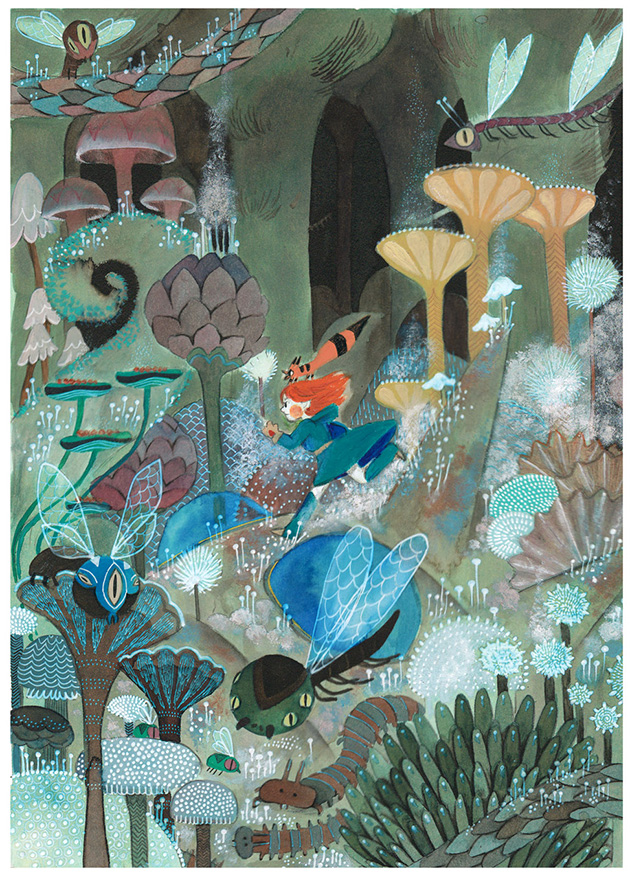
Nausicaä of the Valley of the Wind — Amélie Fléchais

nausicaa

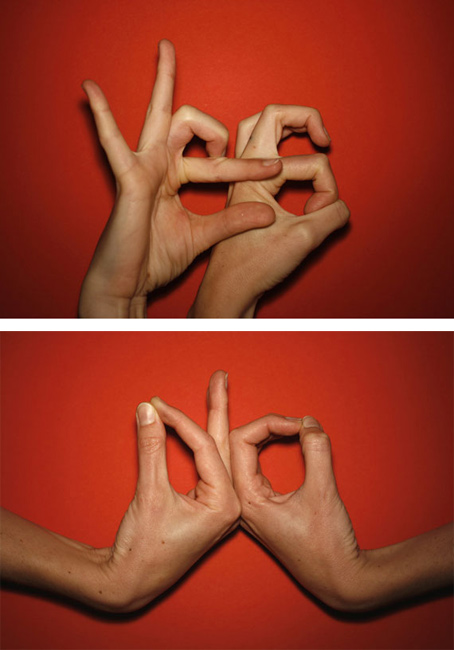
Stacking (Yes), Stacking (No) — Tauba Auerbach

stackingyesno

“Unmasking a Confidence Trickster” — Franz Kafka

“Unmasking a Confidence Trickster”

by

Franz Kafka

Translated by Willa and Edwin Muir

At last, about ten o’clock at night, I came to the doorway of the fine house where I was invited to spend the evening, after the man beside me, whom I was barely acquainted with and who had once again thrust himself unasked upon me, had marched me for two long hours around the streets.

‘Well!’ I said, and clapped my hands to show that I really had to bid him goodbye. I had already made several less explicit attempts to get rid of him. I was tired out. ‘Are you going straight in?’ he asked. I heard a sound in his mouth that was like the snapping of teeth. ‘Yes.’
Continue reading ““Unmasking a Confidence Trickster” — Franz Kafka”

(This Is Not) David Foster Wallace’s Annotated Copy of Ulysses

fake

I first saw this at the tumblr Book Patrol; they corrected their post fairly quickly.

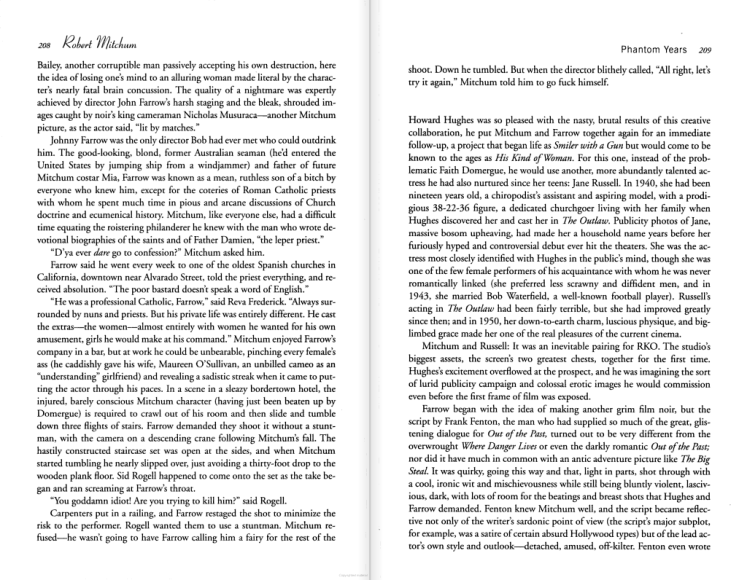
The book, Lee Server’s Baby I Don’t Care, a biography of Robert Mitchum, and its annotations, belong to Tony Shafrazi—

—and—

Enoc Perez took the photo–

The novelist James Boice seems to be the origin of the link between the Mitchum biography to DFW/JJ (clearly a jest):

https://twitter.com/jamesboice/status/467142475459870720

And then somehow the pic got to tumblr.

The University of Texas Libraries does not include Ulysses among its collection of Wallace’s personal books.

Oh, and, here’s a bigger pic of the passage from Server’s book:

phanton


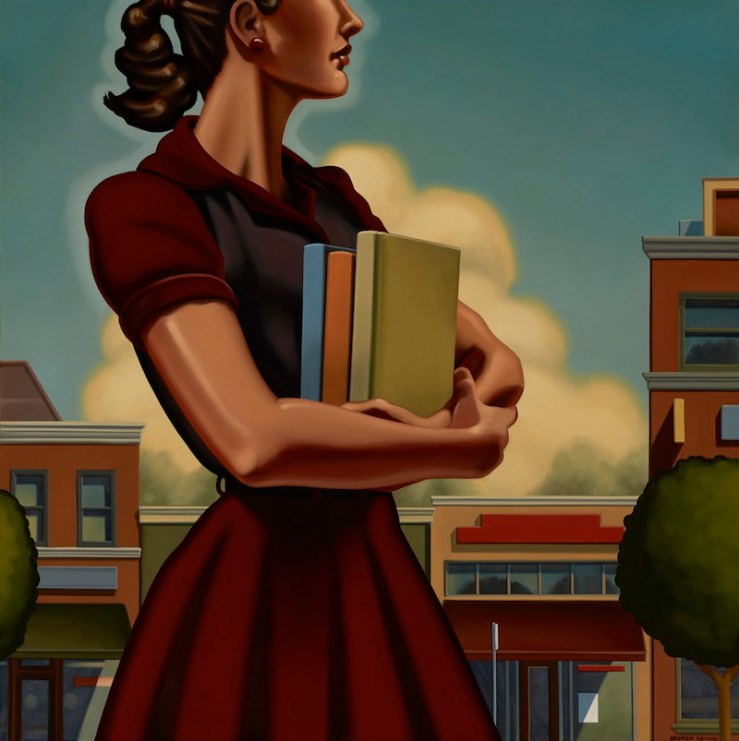
Read #2 — Kenton Nelson

read

Illustration from East of the Sun and West of the Moon — Kay Nielsen

05_nielson_eastrofthesun_morningsun

Cerebus — Ramon Villalobos

cerebus

Portrait of William S. Burroughs — Jonathan Edwards

williamsburroughs

Bruno Jasieński’s The Legs of Izolda Morgan (Book Acquired, 5.01.2014)

20140516-102034.jpg

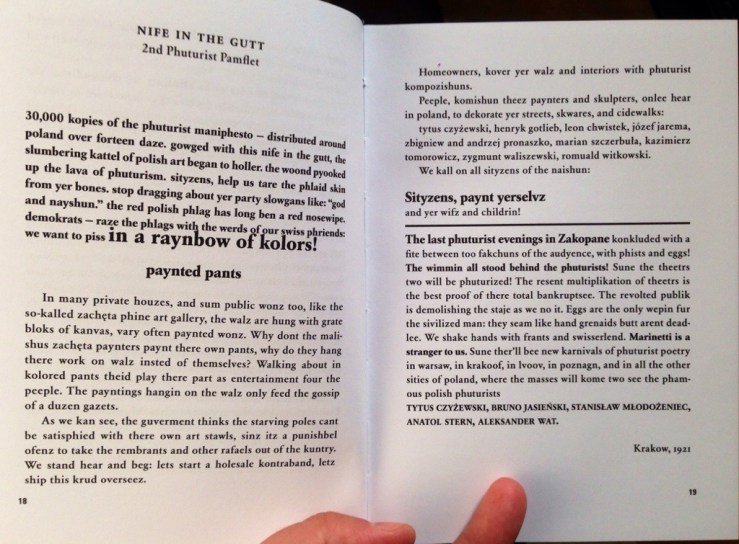
The recent publication of Bruno Jasieński’s The Legs of Izolda Morgan offers another strong argument that Twisted Spoon Press is publishing some of the most fascinating—and most beautiful—books available today. Clothbound and handsomely printed, Izolda Morgan collects several of Jasieński’s futurist manifestos, an essay, stories, and satires.

20140516-093921.jpg

Publisher’s blurb:

Considered the enfant terrible of the Polish avant-garde, lauded by critics and scorned by the public, Bruno Jasieński suddenly declared the end of Futurism in Poland soon after his short “novel” The Legs of Izolda Morgan appeared in 1923. An extraordinary example of Futurist prose, this fantastic tale cautions against the machine supplanting the human while the human body is disaggregated into fetishized constituent parts. As central to Jasieński’s oeuvre, the text is situated here between two seminal manifestoes and the important essay “Polish Futurism,” which signaled the movement’s end in the context of its confused reception in Poland, the towering influence of Mayakovsky, and what set it apart from the futurisms of Italy and Russia. The condensed story “Keys” displays Jasieński’s turn toward satire to lambaste the hypocrisies pervasive in powerful institutions, and this is further developed in the two longer grotesques from his time in the Soviet Union in the 1930s. Translated into English from the Russian for the first time, these two late stories expose the nefarious absurdity of racial persecution and warmongering and the lengths social and political structures will go to underpin them.


A manifesto:

20140516-102256.jpg

Mike Leigh on JMW Turner

Altarpiece, No. 1 — Hilma af Klint

“Saint Cecilia; Or, The Power of Music” — Heinrich von Kleist

“Saint Cecilia; Or, The Power of Music”

by

Heinrich von Kleist

Towards the end of the sixteenth century, when iconoclasm was raging in the Netherlands, three young brothers, who all studied at Wittenberg, chanced to meet at Aix-la-Chapelle with a fourth, who had been appointed preacher at Antwerp. They wished to take possession of an inheritance, which had fallen to them by the death of an old uncle, perfectly unknown to all of them, and had turned into an inn, because no one was on the spot to whom they could apply. After the lapse of some days, which they had passed in listening to the preacher’s accounts of the remarkable occurrences that had taken place in the Netherlands, it chanced that the festival of Corpus Christi was just about to be solemnised by the nuns of St. Cecilia’s convent, which then stood before the city gates. The four brothers heated with fanaticism, youth, and the example of the Netherlands, determined to give the town of Aix-la-Chapelle a spectacle of image-breaking. The preacher, who had been more than once at the head of such enterprises, assembled in the evening preceding the festival a number of young tradesmen and students, devoted to the new doctrine, who spent the night in eating and drinking at the inn. Day had no sooner appeared over the battlements than they provided themselves with axes and all sorts of instruments of destruction, to begin their violent work. Exulting with delight, they agreed upon a signal at which they would begin to knock in the windows, which were painted over with biblical subjects, and, secure of finding a great number of followers among the people, they betook themselves to the cathedral, at the hour when the bells first rang, with the determination not to leave one stone upon another. The abbess, who, as early as daybreak, had been informed by a friend of the peril in which the convent stood, sent several times, but always in vain, to the imperial officer who held command in the town, requesting him to appoint a guard for the protection of the convent. The officer, who, clandestinely at least, was favorably imposed towards the new doctrine, refused her request, under the pretext that she was merely dreaming, and that not the slightest danger to her convent was to be apprehended. In the meanwhile the hour appointed for the commencement of the solemnities arrived, and the nuns prepared themselves for mass, praying and trembling with the apprehension of approaching events. The bailiff of the convent, an old man, aged seventy, with a troop of armed servants, whom he had posted at the entrance of the church, was their only protection. In nuns’ convents, it is well known, the sisters themselves, who are well practised in every sort of instrument, are their own musicians, and they play with a precision, a feeling, and an intelligence, which we often miss in orchestras of men, probably because there is something feminine in this mysterious art. Now it happened, to increase the embarrassment, that the conductress of the orchestra, Sister Antonia, had fallen sick of a nervous fever some days before, and the consequence was, that the whole convent was in the greatest tumult about the performance of a suitable piece of music, to say nothing of the fact that the four profane brothers were already visible, wrapped in mantles among the pillars of the church. The abbess who, on the evening of the preceding day, had ordered the performance of a very old Italian mass, by an unknown master, with which the greatest effect had always been produced on account of its peculiarly sacred and solemn character, and who was now more than ever bent on her purpose, sent again to sister Antonia to know how she was. The nun who took the message, returned with the intelligence that the sister lay in a perfectly unconscious condition and that all notion of her conducting the music must be entirely given up. In the meanwhile, there had already been several very critical scenes in the convent into which more than a hundred impious persons of all ranks and ages, armed with hatchets and crowbars, had gradually found their way. Some of the guards who stood at the portals had been shamefully annoyed, and the nuns, who, engaged in their holy offices, had from time to time appeared singly in the porticoes, were insulted by the most unseemly expressions. At last the bailiff retreated to the sacristy, and there upon his knees implored the abbess to stop the festival, and to seek the protection of the commander in the city. But the abbess was immoveable, insisting that the festival which had been instituted for the honour of the Deity must take its course. She reminded the bailiff that it was his duty to defend the mass, and all the solemnities of the cathedral with life and limb, and as the bell had rang, ordered the nuns, who surrounded her, shaking and trembling, to take an oratorium of some sort or other, and make a beginning by performing it. Continue reading ““Saint Cecilia; Or, The Power of Music” — Heinrich von Kleist”

The Awakening — Llyn Foulkes