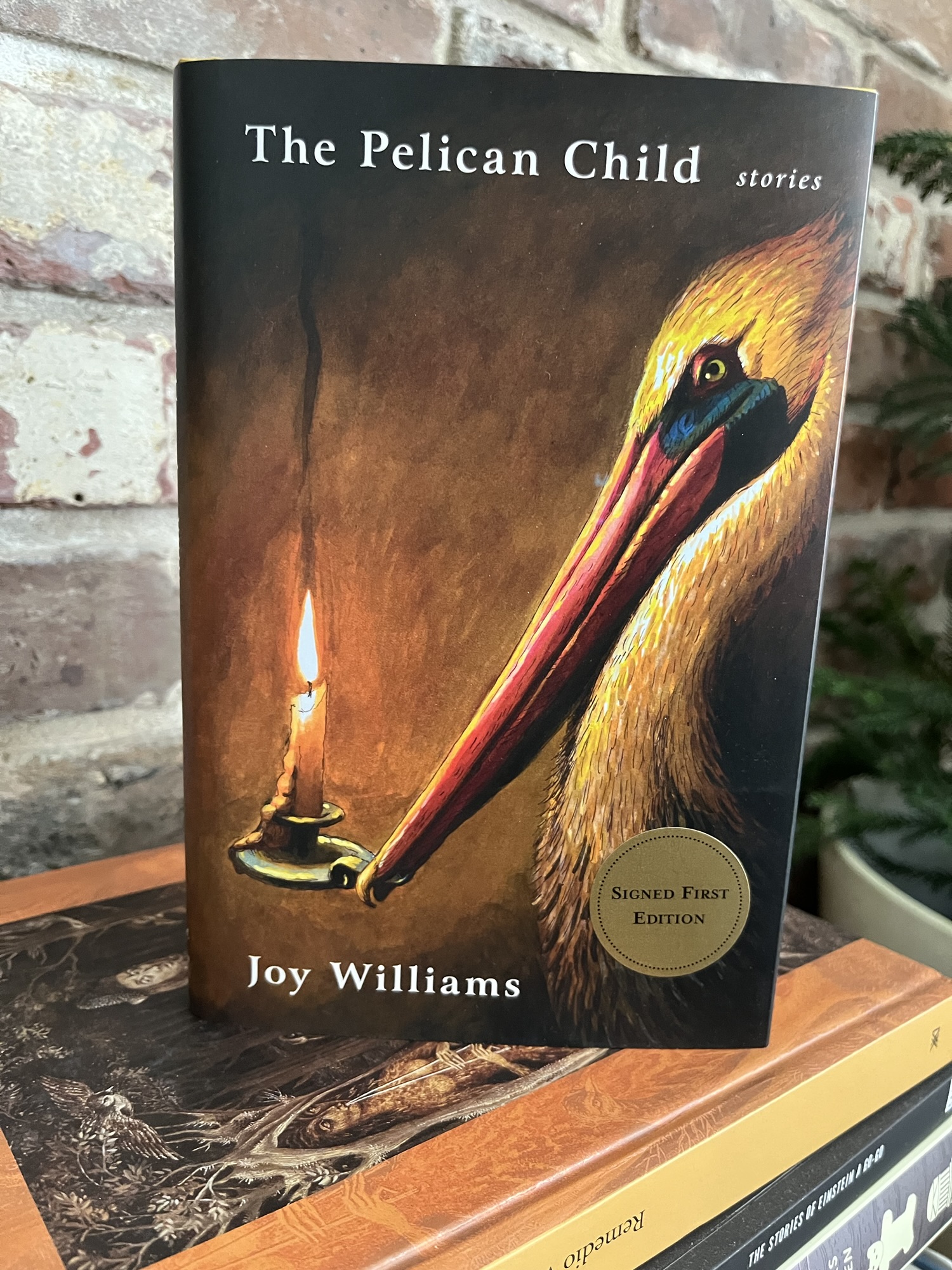
Joy Williams’ The Pelican Child (Book acquired, 27 Dec. 2025)

I finally made it to The Lynx bookstore this weekend while visiting some old friends in Gainesville, FL. The Lynx was opened by novelist Lauren Groff and her husband Clay Kallman last year; its inventory emphasizes challenged and banned books, BIPOC and LGBTQ authors, and Florida writers. There was a nice selection of graphic novels, children’s books, and even some zines. A fair bit of the store’s inventory seemed to be given over to the kind of YAified fiction that sells well, along with a lot of books on contemporary social issues. A lot of those titles tended to skew towards what I think of as “in this house” politics — this ain’t your local anarchist bookstore — but it’s pretty well stocked.

I picked up Joy Williams’ latest collection, The Pelican Child, as well as copy of Williams’ history/guidebook The Florida Keys to give to my hosts, who spend six weeks in the Keys every summer. My wife also got the newest Alison Roman cookbook.

Read a December 1985 interview with the Minutemen

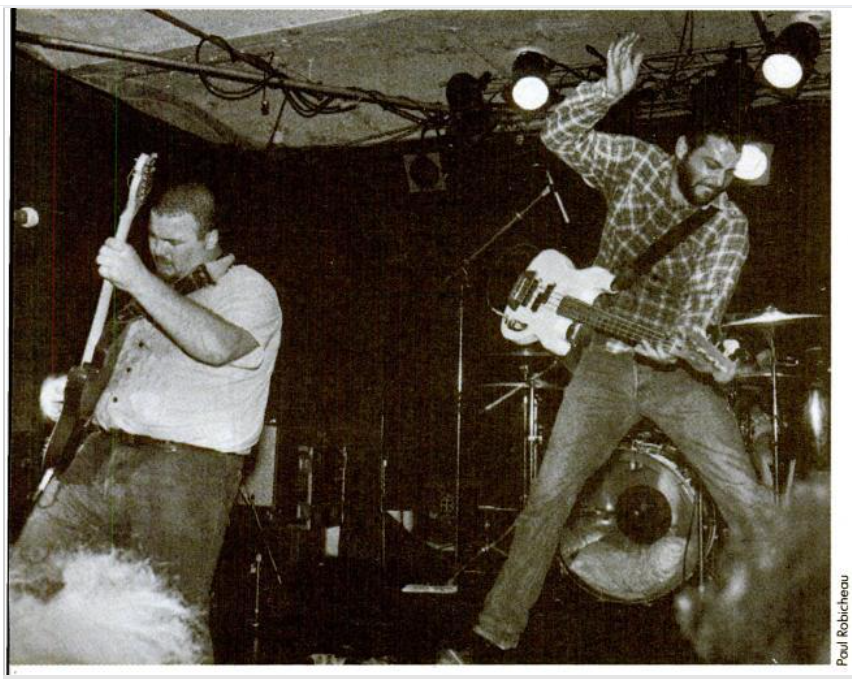
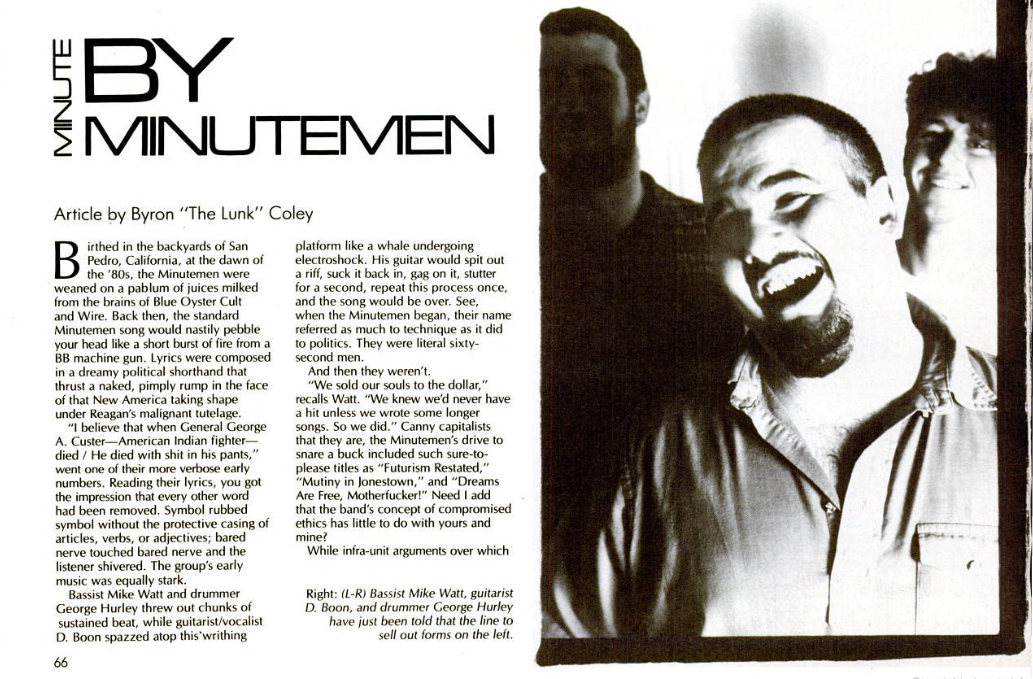
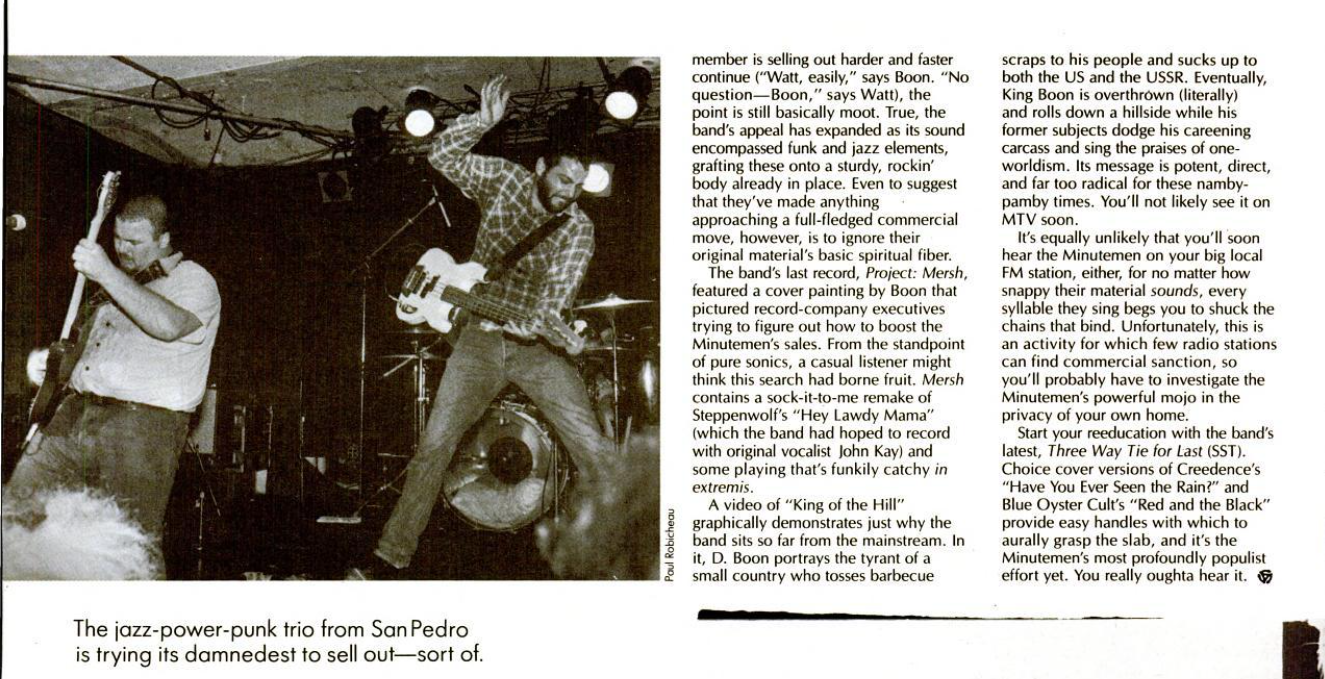
I was looking for something else when I found this brief profile of the Minutemen in the December 1985 issue of SPIN (I didn’t find the thing I was looking for). The article, by Forced Exposure stalwart Byron Coley, focuses on the Minutemen’s attempt to “sell out” with their record 3-Way Tie (For Last). The record, like the issue of SPIN, was released in December 1985.

3-Way Tie ended up being the last studio album by the Minutemen. Singer/guitarist D. Boon died tragically right after its release. From Michael Azerrad’s Our Band Could Be Your Life:

[Mike] Watt’s phone rang early the following morning: December 23, 1985. It was D. Boon’s dad. Boon’s girlfriend had been driving the band’s tour van, her sister in the passenger seat and a feverish Boon sleeping in the back. At around four in the morning, Boon’s girlfriend fell asleep at the wheel. The van crashed and flipped; Boon was thrown out the back door and broke his neck. He died instantly.

I looked through the next two issues of SPIN to see if there was any mention of Boon’s passing but didn’t find anything (there was a feature on Mötley Crüe in the Jan. 1986 issue tastelessly titled “Asleep at the Wheel” and a long profile on crack (the drug) in the Feb. ’86 issue).

Here is the article (followed by a transcription):


“Minute by Minutemen”

Article by Byron “The Lunk” Coley

Born in the backyards of San Pedro, California, at the dawn of the ’80s, the Minutemen were weaned on a pabulum of juices milked from the brains of Blue Öyster Cult and Wire. Back then, the standard Minutemen song would nastily pebble your head like a short burst of fire from a BB machine gun. Lyrics were composed in a dreamy political shorthand that thrust a naked, pimply rump in the face of that New America taking shape under Reagan’s malignant tutelage.

“I believe that when General George A. Custer—American Indian fighter—died / He died with shit in his pants,” went one of their most verbose early numbers. Reading their lyrics, you got the impression that every other word had been removed. Symbol rubbed symbol without the protective casing of articles, verbs, or adjectives; bared nerve touched bared nerve and the listener shivered. The group’s early music was equally stark.

Bassist Mike Watt and drummer George Hurley threw out chunks of sustained beat, while guitarist/vocalist D. Boon spazzed atop this writhing platform like a whale undergoing electroshock. His guitar would spit out a riff, suck it back in, gag on it, stutter for a second, repeat this process once, and the song would be over. See, when the Minutemen began, their name referred as much to technique as it did to politics. They were literal sixty-second men.

And then they weren’t.

“We sold our souls to the dollar,” recalls Watt. “We knew we’d never have a hit unless we wrote some longer songs. So we did.” Canny capitalists that they are, the Minutemen’s drive to snare a buck included such sure-to-please titles as “Futurism Restated,” “Mutiny in Jonestown,” and “Dreams Are Free, Motherfucker.” Need I add that the band’s concept of compromised ethics has little to do with yours and mine?

While infra-unit arguments over which member is selling out harder and faster continue (“Watt, easily,” says Boon. “No question—Boon,” says Watt), the point is still basically moot. True, the band’s appeal has expanded as its sound encompassed funk and jazz elements, grafting these onto a sturdy, rockin’ body already in place. Even to suggest that they’ve made anything approaching a full-fledged commercial move, however, is to ignore their original material’s basic spiritual fiber.

The band’s last record, Project: Mersh, featured a cover painting by Boon that pictured record-company executives trying to figure out how to boost the Minutemen’s sales. From the standpoint of pure sonics, a casual listener might think this search had borne fruit. Mersh contains a sock-it-to-me remake of Steppenwolf’s “Hey Lawdy Mama” (which the band had hoped to record with original vocalist John Kay) and some playing that’s funkily catchy in extremis.

A video of “King of the Hill” graphically demonstrates just why the band sits so far from the mainstream. In it, D. Boon portrays the tyrant of a small country who tosses barbecue scraps to his people and sucks up to both the US and the USSR. Eventually, King Boon is overthrown (literally) and rolls down a hillside while his former subjects dodge his careening carcass and sing the praises of one-worldism. Its message is potent, direct, and far too radical for these namby-pamby times. You’ll not likely see it on MTV soon.

It’s equally unlikely that you’ll soon hear the Minutemen on your big local FM station, either, for no matter how snappy their material sounds, every syllable they sing begs you to shuck the chains that bind. Unfortunately, this is an activity for which few radio stations can find commercial sanction, so you’ll probably have to investigate the Minutemen’s powerful mojo in the privacy of your own home.

Start your reeducation with the band’s latest, Three Way Tie for Last (SST). Choice cover versions of Creedence’s “Have You Ever Seen the Rain?” and Blue Öyster Cult’s “Red and the Black” provide easy handles with which to aurally grasp the slab, and it’s the Minutemen’s most profoundly populist effort yet. You really oughta hear it.


“A Wish for Unconsciousness” — Thomas Hardy

“A Wish for Unconsciousness”

by

Thomas Hardy


If I could but abide
As a tablet on a wall,
Or a hillock daisy-pied,
Or a picture in a hall,
And as nothing else at all,
I should feel no doleful achings,
I should hear no judgment-call,
Have no evil dreams or wakings,
No uncouth or grisly care;
In a word, no cross to bear.

Sunday Comix

From Neat Stuff #1 by Peter Bagge, July, 1985, Fantagraphics Books.

Peasants Washday — Justin John Greene

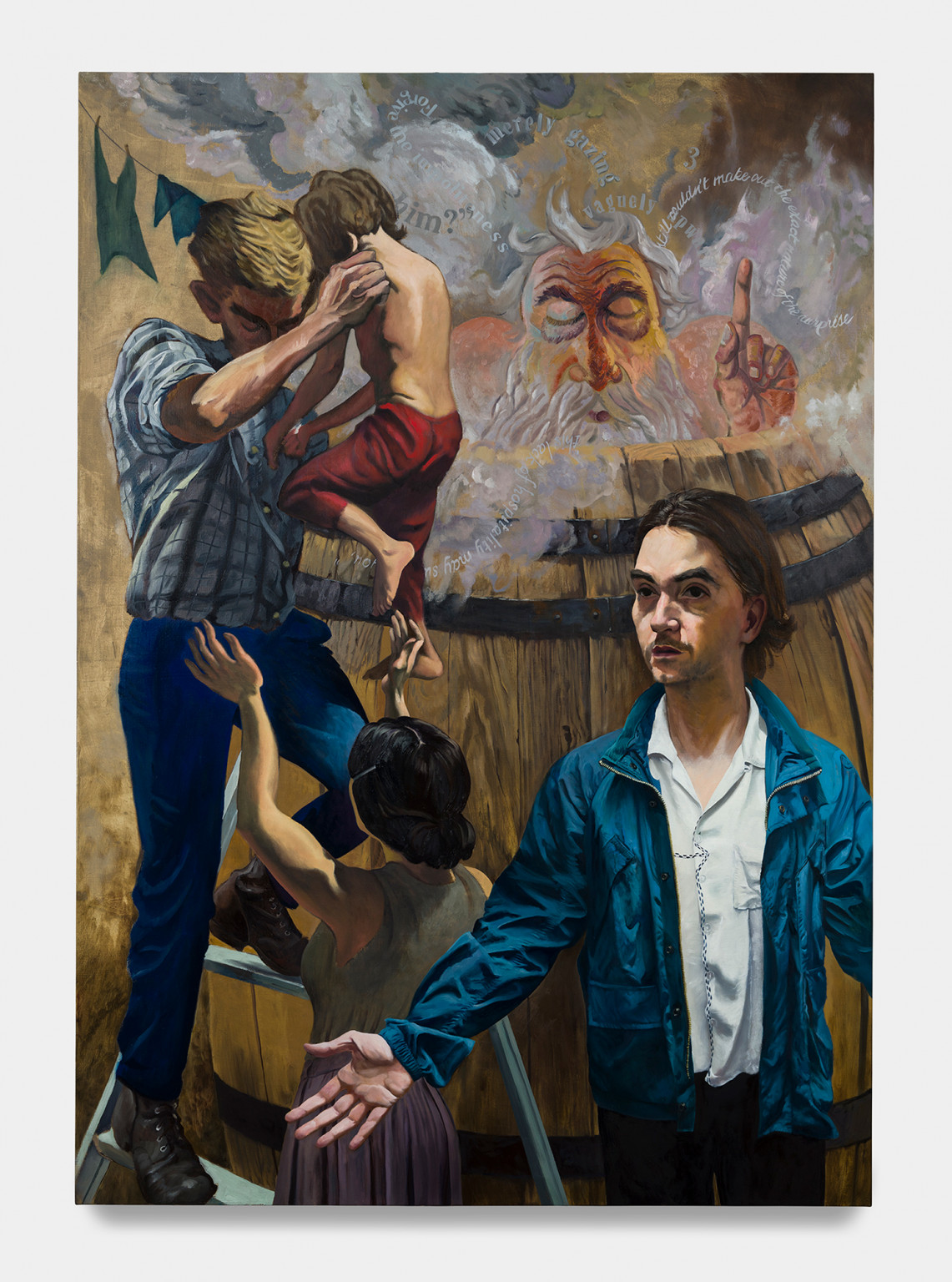
Peasants Washday, 2023 by Justin John Greene (b. 1984)

“After a Journey” — Thomas Hardy

“After a Journey”

by

Thomas Hardy


Hereto I come to view a voiceless ghost;
Whither, O whither will its whim now draw me?
Up the cliff, down, till I’m lonely, lost,
And the unseen waters’ ejaculations awe me.
Where you will next be there’s no knowing,
Facing round about me everywhere,
With your nut-coloured hair,
And gray eyes, and rose-flush coming and going.

Yes: I have re-entered your olden haunts at last;
Through the years, through the dead scenes I have tracked you;
What have you now found to say of our past—
Scanned across the dark space wherein I have lacked you?
Summer gave us sweets, but autumn wrought division?
Things were not lastly as firstly well
With us twain, you tell?
But all’s closed now, despite Time’s derision.

I see what you are doing: you are leading me on
To the spots we knew when we haunted here together,
The waterfall, above which the mist-bow shone
At the then fair hour in the then fair weather,
And the cave just under, with a voice still so hollow
That it seems to call out to me from forty years ago,
When you were all aglow,
And not the thin ghost that I now frailly follow!

Ignorant of what there is flitting here to see,
The waked birds preen and the seals flop lazily;
Soon you will have, Dear, to vanish from me,
For the stars close their shutters and the dawn whitens hazily.
Trust me, I mind not, though Life lours,
The bringing me here; nay, bring me here again!
I am just the same as when
Our days were a joy, and our paths through flowers.

Pentargan Bay.

The Adoration of the Shepherds — James Ensor

The Adoration of the Shepherds, 1888 by James Ensor (1860-1949)

Read “Christmas Eve,” a supernatural tale by Nikolai Gogol

“Christmas Eve”

by

Nikolai Gogol

translated by George Tolstoy

as “The Night of Christmas Eve: A Legend of Little Russia”
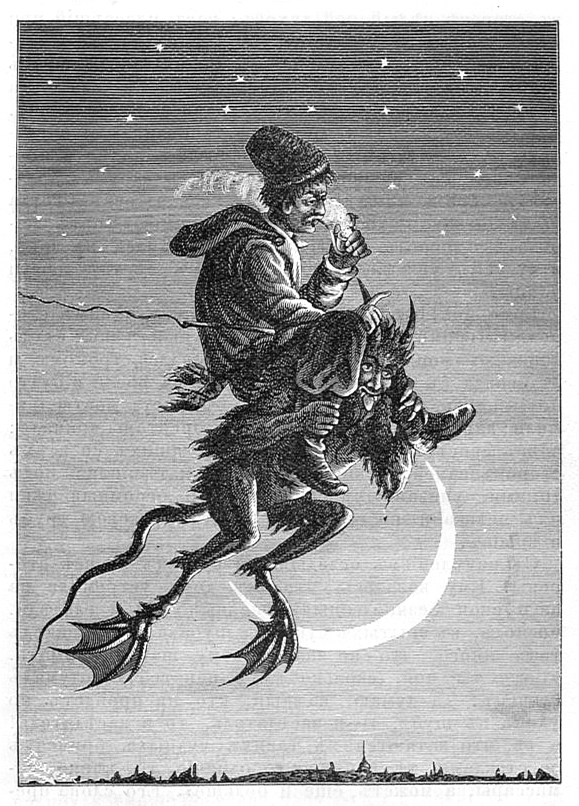

The last day before Christmas had just closed. A bright winter night had come on, stars had appeared, and the moon rose majestically in the heavens to shine upon good men and the whole of the world, so that they might gaily sing carols and hymns in praise of the nativity of Christ. The frost had grown more severe than during the day; but, to make up for this, everything had become so still that the crisping of the snow under foot might be heard nearly half a verst round. As yet there was not a single group of young peasants to be seen under the windows of the cottages; the moon alone peeped stealthily in at them, as if inviting the maidens, who were decking themselves, to make haste and have a run on the crisp snow. Suddenly, out of the chimney of one of the cottages, volumes of smoke ascended in clouds towards the heavens, and in the midst of those clouds rose, on a besom, a witch.

If at that time the magistrate of Sorochinsk had happened to pass in his carriage, drawn by three horses, his head covered by a lancer cap with sheepskin trimming, and wrapped in his great cloak, covered with blue cloth and lined with black sheepskin, and with his tightly plaited lash, which he uses for making the driver drive faster—if this worthy gentleman had happened to pass at that time, no doubt he would have seen the witch, because there is no witch who could glide away without his seeing her. He knows to a certainty how many sucking pigs each swine brings forth in each cottage, how much linen lies in each box, and what each one has pawned in the brandy-shop out of his clothes or his household furniture. But the magistrate of Sorochinsk happened not to pass; and then, what has he to do with those out of his jurisdiction? he has his own circuit. And the witch by this time had risen so high that she only looked like a little dark spot up above; but wherever that spot went, one star after another disappeared from heaven. In a short time the witch had got a whole sleeveful of them. Some three or four only remained shining. On a sudden, from the opposite side, appeared another spot, which went on growing, spreading, and soon became no longer a spot. A short-sighted man, had he put, not only spectacles, but even the wheels of a britzka on his nose, would never have been able to make out what it was. In front, it was just like a German; a narrow snout, incessantly turning on every side, and smelling about, ended like those of our pigs, in a small, round, flattened end; its legs were so thin, that had the village elder got no better, he would have broken them to pieces in the first squatting-dance. But, as if to make amends for these deficiencies, it might have been taken, viewed from behind, for the provincial advocate, so much was its long pointed tail like the skirt of our dress-coats. And yet, a look at the goat’s beard under its snout, at the small horns sticking out of its head, and at the whole of its figure, which was no whiter than that of a chimney sweeper, would have sufficed to make any one guess that it was neither a German nor a provincial advocate, but the Devil in person, to whom only one night more was left for walking about the world and tempting good men to sin. On the morrow, at the first stroke of the church bell, he was to run, with his tail between his legs, back to his quarters. The devil then, as the devil it was, stole warily to the moon, and stretched out his hand to get hold of it; but at the very same moment he drew it hastily back again, as if he had burnt it, shook his foot, sucked his fingers, ran round on the other side, sprang at the moon once more, and once more drew his hand away. Still, notwithstanding his being baffled, the cunning devil did not desist from his mischievous designs. Dashing desperately forwards, he grasped the moon with both hands, and, making wry faces and blowing hard, he threw it from one hand to the other, like a peasant who has taken a live coal in his hand to light his pipe. At last, he hastily hid it in his pocket, and went on his way as if nothing had happened. At Dikanka, nobody suspected that the devil had stolen the moon. It is true that the village scribe, coming out of the brandy-shop on all fours, saw how the moon, without any apparent reason, danced in the sky, and took his oath of it before the whole village, but the distrustful villagers shook their heads, and even laughed at him. And now, what was the reason that the devil had decided on such an unlawful step? Simply this: he knew very well that the rich CossackChoop was invited to an evening party at the parish clerk’s, where he was to meet the elder, also a relation of the clerk, who was in the archbishop’s chapel, and who wore a blue coat and had a most sonorous basso profondo, the Cossack Sverbygooze, and some other acquaintances; where there would be for supper, not only the kootia, but also a varenookha, as well as corn-brandy, flavoured with saffron, and divers other dainties. He knew that in the mean time Choop’s daughter, the belle of the village, would remain at home; and he knew, moreover, that to this daughter would come the blacksmith, a lad of athletic strength, whom the devil held in greater aversion than even the sermons of Father Kondrat. When the blacksmith had no work on hand, he used to practise painting, and had acquired the reputation of being the best painter in the whole district. Even the Centurion had expressly sent for him to Poltava, for the purpose of painting the wooden palisade round his house. All the tureens out of which the Cossacks of Dikanka ate their borsch, were adorned with the paintings of the blacksmith. He was a man of great piety, and often painted images of the saints; even now, some of them may be seen in the village church; but his masterpiece was a painting on the right side of the church-door; in it he had represented the Apostle Peter, at the Day of Judgment, with the keys in his hand, driving the evil spirit out of hell; the terrified devil, apprehending his ruin, rushed hither and thither, and the sinners, freed from their imprisonment, pursued and thrashed him with scourges, logs of wood, and anything that came to hand. All the time that the blacksmith was busy with this picture, and was painting it on a great board, the devil used all his endeavours to spoil it; he pushed his hand, raised the ashes out of the forge, and spread them over the painting; but, notwithstanding all this, the work was finished, the board was brought to the church, and fixed in the wall of the porch. From that time the devil vowed vengeance on the blacksmith. He had only one night left to roam about the world, but even in that night he sought to play some evil trick upon the blacksmith. For this reason he, had resolved to steal the moon, for he knew that old Choop was lazy above all things, not quick to stir his feet; that the road to the clerk’s was long, and went across back lanes, next to mills, along the churchyard, and over the top of a precipice; and though the varenookha and the saffron brandy might have got the better of Choop’s laziness on a moonlight night, yet, in such darkness, it would be difficult to suppose that anything could prevail on him to get down from his oven and quit his cottage. And the blacksmith, who had long been at variance with Choop, would not on any account, in spite even of his strength, visit his daughter in his presence. Continue reading “Read “Christmas Eve,” a supernatural tale by Nikolai Gogol”

A partial glossary for Thomas Pynchon’s Gravity’s Rainbow

The October 1980 issue of Esquire ran a piece titled “What to Think about Gravity’s Rainbow” by the poet Terrill Shepard Soules. It’s not really a what to think piece, though (the title seems an editorial intervention), but rather a witty glossary.

“WHAT TO THINK ABOUT GRAVITY’S RAINBOW

by Terrill Shepard Soules


VERY CLEVER.

THOMAS PYNCHON, AUTHOR, KEEPS A LOW PROFILE.

MAIN CHARACTER: TYRONE SLOTHROP.

FIRST LINE: “A SCREAMING COMES ACROSS THE SKY.” NICE FIRST LINE.

LONG — 760 PAGES IN HARD-COVER.

BUZZWORDS: PIGS, PARANOIA, B MOVIES, SEX, NAZIS.

PUBLISHED 1973; EVERYONE WENT CRAZY.

NATIONAL BOOK AWARD, OF COURSE. PULITZER JUDGES LOVED IT, PULITZER TRUSTEES THOUGHT OBSCENE. ALSO INCOMPREHENSIBLE. NO PULITZER PRIZE. SOMETHING LIKE ULYSSES THAT WAY. A FREQUENT COMPARISON.

INSIDERS CALL IT RAINBOW. INSIDERS ARE INSIDERS BECAUSE THEY LOVE THE IDEA THAT
SOME RECLUSE (A CORNELL GRAD?) WROTE A 760-PAGE BOOK ABOUT PIGS AND PARANOIA. ALSO BECAUSE THEY KNOW SOME VERY EXTRAORDINARY WORDS FROM RAINBOW, LIKE THE ONES IN THE GLOSSARY BELOW (FROM THE HARD-COVER EDITION).


BOOK 1
Beyond the Zero

NARODNIK [p. 11]
From Russian narod, “people.” Intellectual trying to metamorphose peasant into revolutionaries. The Narodniki flourished in the late 1860s. In the late 1960s Student Nonviolent Coordinating Committee activists were referred to as narodoniks. By show-offs.

PRETERITION, PRETERITE
[p. 15 and throughout]
A passing over. Preterition is the Fluke Cosmic, the doctrine that God in John Calvin’s breast (cf. the Jampere-phrenia in Alien) decreed that you and you and you are heavenbound no questions asked but We’re going to have to think about the rest of you — don’t get your hopes up.

MAFFICK [p. 17]
The founder of the Boy Scouts defended the garrison at Mafeking against the Boers for two hundred seventeen days. When the siege was raised, on May 17, 1900, London went crazy, and the jubilant celebratory maffick — it’s a verb! — was born. Here, part of Lieutenant Oliver “Tantivy” Mucker-Maffick’s moniker.

TANTIVY [p. 17]
Mucker-Maffick’s nickname. Means to gallop along, or a blast on a horn, or that headlong gallop itself.

LOVE-IN-IDLENESS [p. 22]
The perfect word for violet. Pynchon’s choice is dazzling. First, on a map of London there’s a star for each of Slothrop’s women, Slothrop “having evidently the time, in his travels among places of death, to devote to girl-chasing.” Second, the many stars are of many colors. Third, Slothrop gets the idea that the stars look like flowers. Now Viola tricolor, the flower in question, turns out to be a violet with yellow, white, and purple petals and several country names. The name our author finally selects enables him to pull off a genuine rampage-prose triple play: “and all over the place, purple and yellow as hickeys, a prevalence of love-in-idleness.” Continue reading “A partial glossary for Thomas Pynchon’s Gravity’s Rainbow”

Sunday Comix

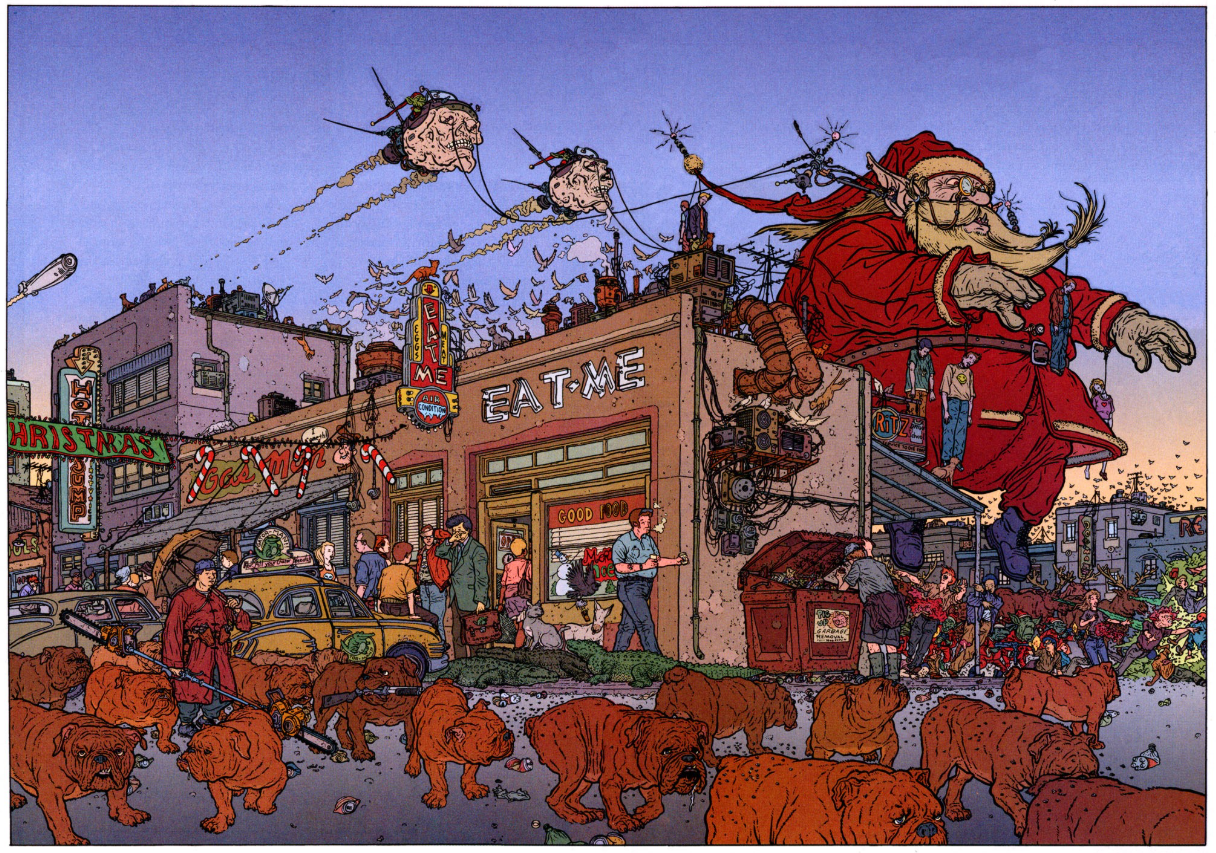
“Christmas” by Geof Darrow; colors by Dave Stewart. From the one-shot anthology Hellboy Christmas Special, 1997, Dark Horse Comics.

Read “Markheim,” a dark Christmas tale by Robert Louis Stevenson

“Markheim”

by

Robert Louis Stevenson


“Yes,” said the dealer, “our windfalls are of various kinds. Some customers are ignorant, and then I touch a dividend on my superior knowledge. Some are dishonest,” and here he held up the candle, so that the light fell strongly on his visitor, “and in that case,” he continued, “I profit by my virtue.”

Markheim had but just entered from the daylight streets, and his eyes had not yet grown familiar with the mingled shine and darkness in the shop. At these pointed words, and before the near presence of the flame, he blinked painfully and looked aside.

The dealer chuckled. “You come to me on Christmas Day,” he resumed, “when you know that I am alone in my house, put up my shutters, and make a point of refusing business. Well, you will have to pay for that; you will have to pay for my loss of time, when I should be balancing my books; you will have to pay, besides, for a kind of manner that I remark in you to-day very strongly. I am the essence of discretion, and ask no awkward questions; but when a customer cannot look me in the eye, he has to pay for it.” The dealer once more chuckled; and then, changing to his usual business voice, though still with a note of irony, “You can give, as usual, a clear account of how you came into the possession of the object?” he continued. “Still your uncle’s cabinet? A remarkable collector, sir!”

And the little pale, round-shouldered dealer stood almost on tip- toe, looking over the top of his gold spectacles, and nodding his head with every mark of disbelief. Markheim returned his gaze with one of infinite pity, and a touch of horror.

Continue reading “Read “Markheim,” a dark Christmas tale by Robert Louis Stevenson”

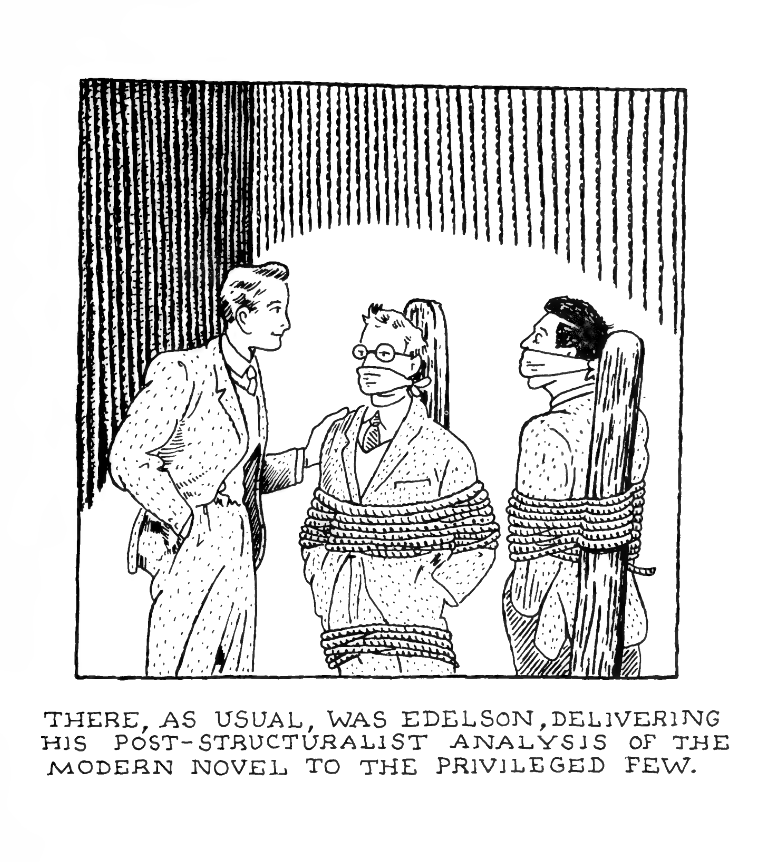
Literary criticism | Glen Baxter

Let me tell you about the nap

2025 was in several ways one of the more fucked up and challenging years of my life. (This sentiment might be familiar to you and yours and many others.) But it was the year I finally learned to take a nap, thanks in part to an anecdote shared by the late novelist Philip Roth.

I have always been jealous of folks who can sleep on planes, in cars, on buses and far more jealous of people who can, like, choose to take a nap. I have envied people like my wife or my daughter or son or brother, who can just, like, conk out for twenty minutes and arise revived. It’s hard enough for me to fall asleep for six or seven or eight hours. As a child I remember reading that Napoleon Bonaparte was very good at taking cat naps, particularly before battles. I don’t know why but this factoid, true or false, made a huge impression on me as a kid. Napping has always seemed like a hidden key to focusing one’s energies.

I couldn’t nap but I was great at staying up for days at a time, particularly in my twenties. I also learned how to make my mind stop, to shut the whole thing down, but that wasn’t napping; it was passing out. None of this was or is healthy behavior.

Late last year a good friend of mine told me he’d picked up most of Philip Roth’s novels at an estate sale or a garage sale or some such. He’d been zipping through them and What do you think of Roth? he asked and I replied something like, I tried — it was Portnoy’s Complaint which I lifted from the Barnes & Noble when I was fifteen and then a few years later the first fifty pages of American Pastoral and all of The Human Stain and then giving up on The Plot Against America. And that was more or less it.

But maybe a year or two before this friend recommended my trying Roth, I’d read on the goddamned website Twitter an excerpt from a Philip Roth interview that stuck with me, primarily because of my desire to become a napper. It was a little screenshot, an excerpt from a 2013 puff piece with NPR celebrating Roth’s becoming an octogenarian. Here is the nap nugget:

Now that he’s not working every day, though, Roth says he’s savoring a gentler pleasure: naps. “Let me tell you about the nap,” he laughs. “It’s absolutely fantastic. When I was a kid, my father was always trying to tell me how to be a man, and he said to me, I was maybe 9, and he said to me, ‘Philip, whenever you take a nap, take your clothes off, put a blanket on you, and you’re going to sleep better.’ Well, as with everything, he was right. … Then the best part of it is that when you wake up, for the first 15 seconds, you have no idea where you are. You’re just alive. That’s all you know. And it’s bliss, it’s absolute bliss.”

My friend’s recommendation to return to Roth recalled this bit of advice and I started to practice it this year, now in my late forties. It has worked for me (or maybe my body has just gotten so old that all the cells and systems and such have agreed to allow consciousness to pause for twenty minutes on a Thursday afternoon). I think Roth’s dad’s advice works because it involves a commitment to the nap. Natural nappers like my lovely wife can shut it down on a couch with the second half of Gillian Armstrong’s 1994 adaptation of Little Women on the teevee, or drift off for a postprandial half-time siesta like an uncle after some ham and turkey and Pinot noir. Natural nappers are blessed; some of us have to work for it though.

I’ve added a few moves to Roth’s simple repertoire — shutting the door, closing the blinds, putting my phone in a different room. The hardest bit though, at first, was consciousness itself, some parcel of images and words and sounds intervening in blips in my mind’s eye when I tried to shut it all down. I remember as a kid being told to count sheep, or count numbers, to visualize the sheep or the numbers.

This bad count the sheep advice led me to realize that my mind stacks images on each other; or, not really stacks images so much as holds images — that when I’m not focused on external sensory input, like, when I’m supposed to be turning off, going to sleep, my mind’s eye (for lack of a better metaphor) has decided to rustle through my imagination and memory to layer visual (and to a much lesser extent, auditory) sensations in thick bundles. My trick this year has been to relax into the image bundle without attempting to make it cohere; I try to feel the blanket on my skin. I think I’ve gotten better at breathing, too.

I like napping. I have taken it up as a midlife hobby. It has made my life better in exactly the kind of way I had hoped it would — a small, minor, gift I thought would never be mine. Maybe I’ll even reach that bliss Roth mentions. But I’m fine without it.

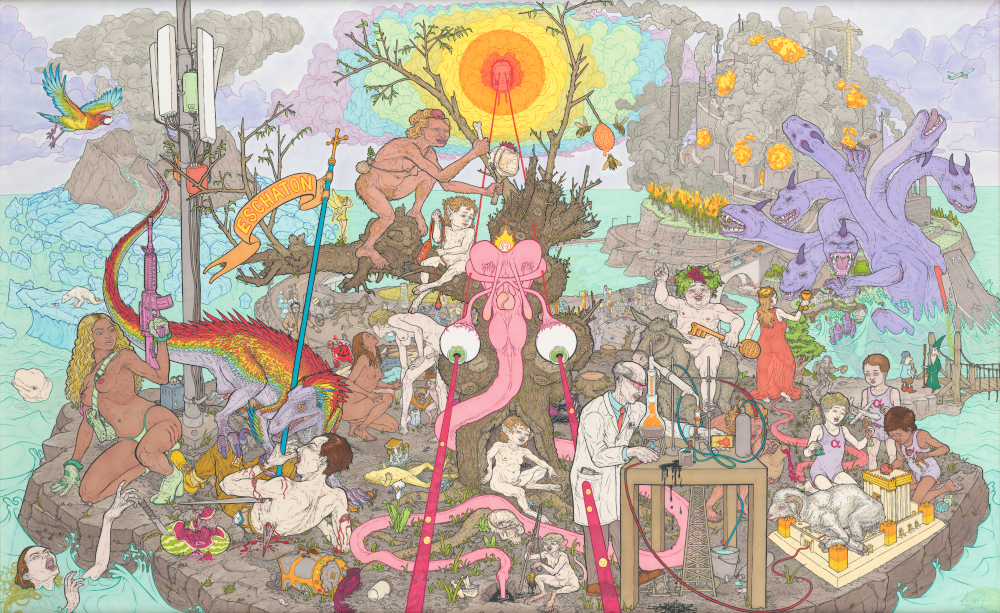
Discovery of Eschaton : Immanentize the Climate Change — Mat Brown

Discovery of Eschaton : Immanentize the Climate Change, 2020 by Mat Brown (b. 1980)

“Cretaceous bird, your giant claw no lime” — Edna St. Vincent Millay

“Cretaceous bird, your giant claw no lime”

by

Edna St. Vincent Millay

from Epitaph for the Race of Man


Cretaceous bird, your giant claw no lime
From bark of holly bruised or mistletoe
Could have arrested, could have held you so
Through fifty million years of jostling time;
Yet cradled with you in the catholic slime
Of the young ocean’s tepid lapse and flow
Slumbered an agent, weak in embryo,
Should grip you straitly, in its sinewy prime.
What bright collision in the zodiac brews,
What mischief dimples at the planet’s core
For shark, for python, for the dove that coos
Under the leaves?—what frosty fate’s in store
For the warm blood of man,—man, out of ooze
But lately crawled, and climbing up the shore?

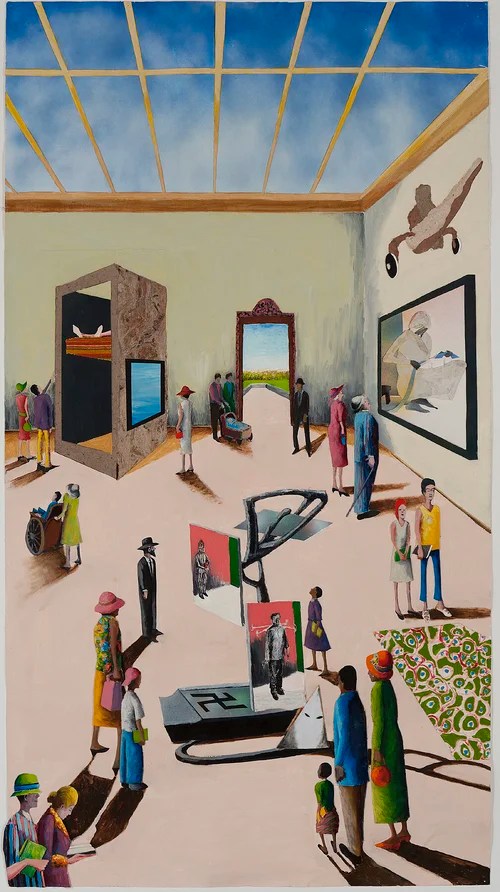
The Idea Museum — Benny Andrews

The Idea Museum, 2002 by Benny Andrews (1930-2006)

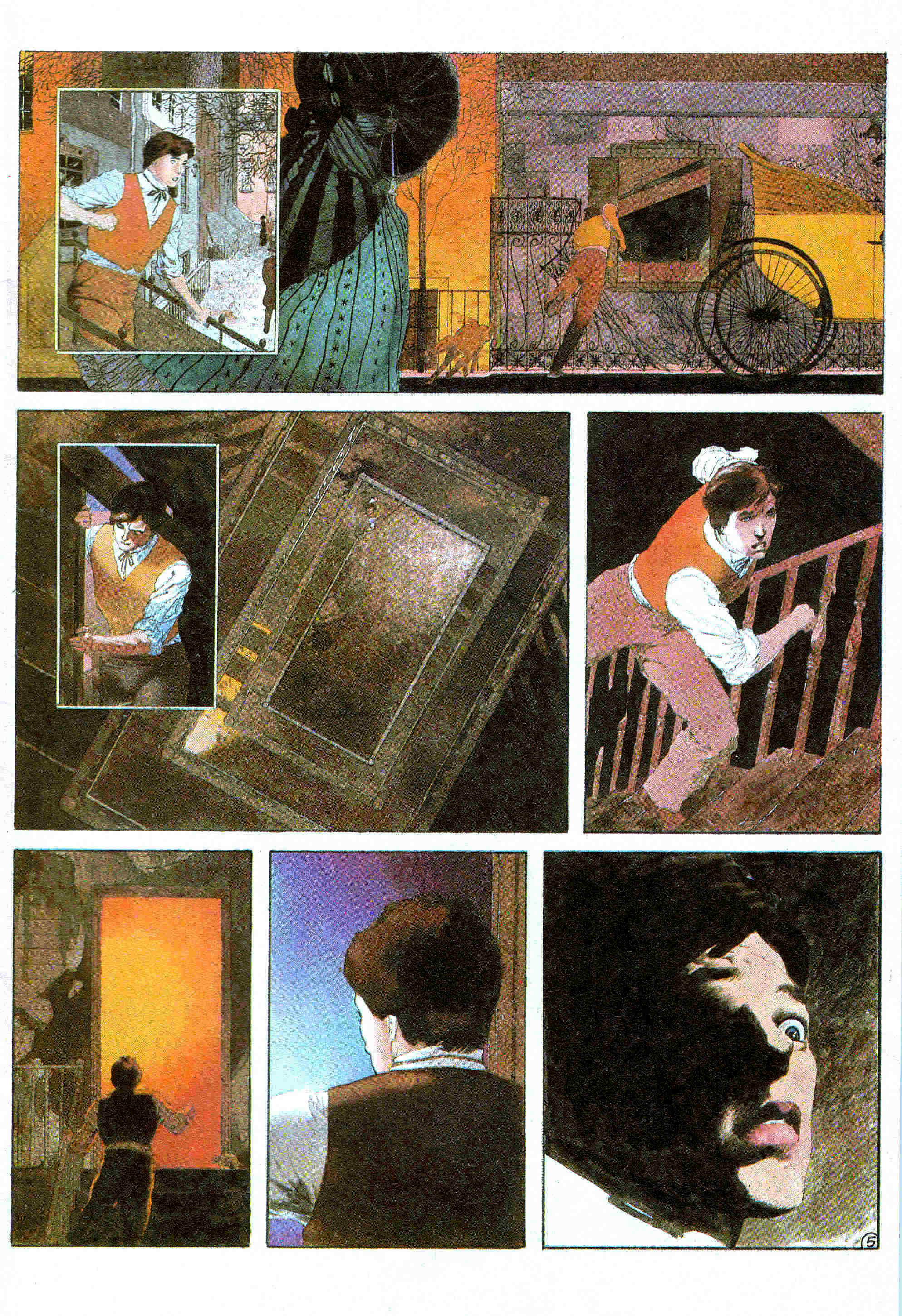
Sunday Comix

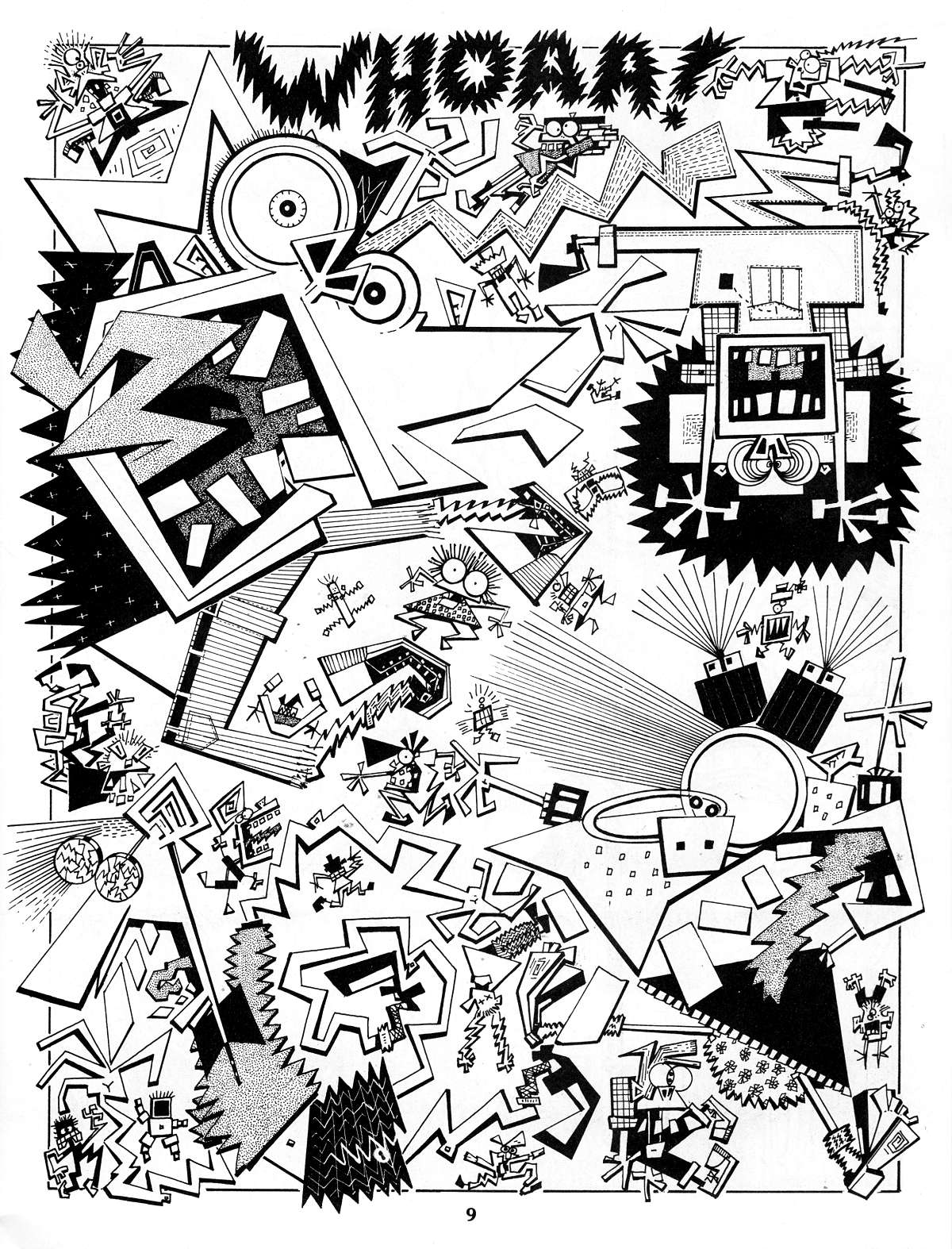
From “The Revenant” by Scott Hampton. Published in Tales of Terror #8, Sept. 1986, Eclipse Comics.